Hi ! Good Morning ! I am Mycobacterium tuberculosis.
LABORATORY DIAGNOSIS OF  MYCOBACTERIUM TUBERCULOSIS
NEED FOR ACCURATE & EARLY DIAGNOSIS OF TUBERCULOSIS. Tuberculosis mainly caused by M.tuberculosis. Is a major health problem world wide. Found in Neolithic remains. Largest cause of “DEATHS” from a single infectious disease. HENCE “ACCURATE” & “EARLY” diagnosis is required for its effective “MANAGEMENT”.
LABORATORY DIAGNOSIS MAY BE ESTABLISHED BY: Demonstration of bacillus by microscopy. Isolation in culture. Transmitting the infection in experimental animals. Demonstration of hypersensitivity to tuberculoprotein – Mantoux test. Enzyme linked Immunosorbent Spot (ELISPOT) Assay.
LABORATORY DIAGNOSIS CONTD. QuantiFeron TB Gold Test. ELISA to detect 38 KDA Mycobacterial Antigen. Molecular methods for early diagnosis. * Amplicor test * E – MTD * DNA sequencing * Line Probe Assay (LiPA) * DNA micro arrays * Molecular beacons. * Single strand conformation  Polymorphism (SSCP) * FRET Probes. Other PCR based Techniques. * Amplification Mutation { ARMS } * Branch Migration Inhibition { BMI } Ligase Chain Reaction. Diagnosis of TB & Drug Resistant TB with Mycobacteriophages.
SPECIMENS  COLLECTED Pulmonary secretions –  ** spontaneously produced or induced sputum ** gastric lavage ** transtracheal aspiration ** bronchoscopy ** laryngeal swabbing Gastric lavage specimens. Urine samples. Faecal specimens. Tissue & Body Fluid specimens. Blood specimens Wound ,skin lesion aspirates. Cervical swab.
SPUTUM EXAMINED BY : DIRECT METHOD  # Z.N.Staining. # Fluorescent Auramine Rhodamine staining AFTER CONCENTRATION
Acid-fast bacilli
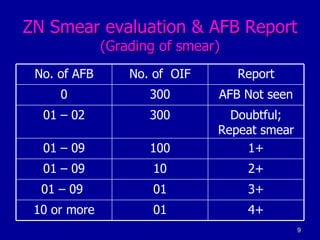
ZN Smear evaluation & AFB Report (Grading of smear) 4+ 01 10 or more 3+ 01 01 – 09  2+ 10 01 – 09 1+ 100 01 – 09 Doubtful; Repeat smear 300 01 – 02 AFB Not seen 300 0 Report No. of  OIF No. of AFB
Indications for Culture  Failures of re-treatment cases Seriously ill cases; extra-pulmonary cases   smear negative cases  childhood TB & HIV-TB For DRS Not for New Smear Positive Cases
Decontamination Procedures 1946 – Trisodium Phosphate  1955 – Pancreatin Desogen  1958 – Pancreatin + 1% cetrimide 1915 – Petroff’s NaOH  1962 – Zephiran Trisodium PO 4 1963 – N-acetyl L- cysteine + 2%NaOH 1969 – Swab culture technique + 1% cetrimide 1975 – CPC + NaCl 2
PETROFF’S METHOD Advantages: Simple, inexpensive & control the growth of contaminants Twenty samples can be processed in 2 Hrs, with centrifuge capacity being the limiting factor Sterilized NaOH can be kept for several weeks Limitations: The specimen exposure times must be strictly followed to prevent over kill of tubercle bacilli. The initial kill is independent of additional contributory factors such as heat build-up in the centrifuge and centrifugal efficiency
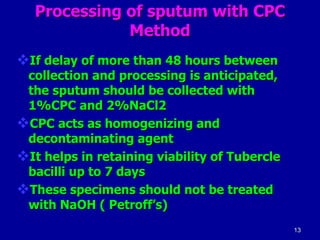
Processing of sputum with CPC Method If delay of more than 48 hours between collection and processing is anticipated, the sputum should be collected with 1%CPC and 2%NaCl2 CPC acts as homogenizing and decontaminating agent  It helps in retaining viability of Tubercle bacilli up to 7 days These specimens should not be treated with NaOH ( Petroff’s)
MYCOBACTERIAL  CULTURE Advantages : Increases number of cases found Detects cases among smear negative patients Establishes viability  of organisms Distinguishing between Mycobacterial species Helps in performing DST Helps in diagnosing cases of failure Limitations : Expensive  Require enriched media Require considerable expertise  Time consuming
Specimen Sterile Non - Sterile Centrifuge & use sediment Liquefaction  (N-acetyl-L- cystein) Decontamination NaOH Neutralization Buffer or H2O Centrifugation > 3000 X g Screen by AFB smear & inoculate media (one liquid & one solid) FLOW CHART OF SPECIMEN PROCESSING FOR ISOLATION OF MYCOBACTERIA
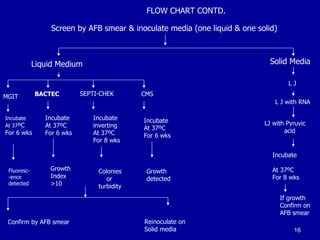
FLOW CHART CONTD. Screen by AFB smear & inoculate media (one liquid & one solid) Liquid Medium Solid Media MGIT BACTEC SEPTI-CHEK CMS Incubate At 37 ºC For 6 wks Incubate At 37ºC For 6 wks Incubate inverting At 37ºC For 8 wks Incubate At 37ºC For 6 wks Fluoresc- -ence detected Growth Index >10 Colonies  or turbidity Growth detected Confirm by AFB smear Reinoculate on Solid media L J L J with RNA LJ with Pyruvic acid Incubate At 37ºC For 8 wks If growth Confirm on AFB smear
Reading and Reporting Characteristics of Tubercle bacilli Growth of Primary culture takes 2 – 4 weeks to obtain visible colonies Colonies are buff colored and rough, having the appearance of bread crumbs or cauliflower Not easily emulsified but give a granular suspension Microscopically frequently arranged in serpentine cords of varying length or show linear clumping
Culture Media : Solid LJ LJ with Na pyruvate LJ with out asparagine Middlebrook’s 7H10 & 7H11 Selective 7H10 & 11 Ogawa  Tarshi’s Blood Agar
Slow growth 3-4 wk
24-hr generation time AFB AFB AFB 24 hr
MYCOBACTERIAL COLONIES ON SOLID MEDIA
Colonies growing on media
Laboratory diagnosis Traditional (slow) Growth on solid media Biochemical tests to speciate Recent Radiometric growth detection BACTEC SEPTI – CHEK MGIT Gene probes to speciate
Flow Chart Identification of Tubercle bacilli & related Growth on LJ Medium Rapid growth within 7 days Growth on MacConkey Agar Aryl-sulphataes test Slow Growth Niacin test Ve Tellurite Reduction + ve M. smegmatis ve M. phlei - ve Type of growth + ve M. tuberculosis + ve M. Fortuitum complex Pigment Scanty Smooth Flat Colonies In Light Group I Photochromogens In Dark Group II Scotochromogens No Pigment Group III Non - Chromogens - ve BCG + ve M. bovis M.Kansasi M.intermedium M.Szulgai M.scrofulaceum M.Avium complex M.gastri
Other Culture Methods Septi-check AFB MGIT 960 Backtec/MB/Bact   ESP Culture ii   M icroscopic  O bservation of  B roth  C ulture  MODS: M icro  C olony  D etection  S ystem
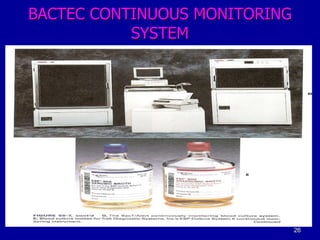
BACTEC CONTINUOUS MONITORING SYSTEM
BLOOD CULTURE BOTTLES FOR BACTEC 9240,9120,9050.
SEPTI - CHECK
Radiolabeled palmitic acid AFB *C___ *C___ *C___ *C___
Detect growth with CO 2 AFB AFB AFB AFB AFB *CO 2 *CO 2 *C___ *C___
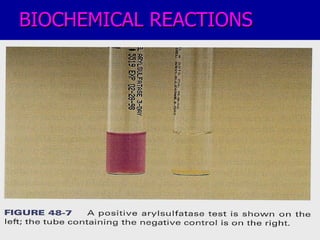
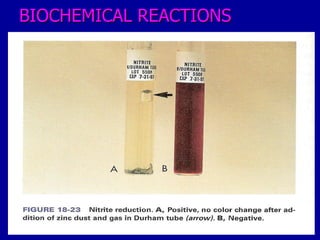
BIOCHEMICAL REACTIONS: + - +/- - - - - - - - M  Africanum + - - +/- - - - - - - M  bovis + + + +/- - + - + - + M tuberculosis UREASE TEST PYRAZI-NAMIDASE  TSET GROWTH ON TCH TELLURI--TE REDUCTION TEST TWEEN 80 HYDRO--LYSIS TSET PEROX---IDASE TEST HOT CATAL---ASE TEST NITRATE REDUC---TION TEST ARYL-SULPH---ATASE TEST NIACIN TEST SPECIES
BIOCHEMICAL REACTIONS
ANIMAL INOCULATION Intramuscular injection of the bacterial  concentrated material into two healthy  guinea pigs of 12 week and autopsied,  one after four weeks & second after eight  weeks of inoculation.
ANTIGEN PROTEIN DETECTION Tuberculostearic acid :  a fatty extracted from  the cell wall of M.tuberculosis detected by gas  chromatography/ mass spectrometry in clinical  samples.  M.tuberculosis is unique to release  tuberculostearic acid . Host enzyme Adenosine deaminase :  Host  enzyme. It is increased in infection caused by  M.tuberculosis.
CHROMATOGRAPHIC ANALYSIS Analysis of mycobacterial lipids by ---- * Thin paper chromatography * Gas liquid chromatography (GLC) * Reverse phase high performance liquid chromatography ( HPLC) HPLC of extracted mycobacteria -   * A very rapid & specific method for identification of species.
Why Measure Interferon-  ? TB infection induces T-cell response (CMI) IFN-    is the ‘classic’ CMI cytokine Produced  in vitro  in response to specific antigen Secreted in measurable and stable amounts Absent from normal circulation Extensive literature showing importance of IFN-   in TB infection
What is  Quanti-FERON ® -TB Gold Blood assay for  M. tuberculosis >  Interferon  γ  release assay In vitro  test using whole blood specimen for the diagnosis of TB infection, whether latent or active Does not distinguish between latent TB infection or TB disease
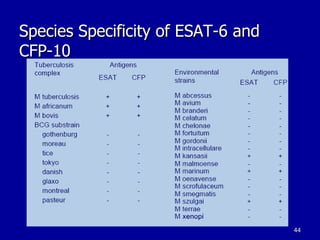
Quanti-FERON ® -TB Gold – Scientific Basis This recognition process involves the generation of interferon- γ , a specific cytokine for cell mediated immune response Individuals infected with  M. tuberculosis  complex organisms have lymphocytes in their blood that recognize mycobacterial antigens The detection and subsequent quantification of IFN- γ  is the basis of this test The test uses synthetic peptide antigens (ESAT-6, CFP-10) that simulate mycobacterial proteins to generate the immune response
Interferon Gamma Release
Whole Blood IFN-   Assay QuantiFERON-TB Test Cellestis ESAT-6 CFP 10 Mitogen Control TMB COLOR Stage 1 Whole Blood Culture Stage 2 IFN-gamma ELISA Nil Control Incubate  ->  INF-   from sensitized T-cells Draw blood  + heparin Aliquot blood & add antigen Harvest plasma from above settled cells Measure [ IFN-  ] in ‘Sandwich’  ELISA Computerized interpretation
Species Specificity of ESAT-6 and CFP-10
QFT Assay
In Vivo  and  In Vitro  Diagnostic Tests Antigen presenting cell Memory T-cell Presentation of mycobacterial antigens IFN-  IFN-  IL-8, etc. IL-8, etc. TNF-  TNF- 
Results and Interpretation MTB infection status cannot be determined as a result of impaired immunity and/or incorrect performance of the test INDETERMINATE No ESAT-6 or CFP-10 responsiveness detected M. tuberculosis  unlikely NEGATIVE ESAT-6 and/or CFP-10 responsiveness detected M. tuberculosis  infection likely POSITIVE INTERPRETATION RESULT
QFT and TST QFT in vitro  test Specific antigens No boosting 1 patient visit Lab variability Results possible in 1 day Requires phlebotomy Includes + control TST in vivo  test Less specific PPD Boosting 2 patient visits Inter-reader variability Results in 2-3 days No phlebotomy required No + control
T-Spot. TB  :  “Six   easy Steps” Oxford Immunotec Nil Control Positive Control Infection Infection
ENZYME LINKED IMMUNOSORBENT   SPOT (ELISPOT) TEST. It is based on ELISA test Allows visualization of secretory products of individual activated cells. Provides information about type of immune protein (qualitative)& number of responding cells (quantitative)
USING ELISA TO DETECT 38kDA MYCOBACTERIAL ANTIGEN 38 kDA secretory protein being one of the  most important specific antigens of MTB It induses B & T cell responses with high  specificity to MTB Detected by Direct & Sandwich ELISA.
Mantoux Tuberculin Skin Test Preferred method of testing for TB  infection in adults and children Tuberculin skin testing useful for Examining person who is not ill but  may be infected Determining how many people in  group are infected Examining  person who has  symptoms of TB
Administering the Tuberculin Skin Test Inject intradermally 0.1 ml of 5 TU PPD tuberculin Produce wheal 6 mm to 10 mm  in diameter Do not recap, bend, or break needles, or remove needles from syringes Follow universal precautions for infection control
Reading the Tuberculin Skin Test Read reaction 48-72 Hours after injection Measure only induration Record reaction in millimeters
Classifying the Tuberculin Reaction > 5 mm is classified as positive in HIV-positive persons Recent contacts of TB case Persons with fibrotic changes on chest radiograph consistent with old healed TB  Patients with organ transplants and other  immunosuppressed patients
Classifying the Tuberculin  Reaction (cont.) > 10 mm is classified as positive in Recent arrivals from high-prevalence countries Injection drug users Residents and employees of high-risk congregate settings Mycobacteriology laboratory personnel Persons with clinical conditions that place them at high risk Children <4 years of age, or children and adolescents exposed to adults in high-risk categories
Classifying the Tuberculin  Reaction (cont.) > 15 mm is classified as positive in Persons with no known risk factors for TB Targeted skin testing programs should only be conducted among high-risk groups
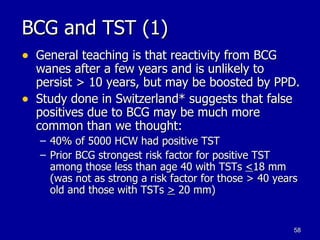
BCG and TST (1) General teaching is that reactivity from BCG wanes after a few years and is unlikely to persist > 10 years, but may be boosted by PPD. Study done in Switzerland* suggests that false positives due to BCG may be much more common than we thought: 40% of 5000 HCW had positive TST Prior BCG strongest risk factor for positive TST among those less than age 40 with TSTs  < 18 mm (was not as strong a risk factor for those > 40 years old and those with TSTs  >  20 mm)
BCG and TST (2) Review of studies that compared TST responses to BCG during and after infancy Vaccination during infancy estimated to cause false-positive TST in 6.3% overall, but only 1% of those tested more than 10 years after vaccination Vaccination at 2 years of age or older estimated to cause false-positive TST in 40% of persons overall, 20% of those tested 10 years or more after vaccination Farhat M et al, Int J Tuberc Lung Dis 2006; 10: 1192-204
Nucleic acid amplification for mycobact. diagnosis Genus specific protocols Targeting genes code for  16S rRNA   65KDa  hsp  M.TB Complex specific  is  6110 Other targets: Genes encoding  38 KDa MPB 64  mtp 40 PMT 64 Methods: Target amplification    - PCR (TMA, LCR, SDA  or  signal amplification EG:  QB amplification) PFYFFER G.E.  J.INF. 1999,  39 ,  21-26. TC/ICM 30
MOLECULAR TECHNIQUES TO DETECT M.TUBERCULOSIS - 1 Amplicor Test ** Detects the presence of the  mycobacterial 16S ribosomal ( rRNA) gene by the PCR amplification  followed by ELISA reaction.
Mycobacteria (AFB) sample U AFB U
Extract 16S RNA U U 16S RNA
Probe for specific 16S RNA U U 16S RNA Probe Probe
Probe remains in sample U U 16S RNA Probe
Detector binds to probe ******* U ******* U 16S RNA Probe
Detector remains in sample ******* U U 16S RNA Probe
Detector identifies 16S RNA ******* VVVVV U U 16S RNA Probe
MOLECULAR TECHNIQUES TO DETECT M.TUBERCULOSIS - 2 E – MTD ** The assay is based on the transcription mediated amplification system ( TMA ).The mycobacterial rRNA from target cells is released by sonication & amplified a billion fold by TMA.
Conventional method for diagnosis of drug resistant M.tuberculosis Biochemical tests :  Catalase & Peroxidase  tests  *** BOTH ARE NEGATIVE IN INH RESISTANT M.TUBERCULOSIS.
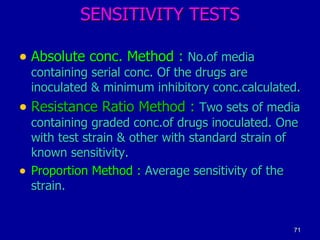
SENSITIVITY TESTS Absolute conc. Method :  No.of media containing serial conc. Of the drugs are inoculated & minimum inhibitory conc.calculated. Resistance Ratio Method :  Two sets of media containing graded conc.of drugs inoculated. One with test strain & other with standard strain of known sensitivity. Proportion Method :  Average sensitivity of the strain.
Various Mycobacterial gene mutations involved in drug resistance. rpoB gene mutation  ---  Rifampicin katG & inhA mutation ---  INH rpsL gene mutation  ---  Streptomycin pncA gene mutation  ---  Pyrazinamide embB gene mutation  ---  Ethambutol
Molecular diagnostic methods for drug resistant M.tuberculosis DNA Sequencing :  reliable & accurate. Line Probe Assay (LiPA) :  to identify mutations in the rpoB core gene. DNA microarrays :  based on principle of hybridization Molecular beacons : they are hair-pin shaped probes to detect presence of specific nucleic acids. Single strand conformation polymorphism : determines presence of mutations in specific DNA regions FRET ( Fluorescent resonance energy transfer) probes:  used to detect presence of mutations in real time PCR.
Other PCR based tests: Amplification Refractory Mutation System:  has been applied to know mutations in rpoB, katG, embB, genes. Branch Migration Inhibition : spontaneous strand exchange is inhibited by sequence difference between two DNA molecules.
Diagnosis of drug resistance with Mycobacteriophages Phage amplified biological assay (phaB) Luciferase reporter phages (LRPs)
Antituberculosis Drugs Currently in Use First-line Drugs Isoniazid Rifampin Rifapentine Rifabutin Ethambutol Pyrazinamide Second-line Drugs Cycloserine Ethionamide Levofloxacin Moxifloxacin Gatifloxacin P -Aminosalicylic acid Streptomycin Amikacin/kanamycin Capreomycin Linezolid
-BCG PREVENTION CHALLENGES WHO Jan 07 “ BCG vaccine should not be used in children known to be  HIV-infected”
THANK YOU

Lab diag. tb

  • 1.
    Hi ! GoodMorning ! I am Mycobacterium tuberculosis.
  • 2.
    LABORATORY DIAGNOSIS OF MYCOBACTERIUM TUBERCULOSIS
  • 3.
    NEED FOR ACCURATE& EARLY DIAGNOSIS OF TUBERCULOSIS. Tuberculosis mainly caused by M.tuberculosis. Is a major health problem world wide. Found in Neolithic remains. Largest cause of “DEATHS” from a single infectious disease. HENCE “ACCURATE” & “EARLY” diagnosis is required for its effective “MANAGEMENT”.
  • 4.
    LABORATORY DIAGNOSIS MAYBE ESTABLISHED BY: Demonstration of bacillus by microscopy. Isolation in culture. Transmitting the infection in experimental animals. Demonstration of hypersensitivity to tuberculoprotein – Mantoux test. Enzyme linked Immunosorbent Spot (ELISPOT) Assay.
  • 5.
    LABORATORY DIAGNOSIS CONTD.QuantiFeron TB Gold Test. ELISA to detect 38 KDA Mycobacterial Antigen. Molecular methods for early diagnosis. * Amplicor test * E – MTD * DNA sequencing * Line Probe Assay (LiPA) * DNA micro arrays * Molecular beacons. * Single strand conformation Polymorphism (SSCP) * FRET Probes. Other PCR based Techniques. * Amplification Mutation { ARMS } * Branch Migration Inhibition { BMI } Ligase Chain Reaction. Diagnosis of TB & Drug Resistant TB with Mycobacteriophages.
  • 6.
    SPECIMENS COLLECTEDPulmonary secretions – ** spontaneously produced or induced sputum ** gastric lavage ** transtracheal aspiration ** bronchoscopy ** laryngeal swabbing Gastric lavage specimens. Urine samples. Faecal specimens. Tissue & Body Fluid specimens. Blood specimens Wound ,skin lesion aspirates. Cervical swab.
  • 7.
    SPUTUM EXAMINED BY: DIRECT METHOD # Z.N.Staining. # Fluorescent Auramine Rhodamine staining AFTER CONCENTRATION
  • 8.
  • 9.
    ZN Smear evaluation& AFB Report (Grading of smear) 4+ 01 10 or more 3+ 01 01 – 09 2+ 10 01 – 09 1+ 100 01 – 09 Doubtful; Repeat smear 300 01 – 02 AFB Not seen 300 0 Report No. of OIF No. of AFB
  • 10.
    Indications for Culture Failures of re-treatment cases Seriously ill cases; extra-pulmonary cases smear negative cases childhood TB & HIV-TB For DRS Not for New Smear Positive Cases
  • 11.
    Decontamination Procedures 1946– Trisodium Phosphate 1955 – Pancreatin Desogen 1958 – Pancreatin + 1% cetrimide 1915 – Petroff’s NaOH 1962 – Zephiran Trisodium PO 4 1963 – N-acetyl L- cysteine + 2%NaOH 1969 – Swab culture technique + 1% cetrimide 1975 – CPC + NaCl 2
  • 12.
    PETROFF’S METHOD Advantages:Simple, inexpensive & control the growth of contaminants Twenty samples can be processed in 2 Hrs, with centrifuge capacity being the limiting factor Sterilized NaOH can be kept for several weeks Limitations: The specimen exposure times must be strictly followed to prevent over kill of tubercle bacilli. The initial kill is independent of additional contributory factors such as heat build-up in the centrifuge and centrifugal efficiency
  • 13.
    Processing of sputumwith CPC Method If delay of more than 48 hours between collection and processing is anticipated, the sputum should be collected with 1%CPC and 2%NaCl2 CPC acts as homogenizing and decontaminating agent It helps in retaining viability of Tubercle bacilli up to 7 days These specimens should not be treated with NaOH ( Petroff’s)
  • 14.
    MYCOBACTERIAL CULTUREAdvantages : Increases number of cases found Detects cases among smear negative patients Establishes viability of organisms Distinguishing between Mycobacterial species Helps in performing DST Helps in diagnosing cases of failure Limitations : Expensive Require enriched media Require considerable expertise Time consuming
  • 15.
    Specimen Sterile Non- Sterile Centrifuge & use sediment Liquefaction (N-acetyl-L- cystein) Decontamination NaOH Neutralization Buffer or H2O Centrifugation > 3000 X g Screen by AFB smear & inoculate media (one liquid & one solid) FLOW CHART OF SPECIMEN PROCESSING FOR ISOLATION OF MYCOBACTERIA
  • 16.
    FLOW CHART CONTD.Screen by AFB smear & inoculate media (one liquid & one solid) Liquid Medium Solid Media MGIT BACTEC SEPTI-CHEK CMS Incubate At 37 ºC For 6 wks Incubate At 37ºC For 6 wks Incubate inverting At 37ºC For 8 wks Incubate At 37ºC For 6 wks Fluoresc- -ence detected Growth Index >10 Colonies or turbidity Growth detected Confirm by AFB smear Reinoculate on Solid media L J L J with RNA LJ with Pyruvic acid Incubate At 37ºC For 8 wks If growth Confirm on AFB smear
  • 17.
    Reading and ReportingCharacteristics of Tubercle bacilli Growth of Primary culture takes 2 – 4 weeks to obtain visible colonies Colonies are buff colored and rough, having the appearance of bread crumbs or cauliflower Not easily emulsified but give a granular suspension Microscopically frequently arranged in serpentine cords of varying length or show linear clumping
  • 18.
    Culture Media :Solid LJ LJ with Na pyruvate LJ with out asparagine Middlebrook’s 7H10 & 7H11 Selective 7H10 & 11 Ogawa Tarshi’s Blood Agar
  • 19.
  • 20.
    24-hr generation timeAFB AFB AFB 24 hr
  • 21.
  • 22.
  • 23.
    Laboratory diagnosis Traditional(slow) Growth on solid media Biochemical tests to speciate Recent Radiometric growth detection BACTEC SEPTI – CHEK MGIT Gene probes to speciate
  • 24.
    Flow Chart Identificationof Tubercle bacilli & related Growth on LJ Medium Rapid growth within 7 days Growth on MacConkey Agar Aryl-sulphataes test Slow Growth Niacin test Ve Tellurite Reduction + ve M. smegmatis ve M. phlei - ve Type of growth + ve M. tuberculosis + ve M. Fortuitum complex Pigment Scanty Smooth Flat Colonies In Light Group I Photochromogens In Dark Group II Scotochromogens No Pigment Group III Non - Chromogens - ve BCG + ve M. bovis M.Kansasi M.intermedium M.Szulgai M.scrofulaceum M.Avium complex M.gastri
  • 25.
    Other Culture MethodsSepti-check AFB MGIT 960 Backtec/MB/Bact ESP Culture ii M icroscopic O bservation of B roth C ulture MODS: M icro C olony D etection S ystem
  • 26.
  • 27.
    BLOOD CULTURE BOTTLESFOR BACTEC 9240,9120,9050.
  • 28.
  • 29.
    Radiolabeled palmitic acidAFB *C___ *C___ *C___ *C___
  • 30.
    Detect growth withCO 2 AFB AFB AFB AFB AFB *CO 2 *CO 2 *C___ *C___
  • 31.
    BIOCHEMICAL REACTIONS: +- +/- - - - - - - - M Africanum + - - +/- - - - - - - M bovis + + + +/- - + - + - + M tuberculosis UREASE TEST PYRAZI-NAMIDASE TSET GROWTH ON TCH TELLURI--TE REDUCTION TEST TWEEN 80 HYDRO--LYSIS TSET PEROX---IDASE TEST HOT CATAL---ASE TEST NITRATE REDUC---TION TEST ARYL-SULPH---ATASE TEST NIACIN TEST SPECIES
  • 32.
  • 33.
  • 34.
  • 35.
  • 36.
    ANIMAL INOCULATION Intramuscularinjection of the bacterial concentrated material into two healthy guinea pigs of 12 week and autopsied, one after four weeks & second after eight weeks of inoculation.
  • 37.
    ANTIGEN PROTEIN DETECTIONTuberculostearic acid : a fatty extracted from the cell wall of M.tuberculosis detected by gas chromatography/ mass spectrometry in clinical samples. M.tuberculosis is unique to release tuberculostearic acid . Host enzyme Adenosine deaminase : Host enzyme. It is increased in infection caused by M.tuberculosis.
  • 38.
    CHROMATOGRAPHIC ANALYSIS Analysisof mycobacterial lipids by ---- * Thin paper chromatography * Gas liquid chromatography (GLC) * Reverse phase high performance liquid chromatography ( HPLC) HPLC of extracted mycobacteria - * A very rapid & specific method for identification of species.
  • 39.
    Why Measure Interferon- ? TB infection induces T-cell response (CMI) IFN-  is the ‘classic’ CMI cytokine Produced in vitro in response to specific antigen Secreted in measurable and stable amounts Absent from normal circulation Extensive literature showing importance of IFN-  in TB infection
  • 40.
    What is Quanti-FERON ® -TB Gold Blood assay for M. tuberculosis > Interferon γ release assay In vitro test using whole blood specimen for the diagnosis of TB infection, whether latent or active Does not distinguish between latent TB infection or TB disease
  • 41.
    Quanti-FERON ® -TBGold – Scientific Basis This recognition process involves the generation of interferon- γ , a specific cytokine for cell mediated immune response Individuals infected with M. tuberculosis complex organisms have lymphocytes in their blood that recognize mycobacterial antigens The detection and subsequent quantification of IFN- γ is the basis of this test The test uses synthetic peptide antigens (ESAT-6, CFP-10) that simulate mycobacterial proteins to generate the immune response
  • 42.
  • 43.
    Whole Blood IFN- Assay QuantiFERON-TB Test Cellestis ESAT-6 CFP 10 Mitogen Control TMB COLOR Stage 1 Whole Blood Culture Stage 2 IFN-gamma ELISA Nil Control Incubate -> INF-  from sensitized T-cells Draw blood + heparin Aliquot blood & add antigen Harvest plasma from above settled cells Measure [ IFN-  ] in ‘Sandwich’ ELISA Computerized interpretation
  • 44.
    Species Specificity ofESAT-6 and CFP-10
  • 45.
  • 46.
    In Vivo and In Vitro Diagnostic Tests Antigen presenting cell Memory T-cell Presentation of mycobacterial antigens IFN-  IFN-  IL-8, etc. IL-8, etc. TNF-  TNF- 
  • 47.
    Results and InterpretationMTB infection status cannot be determined as a result of impaired immunity and/or incorrect performance of the test INDETERMINATE No ESAT-6 or CFP-10 responsiveness detected M. tuberculosis unlikely NEGATIVE ESAT-6 and/or CFP-10 responsiveness detected M. tuberculosis infection likely POSITIVE INTERPRETATION RESULT
  • 48.
    QFT and TSTQFT in vitro test Specific antigens No boosting 1 patient visit Lab variability Results possible in 1 day Requires phlebotomy Includes + control TST in vivo test Less specific PPD Boosting 2 patient visits Inter-reader variability Results in 2-3 days No phlebotomy required No + control
  • 49.
    T-Spot. TB : “Six easy Steps” Oxford Immunotec Nil Control Positive Control Infection Infection
  • 50.
    ENZYME LINKED IMMUNOSORBENT SPOT (ELISPOT) TEST. It is based on ELISA test Allows visualization of secretory products of individual activated cells. Provides information about type of immune protein (qualitative)& number of responding cells (quantitative)
  • 51.
    USING ELISA TODETECT 38kDA MYCOBACTERIAL ANTIGEN 38 kDA secretory protein being one of the most important specific antigens of MTB It induses B & T cell responses with high specificity to MTB Detected by Direct & Sandwich ELISA.
  • 52.
    Mantoux Tuberculin SkinTest Preferred method of testing for TB infection in adults and children Tuberculin skin testing useful for Examining person who is not ill but may be infected Determining how many people in group are infected Examining person who has symptoms of TB
  • 53.
    Administering the TuberculinSkin Test Inject intradermally 0.1 ml of 5 TU PPD tuberculin Produce wheal 6 mm to 10 mm in diameter Do not recap, bend, or break needles, or remove needles from syringes Follow universal precautions for infection control
  • 54.
    Reading the TuberculinSkin Test Read reaction 48-72 Hours after injection Measure only induration Record reaction in millimeters
  • 55.
    Classifying the TuberculinReaction > 5 mm is classified as positive in HIV-positive persons Recent contacts of TB case Persons with fibrotic changes on chest radiograph consistent with old healed TB Patients with organ transplants and other immunosuppressed patients
  • 56.
    Classifying the Tuberculin Reaction (cont.) > 10 mm is classified as positive in Recent arrivals from high-prevalence countries Injection drug users Residents and employees of high-risk congregate settings Mycobacteriology laboratory personnel Persons with clinical conditions that place them at high risk Children <4 years of age, or children and adolescents exposed to adults in high-risk categories
  • 57.
    Classifying the Tuberculin Reaction (cont.) > 15 mm is classified as positive in Persons with no known risk factors for TB Targeted skin testing programs should only be conducted among high-risk groups
  • 58.
    BCG and TST(1) General teaching is that reactivity from BCG wanes after a few years and is unlikely to persist > 10 years, but may be boosted by PPD. Study done in Switzerland* suggests that false positives due to BCG may be much more common than we thought: 40% of 5000 HCW had positive TST Prior BCG strongest risk factor for positive TST among those less than age 40 with TSTs < 18 mm (was not as strong a risk factor for those > 40 years old and those with TSTs > 20 mm)
  • 59.
    BCG and TST(2) Review of studies that compared TST responses to BCG during and after infancy Vaccination during infancy estimated to cause false-positive TST in 6.3% overall, but only 1% of those tested more than 10 years after vaccination Vaccination at 2 years of age or older estimated to cause false-positive TST in 40% of persons overall, 20% of those tested 10 years or more after vaccination Farhat M et al, Int J Tuberc Lung Dis 2006; 10: 1192-204
  • 60.
    Nucleic acid amplificationfor mycobact. diagnosis Genus specific protocols Targeting genes code for 16S rRNA 65KDa hsp M.TB Complex specific is 6110 Other targets: Genes encoding 38 KDa MPB 64 mtp 40 PMT 64 Methods: Target amplification - PCR (TMA, LCR, SDA or signal amplification EG: QB amplification) PFYFFER G.E. J.INF. 1999, 39 , 21-26. TC/ICM 30
  • 61.
    MOLECULAR TECHNIQUES TODETECT M.TUBERCULOSIS - 1 Amplicor Test ** Detects the presence of the mycobacterial 16S ribosomal ( rRNA) gene by the PCR amplification followed by ELISA reaction.
  • 62.
  • 63.
    Extract 16S RNAU U 16S RNA
  • 64.
    Probe for specific16S RNA U U 16S RNA Probe Probe
  • 65.
    Probe remains insample U U 16S RNA Probe
  • 66.
    Detector binds toprobe ******* U ******* U 16S RNA Probe
  • 67.
    Detector remains insample ******* U U 16S RNA Probe
  • 68.
    Detector identifies 16SRNA ******* VVVVV U U 16S RNA Probe
  • 69.
    MOLECULAR TECHNIQUES TODETECT M.TUBERCULOSIS - 2 E – MTD ** The assay is based on the transcription mediated amplification system ( TMA ).The mycobacterial rRNA from target cells is released by sonication & amplified a billion fold by TMA.
  • 70.
    Conventional method fordiagnosis of drug resistant M.tuberculosis Biochemical tests : Catalase & Peroxidase tests *** BOTH ARE NEGATIVE IN INH RESISTANT M.TUBERCULOSIS.
  • 71.
    SENSITIVITY TESTS Absoluteconc. Method : No.of media containing serial conc. Of the drugs are inoculated & minimum inhibitory conc.calculated. Resistance Ratio Method : Two sets of media containing graded conc.of drugs inoculated. One with test strain & other with standard strain of known sensitivity. Proportion Method : Average sensitivity of the strain.
  • 72.
    Various Mycobacterial genemutations involved in drug resistance. rpoB gene mutation --- Rifampicin katG & inhA mutation --- INH rpsL gene mutation --- Streptomycin pncA gene mutation --- Pyrazinamide embB gene mutation --- Ethambutol
  • 73.
    Molecular diagnostic methodsfor drug resistant M.tuberculosis DNA Sequencing : reliable & accurate. Line Probe Assay (LiPA) : to identify mutations in the rpoB core gene. DNA microarrays : based on principle of hybridization Molecular beacons : they are hair-pin shaped probes to detect presence of specific nucleic acids. Single strand conformation polymorphism : determines presence of mutations in specific DNA regions FRET ( Fluorescent resonance energy transfer) probes: used to detect presence of mutations in real time PCR.
  • 74.
    Other PCR basedtests: Amplification Refractory Mutation System: has been applied to know mutations in rpoB, katG, embB, genes. Branch Migration Inhibition : spontaneous strand exchange is inhibited by sequence difference between two DNA molecules.
  • 75.
    Diagnosis of drugresistance with Mycobacteriophages Phage amplified biological assay (phaB) Luciferase reporter phages (LRPs)
  • 76.
    Antituberculosis Drugs Currentlyin Use First-line Drugs Isoniazid Rifampin Rifapentine Rifabutin Ethambutol Pyrazinamide Second-line Drugs Cycloserine Ethionamide Levofloxacin Moxifloxacin Gatifloxacin P -Aminosalicylic acid Streptomycin Amikacin/kanamycin Capreomycin Linezolid
  • 77.
    -BCG PREVENTION CHALLENGESWHO Jan 07 “ BCG vaccine should not be used in children known to be HIV-infected”
  • 78.

Editor's Notes

  • #9 NEJM 7/19/01
  • #44 There are two commercial assays available in the world. The first of these, called the QuantiFERON TB test Gold is available in the United States. The test works like this. First blood is drawn into an heparinized tube. The cells are separated and stimulated with various antigens including positive and negative controls. After incubation, sensitized T cells produce interferon that can be harvested and measured using an ELISA assay. The results are interpreted by a computer program.
  • #47 When we measure a person’s TST result, we are measuring and indirect result of inflammation caused by injection of the PPD into the skin. In this figure, you can see that when an antigen presenting cell such as a macrophage encounters a T-cell, the lymphocyte produces a number of cytokines such as TNF-alpha, interferon-gamma, and various interleukins. These cytokines cause swelling and induration that is measured with a ruler. It is now possible to measure these cytokines directly from the blood. Interferon-gamm is the best cytokine to measure because it is produced in large amounts, is stable and thus easy to measure. Importantly it is also a critical cytokine in the immune response to mycobacterial infections.