Semiconductor Power Switching Devices-2
(Lecture-5)
R S Ananda Murthy
Associate Professor and Head
Department of Electrical & Electronics Engineering,
Sri Jayachamarajendra College of Engineering,
Mysore 570 006
R S Ananda Murthy Semiconductor Power Switching Devices-2
Silicon Controlled Rectifier (SCR)
p+
p
Gate (G)Cathode (K)
Anode (A)
n-
J1
J2
n+
J3
Structure of SCR
p+ indicates heavily doped p-type region
n- indicates lightly doped n-type region
n+ indicates heavily doped n-type region
A
K
G
Circuit Symbol
of SCR
ON
OFF
= Latching Current
= Holding Current
Reverse
Leakage
Current
Forward
Leakage
Current
Thicker n- layer gives higher voltage blocking capability to
the device.
The forward voltage at which the device turns on
decreases with increase in gate current.
R S Ananda Murthy Semiconductor Power Switching Devices-2
Control Characteristics of SCR
vo
iG
vo
+
−
iG
V
t
R
−
+
V
t
SCR is semicontrolled and pulse triggered.
R S Ananda Murthy Semiconductor Power Switching Devices-2
Two Transistor Model of SCR
p1
p2
n1
n2
p1
n1
2p
n2
p2
1n
T1
T2
+
−
Gate
Control
Circuit
IG
+
−
IK
IA
α1
IC1
IC2
α2 T2
IB 1
IB 2
T1
K
A
K
J1
J2
J3
G
R
V
A
K
G
G V
R
A
1.0
0.8
0.6
0.4
0.2
0
0 (mA)1
α
IE
(a) (b)
(c) (d)
R S Ananda Murthy Semiconductor Power Switching Devices-2
Conditions for Turn ON and Turn OFF of SCR
In Figure-(c) of previous slide, by applying KCL to the device we
get
IK = IA +IG and IA = IC1 +IC2 (1)
Considering each transistor we have
IC1 = α1IA +ICBO1 and IC2 = α2IK +ICBO2 (2)
Substituting Eq.(2) in (1) and by rearranging terms we get
IA =
α2IG +(ICBO1 +ICBO2)
[1−(α1 +α2)]
(3)
When (α1 +α2) << 1 the device is OFF as IA ≈ (ICBO1 +ICBO2).
When (α1 +α2) → 1 the device turns ON since IA → ∞.
R S Ananda Murthy Semiconductor Power Switching Devices-2
Factors Causing Turn ON of SCR
Forward voltage vAK > VBO. This should be avoided since
it may permanently damage the device.
Rise in device temperature can cause unwanted turn ON
and hence should be avoided by cooling the device.
By injecting positive gate current IG until IA = IL where IL is
the latching value. This is the preferred method of turning
ON the device.
Forward dvAK /dt > rated value causes undesirable turn
ON and should prevented by connecting a snubber circuit
across the SCR.
Light radiation of specific wavelength incident on junctions
of SCR turns ON the device. LASCR’s are turned ON by
this method.
R S Ananda Murthy Semiconductor Power Switching Devices-2
How to Turn Off SCR?
Gate current has no control over the SCR after it turns ON.
IA should be reduced below the holding value IH in order to
make (α1 +α2) → 0 to stop the internal regenerative action
to turn OFF the device.
After IA drops to zero, the device should be reverse biased
for a duration tq > tOFF where tOFF is known as the device
turn OFF time and tq is known as the circuit turn-off time.
R S Ananda Murthy Semiconductor Power Switching Devices-2
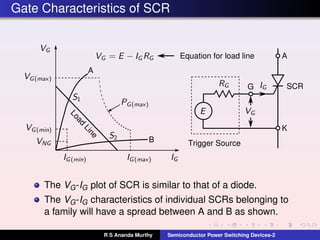
Gate Characteristics of SCR
Load
Line
Equation for load line A
K
G
A
B Trigger Source
SCR
The VG-IG plot of SCR is similar to that of a diode.
The VG-IG characteristics of individual SCRs belonging to
a family will have a spread between A and B as shown.
R S Ananda Murthy Semiconductor Power Switching Devices-2
Reverse Voltage Protection for Gate
A
K
G
Trigger Source
SCR
Connecting resitance between gate and
cathode --- Increases dv/dt capability,
lowers the turn off time of SCR,
minimizes reverse voltage across the device,
and increases holding and latching current.
(a) (b)
(c)
A
K
G
Trigger Source
SCR
A
K
G
Trigger Source
SCR
R S Ananda Murthy Semiconductor Power Switching Devices-2
SCR Turn ON Characteristics
(a)
(b)
(c)
tON increases with increase in the inductance of the load.
R S Ananda Murthy Semiconductor Power Switching Devices-2
SCR Turn OFF Characteristics
(a)
(b)
(c)
tq should be > tOFF and dvAK /dt should be less than rated
value for proper turn off of SCR.
R S Ananda Murthy Semiconductor Power Switching Devices-2
Snubber Circuit for SCR
When SCR is turned ON di/dt through
SCR is limited to safe value by
connecting this inductor.
When SCR is turned ON
this resistor limits the capacitor
discharging current through
the SCR to safe value.
When SCR is turned OFF and forward
voltage appears across the SCR
D1 bypasses R2 and dv/dt across
SCR is limited to safe value by
this R1C1 network.
A
K
SCR
G
R S Ananda Murthy Semiconductor Power Switching Devices-2
Letter Symbols used to Specify Ratings of SCR
A – Anode, ambient J – Junction
(AV) – Average K – Cathode
(BO) – Breakover M, m – Maximum
(BR) – Breakdown Q, q – Turn off
D – Off state or non-trigger R, r – Reverse, repetitive
d – Delay time (RMS) – RMS value
F, f – Forward, falltime rr – Reverse recovery
H – Holding S – surge, nonrepetitive
G, g – Gate terminal T, t – On-state, trigger
Examples:
VRRM – Reverse repetitive maximum voltage.
ITSM – On-state maximum surge current.
VGT – Gate voltage required for triggering.
IT(RMS)– On-state RMS current.
R S Ananda Murthy Semiconductor Power Switching Devices-2
Specifications of BT145 Thyristor Series
R S Ananda Murthy Semiconductor Power Switching Devices-2
Specifications of BT145 Thyristor Series
R S Ananda Murthy Semiconductor Power Switching Devices-2
Specifications of BT145 Thyristor Series
R S Ananda Murthy Semiconductor Power Switching Devices-2
Specifications of BT145 Thyristor Series
R S Ananda Murthy Semiconductor Power Switching Devices-2
Disc Type of SCRs
(Source: www.china-rectifer.com)
R S Ananda Murthy Semiconductor Power Switching Devices-2
Disc Type of SCR
(Source: www.abb.com)
R S Ananda Murthy Semiconductor Power Switching Devices-2
Stud Type of SCRs
(Source: www.china-rectifer.com)
R S Ananda Murthy Semiconductor Power Switching Devices-2
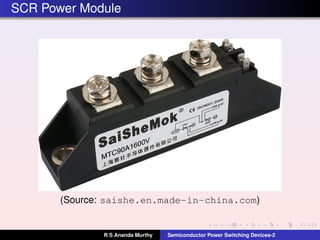
SCR Power Module
(Source: saishe.en.made-in-china.com)
R S Ananda Murthy Semiconductor Power Switching Devices-2
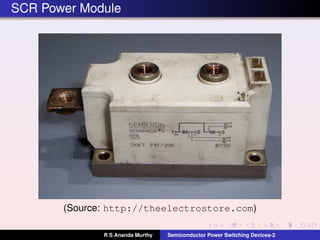
SCR Power Module
(Source: http://theelectrostore.com)
R S Ananda Murthy Semiconductor Power Switching Devices-2
Specifications of SKKT 210/20E Module
R S Ananda Murthy Semiconductor Power Switching Devices-2
Specifications of SKKT 210/20E Module
R S Ananda Murthy Semiconductor Power Switching Devices-2
Next Lecture...
In the next lecture we will discuss some more power
semiconductor switching devices used in power electronics.
Thank You.
R S Ananda Murthy Semiconductor Power Switching Devices-2

L5 semiconductor-power-switching-devices-2-130818121609-phpapp01

  • 1.
    Semiconductor Power SwitchingDevices-2 (Lecture-5) R S Ananda Murthy Associate Professor and Head Department of Electrical & Electronics Engineering, Sri Jayachamarajendra College of Engineering, Mysore 570 006 R S Ananda Murthy Semiconductor Power Switching Devices-2
  • 2.
    Silicon Controlled Rectifier(SCR) p+ p Gate (G)Cathode (K) Anode (A) n- J1 J2 n+ J3 Structure of SCR p+ indicates heavily doped p-type region n- indicates lightly doped n-type region n+ indicates heavily doped n-type region A K G Circuit Symbol of SCR ON OFF = Latching Current = Holding Current Reverse Leakage Current Forward Leakage Current Thicker n- layer gives higher voltage blocking capability to the device. The forward voltage at which the device turns on decreases with increase in gate current. R S Ananda Murthy Semiconductor Power Switching Devices-2
  • 3.
    Control Characteristics ofSCR vo iG vo + − iG V t R − + V t SCR is semicontrolled and pulse triggered. R S Ananda Murthy Semiconductor Power Switching Devices-2
  • 4.
    Two Transistor Modelof SCR p1 p2 n1 n2 p1 n1 2p n2 p2 1n T1 T2 + − Gate Control Circuit IG + − IK IA α1 IC1 IC2 α2 T2 IB 1 IB 2 T1 K A K J1 J2 J3 G R V A K G G V R A 1.0 0.8 0.6 0.4 0.2 0 0 (mA)1 α IE (a) (b) (c) (d) R S Ananda Murthy Semiconductor Power Switching Devices-2
  • 5.
    Conditions for TurnON and Turn OFF of SCR In Figure-(c) of previous slide, by applying KCL to the device we get IK = IA +IG and IA = IC1 +IC2 (1) Considering each transistor we have IC1 = α1IA +ICBO1 and IC2 = α2IK +ICBO2 (2) Substituting Eq.(2) in (1) and by rearranging terms we get IA = α2IG +(ICBO1 +ICBO2) [1−(α1 +α2)] (3) When (α1 +α2) << 1 the device is OFF as IA ≈ (ICBO1 +ICBO2). When (α1 +α2) → 1 the device turns ON since IA → ∞. R S Ananda Murthy Semiconductor Power Switching Devices-2
  • 6.
    Factors Causing TurnON of SCR Forward voltage vAK > VBO. This should be avoided since it may permanently damage the device. Rise in device temperature can cause unwanted turn ON and hence should be avoided by cooling the device. By injecting positive gate current IG until IA = IL where IL is the latching value. This is the preferred method of turning ON the device. Forward dvAK /dt > rated value causes undesirable turn ON and should prevented by connecting a snubber circuit across the SCR. Light radiation of specific wavelength incident on junctions of SCR turns ON the device. LASCR’s are turned ON by this method. R S Ananda Murthy Semiconductor Power Switching Devices-2
  • 7.
    How to TurnOff SCR? Gate current has no control over the SCR after it turns ON. IA should be reduced below the holding value IH in order to make (α1 +α2) → 0 to stop the internal regenerative action to turn OFF the device. After IA drops to zero, the device should be reverse biased for a duration tq > tOFF where tOFF is known as the device turn OFF time and tq is known as the circuit turn-off time. R S Ananda Murthy Semiconductor Power Switching Devices-2
  • 8.
    Gate Characteristics ofSCR Load Line Equation for load line A K G A B Trigger Source SCR The VG-IG plot of SCR is similar to that of a diode. The VG-IG characteristics of individual SCRs belonging to a family will have a spread between A and B as shown. R S Ananda Murthy Semiconductor Power Switching Devices-2
  • 9.
    Reverse Voltage Protectionfor Gate A K G Trigger Source SCR Connecting resitance between gate and cathode --- Increases dv/dt capability, lowers the turn off time of SCR, minimizes reverse voltage across the device, and increases holding and latching current. (a) (b) (c) A K G Trigger Source SCR A K G Trigger Source SCR R S Ananda Murthy Semiconductor Power Switching Devices-2
  • 10.
    SCR Turn ONCharacteristics (a) (b) (c) tON increases with increase in the inductance of the load. R S Ananda Murthy Semiconductor Power Switching Devices-2
  • 11.
    SCR Turn OFFCharacteristics (a) (b) (c) tq should be > tOFF and dvAK /dt should be less than rated value for proper turn off of SCR. R S Ananda Murthy Semiconductor Power Switching Devices-2
  • 12.
    Snubber Circuit forSCR When SCR is turned ON di/dt through SCR is limited to safe value by connecting this inductor. When SCR is turned ON this resistor limits the capacitor discharging current through the SCR to safe value. When SCR is turned OFF and forward voltage appears across the SCR D1 bypasses R2 and dv/dt across SCR is limited to safe value by this R1C1 network. A K SCR G R S Ananda Murthy Semiconductor Power Switching Devices-2
  • 13.
    Letter Symbols usedto Specify Ratings of SCR A – Anode, ambient J – Junction (AV) – Average K – Cathode (BO) – Breakover M, m – Maximum (BR) – Breakdown Q, q – Turn off D – Off state or non-trigger R, r – Reverse, repetitive d – Delay time (RMS) – RMS value F, f – Forward, falltime rr – Reverse recovery H – Holding S – surge, nonrepetitive G, g – Gate terminal T, t – On-state, trigger Examples: VRRM – Reverse repetitive maximum voltage. ITSM – On-state maximum surge current. VGT – Gate voltage required for triggering. IT(RMS)– On-state RMS current. R S Ananda Murthy Semiconductor Power Switching Devices-2
  • 14.
    Specifications of BT145Thyristor Series R S Ananda Murthy Semiconductor Power Switching Devices-2
  • 15.
    Specifications of BT145Thyristor Series R S Ananda Murthy Semiconductor Power Switching Devices-2
  • 16.
    Specifications of BT145Thyristor Series R S Ananda Murthy Semiconductor Power Switching Devices-2
  • 17.
    Specifications of BT145Thyristor Series R S Ananda Murthy Semiconductor Power Switching Devices-2
  • 18.
    Disc Type ofSCRs (Source: www.china-rectifer.com) R S Ananda Murthy Semiconductor Power Switching Devices-2
  • 19.
    Disc Type ofSCR (Source: www.abb.com) R S Ananda Murthy Semiconductor Power Switching Devices-2
  • 20.
    Stud Type ofSCRs (Source: www.china-rectifer.com) R S Ananda Murthy Semiconductor Power Switching Devices-2
  • 21.
    SCR Power Module (Source:saishe.en.made-in-china.com) R S Ananda Murthy Semiconductor Power Switching Devices-2
  • 22.
    SCR Power Module (Source:http://theelectrostore.com) R S Ananda Murthy Semiconductor Power Switching Devices-2
  • 23.
    Specifications of SKKT210/20E Module R S Ananda Murthy Semiconductor Power Switching Devices-2
  • 24.
    Specifications of SKKT210/20E Module R S Ananda Murthy Semiconductor Power Switching Devices-2
  • 25.
    Next Lecture... In thenext lecture we will discuss some more power semiconductor switching devices used in power electronics. Thank You. R S Ananda Murthy Semiconductor Power Switching Devices-2