





Lets play
TRIG𝜃
𝜃
𝜃
Trigonometric
Ratios of Special
Angles
 Find the trigonometric ratios of special
angles
a. Why do you think
these angles called
special?
b. How is the length of
the longer leg of a 30⁰-
60⁰-90⁰ triangle related
to the length of the
shorter leg?
c. How did you
determine the
trigonometric ratios
involving special angles?
Let’s Work
Together
The values of trigonometric ratios can be
determined even without the use of
calculator. Just be reminded that the two
special right triangles are the triangle
30° − 60° − 90° and the isosceles 45° −
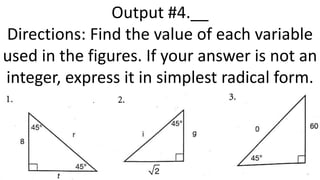
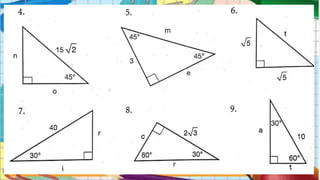
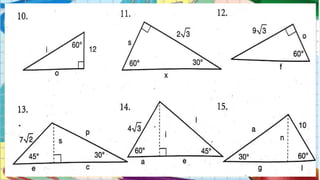
Output #4.__
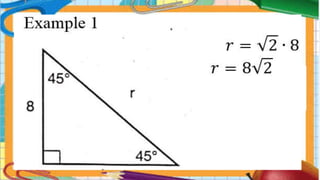
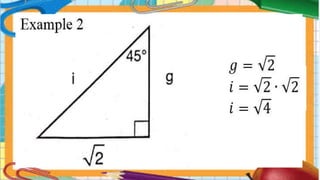
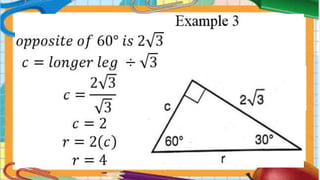
Directions: Find the value of each variable
used in the figures. If your answer is not an
integer, express it in simplest radical form.
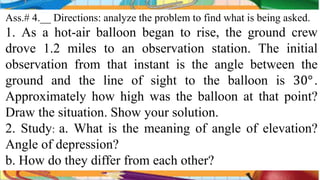
Ass.# 4.__ Directions: analyze the problem to find what is being asked.
1. As a hot-air balloon began to rise, the ground crew
drove 1.2 miles to an observation station. The initial
observation from that instant is the angle between the
ground and the line of sight to the balloon is 30°.
Approximately how high was the balloon at that point?
Draw the situation. Show your solution.
2. Study: a. What is the meaning of angle of elevation?
Angle of depression?
b. How do they differ from each other?

l3. trigonometric function

  • 1.
  • 2.
  • 3.
  • 4.
    Trigonometric Ratios of Special Angles Find the trigonometric ratios of special angles
  • 8.
    a. Why doyou think these angles called special?
  • 9.
    b. How isthe length of the longer leg of a 30⁰- 60⁰-90⁰ triangle related to the length of the shorter leg?
  • 10.
    c. How didyou determine the trigonometric ratios involving special angles?
  • 11.
  • 12.
    The values oftrigonometric ratios can be determined even without the use of calculator. Just be reminded that the two special right triangles are the triangle 30° − 60° − 90° and the isosceles 45° −
  • 13.
    Output #4.__ Directions: Findthe value of each variable used in the figures. If your answer is not an integer, express it in simplest radical form.
  • 16.
    Ass.# 4.__ Directions:analyze the problem to find what is being asked. 1. As a hot-air balloon began to rise, the ground crew drove 1.2 miles to an observation station. The initial observation from that instant is the angle between the ground and the line of sight to the balloon is 30°. Approximately how high was the balloon at that point? Draw the situation. Show your solution. 2. Study: a. What is the meaning of angle of elevation? Angle of depression? b. How do they differ from each other?