Fall semester 2011 Day 3: Intranet / Extranet, Cloud computing principles, Web 2.0,  Social networks Professor: Giuseppe Sindoni ( [email_address] ) Microcomputer applications This material is distributed under the “Creative Commons “Attribution – NonCommercial – Share Alike 3.0” , available at  http://creativecommons.org/licenses/by-nc-sa/3.0/
Intranet A set of internet services accessible only within an organization’s local network Uses Internet technologies and protocols Delivers tools and applications to employees Collaboration Knowledge sharing Internal publishing Internal PR  … Example:  a web interface for an organization’s  staff management system  CS110 Microcomputer applications – G. Sindoni
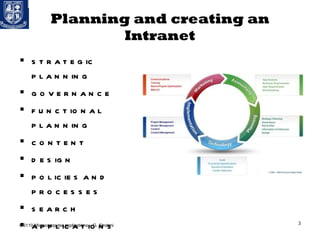
Planning and creating an Intranet strategic planning  governance  functional planning  content  design  policies and processes  search  applications etc.  CS110 Microcomputer applications – G. Sindoni
Extranet A computer network that allows controlled external access for specific business or educational purposes An extension to an intranet An Intranet available from the Internet, but with limited access Applications offered on a  Software as a Service  (SaaS) basis     Example of an extranet:  MyJCU CS110 Microcomputer applications – G. Sindoni
The Google extranet Google services form an extranet for their users Available services: Search engine Docs Gmail YouTube ... Web 2.0 technologies enable software as a network service, as opposed to software as a local application CS110 Microcomputer applications – G. Sindoni
Principles of cloud computing The National Institute of Standards and Technology ( NIST ) provides a concise, specific definition of cloud computing: A model for enabling convenient,  on-demand   network  access to a  shared  pool of  configurable  computing resources (e.g. networks, servers, storage, applications, and services) that can be  rapidly provisioned and released  with  minimal management effort or service provider interaction . CS110 Microcomputer applications – G. Sindoni
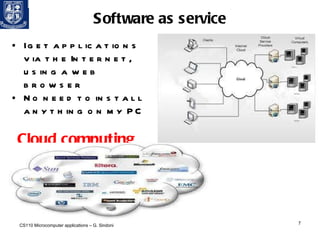
Software as service I get applications via the Internet, using a web browser No need to install anything on my PC    Cloud computing   CS110 Microcomputer applications – G. Sindoni
 
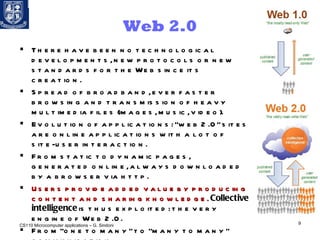
Web 2.0 There have been no technological developments, new protocols or new standards for the Web since its creation. Spread of broadband, ever faster browsing and transmission of heavy multimedia files (images, music, video). Evolution of applications: “web 2.0” sites are online applications with a lot of site-user interaction.  From static to dynamic pages, generated online, always downloaded by a browser via http. Users provide added value by producing content and sharing knowledge.   Collective intelligence  is thus exploited: the very engine of Web 2.0. From “one to many” to “many to many” communication.  Development of  virtual communities . CS110 Microcomputer applications – G. Sindoni
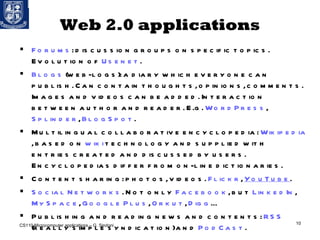
Web 2.0 applications For ums : discussion groups on specific topics. Evolution of  Usenet . Blogs  (web-logs): a diary which everyone can publish. Can contain thoughts, opinions, comments. Images and videos can be added. Interaction between author and reader. E.g.  WordPress ,  Splinder ,  BlogSpot . Multilingual collaborative encyclopedia:  Wikipedia , based on  wiki  technology and supplied with entries created and discussed by users. Encyclopedias differ from on-line dictionaries. Content sharing: photos, videos.  Flickr ,  YouTube . Social Networks . Not only  Facebook , but  LinkedIn ,  MySpace ,  Google Plus ,  Orkut ,  Digg … Publishing and reading news and contents:  RSS  (really simple syndication) and  PodCast . CS110 Microcomputer applications – G. Sindoni
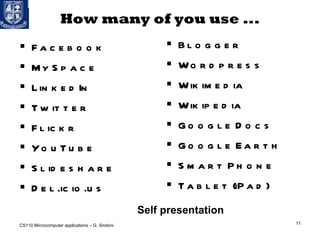
How many of you use ... Facebook MySpace LinkedIn Twitter Flickr YouTube Slideshare Del.icio.us Blogger Wordpress Wikimedia Wikipedia Google Docs Google Earth Smart Phone Tablet (iPad) CS110 Microcomputer applications – G. Sindoni Self presentation
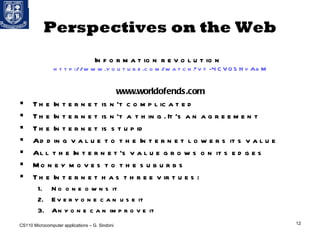
Perspectives on the Web Information revolution  http://www.youtube.com/watch?v=-4CV05HyAbM www.worldofends.com The Internet isn't complicated The Internet isn't a thing. It's an agreement The Internet is stupid Adding value to the Internet lowers its value All the Internet's value grows on its edges Money moves to the suburbs The Internet has three virtues: No one owns it Everyone can use it Anyone can improve it CS110 Microcomputer applications – G. Sindoni
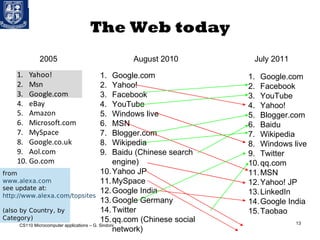
The Web today CS110 Microcomputer applications – G. Sindoni 2005  August 2010  July 2011 Google.com Yahoo!  Facebook YouTube Windows live MSN Blogger.com  Wikipedia Baidu
 (Chinese search engine)  Yahoo JP MySpace Google India Google Germany Twitter qq.com
 (Chinese social network) Google.com Facebook YouTube Yahoo! Blogger.com Baidu Wikipedia Windows live Twitter qq.com MSN Yahoo! JP LinkedIn Google India Taobao
Definition of Web 2.0  The term “Web 2.0” was first used at O’Reilly Media Web 2.0 Conference (October 2004) It 's a catchword/slogan that identifies a major paradigm shift in the web “ Web 2.0 is the business revolution in the computer industry caused by the move to the Internet as a platform, and an attempt to understand the rules for success on that new platform”  Tim O’Reilly CS110 Microcomputer applications – G. Sindoni
More definitions Still from Wikipedia: Web 2.0 can be described in 3 parts: Rich Internet Application ( RIA ) - defines the experience brought from desktop to browser ... buzz words related to RIA include AJAX and Flash Service-oriented Architecture ( SOA ) - a key piece in Web 2.0, which defines how Web 2.0 applications expose their functionality to enable their leverage and integration by other applications, thus providing a set of much richer applications (e.g. Feeds, RSS, Web Services, Mash-ups) Social Web  - defines how Web 2.0 tends to interact much more with the end users, making them an integral part. CS110 Microcomputer applications – G. Sindoni
Web 2.0 according to Tim Berners Lee “ Web 1.0 was all about connecting people. It was an interactive space, and I think Web 2.0 is of course a piece of jargon, nobody even knows what it means. If Web 2.0 for you is blogs and wikis, then that is people to people. But that was what the Web was supposed to be all along. And in fact, you know, this Web 2.0, quote, it means using the standards which have been produced by all these people working on Web 1.0. It means using the document object model, it means for HTML and SVG and so on, it's using HTTP, so it's building stuff using the Web standards, plus Javascript of course. So Web 2.0 for some people it means moving some of the thinking client side so making it more immediate, but the idea of the Web as interaction between people is really what the Web is. That was what it was designed to be as a collaborative space where people can interact.” http://www-128.ibm.com/developerworks/podcast/dwi/cm-int082206.txt CS110 Microcomputer applications – G. Sindoni
Web 2.0 social aspects 1 Using Social Software Software that gives users a way to connect (usually through content sharing) Value sharing: social applications where increased user  participation  increases content quality and quantity and therefore adds value to the service. The collective dimension is thus the guarantee of the service’s existence and quality. E.g. Wikipedia Value sharing and  cooperation : cooperation on content, whether shared or co-created, becomes an added value. The ability to "create content together" greatly improves interpersonal relationships and promotes sociability right from the start of the process. E.g. docs.google.com  CS110 Microcomputer applications – G. Sindoni
Web 2.0 social aspects 2 What is the value of Web 2.0 application contents?  As a service gains content (and value) through the direct participation of users and visitors, Web 2.0 applications are in a way a “hostage” to their users High, constant user participation is essential for the survival of social networking sites The popularity of Web 2.0 services seems to be a critical element that sometimes overpowers the quality of their content Power: User vs. Big Business What would happen if users “ran away” from Google or Facebook? CS110 Microcomputer applications – G. Sindoni
Web 2.0 social aspects 3 Participation Many services adopt mixed policies to encourage participation (E.g. some parts of the site visible to everyone) User participation level can be customized. Systems like WordPress allow blog owners to set up different levels of access to content and to enable comments to be posted by all or by registered users only  Many Web 2.0 services combine free and paid-for use ( freemium ) - paying customers receive better services and additional functions CS110 Microcomputer applications – G. Sindoni
Web 2.0 social aspects 4 New authorship dimensions: Copyright and Copyleft Producing, sharing, assessing and writing online content all raise many issues related to copyright, putting the very concept in doubt  Questions: Who are the real owners of shared content? What about comments? Is content owned wholly by those who wrote it or shared between writer AND those commenting?  If the latter, to what extent?  Are quantitative criteria able and sufficient to determine the degree of authorship? This is even more complicated in the case of collective or co-created content by distributed editors: who is the author and owner of publishing rights for Wikipedia entries? Creative Commons … see  licenses CS110 Microcomputer applications – G. Sindoni

L3 cs110 jcu-sindoni rev10092011

  • 1.
    Fall semester 2011Day 3: Intranet / Extranet, Cloud computing principles, Web 2.0, Social networks Professor: Giuseppe Sindoni ( [email_address] ) Microcomputer applications This material is distributed under the “Creative Commons “Attribution – NonCommercial – Share Alike 3.0” , available at http://creativecommons.org/licenses/by-nc-sa/3.0/
  • 2.
    Intranet A setof internet services accessible only within an organization’s local network Uses Internet technologies and protocols Delivers tools and applications to employees Collaboration Knowledge sharing Internal publishing Internal PR … Example: a web interface for an organization’s staff management system CS110 Microcomputer applications – G. Sindoni
  • 3.
    Planning and creatingan Intranet strategic planning governance functional planning content design policies and processes search applications etc.  CS110 Microcomputer applications – G. Sindoni
  • 4.
    Extranet A computernetwork that allows controlled external access for specific business or educational purposes An extension to an intranet An Intranet available from the Internet, but with limited access Applications offered on a Software as a Service (SaaS) basis   Example of an extranet: MyJCU CS110 Microcomputer applications – G. Sindoni
  • 5.
    The Google extranetGoogle services form an extranet for their users Available services: Search engine Docs Gmail YouTube ... Web 2.0 technologies enable software as a network service, as opposed to software as a local application CS110 Microcomputer applications – G. Sindoni
  • 6.
    Principles of cloudcomputing The National Institute of Standards and Technology ( NIST ) provides a concise, specific definition of cloud computing: A model for enabling convenient, on-demand network access to a shared pool of configurable computing resources (e.g. networks, servers, storage, applications, and services) that can be rapidly provisioned and released with minimal management effort or service provider interaction . CS110 Microcomputer applications – G. Sindoni
  • 7.
    Software as serviceI get applications via the Internet, using a web browser No need to install anything on my PC    Cloud computing CS110 Microcomputer applications – G. Sindoni
  • 8.
  • 9.
    Web 2.0 Therehave been no technological developments, new protocols or new standards for the Web since its creation. Spread of broadband, ever faster browsing and transmission of heavy multimedia files (images, music, video). Evolution of applications: “web 2.0” sites are online applications with a lot of site-user interaction. From static to dynamic pages, generated online, always downloaded by a browser via http. Users provide added value by producing content and sharing knowledge. Collective intelligence is thus exploited: the very engine of Web 2.0. From “one to many” to “many to many” communication. Development of virtual communities . CS110 Microcomputer applications – G. Sindoni
  • 10.
    Web 2.0 applicationsFor ums : discussion groups on specific topics. Evolution of Usenet . Blogs (web-logs): a diary which everyone can publish. Can contain thoughts, opinions, comments. Images and videos can be added. Interaction between author and reader. E.g. WordPress , Splinder , BlogSpot . Multilingual collaborative encyclopedia: Wikipedia , based on wiki technology and supplied with entries created and discussed by users. Encyclopedias differ from on-line dictionaries. Content sharing: photos, videos. Flickr , YouTube . Social Networks . Not only Facebook , but LinkedIn , MySpace , Google Plus , Orkut , Digg … Publishing and reading news and contents: RSS (really simple syndication) and PodCast . CS110 Microcomputer applications – G. Sindoni
  • 11.
    How many ofyou use ... Facebook MySpace LinkedIn Twitter Flickr YouTube Slideshare Del.icio.us Blogger Wordpress Wikimedia Wikipedia Google Docs Google Earth Smart Phone Tablet (iPad) CS110 Microcomputer applications – G. Sindoni Self presentation
  • 12.
    Perspectives on theWeb Information revolution http://www.youtube.com/watch?v=-4CV05HyAbM www.worldofends.com The Internet isn't complicated The Internet isn't a thing. It's an agreement The Internet is stupid Adding value to the Internet lowers its value All the Internet's value grows on its edges Money moves to the suburbs The Internet has three virtues: No one owns it Everyone can use it Anyone can improve it CS110 Microcomputer applications – G. Sindoni
  • 13.
    The Web todayCS110 Microcomputer applications – G. Sindoni 2005 August 2010 July 2011 Google.com Yahoo! Facebook YouTube Windows live MSN Blogger.com Wikipedia Baidu
 (Chinese search engine) Yahoo JP MySpace Google India Google Germany Twitter qq.com
 (Chinese social network) Google.com Facebook YouTube Yahoo! Blogger.com Baidu Wikipedia Windows live Twitter qq.com MSN Yahoo! JP LinkedIn Google India Taobao
  • 14.
    Definition of Web2.0 The term “Web 2.0” was first used at O’Reilly Media Web 2.0 Conference (October 2004) It 's a catchword/slogan that identifies a major paradigm shift in the web “ Web 2.0 is the business revolution in the computer industry caused by the move to the Internet as a platform, and an attempt to understand the rules for success on that new platform” Tim O’Reilly CS110 Microcomputer applications – G. Sindoni
  • 15.
    More definitions Stillfrom Wikipedia: Web 2.0 can be described in 3 parts: Rich Internet Application ( RIA ) - defines the experience brought from desktop to browser ... buzz words related to RIA include AJAX and Flash Service-oriented Architecture ( SOA ) - a key piece in Web 2.0, which defines how Web 2.0 applications expose their functionality to enable their leverage and integration by other applications, thus providing a set of much richer applications (e.g. Feeds, RSS, Web Services, Mash-ups) Social Web - defines how Web 2.0 tends to interact much more with the end users, making them an integral part. CS110 Microcomputer applications – G. Sindoni
  • 16.
    Web 2.0 accordingto Tim Berners Lee “ Web 1.0 was all about connecting people. It was an interactive space, and I think Web 2.0 is of course a piece of jargon, nobody even knows what it means. If Web 2.0 for you is blogs and wikis, then that is people to people. But that was what the Web was supposed to be all along. And in fact, you know, this Web 2.0, quote, it means using the standards which have been produced by all these people working on Web 1.0. It means using the document object model, it means for HTML and SVG and so on, it's using HTTP, so it's building stuff using the Web standards, plus Javascript of course. So Web 2.0 for some people it means moving some of the thinking client side so making it more immediate, but the idea of the Web as interaction between people is really what the Web is. That was what it was designed to be as a collaborative space where people can interact.” http://www-128.ibm.com/developerworks/podcast/dwi/cm-int082206.txt CS110 Microcomputer applications – G. Sindoni
  • 17.
    Web 2.0 socialaspects 1 Using Social Software Software that gives users a way to connect (usually through content sharing) Value sharing: social applications where increased user participation increases content quality and quantity and therefore adds value to the service. The collective dimension is thus the guarantee of the service’s existence and quality. E.g. Wikipedia Value sharing and cooperation : cooperation on content, whether shared or co-created, becomes an added value. The ability to "create content together" greatly improves interpersonal relationships and promotes sociability right from the start of the process. E.g. docs.google.com CS110 Microcomputer applications – G. Sindoni
  • 18.
    Web 2.0 socialaspects 2 What is the value of Web 2.0 application contents? As a service gains content (and value) through the direct participation of users and visitors, Web 2.0 applications are in a way a “hostage” to their users High, constant user participation is essential for the survival of social networking sites The popularity of Web 2.0 services seems to be a critical element that sometimes overpowers the quality of their content Power: User vs. Big Business What would happen if users “ran away” from Google or Facebook? CS110 Microcomputer applications – G. Sindoni
  • 19.
    Web 2.0 socialaspects 3 Participation Many services adopt mixed policies to encourage participation (E.g. some parts of the site visible to everyone) User participation level can be customized. Systems like WordPress allow blog owners to set up different levels of access to content and to enable comments to be posted by all or by registered users only Many Web 2.0 services combine free and paid-for use ( freemium ) - paying customers receive better services and additional functions CS110 Microcomputer applications – G. Sindoni
  • 20.
    Web 2.0 socialaspects 4 New authorship dimensions: Copyright and Copyleft Producing, sharing, assessing and writing online content all raise many issues related to copyright, putting the very concept in doubt Questions: Who are the real owners of shared content? What about comments? Is content owned wholly by those who wrote it or shared between writer AND those commenting? If the latter, to what extent? Are quantitative criteria able and sufficient to determine the degree of authorship? This is even more complicated in the case of collective or co-created content by distributed editors: who is the author and owner of publishing rights for Wikipedia entries? Creative Commons … see licenses CS110 Microcomputer applications – G. Sindoni