![22nd
Bled eConference
eEnablement:
Facilitating an Open, Effective and Representative eSociety
June 14 - 17, 2009; Bled, Slovenia
Social Networking Sites and Equal Opportunity: The
Impact of Accessibility
Denise Leahy
Trinity College Dublin, Ireland
denise.leahy@cs.tcd.ie
Ultan Ó Broin
Trinity College Dublin, Ireland
obroinu@tcd.ie
Abstract
The European Union has recognised the importance of information technology in
addressing issues of social inclusion and equal opportunity and has defined eInclusion
as part of the i2010 initiative (European Commission, 2005). The use of social
networking applications by individuals and by companies is growing and industry
analysts have identified the benefits to organisations of using Web 2.0 social
collaboration tools (Boulton, 2008).
This research examines the use of social networking sites by people with visual
impairments, exploring whether there is full access and therefore social inclusion. Or is
there, as is claimed (Whittle, 2007), a situation that although “sites such as Facebook
and MySpace are meant to have ushered in a new era of online collaboration, (but) not
everyone is invited to the party”? If there is a social exclusion from sites that integrate
with the enterprise for business reasons, what are the implications for established
accessibility guidelines and for e-business theory?
Keywords: accessibility, web 2.0, social networking sites,
1 Introduction
Tim Berners-Lee imagined that the web could be the means for universal
communication twenty years ago: “The dream behind the Web is of a common
information space in which we communicate by sharing information” (Berners-Lee,
1998). With the onset of “Web 2.0”, it appears that the users of the web themselves are
closer than ever in bringing about this dream through their own social interactions
online. Web 2.0 promises social inclusion and opportunity for all, with its fundamental
tenets on collective wisdom, seamlessly built data relationships, open participation,
collaboration by all and user created content.
The importance of this development was emphasised by the EU Commissioner for
Information Society and Media: “We are now living through a new disruptive phase of
the Information Society. Some people call it Web 2.0 or social networking. … What is
new about these uses of the Internet is that they exploit [its] connectivity to support
people networking and creating content.” (Reding, 2006)](https://image.slidesharecdn.com/bled5thmay2009uob-130608175629-phpapp02/75/Social-Networking-Sites-and-Equal-Opportunity-The-Impact-of-Accessibility-1-2048.jpg)
![other business partners (McGee, 2007). CRM applications now contain software links to
allow for direct integration into Facebook, LinkedIn through APIs, and so on.
The availability of Web 2.0-centric development tools from Google, IBM, Adobe,
Yahoo!, and others allows e-businesses to integrate their applications and data sources
with social networking sites and other Web 2.0 services into a single interface (Moltzen,
2008).
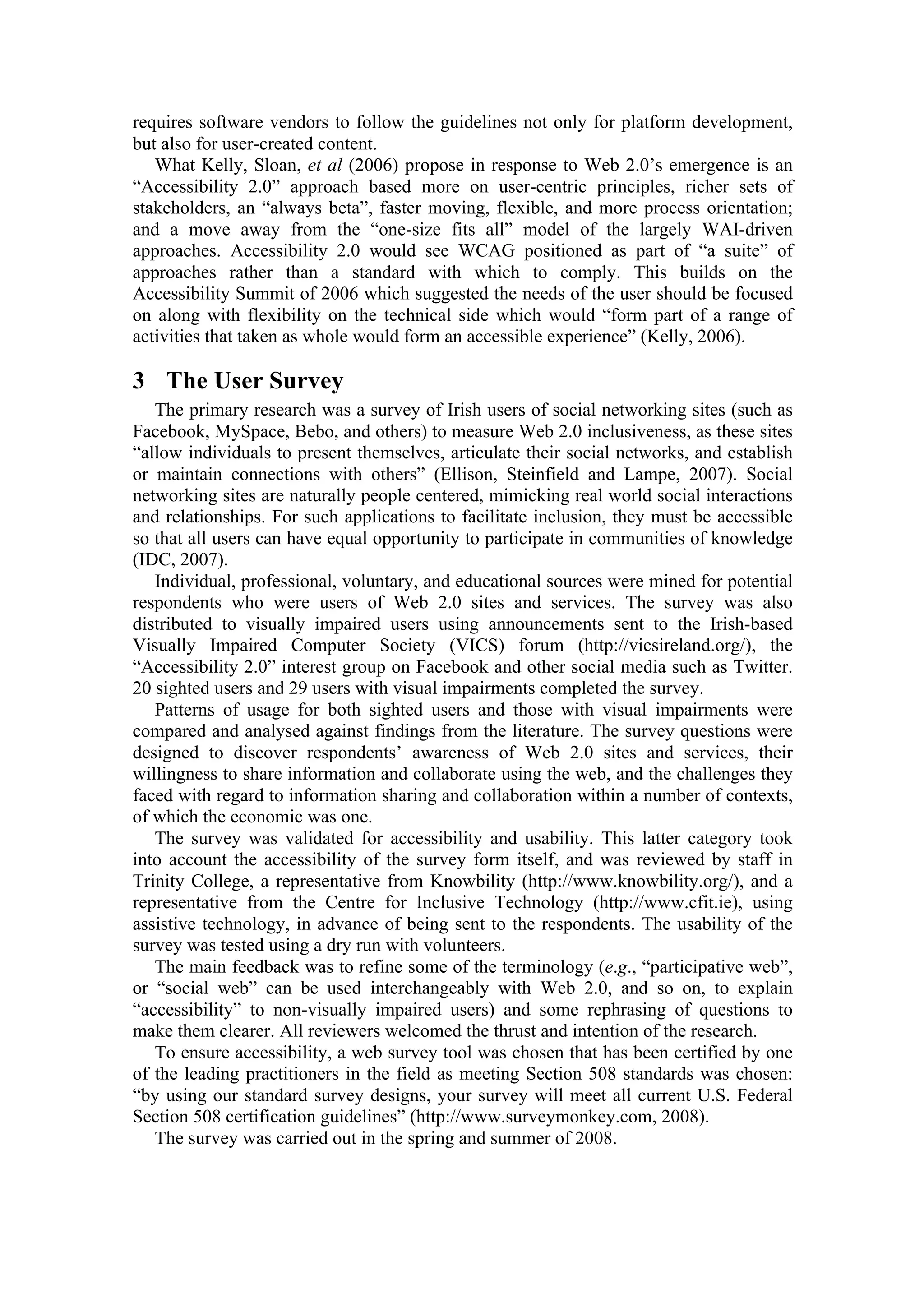
Figure 1: Advertisement for database administrator (DBA) jobs on Facebook
Human resource professionals are using social networking sites (see figure 1)
“Recruiters are taking a close look at those networks, since it’s like going through
someone’s Rolodex … in the past, proprietary databases were unique to a search firm,
including information on larger networks, but these days, most rely on LinkedIn
instead” (Millard, 2008).
What about accessibility? Zajicek (2007) defines accessibility in terms of
“inclusivity” in a way of particular interest to participation on the web: “A community
web site is accessible if it includes the user in its group and the user wants to be
included. If you are excluded from a service, then it is not accessible to you. If you do
not relate to that which is being provided, then you could argue it is not accessible to
you.”
2.2 Current Guidelines and Laws
To address issues of web and e-business accessibility, there are a wide variety of
guidelines and regulations, best known of which are the voluntary guidelines of the Web
Accessibility Initiative (WAI, 1999) and the mandatory requirements of the U.S.
Section 508 of the Rehabilitation Act (Amended) 1998. Others include the Disability
Discrimination Act (DDA) (1995) in the UK, the Disability Act (2005) in Ireland, and
many local, national, and international legislation and aspirations. There are two kinds
of law - legislation which covers public sector services delivered through information
and communication technology (for example, Section 508) and specific disability
legislation (for example, the DDA, and the Americans with Disabilities Act [1990]).
Not everyone agrees conformance to guidelines such as the WAI’s Web Content
Accessibility Guidelines (WCAG), is the best approach to bringing about universal
access (Kelly, Sloan, et al, 2006) and the evidence from the UK’s Disability Rights
Commission is that it does not (Burnett, 2003). Part of the problem is that WCAG also](https://image.slidesharecdn.com/bled5thmay2009uob-130608175629-phpapp02/75/Social-Networking-Sites-and-Equal-Opportunity-The-Impact-of-Accessibility-3-2048.jpg)
![In keeping with the Web 2.0 ethos of participation, users also saw their own
involvement as a way forward to delivering accessibility – through testing, design
feedback, and positive reinforcement of accessibility efforts. Although there was
recognition that the widely accepted guidelines had a role to play, and there was a legal
aspect involved (especially in terms of discrimination), what was largely missing was
input from the users of social networking sites themselves: “Rewards for the good guys
(some kind of web design Oscar?) are likely to work better than imposing legislation
(which country’s legislation can you use anyway?).”
6 Significance of Findings
The survey’s respondents with visual impairments recognized the importance of the
collaborative and participative features of Web 2.0 sites and services and their role in
online economic activity while expressing a desire to be socially included. They also
realized the economic implications of such exclusion; they use social networking sites
and, in many cases, expressed similar usage preferences to sighted users.
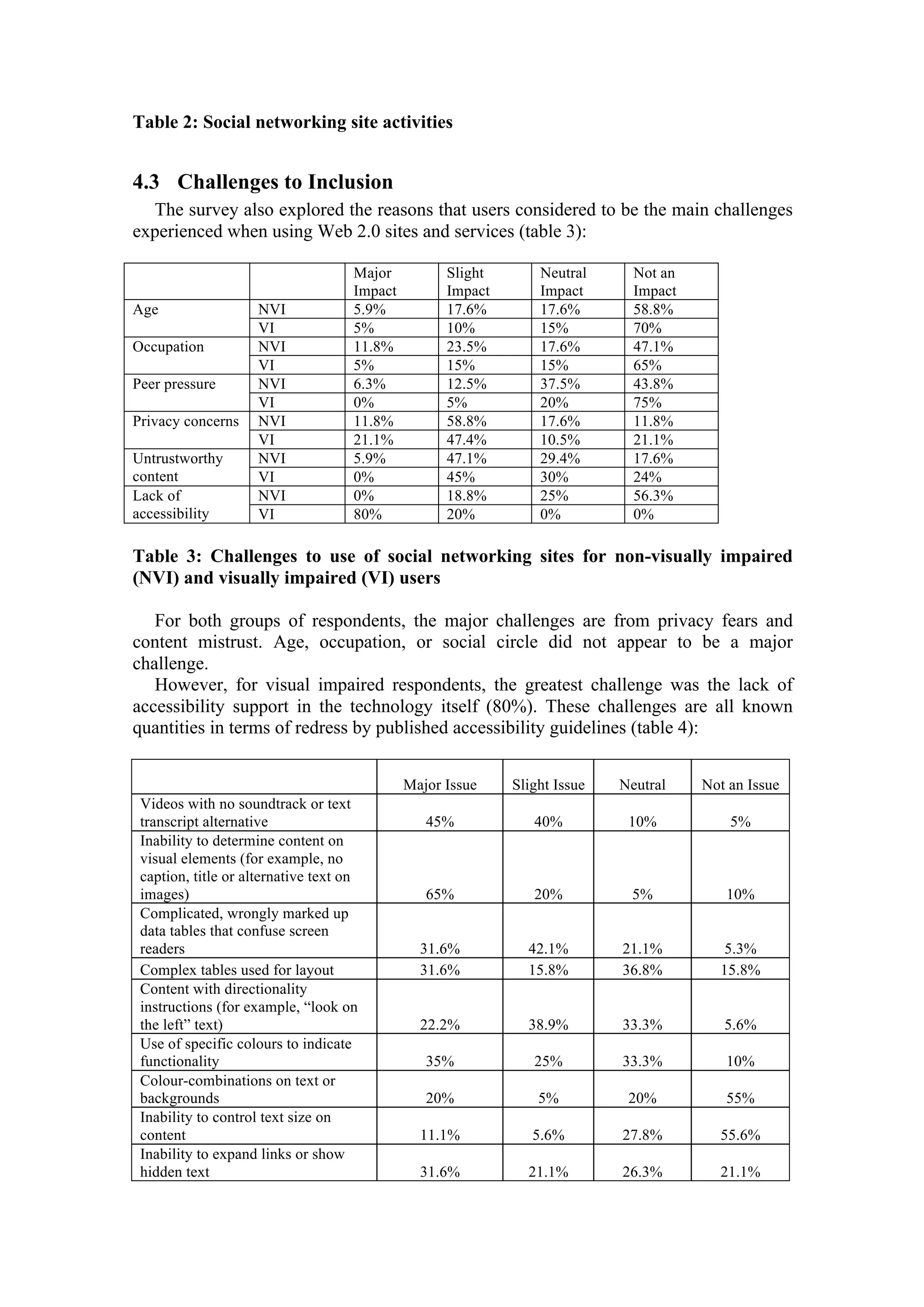
When questioned on the challenges presented to using social networking sites,
accessibility support (or lack of) is by far the greatest challenge to the visually impaired
user. There are other issues of concern to all; issues like privacy, content trust
worthiness and issues like age, occupation, and social circle are similar between visually
impaired and sighted users.
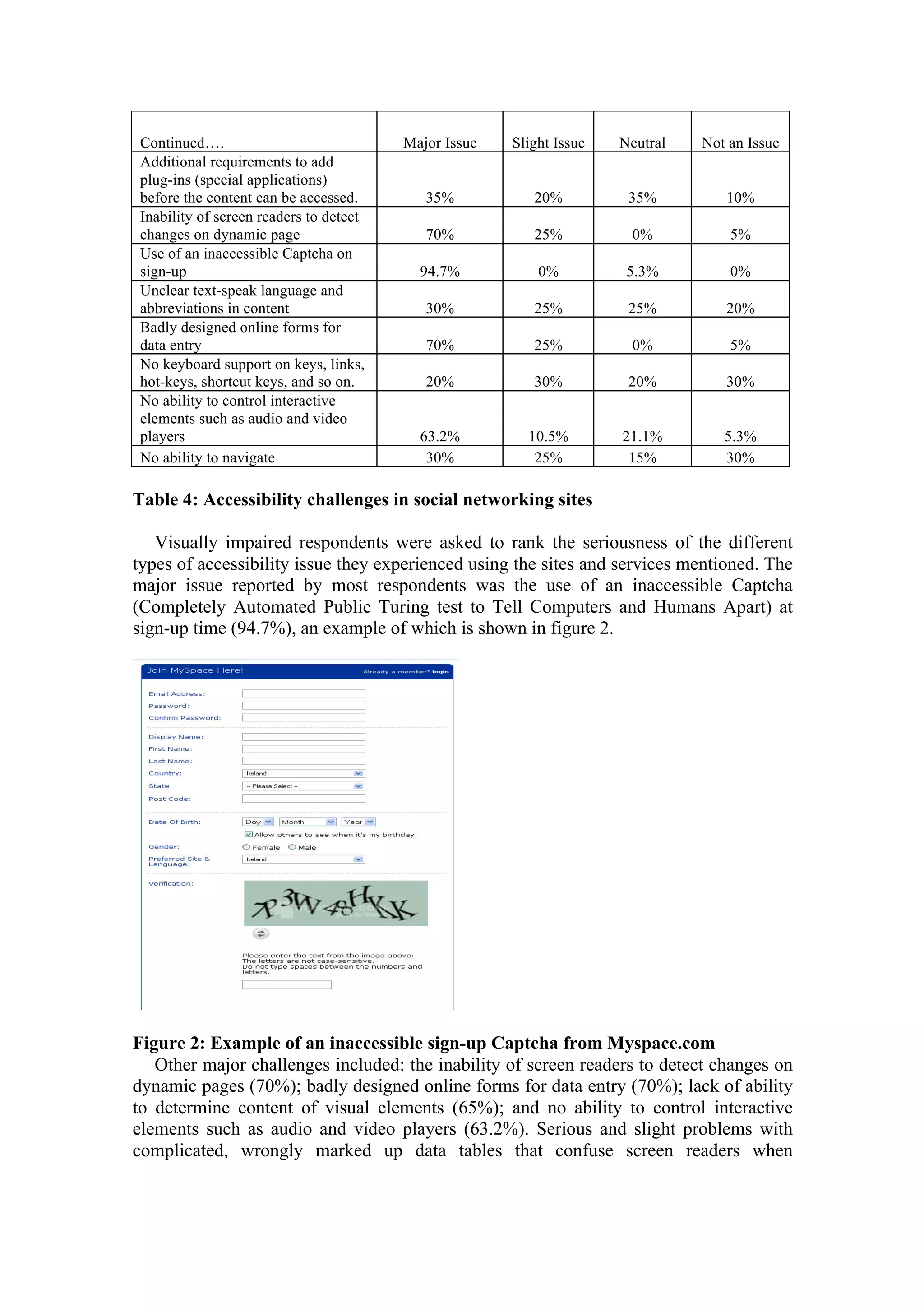
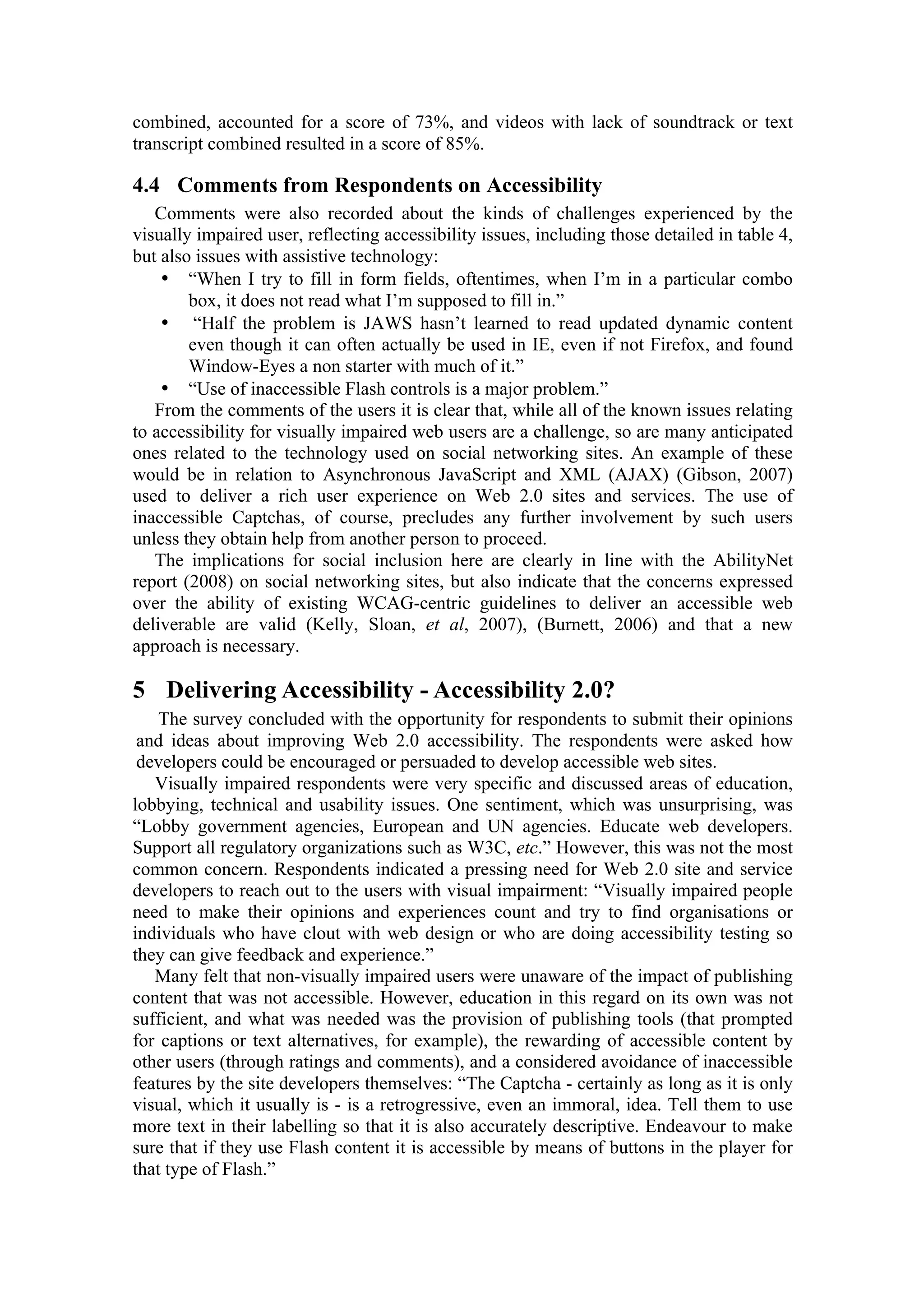
Some of the worst accessibility violations identified included the use of Captchas at
sign-on, the inability to detect dynamic changes on site content (for example through
AJAX), badly designed forms for data entry, lack of ability to determine visual content
with text alternatives, problems with audio and video player control, incorrectly marked
up tables, and lack of soundtrack or text transcripts on content.
None of these accessibility failings is an unknown quantity from an accessibility or
usability viewpoint. Even the more “recent” accessibility issues relating to key Web 2.0
technologies such as AJAX are currently being addressed through WAI-ARIA
(Worldwide Web Consortium [W3C], 2008) or other guidelines (Gibson, 2006). It is
necessary for these to be implemented.
7 Conclusion
These findings have serious implications for the prospect of social inclusion given
the increasing adoption of social networking site integration by enterprises. Visually
impaired respondents recognized the marketing, learning and employment potential of
such sites, but were presented with some very serious accessibility challenges. These
respondents mentioned being “disheartened”, “unable to keep up with colleagues” and
“banished” from these sites. They are excluded from interacting with other users and the
enterprise, from employment opportunities, creating business relationship, obtaining
product information, giving feedback, and so on.
This is contrary to not only the accessibility guidelines such as the WCAG but also
the claims of Web 2.0 thought leaders, and the aspirations of the EU and other public
policy bodies. In some cases, of course, where social networking sites are used to
provide goods and services, such exclusion may even be illegal under the equality
legislation now enacted in many countries (Bowser, 2006). However, reliance on the
law is a reactive and slow process, and legal protection varies, whereas social
networking site usage is global and fast moving.
Such exclusion negatively impacts at a community and individual level, as visually
impaired users are excluded from economic opportunity. It is not acceptable for e-](https://image.slidesharecdn.com/bled5thmay2009uob-130608175629-phpapp02/75/Social-Networking-Sites-and-Equal-Opportunity-The-Impact-of-Accessibility-10-2048.jpg)

This research explores the accessibility of social networking sites for individuals with visual impairments, highlighting the European Union's commitment to e-inclusion through technology. It finds that visually impaired users are less likely to use these platforms compared to sighted users and face significant barriers that impact their social inclusion and opportunity. Recommendations for improving accessibility standards and addressing social exclusion are suggested, emphasizing the need for more user-centric approaches in web development.


![11.[1 9]accessibility analysis and evaluation of government websites in devel...](https://cdn.slidesharecdn.com/ss_thumbnails/11-1-9accessibilityanalysisandevaluationofgovernmentwebsitesindevelopingcountries-120512235341-phpapp02-thumbnail.jpg?width=640&height=640&fit=bounds)


![Interest_Paper_final_1[1]](https://cdn.slidesharecdn.com/ss_thumbnails/06a257e9-5e08-4af8-9754-192abe762900-150423112201-conversion-gate01-thumbnail.jpg?width=640&height=640&fit=bounds)


![Coded Agents – with UiPath SDK + LangGraph [Virtual Hands-on Workshop]](https://cdn.slidesharecdn.com/ss_thumbnails/codedagentsdeck-251215155422-5497c599-thumbnail.jpg?width=640&height=640&fit=bounds)


