Leveraging The  Web 2.0 Movement Exploring Web 2.0,  The Global SOA, and Enterprise 2.0
Introductions Dion Hinchcliffe ZDNet’s Enterprise Web 2.0 http://blogs.zdnet.com/Hinchcliffe  AjaxWorld Magazine, Editor-in-Chief http://ajaxworldmagazine.com Web 2.0 Journal, Editor-in-Chief http://web2journal.com   Hinchcliffe   & Company http://hinchcliffeandco.com mailto:dion@hinchcliffeandco.com Web 2.0 University http://web20university.com
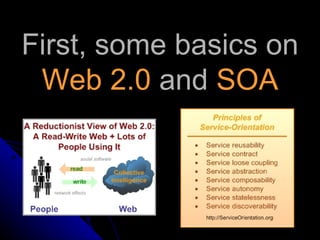
First, some basics on  Web 2.0  and  SOA
A Brief History of the Web 15 years old One entire boom and bust cycle A simple, flat structure based on pages and hyperlinks Everything on the Web happens with HTTP: Invented by Tim Berners-Lee A new type of platform Fundamentally communication-oriented
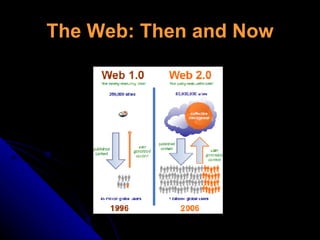
The Web: Then and Now
Web 1.0 Mostly about navigating the Web:  surfing Most content was produced by central media companies Few people put content online themselves and helped shape the Web directly It was hard and expensive to create Web sites and applications Only a few million people online Unproven business models The Web browser was the only way to browse
Web 2.0 Very  two-way  use of the Web to consume and create content Tens of millions of people blogging Participation instead of publishing The Web is now produced primarily on the  edge  of the Internet, instead of the center 1 billion people online.  Source : IDC Proven  business models Many ways to interact with the Web
The Challenge of Defining Web 2.0 Web 2.0  is   Ajax Web 2.0  is  user generated content Web 2.0  is  social software Web 2.0  is  syndication and Web services These are all correct, so there  must  be a deeper underlying principle
First Web 2.0 “Compact” Definition “ Web 2.0 is the network as platform, spanning all connected devices; Web 2.0 applications are those that make the most of the intrinsic advantages of that platform: delivering software as a continually-updated service that gets better the more people use it, consuming and remixing data from multiple sources, including individual users, while providing their own data and services in a form that allows remixing by others, creating network effects through an "architecture of participation," and going beyond the page metaphor of Web 1.0 to deliver rich user experiences.”  – Tim O’Reilly
Our Working Definition of Web 2.0 Today “ Networked applications  that explicitly leverage  network effects .” –  Tim O’Reilly
But what is Web 2.0 really?
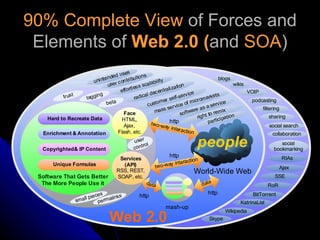
90% Complete View  of Forces and Elements of  Web 2.0 ( and  SOA )
Backgrounder on Web 2.0 A term that signifies a set of  clearly apparent, widespread new trends  in the way that the Web is being used Not a technology ; a widespread change in the behavior and scale of the Web and its audience Sometimes known as the Read/Write Web The core principle often cited is  harnessing collective intelligence  (Source: Tim O’Reilly)
Examples of Web 2.0 Turning the traditional Web page into real software applications (aka AJAX) Office 2.0 Google Maps (maps.google.com) Flickr (flickr.com) Web sites made of content created entirely by their users MySpace –  social networking YouTube – social  media sharing Digg –  peer production news Wikipedia –  reference information eBay –  online product sales
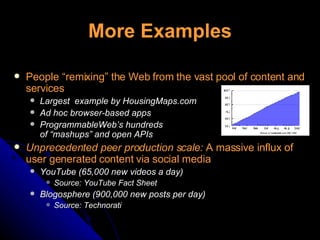
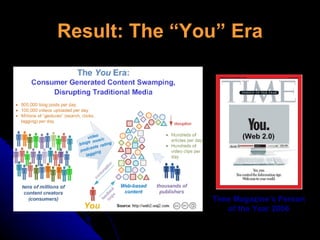
More Examples People “remixing” the Web from the vast pool of content and services Largest  example by HousingMaps.com Ad hoc browser-based apps ProgrammableWeb’s hundreds  of “mashups” and open APIs Unprecedented peer production scale:  A massive influx of user generated content via social media YouTube (65,000 new videos a day) Source: YouTube Fact Sheet Blogosphere (900,000 new posts per day) Source: Technorati
Result: The “You” Era Time Magazine’s Person of the Year 2006
The 7 Core Principles  of Web 2.0 The Web as Platform Data as the next “Intel Inside” End of the Software Release Cycle Lightweight Software and Business Models Software Above the Level of a Single Device Rich User Experiences Harnessing Collective Intelligence
The concepts of  Web 2.0 The  Web As Platform The Web as a real software platform Leveraging it’s intrinsic strengths Harnessing Collective Intelligence Services  that improve and  get richer the more that people use them  (Wikipedia, BitTorrent, YouTube) Production of every kind moving to the edge of the network Information as  the  Core Capability, Not Software Google Maps, SourceForge, “Blogosphere”, NAVTEQ End of Discrete Software Releases Continuous improvement  becomes the norm (zero-footprint Ajax software, SaaS, federated Web services) cont’d...
Tenets of  Web 2.0 Continued Lightweight Programming Models Simple pragmatism: Emergent models that  just work Examples: Ruby on Rails, PHP, mashups, widgets, badges Easy Integration  no matter who is on the other end General preference for RSS, REST, POX/HTTP over SOAP, WS-* Syndication  instead of  coordination  and control Tyranny of the mustUnderstand Header Supports innovation in assembly, similar to the mass production of component PCs Fundamentally Federated Software Systems Examples: iTunes, blogosphere, SourceForge Rich User Experiences Ajax, Flash, Flex, Laszlo, XUL, WPF/E Results in software as good as can be found anywhere with few exceptions Invariably requires a Web service infrastructure or SOA
Core Competencies  of Web 2.0 Online services, not packaged software, with  cost-effective scalability   Software as a Service (Web service or UI) Maintaining control over unique, hard-to-recreate information that gets richer the more that people use it Trusting your users as co-developers  Harnessing collective intelligence  Leveraging  The Long Tail   Lightweight user interfaces, development models, and business models  Business Models:  Customer Self-Service, The Long Tail, Turning Applications into Platforms, Encouraging Unintended Uses
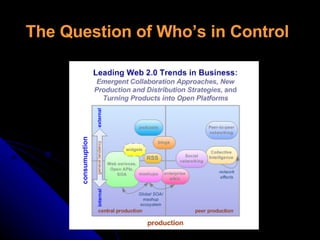
The Question of Who’s in Control
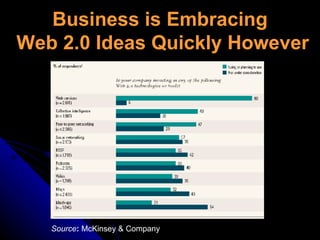
Business is Embracing  Web 2.0 Ideas Quickly However Source :  McKinsey & Company
Brief Introduction to  SOA From xml.com :   SOA  is an  architectural style  whose goal is to achieve  loose coupling  among  interacting software agents . A service is a unit of work done by a service  provider  to achieve desired end results for a service  consumer . Both provider and consumer are roles played by software agents on behalf of their owners. From whatis.com :   SOA  defines how two  computing entities , such as programs, interact in such a way as to enable one entity  to perform a unit of work on behalf of another entity . Service interactions are defined using a  description language . Each interaction is self-contained and loosely coupled, so that each interaction is independent of any other interaction.
SOA Definition  Bottom Line: SOA is a  modular software architecture , and the modules are services designed to interact with each other. Important Note: SOA also contains higher order constructs such as composite applications, orchestration, coordination, and more exist. SOAs are usually based on  open standards  to encourage automatic  interoperability  of services designed separately.  A good SOA could still violate this rule however See Thomas Erl and Seven Principles of SO
Key Trends Gartner recently reported that  Service-Oriented Architecture  is now the leading organizing principle in the enterprise space, with 80% of all development using SOA principles by 2008. McKinsey  and the  Sandhill Group  report that Web 2.0 in the enterprise will be one of the major disruptive influences in enterprise software in 2007. Quote: “Web 2.0 also represents the most significant and easily accessed opportunity for new growth, innovation, and increased productivity.”
More Key Trends 48% of all CIOs globally are planning in 2007 to implement service-oriented architectures for integration with external trading partners. Implications: This is making software increasingly service-based and highly composite The simultaneous rise of services on the Web and services in the enterprise are driving a focus on building service-based software (SaaS) Security, governance, and IT management are all going to change in a world of services
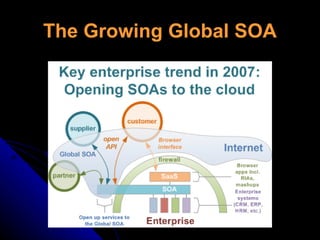
The Growing Global SOA
Key Point: Turning Applications Into Platforms Openly  exposing the features  of software and data to customers, end-users, partners, and suppliers for reuse and remixing This strategy requires documenting, encouraging, and  actively supporting  the  application as a platform Has serious governance implications Provide  legal ,  technical , and  business  reasons to enable this  (or it won’t happen) : Fair licensing, pricing, & support models
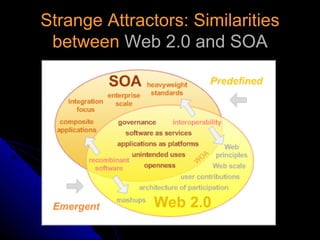
Strange Attractors: Similarities  between  Web 2.0 and SOA
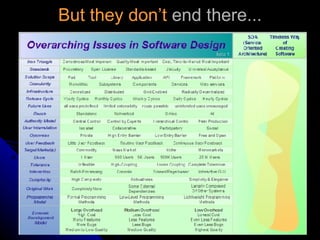
But they don’t  end there...
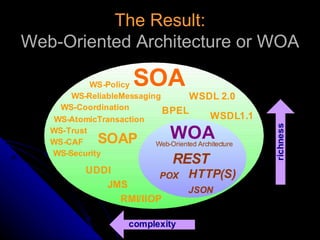
Major implications of Web 2.0 and SOA Convergence Ajax and RIAs are rapidly growing in importance as the front-end to SOAs A natural fit since RIAs must have services to function and open APIs are a leading trend Simpler services have the most reach Both technology (REST, JSON) and interface complexity Challenges for tooling, which tends to support older Web services models The Web is becoming the largest repository of service-oriented functionality and content.
Some  Observations Top-down  vs. Bottom-Up SOAs tends to be a top down architectural phenomenon Few developers report developing with SOA Web 2.0 is a widespread, grassroots industry phenomenon Here today  vs. promises tomorrow Full-strength SOA (WS-* of any kind) is difficult to do with available tooling (60+ standards today) However, Web 2.0 techniques are entirely in existence today Though some, like end-user guided browser mashups, certainly have immature tooling
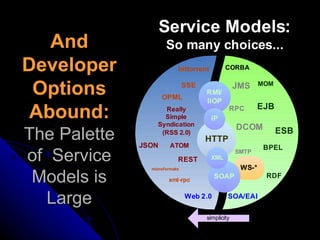
And Developer Options Abound:   The Palette of  Service Models is Large
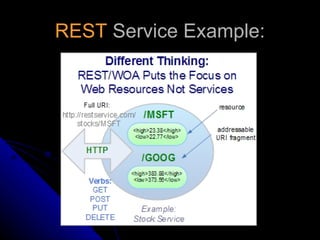
What then are   Web 2.0-style Web services? The most common Web service approaches “in the wild” are ones based on the “grain” of the Web: Representation State Transfer, or REST. Created by Roy Fielding, the co-creator of HTTP, the fundamental protocol of the Web. Designed to fit naturally into Internet architecture Extremely simple, not a standard, just a style of using HTTP Fully embraces the workings of HTTP and uses its verbs (GET, PUT, POST, DELETE) on top of a granular, sensical URL structure to indicate what is to happen.
REST  Service Example:
The Result: Web-Oriented Architecture or WOA
Web 2.0 Stories Just three of many…
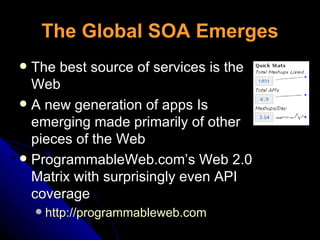
The Global SOA Emerges The best source of services is the Web A new generation of apps Is emerging made primarily of other pieces of the Web ProgrammableWeb.com’s Web 2.0 Matrix with surprisingly even API coverage http://programmableweb.com
Example: XM Radio XM Radio  is a satellite radio provider that has recently embraced some of the tenets of Product Development 2.0.   Their  Top 20 on 20 channel  is one of the most popular channels XM has yet created.  Why?  Because control of it has been entirely handed over to its users.  Says the  Wikipedia entry  on Top 20 on 20: " The channel plays everything new from rock to rap, with the songs chosen by online votes to the XM website. One can also vote their favorite songs by calling the station number, or text messaging.  The channel is completely automated by listener voting with no DJ interruption.   Top 20 on 20 is now one of the most popular music channels on XM. According to XM's internal research, the channel achieves 1.8 million listeners a week. "
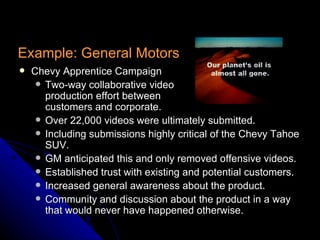
Example: General Motors Chevy Apprentice Campaign Two-way collaborative video  production effort between  customers and corporate. Over 22,000 videos were ultimately submitted. Including submissions highly critical of the Chevy Tahoe SUV. GM anticipated this and only removed offensive videos. Established trust with existing and potential customers. Increased general awareness about the product. Community and discussion about the product in a way that would never have happened otherwise.
Introducing Enterprise 2.0 Conceived by Harvard Business School Professor Andrew McAfee Defined as emergent, freeform, social applications for use within the enterprise Primarily to improve the collaboration problem (discussed shortly) The use of blogs and wikis to capture institutional knowledge, make it discoverable and lets structure and organization emerge naturally
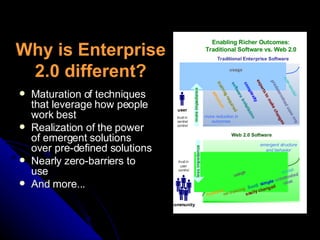
Why is Enterprise 2.0 different? Maturation of techniques that leverage how people work best Realization of the power of emergent solutions over pre-defined solutions Nearly zero-barriers to use And more...
The Enterprise 2.0 Checklist SLATES Search Linking Authorship Tagging Extensions Signals
SLATES explained... SLATES describes the combined use of effective enterprise  search  and discovery; Using  links  to connect information together into a meaningful information ecosystem using the model of the Web; Providing low-barrier social tools for public  authorship  of enterprise content; Tags  to let users create emergent organizational structure; Extensions  to spontaneously provide intelligent content suggestions similar to Amazon's recommendation system, and;  Signals  to let users know when enterprise information they care about has been published or updated, such as when a corporate RSS feed of interest changes.
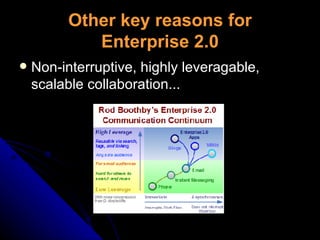
Other key reasons for Enterprise 2.0 Non-interruptive, highly leveragable, scalable collaboration...
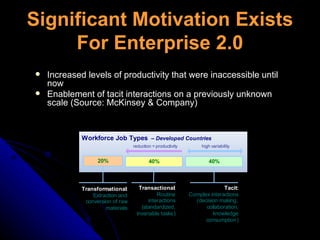
Significant Motivation Exists For Enterprise 2.0 Increased levels of productivity that were inaccessible until now Enablement of tacit interactions on a previously unknown scale (Source: McKinsey & Company)
Conclusion Web 2.0 is  just  beginning The leading edge of the hype is now over and the hard work of applying all this is left. Much more on the horizon Including  Web 3.0 , the final arrival of the  Semantic Web  &  Semantic Enterprise The full aftershocks of Web 2.0 will be felt for 10 or 20 years or more AKA Forrester’s Social Computing vision
Questions or Slides:   [email_address] http://web20university.com   http://e2tvshow.com

Leveraging The Web 2.0 Movement, Dion Hinchliffe

  • 1.
    Leveraging The Web 2.0 Movement Exploring Web 2.0, The Global SOA, and Enterprise 2.0
  • 2.
    Introductions Dion HinchcliffeZDNet’s Enterprise Web 2.0 http://blogs.zdnet.com/Hinchcliffe AjaxWorld Magazine, Editor-in-Chief http://ajaxworldmagazine.com Web 2.0 Journal, Editor-in-Chief http://web2journal.com Hinchcliffe & Company http://hinchcliffeandco.com mailto:dion@hinchcliffeandco.com Web 2.0 University http://web20university.com
  • 3.
    First, some basicson Web 2.0 and SOA
  • 4.
    A Brief Historyof the Web 15 years old One entire boom and bust cycle A simple, flat structure based on pages and hyperlinks Everything on the Web happens with HTTP: Invented by Tim Berners-Lee A new type of platform Fundamentally communication-oriented
  • 5.
  • 6.
    Web 1.0 Mostlyabout navigating the Web: surfing Most content was produced by central media companies Few people put content online themselves and helped shape the Web directly It was hard and expensive to create Web sites and applications Only a few million people online Unproven business models The Web browser was the only way to browse
  • 7.
    Web 2.0 Very two-way use of the Web to consume and create content Tens of millions of people blogging Participation instead of publishing The Web is now produced primarily on the edge of the Internet, instead of the center 1 billion people online. Source : IDC Proven business models Many ways to interact with the Web
  • 8.
    The Challenge ofDefining Web 2.0 Web 2.0 is Ajax Web 2.0 is user generated content Web 2.0 is social software Web 2.0 is syndication and Web services These are all correct, so there must be a deeper underlying principle
  • 9.
    First Web 2.0“Compact” Definition “ Web 2.0 is the network as platform, spanning all connected devices; Web 2.0 applications are those that make the most of the intrinsic advantages of that platform: delivering software as a continually-updated service that gets better the more people use it, consuming and remixing data from multiple sources, including individual users, while providing their own data and services in a form that allows remixing by others, creating network effects through an "architecture of participation," and going beyond the page metaphor of Web 1.0 to deliver rich user experiences.” – Tim O’Reilly
  • 10.
    Our Working Definitionof Web 2.0 Today “ Networked applications that explicitly leverage network effects .” – Tim O’Reilly
  • 11.
    But what isWeb 2.0 really?
  • 12.
    90% Complete View of Forces and Elements of Web 2.0 ( and SOA )
  • 13.
    Backgrounder on Web2.0 A term that signifies a set of clearly apparent, widespread new trends in the way that the Web is being used Not a technology ; a widespread change in the behavior and scale of the Web and its audience Sometimes known as the Read/Write Web The core principle often cited is harnessing collective intelligence (Source: Tim O’Reilly)
  • 14.
    Examples of Web2.0 Turning the traditional Web page into real software applications (aka AJAX) Office 2.0 Google Maps (maps.google.com) Flickr (flickr.com) Web sites made of content created entirely by their users MySpace – social networking YouTube – social media sharing Digg – peer production news Wikipedia – reference information eBay – online product sales
  • 15.
    More Examples People“remixing” the Web from the vast pool of content and services Largest example by HousingMaps.com Ad hoc browser-based apps ProgrammableWeb’s hundreds of “mashups” and open APIs Unprecedented peer production scale: A massive influx of user generated content via social media YouTube (65,000 new videos a day) Source: YouTube Fact Sheet Blogosphere (900,000 new posts per day) Source: Technorati
  • 16.
    Result: The “You”Era Time Magazine’s Person of the Year 2006
  • 17.
    The 7 CorePrinciples of Web 2.0 The Web as Platform Data as the next “Intel Inside” End of the Software Release Cycle Lightweight Software and Business Models Software Above the Level of a Single Device Rich User Experiences Harnessing Collective Intelligence
  • 18.
    The concepts of Web 2.0 The Web As Platform The Web as a real software platform Leveraging it’s intrinsic strengths Harnessing Collective Intelligence Services that improve and get richer the more that people use them (Wikipedia, BitTorrent, YouTube) Production of every kind moving to the edge of the network Information as the Core Capability, Not Software Google Maps, SourceForge, “Blogosphere”, NAVTEQ End of Discrete Software Releases Continuous improvement becomes the norm (zero-footprint Ajax software, SaaS, federated Web services) cont’d...
  • 19.
    Tenets of Web 2.0 Continued Lightweight Programming Models Simple pragmatism: Emergent models that just work Examples: Ruby on Rails, PHP, mashups, widgets, badges Easy Integration no matter who is on the other end General preference for RSS, REST, POX/HTTP over SOAP, WS-* Syndication instead of coordination and control Tyranny of the mustUnderstand Header Supports innovation in assembly, similar to the mass production of component PCs Fundamentally Federated Software Systems Examples: iTunes, blogosphere, SourceForge Rich User Experiences Ajax, Flash, Flex, Laszlo, XUL, WPF/E Results in software as good as can be found anywhere with few exceptions Invariably requires a Web service infrastructure or SOA
  • 20.
    Core Competencies of Web 2.0 Online services, not packaged software, with cost-effective scalability Software as a Service (Web service or UI) Maintaining control over unique, hard-to-recreate information that gets richer the more that people use it Trusting your users as co-developers Harnessing collective intelligence Leveraging The Long Tail Lightweight user interfaces, development models, and business models Business Models: Customer Self-Service, The Long Tail, Turning Applications into Platforms, Encouraging Unintended Uses
  • 21.
    The Question ofWho’s in Control
  • 22.
    Business is Embracing Web 2.0 Ideas Quickly However Source : McKinsey & Company
  • 23.
    Brief Introduction to SOA From xml.com :   SOA is an architectural style whose goal is to achieve loose coupling among interacting software agents . A service is a unit of work done by a service provider to achieve desired end results for a service consumer . Both provider and consumer are roles played by software agents on behalf of their owners. From whatis.com :   SOA defines how two computing entities , such as programs, interact in such a way as to enable one entity to perform a unit of work on behalf of another entity . Service interactions are defined using a description language . Each interaction is self-contained and loosely coupled, so that each interaction is independent of any other interaction.
  • 24.
    SOA Definition Bottom Line: SOA is a modular software architecture , and the modules are services designed to interact with each other. Important Note: SOA also contains higher order constructs such as composite applications, orchestration, coordination, and more exist. SOAs are usually based on open standards to encourage automatic interoperability of services designed separately. A good SOA could still violate this rule however See Thomas Erl and Seven Principles of SO
  • 25.
    Key Trends Gartnerrecently reported that Service-Oriented Architecture is now the leading organizing principle in the enterprise space, with 80% of all development using SOA principles by 2008. McKinsey and the Sandhill Group report that Web 2.0 in the enterprise will be one of the major disruptive influences in enterprise software in 2007. Quote: “Web 2.0 also represents the most significant and easily accessed opportunity for new growth, innovation, and increased productivity.”
  • 26.
    More Key Trends48% of all CIOs globally are planning in 2007 to implement service-oriented architectures for integration with external trading partners. Implications: This is making software increasingly service-based and highly composite The simultaneous rise of services on the Web and services in the enterprise are driving a focus on building service-based software (SaaS) Security, governance, and IT management are all going to change in a world of services
  • 27.
  • 28.
    Key Point: TurningApplications Into Platforms Openly exposing the features of software and data to customers, end-users, partners, and suppliers for reuse and remixing This strategy requires documenting, encouraging, and actively supporting the application as a platform Has serious governance implications Provide legal , technical , and business reasons to enable this (or it won’t happen) : Fair licensing, pricing, & support models
  • 29.
    Strange Attractors: Similarities between Web 2.0 and SOA
  • 30.
    But they don’t end there...
  • 31.
    Major implications ofWeb 2.0 and SOA Convergence Ajax and RIAs are rapidly growing in importance as the front-end to SOAs A natural fit since RIAs must have services to function and open APIs are a leading trend Simpler services have the most reach Both technology (REST, JSON) and interface complexity Challenges for tooling, which tends to support older Web services models The Web is becoming the largest repository of service-oriented functionality and content.
  • 32.
    Some ObservationsTop-down vs. Bottom-Up SOAs tends to be a top down architectural phenomenon Few developers report developing with SOA Web 2.0 is a widespread, grassroots industry phenomenon Here today vs. promises tomorrow Full-strength SOA (WS-* of any kind) is difficult to do with available tooling (60+ standards today) However, Web 2.0 techniques are entirely in existence today Though some, like end-user guided browser mashups, certainly have immature tooling
  • 33.
    And Developer OptionsAbound: The Palette of Service Models is Large
  • 34.
    What then are Web 2.0-style Web services? The most common Web service approaches “in the wild” are ones based on the “grain” of the Web: Representation State Transfer, or REST. Created by Roy Fielding, the co-creator of HTTP, the fundamental protocol of the Web. Designed to fit naturally into Internet architecture Extremely simple, not a standard, just a style of using HTTP Fully embraces the workings of HTTP and uses its verbs (GET, PUT, POST, DELETE) on top of a granular, sensical URL structure to indicate what is to happen.
  • 35.
    REST ServiceExample:
  • 36.
    The Result: Web-OrientedArchitecture or WOA
  • 37.
    Web 2.0 StoriesJust three of many…
  • 38.
    The Global SOAEmerges The best source of services is the Web A new generation of apps Is emerging made primarily of other pieces of the Web ProgrammableWeb.com’s Web 2.0 Matrix with surprisingly even API coverage http://programmableweb.com
  • 39.
    Example: XM RadioXM Radio is a satellite radio provider that has recently embraced some of the tenets of Product Development 2.0.  Their Top 20 on 20 channel is one of the most popular channels XM has yet created.  Why? Because control of it has been entirely handed over to its users.  Says the Wikipedia entry on Top 20 on 20: " The channel plays everything new from rock to rap, with the songs chosen by online votes to the XM website. One can also vote their favorite songs by calling the station number, or text messaging. The channel is completely automated by listener voting with no DJ interruption. Top 20 on 20 is now one of the most popular music channels on XM. According to XM's internal research, the channel achieves 1.8 million listeners a week. "
  • 40.
    Example: General MotorsChevy Apprentice Campaign Two-way collaborative video production effort between customers and corporate. Over 22,000 videos were ultimately submitted. Including submissions highly critical of the Chevy Tahoe SUV. GM anticipated this and only removed offensive videos. Established trust with existing and potential customers. Increased general awareness about the product. Community and discussion about the product in a way that would never have happened otherwise.
  • 41.
    Introducing Enterprise 2.0Conceived by Harvard Business School Professor Andrew McAfee Defined as emergent, freeform, social applications for use within the enterprise Primarily to improve the collaboration problem (discussed shortly) The use of blogs and wikis to capture institutional knowledge, make it discoverable and lets structure and organization emerge naturally
  • 42.
    Why is Enterprise2.0 different? Maturation of techniques that leverage how people work best Realization of the power of emergent solutions over pre-defined solutions Nearly zero-barriers to use And more...
  • 43.
    The Enterprise 2.0Checklist SLATES Search Linking Authorship Tagging Extensions Signals
  • 44.
    SLATES explained... SLATESdescribes the combined use of effective enterprise search and discovery; Using links to connect information together into a meaningful information ecosystem using the model of the Web; Providing low-barrier social tools for public authorship of enterprise content; Tags to let users create emergent organizational structure; Extensions to spontaneously provide intelligent content suggestions similar to Amazon's recommendation system, and; Signals to let users know when enterprise information they care about has been published or updated, such as when a corporate RSS feed of interest changes.
  • 45.
    Other key reasonsfor Enterprise 2.0 Non-interruptive, highly leveragable, scalable collaboration...
  • 46.
    Significant Motivation ExistsFor Enterprise 2.0 Increased levels of productivity that were inaccessible until now Enablement of tacit interactions on a previously unknown scale (Source: McKinsey & Company)
  • 47.
    Conclusion Web 2.0is just beginning The leading edge of the hype is now over and the hard work of applying all this is left. Much more on the horizon Including Web 3.0 , the final arrival of the Semantic Web & Semantic Enterprise The full aftershocks of Web 2.0 will be felt for 10 or 20 years or more AKA Forrester’s Social Computing vision
  • 48.
    Questions or Slides: [email_address] http://web20university.com http://e2tvshow.com