Congestive Heart Failure
Dr Muxyi
2. Congestive Heart Failure
Learning objectives: at the end of this lesson the student will
be able to :
1. Define congestive heart failure.
2. List the etiologic agents of congestive heart failure.
3. Understand the Epidemiology of congestive heart failure.
4. Describe the pathophysiology of congestive heart failure.
5. Identify the clinical manifestation of congestive heart
failure.
6. Understand the diagnostic approach of congestive heart
failure.
7. Manage patients with congestive heart failure.
8. Design strategies for prevention of congestive heart failure.
Definition:
Heart failure is a clinical syndrome characterized
by inadequate systemic perfusion to meet the
body's metabolic demands as a result of
abnormalities of cardiac structure or function.
This may be further subdivided into either
systolic or diastolic heart failure.
• Systolic heart failure: there is reduced cardiac
contractility
• Diastolic heart failure there is impaired
cardiac relaxation and abnormal ventricular
filling.
• The body, sensing inadequate organ
perfusion, activates multiple systemic
neurohormonal pathways which compensate
initially by redistributing blood flow to vital
organs but later exacerbate the patient's
symptoms and lead to clinical deterioration.
Etiology:
The most common cause of heart failure is left
ventricular systolic dysfunction (about 60% to
70% of patients). The following are some of the
underlying causes of heart failure .
1) Decreased contractile function
A. Valvular heart disease
B. Coronary Heart Disease : Myocardial ischemia
C. Myocardial Disease : Cadiomyopathy , Myocarditis
2) Increased after load
a. Acute systemic hypertension
3) Abnormalities in preload
A. Excessive preload
B. Reduced preload
4) Reduced compliance states: Constrictive
pericarditis , Restrictive cardiomyopathy
Precipitating factors for heart failure:
• These are relatively acute disturbances that
place an additional load on a myocardium that
is chronically and excessively burdened.
• In compensated state patients are
asymptomatic; however as patients have
little additional reserve, they become
symptomatic in the presence of these
precipitating factors.
• Knowing the precipitating factors is
important because most of the time they
are treatable and the cardiac function
improves when these precipitating factors are
treated or avoided.
• The most important precipitating factors may
be represented with the mnemonic, HEART
FAILES
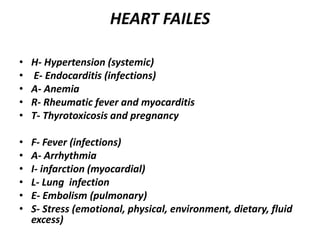
HEART FAILES
• H- Hypertension (systemic)
• E- Endocarditis (infections)
• A- Anemia
• R- Rheumatic fever and myocarditis
• T- Thyrotoxicosis and pregnancy
• F- Fever (infections)
• A- Arrhythmia
• I- infarction (myocardial)
• L- Lung infection
• E- Embolism (pulmonary)
• S- Stress (emotional, physical, environment, dietary, fluid
excess)
Pathophysiology
In left ventricular systolic dysfunction, regardless
of the etiology, cardiac output is low and
pulmonary pressures are high, leading to
pulmonary congestion. As a result, a series of
adaptive mechanisms are activated. Initially,
as a direct result of inadequate cardiac output
and systemic perfusion, the body activates
several neurohormonal pathways in order to
increase circulating blood volume.
• With continuous neurohormonal stimulation,
the left ventricle undergoes remodeling with
left ventricular dilatation and hypertrophy,
such that stroke volume is increased without
an actual increase in ejection fraction. This is
achieved by myocyte hypertrophy and
elongation. However, left ventricular chamber
dilatation causes increased wall tension,
worsens subendocardial myocardial perfusion,
and may provoke ischemia in patients with
coronary atherosclerosis.
• Furthermore, left ventricular chamber
dilatation may cause separation of the mitral
leaflets and mitral regurgitation with
worsening of pulmonary congestion.
Enhanced neurohormonal stimulation of the
myocardium also causes apoptosis, or
programmed cell death, leading to worsening
of ventricular contractility.
Villa Somalia
White house
Clinical Manifestations
1. Progressive dyspnea which initially occurs with
exertion and later occurs at rest.
• Dyspnea on exertion has been found to be the
most sensitive complaint, yet the specificity for
dyspnea is less than 60%.
2. Orthopnea and paroxysmal nocturnal dyspnea (PND)
are more specific symptoms;
however, sensitivity for orthopnea and PND is only 20-
30%.
3. Cough productive of pink, frothy sputum is highly
suggestive of CHF. Wheezing may also occur.
4. Peripheral edema and ascites
5. Nonspecific complaints include the following: easy
fatigability , light headedness , malaise anxiety
abdominal pain , nausea etc
• Past medical history may include the
following: rheumatic fever , alcohol use,
hypertension , angina , previous history of
myocardial infarction and familial history of
heart disease
Physical findings:
• Tachycardia and Tachypnea and signs of respiratory
distress including use of accessory muscles of
respiration
• Jugular venous distention (JVD) frequently is present
and engorged neck veins
• Pulsus alternans (alternating weak and strong pulse
indicative of depressed left ventricle[LV] function
• Wheezing or rales may be heard on lung auscultation
and there may be bilateral basal dullness.
• Apical impulse frequently is displaced laterally
• Cardiac auscultation may reveal aortic or mitral
valvular abnormalities, S3 or S4.
• Skin may be diaphoretic or cold, gray, and
cyanotic
• Lower extremity edema also may be noted,
especially in the subacute process.
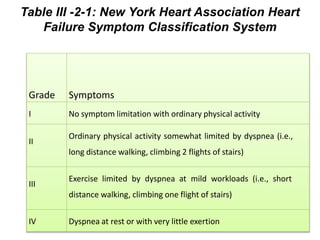
• New York Heart Association Heart Failure
Classification scheme is used to assess the
severity of a patient's functional limitations
and correlates fairly well with cardiovascular
prognosis.
Table III -2-1: New York Heart Association Heart
Failure Symptom Classification System
Grade Symptoms
I No symptom limitation with ordinary physical activity
II
Ordinary physical activity somewhat limited by dyspnea (i.e.,
long distance walking, climbing 2 flights of stairs)
III
Exercise limited by dyspnea at mild workloads (i.e., short
distance walking, climbing one flight of stairs)
IV Dyspnea at rest or with very little exertion
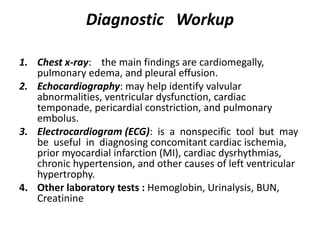
Diagnostic Workup
1. Chest x-ray: the main findings are cardiomegally,
pulmonary edema, and pleural effusion.
2. Echocardiography: may help identify valvular
abnormalities, ventricular dysfunction, cardiac
temponade, pericardial constriction, and pulmonary
embolus.
3. Electrocardiogram (ECG): is a nonspecific tool but may
be useful in diagnosing concomitant cardiac ischemia,
prior myocardial infarction (MI), cardiac dysrhythmias,
chronic hypertension, and other causes of left ventricular
hypertrophy.
4. Other laboratory tests : Hemoglobin, Urinalysis, BUN,
Creatinine
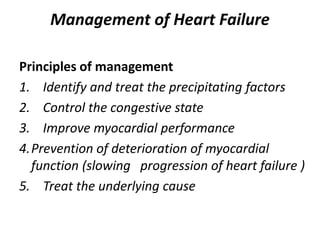
Management of Heart Failure
Principles of management
1. Identify and treat the precipitating factors
2. Control the congestive state
3. Improve myocardial performance
4.Prevention of deterioration of myocardial
function (slowing progression of heart failure )
5. Treat the underlying cause
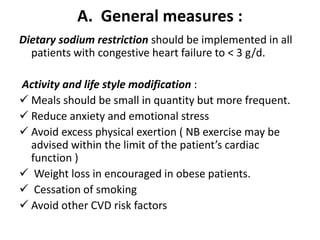
A. General measures :
Dietary sodium restriction should be implemented in all
patients with congestive heart failure to < 3 g/d.
Activity and life style modification :
 Meals should be small in quantity but more frequent.
 Reduce anxiety and emotional stress
 Avoid excess physical exertion ( NB exercise may be
advised within the limit of the patient’s cardiac
function )
 Weight loss in encouraged in obese patients.
 Cessation of smoking
 Avoid other CVD risk factors
B. Control of the Congestive state
Diuretics: are useful in relieving congestion and
reduce or prevent edema.
• Most patients with heart failure have some
degree of symptomatic congestion and benefit
from diuretic therapy.
• Usually a loop diuretic is required, with the
addition of a Thiazide diuretic in patients
refractory to the loop diuretic alone.
1. Furosomide: Initial dose 20-40 mg PO 1-2 X
daily or 20 mg IV Maximum dose 400 mg PO/day
or 80 mg IV /day
2. Hydrochlorothiazide: Initial dose 25 mg
PO/day Maximum dose 100 mg PO/day
• N.B . Loop and thiazide diuretics are useful for
symptomatic relief; however they have not been
shown to improve survival.
Side effects : Azotemia, hypokalemia,
metabolic alkalosis and elevation of
neurohormones
3. Spirinolactone: is an aldosterone inhibitor,
reduces mortality in patients with advanced
heart failure. This drug should be reserved for
patients with moderately severe or severe heart
failure ( class IV symptoms )
Initial dose: 25 mg PO/day or every other day
Maximum dose: 50 mg PO BID or higher
Side effects
Hyperkalemia is common so monitoring K+
the serum potassium level is essential. As a
result, this drug should not be used in
patients with a creatinine above 2.5 mg/dl.
Gynecomastia in men is the other side effect
of this drug.
C. Enhancement of Myocardial
contractility :
1) Digoxin: is a drug which has :
• Inotropic effect and acts by inhibiting the
Na+-K+ ATPase and increase intracellular
calcium. This increases myocardial contractility.
•Neurohormonal modulation of centrally mediated
parasympathomimetic and sympatholytic activity.
By doing so it blocks the AV node and delays
AV conduction.
Initial dose : 0.125 mg PO/day
Maximum dose : 0.25 mg PO/day
The use of digoxin can improve symptoms, reduce the
duration and the need for hospitalization in patients
with heart failure,, but has no effect on long term
survival.
♦ Digoxin is renally excreted and so dose adjustment is
necessary in renal failure.
♦ A low dose of the drug (0.125 mg daily) should be
prescribed, especially in women.
♦ Digoxin use is recommended for patients with left
ventricular systolic dysfunction, particularly if they
have atrial fibrillation.
♦ It is relatively contraindicated in some cardiac disease
 Cardiac outflow obstruction in MS (in the absence of
atrial fibrillation )
 Corpulmonale
Because of it narrow window of safety, digoxin is
associated with different Side effects
including:
GI : anorexia , nausea, vomiting , weight loss
Neuralgia, delirium
Yellow vision
Gynecomastia
Arrhythmias of different types
2) Vasodilators: may be useful in patients with
severe acute heart failure who demonstrate
systemic vasoconstriction despite ACE inhibitor
therapy. Through vasodilatation they reduce the
peripheral resistance and after load and improve
cardiac performance.
Hydralazine:
Initial dose: 25 mg PO TID
Maximum dose: 150 mg PO QID.
Isosorbide dinitrate: Initial dose 10 mg PO TID
Maximum dose: 80 mg PO TID
♦ Hydralazine and nitrates in combination are
effective afterload reducing agents used in ACE-
intolerant patients.
D. Prevention of deterioration of
Myocardial function :
The following drugs prevent deterioration in myocardial
function by inhibiting the neurohumeral mechanism which
causes cardiac remodelling and progression of heart failure.
1) Angiotensin Converting Enzyme (ACE) Inhibitors
Afterload reduction and neurohormonal modulation with ACE
inhibitors ( e.g. Captopril, Enalapril, etc) have been shown
to improve mortality, symptoms, and hospitalizations. The
dose of ACE inhibitors should be titrated to the maximum
that can be tolerated symptomatically or the target dose. .
Initial dose: Captopril 6.25 mg PO/day or every other day
Enalapril 2.5 mg PO BID
Maximum dose: Captopril 50-100 mg PO QID
Enalapril 10- 20 mg PO BID
2) Angiotensin-II Receptor
blocker- These drugs are
useful in patients who cannot
tolerate ACE inhibitors due to
different side effects like
cough angioedema and
lukopenia.
Lasortan: Dose: - 25-50 mg once
0r twice daily
3) Beta Adrenorecepter blockers
Administration of these drugs with
gradually increasing dose has
been reported to improve
symptoms of heart failure, the
need for hospitalization and
reduce mortality. They are
indicated to moderately severe
heart failure.
• They are not indicated in
unstable heart failure ,
hopotensive states , severe fluid
overload , sinus bradycardia , AV
block and asthma.
Metoprololol: Initial dose 6.25
mg PO BID Maximum dose: 75
mg PO BID
L2..ccf
L2..ccf
L2..ccf

L2..ccf

  • 1.
  • 2.
    2. Congestive HeartFailure Learning objectives: at the end of this lesson the student will be able to : 1. Define congestive heart failure. 2. List the etiologic agents of congestive heart failure. 3. Understand the Epidemiology of congestive heart failure. 4. Describe the pathophysiology of congestive heart failure. 5. Identify the clinical manifestation of congestive heart failure. 6. Understand the diagnostic approach of congestive heart failure. 7. Manage patients with congestive heart failure. 8. Design strategies for prevention of congestive heart failure.
  • 3.
    Definition: Heart failure isa clinical syndrome characterized by inadequate systemic perfusion to meet the body's metabolic demands as a result of abnormalities of cardiac structure or function. This may be further subdivided into either systolic or diastolic heart failure. • Systolic heart failure: there is reduced cardiac contractility • Diastolic heart failure there is impaired cardiac relaxation and abnormal ventricular filling.
  • 4.
    • The body,sensing inadequate organ perfusion, activates multiple systemic neurohormonal pathways which compensate initially by redistributing blood flow to vital organs but later exacerbate the patient's symptoms and lead to clinical deterioration.
  • 5.
    Etiology: The most commoncause of heart failure is left ventricular systolic dysfunction (about 60% to 70% of patients). The following are some of the underlying causes of heart failure . 1) Decreased contractile function A. Valvular heart disease B. Coronary Heart Disease : Myocardial ischemia C. Myocardial Disease : Cadiomyopathy , Myocarditis 2) Increased after load a. Acute systemic hypertension
  • 6.
    3) Abnormalities inpreload A. Excessive preload B. Reduced preload 4) Reduced compliance states: Constrictive pericarditis , Restrictive cardiomyopathy
  • 7.
    Precipitating factors forheart failure: • These are relatively acute disturbances that place an additional load on a myocardium that is chronically and excessively burdened. • In compensated state patients are asymptomatic; however as patients have little additional reserve, they become symptomatic in the presence of these precipitating factors.
  • 8.
    • Knowing theprecipitating factors is important because most of the time they are treatable and the cardiac function improves when these precipitating factors are treated or avoided. • The most important precipitating factors may be represented with the mnemonic, HEART FAILES
  • 9.
    HEART FAILES • H-Hypertension (systemic) • E- Endocarditis (infections) • A- Anemia • R- Rheumatic fever and myocarditis • T- Thyrotoxicosis and pregnancy • F- Fever (infections) • A- Arrhythmia • I- infarction (myocardial) • L- Lung infection • E- Embolism (pulmonary) • S- Stress (emotional, physical, environment, dietary, fluid excess)
  • 10.
    Pathophysiology In left ventricularsystolic dysfunction, regardless of the etiology, cardiac output is low and pulmonary pressures are high, leading to pulmonary congestion. As a result, a series of adaptive mechanisms are activated. Initially, as a direct result of inadequate cardiac output and systemic perfusion, the body activates several neurohormonal pathways in order to increase circulating blood volume.
  • 11.
    • With continuousneurohormonal stimulation, the left ventricle undergoes remodeling with left ventricular dilatation and hypertrophy, such that stroke volume is increased without an actual increase in ejection fraction. This is achieved by myocyte hypertrophy and elongation. However, left ventricular chamber dilatation causes increased wall tension, worsens subendocardial myocardial perfusion, and may provoke ischemia in patients with coronary atherosclerosis.
  • 12.
    • Furthermore, leftventricular chamber dilatation may cause separation of the mitral leaflets and mitral regurgitation with worsening of pulmonary congestion. Enhanced neurohormonal stimulation of the myocardium also causes apoptosis, or programmed cell death, leading to worsening of ventricular contractility.
  • 13.
  • 14.
    Clinical Manifestations 1. Progressivedyspnea which initially occurs with exertion and later occurs at rest. • Dyspnea on exertion has been found to be the most sensitive complaint, yet the specificity for dyspnea is less than 60%. 2. Orthopnea and paroxysmal nocturnal dyspnea (PND) are more specific symptoms; however, sensitivity for orthopnea and PND is only 20- 30%. 3. Cough productive of pink, frothy sputum is highly suggestive of CHF. Wheezing may also occur. 4. Peripheral edema and ascites 5. Nonspecific complaints include the following: easy fatigability , light headedness , malaise anxiety abdominal pain , nausea etc
  • 15.
    • Past medicalhistory may include the following: rheumatic fever , alcohol use, hypertension , angina , previous history of myocardial infarction and familial history of heart disease
  • 16.
    Physical findings: • Tachycardiaand Tachypnea and signs of respiratory distress including use of accessory muscles of respiration • Jugular venous distention (JVD) frequently is present and engorged neck veins • Pulsus alternans (alternating weak and strong pulse indicative of depressed left ventricle[LV] function • Wheezing or rales may be heard on lung auscultation and there may be bilateral basal dullness. • Apical impulse frequently is displaced laterally • Cardiac auscultation may reveal aortic or mitral valvular abnormalities, S3 or S4.
  • 17.
    • Skin maybe diaphoretic or cold, gray, and cyanotic • Lower extremity edema also may be noted, especially in the subacute process. • New York Heart Association Heart Failure Classification scheme is used to assess the severity of a patient's functional limitations and correlates fairly well with cardiovascular prognosis.
  • 18.
    Table III -2-1:New York Heart Association Heart Failure Symptom Classification System Grade Symptoms I No symptom limitation with ordinary physical activity II Ordinary physical activity somewhat limited by dyspnea (i.e., long distance walking, climbing 2 flights of stairs) III Exercise limited by dyspnea at mild workloads (i.e., short distance walking, climbing one flight of stairs) IV Dyspnea at rest or with very little exertion
  • 19.
    Diagnostic Workup 1. Chestx-ray: the main findings are cardiomegally, pulmonary edema, and pleural effusion. 2. Echocardiography: may help identify valvular abnormalities, ventricular dysfunction, cardiac temponade, pericardial constriction, and pulmonary embolus. 3. Electrocardiogram (ECG): is a nonspecific tool but may be useful in diagnosing concomitant cardiac ischemia, prior myocardial infarction (MI), cardiac dysrhythmias, chronic hypertension, and other causes of left ventricular hypertrophy. 4. Other laboratory tests : Hemoglobin, Urinalysis, BUN, Creatinine
  • 21.
    Management of HeartFailure Principles of management 1. Identify and treat the precipitating factors 2. Control the congestive state 3. Improve myocardial performance 4.Prevention of deterioration of myocardial function (slowing progression of heart failure ) 5. Treat the underlying cause
  • 22.
    A. General measures: Dietary sodium restriction should be implemented in all patients with congestive heart failure to < 3 g/d. Activity and life style modification :  Meals should be small in quantity but more frequent.  Reduce anxiety and emotional stress  Avoid excess physical exertion ( NB exercise may be advised within the limit of the patient’s cardiac function )  Weight loss in encouraged in obese patients.  Cessation of smoking  Avoid other CVD risk factors
  • 23.
    B. Control ofthe Congestive state Diuretics: are useful in relieving congestion and reduce or prevent edema. • Most patients with heart failure have some degree of symptomatic congestion and benefit from diuretic therapy. • Usually a loop diuretic is required, with the addition of a Thiazide diuretic in patients refractory to the loop diuretic alone. 1. Furosomide: Initial dose 20-40 mg PO 1-2 X daily or 20 mg IV Maximum dose 400 mg PO/day or 80 mg IV /day 2. Hydrochlorothiazide: Initial dose 25 mg PO/day Maximum dose 100 mg PO/day
  • 24.
    • N.B .Loop and thiazide diuretics are useful for symptomatic relief; however they have not been shown to improve survival. Side effects : Azotemia, hypokalemia, metabolic alkalosis and elevation of neurohormones 3. Spirinolactone: is an aldosterone inhibitor, reduces mortality in patients with advanced heart failure. This drug should be reserved for patients with moderately severe or severe heart failure ( class IV symptoms ) Initial dose: 25 mg PO/day or every other day Maximum dose: 50 mg PO BID or higher
  • 25.
    Side effects Hyperkalemia iscommon so monitoring K+ the serum potassium level is essential. As a result, this drug should not be used in patients with a creatinine above 2.5 mg/dl. Gynecomastia in men is the other side effect of this drug.
  • 26.
    C. Enhancement ofMyocardial contractility : 1) Digoxin: is a drug which has : • Inotropic effect and acts by inhibiting the Na+-K+ ATPase and increase intracellular calcium. This increases myocardial contractility. •Neurohormonal modulation of centrally mediated parasympathomimetic and sympatholytic activity. By doing so it blocks the AV node and delays AV conduction. Initial dose : 0.125 mg PO/day Maximum dose : 0.25 mg PO/day
  • 27.
    The use ofdigoxin can improve symptoms, reduce the duration and the need for hospitalization in patients with heart failure,, but has no effect on long term survival. ♦ Digoxin is renally excreted and so dose adjustment is necessary in renal failure. ♦ A low dose of the drug (0.125 mg daily) should be prescribed, especially in women. ♦ Digoxin use is recommended for patients with left ventricular systolic dysfunction, particularly if they have atrial fibrillation. ♦ It is relatively contraindicated in some cardiac disease  Cardiac outflow obstruction in MS (in the absence of atrial fibrillation )  Corpulmonale
  • 28.
    Because of itnarrow window of safety, digoxin is associated with different Side effects including: GI : anorexia , nausea, vomiting , weight loss Neuralgia, delirium Yellow vision Gynecomastia Arrhythmias of different types
  • 29.
    2) Vasodilators: maybe useful in patients with severe acute heart failure who demonstrate systemic vasoconstriction despite ACE inhibitor therapy. Through vasodilatation they reduce the peripheral resistance and after load and improve cardiac performance. Hydralazine: Initial dose: 25 mg PO TID Maximum dose: 150 mg PO QID. Isosorbide dinitrate: Initial dose 10 mg PO TID Maximum dose: 80 mg PO TID ♦ Hydralazine and nitrates in combination are effective afterload reducing agents used in ACE- intolerant patients.
  • 30.
    D. Prevention ofdeterioration of Myocardial function : The following drugs prevent deterioration in myocardial function by inhibiting the neurohumeral mechanism which causes cardiac remodelling and progression of heart failure. 1) Angiotensin Converting Enzyme (ACE) Inhibitors Afterload reduction and neurohormonal modulation with ACE inhibitors ( e.g. Captopril, Enalapril, etc) have been shown to improve mortality, symptoms, and hospitalizations. The dose of ACE inhibitors should be titrated to the maximum that can be tolerated symptomatically or the target dose. . Initial dose: Captopril 6.25 mg PO/day or every other day Enalapril 2.5 mg PO BID Maximum dose: Captopril 50-100 mg PO QID Enalapril 10- 20 mg PO BID
  • 31.
    2) Angiotensin-II Receptor blocker-These drugs are useful in patients who cannot tolerate ACE inhibitors due to different side effects like cough angioedema and lukopenia. Lasortan: Dose: - 25-50 mg once 0r twice daily 3) Beta Adrenorecepter blockers Administration of these drugs with gradually increasing dose has been reported to improve symptoms of heart failure, the need for hospitalization and reduce mortality. They are indicated to moderately severe heart failure. • They are not indicated in unstable heart failure , hopotensive states , severe fluid overload , sinus bradycardia , AV block and asthma. Metoprololol: Initial dose 6.25 mg PO BID Maximum dose: 75 mg PO BID