LECTURE L21
GAMES
Image: mbl.is
Future of games?
Virtual reality game
Valkyrie by CCP
shown at 2015 Fanfest
Games are the
one of the
most powerful

force in the
world
Computer Game History
Early Games
Cathode ray tube amusement device, 1947
Analog game, purely electromechanical
Controlled by control knobs which influences the 

trajectory of the CRT's light beam
Player controls a reticle and aligns it to an airplane to shoot down
Noughts And Crosses, 1952
A Tic-Tac-Toe game 

Ran on EDSAC
Used the tank display CRT as 

35 x 16 pixel screen for 

displaying his game
Game did not get well known
Early Games
Early Games
Early 1960s - Two cultures contributed to the idea that
computers should be things we interact with and play with:
Walter Isaacson: The Innovators
Hackers - “the hands on imperative”
Rebel entrepreneurs - eager to break into the amusement
industry
Spacewar! 1961
Early Games
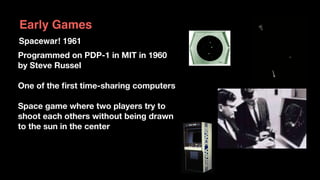
Programmed on PDP-1 in MIT in 1960
by Steve Russel
One of the first time-sharing computers
Space game where two players try to 

shoot each others without being drawn 

to the sun in the center
Spacewar! 1961
Early Games
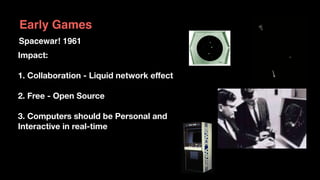
Impact:
1. Collaboration - Liquid network effect
2. Free - Open Source
3. Computers should be Personal and
Interactive in real-time
Spacewar! 1961
Early Games
Arcades
Special purpose machines
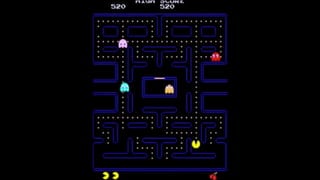
Most popular game was PONG
Arcades became popular amongst

young in 1971-1974
2-D boards and movement

of objects
Special controls and buttons
Pong 1974
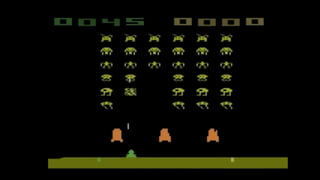
Atari VCS 2600 1977
Game Consoles
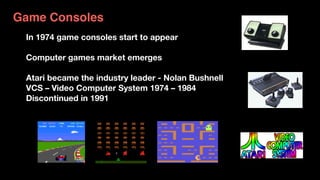
In 1974 game consoles start to appear
Computer games market emerges
Atari became the industry leader - Nolan Bushnell

VCS – Video Computer System 1974 – 1984
Discontinued in 1991
The Video Game Crash
In 1983 the computer game market crashed
Throughout the 1984 and 1985, the home video game industry
was nearly dead
Too much supply of similar games
Low quality
The public lost interest
Atari did not want to credit developers
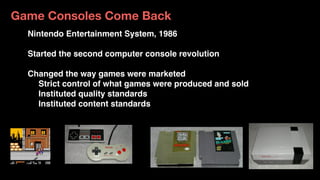
Game Consoles Come Back
Nintendo Entertainment System, 1986
Started the second computer console revolution
Changed the way games were marketed
Strict control of what games were produced and sold
Instituted quality standards
Instituted content standards
Enter the Personal Computer
In the 80s Personal computers become more wide spread
Games slowly appear in the PCs
Interactive fiction
In the 80s Interactive fiction games became popular
Role-playing game in which the player moves around in imaginative
adventure world and solves mysteries
Early games where text games with simple commands
Slowly graphics was added
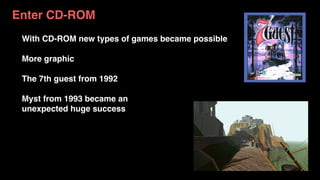
Enter CD-ROM
With CD-ROM new types of games became possible
More graphic
The 7th guest from 1992
Myst from 1993 became an 

unexpected huge success
Multiplayer and 3-D Games
Early games were multiplayer games
Pong and Spacewar! were multiplayer
Most games after that were single player games where
player plays against the computer or players take turn
In the late 80s and early 90s networks start to appear
Ethernet LANs, then the Internet
DOOM introduced 3-D graphics and multiplayer capabilities in 1993
3D game where the player moves around in a 3-D world
Breakthrough graphics
Multiplayer capability on a LAN
Multiplayer and 3-D Games
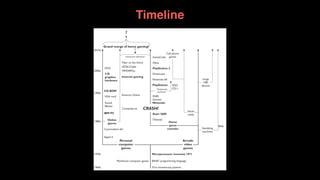
Timeline
Impact of Computer Games
“Games offer immediate feedback, you can see your progress,
you can try something and be frustrated but later learn more…
that’s why game play is so engaging to us.”
—Barbara Chamberlin, project director at
the New Mexico State University Learning Games Lab
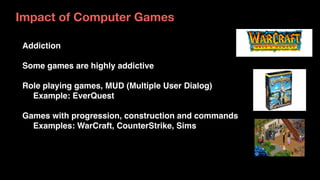
Addiction
Some games are highly addictive
Role playing games, MUD (Multiple User Dialog)
Example: EverQuest
Games with progression, construction and commands
Examples: WarCraft, CounterStrike, Sims
Impact of Computer Games
Really simple game, but highly addictive
Released on May 24, 2013,
discontinued Feb 8, 2014
Violence
Some games are violent, made for mature

adult audience
Most games are not violent
Impact of Computer Games
The Gaming Market
“In twenty years, games will have taken over the world and everything will
be virtual reality.”
-- Ray Kurzwiel
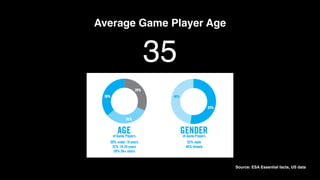
Average Game Player Age
35
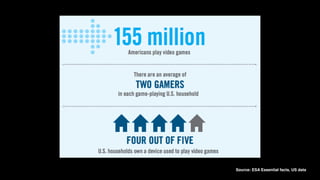
Source: ESA Essential facts, US data
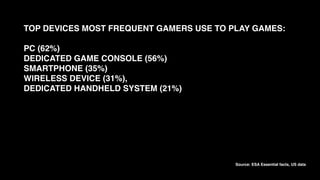
TOP DEVICES MOST FREQUENT GAMERS USE TO PLAY GAMES:
PC (62%)
DEDICATED GAME CONSOLE (56%)
SMARTPHONE (35%)
WIRELESS DEVICE (31%),
DEDICATED HANDHELD SYSTEM (21%)
Source: ESA Essential facts, US data
1990
$10 bn
2000 2010
$20 bn
$50 bn
Games
2014
Game Consoles
Nintendo
Products: GameCube, GameBoy
Wii, Wii U, DS
Appeal to families
Apply strict standards
Wii got a very good start with
Wii Remote
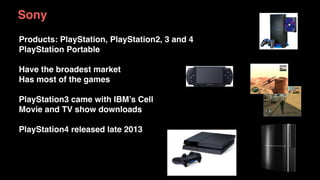
Sony
Products: PlayStation, PlayStation2, 3 and 4
PlayStation Portable
Have the broadest market
Has most of the games
PlayStation3 came with IBM’s Cell
Movie and TV show downloads
PlayStation4 released late 2013
XBox
Products: XBox, XBox 360, XBox One
Appeal to hard-core games
Most powerful console
Xbox Live – online game service

Kinect
Microsoft is promoting

xbox as entertainment 

device
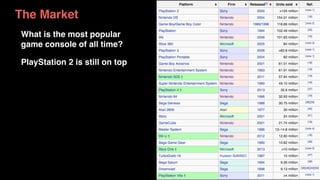
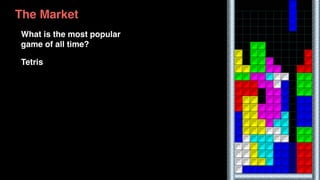
The Market
PlayStation 2 is still on top
What is the most popular
game console of all time?
Games for Everyone

The Market
Tetris
What is the most popular
game of all time?
Games are the
one of the
most powerful

force in the
world
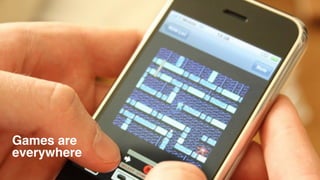
Games are universal
Games are
everywhere
Games are
played by anyone
Games are part of
growing up
Millennials wants
entertainment and play
in their work, education
and social life
Starts early
On-line
digital world
is also
changing
older
generations
Why should we stop 

playing when we

grow up?
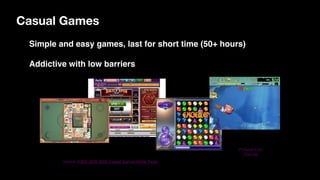
Casual Games
Simple and easy games, last for short time (50+ hours)
Addictive with low barriers
Pictures from 

PopCap
Source: IGDA 2008-2009 Casual Games White Paper
9 billion hours / year
Casual Games
9billion hours / year
Social Games
Multiplayer games that are played with others
Synchronous or Asynchronous
Source: The online computer and video game industry (OECD Report)
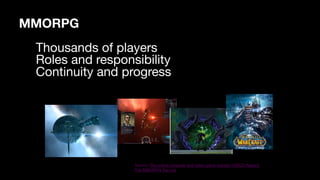
The MMORPG Top List
Thousands of players

Roles and responsibility

Continuity and progress

MMORPG
Monetizing games
Monetizing games
Monetization strategy depends heavily on the type of game
To make successful games, you have to be a really
good game designer
Art style, tone, uniqueness, game design and balancing have to
work
Monetizing games
Ad supported - free, low barrier, large audience
Free 2 Play - optional in-play purchase, time, skills, virtual stuff
Download - Pay for downloads for PC, console and mobile games
Subscription - Pay for access, monthly
Money gaming - Play for money and take rake or percentage
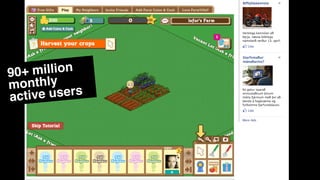
90+ million
monthly
active users
Give player access to play significant portion of the game
without paying
Then charge for extras, VIP access, more choices, virtual
stuff, advancement
Based on the Freemium concept
Free to Play - F2P
VIRTUAL STUFF
Tom Chatfield
7 ways video games engage the brain
(2010)
TED Talk
The 90-9-1 Rule
In social communities, 90% of the
users don’t contribute
In gaming 90% play for free but
are needed so the community
works
90% Play for free
9% Pay for added value
1% Pay for anything
Why give free access to my many hours of labor?
As distribution cost get nearer to zero we have the option of
allowing signifiant part of the player play for free
Giving it for free helps get to scale and with scale there are more
ways to monetize - First payment is the hardest
Sell VIP access, virtual stuff, skills, avatars, advancements
Possiblity to collect usage behavior information
Free to Play - F2P
worth 8billion USD
Image: business insider
Mobile Games
Early Mobile Games
Games appear very early in phones
SMS games, J2ME
Simple single player with real limitations - data,
memory, processing
MOBILE GAMES
With iOS and Android, mobile

game industry has exploded
Fastest growing segment
Once upon a time in the App Store
Next:
Gamification and why it is important for you to play
video games

L21 Games

  • 1.
  • 3.
    Image: mbl.is Future ofgames? Virtual reality game Valkyrie by CCP shown at 2015 Fanfest
  • 4.
    Games are the oneof the most powerful
 force in the world
  • 5.
  • 6.
    Early Games Cathode raytube amusement device, 1947 Analog game, purely electromechanical Controlled by control knobs which influences the 
 trajectory of the CRT's light beam Player controls a reticle and aligns it to an airplane to shoot down
  • 7.
    Noughts And Crosses,1952 A Tic-Tac-Toe game 
 Ran on EDSAC Used the tank display CRT as 
 35 x 16 pixel screen for 
 displaying his game Game did not get well known Early Games
  • 8.
    Early Games Early 1960s- Two cultures contributed to the idea that computers should be things we interact with and play with: Walter Isaacson: The Innovators Hackers - “the hands on imperative” Rebel entrepreneurs - eager to break into the amusement industry
  • 9.
  • 10.
    Programmed on PDP-1in MIT in 1960 by Steve Russel One of the first time-sharing computers Space game where two players try to 
 shoot each others without being drawn 
 to the sun in the center Spacewar! 1961 Early Games
  • 11.
    Impact: 1. Collaboration -Liquid network effect 2. Free - Open Source 3. Computers should be Personal and Interactive in real-time Spacewar! 1961 Early Games
  • 12.
    Arcades Special purpose machines Mostpopular game was PONG Arcades became popular amongst
 young in 1971-1974 2-D boards and movement
 of objects Special controls and buttons
  • 14.
    Pong 1974 Atari VCS2600 1977 Game Consoles In 1974 game consoles start to appear Computer games market emerges Atari became the industry leader - Nolan Bushnell
 VCS – Video Computer System 1974 – 1984 Discontinued in 1991
  • 16.
    The Video GameCrash In 1983 the computer game market crashed Throughout the 1984 and 1985, the home video game industry was nearly dead Too much supply of similar games Low quality The public lost interest Atari did not want to credit developers
  • 17.
    Game Consoles ComeBack Nintendo Entertainment System, 1986 Started the second computer console revolution Changed the way games were marketed Strict control of what games were produced and sold Instituted quality standards Instituted content standards
  • 18.
    Enter the PersonalComputer In the 80s Personal computers become more wide spread Games slowly appear in the PCs
  • 20.
    Interactive fiction In the80s Interactive fiction games became popular Role-playing game in which the player moves around in imaginative adventure world and solves mysteries Early games where text games with simple commands Slowly graphics was added
  • 21.
    Enter CD-ROM With CD-ROMnew types of games became possible More graphic The 7th guest from 1992 Myst from 1993 became an 
 unexpected huge success
  • 23.
    Multiplayer and 3-DGames Early games were multiplayer games Pong and Spacewar! were multiplayer Most games after that were single player games where player plays against the computer or players take turn In the late 80s and early 90s networks start to appear Ethernet LANs, then the Internet
  • 25.
    DOOM introduced 3-Dgraphics and multiplayer capabilities in 1993 3D game where the player moves around in a 3-D world Breakthrough graphics Multiplayer capability on a LAN Multiplayer and 3-D Games
  • 26.
  • 28.
  • 29.
    “Games offer immediatefeedback, you can see your progress, you can try something and be frustrated but later learn more… that’s why game play is so engaging to us.” —Barbara Chamberlin, project director at the New Mexico State University Learning Games Lab
  • 33.
    Addiction Some games arehighly addictive Role playing games, MUD (Multiple User Dialog) Example: EverQuest Games with progression, construction and commands Examples: WarCraft, CounterStrike, Sims Impact of Computer Games
  • 35.
    Really simple game,but highly addictive Released on May 24, 2013, discontinued Feb 8, 2014
  • 36.
    Violence Some games areviolent, made for mature
 adult audience Most games are not violent Impact of Computer Games
  • 38.
    The Gaming Market “Intwenty years, games will have taken over the world and everything will be virtual reality.” -- Ray Kurzwiel
  • 39.
    Average Game PlayerAge 35 Source: ESA Essential facts, US data
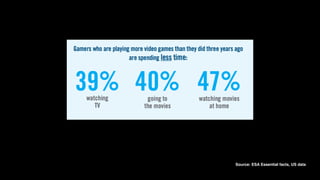
  • 40.
    Source: ESA Essentialfacts, US data
  • 41.
    Source: ESA Essentialfacts, US data TOP DEVICES MOST FREQUENT GAMERS USE TO PLAY GAMES: PC (62%) DEDICATED GAME CONSOLE (56%) SMARTPHONE (35%) WIRELESS DEVICE (31%), DEDICATED HANDHELD SYSTEM (21%)
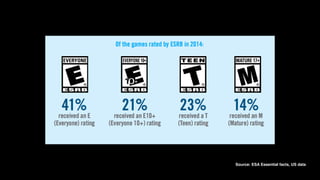
  • 42.
    Source: ESA Essentialfacts, US data
  • 43.
    Source: ESA Essentialfacts, US data
  • 44.
    Source: ESA Essentialfacts, US data
  • 45.
    Source: ESA Essentialfacts, US data
  • 46.
  • 47.
  • 48.
  • 50.
    Nintendo Products: GameCube, GameBoy Wii,Wii U, DS Appeal to families Apply strict standards Wii got a very good start with Wii Remote
  • 52.
    Sony Products: PlayStation, PlayStation2,3 and 4 PlayStation Portable Have the broadest market Has most of the games PlayStation3 came with IBM’s Cell Movie and TV show downloads PlayStation4 released late 2013
  • 54.
    XBox Products: XBox, XBox360, XBox One Appeal to hard-core games Most powerful console Xbox Live – online game service Kinect Microsoft is promoting
 xbox as entertainment 
 device
  • 55.
    The Market PlayStation 2is still on top What is the most popular game console of all time?
  • 56.
  • 57.
    The Market Tetris What isthe most popular game of all time?
  • 58.
    Games are the oneof the most powerful
 force in the world
  • 59.
  • 60.
  • 61.
  • 62.
    Games are partof growing up
  • 63.
    Millennials wants entertainment andplay in their work, education and social life
  • 64.
  • 65.
  • 66.
    Why should westop 
 playing when we
 grow up?
  • 67.
    Casual Games Simple andeasy games, last for short time (50+ hours) Addictive with low barriers Pictures from 
 PopCap Source: IGDA 2008-2009 Casual Games White Paper
  • 68.
  • 69.
  • 70.
  • 71.
    Social Games Multiplayer gamesthat are played with others Synchronous or Asynchronous
  • 73.
    Source: The onlinecomputer and video game industry (OECD Report) The MMORPG Top List Thousands of players Roles and responsibility Continuity and progress MMORPG
  • 74.
  • 75.
    Monetizing games Monetization strategydepends heavily on the type of game To make successful games, you have to be a really good game designer Art style, tone, uniqueness, game design and balancing have to work
  • 76.
    Monetizing games Ad supported- free, low barrier, large audience Free 2 Play - optional in-play purchase, time, skills, virtual stuff Download - Pay for downloads for PC, console and mobile games Subscription - Pay for access, monthly Money gaming - Play for money and take rake or percentage
  • 77.
  • 79.
    Give player accessto play significant portion of the game without paying Then charge for extras, VIP access, more choices, virtual stuff, advancement Based on the Freemium concept Free to Play - F2P
  • 80.
    VIRTUAL STUFF Tom Chatfield 7ways video games engage the brain (2010) TED Talk
  • 82.
    The 90-9-1 Rule Insocial communities, 90% of the users don’t contribute In gaming 90% play for free but are needed so the community works 90% Play for free 9% Pay for added value 1% Pay for anything
  • 83.
    Why give freeaccess to my many hours of labor? As distribution cost get nearer to zero we have the option of allowing signifiant part of the player play for free Giving it for free helps get to scale and with scale there are more ways to monetize - First payment is the hardest Sell VIP access, virtual stuff, skills, avatars, advancements Possiblity to collect usage behavior information Free to Play - F2P
  • 85.
  • 86.
  • 87.
    Early Mobile Games Gamesappear very early in phones SMS games, J2ME Simple single player with real limitations - data, memory, processing
  • 88.
    MOBILE GAMES With iOSand Android, mobile
 game industry has exploded Fastest growing segment Once upon a time in the App Store
  • 96.
    Next: Gamification and whyit is important for you to play video games