Introduction to Shell Structures
Assoc. Prof. Adrian Dogariu
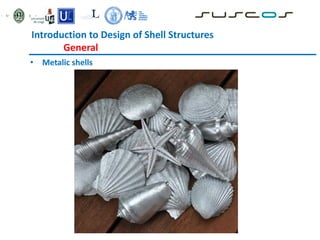
• Metalic shells
Introduction to Design of Shell Structures
General
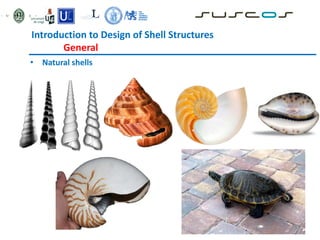
• Natural shells
Introduction to Design of Shell Structures
General
• Natural shells
Introduction to Design of Shell Structures
General
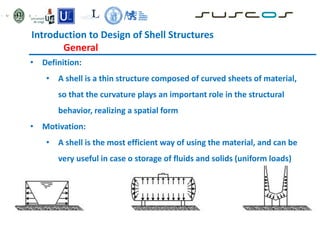
• Definition:
• A shell is a thin structure composed of curved sheets of material,
so that the curvature plays an important role in the structural
behavior, realizing a spatial form
• Motivation:
• A shell is the most efficient way of using the material, and can be
very useful in case o storage of fluids and solids (uniform loads)
Introduction to Design of Shell Structures
General
• The curved form may lead to different failure modes and often
unexpected behavior occurs
• The analytical formulas are very complex and complicated in
comparison with all the other structural forms
• Shell structures are very attractive light weight structures which are
especially suited to building as well as industrial applications.
Introduction to Design of Shell Structures
Difficulties
• The shell structure is typically found
• in nature
• as well as in classical architecture.
• There are two principal uses of shells in civil engineering:
• industrial structures:
– silos, tanks, cooling towers, reactor vessels etc.
• aesthetic and architectural special structures
Introduction to Design of Shell Structures
Range of application
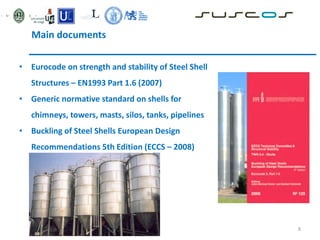
• Eurocode on strength and stability of Steel Shell
Structures – EN1993 Part 1.6 (2007)
• Generic normative standard on shells for
chimneys, towers, masts, silos, tanks, pipelines
• Buckling of Steel Shells European Design
Recommendations 5th Edition (ECCS – 2008)
Main documents
8
• Built structural shells
Introduction to Design of Shell Structures
General
• Built structural shells
Introduction to Design of Shell Structures
General
Reinforced concrete
Steel
Aluminium alloys
Plastics
Glass
Timber
Introduction to Design of Shell Structures
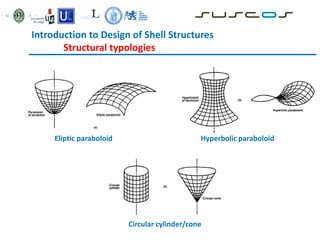
Structural typologies
Eliptic paraboloid Hyperbolic paraboloid
Circular cylinder/cone
Introduction to Design of Shell Structures
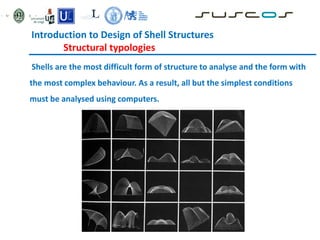
Structural typologies
Shells are the most difficult form of structure to analyse and the form with
the most complex behaviour. As a result, all but the simplest conditions
must be analysed using computers.
Introduction to Design of Shell Structures
Examples – Steel reticulated dome
US pavilion Expo 67 Montreal
Architect: Buckminster Fuller & Shoji Sadao
The 250ft diameter by 200ft high dome roughly
presents a three-quarter sphere, while geodesic
domes before 1967 were hemispherical. The dome
consists of steel pipes and 1,900 acrylic panels. To
keep the indoor temperature acceptable, the design
included mobile triangular panels that would move
over the inner surface following the sun. Although
brilliant on paper, this feature was too advanced for
its time and never worked.
Introduction to Design of Shell Structures
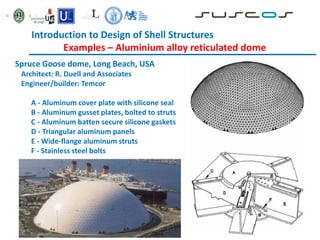
Examples – Aluminium alloy reticulated dome
Spruce Goose dome, Long Beach, USA
Architect: R. Duell and Associates
Engineer/builder: Temcor
A - Aluminum cover plate with silicone seal
B - Aluminum gusset plates, bolted to struts
C - Aluminum batten secure silicone gaskets
D - Triangular aluminum panels
E - Wide-flange aluminum struts
F - Stainless steel bolts
Introduction to Design of Shell Structures
Examples – Timber-steel free form grid shell
Multi-hall, Mainz, Germany
Architect: Mutschler, Frei Otto, consultant
Engineer: Ove Arup
The multi-purpose dome for the 1975 garden
show spans max. 60m with 50x50mm twin
wood slats of 50cm squares that deformed into
rhomboids.
1 - Form-finding model
2 - Interior
3 - Mesh detail (steel bands resist shear)
Introduction to Design of Shell Structures
Examples – Timber-steel free form grid shell
Architect: Thomas Herzog
Engineer: Julius Natterer
Wood grid shell with PTFE membrane
The theme pavilion advanced the philosophy:
• Wood is the only renewable material
• Requires the least energy for production
• Use of wood maintains healthy forests
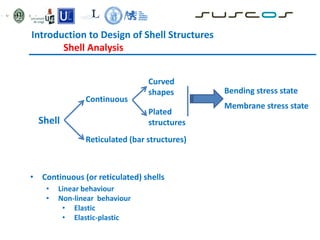
• Continuous (or reticulated) shells
• Linear behaviour
• Non-linear behaviour
• Elastic
• Elastic-plastic
Introduction to Design of Shell Structures
Shell Analysis
Shell
Continuous
Reticulated (bar structures)
Curved
shapes
Plated
structures
Bending stress state
Membrane stress state
• Resistance
• Stability
• Highly sensitive to imperfections
• Buckling is a process by which a structure cannot withstand loads with its original
shape, so that it changes this shape in order to find a new equilibrium
configuration. This is an undesired process (from the point of view of the
engineer), and occurs for a well–defined value of the load.
• The consequences of buckling are basically geometric:
• The are large displacements in the structure
• There may also be consequences for the material, in the sense that
deflections may induce plasticity in the walls of the structure
Introduction to Design of Shell Structures
Shell Design
Local buckling
of a tank
Global buckling
of a wind
turbine tower
Introduction to Design of Shell Structures
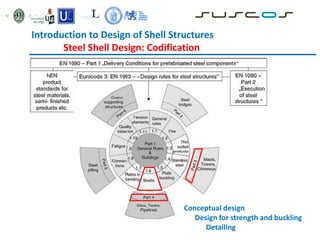
Steel Shell Design: Codification
Conceptual design
Design for strength and buckling
Detailing
Introduction to Design of Shell Structures
Behavioural phenomenology of shells
• Behavior of a given structure (slender!) can be controlled by design if
the three characteristic ranges of load-deformation curve are correctly
defined
• Pre-critical range
• Critical point (or range)
• Post-critical range
P
D
Pcr
Critical point
Post-critical
range
Pre-critical range
P(0, Pcr]  Structural stability
P > Pcr  Structural instability
elastic
Buckling: plastic
dynamic
Introduction to Design of Shell Structures
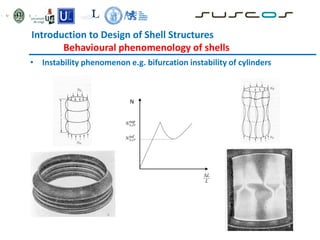
Behavioural phenomenology of shells
• Instability phenomenon e.g. bifurcation instability of cylinders
L
L

N
inf
,
x cr
N
sup
,
x cr
N
Introduction to Design of Shell Structures
Behavioural phenomenology of shells
EREN Exhibition hall,
Bucharest, 1963
• Instability phenomenon – Jump of Equilibrium or Snap Through Instability
• Affects shallow arches and shells, reticulated shells
Introduction to Design of Shell Structures
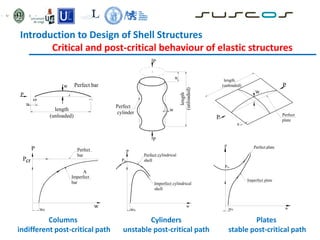
Critical and post-critical behaviour of elastic structures
u
Perfect bar
length
(unloaded)
P
w
Pcr
P
w
A
Perfect
bar
Imperfect
bar
w0
P
u
w
P
Perfect
cylinder
length
(unloaded)
Pcr
P
Perfect cylindrical
shell
w0
w
Imperfect cylindrical
shell
Imperfect plate
Perfect plate
w0
P
Pcr
w
P
P
length
(unloaded)
u
Perfect
plate
w
Columns
indifferent post-critical path
Cylinders
unstable post-critical path
Plates
stable post-critical path
Introduction to Design of Shell Structures
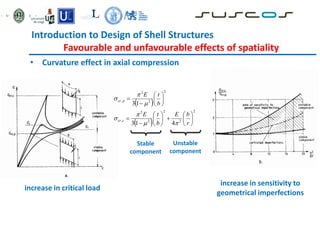
Favourable and unfavourable effects of spatiality
 
 
2
2
2
2
2
,
2
2
2
,
4
1
3
1
3























r
b
E
b
t
E
b
t
E
c
cr
p
cr







Stable
component
Unstable
component
increase in critical load
increase in sensitivity to
geometrical imperfections
• Curvature effect in axial compression
Introduction to Design of Shell Structures
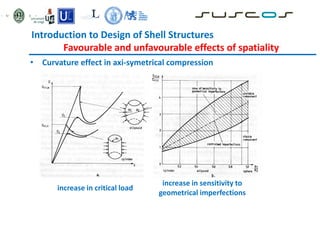
Favourable and unfavourable effects of spatiality
increase in critical load
increase in sensitivity to
geometrical imperfections
• Curvature effect in axi-symetrical compression
Introduction to Design of Shell Structures
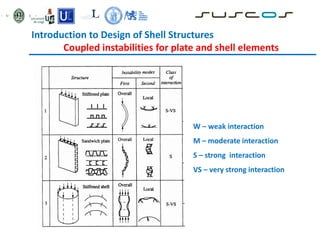
Coupled instabilities for plate and shell elements
W – weak interaction
M – moderate interaction
S – strong interaction
VS – very strong interaction
Introduction to Design of Shell Structures
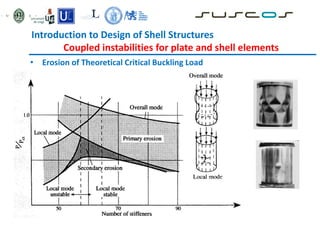
Coupled instabilities for plate and shell elements
• Erosion of Theoretical Critical Buckling Load
Introduction to Design of Shell Structures
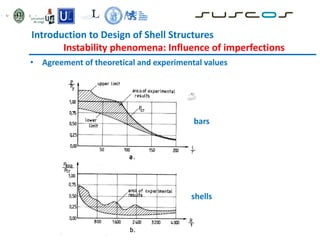
Instability phenomena: Influence of imperfections
• Agreement of theoretical and experimental values
bars
shells
Introduction to Design of Shell Structures
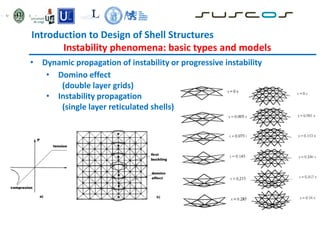
Instability phenomena: basic types and models
• Dynamic propagation of instability or progressive instability
• Domino effect
(double layer grids)
• Instability propagation
(single layer reticulated shells)
Introduction to Design of Shell Structures
Models and Methods of Analysis
• Pre-Critical, Critical and Post-Critical Analysis
• Generic classification of structures in terms of characteristic instability
types and sensitivity to imperfections
• Linear, nonlinear, elastic, plastic models
• Linear buckling analysis (eigen-buckling) – LBA
• Geometrical nonlinear imperfection analysis – GNIA
• Geometrical material nonlinear imperfection analysis – GMNIA
• Pre-critical solver methods (Newton – Raphson) or
• Post-critical solver methods (Arc-length); Designed load checking or
load-deformation curve
Introduction to Design of Shell Structures
Models and Methods of Analysis
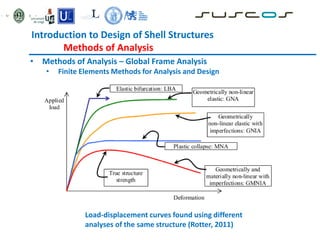
• Design flowchart for the Design of Shells according to EN 1993-1-6
Introduction to Design of Shell Structures
Methods of Analysis
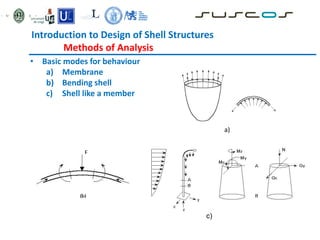
• Methods of Analysis – Global Frame Analysis
• Finite Elements Methods for Analysis and Design
Load-displacement curves found using different
analyses of the same structure (Rotter, 2011)
Introduction to Design of Shell Structures
Methods of Analysis
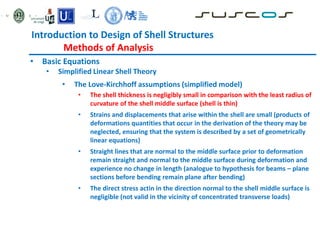
• Basic modes for behaviour
a) Membrane
b) Bending shell
c) Shell like a member
a)
c)
Introduction to Design of Shell Structures
Methods of Analysis
• Basic Equations
• Simplified Linear Shell Theory
• The Love-Kirchhoff assumptions (simplified model)
• The shell thickness is negligibly small in comparison with the least radius of
curvature of the shell middle surface (shell is thin)
• Strains and displacements that arise within the shell are small (products of
deformations quantities that occur in the derivation of the theory may be
neglected, ensuring that the system is described by a set of geometrically
linear equations)
• Straight lines that are normal to the middle surface prior to deformation
remain straight and normal to the middle surface during deformation and
experience no change in length (analogue to hypothesis for beams – plane
sections before bending remain plane after bending)
• The direct stress actin in the direction normal to the shell middle surface is
negligible (not valid in the vicinity of concentrated transverse loads)
Introduction to Design of Shell Structures
Methods of Analysis
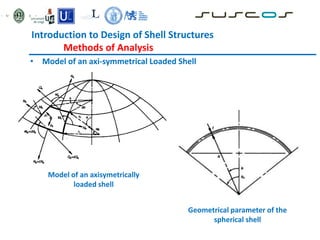
• Model of an axi-symmetrical Loaded Shell
Geometrical parameter of the
spherical shell
Model of an axisymetrically
loaded shell
Introduction to Design of Shell Structures
Methods of Analysis
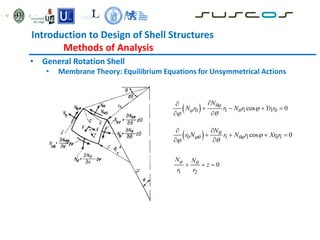
• General Rotation Shell
• Membrane Theory: Equilibrium Equations for Unsymmetrical Actions
 
0 1 1 1 0
cos 0
N
N r r N r Yr r

  
 


   
 
 
0 1 1 0 1
cos 0
N
r N r N r Xr r

  
 


   
 
1 2
0
N N
z
r r
 
  
Introduction to Design of Shell Structures
Methods of Analysis
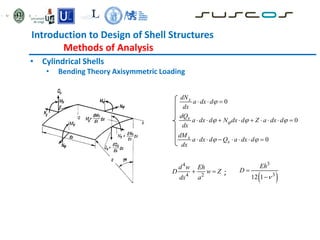
• Cylindrical Shells
• Bending Theory Axisymmetric Loading
0
x
dN
a dx d
dx

  
0
x
dQ
a dx d N dx d Z a dx d
dx

  
        
0
x
x
dM
a dx d Q a dx d
dx
 
      
4
4 2
d w Eh
D w Z
dx a
 
 
3
3
12 1
Eh
D



;
Introduction to Design of Shell Structures
Methods of Analysis
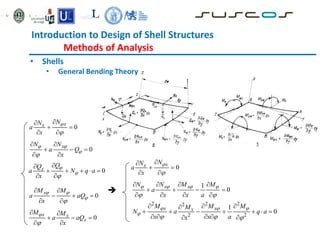
• Shells
• General Bending Theory
0
x
x
N
N
a
x




 
 
0
x
N N
a Q
x
 


 
  
 
0
x
Q
Q
a N q a
x





    
 
0
x x
x
M M
a aQ
x


 
  
 

0
x
M M
a aQ
x
 


 
  
 
0
x
x
N
N
a
x




 
 
1
0
x x
N N M M
a
x x a
   
 
   
   
   
2 2 2
2
2 2
1
0
x x
x
M M M
M
N a q a
x x a
x
  

  
  

      
   
 
Introduction to Design of Shell Structures
Methods of Analysis
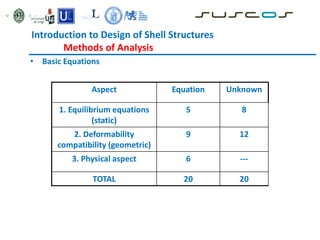
• Basic Equations
Aspect Equation Unknown
1. Equilibrium equations
(static)
5 8
2. Deformability
compatibility (geometric)
9 12
3. Physical aspect 6 ---
TOTAL 20 20
Introduction to Design of Shell Structures
Methods of Analysis
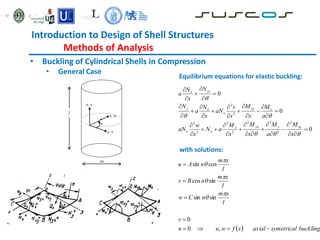
• Buckling of Cylindrical Shells in Compression
• General Case
l
x, u
y, v
z, w

2a
  buckling
symetrical
axial
x
f
w
u
n
v
l
x
m
n
C
w
l
x
m
n
B
v
l
x
m
n
A
u
x
M
a
M
x
M
x
M
a
N
x
w
aN
a
M
x
M
x
v
aN
x
N
a
N
N
x
N
a
xy
y
yx
x
y
x
x
xy
x
x
y
yz
x















































,
0
0
sin
sin
sin
cos
cos
sin
0
0
0
2
2
2
2
2
2
2
2
2
2












Equilibrium equations for elastic buckling:
with solutions:
Introduction to Design of Shell Structures
Methods of Analysis
• Cylindrical Shells
• Membrane Theory Application for Wind Action
2
0
cos
q
N
r




2 sin
N q
  
 
0 cos
N qr
 
 
Introduction to Design of Shell Structures
Methods of Analysis
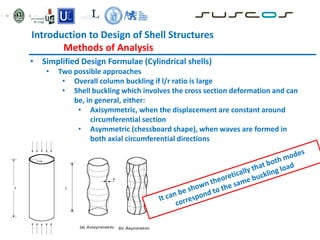
• Simplified Design Formulae (Cylindrical shells)
• Two possible approaches
• Overall column buckling if l/r ratio is large
• Shell buckling which involves the cross section deformation and can
be, in general, either:
• Axisymmetric, when the displacement are constant around
circumferential section
• Asymmetric (chessboard shape), when waves are formed in
both axial circumferential directions
r=a
l
Introduction to Design of Shell Structures
Methods of Analysis
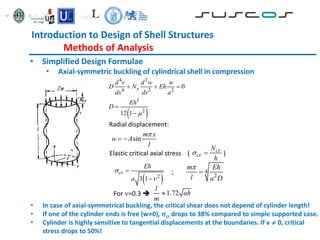
• Simplified Design Formulae
• Axial-symmetric buckling of cylindrical shell in compression
• In case of axial-symmetrical buckling, the critical shear does not depend of cylinder length!
• If one of the cylinder ends is free (w0), cr drops to 38% compared to simple supported case.
• Cylinder is highly sensitive to tangential displacements at the boundaries. If v  0, critical
stress drops to 50%!
 
4 2
4 2 2
3
2
0
12 1
x
d v d w w
D N Eh
dx dx a
Eh
D

  


Elastic critical axial stress ( )
sin
m x
w A
l

 
Radial displacement:
 
2
3 1
cr
Eh
a




4
2
m Eh
l a D


;
For =0.3 
cr
cr
N
h
 
1.72
l
ah
m

Introduction to Design of Shell Structures
Methods of Analysis
• Simplified Design Formulae
• Axial-symmetric buckling of cylindrical shell in compression
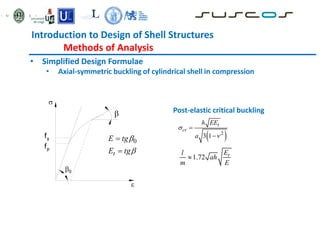
Post-elastic critical buckling
 
2
3 1
t
cr
h EE
a




1.72 t
E
l
ah
m E



0

fp
fy
0
t
E tg
E tg




Introduction to Design of Shell Structures
Methods of Analysis
• Simplified Design Formulae
• Axial-symmetric buckling of cylindrical shell in compression
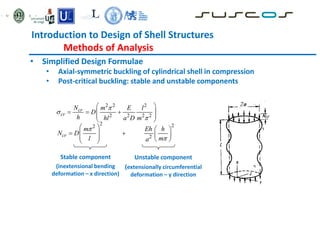
• Post-critical buckling: stable and unstable components
2 2 2
2 2 2 2
cr
cr
N m E l
D
h hl a D m



 
  
 
 
 
2 2
2
2
cr
m Eh h
N D
l m
a


   
 
   
   
 
Stable component
(inextensional bending
deformation – x direction)
Unstable component
(extensionally circumferential
deformation – y direction
Introduction to Design of Shell Structures
Methods of Analysis
• Simplified Design Formulae
• Axial-symmetric buckling of cylindrical shell in compression
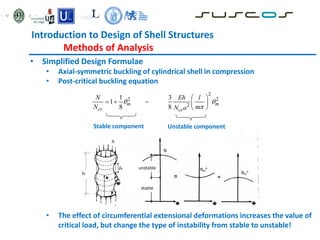
• Post-critical buckling equation
• The effect of circumferential extensional deformations increases the value of
critical load, but change the type of instability from stable to unstable!
2
2 2
2
1 3
1
8 8
m m
cr cr
N Eh l
N m
N a
 

 
    
 
Stable component Unstable component
Introduction to Design of Shell Structures
Methods of Analysis
• Simplified Design Formulae
• Axial-symmetric buckling of cylindrical shell in compression
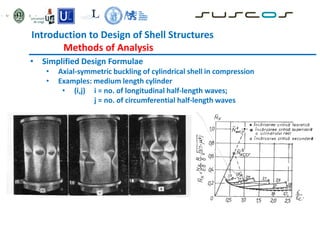
• Examples: medium length cylinder
• (i,j) i = no. of longitudinal half-length waves;
j = no. of circumferential half-length waves
Introduction to Design of Shell Structures
Methods of Analysis
• Simplified Design Formulae
• Axial-symmetric buckling of cylindrical shell in compression
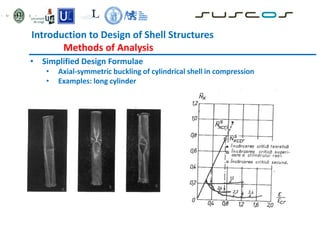
• Examples: long cylinder
Introduction to Design of Shell Structures
Methods of Analysis
• Simplified Design Formulae
• Axial-symmetric buckling of cylindrical shell in compression
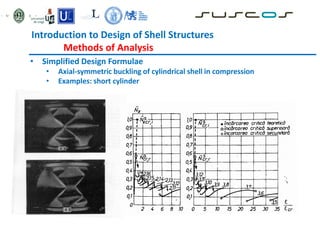
• Examples: short cylinder
Introduction to Design of Shell Structures
Methods of Analysis
• Simplified Design Formulae
• Axial-symmetric buckling of cylindrical shell in compression
• Principle of ECCS approach (ECCS Recommendations 1998)
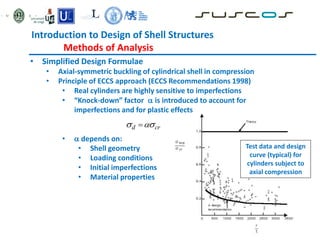
• Real cylinders are highly sensitive to imperfections
• “Knock-down” factor  is introduced to account for
imperfections and for plastic effects
•  depends on:
• Shell geometry
• Loading conditions
• Initial imperfections
• Material properties
Test data and design
curve (typical) for
cylinders subject to
axial compression
d cr

 

Introduction to Design of Shell Structures
Methods of Analysis
• Simplified Design Formulae
• Axial-symmetric buckling of cylindrical shell in compression
• Principle of ECCS approach
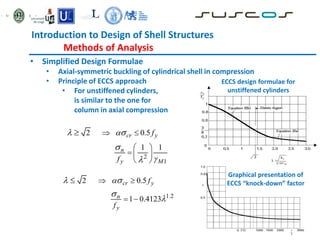
• For unstiffened cylinders,
is similar to the one for
column in axial compression
2
1
2 0.5
1 1
cr y
n
y M
f
f


 


 
 
  
 

1.2
2 0.5
1 0.4123
cr y
n
y
f
f

 


 
 

Graphical presentation of
ECCS “knock-down” factor
ECCS design formulae for
unstiffened cylinders
Introduction to Design of Shell Structures
Methods of Analysis
• Simplified Design Formulae
• Buckling of cylindrical shells under external pressure
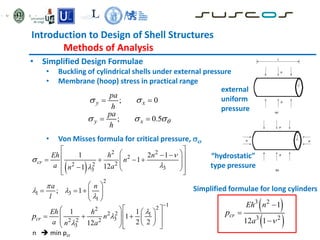
• Membrane (hoop) stress in practical range
• Von Misses formula for critical pressure, cr
; 0
y x
pa
h
 
 
; 0.5
y x
pa
h

  
 
 
2 2
2
2
2 2
3
3
2
1 3
1
1 2 1
1
12
1
; 1
cr
Eh h n
n
a a
n
a n
l




 


 
 
 
 
   
 
 
 
  
 
 
 
    
 
 
1
2
2
2 2 1
3
2 2 2
3
1 1
1
2 2
12
cr
Eh h
n
a n a
p




 
   
 
  
   
  
 
  
n  min pcr
Simplified formulae for long cylinders
 
 
3 2
3 2
1
12 1
cr
Eh n
a
p




external
uniform
pressure
“hydrostatic”
type pressure
Introduction to Design of Shell Structures
Methods of Analysis
• Simplified Design Formulae
• Buckling of cylindrical shells under external pressure
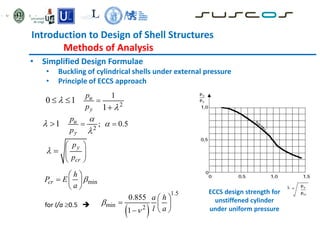
• Principle of ECCS approach
2
; 0.5
1 u
y
p
p




 

2
1
0 1
1
u
y
p
p



 

y
cr
p
p

 
 
 
 

min
cr
h
P E
a

 
  
 
 
1.5
min 2
0.855
1
a h
l a


 
  
 

for l/a0.5 
ECCS design strength for
unstiffened cylinder
under uniform pressure
Introduction to Design of Shell Structures
Methods of Analysis
• Simplified Design Formulae
• Buckling of cylindrical shells under external pressure
• Principle of ECCS approach
• Wind action is more complex than simply an external pressure
• It is needed to check the cylinder stability separately for:
• Wind radial pressure
• Wind axial effects
• Wind tangent effects
• Interaction of the three
• Approximately, wind critical pressure can be taken as 1.6 times critical
external pressure (Maderspach, Gaunt, Sword )
• ECCS Design Recommendations (No. 125/2008) offers also a solution
Introduction to Design of Shell Structures
Methods of Analysis
• Simplified Design Formulae
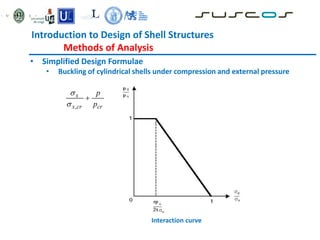
• Buckling of cylindrical shells under compression and external pressure
,
x
x cr cr
p
p



Interaction curve
Introduction to Design of Shell Structures
Methods of Analysis
• Simplified Design Formulae
• Buckling of cylindrical shells in bending
• (Flügge) 
• Long cylinders (Brazier) 
   
, ,
1.33
x
M N
cr x cr x
 

 
2
2
0.99
1
cr
M Eh a



Introduction to Design of Shell Structures
Methods of Analysis
• Simplified Design Formulae
• Buckling of cylindrical shells in torsion
• (Swerin and Flügge)  long cylinders
• (Donnel)  short and medium long cylindrical shells
• Fixed end
• Simple Supported End
 
3 2
3 4
2
3 2 1
cr
E h
a


 
  
 

 
1 2
2 3 2
2
2
4.6 7.8 1.67 1
2
1
cr
E h l
l ah
 

 
 
   
 
 
   
 
   
 
   
  
 
 
 
1 2
3 2
2 2
2
2
2.8 2.6 1.4 1
2
1
cr
E h l
l ah
 

 
 
 
 
   
   
 
 
   
 
 
  
 
 
 
 
Introduction to Design of Shell Structures
Methods of Analysis
• Simplified Design Formulae
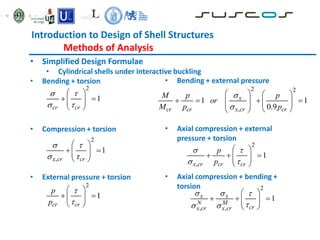
• Cylindrical shells under interactive buckling
• Bending + torsion
• Compression + torsion
• External pressure + torsion
2
1
cr cr
 
 
 
 
 
 
 
2
,
1
x cr cr
 
 
 
 
 
 
 
2
1
cr cr
p
p


 
 
 
 
 
• Bending + external pressure
• Axial compression + external
pressure + torsion
• Axial compression + bending +
torsion
2 2
,
1 1
0.9
x
cr cr x cr cr
M p p
or
M p p


   
   
   
 
 
 
 
2
,
1
x cr cr cr
p
p
 
 
 
  
 
 
 
2
, ,
1
x x
N M
cr
x cr x cr
  

 
 
  
 
 
 
• Basis of design and modelling
• Shells shall be designed in acc. with EN1990 and, in particular, to satisfy the following
requirements:
• Overall equilibrium
• Equilibrium between actions and internal forces and moments
• Limitation of cracks due to cyclic plastification
• Limitation of cracks due to fatigue
• Types of analysis:
• Global analysis
• Membrane theory analysis
• Linear elastic shell analysis
• Linear elastic bifurcation analysis
• Geometrically nonlinear elastic analysis
• Materially nonlinear analysis
• Geometrically and materially nonlinear analysis
• Geometrically nonlinear elastic analysis with imperfections included
• Geometrically and materially nonlinear analysis with imperfections
Introduction to Design of Shell Structures
Design of Steel Structures: Strength and Stability of Shells
• Basis of design and modelling
• Shells shall be designed in acc. with EN1990 and, in particular, to satisfy the following
requirements:
• Overall equilibrium
• Equilibrium between actions and internal forces and moments
• Limitation of cracks due to cyclic plastification
• Limitation of cracks due to fatigue
• Types of analysis:
• Global analysis
• Membrane theory analysis
• Linear elastic shell analysis
• Linear elastic bifurcation analysis
• Geometrically nonlinear elastic analysis
• Materially nonlinear analysis
• Geometrically and materially nonlinear analysis
• Geometrically nonlinear elastic analysis with imperfections included
• Geometrically and materially nonlinear analysis with imperfections
approximate treatments of certain parts of
the structure
Introduction to Design of Shell Structures
Design of Steel Structures: Strength and Stability of Shells
• Basis of design and modelling
• Shells shall be designed in acc. with EN1990 and, in particular, to satisfy the following
requirements:
• Overall equilibrium
• Equilibrium between actions and internal forces and moments
• Limitation of cracks due to cyclic plastification
• Limitation of cracks due to fatigue
• Types of analysis:
• Global analysis
• Membrane theory analysis
• Linear elastic shell analysis
• Linear elastic bifurcation analysis
• Geometrically nonlinear elastic analysis
• Materially nonlinear analysis
• Geometrically and materially nonlinear analysis
• Geometrically nonlinear elastic analysis with imperfections included
• Geometrically and materially nonlinear analysis with imperfections
Conditions of use:
- the boundary conditions are appropriate for
transfer of the stresses in the shell into support
reactions without causing bending effects;
- the shell geometry varies smoothly in shape
(without discontinuities);
- the loads have a smooth distribution (without
locally concentrated or point loads).
Introduction to Design of Shell Structures
Design of Steel Structures: Strength and Stability of Shells
• Basis of design and modelling
• Shells shall be designed in acc. with EN1990 and, in particular, to satisfy the following
requirements:
• Overall equilibrium
• Equilibrium between actions and internal forces and moments
• Limitation of cracks due to cyclic plastification
• Limitation of cracks due to fatigue
• Types of analysis:
• Global analysis
• Membrane theory analysis
• Linear elastic shell analysis
• Linear elastic bifurcation analysis
• Geometrically nonlinear elastic analysis
• Materially nonlinear analysis
• Geometrically and materially nonlinear analysis
• Geometrically nonlinear elastic analysis with imperfections included
• Geometrically and materially nonlinear analysis with imperfections
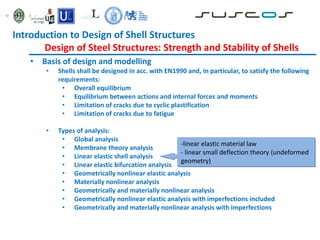
-linear elastic material law
- linear small deflection theory (undeformed
geometry)
Introduction to Design of Shell Structures
Design of Steel Structures: Strength and Stability of Shells
• Basis of design and modelling
• Shells shall be designed in acc. with EN1990 and, in particular, to satisfy the following
requirements:
• Overall equilibrium
• Equilibrium between actions and internal forces and moments
• Limitation of cracks due to cyclic plastification
• Limitation of cracks due to fatigue
• Types of analysis:
• Global analysis
• Membrane theory analysis
• Linear elastic shell analysis
• Linear elastic bifurcation analysis
• Geometrically nonlinear elastic analysis
• Materially nonlinear analysis
• Geometrically and materially nonlinear analysis
• Geometrically nonlinear elastic analysis with imperfections included
• Geometrically and materially nonlinear analysis with imperfections
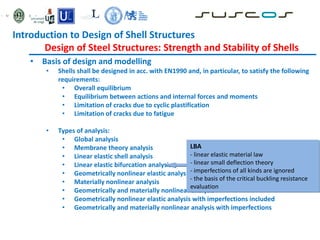
LBA
- linear elastic material law
- linear small deflection theory
- imperfections of all kinds are ignored
- the basis of the critical buckling resistance
evaluation
Introduction to Design of Shell Structures
Design of Steel Structures: Strength and Stability of Shells
• Basis of design and modelling
• Shells shall be designed in acc. with EN1990 and, in particular, to satisfy the following
requirements:
• Overall equilibrium
• Equilibrium between actions and internal forces and moments
• Limitation of cracks due to cyclic plastification
• Limitation of cracks due to fatigue
• Types of analysis:
• Global analysis
• Membrane theory analysis
• Linear elastic shell analysis
• Linear elastic bifurcation analysis
• Geometrically nonlinear elastic analysis
• Materially nonlinear analysis
• Geometrically and materially nonlinear analysis
• Geometrically nonlinear elastic analysis with imperfections included
• Geometrically and materially nonlinear analysis with imperfections
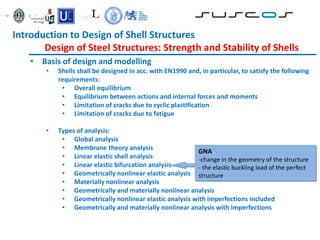
GNA
-change in the geometry of the structure
- the elastic buckling load of the perfect
structure
Introduction to Design of Shell Structures
Design of Steel Structures: Strength and Stability of Shells
• Basis of design and modelling
• Shells shall be designed in acc. with EN1990 and, in particular, to satisfy the following
requirements:
• Overall equilibrium
• Equilibrium between actions and internal forces and moments
• Limitation of cracks due to cyclic plastification
• Limitation of cracks due to fatigue
• Types of analysis:
• Global analysis
• Membrane theory analysis
• Linear elastic shell analysis
• Linear elastic bifurcation analysis
• Geometrically nonlinear elastic analysis
• Materially nonlinear analysis
• Geometrically and materially nonlinear analysis
• Geometrically nonlinear elastic analysis with imperfections included
• Geometrically and materially nonlinear analysis with imperfections
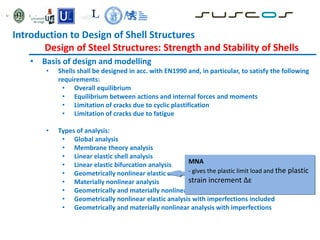
MNA
- gives the plastic limit load and the plastic
strain increment Δε
Introduction to Design of Shell Structures
Design of Steel Structures: Strength and Stability of Shells
• Basis of design and modelling
• Shells shall be designed in acc. with EN1990 and, in particular, to satisfy the following
requirements:
• Overall equilibrium
• Equilibrium between actions and internal forces and moments
• Limitation of cracks due to cyclic plastification
• Limitation of cracks due to fatigue
• Types of analysis:
• Global analysis
• Membrane theory analysis
• Linear elastic shell analysis
• Linear elastic bifurcation analysis
• Geometrically nonlinear elastic analysis
• Materially nonlinear analysis
• Geometrically and materially nonlinear analysis
• Geometrically nonlinear elastic analysis with imperfections included
• Geometrically and materially nonlinear analysis with imperfections
GMNA
- gives the geometrically nonlinear plastic limit
load and the plastic strain increment
Introduction to Design of Shell Structures
Design of Steel Structures: Strength and Stability of Shells
• Basis of design and modelling
• Shells shall be designed in acc. with EN1990 and, in particular, to satisfy the following
requirements:
• Overall equilibrium
• Equilibrium between actions and internal forces and moments
• Limitation of cracks due to cyclic plastification
• Limitation of cracks due to fatigue
• Types of analysis:
• Global analysis
• Membrane theory analysis
• Linear elastic shell analysis
• Linear elastic bifurcation analysis
• Geometrically nonlinear elastic analysis
• Materially nonlinear analysis
• Geometrically and materially nonlinear analysis
• Geometrically nonlinear elastic analysis with imperfections included
• Geometrically and materially nonlinear analysis with imperfections
GNIA
- where compression or shear stresses
dominate in the shell
- elastic buckling loads of the "real" imperfect
structure
Introduction to Design of Shell Structures
Design of Steel Structures: Strength and Stability of Shells
• Basis of design and modelling
• Shells shall be designed in acc. with EN1990 and, in particular, to satisfy the following
requirements:
• Overall equilibrium
• Equilibrium between actions and internal forces and moments
• Limitation of cracks due to cyclic plastification
• Limitation of cracks due to fatigue
• Types of analysis:
• Global analysis
• Membrane theory analysis
• Linear elastic shell analysis
• Linear elastic bifurcation analysis
• Geometrically nonlinear elastic analysis
• Materially nonlinear analysis
• Geometrically and materially nonlinear analysis
• Geometrically nonlinear elastic analysis with imperfections included
• Geometrically and materially nonlinear analysis with imperfections
GNIA
- where compression or shear stresses
dominate in the shell
- elastic buckling loads of the "real" imperfect
structure
GMNIA
- gives the elasto-plastic buckling loads for the
"real" imperfect structure
Introduction to Design of Shell Structures
Design of Steel Structures: Strength and Stability of Shells
• Basis of design and modelling
• Shells shall be designed in acc. with EN1990 and, in particular, to satisfy the following
requirements:
• Overall equilibrium
• Equilibrium between actions and internal forces and moments
• Limitation of cracks due to cyclic plastification
• Limitation of cracks due to fatigue
• Types of analysis:
• Global analysis
• Membrane theory analysis
• Linear elastic shell analysis
• Linear elastic bifurcation analysis
• Geometrically nonlinear elastic analysis
• Materially nonlinear analysis
• Geometrically and materially nonlinear analysis
• Geometrically nonlinear elastic analysis with imperfections included
• Geometrically and materially nonlinear analysis with imperfections
approximate treatments of certain parts of
the structure
Conditions of use:
- the boundary conditions are appropriate for
transfer of the stresses in the shell into support
reactions without causing bending effects;
- the shell geometry varies smoothly in shape
(without discontinuities);
- the loads have a smooth distribution (without
locally concentrated or point loads).
-linear elastic material law
- linear small deflection theory (undeformed
geometry)
LBA
- linear elastic material law
- linear small deflection theory
- imperfections of all kinds are ignored
- the basis of the critical buckling resistance
evaluation
GNA
-change in the geometry of the structure
- the elastic buckling load of the perfect
structure
MNA
- gives the plastic limit load and the plastic
strain increment Δε
GMNA
- gives the geometrically nonlinear plastic limit
load and the plastic strain increment
GNIA
- where compression or shear stresses
dominate in the shell
- elastic buckling loads of the "real" imperfect
structure
GMNIA
- gives the elasto-plastic buckling loads for the
"real" imperfect structure
Introduction to Design of Shell Structures
Design of Steel Structures: Strength and Stability of Shells
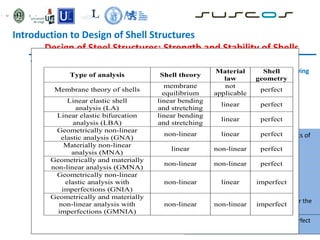
Type of analysis Shell theory
Material
law
Shell
geometry
Membrane theory of shells
membrane
equilibrium
not
applicable
perfect
Linear elastic shell
analysis (LA)
linear bending
and stretching
linear perfect
Linear elastic bifurcation
analysis (LBA)
linear bending
and stretching
linear perfect
Geometrically non-linear
elastic analysis (GNA)
non-linear linear perfect
Materially non-linear
analysis (MNA)
linear non-linear perfect
Geometrically and materially
non-linear analysis (GMNA)
non-linear non-linear perfect
Geometrically non-linear
elastic analysis with
imperfections (GNIA)
non-linear linear imperfect
Geometrically and materially
non-linear analysis with
imperfections (GMNIA)
non-linear non-linear imperfect
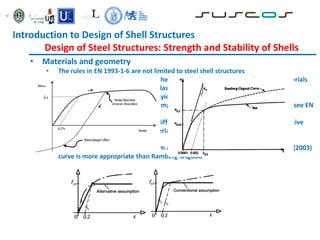
• Materials and geometry
• The rules in EN 1993-1-6 are not limited to steel shell structures
• The standard is valid for isotropic shells and shell segments made from any materials
that may be represented as ideal elastic-plastic
• For materials with no well defined yield point, 0.2% proof stress can be taken
• The material properties apply to temperatures not exceeding 150 ºC (otherwise see EN
13084-7, 2005)
• Where materials has a significant different stress strain curve, there are alternative
ways of representation of the material behaviour
• Bauschinger effect
• For austenitic steels (and aluminium alloys) at higher plastic strains, Rasmussen (2003)
curve is more appropriate than Ramberg-Osgood
Introduction to Design of Shell Structures
Design of Steel Structures: Strength and Stability of Shells
• Materials and geometry
• The rules in EN 1993-1-6 are not limited to steel shell structures
• The standard is valid for isotropic shells and shell segments made from any materials
that may be represented as ideal elastic-plastic
• For materials with no well defined yield point, 0.2% proof stress can be taken
• The material properties apply to temperatures not exceeding 150 ºC (otherwise see EN
13084-7, 2005)
• Where materials has a significant different stress strain curve, there are alternative
ways of representation of the material behaviour
• Bauschinger effect
• For austenitic steels (and aluminium alloys) at higher plastic strains, Rasmussen (2003)
curve is more appropriate than Ramberg-Osgood
Introduction to Design of Shell Structures
Design of Steel Structures: Strength and Stability of Shells
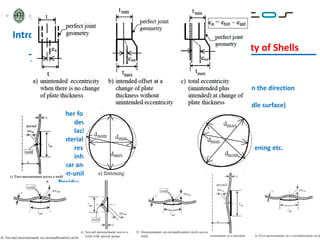
• Geometrical tolerances and imperfections
• Relevant tolerances due to the requirements of serviceability:
• out-of-roundness (deviation from circularity)
• eccentricities (deviations from a continuous middle surface in the direction
normal to the shell along junctions of plates)
• local dimples (local normal deviations from the nominal middle surface)
• Other forms of geometric imperfections:
• deviations from nominal thickness
• lack of evenness of supports
• Material imperfections:
• residual stresses caused by rolling, pressing, welding, straightening etc.
• inhomogeneities and anisotropies
• Wear and corrosion
• Non-uniformities of loading
• Residual stresses
Introduction to Design of Shell Structures
Design of Steel Structures: Strength and Stability of Shells
• Geometrical tolerances and imperfections
• Relevant tolerances due to the requirements of serviceability:
• out-of-roundness (deviation from circularity)
• eccentricities (deviations from a continuous middle surface in the direction
normal to the shell along junctions of plates)
• local dimples (local normal deviations from the nominal middle surface)
• Other forms of geometric imperfections:
• deviations from nominal thickness
• lack of evenness of supports
• Material imperfections:
• residual stresses caused by rolling, pressing, welding, straightening etc.
• inhomogeneities and anisotropies
• Wear and corrosion
• Non-uniformities of loading
• Residual stresses
Introduction to Design of Shell Structures
Design of Steel Structures: Strength and Stability of Shells
• Ultimate limit states in steel shells
• LS1: Plastic limit
• Identifies the strength of the structure when stability plays no significant
role.
• Covers two conditions:
• tensile rupture or compressive yield through the full thickness
• development of a plastic collapse mechanism involving bending
• The plastic limit load is also relevant to a buckling strength assessment
• The plastic limit load does not represent the real strength (even for
stocky structures): strain hardening of material, stabilizing or
destabilizing effects due to change in geometry
Rpl - the plastic limit load
Rcr - the elastic critical load
Introduction to Design of Shell Structures
Design of Steel Structures: Strength and Stability of Shells
• Ultimate limit states in steel shells
• LS1: Plastic limit
• Types of analysis:
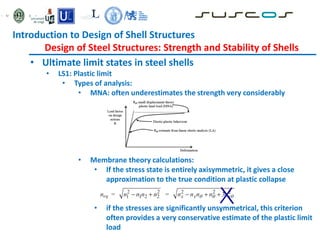
• MNA: often underestimates the strength very considerably
• Membrane theory calculations:
• If the stress state is entirely axisymmetric, it gives a close
approximation to the true condition at plastic collapse
• if the stresses are significantly unsymmetrical, this criterion
often provides a very conservative estimate of the plastic limit
load
Introduction to Design of Shell Structures
Design of Steel Structures: Strength and Stability of Shells
• Ultimate limit states in steel shells
• LS1: Plastic limit
• Types of analysis:
• Linear elastic shell bending theory: This is commonly more
conservative than membrane theory calculation (is based on
the first yield on the surface)
• Geometrically nonlinear calculation (GMNA): problems arise
over whether the structure displays geometric hardening or
geometric softening
• The plastic limit load should be seen only as the ideal value of
the plastic reference resistance
Introduction to Design of Shell Structures
Design of Steel Structures: Strength and Stability of Shells
• Ultimate limit states in steel shells
• LS2: Cyclic plasticity:
• Repeated cycles of loading and unloading, eventually leading to local
cracking by exhaustion of the energy absorption capacity of the material
• Low cycle fatigue failure may be assumed to be prevented if the
procedures set out in the standard are adopted
• Methods of analysis:
• expressions in Annex C
• elastic analysis (LA or GNA)
• MNA or GMNA and find plastic strains
• LS4: Fatigue:
• Repeated cycles of increasing and decreasing stress lead to the
development of a fatigue crack
• Methods of analysis:
• expressions in Annex C (using stress concentration factors)
• elastic analysis (LA or GNA), using stress concentration factors
Introduction to Design of Shell Structures
Design of Steel Structures: Strength and Stability of Shells
• Ultimate limit states in steel shells
• LS3: Buckling:
• Caused by loss of stability under compressive membrane or shear
membrane stresses in the shell wall, leading to inability to sustain any
increase in the stress resultants, possibly causing catastrophic failure
• Three approaches used in the assessment of buckling resistance:
• GMNIA analysis
• MNA/LBA analysis
• Buckling stresses
• The strength under LS3 depends strongly on the quality of construction
• For this purpose, three fabrication quality classes are set out
Introduction to Design of Shell Structures
Design of Steel Structures: Strength and Stability of Shells
• Design concepts for the limit states design of shells
• The limit state verification should be carried out using one of the following:
• Stress design:
• primary
• secondary
• Local
• Direct design by application of standard expressions:
• the limit states may be represented by standard expressions that have been
derived from either membrane theory, plastic mechanism theory or linear elastic
analysis
• The membrane theory (Annex A) - primary stresses needed for assessing LS1 and
LS3.
• The plastic design (Annex B) - plastic limit loads for assessing LS1
• The linear elastic analysis (Annex C) - stresses of the primary plus secondary
stress type for assessing LS2 and LS4. An LS3 assessment may be based on the
membrane part of these expressions.
• Design by global numerical analysis
may be replaced by stress resultants where
appropriate
In general, primary stress states control LS1, whereas
secondary stress states affect LS2 and LS3 and local
stresses govern LS4.
Introduction to Design of Shell Structures
Design of Steel Structures: Strength and Stability of Shells
• Stress resultants and stresses in shells
• Stresses:
• There are eight stress resultants in the shell
• However, the shear stresses xn, θn due to the transverse shear forces qxn, qθn are
insignificant and they may usually be neglected in design
• For most design purposes, the evaluation of the limit states may be made using
only the six stress resultants in the shell wall nx, nθ, nxθ, mx, mθ, mxθ
• Where the structure is axisymmetric and subject only to axisymmetric loading and
support, only nx, nθ, mx and mθ need be used
• Modelling:
• Represention by its middle surface
• Nominal radius of curvature, imperfections neglected (excepting LS3)
• Eccentricities and steps if they induce significant effects
• Eccentricity at junctions between shell segments
• Stringers, corrugations, holes, depending on the conditions
• Boundary conditions
Introduction to Design of Shell Structures
Design of Steel Structures: Strength and Stability of Shells
• Stress resultants and stresses in shells
• Stresses:
• There are eight stress resultants in the shell
• However, the shear stresses xn, θn due to the transverse shear forces qxn, qθn are
insignificant and they may usually be neglected in design
• For most design purposes, the evaluation of the limit states may be made using
only the six stress resultants in the shell wall nx, nθ, nxθ, mx, mθ, mxθ
• Where the structure is axisymmetric and subject only to axisymmetric loading and
support, only nx, nθ, mx and mθ need be used
• Modelling:
• Represention by its middle surface
• Nominal radius of curvature, imperfections neglected (excepting LS3)
• Eccentricities and steps if they induce significant effects
• Eccentricity at junctions between shell segments
• Stringers, corrugations, holes, depending on the conditions
• Boundary conditions
Introduction to Design of Shell Structures
Design of Steel Structures: Strength and Stability of Shells
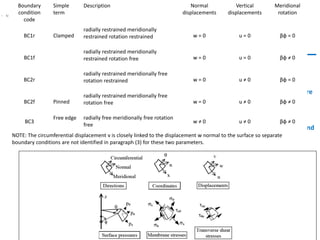
Boundary
condition
code
Simple
term
Description Normal
displacements
Vertical
displacements
Meridional
rotation
BC1r Clamped
radially restrained meridionally
restrained rotation restrained w = 0 u = 0 βφ = 0
BC1f
radially restrained meridionally
restrained rotation free w = 0 u = 0 βφ ≠ 0
BC2r
radially restrained meridionally free
rotation restrained w = 0 u ≠ 0 βφ = 0
BC2f Pinned
radially restrained meridionally free
rotation free w = 0 u ≠ 0 βφ ≠ 0
BC3
Free edge radially free meridionally free rotation
free
w ≠ 0 u ≠ 0 βφ ≠ 0
NOTE: The circumferential displacement v is closely linked to the displacement w normal to the surface so separate
boundary conditions are not identified in paragraph (3) for these two parameters.
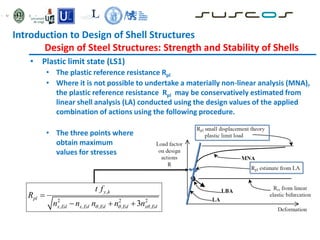
• Plastic limit state (LS1)
• The plastic reference resistance Rpl
• Where it is not possible to undertake a materially non-linear analysis (MNA),
the plastic reference resistance Rpl may be conservatively estimated from
linear shell analysis (LA) conducted using the design values of the applied
combination of actions using the following procedure.
• The three points where
obtain maximum
values for stresses
,
2 2 2
, , , , ,
3
y k
pl
x Ed x Ed Ed Ed x Ed
t f
R
n n n n n
  

  
Introduction to Design of Shell Structures
Design of Steel Structures: Strength and Stability of Shells
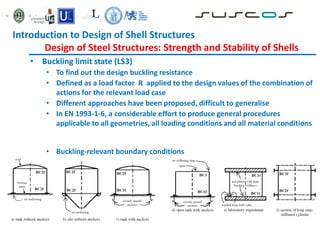
• Buckling limit state (LS3)
• To find out the design buckling resistance
• Defined as a load factor R applied to the design values of the combination of
actions for the relevant load case
• Different approaches have been proposed, difficult to generalise
• In EN 1993-1-6, a considerable effort to produce general procedures
applicable to all geometries, all loading conditions and all material conditions
• Buckling-relevant boundary conditions
Introduction to Design of Shell Structures
Design of Steel Structures: Strength and Stability of Shells
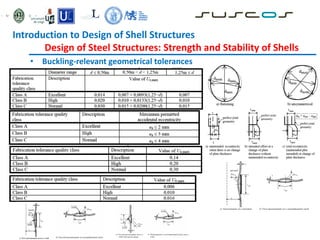
• Buckling-relevant geometrical tolerances
Introduction to Design of Shell Structures
Design of Steel Structures: Strength and Stability of Shells
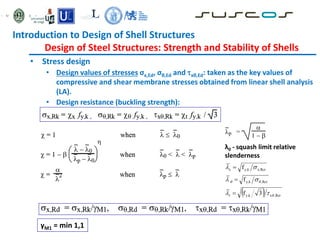
• Stress design
• Design values of stresses σx,Ed, σθ,Ed and xθ,Ed: taken as the key values of
compressive and shear membrane stresses obtained from linear shell analysis
(LA).
• Design resistance (buckling strength):
γM1 = min 1,1
λ0 - squash limit relative
slenderness
 
3
f
f
f
Rcr
,
x
k
y,
Rcr
,
k
y,
Rcr
x,
k
y,
x













Introduction to Design of Shell Structures
Design of Steel Structures: Strength and Stability of Shells
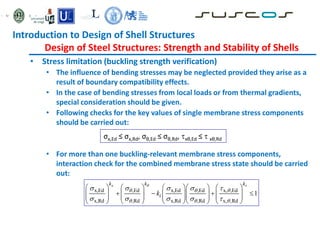
• Stress limitation (buckling strength verification)
• The influence of bending stresses may be neglected provided they arise as a
result of boundary compatibility effects.
• In the case of bending stresses from local loads or from thermal gradients,
special consideration should be given.
• Following checks for the key values of single membrane stress components
should be carried out:
• For more than one buckling-relevant membrane stress components,
interaction check for the combined membrane stress state should be carried
out:
σx,Ed ≤ σx,Rd, σθ,Ed ≤ σθ,Rd, xθ,Ed ≤  xθ,Rd
x,Ed ,Ed x,Ed ,Ed x, ,Ed
x,Rd ,Rd x,Rd ,Rd x, ,Rd
1
x
k k k
i
k
 
  
  
    
    
        
   
        
        
        
Introduction to Design of Shell Structures
Design of Steel Structures: Strength and Stability of Shells
• Buckling design
• EN 1993-1-6 specifies three approaches that are approved for use in the
assessment of buckling resistance:
• Design by means of a global numerical MNA/LBA analysis
• Design by means of a global numerical GMNIA analysis
• Design by means of buckling stresses
Introduction to Design of Shell Structures
Design of Steel Structures: Strength and Stability of Shells
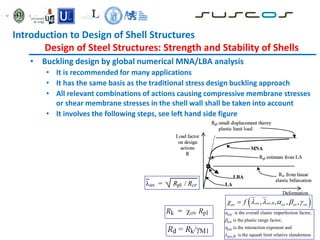
• Buckling design by global numerical MNA/LBA analysis
• It is recommended for many applications
• It has the same basis as the traditional stress design buckling approach
• All relevant combinations of actions causing compressive membrane stresses
or shear membrane stresses in the shell wall shall be taken into account
• It involves the following steps, see left hand side figure
 
,0
, , , ,
ov ov
ov ov ov ov
f
     

ov is the overall elastic imperfection factor,
ov is the plastic range factor,
ov is the interaction exponent and
ov,0 is the squash limit relative slenderness
Introduction to Design of Shell Structures
Design of Steel Structures: Strength and Stability of Shells
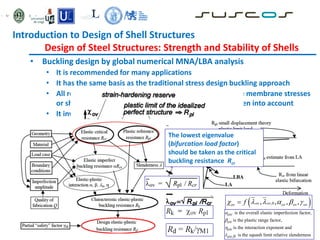
• Buckling design by global numerical MNA/LBA analysis
• It is recommended for many applications
• It has the same basis as the traditional stress design buckling approach
• All relevant combinations of actions causing compressive membrane stresses
or shear membrane stresses in the shell wall shall be taken into account
• It involves the following steps, see left hand side figure
The lowest eigenvalue
(bifurcation load factor)
should be taken as the critical
buckling resistance Rcr
 
,0
, , , ,
ov ov
ov ov ov ov
f
     

ov is the overall elastic imperfection factor,
ov is the plastic range factor,
ov is the interaction exponent and
ov,0 is the squash limit relative slenderness
Introduction to Design of Shell Structures
Design of Steel Structures: Strength and Stability of Shells
• Design by global numerical GMNIA analysis
• Developed to exploit the full power of modern numerical analysis
• Application is more complex than for frame or plated structures
• Several sequence of analysis:
• LA followed by a LBA to evaluate elastic critical buckling resistance
• GMNA to identify the elastic-plastic buckling resistance of the perfect
structure
• GMNIA with different imperfection modes (the lowest value is selected)
• Check the precision of the GMNIA by comparison with test or other
relevant data
• Methodology
• Action combinations causing compressive membrane stresses or shear
membrane stresses
• Rk should be found from the imperfect elastic-plastic critical buckling
resistance RGMNIA, adjusted by the calibration factor kGMNIA.
• The design buckling resistance Rd should then be found using the partial
factor γM1.
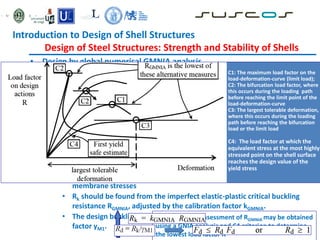
C1: The maximum load factor on the
load-deformation-curve (limit load);
C2: The bifurcation load factor, where
this occurs during the loading path
before reaching the limit point of the
load-deformation-curve
C3: The largest tolerable deformation,
where this occurs during the loading
path before reaching the bifurcation
load or the limit load
C4: The load factor at which the
equivalent stress at the most highly
stressed point on the shell surface
reaches the design value of the
yield stress
Introduction to Design of Shell Structures
Design of Steel Structures: Strength and Stability of Shells
• Design by global numerical GMNIA analysis
• Developed to exploit the full power of modern numerical analysis
• Application is more complex than for frame or plated structures
• Several sequence of analysis:
• LA followed by a LBA to evaluate elastic critical buckling resistance
• GMNA to identify the elastic-plastic buckling resistance of the perfect
structure
• GMNIA with different imperfection modes (the lowest value is selected)
• Check the precision of the GMNIA by comparison with test or other
relevant data
• Methodology
• Action combinations causing compressive membrane stresses or shear
membrane stresses
• Rk should be found from the imperfect elastic-plastic critical buckling
resistance RGMNIA, adjusted by the calibration factor kGMNIA.
• The design buckling resistance Rd should then be found using the partial
factor γM1.
C1: The maximum load factor on the
load-deformation-curve (limit load);
C2: The bifurcation load factor, where
this occurs during the loading path
before reaching the limit point of the
load-deformation-curve
C3: The largest tolerable deformation,
where this occurs during the loading
path before reaching the bifurcation
load or the limit load
C4: The load factor at which the
equivalent stress at the most highly
stressed point on the shell surface
reaches the design value of the
yield stress
A conservative assessment of RGMNIA may be obtained
using a GNIA analysis and C4 criterion to determine
the lowest load factor R
Introduction to Design of Shell Structures
Design of Steel Structures: Strength and Stability of Shells
• GMNIA analysis
• Allowances for imperfections:
• geometric imperfections: pre-deformations, out of-roundness, irregularities at
and near welds, thickness deviation, etc.
• material imperfections: residual stresses, inhomogeneities, anisotropies
• EN 1993-1-6 requires that imperfections are explicitly modelled numerically,
not just treated as small perturbations in geometry
• They are introduced by means of equivalent geometric imperfections in the
form of initial shape deviations perpendicular to the middle surface of the
perfect shell
• The form of the imperfections with the most unfavorable effect should be
considered (the most unfavorable effect on the buckling resistance RGMNIA
of the shell); if practicable, they must reflect the constructional detailing and
the boundary conditions
Introduction to Design of Shell Structures
Design of Steel Structures: Strength and Stability of Shells
• GMNIA analysis
• The analysis should be carried out for a sufficient number of different
imperfection patterns, and the worst case (lowest value of RGMNIA) should be
identified.
• The eigen-mode-affine pattern should be used (the critical buckling mode
associated with the elastic critical buckling resistance Rcr based on an LBA
analysis of the perfect shell)
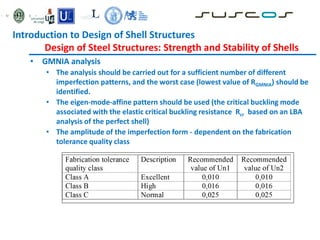
• The amplitude of the imperfection form - dependent on the fabrication
tolerance quality class
Introduction to Design of Shell Structures
Design of Steel Structures: Strength and Stability of Shells
• Imperfections
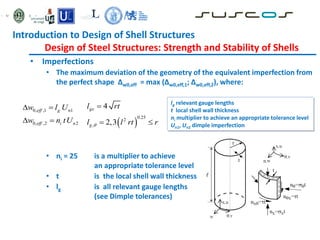
• The maximum deviation of the geometry of the equivalent imperfection from
the perfect shape ∆w0,eff = max (∆w0,eff,1; ∆w0,eff,2), where:
• ni = 25 is a multiplier to achieve
an appropriate tolerance level
• t is the local shell wall thickness
• lg is all relevant gauge lengths
(see Dimple tolerances)
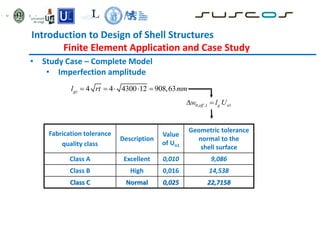
0, ,1 1
0, ,2 2
eff g n
eff i n
w l U
w n tU
 
   
0.25
2
,
4
2,3
gx
g
l rt
l l rt r


 
lg relevant gauge lengths
t local shell wall thickness
ni multiplier to achieve an appropriate tolerance level
Un1, Un2 dimple imperfection
Introduction to Design of Shell Structures
Design of Steel Structures: Strength and Stability of Shells
• GMNIA validation
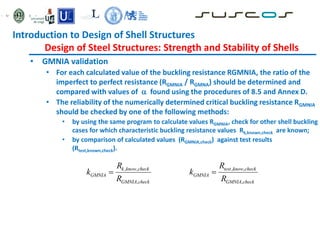
• For each calculated value of the buckling resistance RGMNIA, the ratio of the
imperfect to perfect resistance (RGMNIA / RGMNA) should be determined and
compared with values of  found using the procedures of 8.5 and Annex D.
• The reliability of the numerically determined critical buckling resistance RGMNIA
should be checked by one of the following methods:
• by using the same program to calculate values RGMNIA, check for other shell buckling
cases for which characteristic buckling resistance values Rk,known,check are known;
• by comparison of calculated values (RGMNIA,check) against test results
(Rtest,known,check).
, , , ,
, ,
k know check test know check
GMNIA GMNIA
GMNIA check GMNIA check
R R
k k
R R
 
Introduction to Design of Shell Structures
Design of Steel Structures: Strength and Stability of Shells
• GMNIA validation
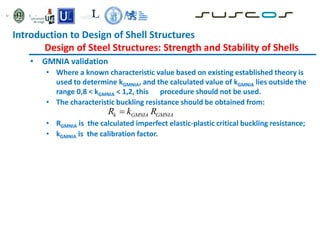
• Where a known characteristic value based on existing established theory is
used to determine kGMNIA, and the calculated value of kGMNIA lies outside the
range 0,8 < kGMNIA < 1,2, this procedure should not be used.
• The characteristic buckling resistance should be obtained from:
• RGMNIA is the calculated imperfect elastic-plastic critical buckling resistance;
• kGMNIA is the calibration factor.
k GMNIA GMNIA
R k R

Introduction to Design of Shell Structures
Design of Steel Structures: Strength and Stability of Shells
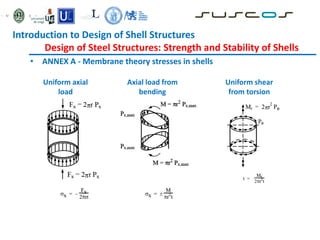
• ANNEX A - Membrane theory stresses in shells
Uniform axial
load
Axial load from
bending
Uniform shear
from torsion
Introduction to Design of Shell Structures
Design of Steel Structures: Strength and Stability of Shells
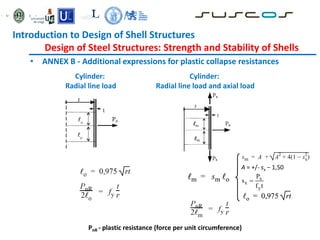
• ANNEX B - Additional expressions for plastic collapse resistances
Cylinder:
Radial line load
Cylinder:
Radial line load and axial load
A = +/- sx − 1,50
x
x
y
P
s
f t

PnR - plastic resistance (force per unit circumference)
Introduction to Design of Shell Structures
Design of Steel Structures: Strength and Stability of Shells
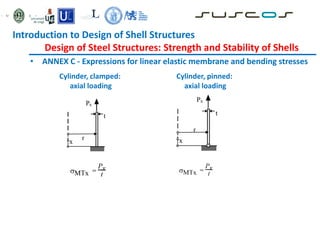
• ANNEX C - Expressions for linear elastic membrane and bending stresses
Cylinder, clamped:
axial loading
Cylinder, pinned:
axial loading
Introduction to Design of Shell Structures
Design of Steel Structures: Strength and Stability of Shells
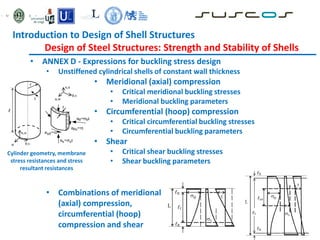
• ANNEX D - Expressions for buckling stress design
• Unstiffened cylindrical shells of constant wall thickness
• Meridional (axial) compression
• Critical meridional buckling stresses
• Meridional buckling parameters
• Circumferential (hoop) compression
• Critical circumferential buckling stresses
• Circumferential buckling parameters
• Shear
• Critical shear buckling stresses
• Shear buckling parameters
• Combinations of meridional
(axial) compression,
circumferential (hoop)
compression and shear
Cylinder geometry, membrane
stress resistances and stress
resultant resistances
Introduction to Design of Shell Structures
Design of Steel Structures: Strength and Stability of Shells
Introduction to Design of Shell Structures
Finite Element Application
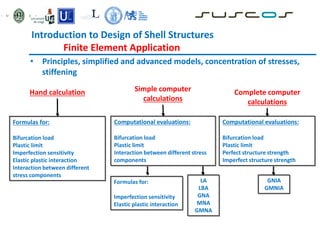
• Principles, simplified and advanced models, concentration of stresses,
stiffening
Hand calculation Simple computer
calculations
Complete computer
calculations
Formulas for:
Bifurcation load
Plastic limit
Imperfection sensitivity
Elastic plastic interaction
Interaction between different
stress components
Computational evaluations:
Bifurcation load
Plastic limit
Interaction between different stress
components
Computational evaluations:
Bifurcation load
Plastic limit
Perfect structure strength
Imperfect structure strength
Formulas for:
Imperfection sensitivity
Elastic plastic interaction
GNIA
GMNIA
LA
LBA
GNA
MNA
GMNA
• Simplified FEM model
• Global analysis
• A simplified bar model using 1D beam finite elements, with or without
the account of global imperfection, using an elastic material law.
• Aim of analysis – find-out the internal forces needed for:
• The global check of the tower capacity;
• Refined local analysis of the relevant tower segments (between two
consecutive flange that assure the appropriate boundary condition, radial
restrained)
• Local analysis of a tower segment
• The 3D shell model should be build using 2D finite elements (plane), that
can be: either Homogeneous shell, either Membranes
Introduction to Design of Shell Structures
Finite Element Application
• Simplified FEM model
• Local analysis of a tower segment
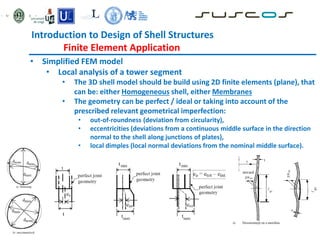
• The 3D shell model should be build using 2D finite elements (plane), that
can be: either Homogeneous shell, either Membranes
• The geometry can be perfect / ideal or taking into account of the
prescribed relevant geometrical imperfection:
• out-of-roundness (deviation from circularity),
• eccentricities (deviations from a continuous middle surface in the direction
normal to the shell along junctions of plates),
• local dimples (local normal deviations from the nominal middle surface).
Introduction to Design of Shell Structures
Finite Element Application
• Advanced FEM Model
• Modelling the entire structure with 2D finite elements with a special
attention of details (connection flanges, welds connection, etc);
• Material behavior:
• Elastic
• Plastic
• Geometry:
• Ideal
• Imperfect
• Finite elements types:
• Homogenous shell
Introduction to Design of Shell Structures
Finite Element Application
• Geometry and state of stress
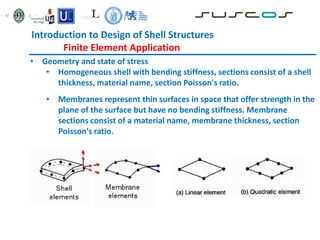
• Homogeneous shell with bending stiffness, sections consist of a shell
thickness, material name, section Poisson's ratio.
• Membranes represent thin surfaces in space that offer strength in the
plane of the surface but have no bending stiffness. Membrane
sections consist of a material name, membrane thickness, section
Poisson's ratio.
Introduction to Design of Shell Structures
Finite Element Application
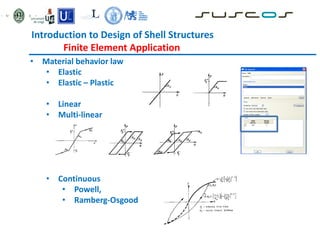
• Material behavior law
• Elastic
• Elastic – Plastic
• Linear
• Multi-linear
• Continuous
• Powell,
• Ramberg-Osgood
Introduction to Design of Shell Structures
Finite Element Application
• Load cases
• The load cases shall be determined from the combination of operational
modes or other design situations, such as specific assembly, erection or
maintenance conditions, with the external conditions.
• All relevant load cases with a reasonable probability of occurrence
shall be considered, together with the behavior of the control and
protection system.
• The design load cases used (IEC 61400-1:2005) to verify the structural integrity
of a wind turbine shall be calculated by combining:
• normal design situations and appropriate normal or extreme external
conditions;
• fault design situations and appropriate external conditions;
• transportation, installation and maintenance design situations and
appropriate external conditions.
Introduction to Design of Shell Structures
Finite Element Application
• Load cases and design situations
• Load cases and assumptions for global analysis
• IEC 61400-1:2005
• Dead loads - Self-weight: tower head; tower body, installation etc.
• Wind action (EN1991-1-4)
• Seismic loads
• Temperature
• Ice
• Design situations
• Power production
• Power production plus occurrence of fault or loss of electrical network
connection
• Start up
• Normal shut down
• Emergency shut down
• Parked (standstill or idling)
• Parked plus fault conditions
• Transport, assembly, maintenance and repair
Introduction to Design of Shell Structures
Finite Element Application
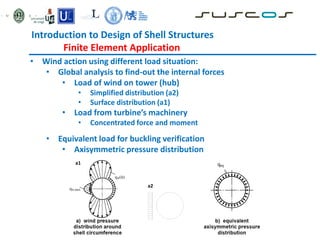
• Wind action using different load situation:
• Global analysis to find-out the internal forces
• Load of wind on tower (hub)
• Simplified distribution (a2)
• Surface distribution (a1)
• Load from turbine’s machinery
• Concentrated force and moment
• Equivalent load for buckling verification
• Axisymmetric pressure distribution
a1
a2
Introduction to Design of Shell Structures
Finite Element Application
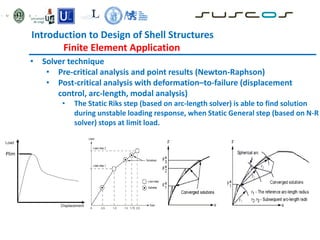
• Solver technique
• Pre-critical analysis and point results (Newton-Raphson)
• Post-critical analysis with deformation–to-failure (displacement
control, arc-length, modal analysis)
• The Static Riks step (based on arc-length solver) is able to find solution
during unstable loading response, when Static General step (based on N-R
solver) stops at limit load.
Plim
Introduction to Design of Shell Structures
Finite Element Application
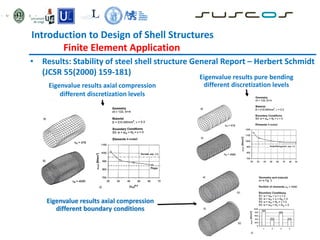
• Results: Stability of steel shell structure General Report – Herbert Schmidt
(JCSR 55(2000) 159-181)
Eigenvalue results pure bending
different discretization levels
Eigenvalue results axial compression
different boundary conditions
Eigenvalue results axial compression
different discretization levels
Introduction to Design of Shell Structures
Finite Element Application
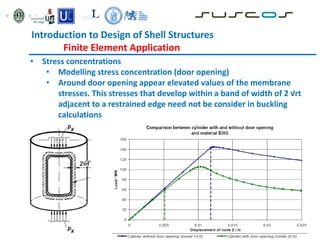
• Stress concentrations
• Modelling stress concentration (door opening)
• Around door opening appear elevated values of the membrane
stresses. This stresses that develop within a band of width of 2 √rt
adjacent to a restrained edge need not be consider in buckling
calculations
Introduction to Design of Shell Structures
Finite Element Application
Introduction to Design of Shell Structures
Finite Element Application and Case Study
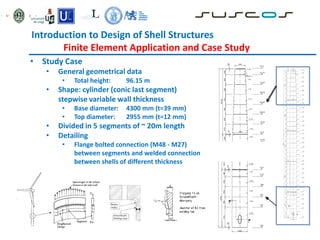
• Study Case
• General geometrical data
• Total height: 96.15 m
• Shape: cylinder (conic last segment)
stepwise variable wall thickness
• Base diameter: 4300 mm (t=39 mm)
• Top diameter: 2955 mm (t=12 mm)
• Divided in 5 segments of ~ 20m length
• Detailing
• Flange bolted connection (M48 - M27)
between segments and welded connection
between shells of different thickness
Introduction to Design of Shell Structures
Finite Element Application and Case Study
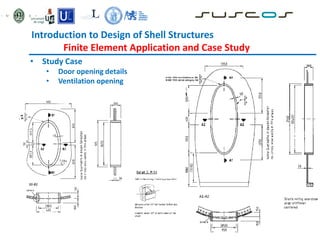
• Study Case
• Door opening details
• Ventilation opening
Introduction to Design of Shell Structures
Finite Element Application and Case Study
• Study Case
• Numerical models
• Simplified bar model
• Refined local segment model
• Relevant segments
• Door opening segment
• Entire model
• Verification procedures
• Analytical determination of moment capacity (LA) →MRd
• Characteristic buckling resistance (LBA + MNA)
• The plastic reference resistance → Rpl
• The elastic critical buckling resistance → Rcr
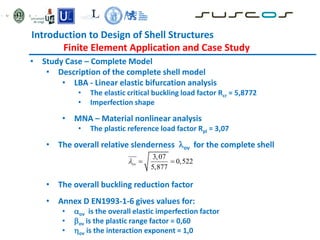
• The overall buckling reduction factor
• Characteristic buckling resistance (GMNIA)
• Calibration factor k GMNIA GMNIA
R k R

k ov pl
R R


Introduction to Design of Shell Structures
Finite Element Application and Case Study
• Study Case
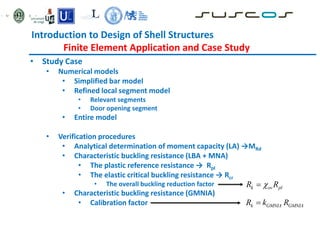
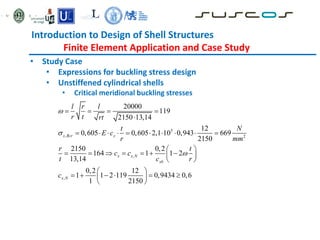
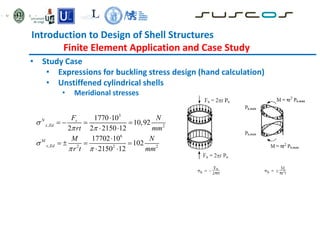
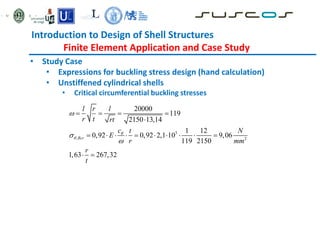
• Expressions for buckling stress design
• Unstiffened cylindrical shells
• Critical meridional buckling stresses
5
, 2
,
,
20000
119
2150 13,14
12
0,605 0,605 2,1 10 0,943 669
2150
2150 0,2
164 1 1 2
13,14
0,2 12
1 1 2 119 0,9434 0,6
1 2150
x Rcr x
x x N
xb
x N
l r l
r t rt
t N
E c
r mm
r t
c c
t c r
c



   

         
 
      
 
 
 
     
 
 
Introduction to Design of Shell Structures
Finite Element Application and Case Study
• Study Case
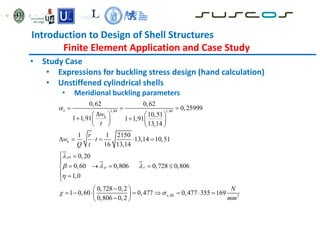
• Expressions for buckling stress design (hand calculation)
• Unstiffened cylindrical shells
• Meridional buckling parameters
1,44 1,44
0
,
0,62 0,62
0,25999
10,51
1 1,91 1 1,91
13,14
1 1 2150
13,14 10,51
16 13,14
0,20
0,60 0,806 0,728 0,806
1,0
0,728 0,2
1 0,60 0,477 0,477
0,806 0,2
x
k
k
x
p x
x Rk
w
t
r
w t
Q t


  

 
  

   
 
   
   
     
 

    

 


 
      
 

 
2
355 169
N
mm

Introduction to Design of Shell Structures
Finite Element Application and Case Study
• Study Case
• Expressions for buckling stress design (hand calculation)
• Unstiffened cylindrical shells
• Meridional stresses
3
, 2
6
, 2 2 2
1770 10
10,92
2 2 2150 12
17702 10
102
2150 12
N x
x Ed
M
x Ed
F N
rt mm
M N
r t mm

 

 

   
 

   
 
Introduction to Design of Shell Structures
Finite Element Application and Case Study
• Study Case
• Expressions for buckling stress design (hand calculation)
• Unstiffened cylindrical shells
• Critical circumferential buckling stresses
5
, 2
20000
119
2150 13,14
1 12
0,92 0,92 2,1 10 9,06
119 2150
1,63 267,32
Rcr
l r l
r t rt
c t N
E
r mm
r
t





   

         
 
Introduction to Design of Shell Structures
Finite Element Application and Case Study
• Study Case
• Expressions for buckling stress design (hand calculation)
• Unstiffened cylindrical shells
• Circumferential buckling parameters
0
,
2 2
2
0,5 ( )
0,40
0,60 1,12 6,26 1,12
1,0
0,5
0,0128 0,0128 355 4,53
6,26
p
Rk
ClassC
N
mm






  


 


 

    

 

      
3
, 2
2150
1,5 1,102 10 0,296
12
Ed n
r N
p
t mm

 
    
Introduction to Design of Shell Structures
Finite Element Application and Case Study
• Study Case – Complete Model
• Imperfection amplitude
0, ,1 1
eff g n
w l U
 
4 4 4300 12 908,63
gx
l rt mm
    
Fabrication tolerance
quality class
Description
Value
of Un1
Geometric tolerance
normal to the
shell surface
Class A Excellent 0,010 9,086
Class B High 0,016 14,538
Class C Normal 0,025 22,7158
Introduction to Design of Shell Structures
Finite Element Application and Case Study
• Study Case – Complete Model
• LA / MNA at reference load results
• Local plastic zones around
connecting flanges
• LBA results Rcr = 5,877
Bottom
section
Axial
force
[kN]
Shear
force
[kN]
Bending
moment
[kNm]
LA 4323 1260 80088
MNA 4323 1260 80088
Introduction to Design of Shell Structures
Finite Element Application and Case Study
• Study Case – Complete Model
• MNA Rpl = 3,07
• GMNA Rpl = 1,77
• GMNIA Rpl = 1,49
0
0.5
1
1.5
2
2.5
3
3.5
0 1 2 3 4 5 6
Displacement [m]
Load
factor
R
GMNA
MNA
GMNIA
Reactions
at
Axial
force
[kN]
Shear
force
[kN]
Bending
moment
[kNm]
R = 1 4323 1260 80088
Introduction to Design of Shell Structures
Finite Element Application and Case Study
• Study Case – Complete Model
• Description of the complete shell model
• LBA - Linear elastic bifurcation analysis
• The elastic critical buckling load factor Rcr = 5,8772
• Imperfection shape
• MNA – Material nonlinear analysis
• The plastic reference load factor Rpl = 3,07
• The overall relative slenderness ov for the complete shell
• The overall buckling reduction factor
• Annex D EN1993-1-6 gives values for:
• ov is the overall elastic imperfection factor
• ov is the plastic range factor = 0,60
• ov is the interaction exponent = 1,0
3,07
0,522
5,877
ov
  
Introduction to Design of Shell Structures
Finite Element Application and Case Study
• Study Case – Refined door opening segment
LBA results Rcr = 12.248
• Numerical model
Section
Axial force
[kN]
Shear force
[kN]
Bending moment
[kNm]
Upper section 4413 1231 73988
Bottom section 4413 1231 88514
Introduction to Design of Shell Structures
Finite Element Application and Case Study
• Study Case – Refined door opening segment
• LA Results
• GMNA Results
Bottom segment
0
0.5
1
1.5
2
2.5
3
0 50 100 150 200 250 300
Displacement [mm]
Load
factor
GMNA
Introduction to Design of Shell Structures
Finite Element Application and Case Study
• Study Case – Refined door opening segment
• Numerical model
Section Axial force
[kN]
Shear force
[kN]
Bending moment
[kNm]
Upper section 1586 409 13055
Bottom section 2015 666 23897
max 2
1 2150
0,46 1 0,1 0,46 1 0,1 0,514
119 13,14
20000
119
2150 13,14
0,541 1430 1,5 1102
w
eq w
c r
k
t
l r l
r t rt
N
q k q
m



   
     
   
 
 
 
 
   

    
• Transformation of typical wind pressure load distribution
• LA Rpl = (126/355)=2,82
• Study Case – Refined door opening segment
• LBA Results
Section Rcr
Without EWL 6,8006
With EWL 6,8003
• GMNIA results
• Imperfection afine first buckling mode
• Amplitude of imperfection 23mm and 17mm
corresponding to normal and high tolerance
Quality class kGMNIA
High (~17 mm) 1,79
Normal (~23 mm) 1,72
Relevant segment
0
0.2
0.4
0.6
0.8
1
1.2
1.4
1.6
1.8
2
0 0.002 0.004 0.006 0.008 0.01 0.012 0.014 0.016
Rotation [rad]
Load
factor
GMNIA normal
GMNIA high
kGMNIA
Introduction to Design of Shell Structures
Finite Element Application and Case Study

L16_17_Shell structures.pdf

  • 1.
    Introduction to ShellStructures Assoc. Prof. Adrian Dogariu
  • 2.
    • Metalic shells Introductionto Design of Shell Structures General
  • 3.
    • Natural shells Introductionto Design of Shell Structures General
  • 4.
    • Natural shells Introductionto Design of Shell Structures General
  • 5.
    • Definition: • Ashell is a thin structure composed of curved sheets of material, so that the curvature plays an important role in the structural behavior, realizing a spatial form • Motivation: • A shell is the most efficient way of using the material, and can be very useful in case o storage of fluids and solids (uniform loads) Introduction to Design of Shell Structures General
  • 6.
    • The curvedform may lead to different failure modes and often unexpected behavior occurs • The analytical formulas are very complex and complicated in comparison with all the other structural forms • Shell structures are very attractive light weight structures which are especially suited to building as well as industrial applications. Introduction to Design of Shell Structures Difficulties
  • 7.
    • The shellstructure is typically found • in nature • as well as in classical architecture. • There are two principal uses of shells in civil engineering: • industrial structures: – silos, tanks, cooling towers, reactor vessels etc. • aesthetic and architectural special structures Introduction to Design of Shell Structures Range of application
  • 8.
    • Eurocode onstrength and stability of Steel Shell Structures – EN1993 Part 1.6 (2007) • Generic normative standard on shells for chimneys, towers, masts, silos, tanks, pipelines • Buckling of Steel Shells European Design Recommendations 5th Edition (ECCS – 2008) Main documents 8
  • 9.
    • Built structuralshells Introduction to Design of Shell Structures General
  • 10.
    • Built structuralshells Introduction to Design of Shell Structures General Reinforced concrete Steel Aluminium alloys Plastics Glass Timber
  • 11.
    Introduction to Designof Shell Structures Structural typologies Eliptic paraboloid Hyperbolic paraboloid Circular cylinder/cone
  • 12.
    Introduction to Designof Shell Structures Structural typologies Shells are the most difficult form of structure to analyse and the form with the most complex behaviour. As a result, all but the simplest conditions must be analysed using computers.
  • 13.
    Introduction to Designof Shell Structures Examples – Steel reticulated dome US pavilion Expo 67 Montreal Architect: Buckminster Fuller & Shoji Sadao The 250ft diameter by 200ft high dome roughly presents a three-quarter sphere, while geodesic domes before 1967 were hemispherical. The dome consists of steel pipes and 1,900 acrylic panels. To keep the indoor temperature acceptable, the design included mobile triangular panels that would move over the inner surface following the sun. Although brilliant on paper, this feature was too advanced for its time and never worked.
  • 14.
    Introduction to Designof Shell Structures Examples – Aluminium alloy reticulated dome Spruce Goose dome, Long Beach, USA Architect: R. Duell and Associates Engineer/builder: Temcor A - Aluminum cover plate with silicone seal B - Aluminum gusset plates, bolted to struts C - Aluminum batten secure silicone gaskets D - Triangular aluminum panels E - Wide-flange aluminum struts F - Stainless steel bolts
  • 15.
    Introduction to Designof Shell Structures Examples – Timber-steel free form grid shell Multi-hall, Mainz, Germany Architect: Mutschler, Frei Otto, consultant Engineer: Ove Arup The multi-purpose dome for the 1975 garden show spans max. 60m with 50x50mm twin wood slats of 50cm squares that deformed into rhomboids. 1 - Form-finding model 2 - Interior 3 - Mesh detail (steel bands resist shear)
  • 16.
    Introduction to Designof Shell Structures Examples – Timber-steel free form grid shell Architect: Thomas Herzog Engineer: Julius Natterer Wood grid shell with PTFE membrane The theme pavilion advanced the philosophy: • Wood is the only renewable material • Requires the least energy for production • Use of wood maintains healthy forests
  • 17.
    • Continuous (orreticulated) shells • Linear behaviour • Non-linear behaviour • Elastic • Elastic-plastic Introduction to Design of Shell Structures Shell Analysis Shell Continuous Reticulated (bar structures) Curved shapes Plated structures Bending stress state Membrane stress state
  • 18.
    • Resistance • Stability •Highly sensitive to imperfections • Buckling is a process by which a structure cannot withstand loads with its original shape, so that it changes this shape in order to find a new equilibrium configuration. This is an undesired process (from the point of view of the engineer), and occurs for a well–defined value of the load. • The consequences of buckling are basically geometric: • The are large displacements in the structure • There may also be consequences for the material, in the sense that deflections may induce plasticity in the walls of the structure Introduction to Design of Shell Structures Shell Design Local buckling of a tank Global buckling of a wind turbine tower
  • 19.
    Introduction to Designof Shell Structures Steel Shell Design: Codification Conceptual design Design for strength and buckling Detailing
  • 20.
    Introduction to Designof Shell Structures Behavioural phenomenology of shells • Behavior of a given structure (slender!) can be controlled by design if the three characteristic ranges of load-deformation curve are correctly defined • Pre-critical range • Critical point (or range) • Post-critical range P D Pcr Critical point Post-critical range Pre-critical range P(0, Pcr]  Structural stability P > Pcr  Structural instability elastic Buckling: plastic dynamic
  • 21.
    Introduction to Designof Shell Structures Behavioural phenomenology of shells • Instability phenomenon e.g. bifurcation instability of cylinders L L  N inf , x cr N sup , x cr N
  • 22.
    Introduction to Designof Shell Structures Behavioural phenomenology of shells EREN Exhibition hall, Bucharest, 1963 • Instability phenomenon – Jump of Equilibrium or Snap Through Instability • Affects shallow arches and shells, reticulated shells
  • 23.
    Introduction to Designof Shell Structures Critical and post-critical behaviour of elastic structures u Perfect bar length (unloaded) P w Pcr P w A Perfect bar Imperfect bar w0 P u w P Perfect cylinder length (unloaded) Pcr P Perfect cylindrical shell w0 w Imperfect cylindrical shell Imperfect plate Perfect plate w0 P Pcr w P P length (unloaded) u Perfect plate w Columns indifferent post-critical path Cylinders unstable post-critical path Plates stable post-critical path
  • 24.
    Introduction to Designof Shell Structures Favourable and unfavourable effects of spatiality     2 2 2 2 2 , 2 2 2 , 4 1 3 1 3                        r b E b t E b t E c cr p cr        Stable component Unstable component increase in critical load increase in sensitivity to geometrical imperfections • Curvature effect in axial compression
  • 25.
    Introduction to Designof Shell Structures Favourable and unfavourable effects of spatiality increase in critical load increase in sensitivity to geometrical imperfections • Curvature effect in axi-symetrical compression
  • 26.
    Introduction to Designof Shell Structures Coupled instabilities for plate and shell elements W – weak interaction M – moderate interaction S – strong interaction VS – very strong interaction
  • 27.
    Introduction to Designof Shell Structures Coupled instabilities for plate and shell elements • Erosion of Theoretical Critical Buckling Load
  • 28.
    Introduction to Designof Shell Structures Instability phenomena: Influence of imperfections • Agreement of theoretical and experimental values bars shells
  • 29.
    Introduction to Designof Shell Structures Instability phenomena: basic types and models • Dynamic propagation of instability or progressive instability • Domino effect (double layer grids) • Instability propagation (single layer reticulated shells)
  • 30.
    Introduction to Designof Shell Structures Models and Methods of Analysis • Pre-Critical, Critical and Post-Critical Analysis • Generic classification of structures in terms of characteristic instability types and sensitivity to imperfections • Linear, nonlinear, elastic, plastic models • Linear buckling analysis (eigen-buckling) – LBA • Geometrical nonlinear imperfection analysis – GNIA • Geometrical material nonlinear imperfection analysis – GMNIA • Pre-critical solver methods (Newton – Raphson) or • Post-critical solver methods (Arc-length); Designed load checking or load-deformation curve
  • 31.
    Introduction to Designof Shell Structures Models and Methods of Analysis • Design flowchart for the Design of Shells according to EN 1993-1-6
  • 32.
    Introduction to Designof Shell Structures Methods of Analysis • Methods of Analysis – Global Frame Analysis • Finite Elements Methods for Analysis and Design Load-displacement curves found using different analyses of the same structure (Rotter, 2011)
  • 33.
    Introduction to Designof Shell Structures Methods of Analysis • Basic modes for behaviour a) Membrane b) Bending shell c) Shell like a member a) c)
  • 34.
    Introduction to Designof Shell Structures Methods of Analysis • Basic Equations • Simplified Linear Shell Theory • The Love-Kirchhoff assumptions (simplified model) • The shell thickness is negligibly small in comparison with the least radius of curvature of the shell middle surface (shell is thin) • Strains and displacements that arise within the shell are small (products of deformations quantities that occur in the derivation of the theory may be neglected, ensuring that the system is described by a set of geometrically linear equations) • Straight lines that are normal to the middle surface prior to deformation remain straight and normal to the middle surface during deformation and experience no change in length (analogue to hypothesis for beams – plane sections before bending remain plane after bending) • The direct stress actin in the direction normal to the shell middle surface is negligible (not valid in the vicinity of concentrated transverse loads)
  • 35.
    Introduction to Designof Shell Structures Methods of Analysis • Model of an axi-symmetrical Loaded Shell Geometrical parameter of the spherical shell Model of an axisymetrically loaded shell
  • 36.
    Introduction to Designof Shell Structures Methods of Analysis • General Rotation Shell • Membrane Theory: Equilibrium Equations for Unsymmetrical Actions   0 1 1 1 0 cos 0 N N r r N r Yr r                 0 1 1 0 1 cos 0 N r N r N r Xr r               1 2 0 N N z r r     
  • 37.
    Introduction to Designof Shell Structures Methods of Analysis • Cylindrical Shells • Bending Theory Axisymmetric Loading 0 x dN a dx d dx     0 x dQ a dx d N dx d Z a dx d dx              0 x x dM a dx d Q a dx d dx          4 4 2 d w Eh D w Z dx a     3 3 12 1 Eh D    ;
  • 38.
    Introduction to Designof Shell Structures Methods of Analysis • Shells • General Bending Theory 0 x x N N a x         0 x N N a Q x            0 x Q Q a N q a x             0 x x x M M a aQ x           0 x M M a aQ x            0 x x N N a x         1 0 x x N N M M a x x a                   2 2 2 2 2 2 1 0 x x x M M M M N a q a x x a x                        
  • 39.
    Introduction to Designof Shell Structures Methods of Analysis • Basic Equations Aspect Equation Unknown 1. Equilibrium equations (static) 5 8 2. Deformability compatibility (geometric) 9 12 3. Physical aspect 6 --- TOTAL 20 20
  • 40.
    Introduction to Designof Shell Structures Methods of Analysis • Buckling of Cylindrical Shells in Compression • General Case l x, u y, v z, w  2a   buckling symetrical axial x f w u n v l x m n C w l x m n B v l x m n A u x M a M x M x M a N x w aN a M x M x v aN x N a N N x N a xy y yx x y x x xy x x y yz x                                                , 0 0 sin sin sin cos cos sin 0 0 0 2 2 2 2 2 2 2 2 2 2             Equilibrium equations for elastic buckling: with solutions:
  • 41.
    Introduction to Designof Shell Structures Methods of Analysis • Cylindrical Shells • Membrane Theory Application for Wind Action 2 0 cos q N r     2 sin N q      0 cos N qr    
  • 42.
    Introduction to Designof Shell Structures Methods of Analysis • Simplified Design Formulae (Cylindrical shells) • Two possible approaches • Overall column buckling if l/r ratio is large • Shell buckling which involves the cross section deformation and can be, in general, either: • Axisymmetric, when the displacement are constant around circumferential section • Asymmetric (chessboard shape), when waves are formed in both axial circumferential directions r=a l
  • 43.
    Introduction to Designof Shell Structures Methods of Analysis • Simplified Design Formulae • Axial-symmetric buckling of cylindrical shell in compression • In case of axial-symmetrical buckling, the critical shear does not depend of cylinder length! • If one of the cylinder ends is free (w0), cr drops to 38% compared to simple supported case. • Cylinder is highly sensitive to tangential displacements at the boundaries. If v  0, critical stress drops to 50%!   4 2 4 2 2 3 2 0 12 1 x d v d w w D N Eh dx dx a Eh D       Elastic critical axial stress ( ) sin m x w A l    Radial displacement:   2 3 1 cr Eh a     4 2 m Eh l a D   ; For =0.3  cr cr N h   1.72 l ah m 
  • 44.
    Introduction to Designof Shell Structures Methods of Analysis • Simplified Design Formulae • Axial-symmetric buckling of cylindrical shell in compression Post-elastic critical buckling   2 3 1 t cr h EE a     1.72 t E l ah m E    0  fp fy 0 t E tg E tg    
  • 45.
    Introduction to Designof Shell Structures Methods of Analysis • Simplified Design Formulae • Axial-symmetric buckling of cylindrical shell in compression • Post-critical buckling: stable and unstable components 2 2 2 2 2 2 2 cr cr N m E l D h hl a D m               2 2 2 2 cr m Eh h N D l m a                   Stable component (inextensional bending deformation – x direction) Unstable component (extensionally circumferential deformation – y direction
  • 46.
    Introduction to Designof Shell Structures Methods of Analysis • Simplified Design Formulae • Axial-symmetric buckling of cylindrical shell in compression • Post-critical buckling equation • The effect of circumferential extensional deformations increases the value of critical load, but change the type of instability from stable to unstable! 2 2 2 2 1 3 1 8 8 m m cr cr N Eh l N m N a             Stable component Unstable component
  • 47.
    Introduction to Designof Shell Structures Methods of Analysis • Simplified Design Formulae • Axial-symmetric buckling of cylindrical shell in compression • Examples: medium length cylinder • (i,j) i = no. of longitudinal half-length waves; j = no. of circumferential half-length waves
  • 48.
    Introduction to Designof Shell Structures Methods of Analysis • Simplified Design Formulae • Axial-symmetric buckling of cylindrical shell in compression • Examples: long cylinder
  • 49.
    Introduction to Designof Shell Structures Methods of Analysis • Simplified Design Formulae • Axial-symmetric buckling of cylindrical shell in compression • Examples: short cylinder
  • 50.
    Introduction to Designof Shell Structures Methods of Analysis • Simplified Design Formulae • Axial-symmetric buckling of cylindrical shell in compression • Principle of ECCS approach (ECCS Recommendations 1998) • Real cylinders are highly sensitive to imperfections • “Knock-down” factor  is introduced to account for imperfections and for plastic effects •  depends on: • Shell geometry • Loading conditions • Initial imperfections • Material properties Test data and design curve (typical) for cylinders subject to axial compression d cr    
  • 51.
    Introduction to Designof Shell Structures Methods of Analysis • Simplified Design Formulae • Axial-symmetric buckling of cylindrical shell in compression • Principle of ECCS approach • For unstiffened cylinders, is similar to the one for column in axial compression 2 1 2 0.5 1 1 cr y n y M f f                 1.2 2 0.5 1 0.4123 cr y n y f f           Graphical presentation of ECCS “knock-down” factor ECCS design formulae for unstiffened cylinders
  • 52.
    Introduction to Designof Shell Structures Methods of Analysis • Simplified Design Formulae • Buckling of cylindrical shells under external pressure • Membrane (hoop) stress in practical range • Von Misses formula for critical pressure, cr ; 0 y x pa h     ; 0.5 y x pa h         2 2 2 2 2 2 3 3 2 1 3 1 1 2 1 1 12 1 ; 1 cr Eh h n n a a n a n l                                             1 2 2 2 2 1 3 2 2 2 3 1 1 1 2 2 12 cr Eh h n a n a p                            n  min pcr Simplified formulae for long cylinders     3 2 3 2 1 12 1 cr Eh n a p     external uniform pressure “hydrostatic” type pressure
  • 53.
    Introduction to Designof Shell Structures Methods of Analysis • Simplified Design Formulae • Buckling of cylindrical shells under external pressure • Principle of ECCS approach 2 ; 0.5 1 u y p p        2 1 0 1 1 u y p p       y cr p p           min cr h P E a           1.5 min 2 0.855 1 a h l a           for l/a0.5  ECCS design strength for unstiffened cylinder under uniform pressure
  • 54.
    Introduction to Designof Shell Structures Methods of Analysis • Simplified Design Formulae • Buckling of cylindrical shells under external pressure • Principle of ECCS approach • Wind action is more complex than simply an external pressure • It is needed to check the cylinder stability separately for: • Wind radial pressure • Wind axial effects • Wind tangent effects • Interaction of the three • Approximately, wind critical pressure can be taken as 1.6 times critical external pressure (Maderspach, Gaunt, Sword ) • ECCS Design Recommendations (No. 125/2008) offers also a solution
  • 55.
    Introduction to Designof Shell Structures Methods of Analysis • Simplified Design Formulae • Buckling of cylindrical shells under compression and external pressure , x x cr cr p p    Interaction curve
  • 56.
    Introduction to Designof Shell Structures Methods of Analysis • Simplified Design Formulae • Buckling of cylindrical shells in bending • (Flügge)  • Long cylinders (Brazier)      , , 1.33 x M N cr x cr x      2 2 0.99 1 cr M Eh a   
  • 57.
    Introduction to Designof Shell Structures Methods of Analysis • Simplified Design Formulae • Buckling of cylindrical shells in torsion • (Swerin and Flügge)  long cylinders • (Donnel)  short and medium long cylindrical shells • Fixed end • Simple Supported End   3 2 3 4 2 3 2 1 cr E h a             1 2 2 3 2 2 2 4.6 7.8 1.67 1 2 1 cr E h l l ah                                         1 2 3 2 2 2 2 2 2.8 2.6 1.4 1 2 1 cr E h l l ah                                          
  • 58.
    Introduction to Designof Shell Structures Methods of Analysis • Simplified Design Formulae • Cylindrical shells under interactive buckling • Bending + torsion • Compression + torsion • External pressure + torsion 2 1 cr cr               2 , 1 x cr cr               2 1 cr cr p p             • Bending + external pressure • Axial compression + external pressure + torsion • Axial compression + bending + torsion 2 2 , 1 1 0.9 x cr cr x cr cr M p p or M p p                       2 , 1 x cr cr cr p p                2 , , 1 x x N M cr x cr x cr                 
  • 59.
    • Basis ofdesign and modelling • Shells shall be designed in acc. with EN1990 and, in particular, to satisfy the following requirements: • Overall equilibrium • Equilibrium between actions and internal forces and moments • Limitation of cracks due to cyclic plastification • Limitation of cracks due to fatigue • Types of analysis: • Global analysis • Membrane theory analysis • Linear elastic shell analysis • Linear elastic bifurcation analysis • Geometrically nonlinear elastic analysis • Materially nonlinear analysis • Geometrically and materially nonlinear analysis • Geometrically nonlinear elastic analysis with imperfections included • Geometrically and materially nonlinear analysis with imperfections Introduction to Design of Shell Structures Design of Steel Structures: Strength and Stability of Shells
  • 60.
    • Basis ofdesign and modelling • Shells shall be designed in acc. with EN1990 and, in particular, to satisfy the following requirements: • Overall equilibrium • Equilibrium between actions and internal forces and moments • Limitation of cracks due to cyclic plastification • Limitation of cracks due to fatigue • Types of analysis: • Global analysis • Membrane theory analysis • Linear elastic shell analysis • Linear elastic bifurcation analysis • Geometrically nonlinear elastic analysis • Materially nonlinear analysis • Geometrically and materially nonlinear analysis • Geometrically nonlinear elastic analysis with imperfections included • Geometrically and materially nonlinear analysis with imperfections approximate treatments of certain parts of the structure Introduction to Design of Shell Structures Design of Steel Structures: Strength and Stability of Shells
  • 61.
    • Basis ofdesign and modelling • Shells shall be designed in acc. with EN1990 and, in particular, to satisfy the following requirements: • Overall equilibrium • Equilibrium between actions and internal forces and moments • Limitation of cracks due to cyclic plastification • Limitation of cracks due to fatigue • Types of analysis: • Global analysis • Membrane theory analysis • Linear elastic shell analysis • Linear elastic bifurcation analysis • Geometrically nonlinear elastic analysis • Materially nonlinear analysis • Geometrically and materially nonlinear analysis • Geometrically nonlinear elastic analysis with imperfections included • Geometrically and materially nonlinear analysis with imperfections Conditions of use: - the boundary conditions are appropriate for transfer of the stresses in the shell into support reactions without causing bending effects; - the shell geometry varies smoothly in shape (without discontinuities); - the loads have a smooth distribution (without locally concentrated or point loads). Introduction to Design of Shell Structures Design of Steel Structures: Strength and Stability of Shells
  • 62.
    • Basis ofdesign and modelling • Shells shall be designed in acc. with EN1990 and, in particular, to satisfy the following requirements: • Overall equilibrium • Equilibrium between actions and internal forces and moments • Limitation of cracks due to cyclic plastification • Limitation of cracks due to fatigue • Types of analysis: • Global analysis • Membrane theory analysis • Linear elastic shell analysis • Linear elastic bifurcation analysis • Geometrically nonlinear elastic analysis • Materially nonlinear analysis • Geometrically and materially nonlinear analysis • Geometrically nonlinear elastic analysis with imperfections included • Geometrically and materially nonlinear analysis with imperfections -linear elastic material law - linear small deflection theory (undeformed geometry) Introduction to Design of Shell Structures Design of Steel Structures: Strength and Stability of Shells
  • 63.
    • Basis ofdesign and modelling • Shells shall be designed in acc. with EN1990 and, in particular, to satisfy the following requirements: • Overall equilibrium • Equilibrium between actions and internal forces and moments • Limitation of cracks due to cyclic plastification • Limitation of cracks due to fatigue • Types of analysis: • Global analysis • Membrane theory analysis • Linear elastic shell analysis • Linear elastic bifurcation analysis • Geometrically nonlinear elastic analysis • Materially nonlinear analysis • Geometrically and materially nonlinear analysis • Geometrically nonlinear elastic analysis with imperfections included • Geometrically and materially nonlinear analysis with imperfections LBA - linear elastic material law - linear small deflection theory - imperfections of all kinds are ignored - the basis of the critical buckling resistance evaluation Introduction to Design of Shell Structures Design of Steel Structures: Strength and Stability of Shells
  • 64.
    • Basis ofdesign and modelling • Shells shall be designed in acc. with EN1990 and, in particular, to satisfy the following requirements: • Overall equilibrium • Equilibrium between actions and internal forces and moments • Limitation of cracks due to cyclic plastification • Limitation of cracks due to fatigue • Types of analysis: • Global analysis • Membrane theory analysis • Linear elastic shell analysis • Linear elastic bifurcation analysis • Geometrically nonlinear elastic analysis • Materially nonlinear analysis • Geometrically and materially nonlinear analysis • Geometrically nonlinear elastic analysis with imperfections included • Geometrically and materially nonlinear analysis with imperfections GNA -change in the geometry of the structure - the elastic buckling load of the perfect structure Introduction to Design of Shell Structures Design of Steel Structures: Strength and Stability of Shells
  • 65.
    • Basis ofdesign and modelling • Shells shall be designed in acc. with EN1990 and, in particular, to satisfy the following requirements: • Overall equilibrium • Equilibrium between actions and internal forces and moments • Limitation of cracks due to cyclic plastification • Limitation of cracks due to fatigue • Types of analysis: • Global analysis • Membrane theory analysis • Linear elastic shell analysis • Linear elastic bifurcation analysis • Geometrically nonlinear elastic analysis • Materially nonlinear analysis • Geometrically and materially nonlinear analysis • Geometrically nonlinear elastic analysis with imperfections included • Geometrically and materially nonlinear analysis with imperfections MNA - gives the plastic limit load and the plastic strain increment Δε Introduction to Design of Shell Structures Design of Steel Structures: Strength and Stability of Shells
  • 66.
    • Basis ofdesign and modelling • Shells shall be designed in acc. with EN1990 and, in particular, to satisfy the following requirements: • Overall equilibrium • Equilibrium between actions and internal forces and moments • Limitation of cracks due to cyclic plastification • Limitation of cracks due to fatigue • Types of analysis: • Global analysis • Membrane theory analysis • Linear elastic shell analysis • Linear elastic bifurcation analysis • Geometrically nonlinear elastic analysis • Materially nonlinear analysis • Geometrically and materially nonlinear analysis • Geometrically nonlinear elastic analysis with imperfections included • Geometrically and materially nonlinear analysis with imperfections GMNA - gives the geometrically nonlinear plastic limit load and the plastic strain increment Introduction to Design of Shell Structures Design of Steel Structures: Strength and Stability of Shells
  • 67.
    • Basis ofdesign and modelling • Shells shall be designed in acc. with EN1990 and, in particular, to satisfy the following requirements: • Overall equilibrium • Equilibrium between actions and internal forces and moments • Limitation of cracks due to cyclic plastification • Limitation of cracks due to fatigue • Types of analysis: • Global analysis • Membrane theory analysis • Linear elastic shell analysis • Linear elastic bifurcation analysis • Geometrically nonlinear elastic analysis • Materially nonlinear analysis • Geometrically and materially nonlinear analysis • Geometrically nonlinear elastic analysis with imperfections included • Geometrically and materially nonlinear analysis with imperfections GNIA - where compression or shear stresses dominate in the shell - elastic buckling loads of the "real" imperfect structure Introduction to Design of Shell Structures Design of Steel Structures: Strength and Stability of Shells
  • 68.
    • Basis ofdesign and modelling • Shells shall be designed in acc. with EN1990 and, in particular, to satisfy the following requirements: • Overall equilibrium • Equilibrium between actions and internal forces and moments • Limitation of cracks due to cyclic plastification • Limitation of cracks due to fatigue • Types of analysis: • Global analysis • Membrane theory analysis • Linear elastic shell analysis • Linear elastic bifurcation analysis • Geometrically nonlinear elastic analysis • Materially nonlinear analysis • Geometrically and materially nonlinear analysis • Geometrically nonlinear elastic analysis with imperfections included • Geometrically and materially nonlinear analysis with imperfections GNIA - where compression or shear stresses dominate in the shell - elastic buckling loads of the "real" imperfect structure GMNIA - gives the elasto-plastic buckling loads for the "real" imperfect structure Introduction to Design of Shell Structures Design of Steel Structures: Strength and Stability of Shells
  • 69.
    • Basis ofdesign and modelling • Shells shall be designed in acc. with EN1990 and, in particular, to satisfy the following requirements: • Overall equilibrium • Equilibrium between actions and internal forces and moments • Limitation of cracks due to cyclic plastification • Limitation of cracks due to fatigue • Types of analysis: • Global analysis • Membrane theory analysis • Linear elastic shell analysis • Linear elastic bifurcation analysis • Geometrically nonlinear elastic analysis • Materially nonlinear analysis • Geometrically and materially nonlinear analysis • Geometrically nonlinear elastic analysis with imperfections included • Geometrically and materially nonlinear analysis with imperfections approximate treatments of certain parts of the structure Conditions of use: - the boundary conditions are appropriate for transfer of the stresses in the shell into support reactions without causing bending effects; - the shell geometry varies smoothly in shape (without discontinuities); - the loads have a smooth distribution (without locally concentrated or point loads). -linear elastic material law - linear small deflection theory (undeformed geometry) LBA - linear elastic material law - linear small deflection theory - imperfections of all kinds are ignored - the basis of the critical buckling resistance evaluation GNA -change in the geometry of the structure - the elastic buckling load of the perfect structure MNA - gives the plastic limit load and the plastic strain increment Δε GMNA - gives the geometrically nonlinear plastic limit load and the plastic strain increment GNIA - where compression or shear stresses dominate in the shell - elastic buckling loads of the "real" imperfect structure GMNIA - gives the elasto-plastic buckling loads for the "real" imperfect structure Introduction to Design of Shell Structures Design of Steel Structures: Strength and Stability of Shells Type of analysis Shell theory Material law Shell geometry Membrane theory of shells membrane equilibrium not applicable perfect Linear elastic shell analysis (LA) linear bending and stretching linear perfect Linear elastic bifurcation analysis (LBA) linear bending and stretching linear perfect Geometrically non-linear elastic analysis (GNA) non-linear linear perfect Materially non-linear analysis (MNA) linear non-linear perfect Geometrically and materially non-linear analysis (GMNA) non-linear non-linear perfect Geometrically non-linear elastic analysis with imperfections (GNIA) non-linear linear imperfect Geometrically and materially non-linear analysis with imperfections (GMNIA) non-linear non-linear imperfect
  • 70.
    • Materials andgeometry • The rules in EN 1993-1-6 are not limited to steel shell structures • The standard is valid for isotropic shells and shell segments made from any materials that may be represented as ideal elastic-plastic • For materials with no well defined yield point, 0.2% proof stress can be taken • The material properties apply to temperatures not exceeding 150 ºC (otherwise see EN 13084-7, 2005) • Where materials has a significant different stress strain curve, there are alternative ways of representation of the material behaviour • Bauschinger effect • For austenitic steels (and aluminium alloys) at higher plastic strains, Rasmussen (2003) curve is more appropriate than Ramberg-Osgood Introduction to Design of Shell Structures Design of Steel Structures: Strength and Stability of Shells
  • 71.
    • Materials andgeometry • The rules in EN 1993-1-6 are not limited to steel shell structures • The standard is valid for isotropic shells and shell segments made from any materials that may be represented as ideal elastic-plastic • For materials with no well defined yield point, 0.2% proof stress can be taken • The material properties apply to temperatures not exceeding 150 ºC (otherwise see EN 13084-7, 2005) • Where materials has a significant different stress strain curve, there are alternative ways of representation of the material behaviour • Bauschinger effect • For austenitic steels (and aluminium alloys) at higher plastic strains, Rasmussen (2003) curve is more appropriate than Ramberg-Osgood Introduction to Design of Shell Structures Design of Steel Structures: Strength and Stability of Shells
  • 72.
    • Geometrical tolerancesand imperfections • Relevant tolerances due to the requirements of serviceability: • out-of-roundness (deviation from circularity) • eccentricities (deviations from a continuous middle surface in the direction normal to the shell along junctions of plates) • local dimples (local normal deviations from the nominal middle surface) • Other forms of geometric imperfections: • deviations from nominal thickness • lack of evenness of supports • Material imperfections: • residual stresses caused by rolling, pressing, welding, straightening etc. • inhomogeneities and anisotropies • Wear and corrosion • Non-uniformities of loading • Residual stresses Introduction to Design of Shell Structures Design of Steel Structures: Strength and Stability of Shells
  • 73.
    • Geometrical tolerancesand imperfections • Relevant tolerances due to the requirements of serviceability: • out-of-roundness (deviation from circularity) • eccentricities (deviations from a continuous middle surface in the direction normal to the shell along junctions of plates) • local dimples (local normal deviations from the nominal middle surface) • Other forms of geometric imperfections: • deviations from nominal thickness • lack of evenness of supports • Material imperfections: • residual stresses caused by rolling, pressing, welding, straightening etc. • inhomogeneities and anisotropies • Wear and corrosion • Non-uniformities of loading • Residual stresses Introduction to Design of Shell Structures Design of Steel Structures: Strength and Stability of Shells
  • 74.
    • Ultimate limitstates in steel shells • LS1: Plastic limit • Identifies the strength of the structure when stability plays no significant role. • Covers two conditions: • tensile rupture or compressive yield through the full thickness • development of a plastic collapse mechanism involving bending • The plastic limit load is also relevant to a buckling strength assessment • The plastic limit load does not represent the real strength (even for stocky structures): strain hardening of material, stabilizing or destabilizing effects due to change in geometry Rpl - the plastic limit load Rcr - the elastic critical load Introduction to Design of Shell Structures Design of Steel Structures: Strength and Stability of Shells
  • 75.
    • Ultimate limitstates in steel shells • LS1: Plastic limit • Types of analysis: • MNA: often underestimates the strength very considerably • Membrane theory calculations: • If the stress state is entirely axisymmetric, it gives a close approximation to the true condition at plastic collapse • if the stresses are significantly unsymmetrical, this criterion often provides a very conservative estimate of the plastic limit load Introduction to Design of Shell Structures Design of Steel Structures: Strength and Stability of Shells
  • 76.
    • Ultimate limitstates in steel shells • LS1: Plastic limit • Types of analysis: • Linear elastic shell bending theory: This is commonly more conservative than membrane theory calculation (is based on the first yield on the surface) • Geometrically nonlinear calculation (GMNA): problems arise over whether the structure displays geometric hardening or geometric softening • The plastic limit load should be seen only as the ideal value of the plastic reference resistance Introduction to Design of Shell Structures Design of Steel Structures: Strength and Stability of Shells
  • 77.
    • Ultimate limitstates in steel shells • LS2: Cyclic plasticity: • Repeated cycles of loading and unloading, eventually leading to local cracking by exhaustion of the energy absorption capacity of the material • Low cycle fatigue failure may be assumed to be prevented if the procedures set out in the standard are adopted • Methods of analysis: • expressions in Annex C • elastic analysis (LA or GNA) • MNA or GMNA and find plastic strains • LS4: Fatigue: • Repeated cycles of increasing and decreasing stress lead to the development of a fatigue crack • Methods of analysis: • expressions in Annex C (using stress concentration factors) • elastic analysis (LA or GNA), using stress concentration factors Introduction to Design of Shell Structures Design of Steel Structures: Strength and Stability of Shells
  • 78.
    • Ultimate limitstates in steel shells • LS3: Buckling: • Caused by loss of stability under compressive membrane or shear membrane stresses in the shell wall, leading to inability to sustain any increase in the stress resultants, possibly causing catastrophic failure • Three approaches used in the assessment of buckling resistance: • GMNIA analysis • MNA/LBA analysis • Buckling stresses • The strength under LS3 depends strongly on the quality of construction • For this purpose, three fabrication quality classes are set out Introduction to Design of Shell Structures Design of Steel Structures: Strength and Stability of Shells
  • 79.
    • Design conceptsfor the limit states design of shells • The limit state verification should be carried out using one of the following: • Stress design: • primary • secondary • Local • Direct design by application of standard expressions: • the limit states may be represented by standard expressions that have been derived from either membrane theory, plastic mechanism theory or linear elastic analysis • The membrane theory (Annex A) - primary stresses needed for assessing LS1 and LS3. • The plastic design (Annex B) - plastic limit loads for assessing LS1 • The linear elastic analysis (Annex C) - stresses of the primary plus secondary stress type for assessing LS2 and LS4. An LS3 assessment may be based on the membrane part of these expressions. • Design by global numerical analysis may be replaced by stress resultants where appropriate In general, primary stress states control LS1, whereas secondary stress states affect LS2 and LS3 and local stresses govern LS4. Introduction to Design of Shell Structures Design of Steel Structures: Strength and Stability of Shells
  • 80.
    • Stress resultantsand stresses in shells • Stresses: • There are eight stress resultants in the shell • However, the shear stresses xn, θn due to the transverse shear forces qxn, qθn are insignificant and they may usually be neglected in design • For most design purposes, the evaluation of the limit states may be made using only the six stress resultants in the shell wall nx, nθ, nxθ, mx, mθ, mxθ • Where the structure is axisymmetric and subject only to axisymmetric loading and support, only nx, nθ, mx and mθ need be used • Modelling: • Represention by its middle surface • Nominal radius of curvature, imperfections neglected (excepting LS3) • Eccentricities and steps if they induce significant effects • Eccentricity at junctions between shell segments • Stringers, corrugations, holes, depending on the conditions • Boundary conditions Introduction to Design of Shell Structures Design of Steel Structures: Strength and Stability of Shells
  • 81.
    • Stress resultantsand stresses in shells • Stresses: • There are eight stress resultants in the shell • However, the shear stresses xn, θn due to the transverse shear forces qxn, qθn are insignificant and they may usually be neglected in design • For most design purposes, the evaluation of the limit states may be made using only the six stress resultants in the shell wall nx, nθ, nxθ, mx, mθ, mxθ • Where the structure is axisymmetric and subject only to axisymmetric loading and support, only nx, nθ, mx and mθ need be used • Modelling: • Represention by its middle surface • Nominal radius of curvature, imperfections neglected (excepting LS3) • Eccentricities and steps if they induce significant effects • Eccentricity at junctions between shell segments • Stringers, corrugations, holes, depending on the conditions • Boundary conditions Introduction to Design of Shell Structures Design of Steel Structures: Strength and Stability of Shells Boundary condition code Simple term Description Normal displacements Vertical displacements Meridional rotation BC1r Clamped radially restrained meridionally restrained rotation restrained w = 0 u = 0 βφ = 0 BC1f radially restrained meridionally restrained rotation free w = 0 u = 0 βφ ≠ 0 BC2r radially restrained meridionally free rotation restrained w = 0 u ≠ 0 βφ = 0 BC2f Pinned radially restrained meridionally free rotation free w = 0 u ≠ 0 βφ ≠ 0 BC3 Free edge radially free meridionally free rotation free w ≠ 0 u ≠ 0 βφ ≠ 0 NOTE: The circumferential displacement v is closely linked to the displacement w normal to the surface so separate boundary conditions are not identified in paragraph (3) for these two parameters.
  • 82.
    • Plastic limitstate (LS1) • The plastic reference resistance Rpl • Where it is not possible to undertake a materially non-linear analysis (MNA), the plastic reference resistance Rpl may be conservatively estimated from linear shell analysis (LA) conducted using the design values of the applied combination of actions using the following procedure. • The three points where obtain maximum values for stresses , 2 2 2 , , , , , 3 y k pl x Ed x Ed Ed Ed x Ed t f R n n n n n        Introduction to Design of Shell Structures Design of Steel Structures: Strength and Stability of Shells
  • 83.
    • Buckling limitstate (LS3) • To find out the design buckling resistance • Defined as a load factor R applied to the design values of the combination of actions for the relevant load case • Different approaches have been proposed, difficult to generalise • In EN 1993-1-6, a considerable effort to produce general procedures applicable to all geometries, all loading conditions and all material conditions • Buckling-relevant boundary conditions Introduction to Design of Shell Structures Design of Steel Structures: Strength and Stability of Shells
  • 84.
    • Buckling-relevant geometricaltolerances Introduction to Design of Shell Structures Design of Steel Structures: Strength and Stability of Shells
  • 85.
    • Stress design •Design values of stresses σx,Ed, σθ,Ed and xθ,Ed: taken as the key values of compressive and shear membrane stresses obtained from linear shell analysis (LA). • Design resistance (buckling strength): γM1 = min 1,1 λ0 - squash limit relative slenderness   3 f f f Rcr , x k y, Rcr , k y, Rcr x, k y, x              Introduction to Design of Shell Structures Design of Steel Structures: Strength and Stability of Shells
  • 86.
    • Stress limitation(buckling strength verification) • The influence of bending stresses may be neglected provided they arise as a result of boundary compatibility effects. • In the case of bending stresses from local loads or from thermal gradients, special consideration should be given. • Following checks for the key values of single membrane stress components should be carried out: • For more than one buckling-relevant membrane stress components, interaction check for the combined membrane stress state should be carried out: σx,Ed ≤ σx,Rd, σθ,Ed ≤ σθ,Rd, xθ,Ed ≤  xθ,Rd x,Ed ,Ed x,Ed ,Ed x, ,Ed x,Rd ,Rd x,Rd ,Rd x, ,Rd 1 x k k k i k                                                           Introduction to Design of Shell Structures Design of Steel Structures: Strength and Stability of Shells
  • 87.
    • Buckling design •EN 1993-1-6 specifies three approaches that are approved for use in the assessment of buckling resistance: • Design by means of a global numerical MNA/LBA analysis • Design by means of a global numerical GMNIA analysis • Design by means of buckling stresses Introduction to Design of Shell Structures Design of Steel Structures: Strength and Stability of Shells
  • 88.
    • Buckling designby global numerical MNA/LBA analysis • It is recommended for many applications • It has the same basis as the traditional stress design buckling approach • All relevant combinations of actions causing compressive membrane stresses or shear membrane stresses in the shell wall shall be taken into account • It involves the following steps, see left hand side figure   ,0 , , , , ov ov ov ov ov ov f        ov is the overall elastic imperfection factor, ov is the plastic range factor, ov is the interaction exponent and ov,0 is the squash limit relative slenderness Introduction to Design of Shell Structures Design of Steel Structures: Strength and Stability of Shells
  • 89.
    • Buckling designby global numerical MNA/LBA analysis • It is recommended for many applications • It has the same basis as the traditional stress design buckling approach • All relevant combinations of actions causing compressive membrane stresses or shear membrane stresses in the shell wall shall be taken into account • It involves the following steps, see left hand side figure The lowest eigenvalue (bifurcation load factor) should be taken as the critical buckling resistance Rcr   ,0 , , , , ov ov ov ov ov ov f        ov is the overall elastic imperfection factor, ov is the plastic range factor, ov is the interaction exponent and ov,0 is the squash limit relative slenderness Introduction to Design of Shell Structures Design of Steel Structures: Strength and Stability of Shells
  • 90.
    • Design byglobal numerical GMNIA analysis • Developed to exploit the full power of modern numerical analysis • Application is more complex than for frame or plated structures • Several sequence of analysis: • LA followed by a LBA to evaluate elastic critical buckling resistance • GMNA to identify the elastic-plastic buckling resistance of the perfect structure • GMNIA with different imperfection modes (the lowest value is selected) • Check the precision of the GMNIA by comparison with test or other relevant data • Methodology • Action combinations causing compressive membrane stresses or shear membrane stresses • Rk should be found from the imperfect elastic-plastic critical buckling resistance RGMNIA, adjusted by the calibration factor kGMNIA. • The design buckling resistance Rd should then be found using the partial factor γM1. C1: The maximum load factor on the load-deformation-curve (limit load); C2: The bifurcation load factor, where this occurs during the loading path before reaching the limit point of the load-deformation-curve C3: The largest tolerable deformation, where this occurs during the loading path before reaching the bifurcation load or the limit load C4: The load factor at which the equivalent stress at the most highly stressed point on the shell surface reaches the design value of the yield stress Introduction to Design of Shell Structures Design of Steel Structures: Strength and Stability of Shells
  • 91.
    • Design byglobal numerical GMNIA analysis • Developed to exploit the full power of modern numerical analysis • Application is more complex than for frame or plated structures • Several sequence of analysis: • LA followed by a LBA to evaluate elastic critical buckling resistance • GMNA to identify the elastic-plastic buckling resistance of the perfect structure • GMNIA with different imperfection modes (the lowest value is selected) • Check the precision of the GMNIA by comparison with test or other relevant data • Methodology • Action combinations causing compressive membrane stresses or shear membrane stresses • Rk should be found from the imperfect elastic-plastic critical buckling resistance RGMNIA, adjusted by the calibration factor kGMNIA. • The design buckling resistance Rd should then be found using the partial factor γM1. C1: The maximum load factor on the load-deformation-curve (limit load); C2: The bifurcation load factor, where this occurs during the loading path before reaching the limit point of the load-deformation-curve C3: The largest tolerable deformation, where this occurs during the loading path before reaching the bifurcation load or the limit load C4: The load factor at which the equivalent stress at the most highly stressed point on the shell surface reaches the design value of the yield stress A conservative assessment of RGMNIA may be obtained using a GNIA analysis and C4 criterion to determine the lowest load factor R Introduction to Design of Shell Structures Design of Steel Structures: Strength and Stability of Shells
  • 92.
    • GMNIA analysis •Allowances for imperfections: • geometric imperfections: pre-deformations, out of-roundness, irregularities at and near welds, thickness deviation, etc. • material imperfections: residual stresses, inhomogeneities, anisotropies • EN 1993-1-6 requires that imperfections are explicitly modelled numerically, not just treated as small perturbations in geometry • They are introduced by means of equivalent geometric imperfections in the form of initial shape deviations perpendicular to the middle surface of the perfect shell • The form of the imperfections with the most unfavorable effect should be considered (the most unfavorable effect on the buckling resistance RGMNIA of the shell); if practicable, they must reflect the constructional detailing and the boundary conditions Introduction to Design of Shell Structures Design of Steel Structures: Strength and Stability of Shells
  • 93.
    • GMNIA analysis •The analysis should be carried out for a sufficient number of different imperfection patterns, and the worst case (lowest value of RGMNIA) should be identified. • The eigen-mode-affine pattern should be used (the critical buckling mode associated with the elastic critical buckling resistance Rcr based on an LBA analysis of the perfect shell) • The amplitude of the imperfection form - dependent on the fabrication tolerance quality class Introduction to Design of Shell Structures Design of Steel Structures: Strength and Stability of Shells
  • 94.
    • Imperfections • Themaximum deviation of the geometry of the equivalent imperfection from the perfect shape ∆w0,eff = max (∆w0,eff,1; ∆w0,eff,2), where: • ni = 25 is a multiplier to achieve an appropriate tolerance level • t is the local shell wall thickness • lg is all relevant gauge lengths (see Dimple tolerances) 0, ,1 1 0, ,2 2 eff g n eff i n w l U w n tU       0.25 2 , 4 2,3 gx g l rt l l rt r     lg relevant gauge lengths t local shell wall thickness ni multiplier to achieve an appropriate tolerance level Un1, Un2 dimple imperfection Introduction to Design of Shell Structures Design of Steel Structures: Strength and Stability of Shells
  • 95.
    • GMNIA validation •For each calculated value of the buckling resistance RGMNIA, the ratio of the imperfect to perfect resistance (RGMNIA / RGMNA) should be determined and compared with values of  found using the procedures of 8.5 and Annex D. • The reliability of the numerically determined critical buckling resistance RGMNIA should be checked by one of the following methods: • by using the same program to calculate values RGMNIA, check for other shell buckling cases for which characteristic buckling resistance values Rk,known,check are known; • by comparison of calculated values (RGMNIA,check) against test results (Rtest,known,check). , , , , , , k know check test know check GMNIA GMNIA GMNIA check GMNIA check R R k k R R   Introduction to Design of Shell Structures Design of Steel Structures: Strength and Stability of Shells
  • 96.
    • GMNIA validation •Where a known characteristic value based on existing established theory is used to determine kGMNIA, and the calculated value of kGMNIA lies outside the range 0,8 < kGMNIA < 1,2, this procedure should not be used. • The characteristic buckling resistance should be obtained from: • RGMNIA is the calculated imperfect elastic-plastic critical buckling resistance; • kGMNIA is the calibration factor. k GMNIA GMNIA R k R  Introduction to Design of Shell Structures Design of Steel Structures: Strength and Stability of Shells
  • 97.
    • ANNEX A- Membrane theory stresses in shells Uniform axial load Axial load from bending Uniform shear from torsion Introduction to Design of Shell Structures Design of Steel Structures: Strength and Stability of Shells
  • 98.
    • ANNEX B- Additional expressions for plastic collapse resistances Cylinder: Radial line load Cylinder: Radial line load and axial load A = +/- sx − 1,50 x x y P s f t  PnR - plastic resistance (force per unit circumference) Introduction to Design of Shell Structures Design of Steel Structures: Strength and Stability of Shells
  • 99.
    • ANNEX C- Expressions for linear elastic membrane and bending stresses Cylinder, clamped: axial loading Cylinder, pinned: axial loading Introduction to Design of Shell Structures Design of Steel Structures: Strength and Stability of Shells
  • 100.
    • ANNEX D- Expressions for buckling stress design • Unstiffened cylindrical shells of constant wall thickness • Meridional (axial) compression • Critical meridional buckling stresses • Meridional buckling parameters • Circumferential (hoop) compression • Critical circumferential buckling stresses • Circumferential buckling parameters • Shear • Critical shear buckling stresses • Shear buckling parameters • Combinations of meridional (axial) compression, circumferential (hoop) compression and shear Cylinder geometry, membrane stress resistances and stress resultant resistances Introduction to Design of Shell Structures Design of Steel Structures: Strength and Stability of Shells
  • 101.
    Introduction to Designof Shell Structures Finite Element Application • Principles, simplified and advanced models, concentration of stresses, stiffening Hand calculation Simple computer calculations Complete computer calculations Formulas for: Bifurcation load Plastic limit Imperfection sensitivity Elastic plastic interaction Interaction between different stress components Computational evaluations: Bifurcation load Plastic limit Interaction between different stress components Computational evaluations: Bifurcation load Plastic limit Perfect structure strength Imperfect structure strength Formulas for: Imperfection sensitivity Elastic plastic interaction GNIA GMNIA LA LBA GNA MNA GMNA
  • 102.
    • Simplified FEMmodel • Global analysis • A simplified bar model using 1D beam finite elements, with or without the account of global imperfection, using an elastic material law. • Aim of analysis – find-out the internal forces needed for: • The global check of the tower capacity; • Refined local analysis of the relevant tower segments (between two consecutive flange that assure the appropriate boundary condition, radial restrained) • Local analysis of a tower segment • The 3D shell model should be build using 2D finite elements (plane), that can be: either Homogeneous shell, either Membranes Introduction to Design of Shell Structures Finite Element Application
  • 103.
    • Simplified FEMmodel • Local analysis of a tower segment • The 3D shell model should be build using 2D finite elements (plane), that can be: either Homogeneous shell, either Membranes • The geometry can be perfect / ideal or taking into account of the prescribed relevant geometrical imperfection: • out-of-roundness (deviation from circularity), • eccentricities (deviations from a continuous middle surface in the direction normal to the shell along junctions of plates), • local dimples (local normal deviations from the nominal middle surface). Introduction to Design of Shell Structures Finite Element Application
  • 104.
    • Advanced FEMModel • Modelling the entire structure with 2D finite elements with a special attention of details (connection flanges, welds connection, etc); • Material behavior: • Elastic • Plastic • Geometry: • Ideal • Imperfect • Finite elements types: • Homogenous shell Introduction to Design of Shell Structures Finite Element Application
  • 105.
    • Geometry andstate of stress • Homogeneous shell with bending stiffness, sections consist of a shell thickness, material name, section Poisson's ratio. • Membranes represent thin surfaces in space that offer strength in the plane of the surface but have no bending stiffness. Membrane sections consist of a material name, membrane thickness, section Poisson's ratio. Introduction to Design of Shell Structures Finite Element Application
  • 106.
    • Material behaviorlaw • Elastic • Elastic – Plastic • Linear • Multi-linear • Continuous • Powell, • Ramberg-Osgood Introduction to Design of Shell Structures Finite Element Application
  • 107.
    • Load cases •The load cases shall be determined from the combination of operational modes or other design situations, such as specific assembly, erection or maintenance conditions, with the external conditions. • All relevant load cases with a reasonable probability of occurrence shall be considered, together with the behavior of the control and protection system. • The design load cases used (IEC 61400-1:2005) to verify the structural integrity of a wind turbine shall be calculated by combining: • normal design situations and appropriate normal or extreme external conditions; • fault design situations and appropriate external conditions; • transportation, installation and maintenance design situations and appropriate external conditions. Introduction to Design of Shell Structures Finite Element Application
  • 108.
    • Load casesand design situations • Load cases and assumptions for global analysis • IEC 61400-1:2005 • Dead loads - Self-weight: tower head; tower body, installation etc. • Wind action (EN1991-1-4) • Seismic loads • Temperature • Ice • Design situations • Power production • Power production plus occurrence of fault or loss of electrical network connection • Start up • Normal shut down • Emergency shut down • Parked (standstill or idling) • Parked plus fault conditions • Transport, assembly, maintenance and repair Introduction to Design of Shell Structures Finite Element Application
  • 109.
    • Wind actionusing different load situation: • Global analysis to find-out the internal forces • Load of wind on tower (hub) • Simplified distribution (a2) • Surface distribution (a1) • Load from turbine’s machinery • Concentrated force and moment • Equivalent load for buckling verification • Axisymmetric pressure distribution a1 a2 Introduction to Design of Shell Structures Finite Element Application
  • 110.
    • Solver technique •Pre-critical analysis and point results (Newton-Raphson) • Post-critical analysis with deformation–to-failure (displacement control, arc-length, modal analysis) • The Static Riks step (based on arc-length solver) is able to find solution during unstable loading response, when Static General step (based on N-R solver) stops at limit load. Plim Introduction to Design of Shell Structures Finite Element Application
  • 111.
    • Results: Stabilityof steel shell structure General Report – Herbert Schmidt (JCSR 55(2000) 159-181) Eigenvalue results pure bending different discretization levels Eigenvalue results axial compression different boundary conditions Eigenvalue results axial compression different discretization levels Introduction to Design of Shell Structures Finite Element Application
  • 112.
    • Stress concentrations •Modelling stress concentration (door opening) • Around door opening appear elevated values of the membrane stresses. This stresses that develop within a band of width of 2 √rt adjacent to a restrained edge need not be consider in buckling calculations Introduction to Design of Shell Structures Finite Element Application
  • 113.
    Introduction to Designof Shell Structures Finite Element Application and Case Study • Study Case • General geometrical data • Total height: 96.15 m • Shape: cylinder (conic last segment) stepwise variable wall thickness • Base diameter: 4300 mm (t=39 mm) • Top diameter: 2955 mm (t=12 mm) • Divided in 5 segments of ~ 20m length • Detailing • Flange bolted connection (M48 - M27) between segments and welded connection between shells of different thickness
  • 114.
    Introduction to Designof Shell Structures Finite Element Application and Case Study • Study Case • Door opening details • Ventilation opening
  • 115.
    Introduction to Designof Shell Structures Finite Element Application and Case Study • Study Case • Numerical models • Simplified bar model • Refined local segment model • Relevant segments • Door opening segment • Entire model • Verification procedures • Analytical determination of moment capacity (LA) →MRd • Characteristic buckling resistance (LBA + MNA) • The plastic reference resistance → Rpl • The elastic critical buckling resistance → Rcr • The overall buckling reduction factor • Characteristic buckling resistance (GMNIA) • Calibration factor k GMNIA GMNIA R k R  k ov pl R R  
  • 116.
    Introduction to Designof Shell Structures Finite Element Application and Case Study • Study Case • Expressions for buckling stress design • Unstiffened cylindrical shells • Critical meridional buckling stresses 5 , 2 , , 20000 119 2150 13,14 12 0,605 0,605 2,1 10 0,943 669 2150 2150 0,2 164 1 1 2 13,14 0,2 12 1 1 2 119 0,9434 0,6 1 2150 x Rcr x x x N xb x N l r l r t rt t N E c r mm r t c c t c r c                                           
  • 117.
    Introduction to Designof Shell Structures Finite Element Application and Case Study • Study Case • Expressions for buckling stress design (hand calculation) • Unstiffened cylindrical shells • Meridional buckling parameters 1,44 1,44 0 , 0,62 0,62 0,25999 10,51 1 1,91 1 1,91 13,14 1 1 2150 13,14 10,51 16 13,14 0,20 0,60 0,806 0,728 0,806 1,0 0,728 0,2 1 0,60 0,477 0,477 0,806 0,2 x k k x p x x Rk w t r w t Q t                                                            2 355 169 N mm 
  • 118.
    Introduction to Designof Shell Structures Finite Element Application and Case Study • Study Case • Expressions for buckling stress design (hand calculation) • Unstiffened cylindrical shells • Meridional stresses 3 , 2 6 , 2 2 2 1770 10 10,92 2 2 2150 12 17702 10 102 2150 12 N x x Ed M x Ed F N rt mm M N r t mm                    
  • 119.
    Introduction to Designof Shell Structures Finite Element Application and Case Study • Study Case • Expressions for buckling stress design (hand calculation) • Unstiffened cylindrical shells • Critical circumferential buckling stresses 5 , 2 20000 119 2150 13,14 1 12 0,92 0,92 2,1 10 9,06 119 2150 1,63 267,32 Rcr l r l r t rt c t N E r mm r t                      
  • 120.
    Introduction to Designof Shell Structures Finite Element Application and Case Study • Study Case • Expressions for buckling stress design (hand calculation) • Unstiffened cylindrical shells • Circumferential buckling parameters 0 , 2 2 2 0,5 ( ) 0,40 0,60 1,12 6,26 1,12 1,0 0,5 0,0128 0,0128 355 4,53 6,26 p Rk ClassC N mm                                   3 , 2 2150 1,5 1,102 10 0,296 12 Ed n r N p t mm        
  • 121.
    Introduction to Designof Shell Structures Finite Element Application and Case Study • Study Case – Complete Model • Imperfection amplitude 0, ,1 1 eff g n w l U   4 4 4300 12 908,63 gx l rt mm      Fabrication tolerance quality class Description Value of Un1 Geometric tolerance normal to the shell surface Class A Excellent 0,010 9,086 Class B High 0,016 14,538 Class C Normal 0,025 22,7158
  • 122.
    Introduction to Designof Shell Structures Finite Element Application and Case Study • Study Case – Complete Model • LA / MNA at reference load results • Local plastic zones around connecting flanges • LBA results Rcr = 5,877 Bottom section Axial force [kN] Shear force [kN] Bending moment [kNm] LA 4323 1260 80088 MNA 4323 1260 80088
  • 123.
    Introduction to Designof Shell Structures Finite Element Application and Case Study • Study Case – Complete Model • MNA Rpl = 3,07 • GMNA Rpl = 1,77 • GMNIA Rpl = 1,49 0 0.5 1 1.5 2 2.5 3 3.5 0 1 2 3 4 5 6 Displacement [m] Load factor R GMNA MNA GMNIA Reactions at Axial force [kN] Shear force [kN] Bending moment [kNm] R = 1 4323 1260 80088
  • 124.
    Introduction to Designof Shell Structures Finite Element Application and Case Study • Study Case – Complete Model • Description of the complete shell model • LBA - Linear elastic bifurcation analysis • The elastic critical buckling load factor Rcr = 5,8772 • Imperfection shape • MNA – Material nonlinear analysis • The plastic reference load factor Rpl = 3,07 • The overall relative slenderness ov for the complete shell • The overall buckling reduction factor • Annex D EN1993-1-6 gives values for: • ov is the overall elastic imperfection factor • ov is the plastic range factor = 0,60 • ov is the interaction exponent = 1,0 3,07 0,522 5,877 ov   
  • 125.
    Introduction to Designof Shell Structures Finite Element Application and Case Study • Study Case – Refined door opening segment LBA results Rcr = 12.248 • Numerical model Section Axial force [kN] Shear force [kN] Bending moment [kNm] Upper section 4413 1231 73988 Bottom section 4413 1231 88514
  • 126.
    Introduction to Designof Shell Structures Finite Element Application and Case Study • Study Case – Refined door opening segment • LA Results • GMNA Results Bottom segment 0 0.5 1 1.5 2 2.5 3 0 50 100 150 200 250 300 Displacement [mm] Load factor GMNA
  • 127.
    Introduction to Designof Shell Structures Finite Element Application and Case Study • Study Case – Refined door opening segment • Numerical model Section Axial force [kN] Shear force [kN] Bending moment [kNm] Upper section 1586 409 13055 Bottom section 2015 666 23897 max 2 1 2150 0,46 1 0,1 0,46 1 0,1 0,514 119 13,14 20000 119 2150 13,14 0,541 1430 1,5 1102 w eq w c r k t l r l r t rt N q k q m                                    • Transformation of typical wind pressure load distribution • LA Rpl = (126/355)=2,82
  • 128.
    • Study Case– Refined door opening segment • LBA Results Section Rcr Without EWL 6,8006 With EWL 6,8003 • GMNIA results • Imperfection afine first buckling mode • Amplitude of imperfection 23mm and 17mm corresponding to normal and high tolerance Quality class kGMNIA High (~17 mm) 1,79 Normal (~23 mm) 1,72 Relevant segment 0 0.2 0.4 0.6 0.8 1 1.2 1.4 1.6 1.8 2 0 0.002 0.004 0.006 0.008 0.01 0.012 0.014 0.016 Rotation [rad] Load factor GMNIA normal GMNIA high kGMNIA Introduction to Design of Shell Structures Finite Element Application and Case Study