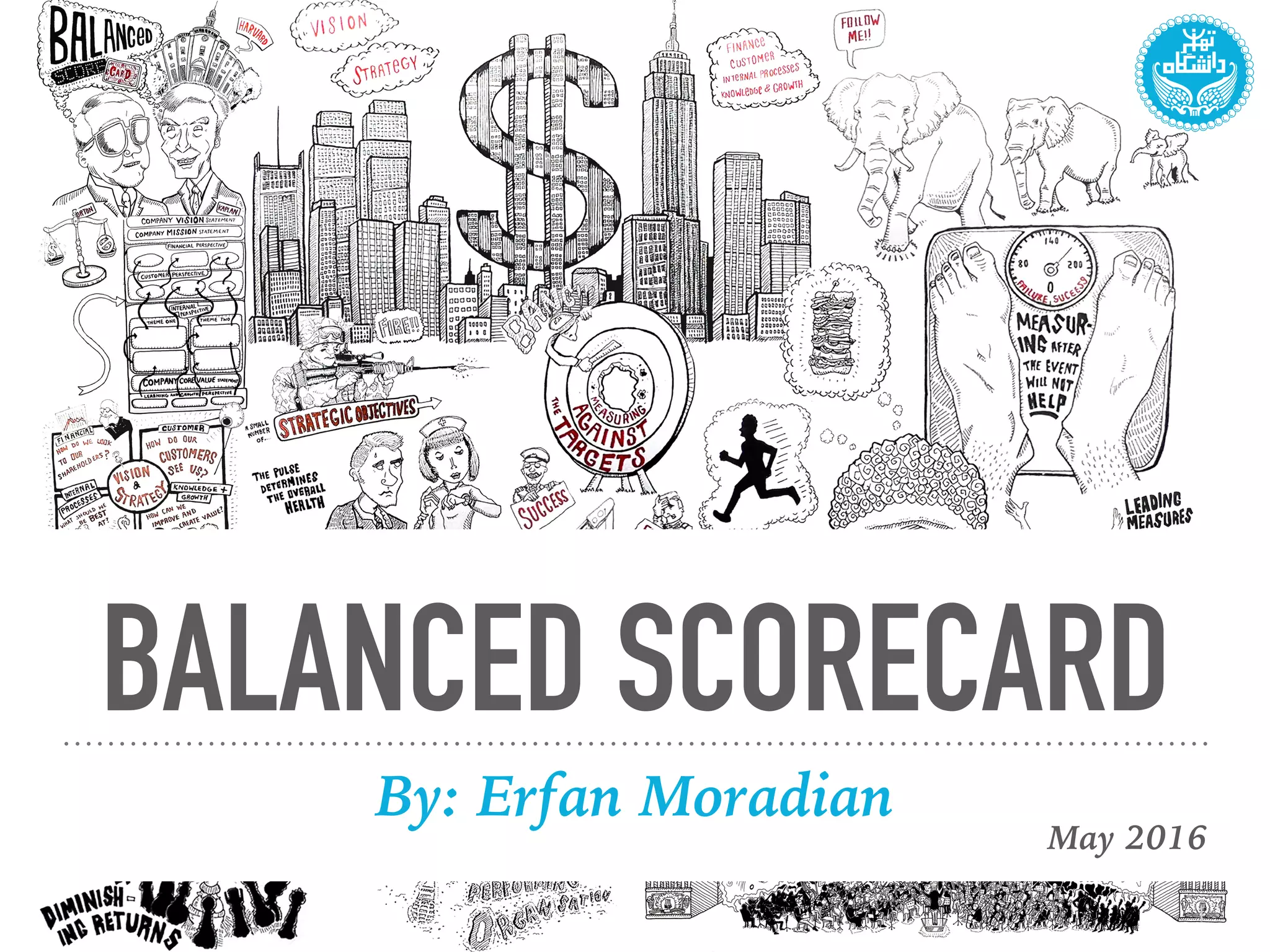


BALANCED SCORECARD
By: Erfan Moradian
May 2016
1
2
BALANCED SCORECARD HISTORY
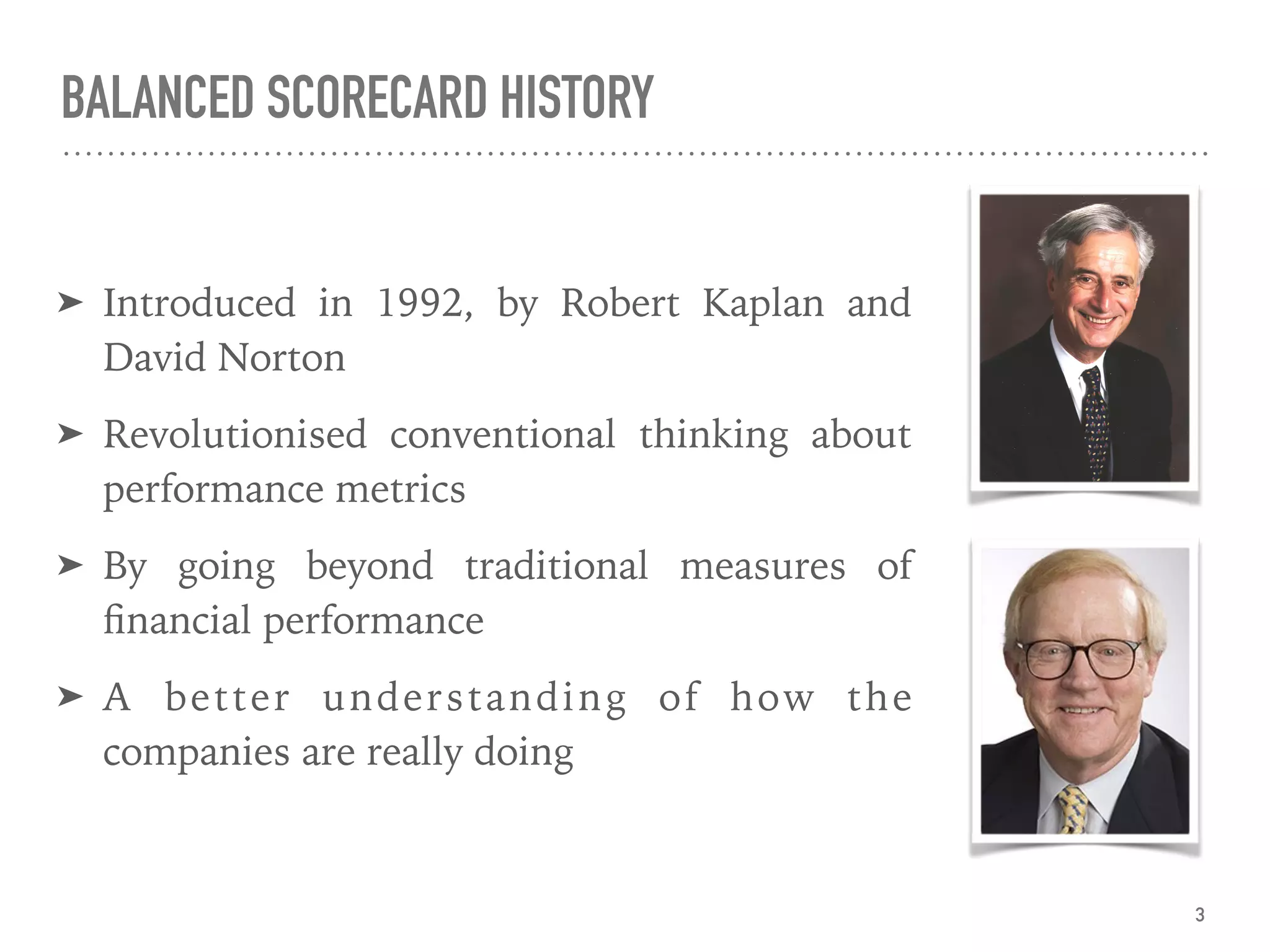
➤ Introduced in 1992, by Robert Kaplan and
David Norton
➤ Revolutionised conventional thinking about
performance metrics
➤ By going beyond traditional measures of
financial performance
➤ A better understanding of how the
companies are really doing
3
BALANCED SCORECARD HISTORY
Articles in Harvard Business Review
➤ “The Balanced Scorecard — Measures that Drive
Performance” January - February 1992
➤ “Putting the Balanced Scorecard to Work” September -
October 1993
➤ “Using the Balanced Scorecard as

a Strategic Management System” January - February 1996
➤ Selected by Harvard Business Review as one of the “most
important management practices of the past 75 years.“
4
BALANCED SCORECARD HISTORY
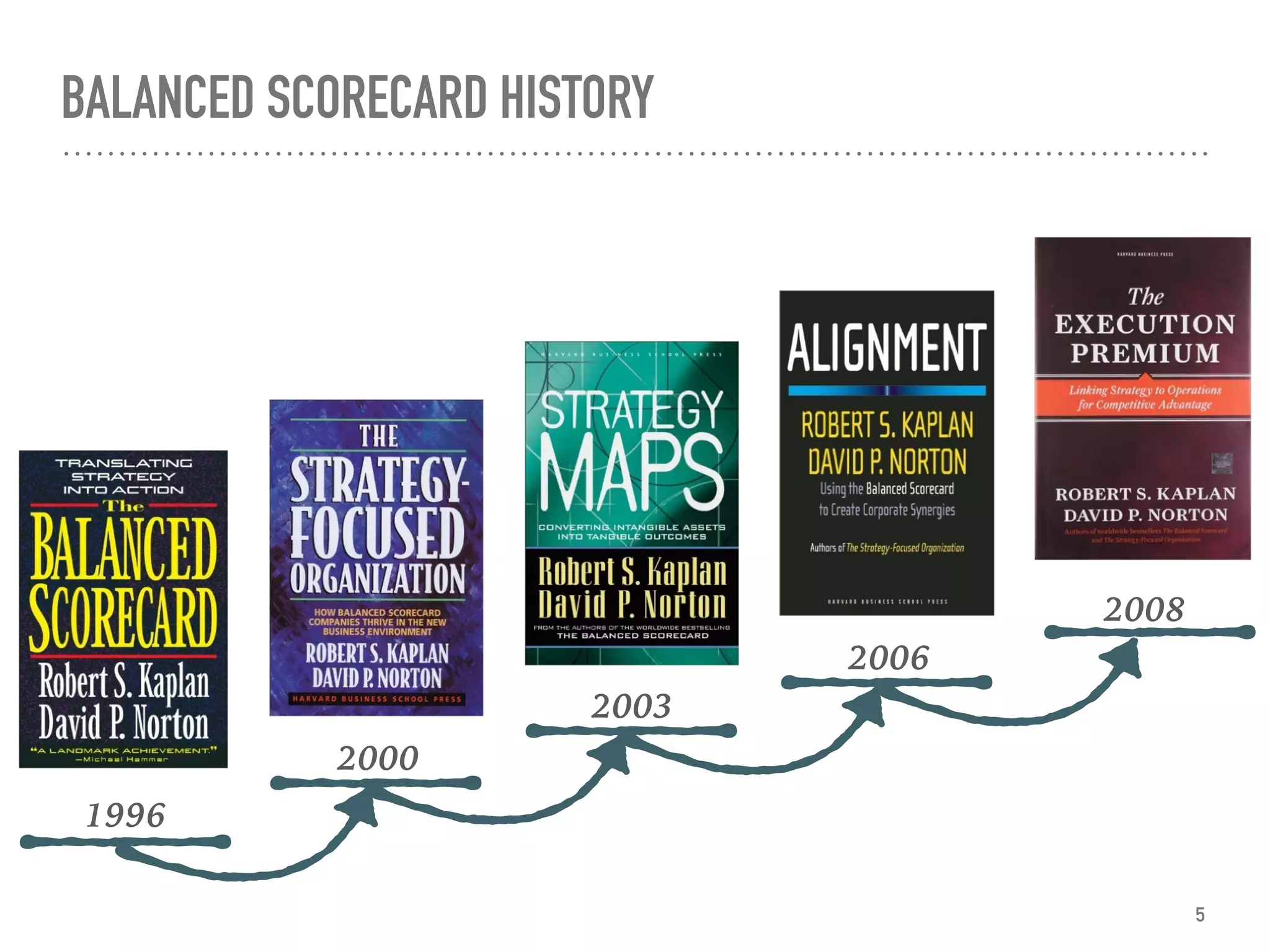
1996
2000
2003
2006
2008
5
INTRODUCTION
Why do budgets often bear little direct
relation to a company’s long-term
strategic objectives?
6
INTRODUCTION
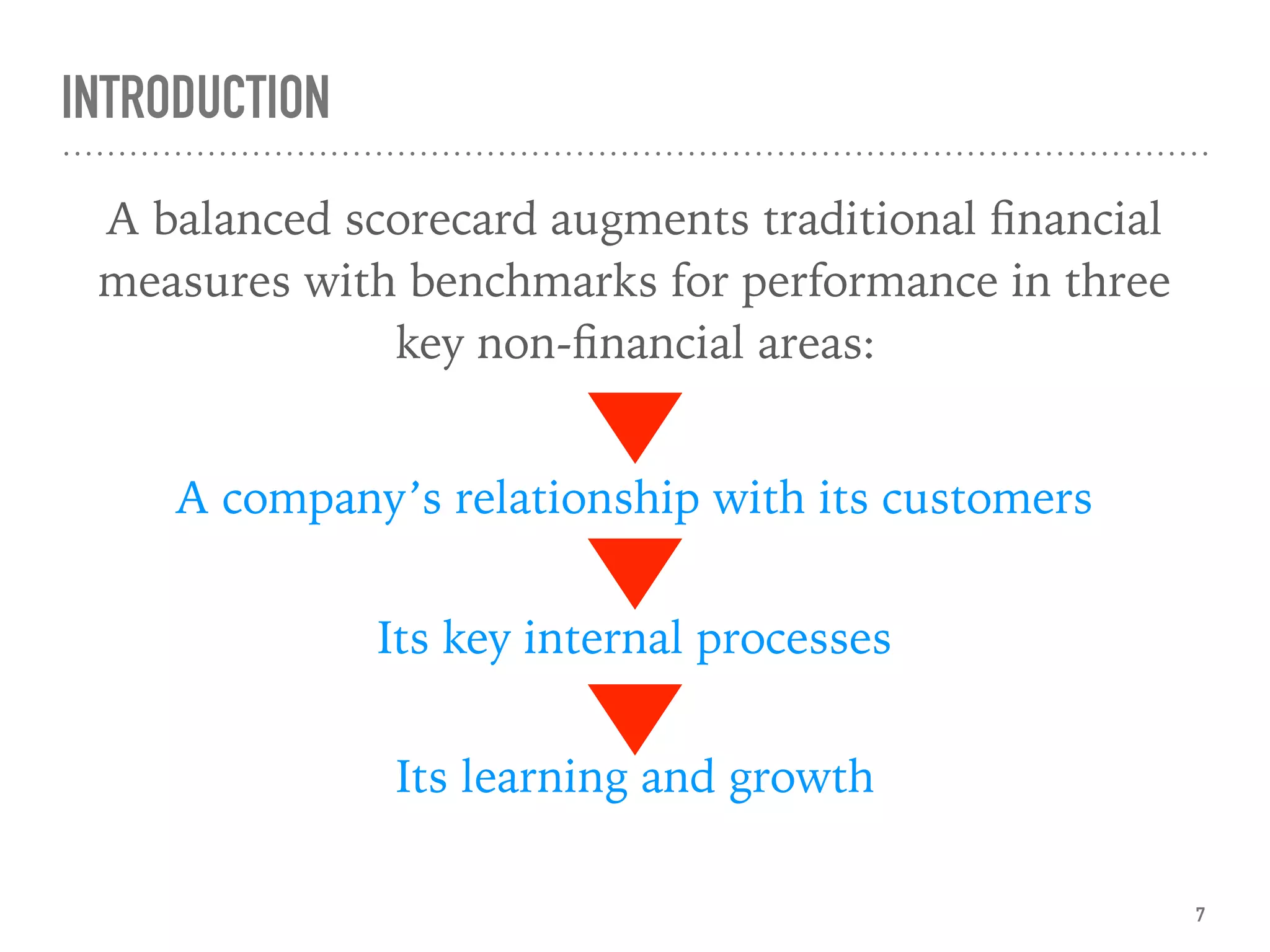
A balanced scorecard augments traditional financial
measures with benchmarks for performance in three
key non-financial areas:
A company’s relationship with its customers 

Its key internal processes 

Its learning and growth

7
INTRODUCTION
The result:
➤ A broader perspective on the company’s health and activities
➤ A powerful organising framework
A sophisticated instrument panel for coordinating and fine-
tuning a company’s operations and businesses so that all
activities are aligned with its strategy. 

8
WHAT IS BALANCED SCORECARD?
A management tool that
provides stakeholders with a
comprehensive measure of how
the organization is progressing
towards the achievement of its
strategic goals.
9
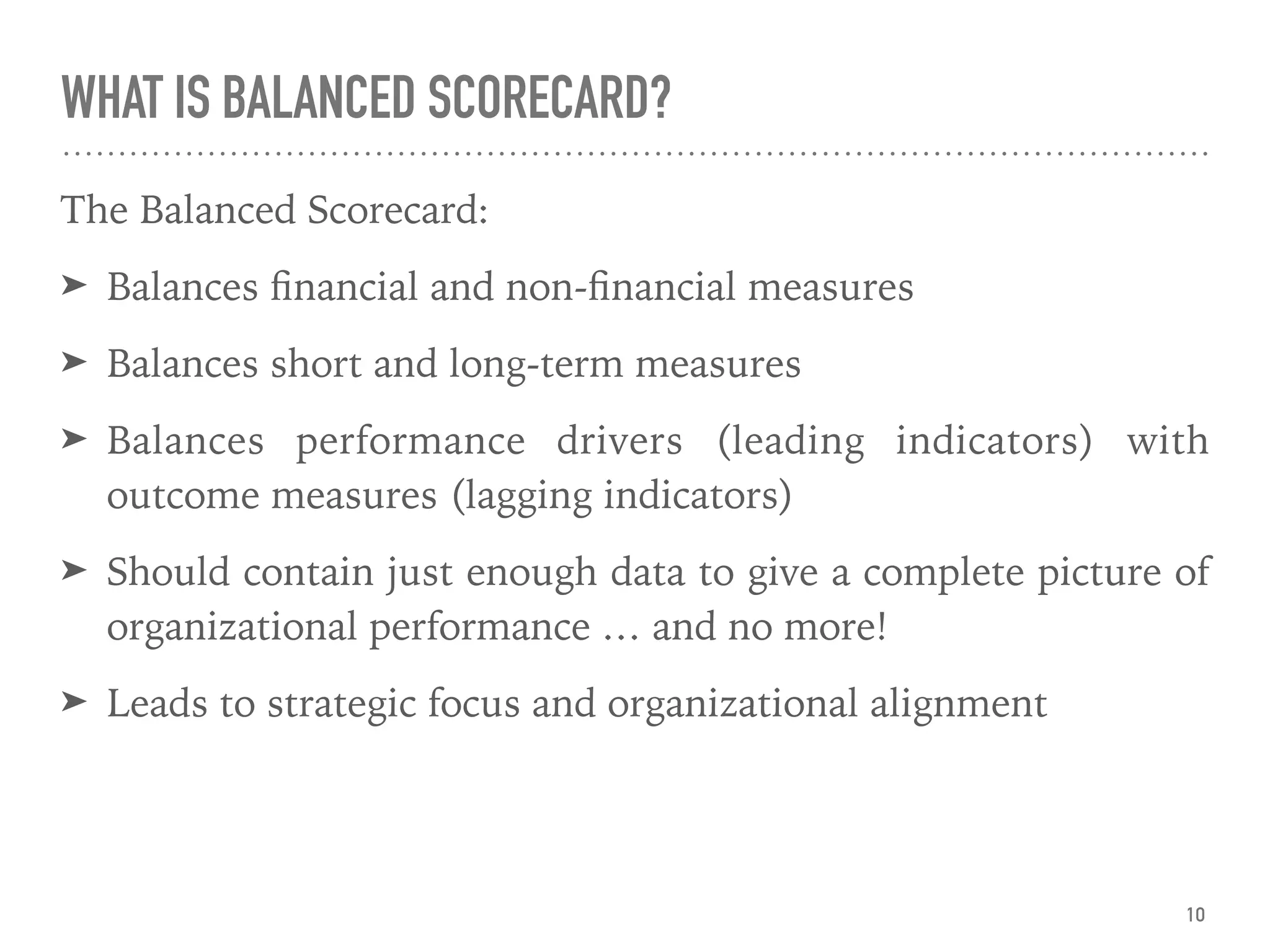
WHAT IS BALANCED SCORECARD?
The Balanced Scorecard:
➤ Balances financial and non-financial measures
➤ Balances short and long-term measures
➤ Balances performance drivers (leading indicators) with
outcome measures (lagging indicators)
➤ Should contain just enough data to give a complete picture of
organizational performance … and no more!
➤ Leads to strategic focus and organizational alignment
10
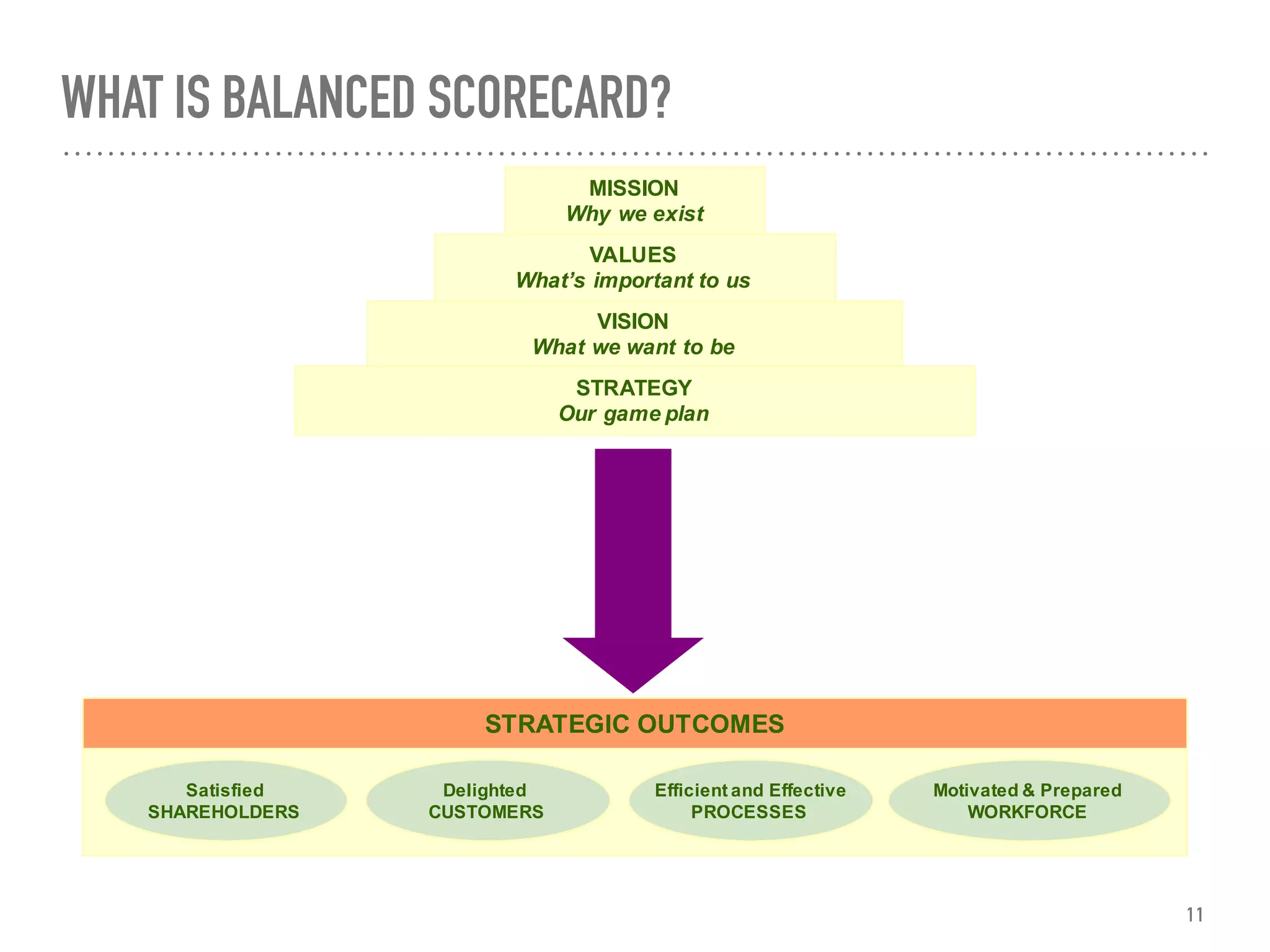
WHAT IS BALANCED SCORECARD?
MISSION
Why we exist
VALUES
What’s important to us
VISION
What we want to be
STRATEGY
Our game plan
STRATEGIC OUTCOMES
Satisfied
SHAREHOLDERS
Delighted
CUSTOMERS
Efficient and Effective
PROCESSES
Motivated & Prepared
WORKFORCE
11
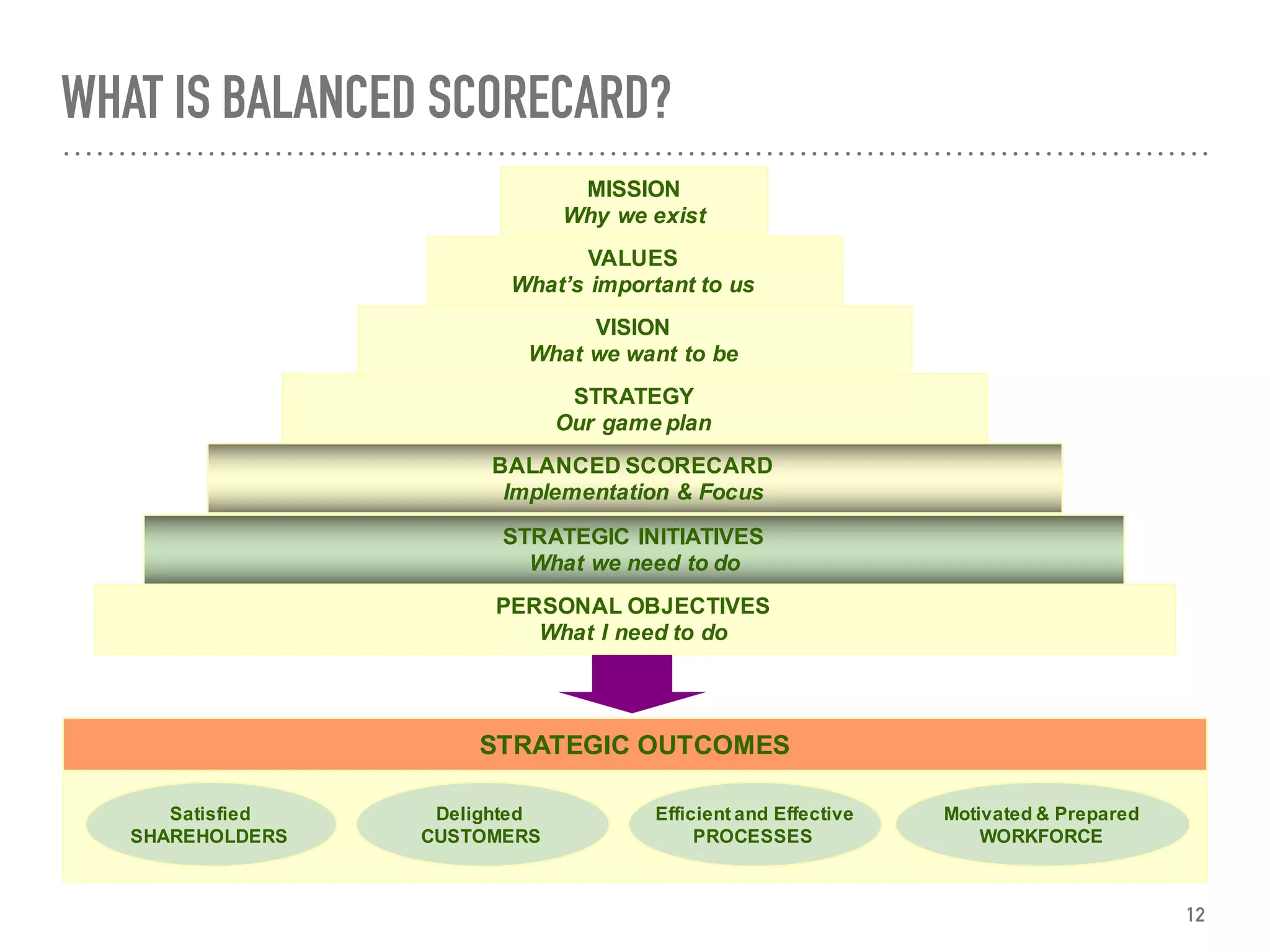
WHAT IS BALANCED SCORECARD?
MISSION
Why we exist
VALUES
What’s important to us
VISION
What we want to be
STRATEGY
Our game plan
BALANCED SCORECARD
Implementation & Focus
STRATEGIC INITIATIVES
What we need to do
STRATEGIC OUTCOMES
Satisfied
SHAREHOLDERS
Delighted
CUSTOMERS
Efficient and Effective
PROCESSES
Motivated & Prepared
WORKFORCE
PERSONAL OBJECTIVES
What I need to do
12
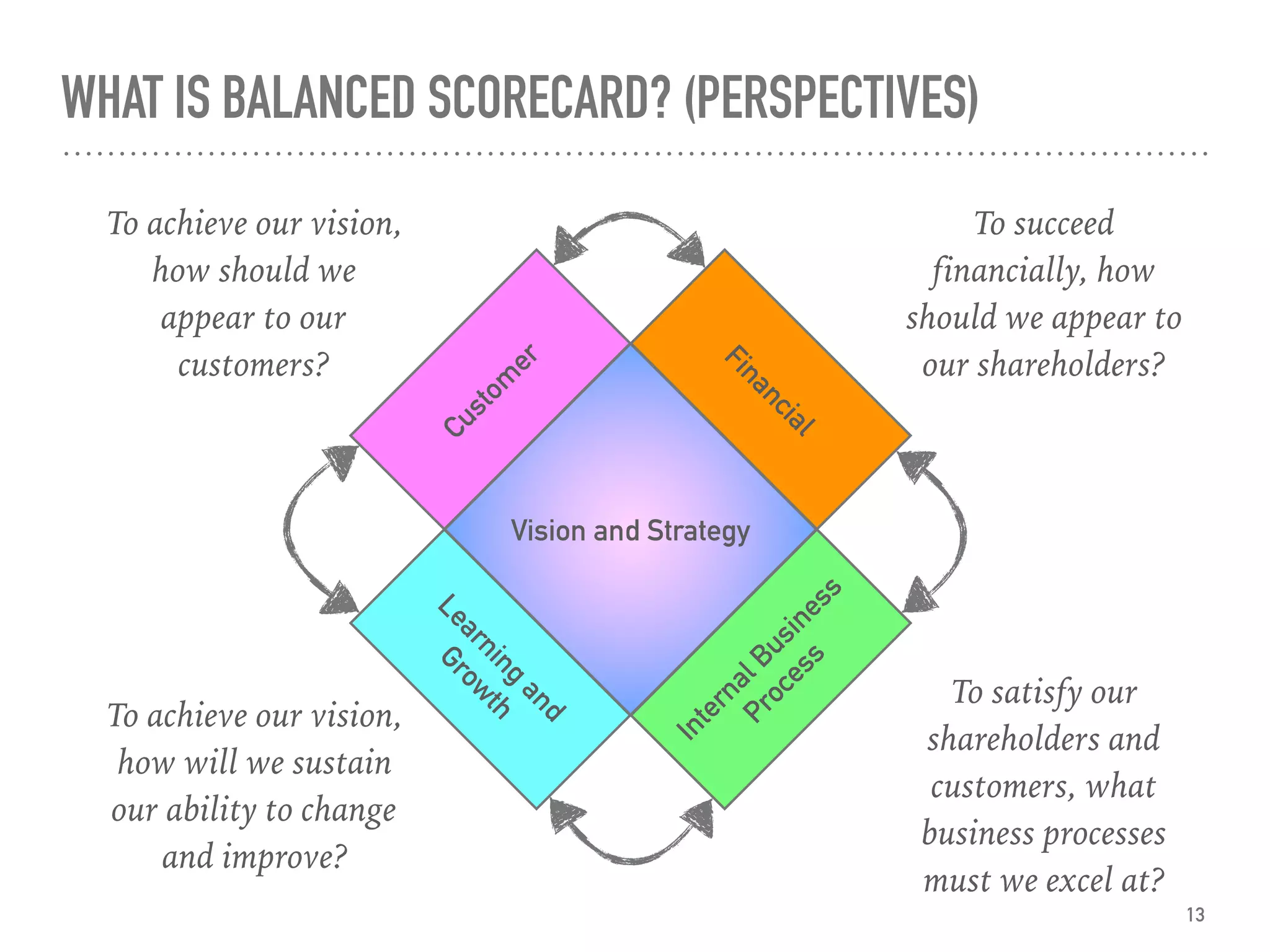
WHAT IS BALANCED SCORECARD? (PERSPECTIVES)
Vision and Strategy
Financial
Custom
er
InternalBusiness
Process
Learning
and
Grow
th
To succeed
financially, how
should we appear to
our shareholders?
To satisfy our
shareholders and
customers, what
business processes
must we excel at?
To achieve our vision,
how will we sustain
our ability to change
and improve?
To achieve our vision,
how should we
appear to our
customers?
13
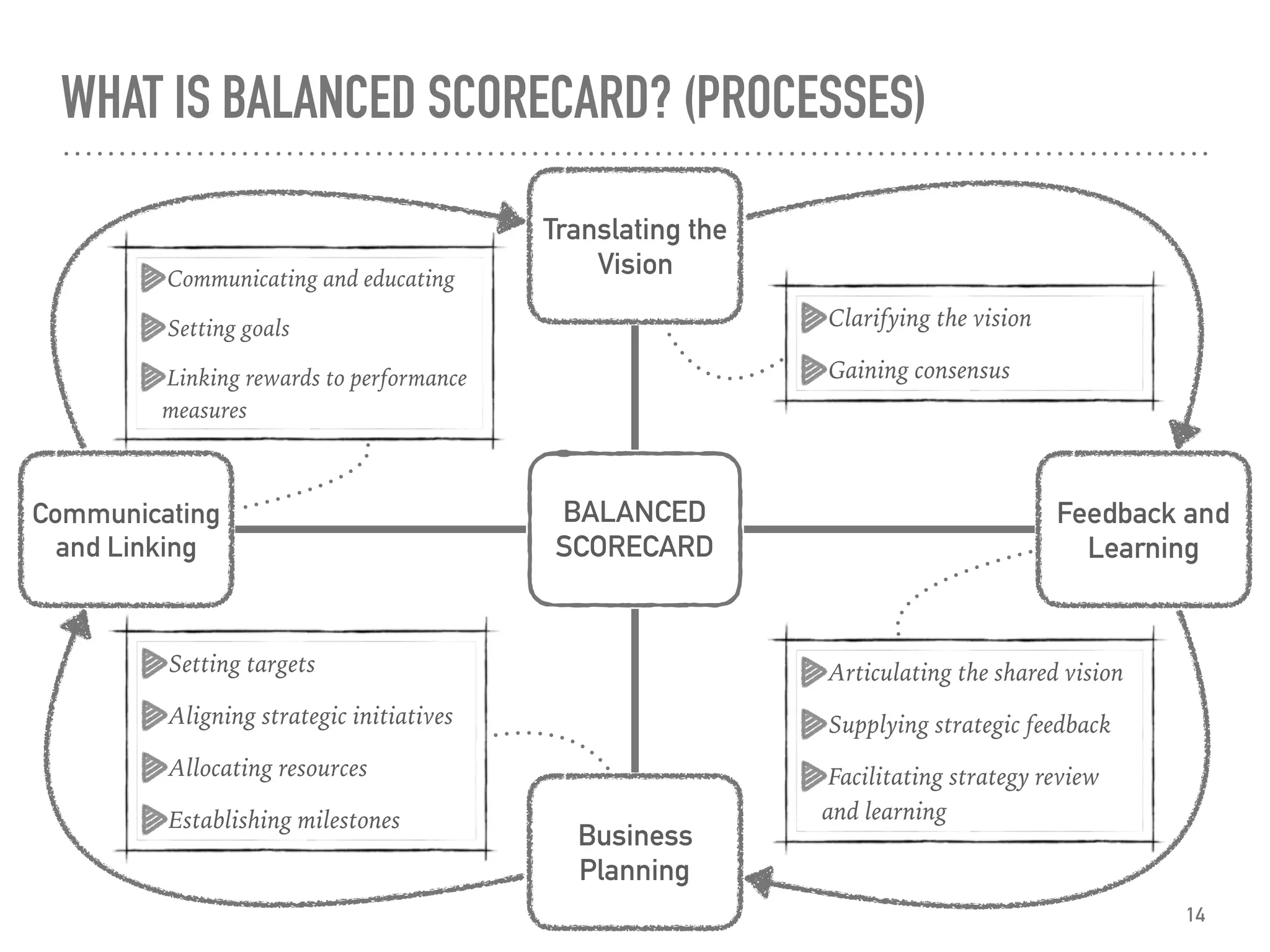
WHAT IS BALANCED SCORECARD? (PROCESSES)
BALANCED
SCORECARD
Feedback and
Learning
Translating the
Vision
Communicating
and Linking
Business
Planning
Clarifying the vision
Gaining consensus
Articulating the shared vision
Supplying strategic feedback
Facilitating strategy review
and learning
Setting targets
Aligning strategic initiatives
Allocating resources
Establishing milestones
Communicating and educating
Setting goals
Linking rewards to performance
measures
14
WHY BALANCED SCORECARD?
➤ To achieve strategic objectives.
➤ To provide quality with fewer resources
➤ To eliminate non-value added efforts
➤ To align customer priorities and expectations with the
customer
➤ To track progress
➤ To evaluate process changes
➤ To continually improve
➤ To increase accountability
15
16
TRANSLATING THE VISION
➤ Helps managers build a consensus around the organisation’s
vision and strategy
“Best in class”
“The number one supplier”
“Empowered organization”
These statements don’t translate easily into operational terms
that provide useful guides to action at the local level.
17
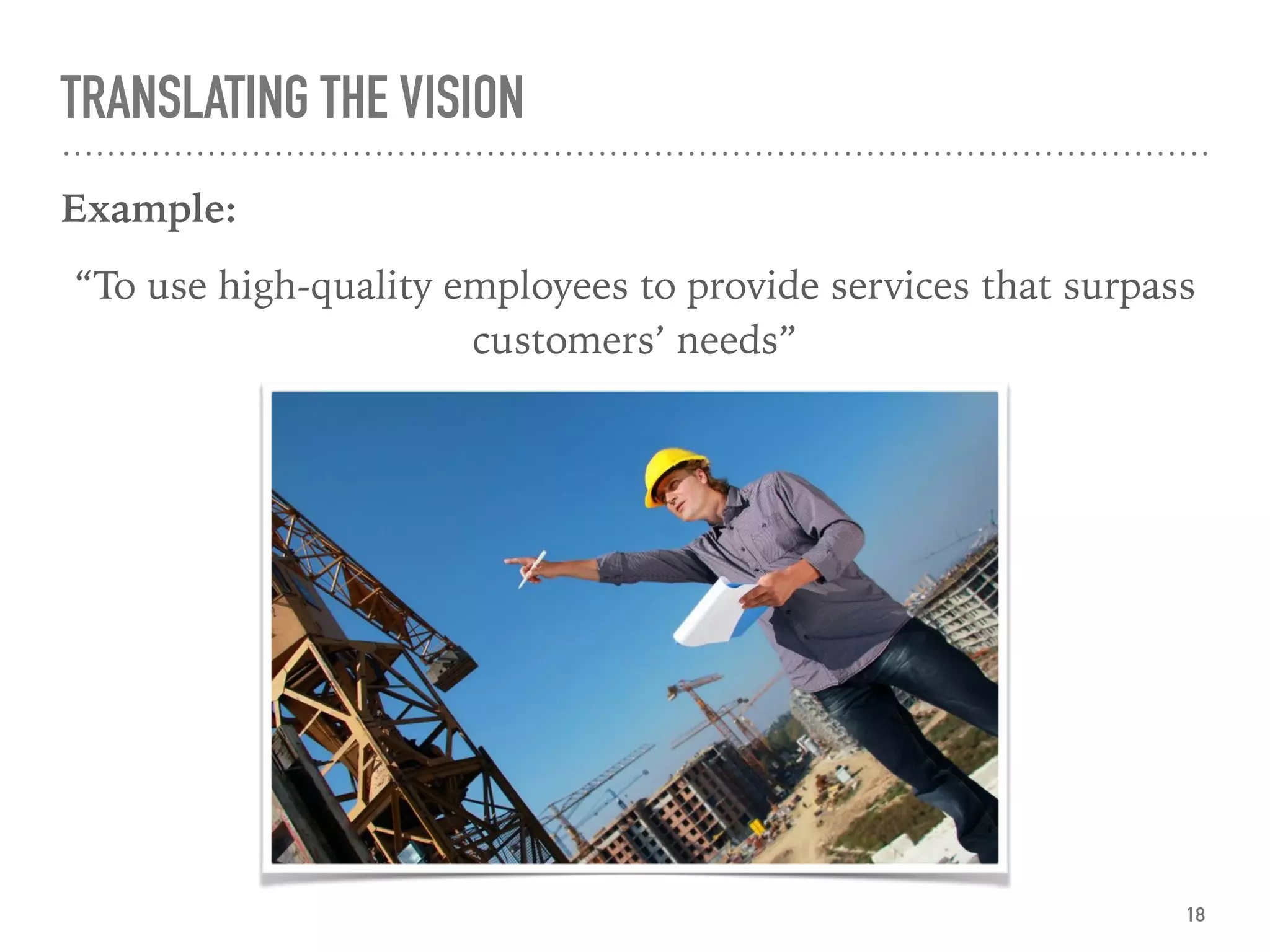
TRANSLATING THE VISION
Example:
“To use high-quality employees to provide services that surpass
customers’ needs”
18
TRANSLATING THE VISION
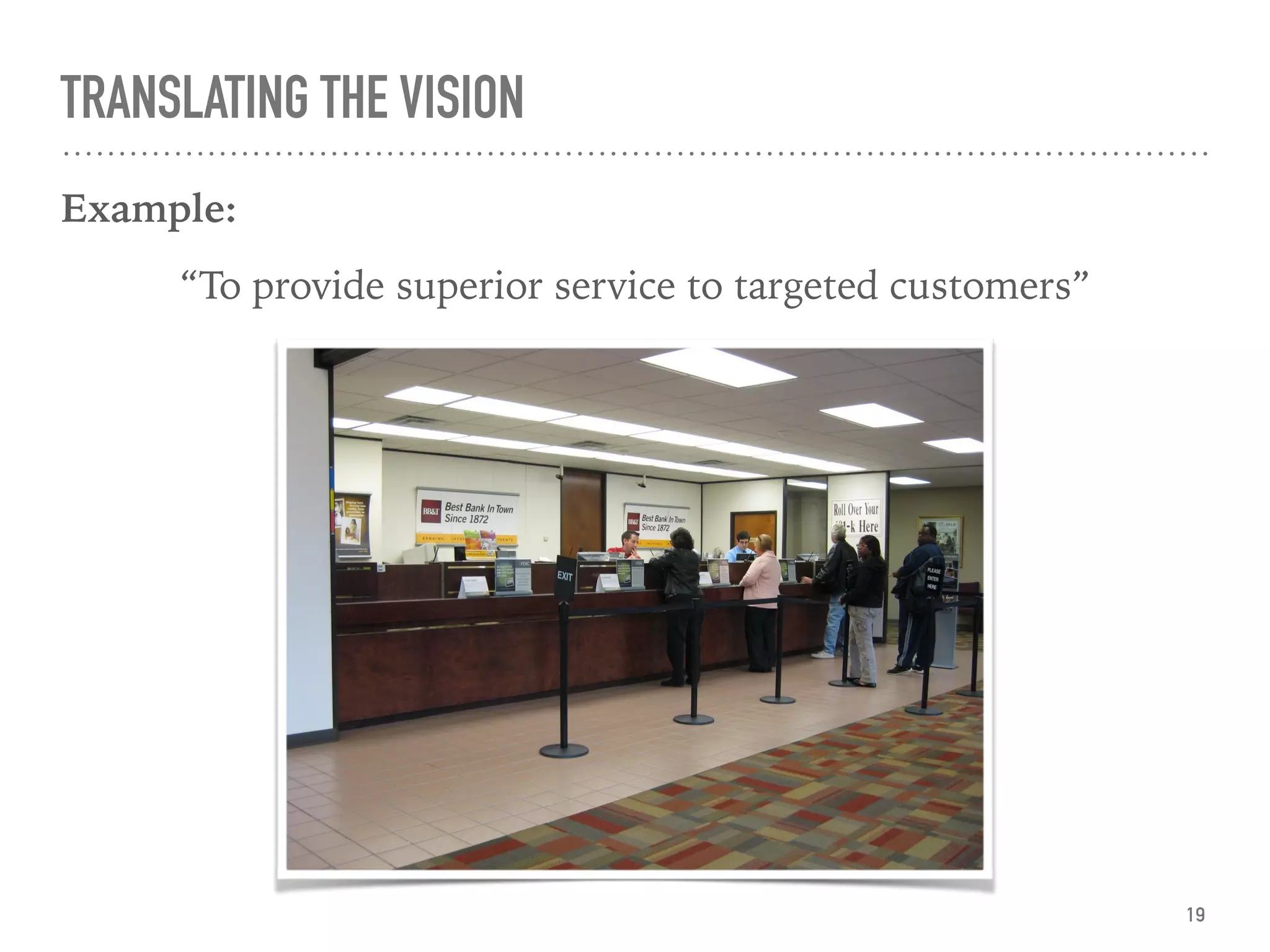
Example:
“To provide superior service to targeted customers”
19
TRANSLATING THE VISION
Those statements must be expressed as an
integrated set of objectives and measures,
agreed upon by all senior executives, that
describe the long-term drivers of success.
20
COMMUNICATING AND LINKING
➤ Lets managers communicate their strategy up and down the
organization and link it to departmental and individual
objectives.
➤ Gives managers a way of ensuring that all levels of the
organization understand the long-term strategy and that both
departmental and individual objectives are aligned with it.
➤ Broad participation in creating a scorecard takes longer, but it
offers several advantages:
21
COMMUNICATING AND LINKING
Broad participation in creating a scorecard takes longer, but it
offers several advantages:
➤ Information from a larger number of managers is incorporated
into the internal objectives
➤ The managers gain a better understanding of the company’s
long-term strategic goals
➤ Such broad participation builds a stronger commitment to
achieving those goals
22
COMMUNICATING AND LINKING
To align employees’ individual performances with the overall
strategy, scorecard users generally engage in three activities:
Communicating and educating
Setting goals
Linking rewards to performance measures
23
COMMUNICATING AND LINKING
Communicating and educating
➤ Implementing a strategy begins with educating those who
have to execute it.
➤ A broad-based communication program shares with all
employees the strategy and the critical objectives they have to
meet if the strategy is to succeed.
✦ One-time events
✦ Bulletin boards
✦ Groupware and electronic bulletin boards
24
COMMUNICATING AND LINKING
Should the balanced scorecard be
communicated beyond the
boardroom to external
shareholders?
25
COMMUNICATING AND LINKING
Setting goals
➤ The organisation’s high-level strategic objectives and measures
must be translated into objectives and measures for operating
units and individuals.
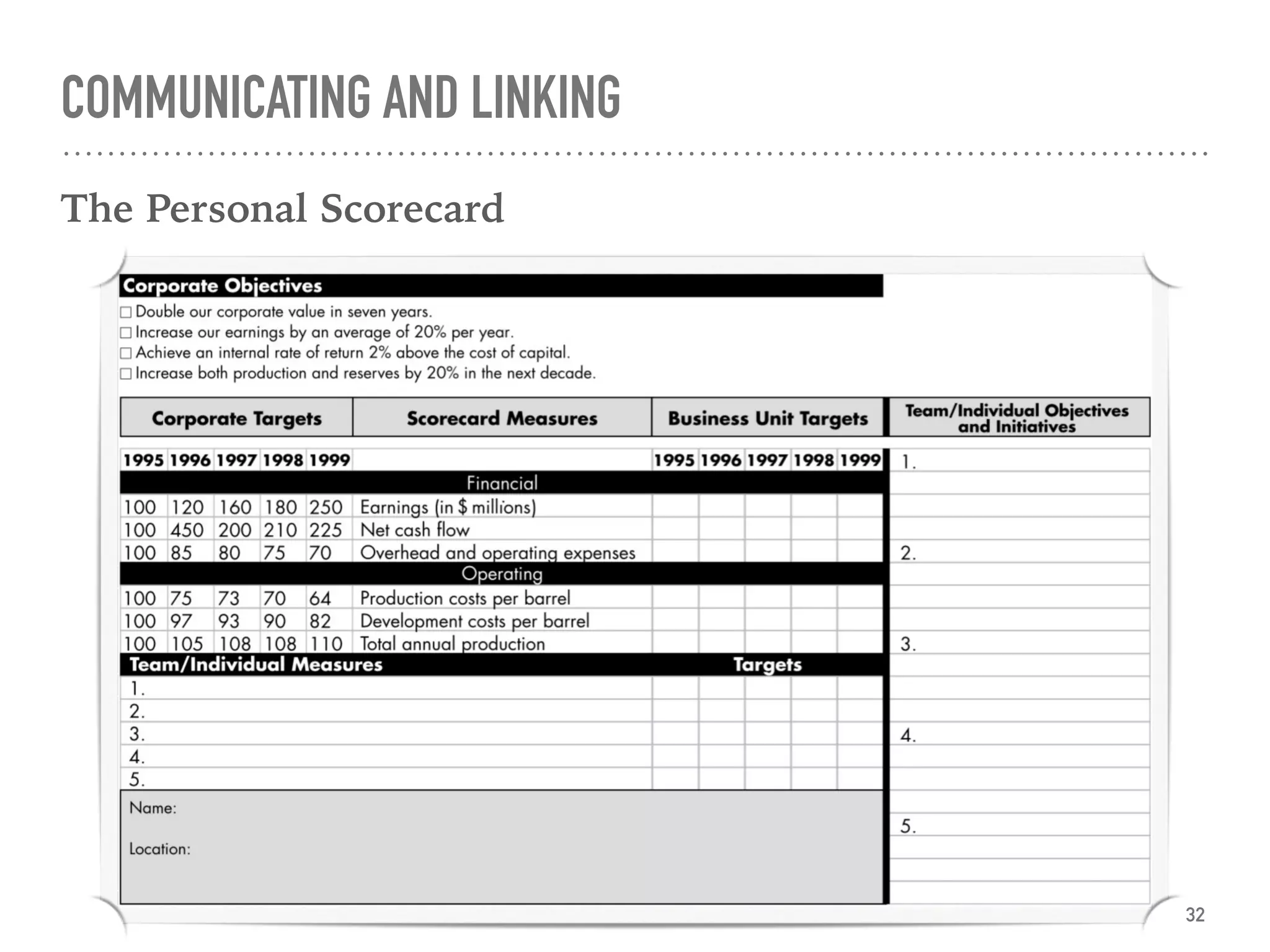
➤ The scorecard contains three levels of information:
✦ Corporate objectives, measures, and targets
✦ Translating corporate targets into targets for each business unit
✦ The individuals’ and teams’ own objectives consistent with the
business unit and corporate objectives; the required initiatives
to achieve their objectives; up to five performance measures for
their objectives and targets for each measure.
26
COMMUNICATING AND LINKING
Why Measure?
➤ To determine how effectively and efficiently the process or
service satisfies the customer
➤ To identify improvement opportunities
➤ To make decisions based on FACT and DATA
27
COMMUNICATING AND LINKING
Measurements Should:
➤ Translate customer expectations into goals
➤ Evaluate the quality of processes
➤ Track our improvement
➤ Focus our efforts on our customers
➤ Support our strategies
28
“If you don’t know where you’re going,
you’re probably not gonna get there.
-Forrest Gump
29
COMMUNICATING AND LINKING
Targets:
➤ Targets need to be set for all measures
➤ Should have a “solid basis”
➤ Give personnel something for which to aim
➤ If achieved, will transform the organization
30
COMMUNICATING AND LINKING
Initiatives:
➤ Once measures and targets are established, it is the
responsibility of management to determine HOW the
organization will achieve its goals.
➤ Measures are used to determine the effectiveness of strategic
initiatives.
31
COMMUNICATING AND LINKING
The Personal Scorecard
32
COMMUNICATING AND LINKING
Linking rewards to performance measures
Should compensation systems be
linked to balanced scorecard
measures?
33
COMMUNICATING AND LINKING
➤ This activity is attractive powerful but it nonetheless carries
risks.
Does the company have the right measures on the scorecard?
Does it have valid and reliable data for the selected
measures?
Could unintended or unexpected consequences arise from
the way the targets for the measures are achieved?
34
35
BUSINESS PLANNING
➤ Most organizations have separate procedures and organizational units
for strategic planning and for resource allocation and budgeting.
➤ Creating a balanced scorecard forces companies to integrate their
strategic planning and budgeting processes and therefore helps to
ensure that their budgets support their strategies.
➤ Building a scorecard enables a company to link its financial budgets
with its strategic goals.
➤ Once the strategy is defined and the drivers are identified, the
scorecard influences managers to concentrate on improving or
reengineering those processes most critical to the organisation’s
strategic success.
➤ The final step in linking strategy to actions is to establish specific
short-term targets, or milestones, for the balanced scorecard measures.
36
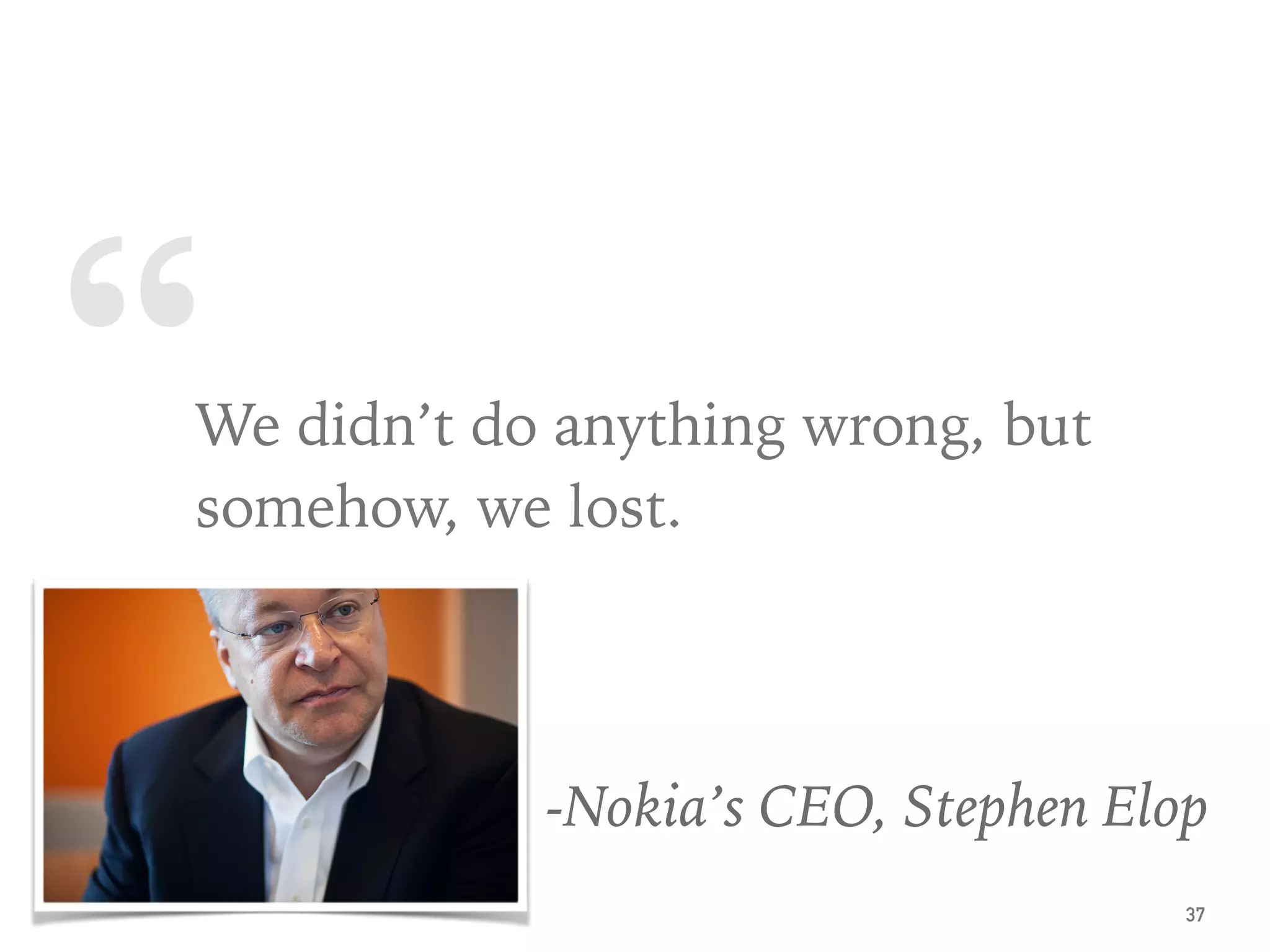
“We didn’t do anything wrong, but
somehow, we lost.
-Nokia’s CEO, Stephen Elop
37
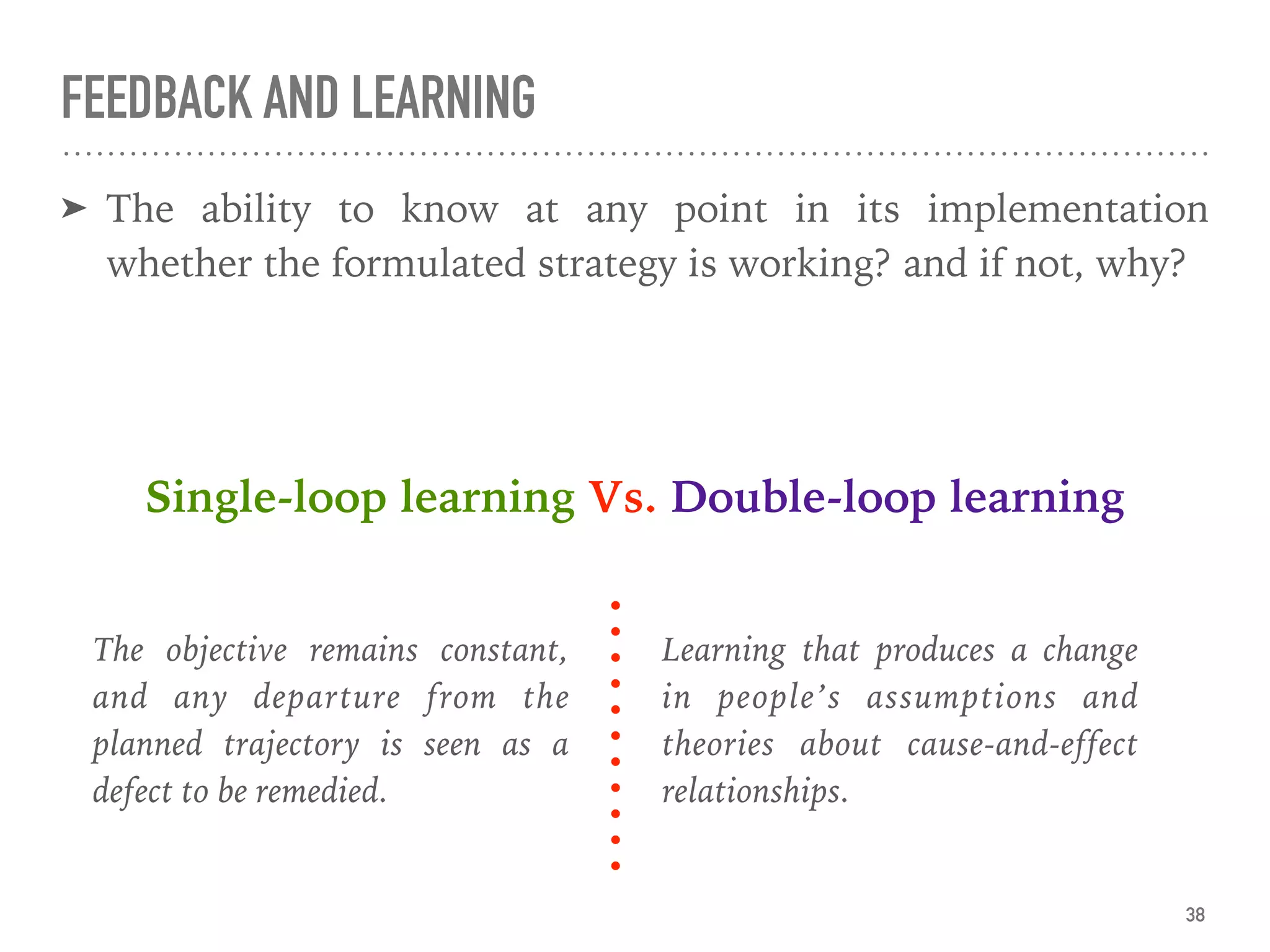
FEEDBACK AND LEARNING
➤ The ability to know at any point in its implementation
whether the formulated strategy is working? and if not, why?
Single-loop learning Vs. Double-loop learning
The objective remains constant,
and any departure from the
planned trajectory is seen as a
defect to be remedied.
Learning that produces a change
in people’s assumptions and
theories about cause-and-effect
relationships.
38
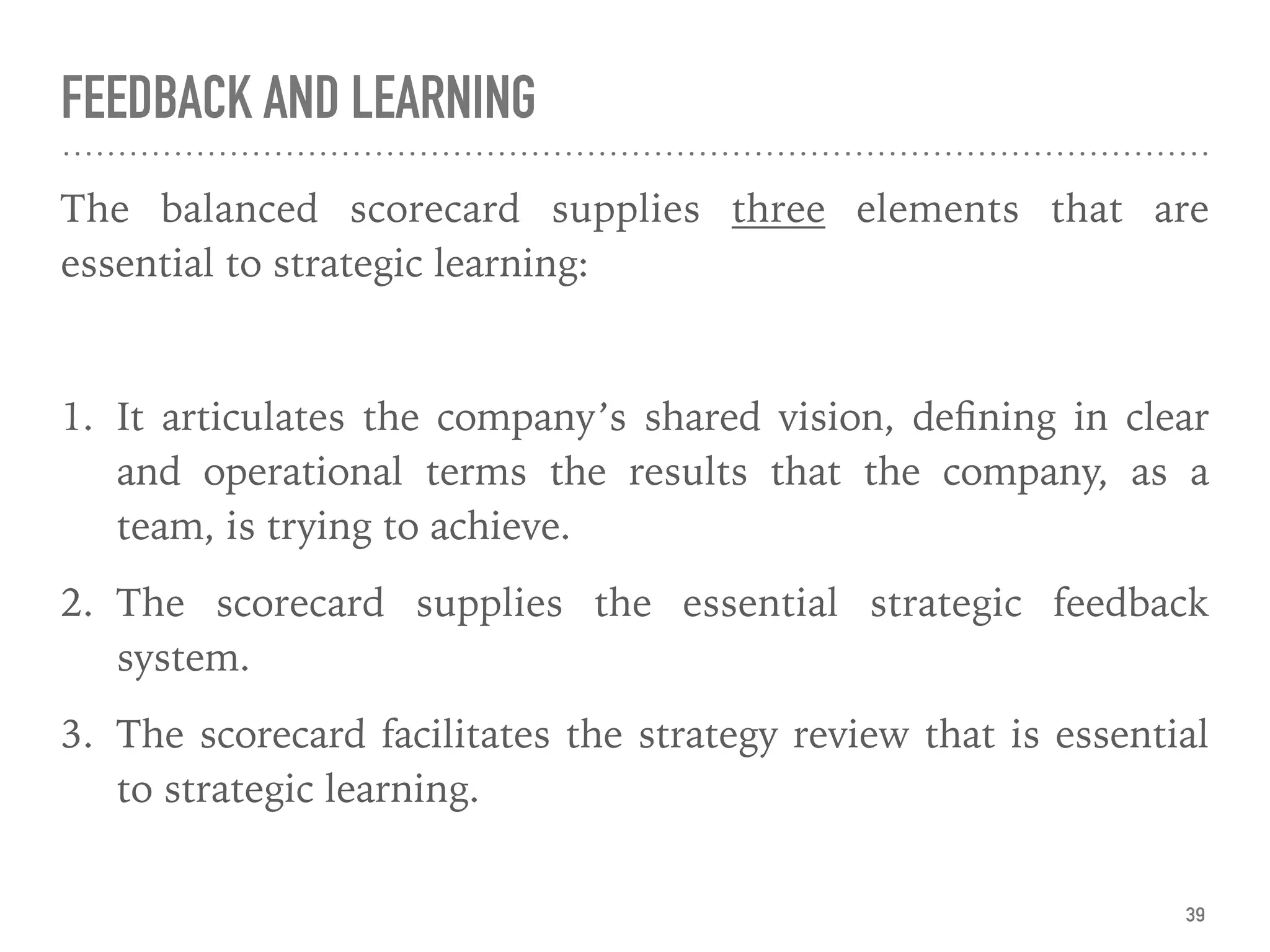
FEEDBACK AND LEARNING
The balanced scorecard supplies three elements that are
essential to strategic learning:
1. It articulates the company’s shared vision, defining in clear
and operational terms the results that the company, as a
team, is trying to achieve.
2. The scorecard supplies the essential strategic feedback
system.
3. The scorecard facilitates the strategy review that is essential
to strategic learning.
39
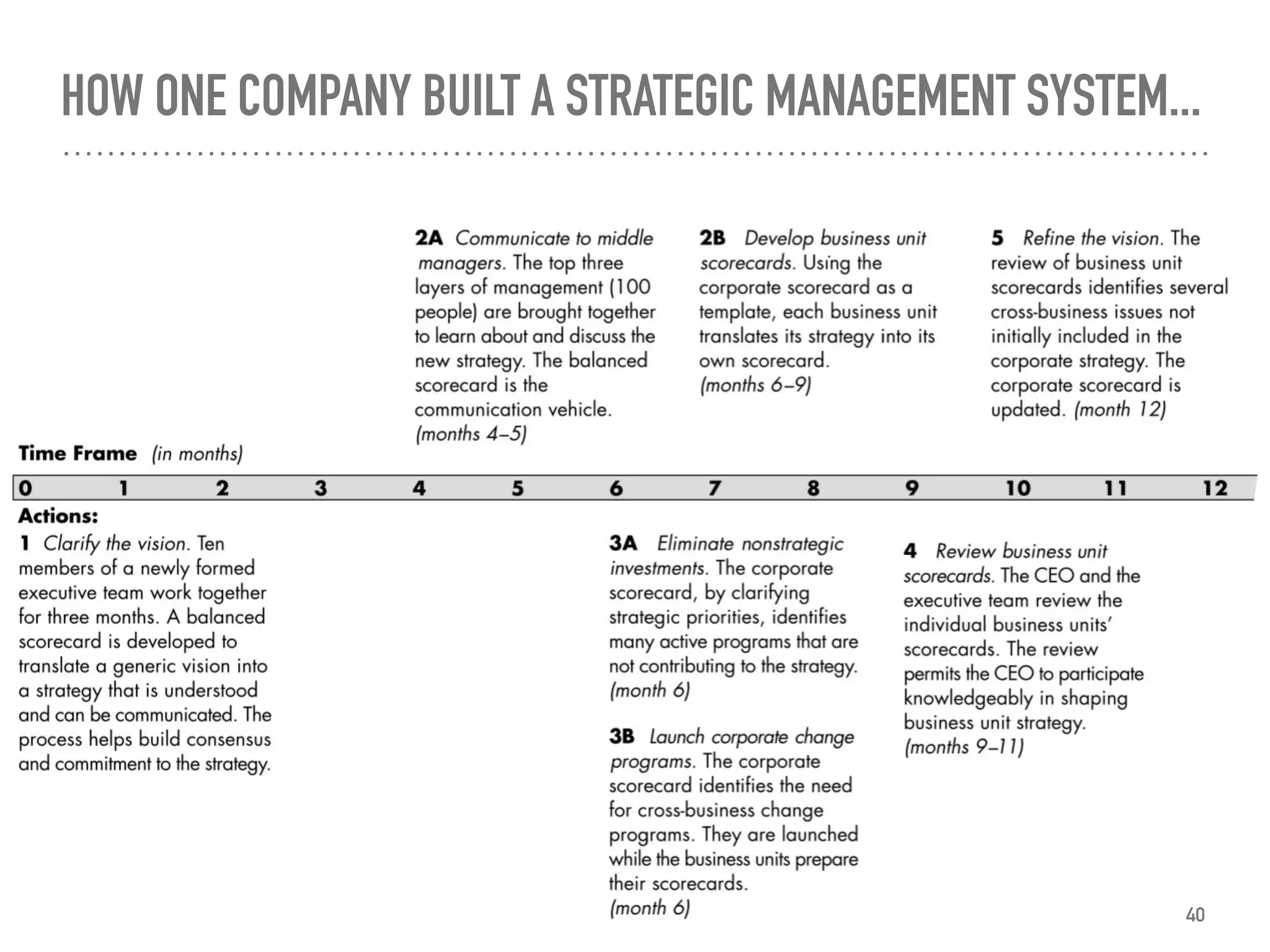
HOW ONE COMPANY BUILT A STRATEGIC MANAGEMENT SYSTEM...
40
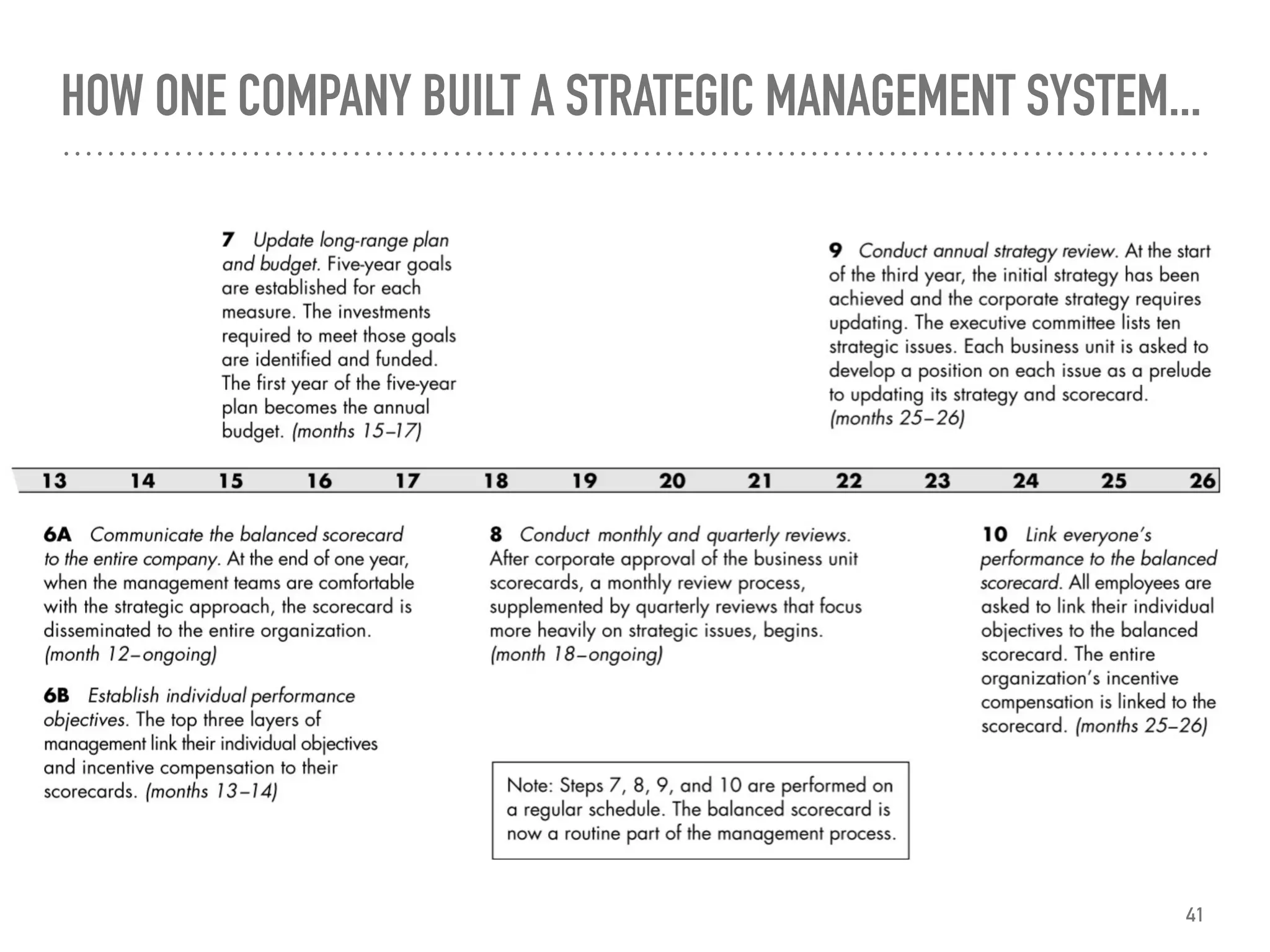
HOW ONE COMPANY BUILT A STRATEGIC MANAGEMENT SYSTEM...
41
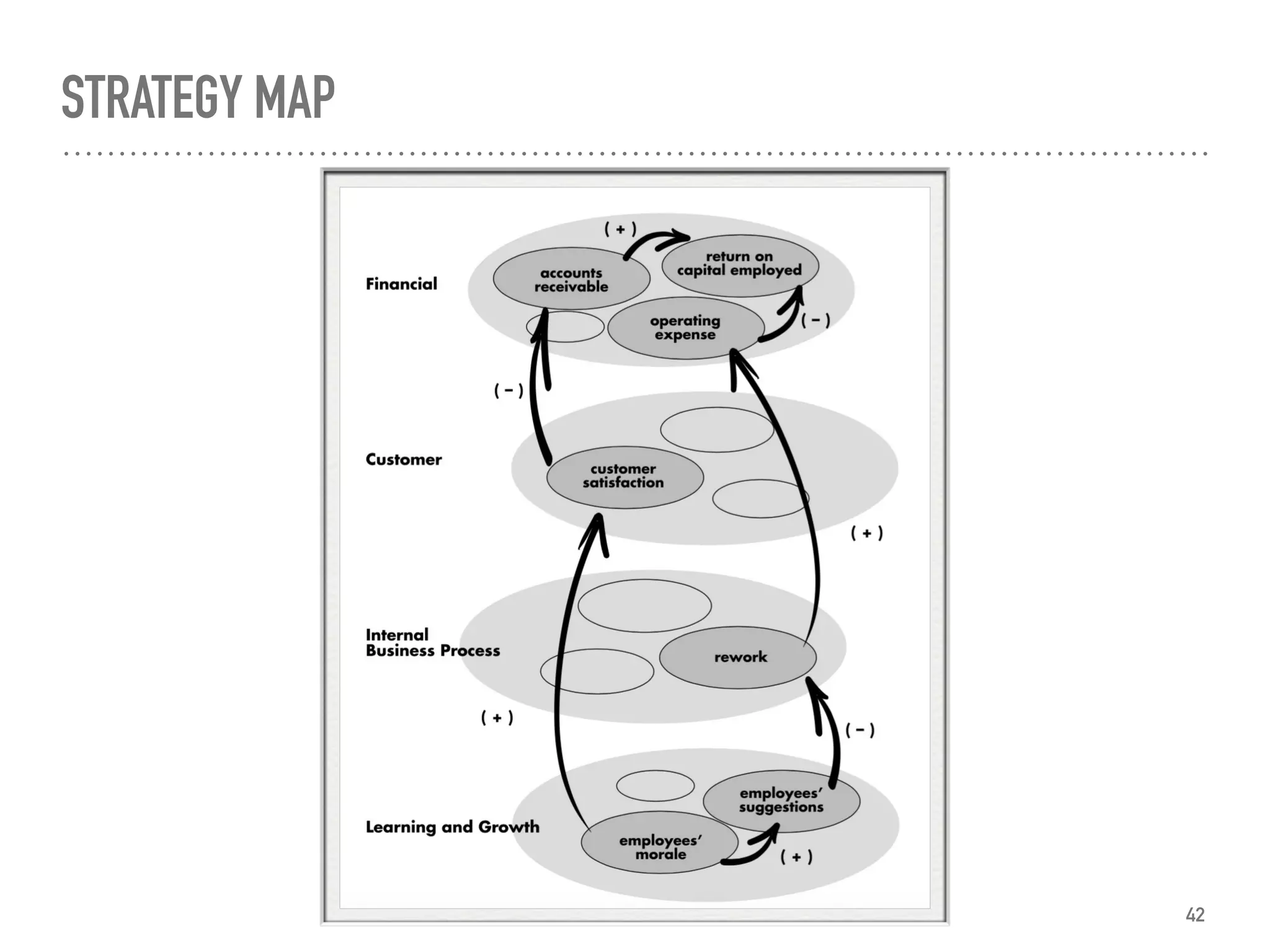
STRATEGY MAP
42
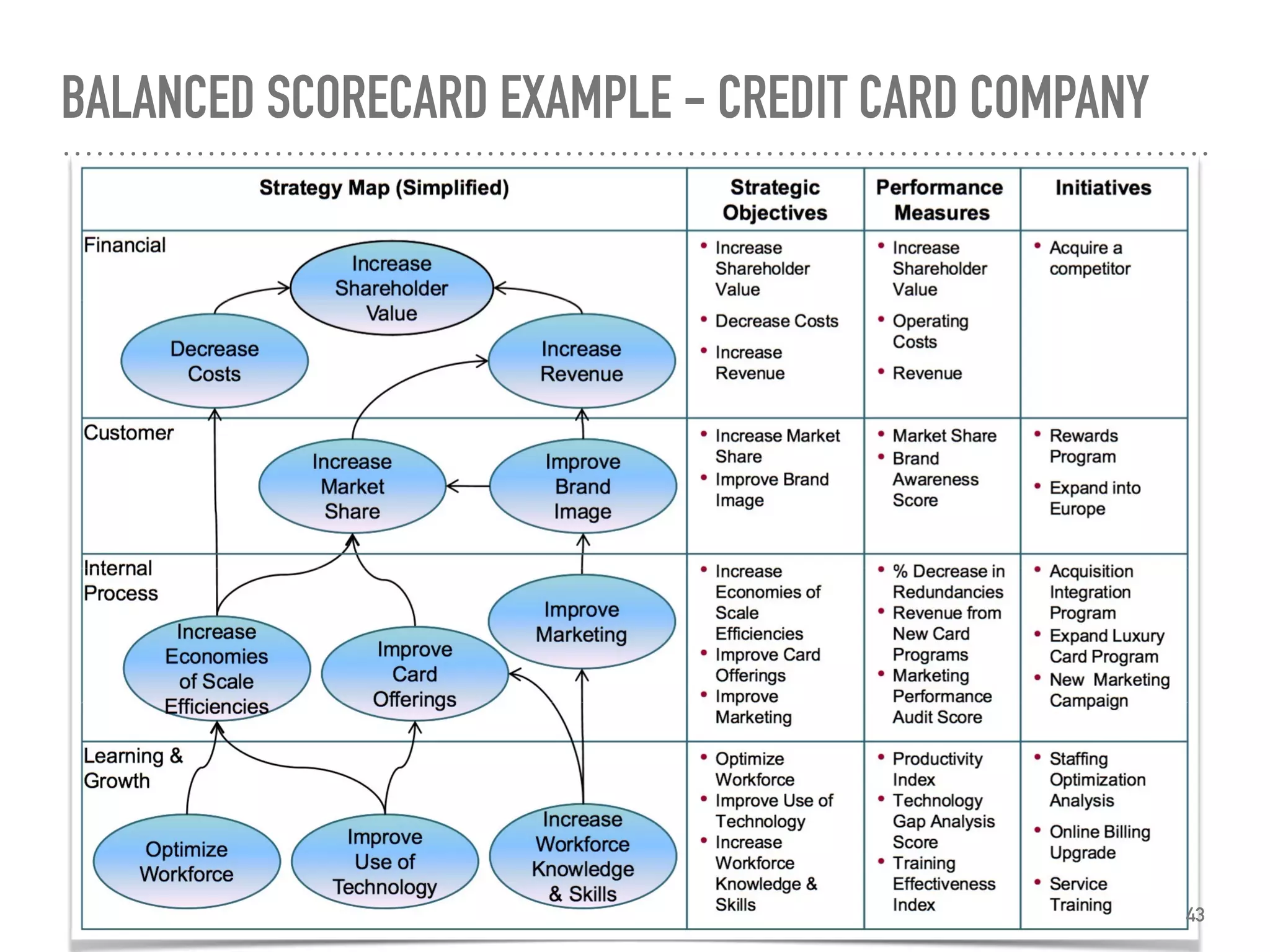
BALANCED SCORECARD EXAMPLE - CREDIT CARD COMPANY
43
BALANCED SCORECARD EXAMPLE - ENERGY COMPANY
44
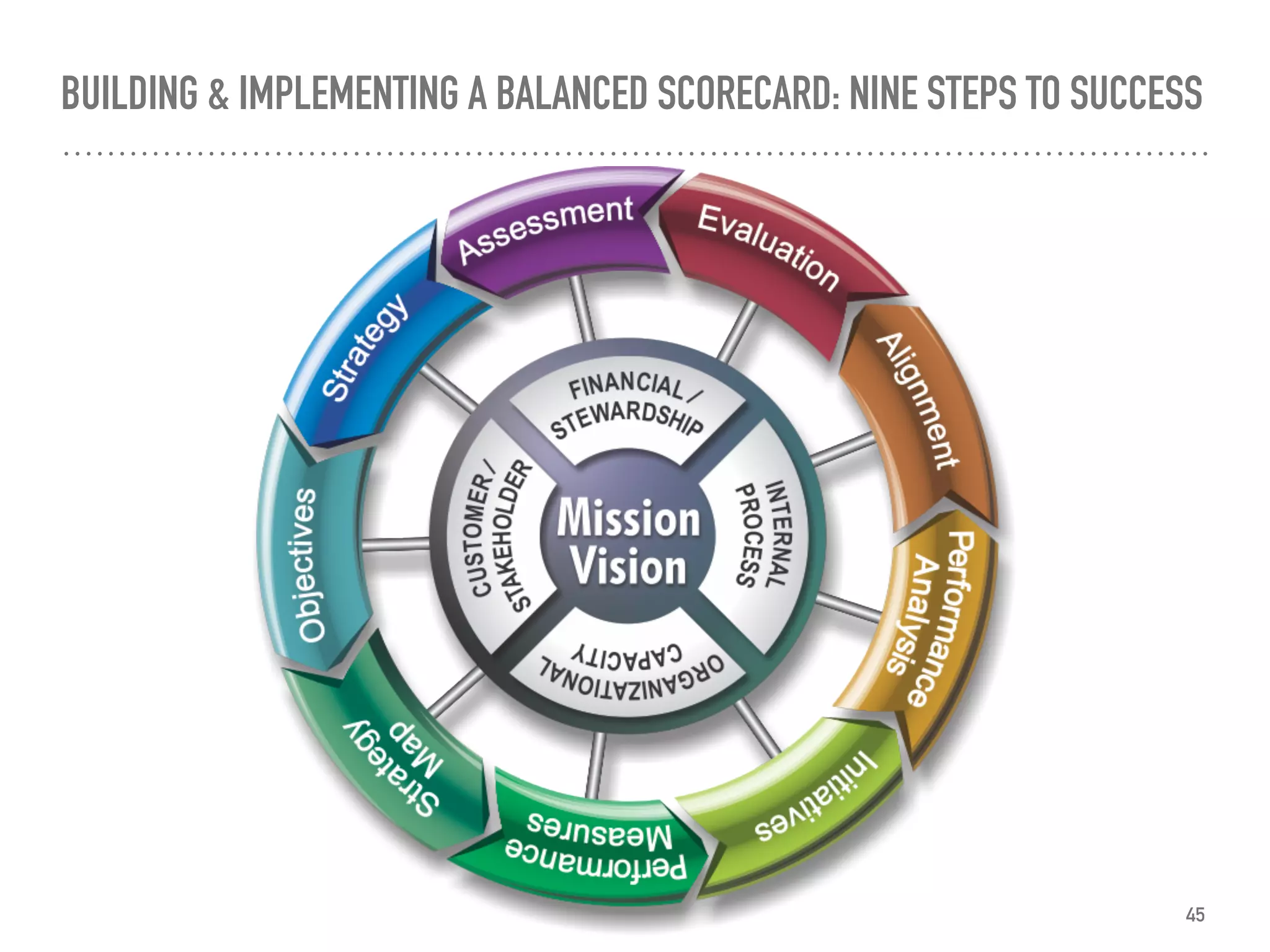
BUILDING & IMPLEMENTING A BALANCED SCORECARD: NINE STEPS TO SUCCESS
45
BALANCED SCORECARD AS A STRATEGIC MANAGEMENT SYSTEM
Companies are using the Balanced Scorecard to:
➤ Clarify and update strategy
➤ Communicate strategy throughout the company
➤ Align unit and individual goals with the strategy
➤ Link strategic objectives to long-term targets and annual
budgets
➤ Identify and align strategic initiatives
➤ Conduct periodic performance reviews to learn about and
improve strategy
46
BALANCED SCORECARD AS A STRATEGIC MANAGEMENT SYSTEM
The balanced scorecard provides a framework
for managing the implementation of strategy
while also allowing the strategy itself to
evolve in response to changes in the
company’s competitive, market, and
technological environments.
47
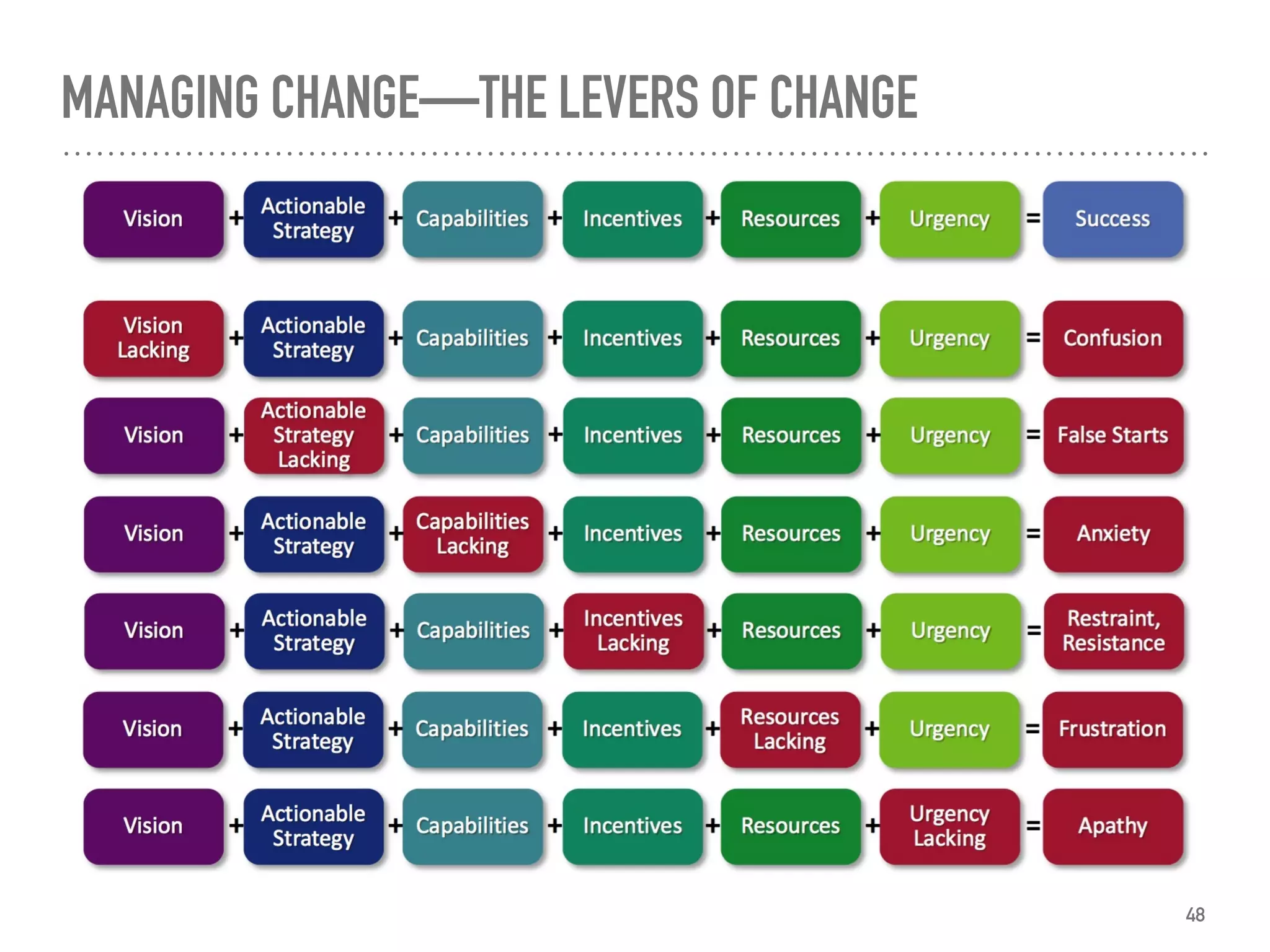
MANAGING CHANGE—THE LEVERS OF CHANGE
48
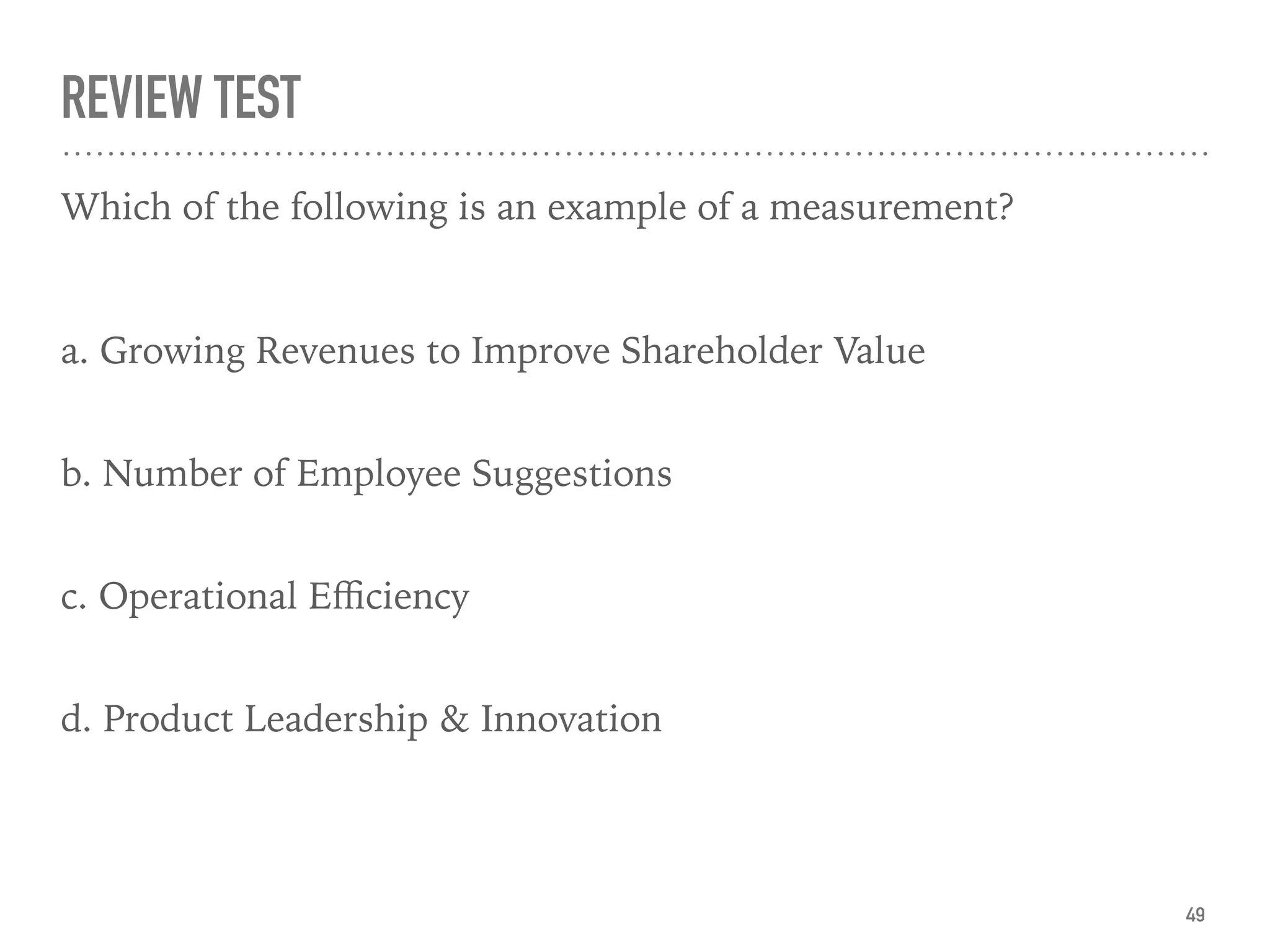
REVIEW TEST
Which of the following is an example of a measurement?
a. Growing Revenues to Improve Shareholder Value 

b. Number of Employee Suggestions 

c. Operational Efficiency 

d. Product Leadership & Innovation 

49
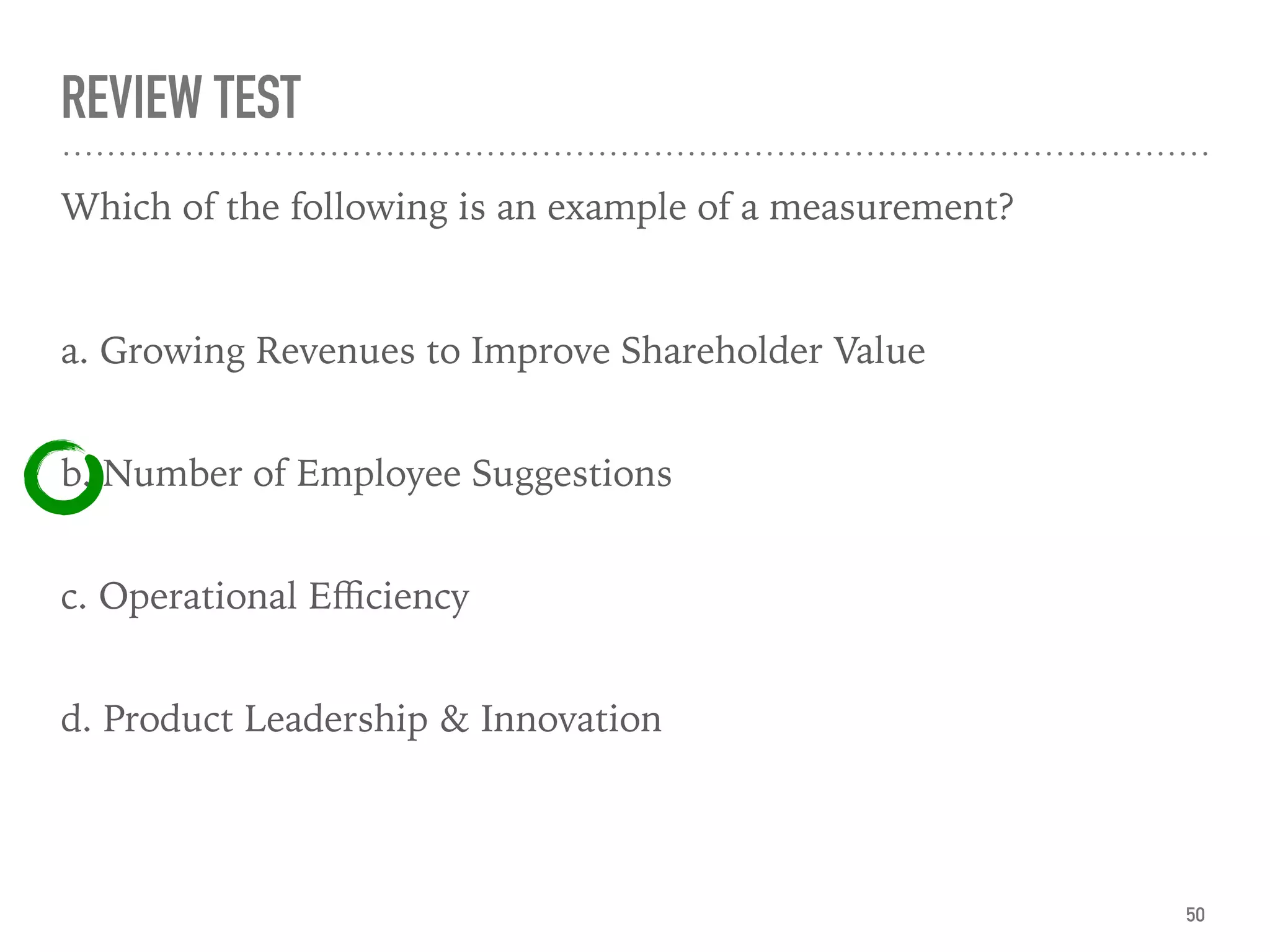
REVIEW TEST
Which of the following is an example of a measurement?
a. Growing Revenues to Improve Shareholder Value 

b. Number of Employee Suggestions 

c. Operational Efficiency 

d. Product Leadership & Innovation 

50
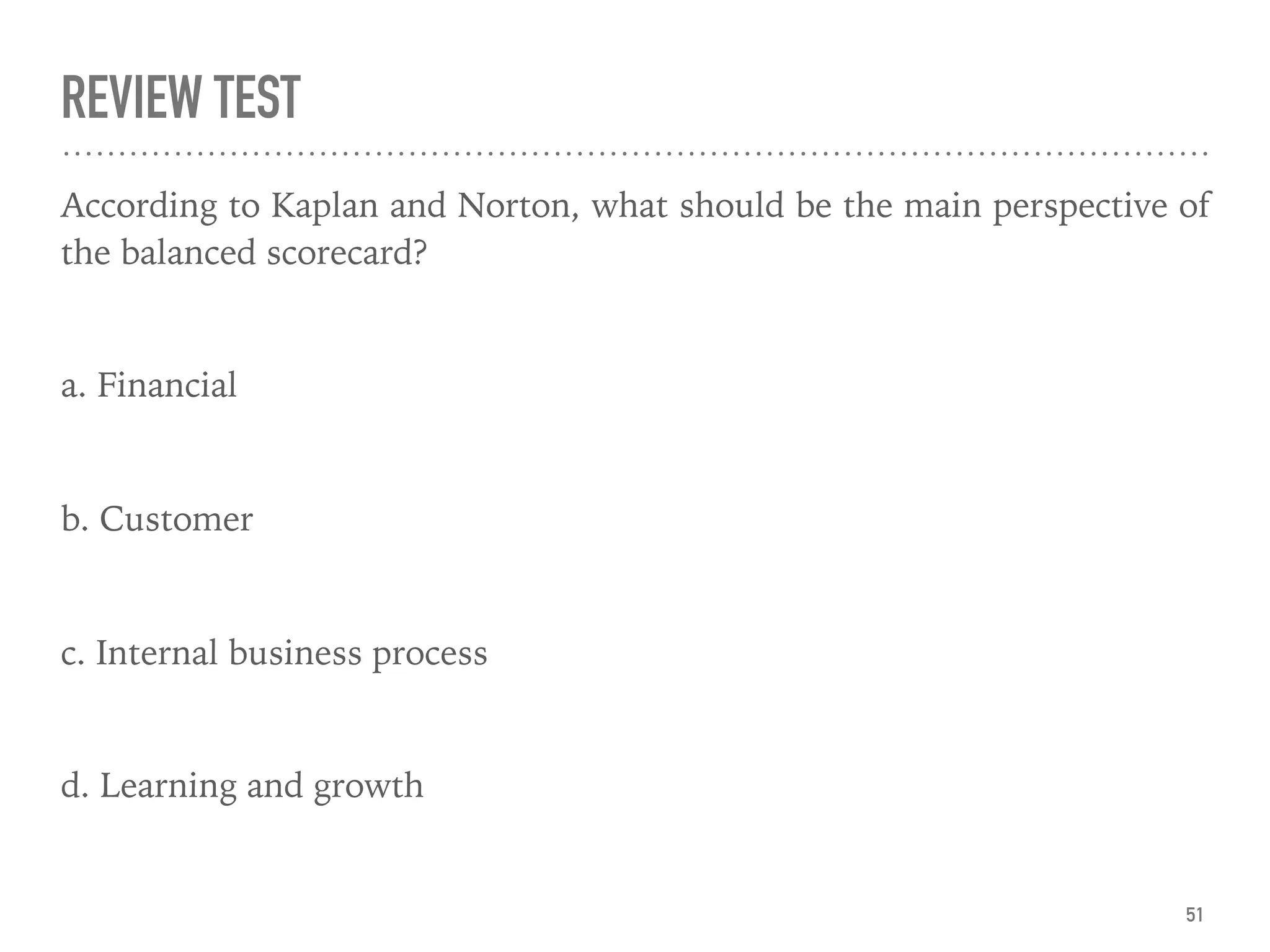
REVIEW TEST
According to Kaplan and Norton, what should be the main perspective of
the balanced scorecard?
a. Financial
b. Customer
c. Internal business process
d. Learning and growth
51
REVIEW TEST
According to Kaplan and Norton, what should be the main perspective of
the balanced scorecard?
a. Financial
b. Customer
c. Internal business process
d. Learning and growth
52
REVIEW TEST
4. The measurement, % of market share, would most likely be placed
in which perspective of the Balanced Scorecard?
a. Financial


b. Customer

c. Product Innovation
d. Learning & Growth
53
REVIEW TEST
4. The measurement, % of market share, would most likely be placed
in which perspective of the Balanced Scorecard?
a. Financial


b. Customer

c. Product Innovation
d. Learning & Growth
54
REVIEW TEST
Arrange the five measurements below in the order of cause and effect.
A. Improve customer loyalty.
B. Improve return on capital employed.
C. Improve repeat and expanded sales.
D. Improve cycle time.
E. Improve on time delivery to customer.
F. Improve employee skills.
a. B →C →A →E →D →F
b. F →E →D →C →A →B
c. F →D →E →A →C →B
d. A →D →F →E →B →C
e. C →A →E →B →D →F
55
REVIEW TEST
Arrange the five measurements below in the order of cause and effect.
A. Improve customer loyalty.
B. Improve return on capital employed.
C. Improve repeat and expanded sales.
D. Improve cycle time.
E. Improve on time delivery to customer.
F. Improve employee skills.
a. B →C →A →E →D →F
b. F →E →D →C →A →B
c. F →D →E →A →C →B
d. A →D →F →E →B →C
e. C →A →E →B →D →F
56
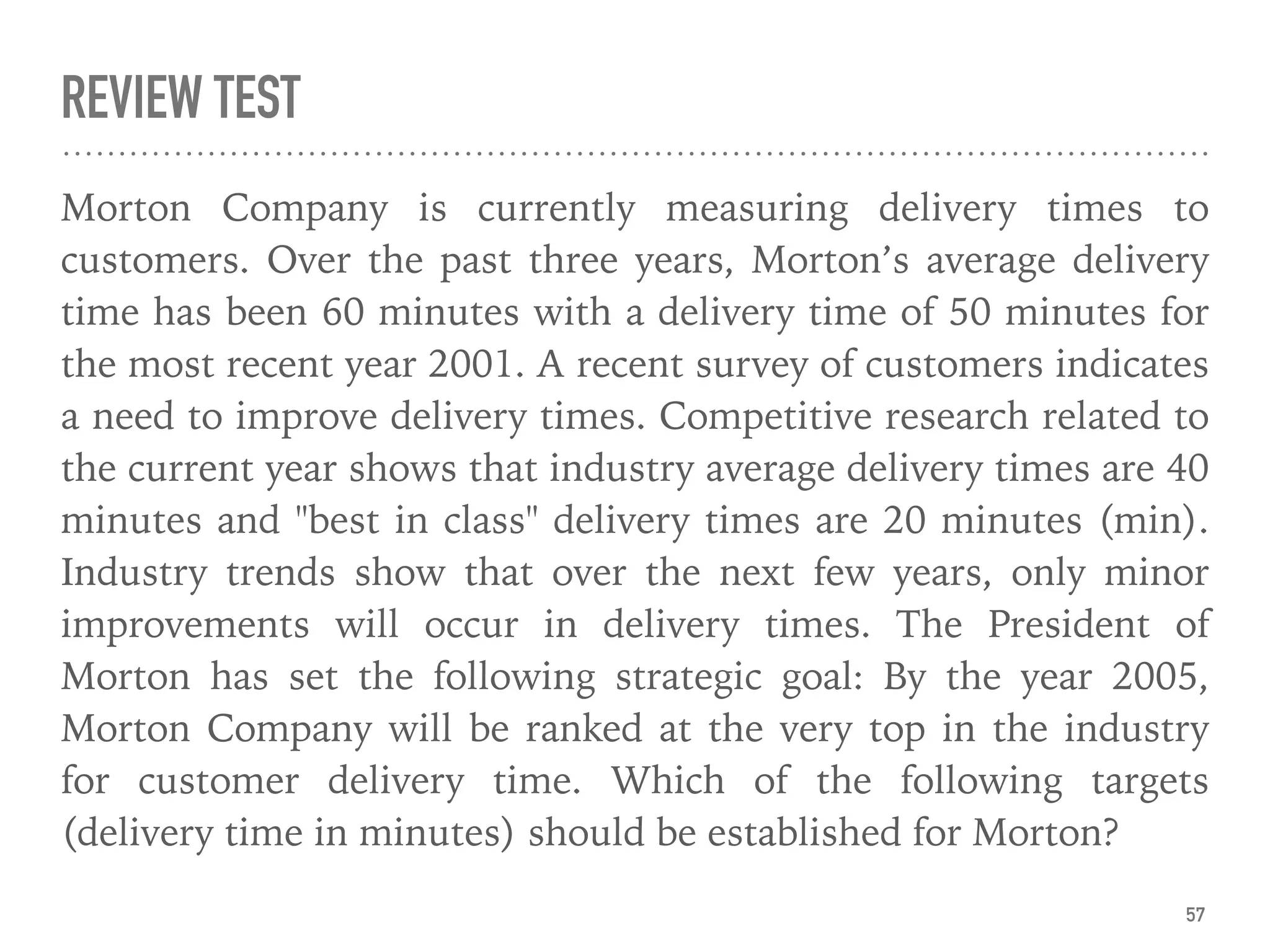
REVIEW TEST
Morton Company is currently measuring delivery times to
customers. Over the past three years, Morton’s average delivery
time has been 60 minutes with a delivery time of 50 minutes for
the most recent year 2001. A recent survey of customers indicates
a need to improve delivery times. Competitive research related to
the current year shows that industry average delivery times are 40
minutes and "best in class" delivery times are 20 minutes (min).
Industry trends show that over the next few years, only minor
improvements will occur in delivery times. The President of
Morton has set the following strategic goal: By the year 2005,
Morton Company will be ranked at the very top in the industry
for customer delivery time. Which of the following targets
(delivery time in minutes) should be established for Morton?
57
REVIEW TEST (CONT.)
Current Year Year 2002 Year 2003 Year 2004 Year 2005
a. 50 min 45 min 40 min 35 min 30 min
b. 60 min 55 min 45 min 35 min 25 min
c. 50 min 40 min 30 min 20 min 15 min
d. 50 min 45 min 40 min 35 min 20 min
58
REVIEW TEST (CONT.)
Current Year Year 2002 Year 2003 Year 2004 Year 2005
a. 50 min 45 min 40 min 35 min 30 min
b. 60 min 55 min 45 min 35 min 25 min
c. 50 min 40 min 30 min 20 min 15 min
d. 50 min 45 min 40 min 35 min 20 min
59
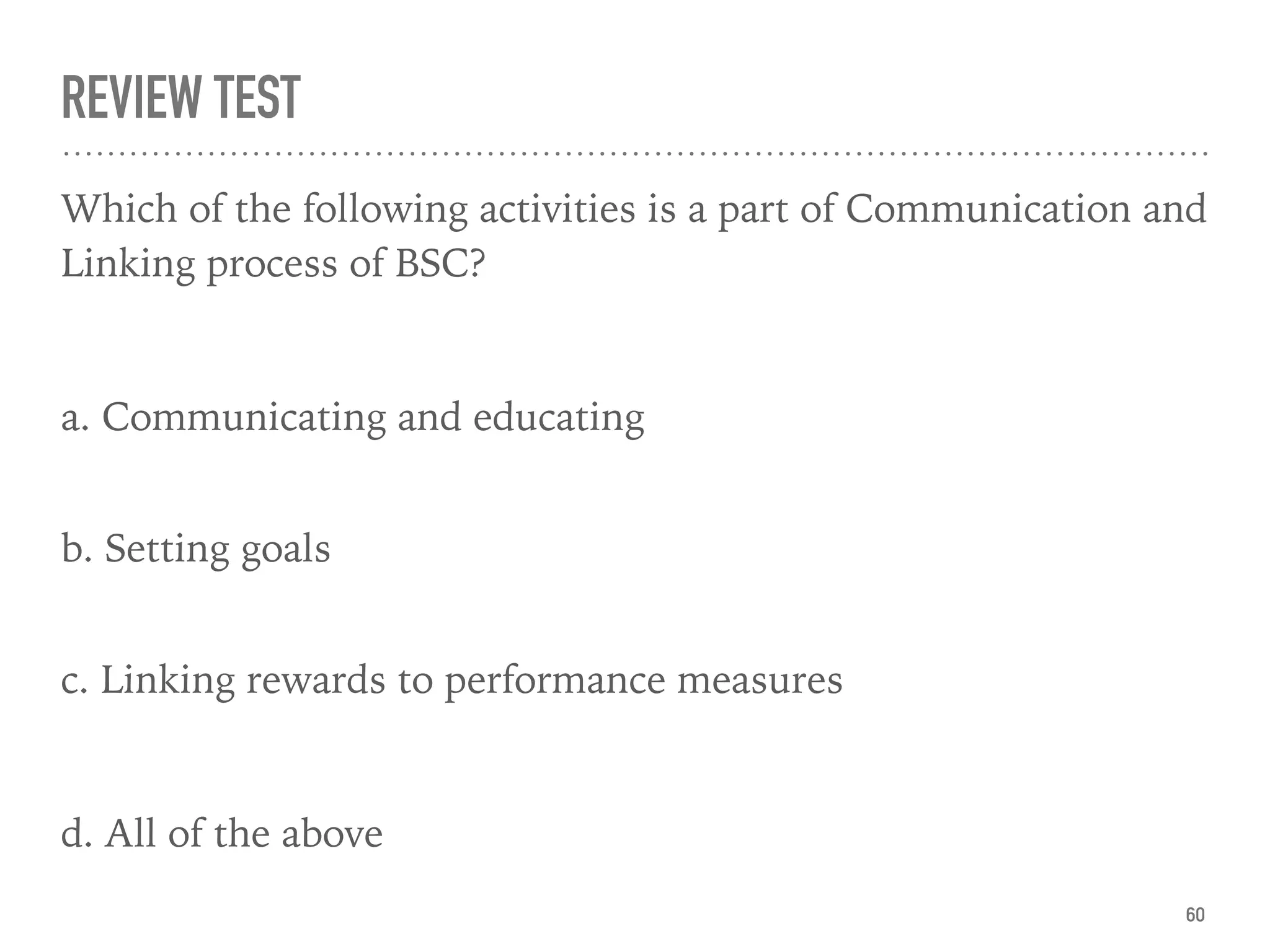
REVIEW TEST
Which of the following activities is a part of Communication and
Linking process of BSC?
a. Communicating and educating


b. Setting goals

c. Linking rewards to performance measures
d. All of the above
60
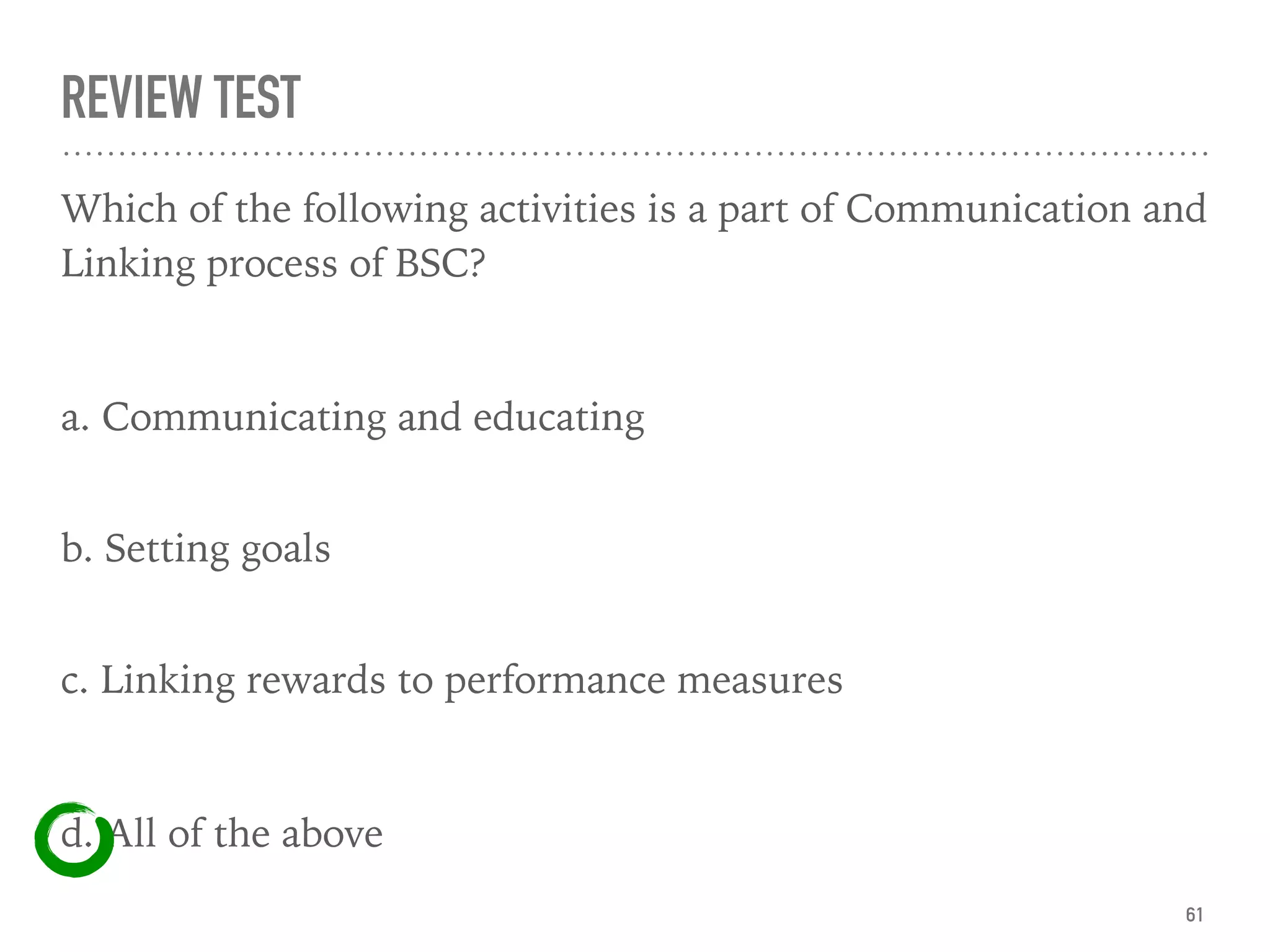
REVIEW TEST
Which of the following activities is a part of Communication and
Linking process of BSC?
a. Communicating and educating


b. Setting goals

c. Linking rewards to performance measures
d. All of the above
61
62

Principles of Balanced Scorecard

  • 1.
    BALANCED SCORECARD By: ErfanMoradian May 2016 1
  • 2.
  • 3.
    BALANCED SCORECARD HISTORY ➤Introduced in 1992, by Robert Kaplan and David Norton ➤ Revolutionised conventional thinking about performance metrics ➤ By going beyond traditional measures of financial performance ➤ A better understanding of how the companies are really doing 3
  • 4.
    BALANCED SCORECARD HISTORY Articlesin Harvard Business Review ➤ “The Balanced Scorecard — Measures that Drive Performance” January - February 1992 ➤ “Putting the Balanced Scorecard to Work” September - October 1993 ➤ “Using the Balanced Scorecard as
 a Strategic Management System” January - February 1996 ➤ Selected by Harvard Business Review as one of the “most important management practices of the past 75 years.“ 4
  • 5.
  • 6.
    INTRODUCTION Why do budgetsoften bear little direct relation to a company’s long-term strategic objectives? 6
  • 7.
    INTRODUCTION A balanced scorecardaugments traditional financial measures with benchmarks for performance in three key non-financial areas: A company’s relationship with its customers 
 Its key internal processes 
 Its learning and growth
 7
  • 8.
    INTRODUCTION The result: ➤ Abroader perspective on the company’s health and activities ➤ A powerful organising framework A sophisticated instrument panel for coordinating and fine- tuning a company’s operations and businesses so that all activities are aligned with its strategy. 
 8
  • 9.
    WHAT IS BALANCEDSCORECARD? A management tool that provides stakeholders with a comprehensive measure of how the organization is progressing towards the achievement of its strategic goals. 9
  • 10.
    WHAT IS BALANCEDSCORECARD? The Balanced Scorecard: ➤ Balances financial and non-financial measures ➤ Balances short and long-term measures ➤ Balances performance drivers (leading indicators) with outcome measures (lagging indicators) ➤ Should contain just enough data to give a complete picture of organizational performance … and no more! ➤ Leads to strategic focus and organizational alignment 10
  • 11.
    WHAT IS BALANCEDSCORECARD? MISSION Why we exist VALUES What’s important to us VISION What we want to be STRATEGY Our game plan STRATEGIC OUTCOMES Satisfied SHAREHOLDERS Delighted CUSTOMERS Efficient and Effective PROCESSES Motivated & Prepared WORKFORCE 11
  • 12.
    WHAT IS BALANCEDSCORECARD? MISSION Why we exist VALUES What’s important to us VISION What we want to be STRATEGY Our game plan BALANCED SCORECARD Implementation & Focus STRATEGIC INITIATIVES What we need to do STRATEGIC OUTCOMES Satisfied SHAREHOLDERS Delighted CUSTOMERS Efficient and Effective PROCESSES Motivated & Prepared WORKFORCE PERSONAL OBJECTIVES What I need to do 12
  • 13.
    WHAT IS BALANCEDSCORECARD? (PERSPECTIVES) Vision and Strategy Financial Custom er InternalBusiness Process Learning and Grow th To succeed financially, how should we appear to our shareholders? To satisfy our shareholders and customers, what business processes must we excel at? To achieve our vision, how will we sustain our ability to change and improve? To achieve our vision, how should we appear to our customers? 13
  • 14.
    WHAT IS BALANCEDSCORECARD? (PROCESSES) BALANCED SCORECARD Feedback and Learning Translating the Vision Communicating and Linking Business Planning Clarifying the vision Gaining consensus Articulating the shared vision Supplying strategic feedback Facilitating strategy review and learning Setting targets Aligning strategic initiatives Allocating resources Establishing milestones Communicating and educating Setting goals Linking rewards to performance measures 14
  • 15.
    WHY BALANCED SCORECARD? ➤To achieve strategic objectives. ➤ To provide quality with fewer resources ➤ To eliminate non-value added efforts ➤ To align customer priorities and expectations with the customer ➤ To track progress ➤ To evaluate process changes ➤ To continually improve ➤ To increase accountability 15
  • 16.
  • 17.
    TRANSLATING THE VISION ➤Helps managers build a consensus around the organisation’s vision and strategy “Best in class” “The number one supplier” “Empowered organization” These statements don’t translate easily into operational terms that provide useful guides to action at the local level. 17
  • 18.
    TRANSLATING THE VISION Example: “Touse high-quality employees to provide services that surpass customers’ needs” 18
  • 19.
    TRANSLATING THE VISION Example: “Toprovide superior service to targeted customers” 19
  • 20.
    TRANSLATING THE VISION Thosestatements must be expressed as an integrated set of objectives and measures, agreed upon by all senior executives, that describe the long-term drivers of success. 20
  • 21.
    COMMUNICATING AND LINKING ➤Lets managers communicate their strategy up and down the organization and link it to departmental and individual objectives. ➤ Gives managers a way of ensuring that all levels of the organization understand the long-term strategy and that both departmental and individual objectives are aligned with it. ➤ Broad participation in creating a scorecard takes longer, but it offers several advantages: 21
  • 22.
    COMMUNICATING AND LINKING Broadparticipation in creating a scorecard takes longer, but it offers several advantages: ➤ Information from a larger number of managers is incorporated into the internal objectives ➤ The managers gain a better understanding of the company’s long-term strategic goals ➤ Such broad participation builds a stronger commitment to achieving those goals 22
  • 23.
    COMMUNICATING AND LINKING Toalign employees’ individual performances with the overall strategy, scorecard users generally engage in three activities: Communicating and educating Setting goals Linking rewards to performance measures 23
  • 24.
    COMMUNICATING AND LINKING Communicatingand educating ➤ Implementing a strategy begins with educating those who have to execute it. ➤ A broad-based communication program shares with all employees the strategy and the critical objectives they have to meet if the strategy is to succeed. ✦ One-time events ✦ Bulletin boards ✦ Groupware and electronic bulletin boards 24
  • 25.
    COMMUNICATING AND LINKING Shouldthe balanced scorecard be communicated beyond the boardroom to external shareholders? 25
  • 26.
    COMMUNICATING AND LINKING Settinggoals ➤ The organisation’s high-level strategic objectives and measures must be translated into objectives and measures for operating units and individuals. ➤ The scorecard contains three levels of information: ✦ Corporate objectives, measures, and targets ✦ Translating corporate targets into targets for each business unit ✦ The individuals’ and teams’ own objectives consistent with the business unit and corporate objectives; the required initiatives to achieve their objectives; up to five performance measures for their objectives and targets for each measure. 26
  • 27.
    COMMUNICATING AND LINKING WhyMeasure? ➤ To determine how effectively and efficiently the process or service satisfies the customer ➤ To identify improvement opportunities ➤ To make decisions based on FACT and DATA 27
  • 28.
    COMMUNICATING AND LINKING MeasurementsShould: ➤ Translate customer expectations into goals ➤ Evaluate the quality of processes ➤ Track our improvement ➤ Focus our efforts on our customers ➤ Support our strategies 28
  • 29.
    “If you don’tknow where you’re going, you’re probably not gonna get there. -Forrest Gump 29
  • 30.
    COMMUNICATING AND LINKING Targets: ➤Targets need to be set for all measures ➤ Should have a “solid basis” ➤ Give personnel something for which to aim ➤ If achieved, will transform the organization 30
  • 31.
    COMMUNICATING AND LINKING Initiatives: ➤Once measures and targets are established, it is the responsibility of management to determine HOW the organization will achieve its goals. ➤ Measures are used to determine the effectiveness of strategic initiatives. 31
  • 32.
    COMMUNICATING AND LINKING ThePersonal Scorecard 32
  • 33.
    COMMUNICATING AND LINKING Linkingrewards to performance measures Should compensation systems be linked to balanced scorecard measures? 33
  • 34.
    COMMUNICATING AND LINKING ➤This activity is attractive powerful but it nonetheless carries risks. Does the company have the right measures on the scorecard? Does it have valid and reliable data for the selected measures? Could unintended or unexpected consequences arise from the way the targets for the measures are achieved? 34
  • 35.
  • 36.
    BUSINESS PLANNING ➤ Mostorganizations have separate procedures and organizational units for strategic planning and for resource allocation and budgeting. ➤ Creating a balanced scorecard forces companies to integrate their strategic planning and budgeting processes and therefore helps to ensure that their budgets support their strategies. ➤ Building a scorecard enables a company to link its financial budgets with its strategic goals. ➤ Once the strategy is defined and the drivers are identified, the scorecard influences managers to concentrate on improving or reengineering those processes most critical to the organisation’s strategic success. ➤ The final step in linking strategy to actions is to establish specific short-term targets, or milestones, for the balanced scorecard measures. 36
  • 37.
    “We didn’t doanything wrong, but somehow, we lost. -Nokia’s CEO, Stephen Elop 37
  • 38.
    FEEDBACK AND LEARNING ➤The ability to know at any point in its implementation whether the formulated strategy is working? and if not, why? Single-loop learning Vs. Double-loop learning The objective remains constant, and any departure from the planned trajectory is seen as a defect to be remedied. Learning that produces a change in people’s assumptions and theories about cause-and-effect relationships. 38
  • 39.
    FEEDBACK AND LEARNING Thebalanced scorecard supplies three elements that are essential to strategic learning: 1. It articulates the company’s shared vision, defining in clear and operational terms the results that the company, as a team, is trying to achieve. 2. The scorecard supplies the essential strategic feedback system. 3. The scorecard facilitates the strategy review that is essential to strategic learning. 39
  • 40.
    HOW ONE COMPANYBUILT A STRATEGIC MANAGEMENT SYSTEM... 40
  • 41.
    HOW ONE COMPANYBUILT A STRATEGIC MANAGEMENT SYSTEM... 41
  • 42.
  • 43.
    BALANCED SCORECARD EXAMPLE- CREDIT CARD COMPANY 43
  • 44.
    BALANCED SCORECARD EXAMPLE- ENERGY COMPANY 44
  • 45.
    BUILDING & IMPLEMENTINGA BALANCED SCORECARD: NINE STEPS TO SUCCESS 45
  • 46.
    BALANCED SCORECARD ASA STRATEGIC MANAGEMENT SYSTEM Companies are using the Balanced Scorecard to: ➤ Clarify and update strategy ➤ Communicate strategy throughout the company ➤ Align unit and individual goals with the strategy ➤ Link strategic objectives to long-term targets and annual budgets ➤ Identify and align strategic initiatives ➤ Conduct periodic performance reviews to learn about and improve strategy 46
  • 47.
    BALANCED SCORECARD ASA STRATEGIC MANAGEMENT SYSTEM The balanced scorecard provides a framework for managing the implementation of strategy while also allowing the strategy itself to evolve in response to changes in the company’s competitive, market, and technological environments. 47
  • 48.
  • 49.
    REVIEW TEST Which ofthe following is an example of a measurement? a. Growing Revenues to Improve Shareholder Value 
 b. Number of Employee Suggestions 
 c. Operational Efficiency 
 d. Product Leadership & Innovation 
 49
  • 50.
    REVIEW TEST Which ofthe following is an example of a measurement? a. Growing Revenues to Improve Shareholder Value 
 b. Number of Employee Suggestions 
 c. Operational Efficiency 
 d. Product Leadership & Innovation 
 50
  • 51.
    REVIEW TEST According toKaplan and Norton, what should be the main perspective of the balanced scorecard? a. Financial b. Customer c. Internal business process d. Learning and growth 51
  • 52.
    REVIEW TEST According toKaplan and Norton, what should be the main perspective of the balanced scorecard? a. Financial b. Customer c. Internal business process d. Learning and growth 52
  • 53.
    REVIEW TEST 4. Themeasurement, % of market share, would most likely be placed in which perspective of the Balanced Scorecard? a. Financial 
 b. Customer
 c. Product Innovation d. Learning & Growth 53
  • 54.
    REVIEW TEST 4. Themeasurement, % of market share, would most likely be placed in which perspective of the Balanced Scorecard? a. Financial 
 b. Customer
 c. Product Innovation d. Learning & Growth 54
  • 55.
    REVIEW TEST Arrange thefive measurements below in the order of cause and effect. A. Improve customer loyalty. B. Improve return on capital employed. C. Improve repeat and expanded sales. D. Improve cycle time. E. Improve on time delivery to customer. F. Improve employee skills. a. B →C →A →E →D →F b. F →E →D →C →A →B c. F →D →E →A →C →B d. A →D →F →E →B →C e. C →A →E →B →D →F 55
  • 56.
    REVIEW TEST Arrange thefive measurements below in the order of cause and effect. A. Improve customer loyalty. B. Improve return on capital employed. C. Improve repeat and expanded sales. D. Improve cycle time. E. Improve on time delivery to customer. F. Improve employee skills. a. B →C →A →E →D →F b. F →E →D →C →A →B c. F →D →E →A →C →B d. A →D →F →E →B →C e. C →A →E →B →D →F 56
  • 57.
    REVIEW TEST Morton Companyis currently measuring delivery times to customers. Over the past three years, Morton’s average delivery time has been 60 minutes with a delivery time of 50 minutes for the most recent year 2001. A recent survey of customers indicates a need to improve delivery times. Competitive research related to the current year shows that industry average delivery times are 40 minutes and "best in class" delivery times are 20 minutes (min). Industry trends show that over the next few years, only minor improvements will occur in delivery times. The President of Morton has set the following strategic goal: By the year 2005, Morton Company will be ranked at the very top in the industry for customer delivery time. Which of the following targets (delivery time in minutes) should be established for Morton? 57
  • 58.
    REVIEW TEST (CONT.) CurrentYear Year 2002 Year 2003 Year 2004 Year 2005 a. 50 min 45 min 40 min 35 min 30 min b. 60 min 55 min 45 min 35 min 25 min c. 50 min 40 min 30 min 20 min 15 min d. 50 min 45 min 40 min 35 min 20 min 58
  • 59.
    REVIEW TEST (CONT.) CurrentYear Year 2002 Year 2003 Year 2004 Year 2005 a. 50 min 45 min 40 min 35 min 30 min b. 60 min 55 min 45 min 35 min 25 min c. 50 min 40 min 30 min 20 min 15 min d. 50 min 45 min 40 min 35 min 20 min 59
  • 60.
    REVIEW TEST Which ofthe following activities is a part of Communication and Linking process of BSC? a. Communicating and educating 
 b. Setting goals
 c. Linking rewards to performance measures d. All of the above 60
  • 61.
    REVIEW TEST Which ofthe following activities is a part of Communication and Linking process of BSC? a. Communicating and educating 
 b. Setting goals
 c. Linking rewards to performance measures d. All of the above 61
  • 62.