Management Science Introduction to Management
UNIT I
INTRODUCTION TO MANAGEMENT
Management is what managers do. It
also refers to people at the top level, in the
organisation, concerned with decision-making.
In the present context, managing has become
one of the most important areas of human
activity because of increasing role of large and
complex organisations in the society. Because
of their increasing role, the organisations have
attracted the attention of both practitioners and
academicians to find out the solutions for
business problems.
M
A --- The Manager
N
A
G --- Knowledge
E
M
E --- The People
N
T --- Technology/Techniques/Tactics
Concept
In the above, Man refers to the manager
who leads the groups and organisation and is
responsible for the performance of other
activities. Here age does not means
chronological age, it refers to the knowledge to
be possessed by a manager to operate the
organisation successfully. Knowledge can be
secured through experience, study and exposure.
The word men stands for the term
people, i.e the team of subordinates working
under the supervision and control of the
managers. They achieve the objectives with the
assistance of subordinates. T denotes
technology, it means know how. Managers
should also possess skills, techniques and tactics
to win the game and to achieve the objects.
DEFINITION
“Management is the art of getting things
done through and with people in formally
organized groups” --- Koontz
“Management is the art of getting things done
through and with people” ----- Mary Parker
“Management is the art of knowing what you
want to do and then seeing that it is done in the
best and cheapest way” – F.W. Taylor
“Management is the accomplishment of results
through the efforts of other people”
-- Lawrence
“Management is to manage is to forecast and
plan, to organize, to command, to coordinate
and control”. -- Henry Fayol (1916)
“Management is a process involving planning,
organizing, staffing, directing and controlling
human efforts to achieve stated objectives in an
organization.”
From the above definitions, the following
features are identified:-
• Organised Activities
• Existence of objectives
• Relationship among resources
• Working with and through people
• Decision Making
1. Organised Activities:
Management is a process of organized
activities. Without organized activities, two
groups of people cannot be involved in the
performance of activities. Where a group of
people are involved in working towards a
common objective, management comes into
existence.
2. Existence of objectives:
The existence of objectives is a basic
criterion of every human organization because
all organizations are deliberate and purposive
creation and, therefore, they should have some
objectives. Without objectives, it becomes
difficult to define the direction where organized
group of activities would lead to.
3. Relationship among resources:
Organised activities meant to achieve
common goals are brought about to establish
N.Durga Chaitanya Prasad MBA, M.Com MS Notes 1
Management Science Introduction to Management
certain relationships about the available resources.
Resources include money, machine, material,
men and methods. All these resources are made
available to those who manage the organization.
Managers apply knowledge, experience,
principles for getting the desired results. Thus,
the essence of management is integration of
various organisational resources.
4. Working with and through people:
Management involves working with
people and getting organisational objectives
achieved through them. The idea of working
through people is interpreted in terms of
assigning and reassigning of activities to
subordinates.
5. Decision Making:
Management process involves decision
making at various levels for getting things done
through people. Decision making basically
involves selecting the most appropriate
alternative out of the several. If there is only one
alternative, there is no question of decision
making.
Nature of Management: -
The study and application of
management techniques in managing the affairs
of the organization have changed its nature over
a period of time. The following points will
describe the nature of management
• Multidisciplinary
• Dynamic nature of Principles
• Relative, Not absolute Principles
• Management: Science or Art
• Management as profession
• Universality of management
• Management is a Situational in Nature
1. Multidisciplinary:
Management has been developed as a
separate discipline, but it draws knowledge and
concepts from various disciplines like
psychology, sociology, anthropology,
economics, statistics, operations research etc.,.
Management integrates the idea and concepts
taken from these disciplines and presents newer
concepts which can be put into practice for
managing the organisations
2. Dynamic nature of Principles:
Principle is a fundamental truth which
establishes cause and effect relationships of a
function. Based on integration and supported by
practical evidences, management has framed
certain principles. However, these principles are
flexible in nature and change with the changes
in the environment in which an organization
exists.
3. Relative, Not absolute Principles:
Management principles are relative, not
absolute, and they should be applied according
to the need of the organization. Each
organization may be different from others. The
difference may exist because of time, place,
socio-cultural factors, etc.,
4. Management: Science or Art:
There is a controversy whether
management is science or art.
An art is personal skill of business
affairs. Art is characterized by practical
knowledge, personal creativity and skill. The
more one practices an art, the more professional
one becomes. Management can be considered as
an art because it satisfies all these criterion of an
art.
A science is a systematized body of
knowledge of facts. It can establish cause-and-
effect relationships among various factors. It
involves basic principles, which are capable of
universal application. Management can be
considered as science because it satisfies all
these criterion of a science.
5. Management as profession:
Management has been regarded as a
profession by many while many have suggested
that it has not achieved the status of a
profession. Profession refers to a vocation or a
branch of advanced learning such as engineering
or medicine.
6. Universality of management:
Management is a universal phenomenon.
However, management principles are not
universally applicable but are to be modified
according to the needs of the situation.
N.Durga Chaitanya Prasad MBA, M.Com MS Notes 2
Management Science Introduction to Management
7. Management is a Situational in Nature:
The same style of management cannot
work for the same situation every time. The
changes in situation may call for a change in the
style of functioning of manager.
Importance of Management
Management has been important to the
daily lives of people and to the organisations.
The importance of management may be traces
with the following.
• Effective utilisation of Resources
• Development of Resources
• It ensures continuity in the organization
• Integrating various interest groups
• Stability in the society
1. Effective utilisation of Resources:
Management tries to make effective
utilisation of various resources. The resources
are scarce in nature and to meet the demand of
the society, their contribution should be more
for the general interests of the society.
Management not only decides in which
particular alternative a particular resource
should be used, but also takes actions to utilize
it in that particular alternative in the best way.
2. Development of Resources:
Management develops various resources.
This is true with human as well as non-human
factors. Most of the researchers for resource
development are carried on in an organized way
and management is involved in these organized
activities.
3. It ensures continuity in the organization:
Continuity is very important in the
organisations. Where there are no proper
guidelines for decision making continuity can
not be guaranteed. It is quite natural that new
people join while some others retire or leave the
organization. It is only management that keeps
the organization continuing.
4. Integrating various interest groups:
In the organized efforts, there are
various interest groups and they put pressure
over other groups for maximum share in the
combined output. For example, in case of a
business organization, there are various pressure
groups such as shareholders, employees, govt.
etc. these interest groups have pressure on an
organization. Management has to balance these
pressures from various interest groups.
5. Stability in the society:
Management provides stability in the
society by changing and modifying the
resources in accordance with the changing
environment of the society. In the modern age,
more emphasis is on new inventions for the
betterment of human beings. These inventions
make old systems and factors mostly obsolete
and inefficient. Management provides
integration between traditions and new
inventions, and safeguards society from the
unfavorable impact of these inventions so that
continuity in social process is maintained.
Functions of Management:-
To achieve the organisational objectives
managers at all levels of organization should
perform different functions. A function is a
group of similar activities.
The list of management functions varies
from author to author with the number of
functions varying from three to eight.
Writers Management Functions
Henry
Fayol
Luther
Gullick
R. Davis
E.F.L.
Breech
Koontz
Planning, Organizing,
Commanding, Coordinating,
Controlling
POSDCORD- Planning,
Organising, Staffing,
Directing, Coordinating,
Reporting, Directing
Planning , Organising,
Controlling
Planning, Organising,
Motivating, Coordinating,
Controlling
Planning, Organising,
N.Durga Chaitanya Prasad MBA, M.Com MS Notes 3
Management Science Introduction to Management
Staffing, Leading, Controlling
Different authors presented different
variations. By combining some of functions,
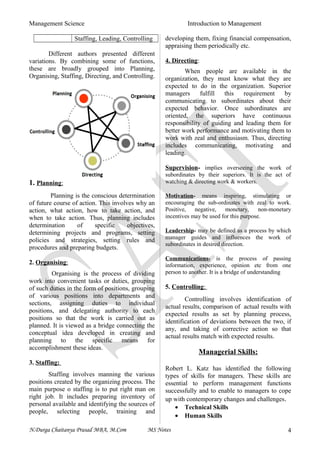
these are broadly grouped into Planning,
Organising, Staffing, Directing, and Controlling.
1. Planning:
Planning is the conscious determination
of future course of action. This involves why an
action, what action, how to take action, and
when to take action. Thus, planning includes
determination of specific objectives,
determining projects and programs, setting
policies and strategies, setting rules and
procedures and preparing budgets.
2. Organising:
Organising is the process of dividing
work into convenient tasks or duties, grouping
of such duties in the form of positions, grouping
of various positions into departments and
sections, assigning duties to individual
positions, and delegating authority to each
positions so that the work is carried out as
planned. It is viewed as a bridge connecting the
conceptual idea developed in creating and
planning to the specific means for
accomplishment these ideas.
3. Staffing:
Staffing involves manning the various
positions created by the organizing process. The
main purpose o staffing is to put right man on
right job. It includes preparing inventory of
personal available and identifying the sources of
people, selecting people, training and
developing them, fixing financial compensation,
appraising them periodically etc.
4. Directing:
When people are available in the
organization, they must know what they are
expected to do in the organization. Superior
managers fulfill this requirement by
communicating to subordinates about their
expected behavior. Once subordinates are
oriented, the superiors have continuous
responsibility of guiding and leading them for
better work performance and motivating them to
work with zeal and enthusiasm. Thus, directing
includes communicating, motivating and
leading.
Supervision- implies overseeing the work of
subordinates by their superiors. It is the act of
watching & directing work & workers.
Motivation- means inspiring, stimulating or
encouraging the sub-ordinates with zeal to work.
Positive, negative, monetary, non-monetary
incentives may be used for this purpose.
Leadership- may be defined as a process by which
manager guides and influences the work of
subordinates in desired direction.
Communications- is the process of passing
information, experience, opinion etc from one
person to another. It is a bridge of understanding
5. Controlling:
Controlling involves identification of
actual results, comparison of actual results with
expected results as set by planning process,
identification of deviations between the two, if
any, and taking of corrective action so that
actual results match with expected results.
Managerial Skills:
Robert L. Katz has identified the following
types of skills for managers. These skills are
essential to perform management functions
successfully and to enable to managers to cope
up with contemporary changes and challenges.
• Technical Skills
• Human Skills
N.Durga Chaitanya Prasad MBA, M.Com MS Notes 4
Management Science Introduction to Management
• Conceptual Skills
• Design Skills
Technical Skills:
It is the prefiency of various methods,
process and procedures in performing activities.
It needs working with tools and techniques. Ex.
To perform the tasks successfully mechanics
must have the knowledge of tools and
accountants should use proper techniques.
Human Skills:
It is the ability to work with people and
to build up cooperative effort. In order to create
effective team work, managers should have
good human skills like sociability, fraternity,
warmth and ability to get along with others etc
Conceptual Skills:
It is the ability to think about the whole
system and to understand the relationship
among the various elements through proper
analysis. It also involves the skill to integrate
the coordinate the different activities.
Design Skills:
Managers should have the ability not
only to find out the problem but also to solve
them successfully. Design skills refer to solve
problems in such a way that will benefit the
organization.
How ever these skills are different
needed at various levels of management.
Technical skills require at lower or supervisory
level of management. Whereas more human
skills necessary for middle level managers. And
managers at the upper level should posses a
great amount of conceptual and design skills.
Managerial Roles:
Professor Henry Mintzberg did careful study
of the activities of CEO practically in a variety
of organization; he has come to a conclusion
that managers do not perform the classical
management process. They have to perform a
variety of activities, called Roles. He has started
ten roles of managers consisting of three broach
categories
1. Interpersonal Roles
2. Informational Roles
3. Decision Roles
1. Interpersonal Roles:
• The figure Head Roles:- The
manager performs ceremonial and social
duties and the representative of the
organization.
• The Leader Role: He leads the
groups
• The Liaison Role: He performs
talks with various people particularly with
outsiders.
2. Informational Roles:
• The Recipient Role: He receives
information about the operation of an
enterprise.
• The Disseminator Roles: He passes
information to subordinates.
• The Spokes Person Role: He transmits
the information to those outside the
organization.
3. Decision Roles:
• The Entrepreneurial Role: The
innovates and initiate the activities
• The disturbance Handler Role:
He settles disputes and conflicts
• The Resources Allocate Role:
He allocates the resources towards various
ends.
• The Negotiator Role: He deals
with various persons and groups of persons
LEVELS OF MANAGEMENT
The term “Levels of Management’
refers to a line of separation between various
managerial positions in an organization. The
number of levels in management increases when
the size of the business and work force increases
and vice versa. The level of management
N.Durga Chaitanya Prasad MBA, M.Com MS Notes 5
Management Science Introduction to Management
determines a chain of command, the amount of
authority & status enjoyed by any managerial
position. The levels of management can be
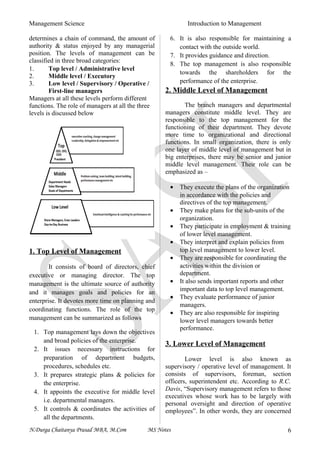
classified in three broad categories:
1. Top level / Administrative level
2. Middle level / Executory
3. Low level / Supervisory / Operative /
First-line managers
Managers at all these levels perform different
functions. The role of managers at all the three
levels is discussed below
1. Top Level of Management
It consists of board of directors, chief
executive or managing director. The top
management is the ultimate source of authority
and it manages goals and policies for an
enterprise. It devotes more time on planning and
coordinating functions. The role of the top
management can be summarized as follows
1. Top management lays down the objectives
and broad policies of the enterprise.
2. It issues necessary instructions for
preparation of department budgets,
procedures, schedules etc.
3. It prepares strategic plans & policies for
the enterprise.
4. It appoints the executive for middle level
i.e. departmental managers.
5. It controls & coordinates the activities of
all the departments.
6. It is also responsible for maintaining a
contact with the outside world.
7. It provides guidance and direction.
8. The top management is also responsible
towards the shareholders for the
performance of the enterprise.
2. Middle Level of Management
The branch managers and departmental
managers constitute middle level. They are
responsible to the top management for the
functioning of their department. They devote
more time to organizational and directional
functions. In small organization, there is only
one layer of middle level of management but in
big enterprises, there may be senior and junior
middle level management. Their role can be
emphasized as –
• They execute the plans of the organization
in accordance with the policies and
directives of the top management.
• They make plans for the sub-units of the
organization.
• They participate in employment & training
of lower level management.
• They interpret and explain policies from
top level management to lower level.
• They are responsible for coordinating the
activities within the division or
department.
• It also sends important reports and other
important data to top level management.
• They evaluate performance of junior
managers.
• They are also responsible for inspiring
lower level managers towards better
performance.
3. Lower Level of Management
Lower level is also known as
supervisory / operative level of management. It
consists of supervisors, foreman, section
officers, superintendent etc. According to R.C.
Davis, “Supervisory management refers to those
executives whose work has to be largely with
personal oversight and direction of operative
employees”. In other words, they are concerned
N.Durga Chaitanya Prasad MBA, M.Com MS Notes 6
Management Science Introduction to Management
with direction and controlling function of
management. Their activities include –
• Assigning of jobs and tasks to various
workers.
• They guide and instruct workers for day
to day activities.
• They are responsible for the quality as
well as quantity of production.
• They communicate workers problems,
suggestions, and recommendatory
appeals etc to the higher level and higher
level goals and objectives to the
workers.
• They help to solve the grievances of the
workers.
• They supervise & guide the sub-
ordinates.
• They are responsible for providing
training to the workers.
• They arrange necessary materials,
machines, tools etc for getting the things
done.
• They prepare periodical reports about
the performance of the workers.
• They ensure discipline in the enterprise.
• They motivate workers.
Challenges to the Management
Managers may have to face many challenges in
the years to come in doing their job. These
challenges involve complex issues to deal with.
The following is an inclusive list of the
challenges the manager has to face.
• The changing life styles and changing
values
• Increasing opportunities as a result of all
round globalization, privatization and
liberalization.
• Increasing life expectancy
• Missing at Business ethics
• Changing Technology
• Environmental pollution
• More expectation of customers and
employees.
All these challenges directly and
indirectly point that the manager has to be
creative and competent to continue to be more
effective in his job.
Concept of Ornisation:
Organisation is refers to a social groups
designed to achieve certain goals. Organisation
involves creating a structure of relationship
among people working for the desired results.
Definition:
“Organisations are complex human strategies
designed to achieve certain objectives”.
-----Argyris(1960)
“Organisation is the framework of the
management process” ---- Brech(1965)
“Organisations are systems of interdependent
human beings” ------ Pugh (1990)
Significance of Organisation:
• It facilitates administration
• It facilitates growth and diversification
• It ensures effective utilisation of manpower
• It stimulates creativity
• It ensures optimum utilisation of resource
• It facilitates administration
When organisation structure is created,
organisation procedures are developed, the task
of administration is made easier. Top
management decision can be put into practice
with ease.
• It facilitates growth and diversification
The business house can grow and
diversity only when their internal organisation is
strong and result oriented.
• It ensures effective utilisation of
manpower
The organisation structure forms the basis to
identity, recruit and effectively utilize the
manpower at different levels in the organisation.
• It stimulates creativity:
One of the main features of the organisation is
flexibility. Progressive organisation do not
block the creativity of their manager thorough
the organisation structures. They grant full
freedom to its staff to be more creative. The
N.Durga Chaitanya Prasad MBA, M.Com MS Notes 7
Management Science Introduction to Management
leading companies like Infosys, Visualsoft and
others, stand monumental evidence for this
• It ensures optimum utilisation of resource
Organisations are well through outfits
which deploy resources, strategically to achieve
the given goals in an optimum manner.
N.Durga Chaitanya Prasad MBA, M.Com MS Notes 8

Introduction to Management

  • 1.
    Management Science Introductionto Management UNIT I INTRODUCTION TO MANAGEMENT Management is what managers do. It also refers to people at the top level, in the organisation, concerned with decision-making. In the present context, managing has become one of the most important areas of human activity because of increasing role of large and complex organisations in the society. Because of their increasing role, the organisations have attracted the attention of both practitioners and academicians to find out the solutions for business problems. M A --- The Manager N A G --- Knowledge E M E --- The People N T --- Technology/Techniques/Tactics Concept In the above, Man refers to the manager who leads the groups and organisation and is responsible for the performance of other activities. Here age does not means chronological age, it refers to the knowledge to be possessed by a manager to operate the organisation successfully. Knowledge can be secured through experience, study and exposure. The word men stands for the term people, i.e the team of subordinates working under the supervision and control of the managers. They achieve the objectives with the assistance of subordinates. T denotes technology, it means know how. Managers should also possess skills, techniques and tactics to win the game and to achieve the objects. DEFINITION “Management is the art of getting things done through and with people in formally organized groups” --- Koontz “Management is the art of getting things done through and with people” ----- Mary Parker “Management is the art of knowing what you want to do and then seeing that it is done in the best and cheapest way” – F.W. Taylor “Management is the accomplishment of results through the efforts of other people” -- Lawrence “Management is to manage is to forecast and plan, to organize, to command, to coordinate and control”. -- Henry Fayol (1916) “Management is a process involving planning, organizing, staffing, directing and controlling human efforts to achieve stated objectives in an organization.” From the above definitions, the following features are identified:- • Organised Activities • Existence of objectives • Relationship among resources • Working with and through people • Decision Making 1. Organised Activities: Management is a process of organized activities. Without organized activities, two groups of people cannot be involved in the performance of activities. Where a group of people are involved in working towards a common objective, management comes into existence. 2. Existence of objectives: The existence of objectives is a basic criterion of every human organization because all organizations are deliberate and purposive creation and, therefore, they should have some objectives. Without objectives, it becomes difficult to define the direction where organized group of activities would lead to. 3. Relationship among resources: Organised activities meant to achieve common goals are brought about to establish N.Durga Chaitanya Prasad MBA, M.Com MS Notes 1
  • 2.
    Management Science Introductionto Management certain relationships about the available resources. Resources include money, machine, material, men and methods. All these resources are made available to those who manage the organization. Managers apply knowledge, experience, principles for getting the desired results. Thus, the essence of management is integration of various organisational resources. 4. Working with and through people: Management involves working with people and getting organisational objectives achieved through them. The idea of working through people is interpreted in terms of assigning and reassigning of activities to subordinates. 5. Decision Making: Management process involves decision making at various levels for getting things done through people. Decision making basically involves selecting the most appropriate alternative out of the several. If there is only one alternative, there is no question of decision making. Nature of Management: - The study and application of management techniques in managing the affairs of the organization have changed its nature over a period of time. The following points will describe the nature of management • Multidisciplinary • Dynamic nature of Principles • Relative, Not absolute Principles • Management: Science or Art • Management as profession • Universality of management • Management is a Situational in Nature 1. Multidisciplinary: Management has been developed as a separate discipline, but it draws knowledge and concepts from various disciplines like psychology, sociology, anthropology, economics, statistics, operations research etc.,. Management integrates the idea and concepts taken from these disciplines and presents newer concepts which can be put into practice for managing the organisations 2. Dynamic nature of Principles: Principle is a fundamental truth which establishes cause and effect relationships of a function. Based on integration and supported by practical evidences, management has framed certain principles. However, these principles are flexible in nature and change with the changes in the environment in which an organization exists. 3. Relative, Not absolute Principles: Management principles are relative, not absolute, and they should be applied according to the need of the organization. Each organization may be different from others. The difference may exist because of time, place, socio-cultural factors, etc., 4. Management: Science or Art: There is a controversy whether management is science or art. An art is personal skill of business affairs. Art is characterized by practical knowledge, personal creativity and skill. The more one practices an art, the more professional one becomes. Management can be considered as an art because it satisfies all these criterion of an art. A science is a systematized body of knowledge of facts. It can establish cause-and- effect relationships among various factors. It involves basic principles, which are capable of universal application. Management can be considered as science because it satisfies all these criterion of a science. 5. Management as profession: Management has been regarded as a profession by many while many have suggested that it has not achieved the status of a profession. Profession refers to a vocation or a branch of advanced learning such as engineering or medicine. 6. Universality of management: Management is a universal phenomenon. However, management principles are not universally applicable but are to be modified according to the needs of the situation. N.Durga Chaitanya Prasad MBA, M.Com MS Notes 2
  • 3.
    Management Science Introductionto Management 7. Management is a Situational in Nature: The same style of management cannot work for the same situation every time. The changes in situation may call for a change in the style of functioning of manager. Importance of Management Management has been important to the daily lives of people and to the organisations. The importance of management may be traces with the following. • Effective utilisation of Resources • Development of Resources • It ensures continuity in the organization • Integrating various interest groups • Stability in the society 1. Effective utilisation of Resources: Management tries to make effective utilisation of various resources. The resources are scarce in nature and to meet the demand of the society, their contribution should be more for the general interests of the society. Management not only decides in which particular alternative a particular resource should be used, but also takes actions to utilize it in that particular alternative in the best way. 2. Development of Resources: Management develops various resources. This is true with human as well as non-human factors. Most of the researchers for resource development are carried on in an organized way and management is involved in these organized activities. 3. It ensures continuity in the organization: Continuity is very important in the organisations. Where there are no proper guidelines for decision making continuity can not be guaranteed. It is quite natural that new people join while some others retire or leave the organization. It is only management that keeps the organization continuing. 4. Integrating various interest groups: In the organized efforts, there are various interest groups and they put pressure over other groups for maximum share in the combined output. For example, in case of a business organization, there are various pressure groups such as shareholders, employees, govt. etc. these interest groups have pressure on an organization. Management has to balance these pressures from various interest groups. 5. Stability in the society: Management provides stability in the society by changing and modifying the resources in accordance with the changing environment of the society. In the modern age, more emphasis is on new inventions for the betterment of human beings. These inventions make old systems and factors mostly obsolete and inefficient. Management provides integration between traditions and new inventions, and safeguards society from the unfavorable impact of these inventions so that continuity in social process is maintained. Functions of Management:- To achieve the organisational objectives managers at all levels of organization should perform different functions. A function is a group of similar activities. The list of management functions varies from author to author with the number of functions varying from three to eight. Writers Management Functions Henry Fayol Luther Gullick R. Davis E.F.L. Breech Koontz Planning, Organizing, Commanding, Coordinating, Controlling POSDCORD- Planning, Organising, Staffing, Directing, Coordinating, Reporting, Directing Planning , Organising, Controlling Planning, Organising, Motivating, Coordinating, Controlling Planning, Organising, N.Durga Chaitanya Prasad MBA, M.Com MS Notes 3
  • 4.
    Management Science Introductionto Management Staffing, Leading, Controlling Different authors presented different variations. By combining some of functions, these are broadly grouped into Planning, Organising, Staffing, Directing, and Controlling. 1. Planning: Planning is the conscious determination of future course of action. This involves why an action, what action, how to take action, and when to take action. Thus, planning includes determination of specific objectives, determining projects and programs, setting policies and strategies, setting rules and procedures and preparing budgets. 2. Organising: Organising is the process of dividing work into convenient tasks or duties, grouping of such duties in the form of positions, grouping of various positions into departments and sections, assigning duties to individual positions, and delegating authority to each positions so that the work is carried out as planned. It is viewed as a bridge connecting the conceptual idea developed in creating and planning to the specific means for accomplishment these ideas. 3. Staffing: Staffing involves manning the various positions created by the organizing process. The main purpose o staffing is to put right man on right job. It includes preparing inventory of personal available and identifying the sources of people, selecting people, training and developing them, fixing financial compensation, appraising them periodically etc. 4. Directing: When people are available in the organization, they must know what they are expected to do in the organization. Superior managers fulfill this requirement by communicating to subordinates about their expected behavior. Once subordinates are oriented, the superiors have continuous responsibility of guiding and leading them for better work performance and motivating them to work with zeal and enthusiasm. Thus, directing includes communicating, motivating and leading. Supervision- implies overseeing the work of subordinates by their superiors. It is the act of watching & directing work & workers. Motivation- means inspiring, stimulating or encouraging the sub-ordinates with zeal to work. Positive, negative, monetary, non-monetary incentives may be used for this purpose. Leadership- may be defined as a process by which manager guides and influences the work of subordinates in desired direction. Communications- is the process of passing information, experience, opinion etc from one person to another. It is a bridge of understanding 5. Controlling: Controlling involves identification of actual results, comparison of actual results with expected results as set by planning process, identification of deviations between the two, if any, and taking of corrective action so that actual results match with expected results. Managerial Skills: Robert L. Katz has identified the following types of skills for managers. These skills are essential to perform management functions successfully and to enable to managers to cope up with contemporary changes and challenges. • Technical Skills • Human Skills N.Durga Chaitanya Prasad MBA, M.Com MS Notes 4
  • 5.
    Management Science Introductionto Management • Conceptual Skills • Design Skills Technical Skills: It is the prefiency of various methods, process and procedures in performing activities. It needs working with tools and techniques. Ex. To perform the tasks successfully mechanics must have the knowledge of tools and accountants should use proper techniques. Human Skills: It is the ability to work with people and to build up cooperative effort. In order to create effective team work, managers should have good human skills like sociability, fraternity, warmth and ability to get along with others etc Conceptual Skills: It is the ability to think about the whole system and to understand the relationship among the various elements through proper analysis. It also involves the skill to integrate the coordinate the different activities. Design Skills: Managers should have the ability not only to find out the problem but also to solve them successfully. Design skills refer to solve problems in such a way that will benefit the organization. How ever these skills are different needed at various levels of management. Technical skills require at lower or supervisory level of management. Whereas more human skills necessary for middle level managers. And managers at the upper level should posses a great amount of conceptual and design skills. Managerial Roles: Professor Henry Mintzberg did careful study of the activities of CEO practically in a variety of organization; he has come to a conclusion that managers do not perform the classical management process. They have to perform a variety of activities, called Roles. He has started ten roles of managers consisting of three broach categories 1. Interpersonal Roles 2. Informational Roles 3. Decision Roles 1. Interpersonal Roles: • The figure Head Roles:- The manager performs ceremonial and social duties and the representative of the organization. • The Leader Role: He leads the groups • The Liaison Role: He performs talks with various people particularly with outsiders. 2. Informational Roles: • The Recipient Role: He receives information about the operation of an enterprise. • The Disseminator Roles: He passes information to subordinates. • The Spokes Person Role: He transmits the information to those outside the organization. 3. Decision Roles: • The Entrepreneurial Role: The innovates and initiate the activities • The disturbance Handler Role: He settles disputes and conflicts • The Resources Allocate Role: He allocates the resources towards various ends. • The Negotiator Role: He deals with various persons and groups of persons LEVELS OF MANAGEMENT The term “Levels of Management’ refers to a line of separation between various managerial positions in an organization. The number of levels in management increases when the size of the business and work force increases and vice versa. The level of management N.Durga Chaitanya Prasad MBA, M.Com MS Notes 5
  • 6.
    Management Science Introductionto Management determines a chain of command, the amount of authority & status enjoyed by any managerial position. The levels of management can be classified in three broad categories: 1. Top level / Administrative level 2. Middle level / Executory 3. Low level / Supervisory / Operative / First-line managers Managers at all these levels perform different functions. The role of managers at all the three levels is discussed below 1. Top Level of Management It consists of board of directors, chief executive or managing director. The top management is the ultimate source of authority and it manages goals and policies for an enterprise. It devotes more time on planning and coordinating functions. The role of the top management can be summarized as follows 1. Top management lays down the objectives and broad policies of the enterprise. 2. It issues necessary instructions for preparation of department budgets, procedures, schedules etc. 3. It prepares strategic plans & policies for the enterprise. 4. It appoints the executive for middle level i.e. departmental managers. 5. It controls & coordinates the activities of all the departments. 6. It is also responsible for maintaining a contact with the outside world. 7. It provides guidance and direction. 8. The top management is also responsible towards the shareholders for the performance of the enterprise. 2. Middle Level of Management The branch managers and departmental managers constitute middle level. They are responsible to the top management for the functioning of their department. They devote more time to organizational and directional functions. In small organization, there is only one layer of middle level of management but in big enterprises, there may be senior and junior middle level management. Their role can be emphasized as – • They execute the plans of the organization in accordance with the policies and directives of the top management. • They make plans for the sub-units of the organization. • They participate in employment & training of lower level management. • They interpret and explain policies from top level management to lower level. • They are responsible for coordinating the activities within the division or department. • It also sends important reports and other important data to top level management. • They evaluate performance of junior managers. • They are also responsible for inspiring lower level managers towards better performance. 3. Lower Level of Management Lower level is also known as supervisory / operative level of management. It consists of supervisors, foreman, section officers, superintendent etc. According to R.C. Davis, “Supervisory management refers to those executives whose work has to be largely with personal oversight and direction of operative employees”. In other words, they are concerned N.Durga Chaitanya Prasad MBA, M.Com MS Notes 6
  • 7.
    Management Science Introductionto Management with direction and controlling function of management. Their activities include – • Assigning of jobs and tasks to various workers. • They guide and instruct workers for day to day activities. • They are responsible for the quality as well as quantity of production. • They communicate workers problems, suggestions, and recommendatory appeals etc to the higher level and higher level goals and objectives to the workers. • They help to solve the grievances of the workers. • They supervise & guide the sub- ordinates. • They are responsible for providing training to the workers. • They arrange necessary materials, machines, tools etc for getting the things done. • They prepare periodical reports about the performance of the workers. • They ensure discipline in the enterprise. • They motivate workers. Challenges to the Management Managers may have to face many challenges in the years to come in doing their job. These challenges involve complex issues to deal with. The following is an inclusive list of the challenges the manager has to face. • The changing life styles and changing values • Increasing opportunities as a result of all round globalization, privatization and liberalization. • Increasing life expectancy • Missing at Business ethics • Changing Technology • Environmental pollution • More expectation of customers and employees. All these challenges directly and indirectly point that the manager has to be creative and competent to continue to be more effective in his job. Concept of Ornisation: Organisation is refers to a social groups designed to achieve certain goals. Organisation involves creating a structure of relationship among people working for the desired results. Definition: “Organisations are complex human strategies designed to achieve certain objectives”. -----Argyris(1960) “Organisation is the framework of the management process” ---- Brech(1965) “Organisations are systems of interdependent human beings” ------ Pugh (1990) Significance of Organisation: • It facilitates administration • It facilitates growth and diversification • It ensures effective utilisation of manpower • It stimulates creativity • It ensures optimum utilisation of resource • It facilitates administration When organisation structure is created, organisation procedures are developed, the task of administration is made easier. Top management decision can be put into practice with ease. • It facilitates growth and diversification The business house can grow and diversity only when their internal organisation is strong and result oriented. • It ensures effective utilisation of manpower The organisation structure forms the basis to identity, recruit and effectively utilize the manpower at different levels in the organisation. • It stimulates creativity: One of the main features of the organisation is flexibility. Progressive organisation do not block the creativity of their manager thorough the organisation structures. They grant full freedom to its staff to be more creative. The N.Durga Chaitanya Prasad MBA, M.Com MS Notes 7
  • 8.
    Management Science Introductionto Management leading companies like Infosys, Visualsoft and others, stand monumental evidence for this • It ensures optimum utilisation of resource Organisations are well through outfits which deploy resources, strategically to achieve the given goals in an optimum manner. N.Durga Chaitanya Prasad MBA, M.Com MS Notes 8