AN INVENTORY ON THE 
KYOTO PROTOCOL AND 
ITS EFFECTS ON AND FOR 
DEVELOPMENT 
TERM PAPER FOR THE SUBJECT : 
DEVELOPMENT PLANNINGAND MANAGEMENT
INTRODUCTION TO KYOTO 
PROTOCOL AND THE 3 MAJOR 
GOALS 
 The international bindings to encourage readdress of climate change the 
core is lead by the United Nations Framework Convention On Climate 
Change (UNFCCC). 
 Set up in 1997, the Conference of parties III in kyoto, japan, a consensus 
was reached. 
 Developed Countries agreed to cuts in the carbon emissions of Greenhouse 
gases, with a much detailed framework and country annexure specific 
framework. 
 The Three Kyoto Mechanisms are: 
 Emissions Trading known as The Carbon Market, 
 The Clean Development Mechanism (CDM) 
 Joint Implementation (JI).
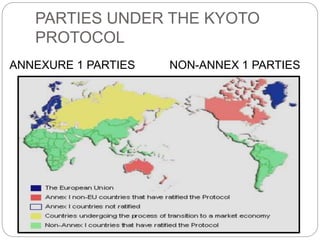
PARTIES UNDER THE KYOTO 
PROTOCOL 
ANNEXURE 1 PARTIES NON-ANNEX 1 PARTIES
EFFECTS OF THE PROTOCOL 
 The Annex 1 countries as seen are the countries on the 
accountability of which the Non Annex 1 countries work. with 
measures taken to downsize the carbon emissions. such 
measures end up acting as a ripple effect to the countries as 
before stated to have to burden the effect. 
 When taken into consideration , the developing economies and 
their methods to track down the ongoing emissions, mostly seen 
these countries tend to reap by putting extra taxes on the fuel 
consumption, targeting both reduction in emission as well the 
collection of taxes for revenue to fund the Kyoto target.
MIT CASE STUDY 
 Consider two sets of actions that Annex 1 countries could take to limit 
negative impacts on Non-Annex 1 countries. Kyoto Protocol and used in 
this analysis. 
Implementation of Annex 1 controls: 
 Revision of fuel taxation policies 
 Removal of coal subsidies 
 Trading of emission permits 
The second set of policy measures includes actions: 
 That Annex 1 countries might consider to meet the needs of particular 
developing countries. These actions include: 
 Special tariff concessions 
 Direct financial compensation,

The Kyoto Protocol

  • 1.
    AN INVENTORY ONTHE KYOTO PROTOCOL AND ITS EFFECTS ON AND FOR DEVELOPMENT TERM PAPER FOR THE SUBJECT : DEVELOPMENT PLANNINGAND MANAGEMENT
  • 2.
    INTRODUCTION TO KYOTO PROTOCOL AND THE 3 MAJOR GOALS  The international bindings to encourage readdress of climate change the core is lead by the United Nations Framework Convention On Climate Change (UNFCCC).  Set up in 1997, the Conference of parties III in kyoto, japan, a consensus was reached.  Developed Countries agreed to cuts in the carbon emissions of Greenhouse gases, with a much detailed framework and country annexure specific framework.  The Three Kyoto Mechanisms are:  Emissions Trading known as The Carbon Market,  The Clean Development Mechanism (CDM)  Joint Implementation (JI).
  • 3.
    PARTIES UNDER THEKYOTO PROTOCOL ANNEXURE 1 PARTIES NON-ANNEX 1 PARTIES
  • 4.
    EFFECTS OF THEPROTOCOL  The Annex 1 countries as seen are the countries on the accountability of which the Non Annex 1 countries work. with measures taken to downsize the carbon emissions. such measures end up acting as a ripple effect to the countries as before stated to have to burden the effect.  When taken into consideration , the developing economies and their methods to track down the ongoing emissions, mostly seen these countries tend to reap by putting extra taxes on the fuel consumption, targeting both reduction in emission as well the collection of taxes for revenue to fund the Kyoto target.
  • 5.
    MIT CASE STUDY  Consider two sets of actions that Annex 1 countries could take to limit negative impacts on Non-Annex 1 countries. Kyoto Protocol and used in this analysis. Implementation of Annex 1 controls:  Revision of fuel taxation policies  Removal of coal subsidies  Trading of emission permits The second set of policy measures includes actions:  That Annex 1 countries might consider to meet the needs of particular developing countries. These actions include:  Special tariff concessions  Direct financial compensation,