United Nations – Framework
Convention for Climate Change


Jada Garofalo
C2C Fellows Program Assistant
BCEP Class of 2014
• The Problems: Climate Change, a transboundary issue

   • Global warming result of decades of industrialization activities of wealthy
     developed countries

   • Around 75% of global carbon emissions had been caused by the developed
     countries (the “Annex 1 Countries” of the Kyoto Protocol)

   • Annex 1 countries responsible to cut back carbon emissions, and to provide
     assistance to non Annex 1 to sustainably develop and mitigate suffering from
     the adverse impacts of climate change

   • This is referred to as the historical debt of industrialized countries to the rest
     of the world

   • Discussions have been rife with dissent and progress has been slow

   • “If not us, then who? If not now, then when? ...”
• Attaining Agenda Status:
   • 1950’s World Meteorological Organization (WMO) was created by the UN (1951) to
     establish climate as a global issue and monitor climate change
   • 1960’s Keeling Curve offered striking visual demonstration of carbon emissions
   • 1970’s further pursuit of environmental research motivated the formation of the National
     Oceanic and Atmosphere Administration (NOAA)-study the conditions of oceans and
     atmosphere
   • 1972 UN Environmental Program (UNEP), which worked to create environmental policies


      • 1979: First World Climate Conference formed (WCC)
          • Establishing climate as a global issue
      • 1988: Intergovernmental Panel on Climate Change formed (IPCC)
      • 1990: IPCC- first assessment report released
          • IPCC and second World Climate Conference call for a global treaty on climate
            change
          • United Nations General Assembly negotiations on a framework convention begin
          • Agenda Status Established
• Launched by UN General Assembly
   • Negotiations began 1990
   • Run by Intergovernmental Negotiating Committee (INC)
   • Negotiations lasted15 months


• 1991: Intergovernmental Negotiating Committee formed (INC)

• Adopted May 9, 1992
   • Opened for signature June 1992 - UN Conference on Environment and
     Development - Rio de Janeiro, Brazil


• Entered into force March 21, 1994
   • Requisite 50 ratifications
• Member countries: called parties hold annual meetings called
  Conferences of the Parties (COP)
  • Since 2005 the COP are held in combination with the Meetings of Parties
    (MOP) of the Kyoto Protocol
  • UNFCCC parties who are not parties to the Kyoto Protocol can participate in
    the MOP as observers


• Routine work: Conference of the Parties (COP)
  • Parties negotiate to make decisions to advance implementation via subsidiary
    bodies
     • Subsidiary Body for Scientific and Technological Advice (SBSTA)
     • Subsidiary Body for Implementation (SBI)
• COP 1: 1995: Berlin, Germany
   • First meeting of the COP
• COP 2: 1996: Geneva, Switzerland
   • Call for “legally binding mid-term targets”
• COP 3: 1997: Kyoto
   • Kyoto Protocol on Climate Change
• COP 4: 1998: Buenos Aires, Argentina
   • 2-year “plan of action” to advance efforts and devise mechanisms for implementation
     of Kyoto Protocol
• COP 5: 1999: Bonn, Germany
   • Agreement includes a provision on Carbon sinks- credits granted for activities that
     absorb carbon or store it including management of forest and agriculture land as well
     as re-vegetation/re-forestation
   • Agreement to establish three new funds:
      • 1. Fund for Climate change supporting series of climate measures
      • 2. Least developed country fund to support National Adaptation Programs of
         Action
      • 3. Kyoto Protocol adaptation fund supported by a Clean Development Mechanism
         (CDM) levy and voluntary contributions
• CDM: Clean development Mechanism
   • Flexibility mechanism of Kyoto Protocol provides emissions reduction projects generating
     Certified Emissions Reduction units to be traded in reduction schemes
   • Intended to meet two objectives:
       • 1) Assist non Annex 1 Parties in achieving sustainable development and their
          contribution to the UNFCCC objective- to prevent potentially dangerous Climate change
       • 2) Assist Annex I Parties in achieving compliance with their quantified emission limitation
          and reduction
   • Annex I parties are countries listed in Annex I of the treaty, and are industrialized
   • Non-Annex I parties are developing countries

• JI: Joint implementation- Article 6 in the Kyoto Protocol
   • Allows a country (Non Annex 1Party) with an emission reduction/limitation commitment under
     the Kyoto Protocol to earn emission reduction units (ERUs) from an emission-reduction or
     emission removal project in another Non Annex 1Party, each equivalent to one tonne of
     CO2, which can be counted towards meeting its Kyoto target

• Joint implementation offers Parties a flexible and cost-efficient means of
  fulfilling a part of their Kyoto commitments, while the host Party benefits from
  foreign investment and technology transfer
• COP 6: 2000: Hague, Netherlands
   • Controversy over the United States’ proposal to allow credit for carbon sinks in forests
     and agricultural lands


• COP 7: 2001: Marrakesh, Morocco
   • Marrakesh Accords: Decisions on the operational details needed for the ratification of
     the Kyoto Protocol by States, including decision on the rules for international emissions
     trading
   • Establishment of the Adaptation Fund

• COP 8: 2002: New Delhi, India
   • Delhi Ministerial Declaration: calls for efforts by developing countries to transfer
     technology and minimize the impact of climate change on developing countries

• COP 9: 2003: Milan, Italy
   • Agreement to use the Adaptation Fund mainly for supporting developing countries to
     better adapt to climate change and for capacity-building through technology transfer
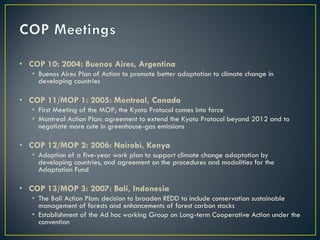
• COP 10: 2004: Buenos Aires, Argentina
   • Buenos Aires Plan of Action to promote better adaptation to climate change in
     developing countries

• COP 11/MOP 1: 2005: Montreal, Canada
   • First Meeting of the MOP; the Kyoto Protocol comes into force
   • Montreal Action Plan: agreement to extend the Kyoto Protocol beyond 2012 and to
     negotiate more cute in greenhouse-gas emissions

• COP 12/MOP 2: 2006: Nairobi, Kenya
   • Adoption of a five-year work plan to support climate change adaptation by
     developing countries, and agreement on the procedures and modalities for the
     Adaptation Fund

• COP 13/MOP 3: 2007: Bali, Indonesia
   • The Bali Action Plan: decision to broaden REDD to include conservation sustainable
     management of forests and enhancements of forest carbon stocks
   • Establishment of the Ad hoc working Group on Long-term Cooperative Action under the
     convention
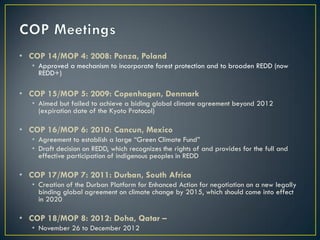
• COP 14/MOP 4: 2008: Ponza, Poland
   • Approved a mechanism to incorporate forest protection and to broaden REDD (now
     REDD+)

• COP 15/MOP 5: 2009: Copenhagen, Denmark
   • Aimed but failed to achieve a biding global climate agreement beyond 2012
     (expiration date of the Kyoto Protocol)

• COP 16/MOP 6: 2010: Cancun, Mexico
   • Agreement to establish a large “Green Climate Fund”
   • Draft decision on REDD, which recognizes the rights of and provides for the full and
     effective participation of indigenous peoples in REDD

• COP 17/MOP 7: 2011: Durban, South Africa
   • Creation of the Durban Platform for Enhanced Action for negotiation on a new legally
     binding global agreement on climate change by 2015, which should come into effect
     in 2020

• COP 18/MOP 8: 2012: Doha, Qatar –
   • November 26 to December 2012
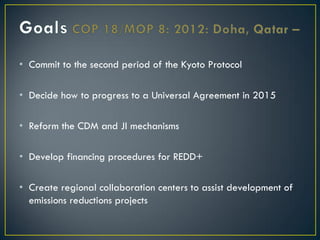
• Commit to the second period of the Kyoto Protocol

• Decide how to progress to a Universal Agreement in 2015

• Reform the CDM and JI mechanisms

• Develop financing procedures for REDD+

• Create regional collaboration centers to assist development of
  emissions reductions projects
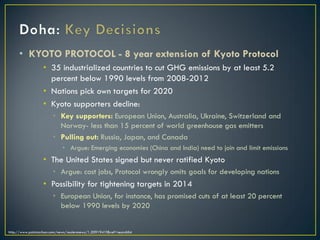
• KYOTO PROTOCOL - 8 year extension of Kyoto Protocol
                   • 35 industrialized countries to cut GHG emissions by at least 5.2
                     percent below 1990 levels from 2008-2012
                   • Nations pick own targets for 2020
                   • Kyoto supporters decline:
                        • Key supporters: European Union, Australia, Ukraine, Switzerland and
                          Norway- less than 15 percent of world greenhouse gas emitters
                        • Pulling out: Russia, Japan, and Canada
                              • Argue: Emerging economies (China and India) need to join and limit emissions
                   • The United States signed but never ratified Kyoto
                        • Argue: cost jobs, Protocol wrongly omits goals for developing nations
                   • Possibility for tightening targets in 2014
                        • European Union, for instance, has promised cuts of at least 20 percent
                          below 1990 levels by 2020


http://www.pointcarbon.com/news/reutersnews/1.2091941?&ref=searchlist
• FUTURE TALKS
  • Timetable for new global deal applying to all nations Kyoto only sets
    targets for industrialized nations
     • Due 2015
     • Entering into force 2020
  • Two “work streams” negotiations
     • 1. Combat climate change 2020
     • 2. Step up ambition before 2020
       • First session talks “Durban Platform” - April/May 2013 - Bonn, Germany
       • Possibly another - September 2013
       • Two more sessions 2014 and two more 2015
C2C Fellows “Conversations on Doha” Panel Agenda
• Attended UNFCCC talks in Copenhagen
• Audio only
Heather Hatzenbuhler
●   Sierra Student Coalition (SSC):
    http://ssc.sierraclub.org
●   SSC International:
    https://www.facebook.com/SSCInternation
    al/info
●   SSC @ UGA (UGA Beyond Coal):
●   https://www.facebook.com/ugabeyondcoal
●   Me: heatherhatz@gmail.com
UNFCCC 2012
BY: Amanda Nesheiwat
• Hesitate giving more money to the Climate
  Fund because US doesn’t know what it will
  fund. Hindered Finance Negotiations.
• We said we would cut emissions, but there
  is no transparency. We don’t know how.
• US is worried Congress not cooperating.
• We have a better understanding of what will work.
• Countries agreed to have a second commitment Kyoto Protocol
  period.
• All countries will be gather in 2014 and consider raising
  ambitions on emission reduction targets.
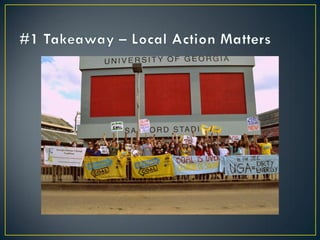
• We need more Domestic Action!
• Communities must lead by example.
• The top down approach will never work without a strong bottom
  up movement.
• Develop a work plan for 2013.
Any Questions?
E-mail: amandanesheiwat@gmail.com

C2C Fellow Conversations on Doha

  • 1.
    United Nations –Framework Convention for Climate Change Jada Garofalo C2C Fellows Program Assistant BCEP Class of 2014
  • 2.
    • The Problems:Climate Change, a transboundary issue • Global warming result of decades of industrialization activities of wealthy developed countries • Around 75% of global carbon emissions had been caused by the developed countries (the “Annex 1 Countries” of the Kyoto Protocol) • Annex 1 countries responsible to cut back carbon emissions, and to provide assistance to non Annex 1 to sustainably develop and mitigate suffering from the adverse impacts of climate change • This is referred to as the historical debt of industrialized countries to the rest of the world • Discussions have been rife with dissent and progress has been slow • “If not us, then who? If not now, then when? ...”
  • 3.
    • Attaining AgendaStatus: • 1950’s World Meteorological Organization (WMO) was created by the UN (1951) to establish climate as a global issue and monitor climate change • 1960’s Keeling Curve offered striking visual demonstration of carbon emissions • 1970’s further pursuit of environmental research motivated the formation of the National Oceanic and Atmosphere Administration (NOAA)-study the conditions of oceans and atmosphere • 1972 UN Environmental Program (UNEP), which worked to create environmental policies • 1979: First World Climate Conference formed (WCC) • Establishing climate as a global issue • 1988: Intergovernmental Panel on Climate Change formed (IPCC) • 1990: IPCC- first assessment report released • IPCC and second World Climate Conference call for a global treaty on climate change • United Nations General Assembly negotiations on a framework convention begin • Agenda Status Established
  • 4.
    • Launched byUN General Assembly • Negotiations began 1990 • Run by Intergovernmental Negotiating Committee (INC) • Negotiations lasted15 months • 1991: Intergovernmental Negotiating Committee formed (INC) • Adopted May 9, 1992 • Opened for signature June 1992 - UN Conference on Environment and Development - Rio de Janeiro, Brazil • Entered into force March 21, 1994 • Requisite 50 ratifications
  • 5.
    • Member countries:called parties hold annual meetings called Conferences of the Parties (COP) • Since 2005 the COP are held in combination with the Meetings of Parties (MOP) of the Kyoto Protocol • UNFCCC parties who are not parties to the Kyoto Protocol can participate in the MOP as observers • Routine work: Conference of the Parties (COP) • Parties negotiate to make decisions to advance implementation via subsidiary bodies • Subsidiary Body for Scientific and Technological Advice (SBSTA) • Subsidiary Body for Implementation (SBI)
  • 6.
    • COP 1:1995: Berlin, Germany • First meeting of the COP • COP 2: 1996: Geneva, Switzerland • Call for “legally binding mid-term targets” • COP 3: 1997: Kyoto • Kyoto Protocol on Climate Change • COP 4: 1998: Buenos Aires, Argentina • 2-year “plan of action” to advance efforts and devise mechanisms for implementation of Kyoto Protocol • COP 5: 1999: Bonn, Germany • Agreement includes a provision on Carbon sinks- credits granted for activities that absorb carbon or store it including management of forest and agriculture land as well as re-vegetation/re-forestation • Agreement to establish three new funds: • 1. Fund for Climate change supporting series of climate measures • 2. Least developed country fund to support National Adaptation Programs of Action • 3. Kyoto Protocol adaptation fund supported by a Clean Development Mechanism (CDM) levy and voluntary contributions
  • 7.
    • CDM: Cleandevelopment Mechanism • Flexibility mechanism of Kyoto Protocol provides emissions reduction projects generating Certified Emissions Reduction units to be traded in reduction schemes • Intended to meet two objectives: • 1) Assist non Annex 1 Parties in achieving sustainable development and their contribution to the UNFCCC objective- to prevent potentially dangerous Climate change • 2) Assist Annex I Parties in achieving compliance with their quantified emission limitation and reduction • Annex I parties are countries listed in Annex I of the treaty, and are industrialized • Non-Annex I parties are developing countries • JI: Joint implementation- Article 6 in the Kyoto Protocol • Allows a country (Non Annex 1Party) with an emission reduction/limitation commitment under the Kyoto Protocol to earn emission reduction units (ERUs) from an emission-reduction or emission removal project in another Non Annex 1Party, each equivalent to one tonne of CO2, which can be counted towards meeting its Kyoto target • Joint implementation offers Parties a flexible and cost-efficient means of fulfilling a part of their Kyoto commitments, while the host Party benefits from foreign investment and technology transfer
  • 8.
    • COP 6:2000: Hague, Netherlands • Controversy over the United States’ proposal to allow credit for carbon sinks in forests and agricultural lands • COP 7: 2001: Marrakesh, Morocco • Marrakesh Accords: Decisions on the operational details needed for the ratification of the Kyoto Protocol by States, including decision on the rules for international emissions trading • Establishment of the Adaptation Fund • COP 8: 2002: New Delhi, India • Delhi Ministerial Declaration: calls for efforts by developing countries to transfer technology and minimize the impact of climate change on developing countries • COP 9: 2003: Milan, Italy • Agreement to use the Adaptation Fund mainly for supporting developing countries to better adapt to climate change and for capacity-building through technology transfer
  • 9.
    • COP 10:2004: Buenos Aires, Argentina • Buenos Aires Plan of Action to promote better adaptation to climate change in developing countries • COP 11/MOP 1: 2005: Montreal, Canada • First Meeting of the MOP; the Kyoto Protocol comes into force • Montreal Action Plan: agreement to extend the Kyoto Protocol beyond 2012 and to negotiate more cute in greenhouse-gas emissions • COP 12/MOP 2: 2006: Nairobi, Kenya • Adoption of a five-year work plan to support climate change adaptation by developing countries, and agreement on the procedures and modalities for the Adaptation Fund • COP 13/MOP 3: 2007: Bali, Indonesia • The Bali Action Plan: decision to broaden REDD to include conservation sustainable management of forests and enhancements of forest carbon stocks • Establishment of the Ad hoc working Group on Long-term Cooperative Action under the convention
  • 10.
    • COP 14/MOP4: 2008: Ponza, Poland • Approved a mechanism to incorporate forest protection and to broaden REDD (now REDD+) • COP 15/MOP 5: 2009: Copenhagen, Denmark • Aimed but failed to achieve a biding global climate agreement beyond 2012 (expiration date of the Kyoto Protocol) • COP 16/MOP 6: 2010: Cancun, Mexico • Agreement to establish a large “Green Climate Fund” • Draft decision on REDD, which recognizes the rights of and provides for the full and effective participation of indigenous peoples in REDD • COP 17/MOP 7: 2011: Durban, South Africa • Creation of the Durban Platform for Enhanced Action for negotiation on a new legally binding global agreement on climate change by 2015, which should come into effect in 2020 • COP 18/MOP 8: 2012: Doha, Qatar – • November 26 to December 2012
  • 11.
    • Commit tothe second period of the Kyoto Protocol • Decide how to progress to a Universal Agreement in 2015 • Reform the CDM and JI mechanisms • Develop financing procedures for REDD+ • Create regional collaboration centers to assist development of emissions reductions projects
  • 12.
    • KYOTO PROTOCOL- 8 year extension of Kyoto Protocol • 35 industrialized countries to cut GHG emissions by at least 5.2 percent below 1990 levels from 2008-2012 • Nations pick own targets for 2020 • Kyoto supporters decline: • Key supporters: European Union, Australia, Ukraine, Switzerland and Norway- less than 15 percent of world greenhouse gas emitters • Pulling out: Russia, Japan, and Canada • Argue: Emerging economies (China and India) need to join and limit emissions • The United States signed but never ratified Kyoto • Argue: cost jobs, Protocol wrongly omits goals for developing nations • Possibility for tightening targets in 2014 • European Union, for instance, has promised cuts of at least 20 percent below 1990 levels by 2020 http://www.pointcarbon.com/news/reutersnews/1.2091941?&ref=searchlist
  • 13.
    • FUTURE TALKS • Timetable for new global deal applying to all nations Kyoto only sets targets for industrialized nations • Due 2015 • Entering into force 2020 • Two “work streams” negotiations • 1. Combat climate change 2020 • 2. Step up ambition before 2020 • First session talks “Durban Platform” - April/May 2013 - Bonn, Germany • Possibly another - September 2013 • Two more sessions 2014 and two more 2015
  • 14.
    C2C Fellows “Conversationson Doha” Panel Agenda
  • 15.
    • Attended UNFCCCtalks in Copenhagen • Audio only
  • 16.
  • 24.
    Sierra Student Coalition (SSC): http://ssc.sierraclub.org ● SSC International: https://www.facebook.com/SSCInternation al/info ● SSC @ UGA (UGA Beyond Coal): ● https://www.facebook.com/ugabeyondcoal ● Me: heatherhatz@gmail.com
  • 25.
  • 30.
    • Hesitate givingmore money to the Climate Fund because US doesn’t know what it will fund. Hindered Finance Negotiations. • We said we would cut emissions, but there is no transparency. We don’t know how. • US is worried Congress not cooperating.
  • 31.
    • We havea better understanding of what will work. • Countries agreed to have a second commitment Kyoto Protocol period. • All countries will be gather in 2014 and consider raising ambitions on emission reduction targets.
  • 32.
    • We needmore Domestic Action! • Communities must lead by example. • The top down approach will never work without a strong bottom up movement. • Develop a work plan for 2013.
  • 33.