MC ENG 1
TEACHING ENGLISH IN
ELEMENTARY GRADES
(Language Arts)
MELANY A. MANRIZA
Class Instructor
MC TLE 1- Teaching English in Elementary Grades
MELANY A. MANRIZA
Class Instructor
MC TLE 1- Teaching English in Elementary Grades
SHORT ORIENTATION
 ATTENDANCE
 STUDENTS’ DISCIPLINE
 CLASSROOM MANAGEMENT
 SUBMISSION OF OUTPUTS/PROJECTS
 NO CP DURING DISCUSSION and
EXAMINATION UNLESS REQUIRED BY THE
TEACHER
 UNIFORM
MELANY A. MANRIZA
Class Instructor
MC TLE 1- Teaching English in Elementary Grades
MELANY A. MANRIZA
Class Instructor
MC TLE 1- Teaching English in Elementary Grades
GRADING SYSTEM
CRITERIA MC 1-ENGLISH
ATTENDANCE 10
CLASS RECITATION 20
QUIZZES
(Formative/Summative)
10
PRE-MIDTERM/PRE-FINAL 15
MID-TERM/FINAL 25
OUTPUT/PROJECT/PRACTICUM 20
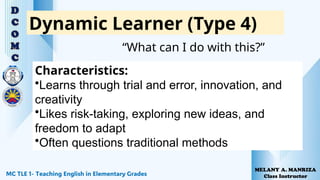
100%
MELANY A. MANRIZA
Class Instructor
MC TLE 1- Teaching English in Elementary Grades
Course Description
This course will emphasize English as a second language with
focus on language teaching methodologies to improve
knowledge on the structure and fluency in the English
language, and literacy skills, through listening ,speaking,
reading, writing and viewing. It consists of content-based
lessons that will enhance the students' skills along application
of various teaching strategies in teaching English, the use of
ICT to facilitate the teaching learning process and selecting,
designing and organization of appropriate assessment
strategies. Demonstrating knowledge and skills on content
and pedagogy through lesson presentations is an important
highlight of this course.
CONTENT
General Principles in Language
Arts Teaching
The structure of the K to 12
Language arts Curriculum
Five Macro Skills in language
a. Listening
b. Speaking
c. Reading
d. Writing
e. Viewing
Background on Approaches,
Strategies,
Methods and Techniques
 The Approaches for
Language Arts Teaching
a. Communicative
b. Language
Scaffolding
c. Cooperative Learning
d. Situational
e. Functional-notional
Multi-skill
g. Content-based
h. Task-based
Participatory
 The Methods of
Teaching Language Arts
a. The Grammar-
translation
b. The Direct method
c. The Audiolingual
method
d. Total Physical
response
e. Community
language learning “The
Silent” way
g. Language experience
method
h. Desuggestopedia
 Learning Strategies and Assessment
technique as applied to teaching
language
 Strategies: -Content language
integrated learning CALL Computer
assisted language learning
 Instructional material selection, design
and development
 Development of learning plans for
English language arts subject
 Lesson Presentation
a. Micro teaching
b. Team teaching
c. Individual teaching
Goal:
Identify teaching principles in
language Arts teaching and
explain how these principles are
used in teaching.
LANGUAGE
“primary instrument of
thought”
Use to bring ideas into the world
around us and make meaning
out the human experience.
K to 12 English Curriculum or the Language Arts and Multiliteracies
Curriculum
ART
is a way of communicating
an idea, whether it is done
through music, paint,
sculpture, or dance. The goal
of “art” is to communicate an
idea
The goal of “language arts” is to be
able to use a language proficiently in
order to communicate an idea.
A Language Arts is the art of using
language proficiently to communicate an
idea. It is a very important area in the
education curriculum in which a range of
skills are taught to students for them to
become proficient in using the language.
RULES OF LANGUAGE
refer to the principles that govern
word formation, syntax,
pronunciation, and several other
features of the language.
also refer to the grammar or the so
called “correct” or conventional forms
of the language.
Guissabi (2017) points out that
“culture is a language itself”.
Language is used by people to
convey everyday ideas, and it
carries with it the culture of the
people using it.
UNDERSTANDING SOCIETY
INTERACTION
Learning a language therefore is
not only to read, speak, and
write in another language, but
to learn of another culture.
Language evolves and become richer.
The following principles guide the K to 12
English Curriculum in Language Arts Teaching:
1.All language are interrelated and
independent.
2.Language acquisition and
learning is an active process that
begins at birth and continues
throughout life.
The following principles guide the K to 12
English Curriculum in Language Arts Teaching:
3. Learning requires meaning.
4. Learners learn about language
and how to use it effectively
through their engagement with
and study text.
The following principles guide the K to 12
English Curriculum in Language Arts Teaching:
5. Successful language
learning involves viewing,
listening, reading, and
writing activities.
The following principles guide the K to 12
English Curriculum in Language Arts Teaching:
6. Language learning involves
recognizing, accepting, valuing,
and building on learners’ existing
language, and extending the
range of language available to
learners’.
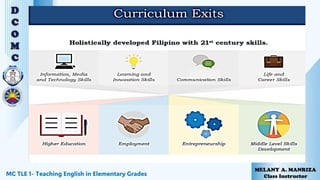
The Structure Of The
K To 12 Language
Arts Curriculum
FRAMEWORK OF THE K TO 12
ENGLISH CURRICULUM
THE LEARNERS IN
THE EYES OF THE
K TO 12 CURRICULUM
GENERATION Z
DIGITAL
AGE
computers
Technology/
devices
Digital
Learning/
Work
Other
electronic
media
AI’s
Mobile
phones
Born between 1997
and 2012
dynamic
Tech-savvy
Socially-aware
generation
GENERATION Z
Popularized by William Strauss and Neil
Howe in the September 1992
The term describes a cohort of people
born after the year 1997.
Learners of this generation are
generally described as to have used
technology and social media at a very
young age.
GENERATION Z
Marc Wensky (2001) calls them
“digital natives” who have
exposed to technologies at a
very young age and are having a
greater understanding of their
basic concepts.
Bernice McCarthy proposes a model that
describes four types of learners that teachers
may encounter in the classroom:
1. Imaginative Learner
2. Analytical Learner
3. Common- Sense Learner
4. Dynamic Learner
Imaginative Learner (Type
1) “Why do I need to learn this?”
Characteristics:
•Relates learning to personal experience
and feelings
•Enjoys storytelling, reflection, group
discussion
•Learns best through listening and
sharing
•Seeks meaning, relevance, and connection
Analytical Learner (Type 2)
“What is the content?”
Characteristics:
•Prefers facts, theories, data, and structured
explanation
•Learns through reading, lectures, and analysis
•Focused on understanding concepts and
logic.
Common-sense Learner
(Type 3) “How does this work?”
Characteristics:
•Likes practical applications and hands-on
tasks
•Learns by experimenting, doing, and problem-
solving
•Enjoys figuring out how things work
Dynamic Learner (Type 4)
“What can I do with this?”
Characteristics:
•Learns through trial and error, innovation, and
creativity
•Likes risk-taking, exploring new ideas, and
freedom to adapt
•Often questions traditional methods
What learning style/s do you
think is more representative of
today's learners? What
behaviors would support the
idea?
Group 1. Imaginative Learners
(Ask “Why?” – value emotion, connection, storytelling)
Task: Create a Personal Poem or
Spoken Poetry
Based on themes like identity,
belonging, or dreams.
Group 2. Analytical Learners
(Ask “What?” – prefer logic, data, explanations)
Task: Compare and Contrast Task
Prompt: “Compare traditional vs.
modern communication styles.”
Group 3. Common-Sense Learners(Ask “How?”
️ 🛠️
– hands-on, practical problem-solvers)
Task: Real-World Scenario Problem
Solving
Prompt: “How can a student reduce
screen time while staying productive?”
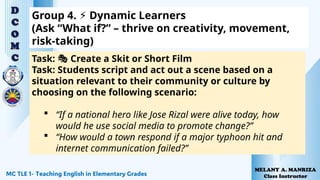
Group 4. Dynamic Learners
⚡
(Ask “What if?” – thrive on creativity, movement,
risk-taking)
Task: Create a Skit or Short Film
🎭
Task: Students script and act out a scene based on a
situation relevant to their community or culture by
choosing on the following scenario:
 “If a national hero like Jose Rizal were alive today, how
would he use social media to promote change?”
 “How would a town respond if a major typhoon hit and
internet communication failed?”
GROUP PRESENTATION
🕺 The TikTok Clap
Do a quick 3-count clap: Clap–
Clap–Snap!
•Say in sync: “That was 🔥 (fire)!”
GROUP PRESENTATION
🧠 The Brainy Clap
Tap your head twice (like you're
thinking), then clap three times
and say:
“Bright minds!, brilliant job!”
GROUP PRESENTATION
💫 The Fireworks Clap
Clap once, then: Hands up like
sparks — “Fssshhhh!”Clap again —
“Boom!”
Say together: “You blew us away!”
GROUP PRESENTATION
🎉 The Rollercoaster Clap
Raise hands slowly while saying
“WooOOooOOO...”
When hands reach the top,
shout: “Amazing job!” (and clap
twice)
Teaching English in Elementary Grades MC

Teaching English in Elementary Grades MC

  • 1.
    MC ENG 1 TEACHINGENGLISH IN ELEMENTARY GRADES (Language Arts)
  • 2.
    MELANY A. MANRIZA ClassInstructor MC TLE 1- Teaching English in Elementary Grades
  • 3.
    MELANY A. MANRIZA ClassInstructor MC TLE 1- Teaching English in Elementary Grades SHORT ORIENTATION  ATTENDANCE  STUDENTS’ DISCIPLINE  CLASSROOM MANAGEMENT  SUBMISSION OF OUTPUTS/PROJECTS  NO CP DURING DISCUSSION and EXAMINATION UNLESS REQUIRED BY THE TEACHER  UNIFORM
  • 4.
    MELANY A. MANRIZA ClassInstructor MC TLE 1- Teaching English in Elementary Grades
  • 5.
    MELANY A. MANRIZA ClassInstructor MC TLE 1- Teaching English in Elementary Grades GRADING SYSTEM CRITERIA MC 1-ENGLISH ATTENDANCE 10 CLASS RECITATION 20 QUIZZES (Formative/Summative) 10 PRE-MIDTERM/PRE-FINAL 15 MID-TERM/FINAL 25 OUTPUT/PROJECT/PRACTICUM 20 100%
  • 6.
    MELANY A. MANRIZA ClassInstructor MC TLE 1- Teaching English in Elementary Grades Course Description This course will emphasize English as a second language with focus on language teaching methodologies to improve knowledge on the structure and fluency in the English language, and literacy skills, through listening ,speaking, reading, writing and viewing. It consists of content-based lessons that will enhance the students' skills along application of various teaching strategies in teaching English, the use of ICT to facilitate the teaching learning process and selecting, designing and organization of appropriate assessment strategies. Demonstrating knowledge and skills on content and pedagogy through lesson presentations is an important highlight of this course.
  • 7.
    CONTENT General Principles inLanguage Arts Teaching The structure of the K to 12 Language arts Curriculum Five Macro Skills in language a. Listening b. Speaking c. Reading d. Writing e. Viewing Background on Approaches, Strategies, Methods and Techniques  The Approaches for Language Arts Teaching a. Communicative b. Language Scaffolding c. Cooperative Learning d. Situational e. Functional-notional Multi-skill g. Content-based h. Task-based Participatory
  • 8.
     The Methodsof Teaching Language Arts a. The Grammar- translation b. The Direct method c. The Audiolingual method d. Total Physical response e. Community language learning “The Silent” way g. Language experience method h. Desuggestopedia  Learning Strategies and Assessment technique as applied to teaching language  Strategies: -Content language integrated learning CALL Computer assisted language learning  Instructional material selection, design and development  Development of learning plans for English language arts subject  Lesson Presentation a. Micro teaching b. Team teaching c. Individual teaching
  • 9.
    Goal: Identify teaching principlesin language Arts teaching and explain how these principles are used in teaching.
  • 10.
    LANGUAGE “primary instrument of thought” Useto bring ideas into the world around us and make meaning out the human experience. K to 12 English Curriculum or the Language Arts and Multiliteracies Curriculum
  • 11.
    ART is a wayof communicating an idea, whether it is done through music, paint, sculpture, or dance. The goal of “art” is to communicate an idea
  • 12.
    The goal of“language arts” is to be able to use a language proficiently in order to communicate an idea. A Language Arts is the art of using language proficiently to communicate an idea. It is a very important area in the education curriculum in which a range of skills are taught to students for them to become proficient in using the language.
  • 13.
    RULES OF LANGUAGE referto the principles that govern word formation, syntax, pronunciation, and several other features of the language. also refer to the grammar or the so called “correct” or conventional forms of the language.
  • 14.
    Guissabi (2017) pointsout that “culture is a language itself”. Language is used by people to convey everyday ideas, and it carries with it the culture of the people using it.
  • 15.
    UNDERSTANDING SOCIETY INTERACTION Learning alanguage therefore is not only to read, speak, and write in another language, but to learn of another culture. Language evolves and become richer.
  • 16.
    The following principlesguide the K to 12 English Curriculum in Language Arts Teaching: 1.All language are interrelated and independent. 2.Language acquisition and learning is an active process that begins at birth and continues throughout life.
  • 17.
    The following principlesguide the K to 12 English Curriculum in Language Arts Teaching: 3. Learning requires meaning. 4. Learners learn about language and how to use it effectively through their engagement with and study text.
  • 18.
    The following principlesguide the K to 12 English Curriculum in Language Arts Teaching: 5. Successful language learning involves viewing, listening, reading, and writing activities.
  • 19.
    The following principlesguide the K to 12 English Curriculum in Language Arts Teaching: 6. Language learning involves recognizing, accepting, valuing, and building on learners’ existing language, and extending the range of language available to learners’.
  • 20.
    The Structure OfThe K To 12 Language Arts Curriculum
  • 25.
    FRAMEWORK OF THEK TO 12 ENGLISH CURRICULUM
  • 27.
    THE LEARNERS IN THEEYES OF THE K TO 12 CURRICULUM
  • 28.
  • 29.
    GENERATION Z Popularized byWilliam Strauss and Neil Howe in the September 1992 The term describes a cohort of people born after the year 1997. Learners of this generation are generally described as to have used technology and social media at a very young age.
  • 30.
    GENERATION Z Marc Wensky(2001) calls them “digital natives” who have exposed to technologies at a very young age and are having a greater understanding of their basic concepts.
  • 31.
    Bernice McCarthy proposesa model that describes four types of learners that teachers may encounter in the classroom: 1. Imaginative Learner 2. Analytical Learner 3. Common- Sense Learner 4. Dynamic Learner
  • 32.
    Imaginative Learner (Type 1)“Why do I need to learn this?” Characteristics: •Relates learning to personal experience and feelings •Enjoys storytelling, reflection, group discussion •Learns best through listening and sharing •Seeks meaning, relevance, and connection
  • 33.
    Analytical Learner (Type2) “What is the content?” Characteristics: •Prefers facts, theories, data, and structured explanation •Learns through reading, lectures, and analysis •Focused on understanding concepts and logic.
  • 34.
    Common-sense Learner (Type 3)“How does this work?” Characteristics: •Likes practical applications and hands-on tasks •Learns by experimenting, doing, and problem- solving •Enjoys figuring out how things work
  • 35.
    Dynamic Learner (Type4) “What can I do with this?” Characteristics: •Learns through trial and error, innovation, and creativity •Likes risk-taking, exploring new ideas, and freedom to adapt •Often questions traditional methods
  • 36.
    What learning style/sdo you think is more representative of today's learners? What behaviors would support the idea?
  • 37.
    Group 1. ImaginativeLearners (Ask “Why?” – value emotion, connection, storytelling) Task: Create a Personal Poem or Spoken Poetry Based on themes like identity, belonging, or dreams.
  • 38.
    Group 2. AnalyticalLearners (Ask “What?” – prefer logic, data, explanations) Task: Compare and Contrast Task Prompt: “Compare traditional vs. modern communication styles.”
  • 39.
    Group 3. Common-SenseLearners(Ask “How?” ️ 🛠️ – hands-on, practical problem-solvers) Task: Real-World Scenario Problem Solving Prompt: “How can a student reduce screen time while staying productive?”
  • 40.
    Group 4. DynamicLearners ⚡ (Ask “What if?” – thrive on creativity, movement, risk-taking) Task: Create a Skit or Short Film 🎭 Task: Students script and act out a scene based on a situation relevant to their community or culture by choosing on the following scenario:  “If a national hero like Jose Rizal were alive today, how would he use social media to promote change?”  “How would a town respond if a major typhoon hit and internet communication failed?”
  • 42.
    GROUP PRESENTATION 🕺 TheTikTok Clap Do a quick 3-count clap: Clap– Clap–Snap! •Say in sync: “That was 🔥 (fire)!”
  • 43.
    GROUP PRESENTATION 🧠 TheBrainy Clap Tap your head twice (like you're thinking), then clap three times and say: “Bright minds!, brilliant job!”
  • 44.
    GROUP PRESENTATION 💫 TheFireworks Clap Clap once, then: Hands up like sparks — “Fssshhhh!”Clap again — “Boom!” Say together: “You blew us away!”
  • 45.
    GROUP PRESENTATION 🎉 TheRollercoaster Clap Raise hands slowly while saying “WooOOooOOO...” When hands reach the top, shout: “Amazing job!” (and clap twice)

Editor's Notes

  • #16 1. Interrelated: Languages Share Common Roots Languages are interrelated because: Many languages come from common ancestors. For example: English, Spanish, and Hindi all belong to the Indo-European language family. They share grammar structures, vocabulary roots, and phonetics. Language borrowing happens constantly: English has borrowed words from French, Latin, German, Arabic, etc. Japanese uses many English words (like “コンピュータ” – computer). Universal linguistic features: All languages have grammar, sound systems, and ways to express past, present, questions, etc. This suggests shared cognitive and cultural foundations. 🧠 So, “interrelated” means languages influence each other and often come from shared origins. 🧍‍♀️ 2. Independent: Each Language is Unique Languages are also independent because: Each language has its own: Grammar rules (e.g., sentence structure, verb forms). Vocabulary that reflects its culture (e.g., words for snow in Inuit languages). Sound system (some languages have tones, others don’t). Writing system (e.g., Arabic vs. Chinese vs. English). Some languages developed in isolation, shaped by local environment, culture, or history. A speaker of one language can't automatically understand another—even if they’re related (like English and German). 🔓 So, “independent” means every language stands on its own and expresses the world in its own way. 📚 Example: English and Hindi Interrelated: Both come from the Indo-European family. Words like “mother” (English) and “माता / maataa” (Hindi) share common roots. Independent: They have different scripts, grammar, sounds, and cultural expressions. ✅ Conclusion “All languages are interrelated and independent” means: Languages influence each other and often share deep historical or structural connections, but each one is still a unique system with its own identity.
  • #36 Dynamic and Common-Sense learners are most representative of today’s students, who value creativity, real-world relevance, independence, and digital interactivity. Their behaviors—such as learning through tech, engaging with real-life tasks, and showing a desire for flexible, meaningful education—reflect a shift from passive to active, personalized, and applied learning.