KOTHARI INDIAN EDUCATION COMMISSION
(1964-66)
INTRODUCTION
• In the view of the important role of education in the
national development and in building up a truly
democratic society , the Government considered it
necessary to survey and examine the entire field of
education in order to realise a well balanced ,
integrated and adequate system of national
education, capable of making a powerful contribution
to all aspects of national life.
Implementation of commission
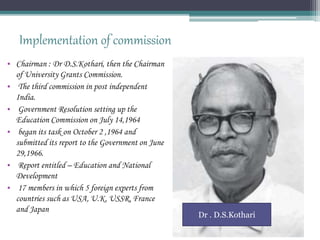
• Chairman : Dr D.S.Kothari, then the Chairman
of University Grants Commission.
• The third commission in post independent
India.
• Government Resolution setting up the
Education Commission on July 14,1964
• began its task on October 2 ,1964 and
submitted its report to the Government on June
29,1966.
• Report entitled – Education and National
Development
• 17 members in which 5 foreign experts from
countries such as USA, U.K, USSR, France
and Japan
Dr . D.S.Kothari
Features
• It tired to cover every field and aspect of the entire
educational system .
• Its firm belief that education is the most powerful
instrument of national development.
The opening of the commission, ‘ the destiny of India is
being shaped in the classrooms’, denotes the value of
education that determine the level of prosperity, welfare and
future of the country.
Major Recommendations
AIMSOFEDUCATION
Education should be related to the life, needs and aspirations of
the people so that the national objectives may be achieved.
 Education for increasing productivity
 Make science education an integral part of school course.
 Work experience
 Vocational education to meet the needs of industry,
commerce, agriculture etc.
 Improvement of scientific and technical education and
research at the university stage.
 Education for social and national integration
 Common school system
 Social service programmes
 Teaching of languages, literature, philosophy and history of
India.
 Education for modernization
 Adopting new methods of teaching.
 Proper development of intrinsic attitudes and values and
building essential skills like independent training.
 Emphasizing teaching of vocational subjects and science.
 Development of Democracy
 The success of democracy depends on the enlightened
citizenship is based on the education of the masses. Education is
the most powerful instrument to make the people aware of their
rights and responsibilities.
 Cultivation of social, moral and spiritual values
 Education system should emphasize the development of
fundamental, social, moral and spiritual values.
 The commission recommended the study of major religions
of the world.
 Educational Structure And Standard
 General education should last for a period of 10 years.( 4 years
lower primary, 3 years of higher primary and 3 years of lower
secondary education).
 Prior to general education, pre-primary education should also be
given.
 The theme of higher secondary education should be fixed for 2
years.
 After degree course there should be a post graduate course of three
years. The graduate course should be extended from two to three
years.
 The number of instructional days in a year should be increased to
about 234(39weeks) for schools and 216 (36 weeks)for colleges
and pre-primary schools.
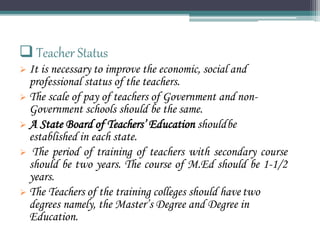
 Teacher Status
 It is necessary to improve the economic, social and
professional status of the teachers.
 The scale of pay of teachers of Government and non-
Government schools should be the same.
 A State Board of Teachers’ Education shouldbe
established in each state.
 The period of training of teachers with secondary course
should be two years. The course of M.Ed should be 1-1/2
years.
 The Teachers of the training colleges should have two
degrees namely, the Master’s Degree and Degree in
Education.
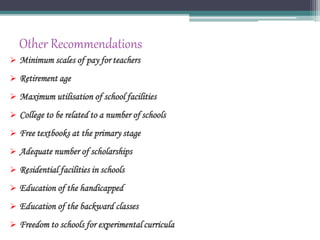
Other Recommendations
 Minimum scales of pay for teachers
 Retirement age
 Maximum utilisation of school facilities
 College to be related to a number of schools
 Free textbooks at the primary stage
 Adequate number of scholarships
 Residential facilities in schools
 Education of the handicapped
 Education of the backward classes
 Freedom to schools for experimental curricula
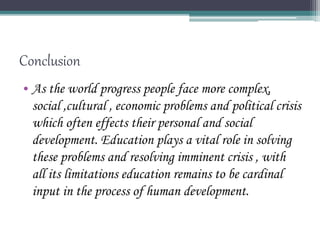
Conclusion
• As the world progress people face more complex,
social ,cultural , economic problems and political crisis
which often effects their personal and social
development. Education plays a vital role in solving
these problems and resolving imminent crisis , with
all its limitations education remains to be cardinal
input in the process of human development.

Netra roll no 14

  • 1.
    KOTHARI INDIAN EDUCATIONCOMMISSION (1964-66)
  • 2.
    INTRODUCTION • In theview of the important role of education in the national development and in building up a truly democratic society , the Government considered it necessary to survey and examine the entire field of education in order to realise a well balanced , integrated and adequate system of national education, capable of making a powerful contribution to all aspects of national life.
  • 3.
    Implementation of commission •Chairman : Dr D.S.Kothari, then the Chairman of University Grants Commission. • The third commission in post independent India. • Government Resolution setting up the Education Commission on July 14,1964 • began its task on October 2 ,1964 and submitted its report to the Government on June 29,1966. • Report entitled – Education and National Development • 17 members in which 5 foreign experts from countries such as USA, U.K, USSR, France and Japan Dr . D.S.Kothari
  • 4.
    Features • It tiredto cover every field and aspect of the entire educational system . • Its firm belief that education is the most powerful instrument of national development. The opening of the commission, ‘ the destiny of India is being shaped in the classrooms’, denotes the value of education that determine the level of prosperity, welfare and future of the country.
  • 5.
    Major Recommendations AIMSOFEDUCATION Education shouldbe related to the life, needs and aspirations of the people so that the national objectives may be achieved.  Education for increasing productivity  Make science education an integral part of school course.  Work experience  Vocational education to meet the needs of industry, commerce, agriculture etc.  Improvement of scientific and technical education and research at the university stage.
  • 6.
     Education forsocial and national integration  Common school system  Social service programmes  Teaching of languages, literature, philosophy and history of India.  Education for modernization  Adopting new methods of teaching.  Proper development of intrinsic attitudes and values and building essential skills like independent training.  Emphasizing teaching of vocational subjects and science.
  • 7.
     Development ofDemocracy  The success of democracy depends on the enlightened citizenship is based on the education of the masses. Education is the most powerful instrument to make the people aware of their rights and responsibilities.  Cultivation of social, moral and spiritual values  Education system should emphasize the development of fundamental, social, moral and spiritual values.  The commission recommended the study of major religions of the world.
  • 8.
     Educational StructureAnd Standard  General education should last for a period of 10 years.( 4 years lower primary, 3 years of higher primary and 3 years of lower secondary education).  Prior to general education, pre-primary education should also be given.  The theme of higher secondary education should be fixed for 2 years.  After degree course there should be a post graduate course of three years. The graduate course should be extended from two to three years.  The number of instructional days in a year should be increased to about 234(39weeks) for schools and 216 (36 weeks)for colleges and pre-primary schools.
  • 9.
     Teacher Status It is necessary to improve the economic, social and professional status of the teachers.  The scale of pay of teachers of Government and non- Government schools should be the same.  A State Board of Teachers’ Education shouldbe established in each state.  The period of training of teachers with secondary course should be two years. The course of M.Ed should be 1-1/2 years.  The Teachers of the training colleges should have two degrees namely, the Master’s Degree and Degree in Education.
  • 10.
    Other Recommendations  Minimumscales of pay for teachers  Retirement age  Maximum utilisation of school facilities  College to be related to a number of schools  Free textbooks at the primary stage  Adequate number of scholarships  Residential facilities in schools  Education of the handicapped  Education of the backward classes  Freedom to schools for experimental curricula
  • 11.
    Conclusion • As theworld progress people face more complex, social ,cultural , economic problems and political crisis which often effects their personal and social development. Education plays a vital role in solving these problems and resolving imminent crisis , with all its limitations education remains to be cardinal input in the process of human development.