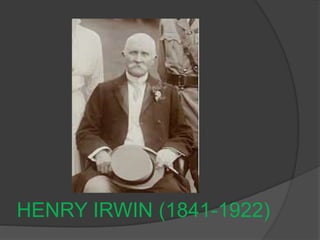
HENRY IRWIN (1841-1922)
 Architect of British India
 Born on 21st January 1841, in Tarbett, Ireland.
 1864- Joined the public works department in England.
 1866- was moved to ceylon.
 1868- moved to India in PWD, Shimla.
 1872- Became the executive engineer, nagpur and central
provinces.
 Got a real boost in 1888, after completetion of VICE REGAL
LODGE, Shimla
 Became the superintendent engineer, Shimla Imperial Circle of
central PWD.
 Then he moved to Madras, as consulting architect for the Madras
Presidency.
 Last project was Mysore palace 1897-1912, after which he retired
and went to Ooty.
 He died on 5th August, 1922.
Philosophies :-
 Respecter of local traditions.
 Initially all his works are gothic
 Afterwards Indo-saracenic.
 Depicting British authority (after 1857)
“Architecture should speak of its time and
place, but yearn for timelessness.”
Henry Irwin
Explanation of choice :-
 His projects.
 Palaces – mystery.
 A glimpse of past.
 A British on Indian land.
 Evolution stages of architect.
Major Works:-
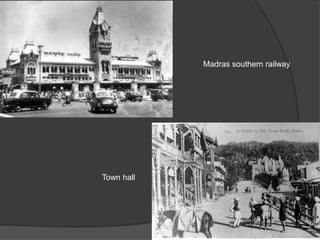
 Headquarters of the Madras and Southern Mahratta Railway
Chennai–1873- Gothic revival style.
 Christ church, Panchmarhi – 1880 – Gothic revival style.
 The American College, Madurai -1881-Saracenic style (red
bricks, blending with surroundings).
 Vice Regal lodge-(1880-1888) – Jacobethan Style.
 Gaiety Theatre, Shimla - 1888 (Stone)- exclusively for
Britishers hence neo-Gothic style.
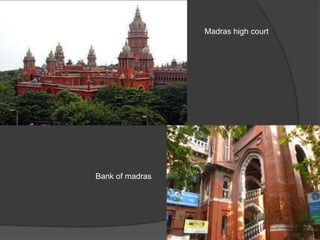
 Madras High Court, Chennai – 1892 – Indo Saracenic style.
 Law College Buildings, Chennai - July 1892- Indo Saracenic
style.
 Headquarters of the State Bank of Madras -1896 – Indo
Saracenic style.
 Government Museum, Chennai – 1896- Indo Saracenic style.
 The Hindu Higher Secondary School, Chennai- 1897(the L-
shaped red brick building)- Saracenic style.
 Mysore palace – (1897-1912) – Indo Saracenic Revival style.
Styles:
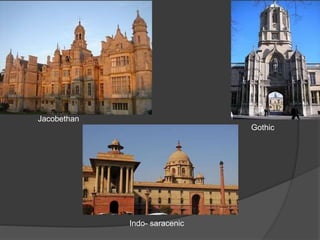
 Jacobethan style – Mixed renaissance and Elizabethan
style. Classical over Gothic.
 Gothic revival- gothic + Elizabethan.
 Saracenic – Islamic architecture.
 Indo- saracenic- Indo Islamic.
 Indo Saracenic Revival – Indo Islamic + Gothic.
Jacobethan
Gothic
Indo- saracenic
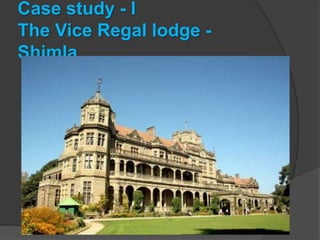
Case study - I
The Vice Regal lodge -
Shimla
Philosophy :-
 Built in 1880s ( after 1857)
 He had just started in India.
 Influenced by Scottish castles, English renaissance.
 Used local material
 Jacobethan style.
History --
 Started in 1885
 Got the project because the then Viceroy of India- Lord Dufferin
loved Gothic style.
 Completed in 1888
 1947– renamed as Rashtrapati niwas.
 1964– given to Indian institute of advanced study.
 Viceroy visited the site every day
 Result got mixed reactions.
 Shimla conference.
 F. B. Hebbert and L. M. St. Clair- executive engineers.
Materials used:
 Local woods like pine, walnut and cedar.
 Light blue-grey masonary
 Tiled pitch roofing.
 Wrought stone work
 Interior by wood.
Architecture :-
 Jacobethan style
 Renovations being done.
 The top of Observatory Hill was leveled out to create a wide plateau.
 Surface of crushed shale - cracked in every direction'. Concrete was
liberally used for the foundations.
 Sprawling gardens.
 First govt. building to have electricity, and internal wiring, with
elevator.
 Rain water harvesting system, still used today.
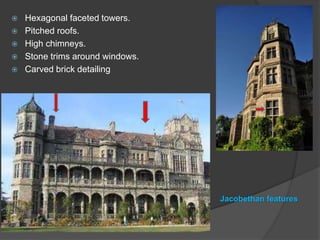
 Hexagonal faceted towers.
 Pitched roofs.
 High chimneys.
 Stone trims around windows.
 Carved brick detailing
Jacobethan features
 Exterior completely
of stone and stained
Glass.
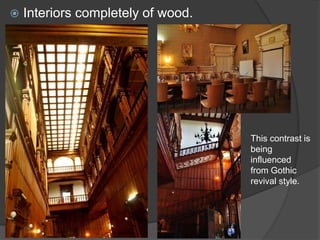
 Interiors completely of wood.
This contrast is
being
influenced
from Gothic
revival style.
 Verandah and terraces-at different levels.
 Fire fighting mechanism through wax tipped water ducts.
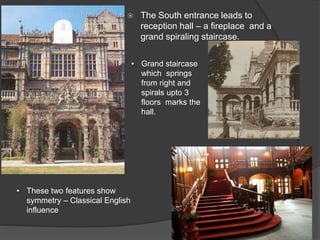
 The South entrance leads to
reception hall – a fireplace and a
grand spiraling staircase.
• Grand staircase
which springs
from right and
spirals upto 3
floors marks the
hall.
• These two features show
symmetry – Classical English
influence
 The building has six stories.
 The teak paneled gallery- leads to the state drawing room,
ballroom and the wood-paneled dining room.
Critics:
 Edward Lutyens had a low opinion of the design.
He is reported to have said,
“If one was told that it was built by monkeys all one
could say was, ‘What wonderful monkeys!' But they
must be shot if they tried to do it again.”
Case study - II
The Mysore Palace
Philosophy :-
 Built in 1900s.
 Working in Madras.
 Mental state on Indo- Saracenic.
 But wanted to do new, as last project, hence
developed Indo- Saracenic revival style.
 Lots of inspirations in one structure. Not disorderly
mix of design elements.
History :
 Also known as Amba vilas palace.
 Currently owned by Wodeyars(royal family of Mysore).
 1897-1912
 Additions later in 1940—public durbar hall wing
 Fireproof.
 The maharani insisted-
 new palace be built in model and foundations of the old
one.
 In the reconstruction, stone, brick and iron should be the
chief materials.
Materials used:-
 Locally available.
 Wooden doors.
 Pink stone.
 Hard granite - Myosre district.
 Stone - of Turuvekere in Tumkur - easy fine details
(discovered)
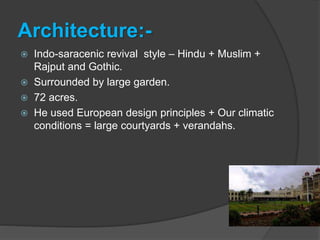
Architecture:-
 Indo-saracenic revival style – Hindu + Muslim +
Rajput and Gothic.
 Surrounded by large garden.
 72 acres.
 He used European design principles + Our climatic
conditions = large courtyards + verandahs.
 Three storey marble domes
 145 ft. five storeyed tower.
 Tallest tower of the palace
-Tower of a Gothic
cathedral.
-Top of it is a large dome -
Islamic/Persian style
structures.
-Above dome is a domed
Chhatri- Rajput style.
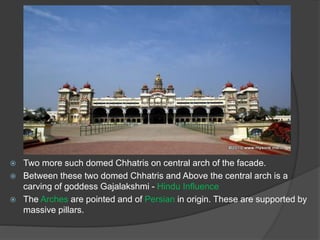
 Two more such domed Chhatris on central arch of the facade.
 Between these two domed Chhatris and Above the central arch is a
carving of goddess Gajalakshmi - Hindu Influence
 The Arches are pointed and of Persian in origin. These are supported by
massive pillars.
 Fine grey granite + pink domes( indo- saracenic) = cherry.
 Protruding balconies - ‘jharokha’ Rajshani architecture.
 Top of the balcony is with deep pink stone , that forms a semi
dome
 Bottom is supported by a structural feature in the form a
lotus.
Planning:-
 Enter the palace building through a smaller verandah - south side.
 The main archway - expansive central court.
 The whole court is netted at the top to prevent birds messing the
inside and an enclosed verandah runs around this court.
 The dolls pavilion leads to a large brass gate.
 Next to the armory is the trophy room.
 Then we have many unique rooms surrounding the courtyard as,
 Kalyana Mantapa, a ceremonial hall
 with wrought-iron pillars and a stained glass ceiling with a prominent peacock
motif ---- Persian/Islamic influence.
 The staircase leads to the Durbar Hall, or the Diwan-e-Aam.
 The Durbar Hall leads to the Amba vilasa, or the Diwan-e-Khas,
Kalyana mantapa
Deewan – e - aam
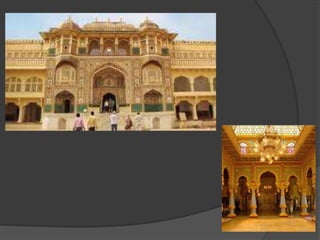
 Amba vilasa--- used by king and for private audience.
 Entry through a carved rosewood doorway inlaid with ivory
that opens into a shrine to Ganesha.--- Hindu Influence.
 The central nave of the hall
-ornately gilded columns,
-stained glass ceilings,
-decorative steel grills,
-chandeliers with fine floral motifs,
-mirrored in the pietra dura mosaic floor embellished
with semi-precious stones.
Gombe thotti ( doll’s pavillion)
 Entry to the palace is through the Gombe Thotti or the Doll’s
Pavilion, a gallery of traditional dolls from the nineteenth and
early twentieth centuries.
 Classical European sculptures, and influence.
 The palace complex includes twelve Hindu temples.
 Interiors.
 The squinch (where the pillar meets the
ceiling ) and the domical ceiling above the
verandah, plaster work on the ceiling, the
capitals carved with hard granite. This too is
a present blend of native and gothic styles.
 Massive doors carved out of teak (yellow-brown) and
rosewood (coffee colored).
 On the rosewood doors, frames and lintels you can see
the finely done inlay work.
 These again show local Craftmanship as his
philosophy.
 On the floor, embedded inlay work – Pietra dura-
that is popularly known as Agra work.
 The living palace - located right behind the main
palace.
 This is made in a more human scale.
Evolutions:-
 Headquarters of the Madras and Southern
Mahratta Railway Chennai–1873- Gothic revival
style. - it was to also incorporate Dravidian
decorations, perhaps a first in that direction.
 The American College, Madurai -1881-Saracenic
style (red bricks, blending with surroundings).
Madras southern railway
Town hall
 Town Hall (1888)- overlooked the use of substandard materials,
within 20 years of its construction it had to be dismantled.
 Gaiety Theatre, Shimla - 1888 (Stone)- exclusively for Britishers
hence neo-Gothic style.
 Vice Regal Lodge – (1885-1888) – Jacobethan style.
 Use of rhythmic symmetry from renaissance ( Elizabethan +
Gothic)
Gaiety theatre
 Madras High Court, Chennai – 1892 – Indo Saracenic
style
blend with other high court
buildings in vicinity.
 Headquarters of the State Bank of Madras -1896 – Indo
Saracenic style. - Mughal elements
 Mysore palace – (1897-1912) – Indo Saracenic Revival
style.
Madras high court
Bank of madras
What we can learn :-
 Adaptability.
 His love for local materials, and local
craftmanship.
 Mixing of various styles.
 Dealing with clients ( viceroy, pavillion).
Thank you
“ The greatest advances of civilization, whether in
architecture or painting, in science and literature, in
industry or agriculture, have never come from centralized
government.”
Milton Friedman

Henry irwin

  • 1.
  • 2.
     Architect ofBritish India  Born on 21st January 1841, in Tarbett, Ireland.  1864- Joined the public works department in England.  1866- was moved to ceylon.  1868- moved to India in PWD, Shimla.  1872- Became the executive engineer, nagpur and central provinces.  Got a real boost in 1888, after completetion of VICE REGAL LODGE, Shimla  Became the superintendent engineer, Shimla Imperial Circle of central PWD.  Then he moved to Madras, as consulting architect for the Madras Presidency.  Last project was Mysore palace 1897-1912, after which he retired and went to Ooty.  He died on 5th August, 1922.
  • 3.
    Philosophies :-  Respecterof local traditions.  Initially all his works are gothic  Afterwards Indo-saracenic.  Depicting British authority (after 1857) “Architecture should speak of its time and place, but yearn for timelessness.” Henry Irwin
  • 4.
    Explanation of choice:-  His projects.  Palaces – mystery.  A glimpse of past.  A British on Indian land.  Evolution stages of architect.
  • 5.
    Major Works:-  Headquartersof the Madras and Southern Mahratta Railway Chennai–1873- Gothic revival style.  Christ church, Panchmarhi – 1880 – Gothic revival style.  The American College, Madurai -1881-Saracenic style (red bricks, blending with surroundings).  Vice Regal lodge-(1880-1888) – Jacobethan Style.  Gaiety Theatre, Shimla - 1888 (Stone)- exclusively for Britishers hence neo-Gothic style.
  • 6.
     Madras HighCourt, Chennai – 1892 – Indo Saracenic style.  Law College Buildings, Chennai - July 1892- Indo Saracenic style.  Headquarters of the State Bank of Madras -1896 – Indo Saracenic style.  Government Museum, Chennai – 1896- Indo Saracenic style.  The Hindu Higher Secondary School, Chennai- 1897(the L- shaped red brick building)- Saracenic style.  Mysore palace – (1897-1912) – Indo Saracenic Revival style.
  • 7.
    Styles:  Jacobethan style– Mixed renaissance and Elizabethan style. Classical over Gothic.  Gothic revival- gothic + Elizabethan.  Saracenic – Islamic architecture.  Indo- saracenic- Indo Islamic.  Indo Saracenic Revival – Indo Islamic + Gothic.
  • 8.
  • 9.
    Case study -I The Vice Regal lodge - Shimla
  • 10.
    Philosophy :-  Builtin 1880s ( after 1857)  He had just started in India.  Influenced by Scottish castles, English renaissance.  Used local material  Jacobethan style.
  • 11.
    History --  Startedin 1885  Got the project because the then Viceroy of India- Lord Dufferin loved Gothic style.  Completed in 1888  1947– renamed as Rashtrapati niwas.  1964– given to Indian institute of advanced study.  Viceroy visited the site every day  Result got mixed reactions.  Shimla conference.  F. B. Hebbert and L. M. St. Clair- executive engineers.
  • 12.
    Materials used:  Localwoods like pine, walnut and cedar.  Light blue-grey masonary  Tiled pitch roofing.  Wrought stone work  Interior by wood.
  • 13.
    Architecture :-  Jacobethanstyle  Renovations being done.  The top of Observatory Hill was leveled out to create a wide plateau.  Surface of crushed shale - cracked in every direction'. Concrete was liberally used for the foundations.  Sprawling gardens.  First govt. building to have electricity, and internal wiring, with elevator.  Rain water harvesting system, still used today.
  • 14.
     Hexagonal facetedtowers.  Pitched roofs.  High chimneys.  Stone trims around windows.  Carved brick detailing Jacobethan features
  • 15.
     Exterior completely ofstone and stained Glass.
  • 16.
     Interiors completelyof wood. This contrast is being influenced from Gothic revival style.
  • 17.
     Verandah andterraces-at different levels.  Fire fighting mechanism through wax tipped water ducts.
  • 18.
     The Southentrance leads to reception hall – a fireplace and a grand spiraling staircase. • Grand staircase which springs from right and spirals upto 3 floors marks the hall. • These two features show symmetry – Classical English influence
  • 19.
     The buildinghas six stories.  The teak paneled gallery- leads to the state drawing room, ballroom and the wood-paneled dining room.
  • 20.
    Critics:  Edward Lutyenshad a low opinion of the design. He is reported to have said, “If one was told that it was built by monkeys all one could say was, ‘What wonderful monkeys!' But they must be shot if they tried to do it again.”
  • 21.
    Case study -II The Mysore Palace
  • 22.
    Philosophy :-  Builtin 1900s.  Working in Madras.  Mental state on Indo- Saracenic.  But wanted to do new, as last project, hence developed Indo- Saracenic revival style.  Lots of inspirations in one structure. Not disorderly mix of design elements.
  • 23.
    History :  Alsoknown as Amba vilas palace.  Currently owned by Wodeyars(royal family of Mysore).  1897-1912  Additions later in 1940—public durbar hall wing  Fireproof.  The maharani insisted-  new palace be built in model and foundations of the old one.  In the reconstruction, stone, brick and iron should be the chief materials.
  • 24.
    Materials used:-  Locallyavailable.  Wooden doors.  Pink stone.  Hard granite - Myosre district.  Stone - of Turuvekere in Tumkur - easy fine details (discovered)
  • 25.
    Architecture:-  Indo-saracenic revivalstyle – Hindu + Muslim + Rajput and Gothic.  Surrounded by large garden.  72 acres.  He used European design principles + Our climatic conditions = large courtyards + verandahs.
  • 26.
     Three storeymarble domes  145 ft. five storeyed tower.  Tallest tower of the palace -Tower of a Gothic cathedral. -Top of it is a large dome - Islamic/Persian style structures. -Above dome is a domed Chhatri- Rajput style.
  • 27.
     Two moresuch domed Chhatris on central arch of the facade.  Between these two domed Chhatris and Above the central arch is a carving of goddess Gajalakshmi - Hindu Influence  The Arches are pointed and of Persian in origin. These are supported by massive pillars.
  • 28.
     Fine greygranite + pink domes( indo- saracenic) = cherry.  Protruding balconies - ‘jharokha’ Rajshani architecture.  Top of the balcony is with deep pink stone , that forms a semi dome  Bottom is supported by a structural feature in the form a lotus.
  • 29.
    Planning:-  Enter thepalace building through a smaller verandah - south side.  The main archway - expansive central court.  The whole court is netted at the top to prevent birds messing the inside and an enclosed verandah runs around this court.
  • 31.
     The dollspavilion leads to a large brass gate.  Next to the armory is the trophy room.  Then we have many unique rooms surrounding the courtyard as,  Kalyana Mantapa, a ceremonial hall  with wrought-iron pillars and a stained glass ceiling with a prominent peacock motif ---- Persian/Islamic influence.  The staircase leads to the Durbar Hall, or the Diwan-e-Aam.  The Durbar Hall leads to the Amba vilasa, or the Diwan-e-Khas,
  • 32.
  • 33.
     Amba vilasa---used by king and for private audience.  Entry through a carved rosewood doorway inlaid with ivory that opens into a shrine to Ganesha.--- Hindu Influence.  The central nave of the hall -ornately gilded columns, -stained glass ceilings, -decorative steel grills, -chandeliers with fine floral motifs, -mirrored in the pietra dura mosaic floor embellished with semi-precious stones.
  • 35.
    Gombe thotti (doll’s pavillion)  Entry to the palace is through the Gombe Thotti or the Doll’s Pavilion, a gallery of traditional dolls from the nineteenth and early twentieth centuries.  Classical European sculptures, and influence.
  • 36.
     The palacecomplex includes twelve Hindu temples.
  • 37.
     Interiors.  Thesquinch (where the pillar meets the ceiling ) and the domical ceiling above the verandah, plaster work on the ceiling, the capitals carved with hard granite. This too is a present blend of native and gothic styles.
  • 38.
     Massive doorscarved out of teak (yellow-brown) and rosewood (coffee colored).  On the rosewood doors, frames and lintels you can see the finely done inlay work.  These again show local Craftmanship as his philosophy.
  • 39.
     On thefloor, embedded inlay work – Pietra dura- that is popularly known as Agra work.  The living palace - located right behind the main palace.  This is made in a more human scale.
  • 40.
    Evolutions:-  Headquarters ofthe Madras and Southern Mahratta Railway Chennai–1873- Gothic revival style. - it was to also incorporate Dravidian decorations, perhaps a first in that direction.  The American College, Madurai -1881-Saracenic style (red bricks, blending with surroundings).
  • 41.
  • 42.
     Town Hall(1888)- overlooked the use of substandard materials, within 20 years of its construction it had to be dismantled.  Gaiety Theatre, Shimla - 1888 (Stone)- exclusively for Britishers hence neo-Gothic style.  Vice Regal Lodge – (1885-1888) – Jacobethan style.  Use of rhythmic symmetry from renaissance ( Elizabethan + Gothic) Gaiety theatre
  • 43.
     Madras HighCourt, Chennai – 1892 – Indo Saracenic style blend with other high court buildings in vicinity.  Headquarters of the State Bank of Madras -1896 – Indo Saracenic style. - Mughal elements  Mysore palace – (1897-1912) – Indo Saracenic Revival style.
  • 44.
  • 45.
    What we canlearn :-  Adaptability.  His love for local materials, and local craftmanship.  Mixing of various styles.  Dealing with clients ( viceroy, pavillion).
  • 46.
    Thank you “ Thegreatest advances of civilization, whether in architecture or painting, in science and literature, in industry or agriculture, have never come from centralized government.” Milton Friedman