- Is cognitive theoretical
framework that focuses on how
knowledge enters and is stored in
and is retrieved from our memory.
Information Processing
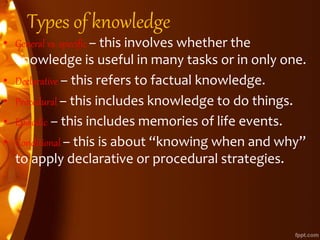
Types of knowledge
• General vs. specific – this involves whether the
knowledge is useful in many tasks or in only one.
• Declarative – this refers to factual knowledge.
• Procedural – this includes knowledge to do things.
• Episodic – this includes memories of life events.
• Conditional – this is about “knowing when and why”
to apply declarative or procedural strategies.
Stages in the information processing theory
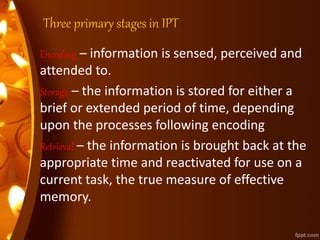
Three primary stages in IPT
1. Encoding – information is sensed, perceived and
attended to.
2. Storage – the information is stored for either a
brief or extended period of time, depending
upon the processes following encoding
3. Retrieval – the information is brought back at the
appropriate time and reactivated for use on a
current task, the true measure of effective
memory.
Three main stages in the memory process
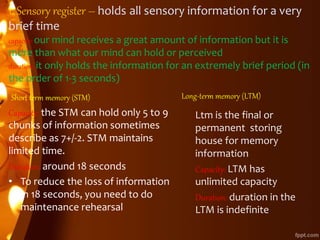
1. Sensory register – holds all sensory information for a very
brief time
capacity: our mind receives a great amount of information but it is
more than what our mind can hold or perceived
duration: it only holds the information for an extremely brief period (in
the order of 1-3 seconds)
Short term memory (STM)
Capacity: the STM can hold only 5 to 9
chunks of information sometimes
describe as 7+/-2. STM maintains
limited time.
Duration: around 18 seconds
• To reduce the loss of information
in 18 seconds, you need to do
maintenance rehearsal
Long-term memory (LTM)
Ltm is the final or
permanent storing
house for memory
information
Capacity: LTM has
unlimited capacity
Duration: duration in the
LTM is indefinite
Executive control processes
• It involves the executive processor or
what is referred to as metacognitive
Forgetting
• It is the inablilty to retrieve or
access information when needed
Two main ways in which forgetting likely occurs:
Decay – information is not attended to and
eventually “fades” away.
Interference – new or old information “blocks”
access to the information in question.
Methods of increasing retrieval of information
Rehearsal – this is repeating information
verbatim, either mentally or aloud.
Meaningful learning – this is making connections
between new information and prior
knowledge.
Organization – it is making connections among
various pieces of information.
Elaboration – this is adding additional ideas to
new information based on what one
already know.
Visual imagery – this means forming a
“picture” of the information.
Generation – things we “produce” are easier
to remember than things we “hear”
context – remembering the situation helps
recover information
personalization – it is making the information
relevant to the individual.
Other memory methods
Serial position effect (recency and primacy)-
You will remember the beginning and end of
a ‘list’ more readily.
Part Learning-Break up the list or chunk
information to increase memorization.
Distributed Practice-Break up learning
sessions, rather than cramming all the info
in at once(Massed Practice).
Mnemonic Aids-These are memory
techniques that learners may employ to
help them retain and retrieve information
more effectively.

Facilitating learning

  • 1.
    - Is cognitivetheoretical framework that focuses on how knowledge enters and is stored in and is retrieved from our memory. Information Processing
  • 2.
    Types of knowledge •General vs. specific – this involves whether the knowledge is useful in many tasks or in only one. • Declarative – this refers to factual knowledge. • Procedural – this includes knowledge to do things. • Episodic – this includes memories of life events. • Conditional – this is about “knowing when and why” to apply declarative or procedural strategies.
  • 3.
    Stages in theinformation processing theory
  • 4.
    Three primary stagesin IPT 1. Encoding – information is sensed, perceived and attended to. 2. Storage – the information is stored for either a brief or extended period of time, depending upon the processes following encoding 3. Retrieval – the information is brought back at the appropriate time and reactivated for use on a current task, the true measure of effective memory.
  • 5.
    Three main stagesin the memory process
  • 6.
    1. Sensory register– holds all sensory information for a very brief time capacity: our mind receives a great amount of information but it is more than what our mind can hold or perceived duration: it only holds the information for an extremely brief period (in the order of 1-3 seconds) Short term memory (STM) Capacity: the STM can hold only 5 to 9 chunks of information sometimes describe as 7+/-2. STM maintains limited time. Duration: around 18 seconds • To reduce the loss of information in 18 seconds, you need to do maintenance rehearsal Long-term memory (LTM) Ltm is the final or permanent storing house for memory information Capacity: LTM has unlimited capacity Duration: duration in the LTM is indefinite
  • 7.
    Executive control processes •It involves the executive processor or what is referred to as metacognitive
  • 8.
    Forgetting • It isthe inablilty to retrieve or access information when needed
  • 9.
    Two main waysin which forgetting likely occurs: Decay – information is not attended to and eventually “fades” away. Interference – new or old information “blocks” access to the information in question.
  • 10.
    Methods of increasingretrieval of information Rehearsal – this is repeating information verbatim, either mentally or aloud. Meaningful learning – this is making connections between new information and prior knowledge. Organization – it is making connections among various pieces of information. Elaboration – this is adding additional ideas to new information based on what one already know.
  • 11.
    Visual imagery –this means forming a “picture” of the information. Generation – things we “produce” are easier to remember than things we “hear” context – remembering the situation helps recover information personalization – it is making the information relevant to the individual.
  • 12.
    Other memory methods Serialposition effect (recency and primacy)- You will remember the beginning and end of a ‘list’ more readily. Part Learning-Break up the list or chunk information to increase memorization. Distributed Practice-Break up learning sessions, rather than cramming all the info in at once(Massed Practice). Mnemonic Aids-These are memory techniques that learners may employ to help them retain and retrieve information more effectively.