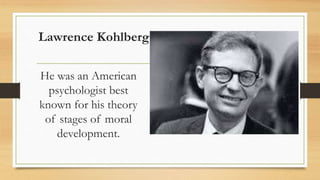
Lawrence Kohlberg
He was an American
psychologist best
known for his theory
of stages of moral
development.
Kohlberg's theory of Moral
development
This theory focuses on how children develop morality
and moral reasoning. Kohlberg’s theory suggest that
moral development occurs in a series of six stages and
that moral logic is primarily focused on seeking and
maintaining justice
The levels of the Kohlberg's Theory of moral
Development
• There are three levels on the Kohlberg's theory of moral
development and
each one of them have two stages which are Preconventional
Stages,
Conventional Stages, Post conventional
Kohlberg’s Stages
Pre-conventional level
• Stage 1: The punishment and obedience orientation
• Stage 2: The instrumental purpose orientation
Conventional level
• Stage 3: The “good boy-good girl” orientation
• Stage 4: The social-order-maintaining orientation
Post-conventional level
• Stage 5: The social-contract orientation
• Stage 6: The universal ethical principle orientation
Level 1 - Preconventional morality
Preconventional morality is the first stage of moral
development, and lasts until approximately age 9. At the
preconventional level children don’t have a personal code
of morality, and instead moral decisions are shaped by
the standards of adults and the consequences of following
or breaking their rules.
For example, if an action leads to punishment is
must be bad, and if it leads to a reward is must be
good.
Authority is outside the individual and children
often make moral decisions based on the physical
consequences of actions.
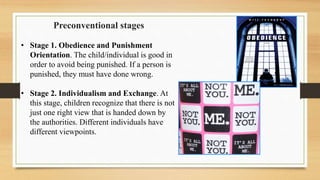
Preconventional stages
• Stage 1. Obedience and Punishment
Orientation. The child/individual is good in
order to avoid being punished. If a person is
punished, they must have done wrong.
• Stage 2. Individualism and Exchange. At
this stage, children recognize that there is not
just one right view that is handed down by
the authorities. Different individuals have
different viewpoints.
Preconventional
• People want to be treated with respect but they refused to treat
others with respect.
• Most people outgrow preconventional stages by high school
• I remembered when I was twelve years old I used to be mean to
my little sister but dislike when she treats me the same
Examples of preconventional
• Example: A friend who let someone bully you even if they know it is
wrong just because they want this person to love her.
• Example: A friend who always want you to be there for her when she
needs you but when you need her she is nowhere to be found.
• Example: A teenager who is refusing to follow the rules but does not
want the consequences
Conventional Stages
Level 2 - Conventional morality
Conventional morality is the second stage of moral development, and is
characterized by an acceptance of social rules concerning right and
wrong. At the conventional level (most adolescents and adults), we begin
to internalize the moral standards of valued adult role models.
Authority is internalized but not questioned, and reasoning is based on
the norms of the group to which the person belongs.
A social system that stresses the responsibilities of relationships as well
as social order is seen as desirable and must, therefore, influence our
view of what is right and wrong.
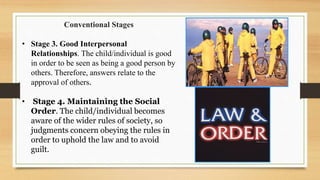
Conventional Stages
• Stage 3. Good Interpersonal
Relationships. The child/individual is good
in order to be seen as being a good person by
others. Therefore, answers relate to the
approval of others.
• Stage 4. Maintaining the Social
Order. The child/individual becomes
aware of the wider rules of society, so
judgments concern obeying the rules in
order to uphold the law and to avoid
guilt.
Conventional Stages
• They like to follow others, they look for others
approval.
• I remembered in middle I always want everyone
to like me I constantly look to others for approval
Examples of conventional Stages
• Example: I have to study for a test tomorrow
but I decided to go to a party with my friend
because I did not want to upset her. I put
myself at risk of failing that test
Postconventional Stages
Level 3 - Postconventional morality
Postconventional morality is the third stage of moral development, and is characterized
by an individuals’ understanding of universal ethical principles. These are abstract and
ill-defined, but might include: the preservation of life at all costs, and the importance
of human dignity.
Individual judgment is based on self-chosen principles, and moral reasoning is based
on individual rights and justice. According to Kohlberg this level of moral reasoning is
as far as most people get.
Only 10-15% are capable of the kind of abstract thinking necessary for stage 5 or 6
(post-conventional morality). That is to say, most people take their moral views from
those around them and only a minority think through ethical principles for themselves.
Postconventional
• Stage 5. Social Contract and Individual Rights. The
child/individual becomes aware that while rules/laws might
exist for the good of the greatest number, there are times when
they will work against the interest of particular individuals.
The issues are not always clear-cut. For example, in Heinz’s
dilemma, the protection of life is more important than breaking
the law against stealing.
• Stage 6. Universal Principles. People at this stage have
developed their own set of moral guidelines which may or
may not fit the law. The principles apply to everyone.
E.g., human rights, justice, and equality. The person will be
prepared to act to defend these principles even if it means going
against the rest of society in the process and having to pay the
consequences of disapproval and or imprisonment. Kohlberg
doubted few people reached this stage.
Postconventional
As a child I used to be more about
myself as I get older I learned to stop
being more about myself and learn to
be there for others when they need me
Example of postconventional
• Example: I rather am late for work
instead of speeding to get there on time
for work because I do not want to break
the laws
Thank You

Kohlberg Final.pptx

  • 1.
    Lawrence Kohlberg He wasan American psychologist best known for his theory of stages of moral development.
  • 2.
    Kohlberg's theory ofMoral development This theory focuses on how children develop morality and moral reasoning. Kohlberg’s theory suggest that moral development occurs in a series of six stages and that moral logic is primarily focused on seeking and maintaining justice
  • 3.
    The levels ofthe Kohlberg's Theory of moral Development • There are three levels on the Kohlberg's theory of moral development and each one of them have two stages which are Preconventional Stages, Conventional Stages, Post conventional
  • 4.
    Kohlberg’s Stages Pre-conventional level •Stage 1: The punishment and obedience orientation • Stage 2: The instrumental purpose orientation Conventional level • Stage 3: The “good boy-good girl” orientation • Stage 4: The social-order-maintaining orientation Post-conventional level • Stage 5: The social-contract orientation • Stage 6: The universal ethical principle orientation
  • 5.
    Level 1 -Preconventional morality Preconventional morality is the first stage of moral development, and lasts until approximately age 9. At the preconventional level children don’t have a personal code of morality, and instead moral decisions are shaped by the standards of adults and the consequences of following or breaking their rules.
  • 6.
    For example, ifan action leads to punishment is must be bad, and if it leads to a reward is must be good. Authority is outside the individual and children often make moral decisions based on the physical consequences of actions.
  • 7.
    Preconventional stages • Stage1. Obedience and Punishment Orientation. The child/individual is good in order to avoid being punished. If a person is punished, they must have done wrong. • Stage 2. Individualism and Exchange. At this stage, children recognize that there is not just one right view that is handed down by the authorities. Different individuals have different viewpoints.
  • 8.
    Preconventional • People wantto be treated with respect but they refused to treat others with respect. • Most people outgrow preconventional stages by high school • I remembered when I was twelve years old I used to be mean to my little sister but dislike when she treats me the same
  • 9.
    Examples of preconventional •Example: A friend who let someone bully you even if they know it is wrong just because they want this person to love her. • Example: A friend who always want you to be there for her when she needs you but when you need her she is nowhere to be found. • Example: A teenager who is refusing to follow the rules but does not want the consequences
  • 10.
  • 11.
    Level 2 -Conventional morality Conventional morality is the second stage of moral development, and is characterized by an acceptance of social rules concerning right and wrong. At the conventional level (most adolescents and adults), we begin to internalize the moral standards of valued adult role models. Authority is internalized but not questioned, and reasoning is based on the norms of the group to which the person belongs. A social system that stresses the responsibilities of relationships as well as social order is seen as desirable and must, therefore, influence our view of what is right and wrong.
  • 12.
    Conventional Stages • Stage3. Good Interpersonal Relationships. The child/individual is good in order to be seen as being a good person by others. Therefore, answers relate to the approval of others. • Stage 4. Maintaining the Social Order. The child/individual becomes aware of the wider rules of society, so judgments concern obeying the rules in order to uphold the law and to avoid guilt.
  • 13.
    Conventional Stages • Theylike to follow others, they look for others approval. • I remembered in middle I always want everyone to like me I constantly look to others for approval
  • 14.
    Examples of conventionalStages • Example: I have to study for a test tomorrow but I decided to go to a party with my friend because I did not want to upset her. I put myself at risk of failing that test
  • 15.
  • 16.
    Level 3 -Postconventional morality Postconventional morality is the third stage of moral development, and is characterized by an individuals’ understanding of universal ethical principles. These are abstract and ill-defined, but might include: the preservation of life at all costs, and the importance of human dignity. Individual judgment is based on self-chosen principles, and moral reasoning is based on individual rights and justice. According to Kohlberg this level of moral reasoning is as far as most people get. Only 10-15% are capable of the kind of abstract thinking necessary for stage 5 or 6 (post-conventional morality). That is to say, most people take their moral views from those around them and only a minority think through ethical principles for themselves.
  • 17.
    Postconventional • Stage 5.Social Contract and Individual Rights. The child/individual becomes aware that while rules/laws might exist for the good of the greatest number, there are times when they will work against the interest of particular individuals. The issues are not always clear-cut. For example, in Heinz’s dilemma, the protection of life is more important than breaking the law against stealing. • Stage 6. Universal Principles. People at this stage have developed their own set of moral guidelines which may or may not fit the law. The principles apply to everyone. E.g., human rights, justice, and equality. The person will be prepared to act to defend these principles even if it means going against the rest of society in the process and having to pay the consequences of disapproval and or imprisonment. Kohlberg doubted few people reached this stage.
  • 18.
    Postconventional As a childI used to be more about myself as I get older I learned to stop being more about myself and learn to be there for others when they need me
  • 19.
    Example of postconventional •Example: I rather am late for work instead of speeding to get there on time for work because I do not want to break the laws
  • 20.