Unit - 3
KNUCKLE JOINT
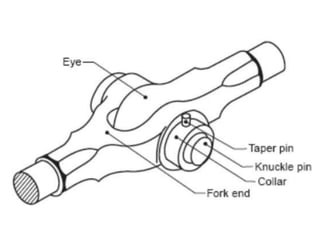
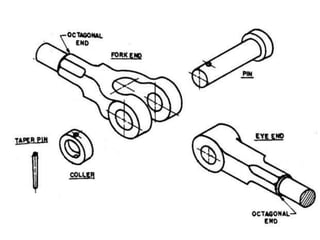
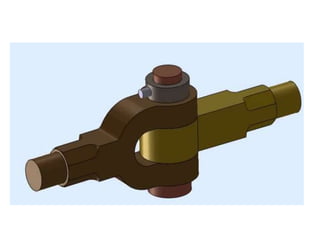
• A knuckle joint is used to connect two rods
which are under the action of tensile loads.
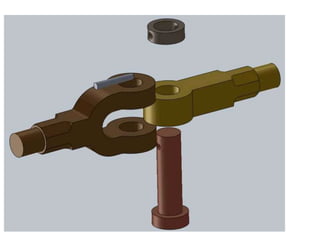
• It consists of mainly three elements a fork
or double eye rod, a single eye rod and
knuckle pin.
• Its use may be found in the link of a cycle
chain, tie rod joint for roof truss
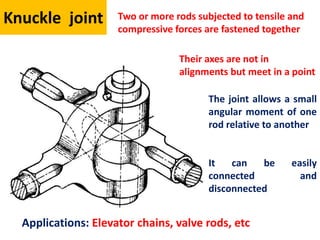
Knuckle joint Two or more rods subjected to tensile and
compressive forces are fastened together
Their axes are not in
alignments but meet in a point
The joint allows a small
angular moment of one
rod relative to another
It can be easily
connected and
disconnected
Applications: Elevator chains, valve rods, etc
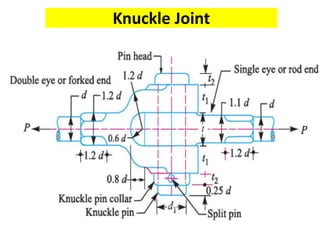
Knuckle Joint
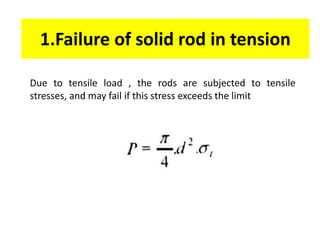
1.Failure of solid rod in tension
Due to tensile load , the rods are subjected to tensile
stresses, and may fail if this stress exceeds the limit
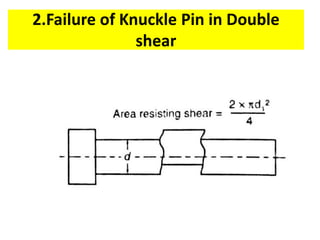
2.Failure of Knuckle Pin in Double
shear
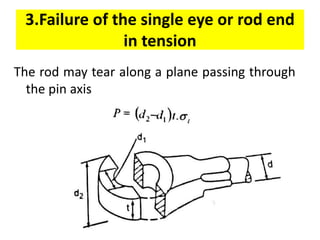
The rod may tear along a plane passing through
the pin axis
3.Failure of the single eye or rod end
in tension
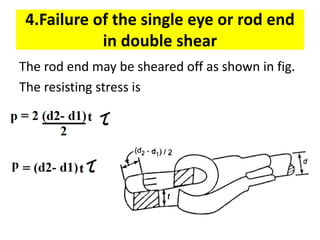
The rod end may be sheared off as shown in fig.
The resisting stress is
4.Failure of the single eye or rod end
in double shear
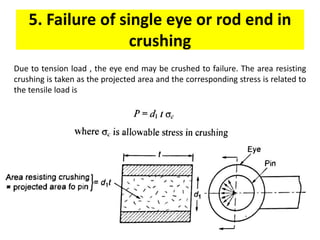
5. Failure of single eye or rod end in
crushing
Due to tension load , the eye end may be crushed to failure. The area resisting
crushing is taken as the projected area and the corresponding stress is related to
the tensile load is
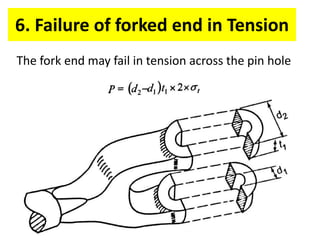
6. Failure of forked end in Tension
The fork end may fail in tension across the pin hole
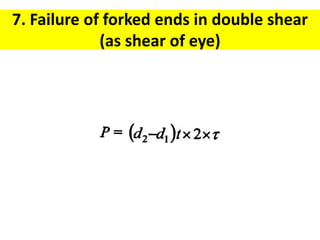
7. Failure of forked ends in double shear
(as shear of eye)
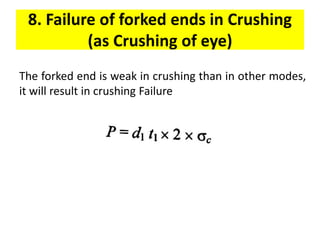
8. Failure of forked ends in Crushing
(as Crushing of eye)
The forked end is weak in crushing than in other modes,
it will result in crushing Failure
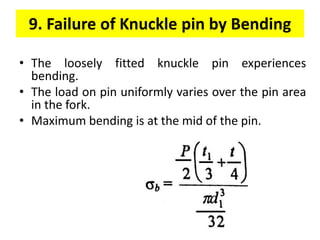
9. Failure of Knuckle pin by Bending
• The loosely fitted knuckle pin experiences
bending.
• The load on pin uniformly varies over the pin area
in the fork.
• Maximum bending is at the mid of the pin.

Knuckle joint

  • 1.
  • 2.
    • A knucklejoint is used to connect two rods which are under the action of tensile loads. • It consists of mainly three elements a fork or double eye rod, a single eye rod and knuckle pin. • Its use may be found in the link of a cycle chain, tie rod joint for roof truss
  • 3.
    Knuckle joint Twoor more rods subjected to tensile and compressive forces are fastened together Their axes are not in alignments but meet in a point The joint allows a small angular moment of one rod relative to another It can be easily connected and disconnected Applications: Elevator chains, valve rods, etc
  • 8.
  • 9.
    1.Failure of solidrod in tension Due to tensile load , the rods are subjected to tensile stresses, and may fail if this stress exceeds the limit
  • 10.
    2.Failure of KnucklePin in Double shear
  • 11.
    The rod maytear along a plane passing through the pin axis 3.Failure of the single eye or rod end in tension
  • 12.
    The rod endmay be sheared off as shown in fig. The resisting stress is 4.Failure of the single eye or rod end in double shear
  • 13.
    5. Failure ofsingle eye or rod end in crushing Due to tension load , the eye end may be crushed to failure. The area resisting crushing is taken as the projected area and the corresponding stress is related to the tensile load is
  • 14.
    6. Failure offorked end in Tension The fork end may fail in tension across the pin hole
  • 15.
    7. Failure offorked ends in double shear (as shear of eye)
  • 16.
    8. Failure offorked ends in Crushing (as Crushing of eye) The forked end is weak in crushing than in other modes, it will result in crushing Failure
  • 17.
    9. Failure ofKnuckle pin by Bending • The loosely fitted knuckle pin experiences bending. • The load on pin uniformly varies over the pin area in the fork. • Maximum bending is at the mid of the pin.