Design of Knuckle Joint
Sunilkumar N Chaudhari
Mechanical engineering Department
BBIT V.V.Nagar
Date :30/7/2020
Introduction
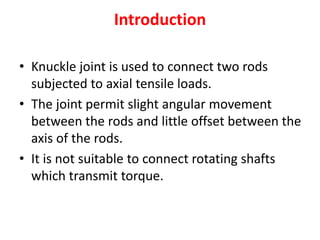
• Knuckle joint is used to connect two rods
subjected to axial tensile loads.
• The joint permit slight angular movement
between the rods and little offset between the
axis of the rods.
• It is not suitable to connect rotating shafts
which transmit torque.
Main parts of knuckle joint
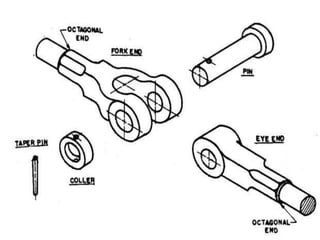
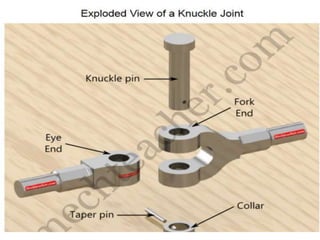
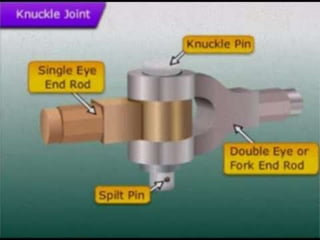
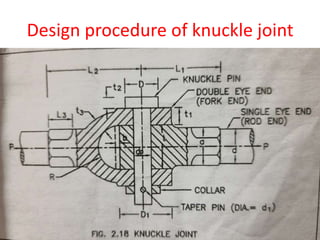
• Single eye end(rod end)
• Double eye end (fork end)
• Knuckle pin
• Collar
• Taper pin(split pin)
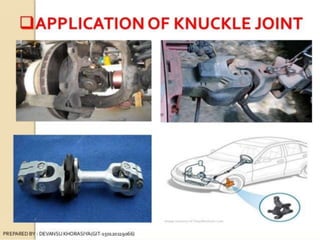
Application of knuckle joint
• To connect valve rod and eccentric rod of
steam engine .
• To connect structural members under tension.
• To connect links in some material handling
equipment.
• In locomotive engine for connecting links for
The air brake assembly.
Advantages of the knuckle joint
• Permits slight angular movement between the
rods.
• Easy to assemble and disassemble.
• Permits little offset between the axes of the
rods
Design procedure of knuckle joint
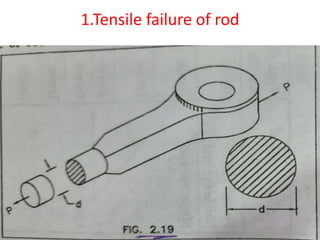
1.Tensile failure of rod
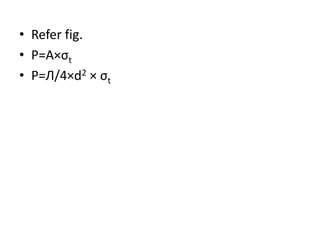
• Refer fig.
• P=A×σt
• P=Л/4×d2 × σt
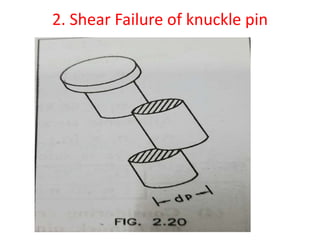
2. Shear Failure of knuckle pin
• As shown in fig. The pin may fail in double
shear due to tensile load
• P=2× Л/4×dp
2×[τ]
• Where dp=pin diameter
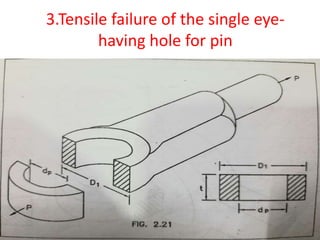
3.Tensile failure of the single eye-
having hole for pin
• Eye dimension are obtained by taking
proportions.
• D1=2dp; t=1.2 dp
• Checking the eye for tensile failure
• P=( D1 - dp )×t× σt
• If σt˂[ σt] the eye is safe for tensile failure
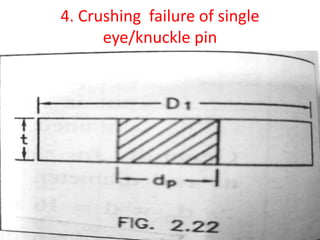
4. Crushing failure of single
eye/knuckle pin
• P= dp ×t × σc
• If σc˂[ σc] the eye / pin is safe for crushing
failure
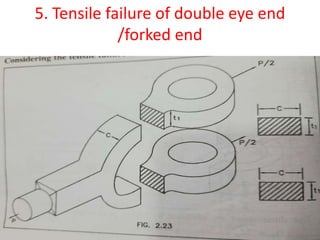
5. Tensile failure of double eye end
/forked end
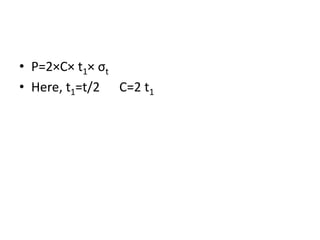
• P=2×C× t1× σt
• Here, t1=t/2 C=2 t1
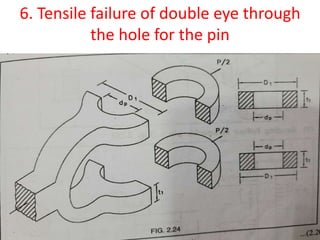
6. Tensile failure of double eye through
the hole for the pin
• P=2(D1- dp )t1× σt
• If σt˂[ σt] the double eye is safe for tensile
failure
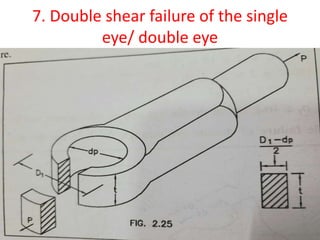
7. Double shear failure of the single
eye/ double eye
• P=2×[(D1- dp )/2] ×t×τ
• If τ˂[ τ] the double eye end / single eye end is
safe against shear failure.
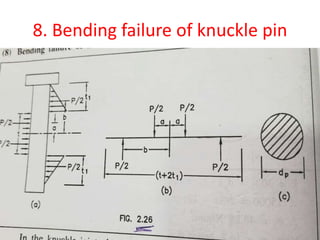
8. Bending failure of knuckle pin
• In the knuckle joint, the clearance is provided between
pin and the hole of single and double eye and hence
the possibility of bending of the pin will be there.
• Pin is considered to be a beam subjected to UDL
on its length in the single eye and varying load on the
length in the double eye with maximum load at the
inner most end and zero at outer end .
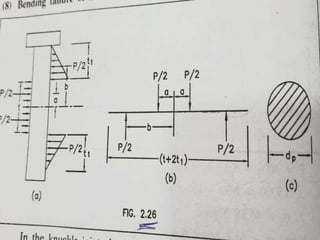
• Hear , as shown in fig.
• a = distance of line of action of load on one side of
single eye end from the axis of the joint.
• b = distance of line of action of load on one side of
double eye end from the axis of the joint.
• With this loading , maximum bending stress in the pin
is determined and compared with allowable to check
for the failure.
• Bending moment , Mb =P/2×b - P/2×a
• =P/2 (b-a)
• b = t/2 +t1/3 ; a=t/4
• Mb =P/2[t/2 +t1/3 - t/4]
• =P/2 [t/4 +t1/3]
• Taking , t1 = t/2
•
• Mb= P/2 [t/4 +t/6]
• Mb =5/24 P×t
• σb = Mb/Z
• Z= Л/32 dp
3
• Here , If σb˂[ σb] the pin is safe for bending
•
Problem 1
• Design of knuckle joint to connect two m .s
rods of equal diameter subjected to axial
tensile load of 12kN
• [σt]=75N/mm2; [ σc ] =140 N/mm2; [τ]=55
N/mm2
Solution
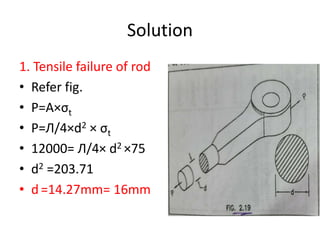
1. Tensile failure of rod
• Refer fig.
• P=A×σt
• P=Л/4×d2 × σt
• 12000= Л/4× d2 ×75
• d2 =203.71
• d =14.27mm= 16mm
2.Shear Failure of knuckle pin
• As shown in fig. The pin may fail in double shear due to
tensile load
• P=2× Л/4×dp
2×[τ]
• Where dp=pin diameter
• 12000=2× Л/4×dp
2×55
• dp =11.78
• note : here ,pin is also subjected to bending and hence
possibility of bending is more compared to shear.
Hence the diameter of pin is increased by 25% to 30%
to that obtained for shear failure.
• Generally for safety and simplicity in design , the pin
diameter is taken same as rod diameter.
• dp=d=16mm
3.Tensile failure of the single eye-
having hole for pin
• Eye dimension are obtained by taking proportions.
• D1=2dp; t=1.2 dp
• D1 =2×16=32mm
• t =1.2 ×16 =19.2=20mm
• Checking the eye for tensile failure
• P=( D1 - dp )×t× σt
• 12000=( 32 – 16)×20× σt
• σt =37.5 N/mm2
• allowable stress [σt]=75N/mm2
• as σt˂[ σt]
• The eye is safe for tensile failure
•
4.Crushing failure of single
eye/knuckle pin
• P= dp ×t×σc
• 12000= 16 ×20×σc
• σc =37.5 N/mm2
• here, σc˂[ σc] ,
hence the eye / pin is safe for crushing failure
•
5.Tensile failure of double eye end
/forked end
• P=2×C× t1× σt
• Here, t1=t/2 =20/2=10mm ;
C=2t1=2×10=20mm
• 12000=2×20× 10× σt
• σt =30 N/mm2
• here, σt˂[ σt] the double eye is safe for tensile
failure
6.Tensile failure of double eye through
the hole for the pin
• P=2(D1- dp )t1× σt
• 12000=2(32- 16 )10× σt
• σt =37.5 N/mm2
• here,σt˂[ σt],
hence double eye is safe for tensile failure
7.Double shear failure of the single
eye/ double eye
• P=2×[(D1- dp )/2] ×t×τ
• 12000=2×[(32- 16 )/2] ×20×τ
• τ =37.5 N/mm2
• here , τ˂[ τ] ,
• hence the double eye end / single eye end is safe
against shear failure.
8. Bending failure of knuckle pin
• In the knuckle joint, the clearance is provided between pin
and the hole of single and double eye and hence the
possibilityof bending of the pin will be there.
• Pin is considered to be a beam subjected to UDL on its
length in the single eye and varying load on the length in the
double eye with maximum load at the inner most end and
zero at outer end .
• Hear , as shown in fig.
• a = distance of line of action of load on one side of single eye
end from the axis of the joint.
• b = distance of line of action of load on one side of double
eye end from the axis of the joint.
• With this loading , maximum bending stress in the pin is
determined and compared with allowable to check for the
failure.
• Bending moment,Mb =P/2×b - P/2×a
• =P/2 (b-a)
• b = t/2 +t1/3 ; a=t/4
• Mb =P/2[t/2 +t1/3 - t/4]
• =P/2 [t/4 +t1/3]
• Taking , t1 = t/2
•
• Mb= P/2 [t/4 +t/6]
• Mb =5/24 P×t
• σb = Mb/Z
• taking [σb ] =1.4 [σt ]
• [σb ]= 1.4×75
• [σb ] =105N/mm2
•
• Z= Л/32 dp
3 = Л/32 ×(16)3
• Z =402.12 mm3
• Mb =5/24×12000×20
• Mb =50000N.mm
• σb = Mb/Z
• σb =50000/401.92
• σb =124.40 N/ mm2
• Here , σb˃[ σb] the pin is not safe in bending
• Let pin diameter, dp =20mm
• Z= Л/32 ×(20)3
• Z=785.39 mm3
• σb = Mb/Z
• σb = 50000/785.39
• σb =63.66 N/ mm2
• Here , σb˂[ σb] the pin is safe in bending

knuckle joint.pptx

  • 1.
    Design of KnuckleJoint Sunilkumar N Chaudhari Mechanical engineering Department BBIT V.V.Nagar Date :30/7/2020
  • 2.
    Introduction • Knuckle jointis used to connect two rods subjected to axial tensile loads. • The joint permit slight angular movement between the rods and little offset between the axis of the rods. • It is not suitable to connect rotating shafts which transmit torque.
  • 6.
    Main parts ofknuckle joint • Single eye end(rod end) • Double eye end (fork end) • Knuckle pin • Collar • Taper pin(split pin)
  • 7.
    Application of knucklejoint • To connect valve rod and eccentric rod of steam engine . • To connect structural members under tension. • To connect links in some material handling equipment. • In locomotive engine for connecting links for The air brake assembly.
  • 10.
    Advantages of theknuckle joint • Permits slight angular movement between the rods. • Easy to assemble and disassemble. • Permits little offset between the axes of the rods
  • 11.
    Design procedure ofknuckle joint
  • 12.
  • 13.
    • Refer fig. •P=A×σt • P=Л/4×d2 × σt
  • 14.
    2. Shear Failureof knuckle pin
  • 15.
    • As shownin fig. The pin may fail in double shear due to tensile load • P=2× Л/4×dp 2×[τ] • Where dp=pin diameter
  • 16.
    3.Tensile failure ofthe single eye- having hole for pin
  • 17.
    • Eye dimensionare obtained by taking proportions. • D1=2dp; t=1.2 dp • Checking the eye for tensile failure • P=( D1 - dp )×t× σt • If σt˂[ σt] the eye is safe for tensile failure
  • 18.
    4. Crushing failureof single eye/knuckle pin
  • 19.
    • P= dp×t × σc • If σc˂[ σc] the eye / pin is safe for crushing failure
  • 20.
    5. Tensile failureof double eye end /forked end
  • 21.
    • P=2×C× t1×σt • Here, t1=t/2 C=2 t1
  • 22.
    6. Tensile failureof double eye through the hole for the pin
  • 23.
    • P=2(D1- dp)t1× σt • If σt˂[ σt] the double eye is safe for tensile failure
  • 24.
    7. Double shearfailure of the single eye/ double eye
  • 25.
    • P=2×[(D1- dp)/2] ×t×τ • If τ˂[ τ] the double eye end / single eye end is safe against shear failure.
  • 26.
    8. Bending failureof knuckle pin
  • 27.
    • In theknuckle joint, the clearance is provided between pin and the hole of single and double eye and hence the possibility of bending of the pin will be there. • Pin is considered to be a beam subjected to UDL on its length in the single eye and varying load on the length in the double eye with maximum load at the inner most end and zero at outer end . • Hear , as shown in fig. • a = distance of line of action of load on one side of single eye end from the axis of the joint. • b = distance of line of action of load on one side of double eye end from the axis of the joint. • With this loading , maximum bending stress in the pin is determined and compared with allowable to check for the failure.
  • 28.
    • Bending moment, Mb =P/2×b - P/2×a • =P/2 (b-a) • b = t/2 +t1/3 ; a=t/4 • Mb =P/2[t/2 +t1/3 - t/4] • =P/2 [t/4 +t1/3] • Taking , t1 = t/2 • • Mb= P/2 [t/4 +t/6] • Mb =5/24 P×t • σb = Mb/Z • Z= Л/32 dp 3 • Here , If σb˂[ σb] the pin is safe for bending •
  • 29.
    Problem 1 • Designof knuckle joint to connect two m .s rods of equal diameter subjected to axial tensile load of 12kN • [σt]=75N/mm2; [ σc ] =140 N/mm2; [τ]=55 N/mm2
  • 30.
    Solution 1. Tensile failureof rod • Refer fig. • P=A×σt • P=Л/4×d2 × σt • 12000= Л/4× d2 ×75 • d2 =203.71 • d =14.27mm= 16mm
  • 31.
    2.Shear Failure ofknuckle pin • As shown in fig. The pin may fail in double shear due to tensile load • P=2× Л/4×dp 2×[τ] • Where dp=pin diameter • 12000=2× Л/4×dp 2×55 • dp =11.78 • note : here ,pin is also subjected to bending and hence possibility of bending is more compared to shear. Hence the diameter of pin is increased by 25% to 30% to that obtained for shear failure. • Generally for safety and simplicity in design , the pin diameter is taken same as rod diameter. • dp=d=16mm
  • 32.
    3.Tensile failure ofthe single eye- having hole for pin • Eye dimension are obtained by taking proportions. • D1=2dp; t=1.2 dp • D1 =2×16=32mm • t =1.2 ×16 =19.2=20mm • Checking the eye for tensile failure • P=( D1 - dp )×t× σt • 12000=( 32 – 16)×20× σt • σt =37.5 N/mm2 • allowable stress [σt]=75N/mm2 • as σt˂[ σt] • The eye is safe for tensile failure •
  • 33.
    4.Crushing failure ofsingle eye/knuckle pin • P= dp ×t×σc • 12000= 16 ×20×σc • σc =37.5 N/mm2 • here, σc˂[ σc] , hence the eye / pin is safe for crushing failure •
  • 34.
    5.Tensile failure ofdouble eye end /forked end • P=2×C× t1× σt • Here, t1=t/2 =20/2=10mm ; C=2t1=2×10=20mm • 12000=2×20× 10× σt • σt =30 N/mm2 • here, σt˂[ σt] the double eye is safe for tensile failure
  • 35.
    6.Tensile failure ofdouble eye through the hole for the pin • P=2(D1- dp )t1× σt • 12000=2(32- 16 )10× σt • σt =37.5 N/mm2 • here,σt˂[ σt], hence double eye is safe for tensile failure
  • 36.
    7.Double shear failureof the single eye/ double eye • P=2×[(D1- dp )/2] ×t×τ • 12000=2×[(32- 16 )/2] ×20×τ • τ =37.5 N/mm2 • here , τ˂[ τ] , • hence the double eye end / single eye end is safe against shear failure.
  • 37.
    8. Bending failureof knuckle pin • In the knuckle joint, the clearance is provided between pin and the hole of single and double eye and hence the possibilityof bending of the pin will be there. • Pin is considered to be a beam subjected to UDL on its length in the single eye and varying load on the length in the double eye with maximum load at the inner most end and zero at outer end . • Hear , as shown in fig. • a = distance of line of action of load on one side of single eye end from the axis of the joint. • b = distance of line of action of load on one side of double eye end from the axis of the joint. • With this loading , maximum bending stress in the pin is determined and compared with allowable to check for the failure.
  • 39.
    • Bending moment,Mb=P/2×b - P/2×a • =P/2 (b-a) • b = t/2 +t1/3 ; a=t/4 • Mb =P/2[t/2 +t1/3 - t/4] • =P/2 [t/4 +t1/3] • Taking , t1 = t/2 • • Mb= P/2 [t/4 +t/6] • Mb =5/24 P×t • σb = Mb/Z • taking [σb ] =1.4 [σt ] • [σb ]= 1.4×75 • [σb ] =105N/mm2 • • Z= Л/32 dp 3 = Л/32 ×(16)3 • Z =402.12 mm3
  • 40.
    • Mb =5/24×12000×20 •Mb =50000N.mm • σb = Mb/Z • σb =50000/401.92 • σb =124.40 N/ mm2 • Here , σb˃[ σb] the pin is not safe in bending • Let pin diameter, dp =20mm • Z= Л/32 ×(20)3 • Z=785.39 mm3 • σb = Mb/Z • σb = 50000/785.39 • σb =63.66 N/ mm2 • Here , σb˂[ σb] the pin is safe in bending