STRUCTURAL CONNECTION DESIGN
By: AMWAL AHMAD
CIVIL DESIGN ENGINEER
PROJECT SERVICES TEAM(S&EK)
August 2023
AND
CONSTRUCTION ASPECTS
2
Content
 Objectives
 Definition of Connection
 Importance of Connection
 Simple Connection Design(Bolted/Welded)
 Bolted Connection Design-Examples
 General Connection Guidelines
 Constructability in Steel(Construction Aspect)
 General Consideration in Constructability
 Common Site issues/suggestions related to Constructability
 References
3
Objectives
To explain the importance of connection design and its implementation in design and construction field.
The objective of this session is to have a overview on simple connection design and related constructability constraint
at construction site.
4
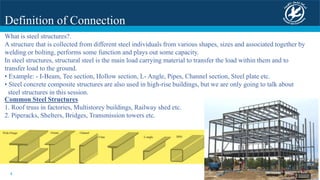
What is steel structures?.
A structure that is collected from different steel individuals from various shapes, sizes and associated together by
welding or bolting, performs some function and plays out some capacity.
In steel structures, structural steel is the main load carrying material to transfer the load within them and to
transfer load to the ground.
• Example: - I-Beam, Tee section, Hollow section, L- Angle, Pipes, Channel section, Steel plate etc.
• Steel concrete composite structures are also used in high-rise buildings, but we are only going to talk about
steel structures in this session.
Definition of Connection
Common Steel Structures
1. Roof truss in factories, Multistorey buildings, Railway shed etc.
2. Piperacks, Shelters, Bridges, Transmission towers etc.
5
Definition of Connection (Cont.)
A connection is an assembly of one or more joints that is used to transmit forces between two or more members,
from secondary to main member/ column.
An intuitive knowledge of how a system will transmit loads(the art of load paths) and understanding of structural
mechanics are necessary to achieve connections which are both safe and economic.
The principal structural requirement of a connection is that it should be capable of safely transferring load from
the supported members(secondary member) to the supporting member (main member).
The above requirement implies that three properties of the connection needs to be considered:
strength, stiffness and deformation capacity.
End Plate Shear
Connection
Fin Plate Shear
Connection
Top & Bottom Flange
Plate Moment Connection
Vertical Bracing
Connection
6
Definition of Connection (Cont.)
7
Structural steel connections are crucial to any steel structure, which is vital in forming a stable and secure
connection. Over the years, various steel connections have been developed, each designed for a specific purpose.
The importance of proper steel connections cannot be overstated, as they directly impact a steel structure's integrity
and overall safety. By selecting the appropriate connection type for a given application and ensuring it is
appropriately installed, engineers can ensure that a steel structure will perform as intended, even under extreme
conditions.
Connections are an intimate part of a steel structure and their proper treatment is essential for a safe and economic
structure.
Connections accounts almost for half the cost of structural steelwork ,so their design and detailing should be given
top priority for both safety and structural economy.
A structure is as strong as its weakest link and a connection can be that weakest link. Therefore it has to be designed
very carefully.
Aim should be, to provide simple, repetitive and easy to erect connections, as its fabrication & erection accounts
60 ~ 65 % of cost of steel structure.
Importance of Connection
8
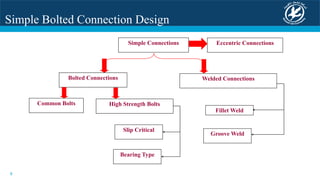
Simple Connections
Bolted Connections Welded Connections
Common Bolts High Strength Bolts
Slip Critical
Bearing Type
Fillet Weld
Groove Weld
Eccentric Connections
Simple Bolted Connection Design
9
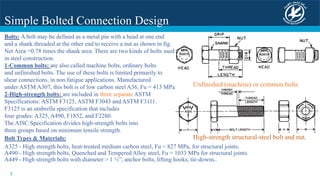
Bolts: A bolt may be defined as a metal pin with a head at one end
and a shank threaded at the other end to receive a nut as shown in fig.
Net Area =0.78 times the shank area. There are two kinds of bolts used
in steel construction.
1-Common bolts: are also called machine bolts, ordinary bolts
and unfinished bolts. The use of these bolts is limited primarily to
shear connections, in non fatigue applications. Manufactured
under ASTM A307, this bolt is of low carbon steel A36, Fu = 413 MPa.
2-High-strength bolts: are included in three separate ASTM
Specifications: ASTM F3125, ASTM F3043 and ASTM F3111.
F3125 is an umbrella specification that includes
four grades: A325, A490, F1852, and F2280.
The AISC Specification divides high-strength bolts into
three groups based on minimum tensile strength.
High-strength structural-steel bolt and nut.
Unfinished (machine) or common bolts
Simple Bolted Connection Design
Bolt Types & Materials:
A325 - High strength bolts, heat-treated medium carbon steel, Fu = 827 MPa, for structural joints.
A490 - High strength bolts, Quenched and Tempered Alloy steel, Fu = 1033 MPa for structural joints.
A449 - High strength bolts with diameter > 1 ½”, anchor bolts, lifting hooks, tie-downs..
10
Structural bolts can be installed pretensioned or snug tight. Pretensioned means
that the bolt is tightened until a tension force approximately equal to 70% of its
minimum tensile strength is produced in the bolt.
Snug tight (snug being defined as the tightness necessary to bring all elements
of the connection into firm contact). It can be attained by a few impacts of an
impact wrench or the full effort of a man using an ordinary spud wrench.
Common bolts (A307) can be installed only to the snug-tight condition. There
is no recognized procedure for tightening these bolts beyond this point. Impact Wrench
Spud Wrench
Simple Bolted Connection Design
Pretensioned structural bolts must be used in certain locations. Section J3.1 of the AISC that they be used for the following joints:
1. Joints that are subject to significant load reversal.
2. Joints that are subject to fatigue load with no reversal of the loading direction.
3. Joints with ASTM A325 or F1852 bolts that are subject to tensile fatigue.
4. Joints with ASTM A490 or F2280 bolts are subject to tension or combined shear and tension, with or without fatigue.
5. Connections subjected to vibratory loads where bolt loosening is a consideration.
As pointed out in a above sections, pretensioned bolts must be used for certain connections.
For other locations, snug-tight bolts should be used because they are cheaper with no reduction in strength.
The majority of shear connections in buildings can be snug tight and shear connections are the predominate in every building.
11
Threads Included in Shear Planes. The bearing-type connection with threads in shear planes is most frequently used. Since
location of threads is not restricted, bolts can be inserted from either side of a connection. Either the head or the nut can be the
element turned. Paint of any type is permitted on the faying surfaces (contact area between the connected parts).
Threads Excluded from Shear Planes. The bearing-type connection with threads excluded from shear planes is the most
economical high-strength bolted connection, because fewer bolts generally are needed for a given required strength. There can
be difficulties involved in excluding the threads from the shear planes when either one or both of the outer plies of the joint is
thin. The location of the thread runout or vanish depends on which side of the connection the bolt is entered and whether a
washer is placed under the head or the nut. This location is difficult to control in the shop but even more so in the field.
However, since for a given diameter of bolt the thread length is constant, threads can often be excluded in heavy joints with no
additional effort.
Simple Bolted Connection Design
520
414
A490
414
330
A325
Type X (Threads excluded)
Type N (Threads included)
Type
Table J3.2 Shows the values of Fnv (MPa) for different types of bolts
Type X-Bolt
Type N-Bolt
If the level of threads is unknown, it is conservative
to assume that the threads are included(Type-N)
12
Simple Bolted Connection Design
Connections are used to transfer the forces from one member to another. Although both welded and bolted connections can be used
in steel structures, bolted connections are commonly used because of the ease of fabrication, buildability and ability to
accommodate minor site adjustments. Bolted Connection can be classified into three categories as follows:
A- Based on the force transfer mechanism
1) Bearing connection: Common bolt with low strength are used,
so the amount of clamping action by tightening is small. Then
bolt and connecting member come in contact. Load is transferred
to bolts from members through contact, known as bearing.
2) Friction connection: In the friction mechanism, high strength
friction grip(HSFG) bolts are used in connection. These bolts
have high strength, so they can be tightened up to the desired
degree. Thus, they are tightened such as to induce a predefined
tension in the bolt. The tightening of the bolts generates a
clamping action in which the members are connected. Such connections
are called no-slip connection or slip-critical connections.
The 2016 AISC specification requires the use of slip-critical connections when:
(a) Bolts are installed in oversized holes.
(b) Bolts are installed in slotted holes with the direction of the load parallel to the slot.
(c) Bolts joining the extended portion of bolted, partial-length cover plates, as required in Section F13.3.
13
B- Based on the line of action of resultant force transferred:
1) Concentric (Simple) connections: Applied load passes through C.G of connections i.e. force transfer in tension
and compression member. Ideal concentric connections should have only one bolt passing through all the
members meeting at a joint, see figure (a).
However, in practice, this is not usually possible and so it is only ensured that the centroidal axes of the members
meet at one point see figure (b).
2) Eccentric connections: Applied load does not pass through C.G of connections i.e.
(in reaction transferring of bracket loads) or moment resisting connections (in beam
to column connections in frames).
Simple Bolted Connection Design
Bracket Connection
14
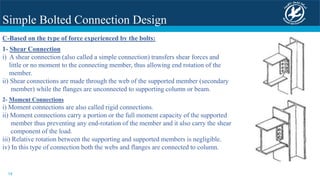
C-Based on the type of force experienced by the bolts:
1- Shear Connection
i) A shear connection (also called a simple connection) transfers shear forces and
little or no moment to the connecting member, thus allowing end rotation of the
member.
ii) Shear connections are made through the web of the supported member (secondary
member) while the flanges are unconnected to supporting column or beam.
2- Moment Connections
i) Moment connections are also called rigid connections.
ii) Moment connections carry a portion or the full moment capacity of the supported
member thus preventing any end-rotation of the member and it also carry the shear
component of the load.
iii) Relative rotation between the supporting and supported members is negligible.
iv) In this type of connection both the webs and flanges are connected to column.
Simple Bolted Connection Design
15
3- Beam and column splices
i) It is often required to join structural members (Beam, Column) along their
length, due to the available length of sections being limited, also due to
transportation and erection constraints. Such joints are called splices.
Typical bolted column splices used for rolled I-Section members is shown here.
Simple Bolted Connection Design
Advantages of Bolted Connection:
i) It is a faster way of installing any members on site.
ii) Bolting is a cold process hence there is no risk of fire.
iii) simple to apply on the members i.e. no skilled human power is required
iv) bolted connection can be easily replaced, retighten, and removed if there is
any damage in any parts of the structure.
Disadvantages of Bolted Connection:
i) If subjected to vibratory loads, results in reduction in strength get loosened.
ii) Bolt required a hole in the plate connection, so it reduces the area of the plate where the bolt has to be connected.
It makes the plate weaker than the previous one.
iii)The bolt should be protected with paints or chemicals to prevent it from corrosion.
16
• (a)-Shear failure of bolt
• (b)-Shear failure of plate
• (c)-Bearing failure of bolt
• (d)-Bearing failure of plate
• (e)-Tensile failure of bolts
• (f)-Bending of bolts
• (g)-Tensile failure of plate
Simple Bolted Connection Design
Bolted connections can fail either due to failure of the
connection itself or due to failure of the connecting
components.
Some of these failures, i.e. the plate's shear failure, plate's
splitting failure and plate's bearing failure, can be prevented
by adhering to edge distance criteria.
Bolted connection may fail in any one of the following
modes:
17
The bolted connection can fail in any of the six methods listed below:
• Tension failure of the plate: Occurs when the bolts are stronger than the connected plates.
• Bearing failure of bolt: Occurs when low strength bolts are used to connect high strength plates. In this failure,
the bolt gets crushed around half of its circumference when the connected plates slip due to applied force.
• Bearing failure of the plate: Occurs when high-strength bolts are used to connect low-strength plates. The
presence of a neighboring bolt or the proximity of an edge in the load direction can aggravate the bearing
problem. When ordinary bolts are subjected to shear forces, slip occurs and bolts comes in contact with the plates.
The plate may get crushed if the plate material is weaker than the bolt material.
• Shear failure of a bolt: The bolt gets cut or separated about the shear interface. The number of shear interfaces
can be one or multiple depending upon joints. Based on the number of shear planes, a bolt may fail in single shear
or double shear, etc. Shear stresses are created when plates slip due to applied forces. If the maximum factored
shear force exceeds the shear capacity of bolts, the bolt's shear failure occurs at the bolt shear plane.
• Shear failure of a plate: It is a type of excessive bearing failure when the bolt hole is near the end of the plate.
• Plate splitting failure: Occurs when high-strength bolts are used to connect high-strength plates. It is a combined
failure of shear and tension. Sometimes bolts may have to be placed at a lesser end distance than required,
leading to plates shearing out. Due to this, a block of material within the bolted area breaks away from the
remaining area.
Simple Bolted Connection Design
18
End Plate shear Connection
End Plate Shear Connection
End Plate shear connection involves welding a plate perpendicular to end of supported web
and bolting/welding to the supporting member. End plate shear connections do not resist any
moments and allows rotation, which is usually analyzed as pin support connection.
Failure Modes
End Plate Shear Connection failure modes are :
• Bolt shear (BS)
• Bolt bearing (BB)
• Block shear rupture (BSR)
• Shear yielding (SY)
• Shear rupture (SR)
End Plate Connection Load Path-Force flow from beam to end plate through weld, then end
plate to the column by the bolt.
There will always be a small amount of moment transferred but this is a negligible amount and
assumed to be zero. In construction, this is achieved through using fin plates and flexible end plates.
A rule of thumb for an indicative connection is to use a plate thickness equal to the bolt
diameter. This way, you will avoid the problem with prying action. But, of course, every
connection needs to be calculated accordingly.
Simple Bolted Connection Design-Failure Modes
19
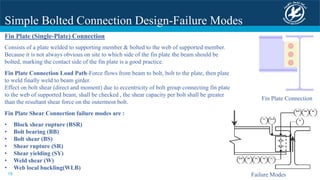
Fin Plate (Single-Plate) Connection
Consists of a plate welded to supporting member & bolted to the web of supported member.
Because it is not always obvious on site to which side of the fin plate the beam should be
bolted, marking the contact side of the fin plate is a good practice.
Fin Plate Connection Load Path-Force flows from beam to bolt, bolt to the plate, then plate
to weld finally weld to beam girder.
Effect on bolt shear (direct and moment) due to eccentricity of bolt group connecting fin plate
to the web of supported beam, shall be checked , the shear capacity per bolt shall be greater
than the resultant shear force on the outermost bolt.
Fin Plate Shear Connection failure modes are :
• Block shear rupture (BSR)
• Bolt bearing (BB)
• Bolt shear (BS)
• Shear rupture (SR)
• Shear yielding (SY)
• Weld shear (W)
• Web local buckling(WLB)
Fin Plate Connection
Failure Modes
Simple Bolted Connection Design-Failure Modes
20
2-Bolt Bearing(BB): Bolt bearing is concerned with the deformation of
material at the loaded edge of the bolt holes. Bearing capacity of the
connection is influenced by the proximity of the bolt to the loaded edge.
Bolt bearing is applicable to each bolted ply of a connection.
1-Block Shear Rupture(BSR): BSR is a limit state in which the failure path includes an area subject
to shear and an area subject to tension. This limit state is so named because the associated failure path
tears out a “block” of material. Block shear occur in plies that are bolted or in plies that are welded.
The only difference between the treatments of either the bolted or welded block shear limit state is that
in the absence of bolt holes, the gross areas are equal to the net areas.
Block Shear Rupture
Bolt Bearing
Bolt Shear
3-Bolt Shear (BS): Bolt shear is applicable to each bolted ply of a connection that is subjected to shear. The
shear strength of a bolt is directly proportional to the number of interfaces (shear planes) between the plies
within the grip of the bolt that a single shear force is transmitted through. Single shear occurs when the
individual shear force is transmitted through bolts that have two plies within the grip of the bolt.
Additional plies further distribute the shear force. Three plies of material represent two shear planes,
thus the bolt or bolt group is in double shear and has effectively twice the strength as single shear.
Simple Bolted Connection Design-Failure Modes
21
4-Shear Yielding and Shear Rupture ( SY & SR):The elements in the connection that are subject
to shear forces must be investigated for shear yielding and shear rupture. Both limit states
will apply regardless of fastening method(bolt or weld). For welded plies, without bolt holes,
shear yielding will usually control over shear rupture. If the ratio of yield strength to ultimate
tensile strength is less than 1.2, then shear rupture will generally control.
If both flanges of the supported member are coped, then a potential shear failure path on
the beam is present and shear yielding and shear rupture must be investigated for this member.
Shear Yielding and Shear Rupture
Weld Shear
5-Weld Shear(WS): Weld shear is applicable to each welded ply of a connection. The failure mode for
fillet welds is always assumed to be a shear failure on the effective throat of the weld. In a similar fashion as
bolt shear, if the load path does not pass through the center of gravity of a weld group, then the load is
considered eccentric. Eccentrically loaded weld groups are subject to a moment that tends to induce either
additional shear (for in-plane loads) or combined shear and tension (for out-of-plane loads).
6-Web Local Buckling (WLB):Sometimes forces that are transferred from one member to another create localized
deformation (yielding) or buckling. The applicable limit states depend on the specific connection geometry. The
limit states for concentrated forces most often occur in seated connections and moment connections. For example,
when the supported beam is coped, (i.e. flange material has been removed) the remaining web may be susceptible
to web local buckling. Since most moment connections provide continuity between the supporting and supported
members, the flanges of the supported member transfer concentrated tension and compression forces to the
supporting member. Flange local bending, web local yielding, web crippling and web compression buckling limit
states must be investigated.
Simple Bolted Connection Design-Failure Modes
22
Simple Fin Plate Connection -Failure Modes
23
Block Shear Failure
• Bolts may have been placed at a lesser end distance than required
causing the plates to shear out.
• May occur when a block of material within the bolted area brakes
away from the remainder area.
• Occur when fewer bolts of high strength are used. Also checked by
observing the specifications of end distance.
Simple Bolted Connection Design
Block shear failure of plate in tension
In block shear failure, block of material is torn out by applied shear.
Failure occurs in shear along bolt holes parallel to the applied loads
accompanied by tensile rupture along a perpendicular face.
Ubs=1.0 when tension stress is uniform
Ubs =0.5 when tension stress is non-uniform
Ubs=Reduction coefficient, used in calc block shear
Single Row bolt Ubs=1.0, Multiple Row Ubs=0.5
24
Simple Bolted Connection Design
Simple Connection:
• If the line of action of the force acting on the connection passes through the center of gravity of the connection, then each bolt
can be assumed to resist an equal share of the load.
• The strength of the simple connection will be equal to the sum of the strengths of the individual bolts in the connection.
We will concentrate on simple bolted shear connections in this session
Tension member Connection/Splice
Beam end/Simple shear connection
Moment resisting connection Hanger connection (Tension)
Connection can be categorized based on the type of loading.
Tension member connection and splice: It subjects the bolts to forces that tend to shear the shank.
Beam end simple connection: This also subjects the bolts to forces that tend to shear the shank.
Hanger connection: The hanger connection puts the bolts in tension.
25
Common Bolt Terminologies:
A325-SC –slip-critical A325 bolts.
A325-N –snug-tight or bearing A325 bolts with thread included in the shear planes.
A325-X –snug-tight or bearing A325 bolts with thread excluded in the shear planes.
Gage(g) –center-to-center distance of bolts in direction perpendicular member’s axis.
Pitch(p) –parallel to member’s axis.
Edge Distance – Distance from center of bolt to adjacent edge of a member.
g
p
p
p
Edge
distance
p
Example. 1-ASD Method (AISC 13th Edition):
Calculate and check the design strength of the simple connection shown below. Is the
connection adequate for carrying the service load of 200 kN?.
Bolted Connection Design-Gusset Plate Example-1
200 kN
Step I. Shear Strength of bolts
The shear strength of one bolt, Rn = Fnv Ab = 330 x π x 202/(4x1000) =103.72 kN
Fnv=Nominal shear stress (330 MPa) bearing type connection (Table J3.2)
Rn/ Ω= allowable shear strength= 103.72/2=51.85kN
Shear strength of connection = 4 x 51.85 = 207.44 kN
As specified in KOC-C-002 (Rev-3), Cl.18.3.2, only ASD method shall
be used in steel design, same method of design we will follow here.
26
Step II. Minimum edge distance and spacing requirements
See Table J3.4M(AISC), minimum edge distance = 26 mm for rolled edges of plates
The given edge distances (30 mm) > 26 mm.
Therefore, minimum edge distance requirements are satisfied.
Minimum spacing = 2.67 db = 2.67 x 20 = 53.4 mm. (AISC Specifications J3.3), db= Dia of bolt
Preferred spacing = 3.0 db = 3.0 x 20 = 60 mm, The given spacing (60 mm) = 60 mm.
Therefore, spacing requirements are satisfied.
Bolted Connection Design- Gusset Plate Example
Deformation at bolt hole is a concern, Rn = 1.2 Lc t Fu ≤ 2.4 db t Fu-------- J6-3a(AISC)
Deformation at bolt hole is not a concern, Rn = 1.5 Lc t Fu ≤ 3.0 db t Fu------J6-3b(AISC)
Long slotted holes with the slot perpendicular to the load, Rn = 1.0 Lc t Fu ≤ 2.0 db t Fu-------J6-3c(AISC)
Where; Rn = Nominal bearing strength,
Fu = Specified minimum tensile stress=400 MPa,
Lc = Clear distance between the edges of the hole in the direction of the load,
db = Nominal bolt diameter
t = Thickness of connected material
Ω = resistance factor 2.0 (ASD)
Step III. For bearing of plate material at bolt holes:
27
A-Bearing strength at bolt holes in connected part (120x15 mm plate)
At edges, Lc = 30 – hole diameter/2 = 30 – (20 + 2)/2 = 19 mm
Rn = 1.2 Lc t Fu ≤ 2.4 db t Fu--------------(J3-6a) AISC
Allowable strength= (1.2 x19 x15x400)/1000 = 136.8 kN, Rn/ Ω=136.8/2=68.4 kN
at edges Rn ≤ 2.4 db t Fu = 2.4 x 20x15x400/1000 = 288 kN, Rn/ Ω=288/2=144 kN
So, 68.4 kN ≤ 144 kN, requirement satisfied.
At other holes, s = 60 mm, Lc = 60 – (20 + 2) = 38 mm.
Allowable strength = (1.2 x38 x15x400)/1000=273.6/2=136.8 kN
But, allowable strength ≤ 2.4 db t Fu = 288/2=144 kN. Therefore, allowable strength = 136.8 kN at other holes
Therefore, bearing strength at bolt holes = 2 x 68.4 + 2 x 136.8 = 410.4 kN
B-Bearing strength at bolt holes in gusset plate (10 mm plate)
At edges, Lc = 30 – hole diameter/2 = 30 – (20 + 2)/2 = 19 mm.
Allowable strength = 1.2 Lc t Fu = 1.2 x 19 x 10 x 400/1000 = 91.2 kN, Rn/ Ω=91.2/2=45.6 kN
But, allowable strength ≤ 2.4 db t Fu = 2.4 x 20 x 10 x 400/1000 = 192 kN, Rn/ Ω=192/2=96 kN
Therefore, allowable strength at edges holes = 45.6 kN
Bolted Connection Design- Gusset Plate Example
28
At other holes, s = 60 mm, Lc = 60 – (20 +2) = 38 mm
Allowable strength(Rn/Ω) = 1.2 Lc t Fu = 1.2 x 38 x 10x 400/1000 = 182.4 kN, 182.4/2=91.2kN
But, Allowable strength ≤ 2.4 db t Fu =2.4x20x10x400/1000= 192 kN, 192/2=96 kN
Therefore, allowable strength= 91.2 kN at other holes
Therefore, bearing strength at edges holes = 2 x 45.6 + 2 x 91.2 = 273.6 kN
Bearing strength of the connection is the smaller of the bearing strengths = 273.6 kN, O.K
Connection Strength
Shear strength = 207.44 kN
Bearing strength (plate) = 410.4 kN
Bearing strength (gusset) = 273.6 kN
Connection strength (Rn/Ω) > Applied load- 200 kN, Therefore OK.
Bolted Connection Design- Gusset Plate Example
29
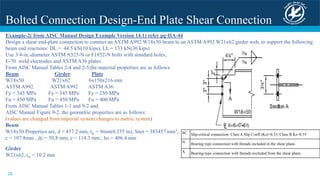
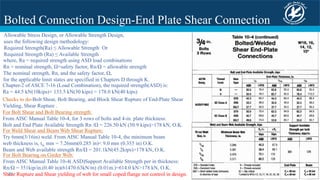
Example-2( from AISC Manual Design Example Version 14.1) refer pg-IIA-44
Design a shear end-plate connection to connect an ASTM A992 W18x50 beam to an ASTM A992 W21x62 girder web, to support the following
beam end reactions: DL = 44.5 kN(10 kips), LL = 133 kN(30 kips)
Use 3/4-in.-diameter ASTM A325-N or F1852-N bolts with standard holes,
E-70 weld electrodes and ASTM A36 plates.
From AISC Manual Tables 2-4 and 2-5,the material properties are as follows:
Beam Girder Plate
W18x50 W21x62 6x150x216 mm
ASTM A992 ASTM A992 ASTM A36
Fy = 345 MPa Fy = 345 MPa Fy = 250 MPa
Fu = 450 MPa Fu = 450 MPa Fu = 400 MPa
From AISC Manual Tables 1-1 and 9-2 and
AISC Manual Figure 9-2, the geometric properties are as follows:
(values are changed from imperial system changes to metric system)
Beam
W18x50 Properties are, d = 457.2 mm, tw = 9mm(0.355 in), Snet = 383457 mm3,
c = 107.8mm , dc = 50.8 mm, e = 114.3 mm., ho = 406.4 mm
Girder
W21x62, tw = 10.2 mm
Bolted Connection Design-End Plate Shear Connection
SC Slip-critical connection. Class A Slip Coeff (Ks)=0.33, Class B Ks=0.55
N Bearing type connection with threads included in the shear plane.
X Bearing-type connection with threads excluded from the shear plane.
30
Chapter-2 of ASCE 7-16 (Load Combination), the required strength(ASD) is:
Ra = 44.5 kN(10kips)+ 133.5 kN(30 kips) = 178.0 kN(40 kips)
Checks to do-Bolt Shear, Bolt Bearing, and Block Shear Rupture of End-Plate Shear
Yielding, Shear Rupture .
For Bolt Shear and Bolt Bearing strength:
From AISC Manual Table 10-4, for 3 rows of bolts and 4-in. plate thickness:
Bolt and End Plate Available Strength Rn /Ω = 226.50 kN (50.9 kips)˃178 kN, O.K.
where, Ra = required strength using ASD load combinations
Rn = nominal strength, Ω=safety factor, Rn/Ω = allowable strength
The nominal strength, Rn, and the safety factor, Ω,
for the applicable limit states are specified in Chapters D through K.
For Weld Shear and Beam Web Shear Rupture:
Try 6mm(3/16in) weld. From AISC Manual Table 10-4, the minimum beam
web thickness is, tw min = 7.26mm(0.285 in)< 9.0 mm (0.355 in) O.K.
Beam and Web available strength Rn/Ω = 201.1kN(45.2kips)˃178 kN, O.K.
For Bolt Bearing on Girder Web:
From AISC Manual Table 10-4( ASD)Support Available Strength per in thickness:
Rn/Ω = 351kip/in.(0.40 in)(61470.63kN/m) (0.01m.)=614.0 kN˃178 kN, O.K.
Shear Rupture and Shear yielding of web for small coped flange not control in design.
Bolted Connection Design-End Plate Shear Connection
Allowable Stress Design, or Allowable Strength Design,
uses the following design methodology:
Required Strength(Ra) ≤ Allowable Strength Or
Required Strength (Ra) ≤ Available Strength
31
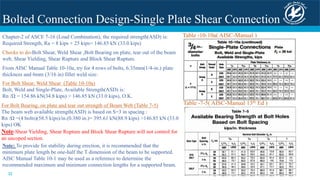
Design a single-plate connection between an ASTM A992 W16x50 beam and an ASTM A992 W14x90
column flange to support the following beam end reactions:
DL = 35.6 kN(8.0 kips) LL = 111.25 kN (25 kips)
Use 4-Nos-3/4 in. diameter ASTM A325-N or F1852-N bolts with standard holes, E70-weld electrode
and an ASTM A36 plate.
Example-3 ( From AISC Manual Design Example Version 14.1) refer pg-IIA-17A
Solution:
Beam Girder Plate
W16x50 W14x90 6x115x292 mm
ASTM A992 ASTM A992 ASTM A36
Fy = 345 MPa Fy = 345 MPa Fy = 250 MPa
Fu = 450 MPa Fu = 450 MPa Fu = 400 MPa
From AISC Manual Tables 2-4 and 2-5, the material properties are as follows:
From AISC Manual Tables 1-1,the geometric properties are as follows:
Beam (values are changed from imperial system changes to metric system)
W16x50 , tw = 9.6mm(0.380in.), d = 414.0mm(16.3in.), tf = 16mm(0.630 in),
Column
W14x90, tw = 18.03mm(0.710 in.)
Bolted Connection Design-Single Plate Shear Connection
32
Chapter-2 of ASCE 7-16 (Load Combination), the required strength(ASD) is:
Required Strength, Ra = 8 kips + 25 kips= 146.85 kN (33.0 kips)
Checks to do-Bolt Shear, Weld Shear ,Bolt Bearing on plate, tear out of the beam
web, Shear Yielding, Shear Rupture and Block Shear Rupture.
From AISC Manual Table 10-10a, try for 4 rows of bolts, 6.35mm(1/4-in.) plate
thickness and 6mm (3/16 in) fillet weld size:
For Bolt Shear, Weld Shear (Table 10-10a)
Bolt, Weld and Single-Plate, Available Strength(ASD) is:
Rn /Ω = 154.86 kN(34.8 kips) ˃ 146.85 kN (33.0 kips), O.K.
For Bolt Bearing, on plate and tear out strength of Beam Web (Table 7-5)
The beam web available strength(ASD) is based on S=3 in spacing :
Rn /Ω =(4 bolts)(58.5 kips)/in.(0.380 in.)= 395.61 kN(88.9 kips) >146.85 kN (33.0
kips) OK
Note-Shear Yielding, Shear Rupture and Block Shear Rupture.will not control for
an uncoped section.
Note: To provide for stability during erection, it is recommended that the
minimum plate length be one-half the T dimension of the beam to be supported.
AISC Manual Table 10-1 may be used as a reference to determine the
recommended maximum and minimum connection lengths for a supported beam.
Table -10-10a( AISC-Manual )
Bolted Connection Design-Single Plate Shear Connection
Table -7-5( AISC-Manual 13th Ed )
33
Double cleat End plate Shear tab(Fin plate)
Flexibility High Medium Low
Site adjustment Minor Not possible Minor
Design Easy in design
without
eccentricity.
Easy in design
without eccentricity.
Complex in design, as bolt
shear to be checked for
additional shear due to
eccentricity.
Fabrication Large number of
holes to be drilled.
Medium. Low
fabrication tolerance.
Fabricator’s delight
Erection Good lateral
stability.
Less stable if not
connected to flange
of the beam. Lowest
erection tolerance.
Easy for erection.
Comparison between type of Shear Connections
Simple Bolted Connection Design
34
Simple Welded Connections
Structural welding is a process by which the parts that are to be connected are heated and fused, with supplementary
molten metal at the joint.
A relatively small depth of material will become molten, and upon cooling, the structural steel and weld metal will act as
one continuous part where they are joined.
The two most common types of welds are the fillet weld and the groove weld.
Fillet weld
Fillet weld
Fillet weld
Fillet weld
Fillet weld
Fillet weld
Welding Process – Fillet Weld
Simple Welded Connection Design
35
Fillet Weld:
Lap joint-weld placed in the corner formed by two plates.
Tee joint-weld placed at the intersection of two plates.
Most popular electrode used is E70XX.
Fillet weld can be loaded in any direction in shear, compression or tension. However it always fail in shear.
Simple Welded Connection Design
Classification of Welds
According to type of weld
• Fillet weld , Groove weld
According to weld position
• Flat, Horizontal, vertical or overhead weld
According to type of joint
• Butt, lap, tee, edge or corner
According to the weld process
• SMAW, SAW
Groove Weld:
• Deposited in a gap or groove between two parts to be connected e.g. butt , tee & corner joints with prepared edges.
• Partial penetration groove welds can be made from one or both sides with or without edge preparation.
36
• Groove Weld ( More reliable than others).
• Fillet Weld (Mostly used, Weaker than groove and others).
• Plug Weld (expensive – poor transmission of tensile forces).
• Slot Weld (expensive - poor transmission of tensile forces).
• Plug and Slot welds – stitch different parts of members together.
Advantages of Welded Connection
• Economical – Cost of materials and labors.
• Efficiency is 100% as compared to bolts (75- 90%).
• Fabrication of Complex Structures – Easy – like Circular Steel pipes.
• Provides Rigid Joints – Modern Practice is of Rigid Joints.
Disadvantages of Welded Connection
• No provision for expansion or contraction therefore greater chances of cracking.
• Uneven heating and cooling - member may distort -may result in additional stresses.
• Inspection is difficult and more costlier than bolts.
Simple Welded Connection Design
Types of Weld:
37
Fillet welds are most common and used in all structures.
Weld sizes are specified in 1 mm increments
A fillet weld can be loaded in any direction in shear, compression, or tension. However, it always fails in shear.
The shear failure of the fillet weld occurs along a plane through the throat of the weld, as shown in the figure.
Simple Welded Connections
a
a
Throat = a x cos45o
= 0.707 a
a
a
Throat = a x cos45o
= 0.707 a
Failure Plane
L
Nominal Strength, Rn = fw x 0.707 x a x Lw,
Rn = 0.75 x fw x 0.707 x a x Lw i.e.,  factor = 0.75 (LRFD) Ω= 2.00 (ASD)
fw = Shear strength of the weld metal is a function of the electrode used in the SMAW process.
The tensile strength of the weld electrode can be 413, 482, 551, 620, 688, 758, or 827 MPa.
The corresponding electrodes are specified using the nomenclature E60XX, E70XX, E80XX, and so on.
This is the standard terminology for weld electrodes.
Lw = length of the weld
a = size of the weld
The two digits "XX" denote the type of coating. The strength of the electrode should match
the strength of the base metal.
If yield stress (y) of the base metal is  413 - 448 MPa, use E70XX electrode.
If yield stress (y) of the base metal is  413 - 448 MPa, use E80XX electrode.
E70XX is the most popular electrode used for fillet welds made by the SMAW method.
Where, E – Electrode,
70 – Tensile strength of electrode (ksi) = 482 MPa
XX – Type of coating
Simple Welded Connection Design
38
Weld Symbols (American Welding Society AWS):
Fillet weld on arrow side. Weld’s leg size is 10 mm. Weld size is given to the left of the weld
symbol. Weld length (200 mm) is given to the right of the symbol
Fillet weld, 12 mm size and 75 mm long intermittent welds 125 on center, on the far side
Site fillet welds, 6 mm in size and 200 mm long, both sides.
Fillet welds on both sides, staggered intermittent 10 mm in size, 50 mm long and 150 mm on
center
Weld all around joint
Tail used to reference certain specification or process
V- Butt Weld on one side
6
10 50@150
Simple Welded Connection Design
39
Fillet Weld Butt Weld
Simple, fast and economical to make. More expensive than fillet welds because of the edge
preparation required.
No prior edge preparation is necessary. Easily designed and fabricated to be as strong as the
member.
Does not require very skilled labor. Require more skilled manpower, than that required for
filled welds.
Less attractive in appearance. Better appearance, compared to fillet welds.
Poorer performance under fatigue loading, Better fatigue characteristics, compared to fillet welds.
Throat thickness=0.707 x weld size. Thickness=(5/8) x thickness of thinner plate.
Not appropriate to transfer forces large in
magnitude.
Easy to detail and the length of the connection is
considerably reduced.
Difference Between Fillet Weld And Butt Weld
Simple Welded Connection Design
40
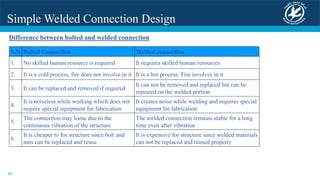
S.N Bolted Connection Welded connection
1. No skilled human resource is required It requires skilled human resources
2. It is a cold process, fire does not involve in it It is a hot process. Fire involves in it
3. It can be replaced and removed if required
It can not be removed and replaced but can be
repeated on the welded portion
4.
It is noiseless while working which does not
require special equipment for fabrication
It creates noise while welding and requires special
equipment for fabrication
5.
The connection may loose due to the
continuous vibration of the structure
The welded connection remains stable for a long
time even after vibration
6.
It is cheaper to for structure since bolt and
nuts can be replaced and reuse.
It is expensive for structure since welded materials
can not be replaced and reused properly
Difference between bolted and welded connection
Simple Welded Connection Design
41
General requirement for Connection Design
i) Minimum strength of the connection to be ensured. At least two bolts or equivalent weld per connection should be provided
ii) If CG of the weld/bolt group does not coincide with that of member, connection to be designed for the eccentricity.
iii) Work point of members should coincide otherwise eccentricity should be considered during analysis of the structure.
iv) Bracing angle should not be less than 30 degree.
v) Gusset plate should not have re-entrant corner to avoid stress concentration.
vi) Proper caution to be given to edge distance and bolt pitch.
vii) Single angle bracings to be used only for small forces..
viii) Normally eccentric connections should be avoided.
1. Design
a) Preference to be given on welded shop connection and bolted field connection.
b) Preference to be given to fillet weld over butt weld.
c) Preference to be given to grade 8.8 bolts over HSFG bolt.
2. Fabrication
a) Repetition of detail through standardization.
b) Holes should be on standard gage line.
c) Fillet weld preferably be limited to 8mm.
d) Stiffeners are costly- should be avoided or be used judiciously.
3. Erection
a) Clearance should be provided for easy positioning.
b) Access should be provided for bolting and welding.
General Connection Guidelines
42
Bolted connections shall be made with high strength structural bolts, except in the following minor connections where ordinary
bolts should be used:
a) Purlins, girts, stair framing, sheeting rails and light bracings.
b) Platforms and walkways attached to vessels.
c) Removable floor plates, removable hand railings and ladder cage assemblies.
As per KOC Standard KOC-C-002 (Cl. 18.7.2):
Connections for steel structures shall conform to the following requirements:
a) Shop connections should be bolted or welded. Field connections shall normally be bolted; however, when approved by the
KOC, welded field connections should be used.
b) Bolted connections for primary members shall utilize high-strength structural bolts of grade A325M Type-1 or grade A490M
Type-1 conforming to ASTM F3125/F3125M or ISO 898-1 Property class 8.8 or BS 3692 Grade 8.8. All bolts shall be
designed, installed and inspected in accordance with “RCSC Specification for Structural Joints Using High Strength Bolts”.
c) All Connections (Moment, Shear or any special connections) shall be designed and detailed in accordance with KOC-C-007.
KOC Connection Design Guidelines
d) Eccentric placement of bolt shall be avoided in fin / cleat plate connection.
e) Main beam size shall be equal or higher than secondary beam size for better connections.
f) Gusset plates and stiffeners shall be minimum 10 mm thick. Welded endplates shall be minimum 12 mm thick.
43
Constructability is “ the optimum use of construction knowledge and experience in planning, design and field
operations to achieve overall project objectives”.
Why Constructability?
Construction Industry Institute (CII) studies have shown that the cost savings associated with a project are in direct
proportion to the project phase in which constructability is initiated-the earlier the implementation, the greater the
savings.
The objectives of effective utilization of construction knowledge and experience are as follows:
• Quality improvement
• Schedule pull back
• Cost effective
• Construction ease
Constructability in Steel(Construction Aspect)
44
Steps in Steel Construction:
i) Preparation of shop drawing.
ii) Fabrication, fireproofing & galvanizing.
iii) Erection of column, beams, grating and equipment mounting.
I- Preparation of Shop Drawing:
• Based on engineering drawing fabricator prepares shop drawing.
• Shop drawing includes Erection drawing, assembly drawing and part drawing
• Erection drawings shows assembly and part name for each member.
II- Fabrication, fireproofing and galvanizing:
• Individual members are fabricated in shop based on shop drawing.
• Fireproofing can be done at yard or site depending upon type of fireproofing.
• Galvanizing
Constructability in Steel(Construction Aspect)
45
III-Erection of Columns, Beams, Grating and Equipment mounting:
• It involves bolting of the column’s base to the anchoring bolts of column base connection, and bolting of steel
beams to the column, sometimes connections can be done by welding, too.
• Column erection is an integral part of steel-framed building construction.
• First columns are erected, normally a portal is erected first and then tied to ground using wires and ropes.
• Then longitudinal beams tying these portals are erected.
• After long beams vertical brace, secondary beams, horizontal braces are erected. Grating is installed once all joist
beam is erected. Equipment mounting is done once all bolts are fully tightened.
Constructability in Steel(Construction Aspect)
46
Issues Implementation Cost /Benefit
Minimize use of cross-bracing at ground level. Improves access during const. maintenance
and operations
Design structural steel with bolted field connections instead of
welded connections.
Reduces need for structural welders and
shortens erection time.
Minimize the use of bracing and small members since these
items are labor intensive to install.
Reduces installation costs.
Take into consideration the probability of various brackets and
other items being field welded to structural beams and columns
without proper welding procedures or stress relieving.
Improves safety and reduces costs of
rework and revisions.
Coordinate with Construction and Procurement to determine
those shapes that are easiest to obtain and work for fabricator.
Increased productivity. Saves
fieldwork hours = cost savings.
In the design of structural steel, use as few different member
sizes as possible, avoid special or hard to fabricate shapes.
"Keep it Simple".
Increased productivity. Saves
fieldwork hours = cost savings.
Standardize specifications, dimensions and field connections. Review dimensions of fireproofing with
For Design of Steel Structure - Sample Check list for Design Engineer
Constructability in Steel(Construction Aspect)
47
Issues Implementation Cost /Benefit
Specify that erection drawings, bolt lists, and fasteners be
delivered prior to/or with the fabricated steel.
Supports planning effort and reduces schedule
delays
Specify A325 or A490 high strength bolts and load indicator
washers or Tension Shear Bolting for all structural connections.
Reduces installation errors and warehousing
problems
All required fasteners for a structure are to be delivered
prior to or with first delivery of that structure and should be
accompanied with list showing description, size, quality and ID.
Increased productivity. Saves
fieldwork hours = cost savings
Minimize or eliminate the use of through-web beam connection.
If this type connection is required, place seat angles on columns.
Facilitates safe erection
Review delivery schedule. Concentrate efforts toward and
release of drawings in accordance with construction agree
priorities, detail executable steel.
Schedule and erection sequence
enhancement.
Obtain construction input for establishing delivery sequence. Enhances schedule.
Consider utilizing galvanized structural and miscellaneous steel. Eliminates need for field coating.
Design and erect permanent stairways, platforms, and ladders as
soon as practical.
Reduces need for temporary access and
scaffolding and improves job site safety.
For Design of Steel Structure - Sample Check list for Design Engineer (Cont.)
Constructability in Steel(Construction Aspect)
48
Check Anchor bolt projection and threaded length:
Projection above TOG= Grip + Nut Allowance
Anchor bolt projection should neither be too short
and nor should be too long.
General Consideration in Constructability
49
Ensure nominal hole dimensions as per used connection type (Table J3.3M- AISC 360-16)
General Consideration in Constructability
Oversize hole should not be used in bearing connections
50
General Consideration in Constructability
Fillet weld size vis-à-vis member thickness
The minimum size of fillet welds shall be not less than the size required to transmit calculated forces, nor the size
as shown in Table J2.4 ( AISC 360-16). These provisions do not apply to fillet weld reinforcements of partial- or
complete-joint-penetration groove welds.
The maximum size of fillet welds of connected parts shall be:
(a) Along edges of material less than 1/4-in. (6 mm) thick;
not greater than the thickness of the material.
(b) Along edges of material 1/4 in. (6 mm) or more in thickness;
not greater than the thickness of the material minus 1/16 in.(2 mm),
unless the weld is especially designated on the drawings to be built
out to obtain full-throat thickness. In the as-welded condition,
the distance between the edge of the base metal and the toe of
the weld is permitted to be less than 1/16 in. (2 mm)
provided the weld size is clearly verifiable.
Basic difference: Single-pass welding wire is ideal for thinner
materials with a thickness of ¼-inch or less. In contrast, the multi-pass welding wire is perfect for thicker metals
that are more than ¼-inch thick. Single-pass welding wire can’t be used in horizontal or overhead positions. But
multipass welding wire can be used in any position. Single-pass takes a short time to complete the welding session.
51
Check installation space for beam near stiffener of gusset
General Consideration in Constructability
When the horizontal braces with stiffener are installing on both sides of beam, enough space for the
installation of the beam shall be kept.
52
General Consideration in Constructability
Check clash of gusset plate with bolts of end plate.
When the horizontal brace is connected with moment connected beam member, the connection with end plate, installation level
and/or the location of W.P of horizontal brace shall be adjusted to avoid clash with any bolts on these end plates.
53
General Consideration in Constructability
Plan equipment mounting detail for construction ease
54
General Consideration in Constructability
Check for Horizontal brace gusset clash with pipe anchor
55
General Consideration in Constructability
Avoid unnecessary extension of beam flange to support stub column
Beam Flange shall be extended in accordance with following rules:
1- Where the edge of base plate overhang the edge of beam by
30mm or more, Beam Flange shall be extended.
56
General Consideration in Constructability
For grating supporting channels use extended tab connection wherever possible
57
General Consideration in Constructability
Top of Horizontal Brace member shall be kept minimum 75mm~100mm below TOS of connecting beam for beams
having thick flanges
58
• Agree on preferred member grade/size/sections.
• Do not alter details on galvanized steel members once released for IFC.
• Do not alter base plate detail–concrete interface.
• Standardize embedded plate sizes.
• Follow standard drawing as much as possible however if some detail is missing in standard drawing, provide
that detail in engineering drawing.
• A reduction in the number of connection types which:
i) Leads to a better understanding of their cost and performance by all sides of the industry.
ii) Encourages the development of design aids and computer software.
• The use of one grade and diameter of bolt in a limited range of lengths which:
i)saves time changing drills or punches in the shop
ii) leads to faster erection and fewer errors on site.
In practice, steel structures can be complex and there will be times when the standard connections are not suitable.
However, even in these cases it will still be possible to adopt some of the general principles of standardization.
General Consideration in Constructability
59
Common site issues/suggestions related to Constructability
Check for pipe clash with horizontal brace due to shifting of work point
60
Check Clash with Vessel Stiffeners normally not modeled by piping
Common site issues/suggestions related to Constructability
61
Check Available gap between two beams to accommodate
haunch connection
Common site issues/suggestions related to Constructability
62
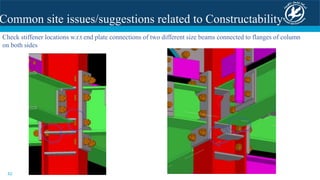
Check stiffener locations w.r.t end plate connections of two different size beams connected to flanges of column
on both sides
Common site issues/suggestions related to Constructability
63
Check location of H Brace w.r.t other connections
Common site issues/suggestions related to Constructability
64
References
• AISC 360-2016.
• AISC Steel Construction Manual.
• AISC Manual Design Example Version 14.1
• Joints in Steel Construction-Simple Connections.
• KOC-C-002-Rev 3, KOC Standard for Engineering Design Basis of Civil and Structural Work.
• KOC-C-007-Rev 2, KOC Standard for Structural Steel Work-Materials, Fabrication and Erection.
THANK YOU

Structural Connection Design & Construction Aspect .pptx

  • 1.
    STRUCTURAL CONNECTION DESIGN By:AMWAL AHMAD CIVIL DESIGN ENGINEER PROJECT SERVICES TEAM(S&EK) August 2023 AND CONSTRUCTION ASPECTS
  • 2.
    2 Content  Objectives  Definitionof Connection  Importance of Connection  Simple Connection Design(Bolted/Welded)  Bolted Connection Design-Examples  General Connection Guidelines  Constructability in Steel(Construction Aspect)  General Consideration in Constructability  Common Site issues/suggestions related to Constructability  References
  • 3.
    3 Objectives To explain theimportance of connection design and its implementation in design and construction field. The objective of this session is to have a overview on simple connection design and related constructability constraint at construction site.
  • 4.
    4 What is steelstructures?. A structure that is collected from different steel individuals from various shapes, sizes and associated together by welding or bolting, performs some function and plays out some capacity. In steel structures, structural steel is the main load carrying material to transfer the load within them and to transfer load to the ground. • Example: - I-Beam, Tee section, Hollow section, L- Angle, Pipes, Channel section, Steel plate etc. • Steel concrete composite structures are also used in high-rise buildings, but we are only going to talk about steel structures in this session. Definition of Connection Common Steel Structures 1. Roof truss in factories, Multistorey buildings, Railway shed etc. 2. Piperacks, Shelters, Bridges, Transmission towers etc.
  • 5.
    5 Definition of Connection(Cont.) A connection is an assembly of one or more joints that is used to transmit forces between two or more members, from secondary to main member/ column. An intuitive knowledge of how a system will transmit loads(the art of load paths) and understanding of structural mechanics are necessary to achieve connections which are both safe and economic. The principal structural requirement of a connection is that it should be capable of safely transferring load from the supported members(secondary member) to the supporting member (main member). The above requirement implies that three properties of the connection needs to be considered: strength, stiffness and deformation capacity. End Plate Shear Connection Fin Plate Shear Connection Top & Bottom Flange Plate Moment Connection Vertical Bracing Connection
  • 6.
  • 7.
    7 Structural steel connectionsare crucial to any steel structure, which is vital in forming a stable and secure connection. Over the years, various steel connections have been developed, each designed for a specific purpose. The importance of proper steel connections cannot be overstated, as they directly impact a steel structure's integrity and overall safety. By selecting the appropriate connection type for a given application and ensuring it is appropriately installed, engineers can ensure that a steel structure will perform as intended, even under extreme conditions. Connections are an intimate part of a steel structure and their proper treatment is essential for a safe and economic structure. Connections accounts almost for half the cost of structural steelwork ,so their design and detailing should be given top priority for both safety and structural economy. A structure is as strong as its weakest link and a connection can be that weakest link. Therefore it has to be designed very carefully. Aim should be, to provide simple, repetitive and easy to erect connections, as its fabrication & erection accounts 60 ~ 65 % of cost of steel structure. Importance of Connection
  • 8.
    8 Simple Connections Bolted ConnectionsWelded Connections Common Bolts High Strength Bolts Slip Critical Bearing Type Fillet Weld Groove Weld Eccentric Connections Simple Bolted Connection Design
  • 9.
    9 Bolts: A boltmay be defined as a metal pin with a head at one end and a shank threaded at the other end to receive a nut as shown in fig. Net Area =0.78 times the shank area. There are two kinds of bolts used in steel construction. 1-Common bolts: are also called machine bolts, ordinary bolts and unfinished bolts. The use of these bolts is limited primarily to shear connections, in non fatigue applications. Manufactured under ASTM A307, this bolt is of low carbon steel A36, Fu = 413 MPa. 2-High-strength bolts: are included in three separate ASTM Specifications: ASTM F3125, ASTM F3043 and ASTM F3111. F3125 is an umbrella specification that includes four grades: A325, A490, F1852, and F2280. The AISC Specification divides high-strength bolts into three groups based on minimum tensile strength. High-strength structural-steel bolt and nut. Unfinished (machine) or common bolts Simple Bolted Connection Design Bolt Types & Materials: A325 - High strength bolts, heat-treated medium carbon steel, Fu = 827 MPa, for structural joints. A490 - High strength bolts, Quenched and Tempered Alloy steel, Fu = 1033 MPa for structural joints. A449 - High strength bolts with diameter > 1 ½”, anchor bolts, lifting hooks, tie-downs..
  • 10.
    10 Structural bolts canbe installed pretensioned or snug tight. Pretensioned means that the bolt is tightened until a tension force approximately equal to 70% of its minimum tensile strength is produced in the bolt. Snug tight (snug being defined as the tightness necessary to bring all elements of the connection into firm contact). It can be attained by a few impacts of an impact wrench or the full effort of a man using an ordinary spud wrench. Common bolts (A307) can be installed only to the snug-tight condition. There is no recognized procedure for tightening these bolts beyond this point. Impact Wrench Spud Wrench Simple Bolted Connection Design Pretensioned structural bolts must be used in certain locations. Section J3.1 of the AISC that they be used for the following joints: 1. Joints that are subject to significant load reversal. 2. Joints that are subject to fatigue load with no reversal of the loading direction. 3. Joints with ASTM A325 or F1852 bolts that are subject to tensile fatigue. 4. Joints with ASTM A490 or F2280 bolts are subject to tension or combined shear and tension, with or without fatigue. 5. Connections subjected to vibratory loads where bolt loosening is a consideration. As pointed out in a above sections, pretensioned bolts must be used for certain connections. For other locations, snug-tight bolts should be used because they are cheaper with no reduction in strength. The majority of shear connections in buildings can be snug tight and shear connections are the predominate in every building.
  • 11.
    11 Threads Included inShear Planes. The bearing-type connection with threads in shear planes is most frequently used. Since location of threads is not restricted, bolts can be inserted from either side of a connection. Either the head or the nut can be the element turned. Paint of any type is permitted on the faying surfaces (contact area between the connected parts). Threads Excluded from Shear Planes. The bearing-type connection with threads excluded from shear planes is the most economical high-strength bolted connection, because fewer bolts generally are needed for a given required strength. There can be difficulties involved in excluding the threads from the shear planes when either one or both of the outer plies of the joint is thin. The location of the thread runout or vanish depends on which side of the connection the bolt is entered and whether a washer is placed under the head or the nut. This location is difficult to control in the shop but even more so in the field. However, since for a given diameter of bolt the thread length is constant, threads can often be excluded in heavy joints with no additional effort. Simple Bolted Connection Design 520 414 A490 414 330 A325 Type X (Threads excluded) Type N (Threads included) Type Table J3.2 Shows the values of Fnv (MPa) for different types of bolts Type X-Bolt Type N-Bolt If the level of threads is unknown, it is conservative to assume that the threads are included(Type-N)
  • 12.
    12 Simple Bolted ConnectionDesign Connections are used to transfer the forces from one member to another. Although both welded and bolted connections can be used in steel structures, bolted connections are commonly used because of the ease of fabrication, buildability and ability to accommodate minor site adjustments. Bolted Connection can be classified into three categories as follows: A- Based on the force transfer mechanism 1) Bearing connection: Common bolt with low strength are used, so the amount of clamping action by tightening is small. Then bolt and connecting member come in contact. Load is transferred to bolts from members through contact, known as bearing. 2) Friction connection: In the friction mechanism, high strength friction grip(HSFG) bolts are used in connection. These bolts have high strength, so they can be tightened up to the desired degree. Thus, they are tightened such as to induce a predefined tension in the bolt. The tightening of the bolts generates a clamping action in which the members are connected. Such connections are called no-slip connection or slip-critical connections. The 2016 AISC specification requires the use of slip-critical connections when: (a) Bolts are installed in oversized holes. (b) Bolts are installed in slotted holes with the direction of the load parallel to the slot. (c) Bolts joining the extended portion of bolted, partial-length cover plates, as required in Section F13.3.
  • 13.
    13 B- Based onthe line of action of resultant force transferred: 1) Concentric (Simple) connections: Applied load passes through C.G of connections i.e. force transfer in tension and compression member. Ideal concentric connections should have only one bolt passing through all the members meeting at a joint, see figure (a). However, in practice, this is not usually possible and so it is only ensured that the centroidal axes of the members meet at one point see figure (b). 2) Eccentric connections: Applied load does not pass through C.G of connections i.e. (in reaction transferring of bracket loads) or moment resisting connections (in beam to column connections in frames). Simple Bolted Connection Design Bracket Connection
  • 14.
    14 C-Based on thetype of force experienced by the bolts: 1- Shear Connection i) A shear connection (also called a simple connection) transfers shear forces and little or no moment to the connecting member, thus allowing end rotation of the member. ii) Shear connections are made through the web of the supported member (secondary member) while the flanges are unconnected to supporting column or beam. 2- Moment Connections i) Moment connections are also called rigid connections. ii) Moment connections carry a portion or the full moment capacity of the supported member thus preventing any end-rotation of the member and it also carry the shear component of the load. iii) Relative rotation between the supporting and supported members is negligible. iv) In this type of connection both the webs and flanges are connected to column. Simple Bolted Connection Design
  • 15.
    15 3- Beam andcolumn splices i) It is often required to join structural members (Beam, Column) along their length, due to the available length of sections being limited, also due to transportation and erection constraints. Such joints are called splices. Typical bolted column splices used for rolled I-Section members is shown here. Simple Bolted Connection Design Advantages of Bolted Connection: i) It is a faster way of installing any members on site. ii) Bolting is a cold process hence there is no risk of fire. iii) simple to apply on the members i.e. no skilled human power is required iv) bolted connection can be easily replaced, retighten, and removed if there is any damage in any parts of the structure. Disadvantages of Bolted Connection: i) If subjected to vibratory loads, results in reduction in strength get loosened. ii) Bolt required a hole in the plate connection, so it reduces the area of the plate where the bolt has to be connected. It makes the plate weaker than the previous one. iii)The bolt should be protected with paints or chemicals to prevent it from corrosion.
  • 16.
    16 • (a)-Shear failureof bolt • (b)-Shear failure of plate • (c)-Bearing failure of bolt • (d)-Bearing failure of plate • (e)-Tensile failure of bolts • (f)-Bending of bolts • (g)-Tensile failure of plate Simple Bolted Connection Design Bolted connections can fail either due to failure of the connection itself or due to failure of the connecting components. Some of these failures, i.e. the plate's shear failure, plate's splitting failure and plate's bearing failure, can be prevented by adhering to edge distance criteria. Bolted connection may fail in any one of the following modes:
  • 17.
    17 The bolted connectioncan fail in any of the six methods listed below: • Tension failure of the plate: Occurs when the bolts are stronger than the connected plates. • Bearing failure of bolt: Occurs when low strength bolts are used to connect high strength plates. In this failure, the bolt gets crushed around half of its circumference when the connected plates slip due to applied force. • Bearing failure of the plate: Occurs when high-strength bolts are used to connect low-strength plates. The presence of a neighboring bolt or the proximity of an edge in the load direction can aggravate the bearing problem. When ordinary bolts are subjected to shear forces, slip occurs and bolts comes in contact with the plates. The plate may get crushed if the plate material is weaker than the bolt material. • Shear failure of a bolt: The bolt gets cut or separated about the shear interface. The number of shear interfaces can be one or multiple depending upon joints. Based on the number of shear planes, a bolt may fail in single shear or double shear, etc. Shear stresses are created when plates slip due to applied forces. If the maximum factored shear force exceeds the shear capacity of bolts, the bolt's shear failure occurs at the bolt shear plane. • Shear failure of a plate: It is a type of excessive bearing failure when the bolt hole is near the end of the plate. • Plate splitting failure: Occurs when high-strength bolts are used to connect high-strength plates. It is a combined failure of shear and tension. Sometimes bolts may have to be placed at a lesser end distance than required, leading to plates shearing out. Due to this, a block of material within the bolted area breaks away from the remaining area. Simple Bolted Connection Design
  • 18.
    18 End Plate shearConnection End Plate Shear Connection End Plate shear connection involves welding a plate perpendicular to end of supported web and bolting/welding to the supporting member. End plate shear connections do not resist any moments and allows rotation, which is usually analyzed as pin support connection. Failure Modes End Plate Shear Connection failure modes are : • Bolt shear (BS) • Bolt bearing (BB) • Block shear rupture (BSR) • Shear yielding (SY) • Shear rupture (SR) End Plate Connection Load Path-Force flow from beam to end plate through weld, then end plate to the column by the bolt. There will always be a small amount of moment transferred but this is a negligible amount and assumed to be zero. In construction, this is achieved through using fin plates and flexible end plates. A rule of thumb for an indicative connection is to use a plate thickness equal to the bolt diameter. This way, you will avoid the problem with prying action. But, of course, every connection needs to be calculated accordingly. Simple Bolted Connection Design-Failure Modes
  • 19.
    19 Fin Plate (Single-Plate)Connection Consists of a plate welded to supporting member & bolted to the web of supported member. Because it is not always obvious on site to which side of the fin plate the beam should be bolted, marking the contact side of the fin plate is a good practice. Fin Plate Connection Load Path-Force flows from beam to bolt, bolt to the plate, then plate to weld finally weld to beam girder. Effect on bolt shear (direct and moment) due to eccentricity of bolt group connecting fin plate to the web of supported beam, shall be checked , the shear capacity per bolt shall be greater than the resultant shear force on the outermost bolt. Fin Plate Shear Connection failure modes are : • Block shear rupture (BSR) • Bolt bearing (BB) • Bolt shear (BS) • Shear rupture (SR) • Shear yielding (SY) • Weld shear (W) • Web local buckling(WLB) Fin Plate Connection Failure Modes Simple Bolted Connection Design-Failure Modes
  • 20.
    20 2-Bolt Bearing(BB): Boltbearing is concerned with the deformation of material at the loaded edge of the bolt holes. Bearing capacity of the connection is influenced by the proximity of the bolt to the loaded edge. Bolt bearing is applicable to each bolted ply of a connection. 1-Block Shear Rupture(BSR): BSR is a limit state in which the failure path includes an area subject to shear and an area subject to tension. This limit state is so named because the associated failure path tears out a “block” of material. Block shear occur in plies that are bolted or in plies that are welded. The only difference between the treatments of either the bolted or welded block shear limit state is that in the absence of bolt holes, the gross areas are equal to the net areas. Block Shear Rupture Bolt Bearing Bolt Shear 3-Bolt Shear (BS): Bolt shear is applicable to each bolted ply of a connection that is subjected to shear. The shear strength of a bolt is directly proportional to the number of interfaces (shear planes) between the plies within the grip of the bolt that a single shear force is transmitted through. Single shear occurs when the individual shear force is transmitted through bolts that have two plies within the grip of the bolt. Additional plies further distribute the shear force. Three plies of material represent two shear planes, thus the bolt or bolt group is in double shear and has effectively twice the strength as single shear. Simple Bolted Connection Design-Failure Modes
  • 21.
    21 4-Shear Yielding andShear Rupture ( SY & SR):The elements in the connection that are subject to shear forces must be investigated for shear yielding and shear rupture. Both limit states will apply regardless of fastening method(bolt or weld). For welded plies, without bolt holes, shear yielding will usually control over shear rupture. If the ratio of yield strength to ultimate tensile strength is less than 1.2, then shear rupture will generally control. If both flanges of the supported member are coped, then a potential shear failure path on the beam is present and shear yielding and shear rupture must be investigated for this member. Shear Yielding and Shear Rupture Weld Shear 5-Weld Shear(WS): Weld shear is applicable to each welded ply of a connection. The failure mode for fillet welds is always assumed to be a shear failure on the effective throat of the weld. In a similar fashion as bolt shear, if the load path does not pass through the center of gravity of a weld group, then the load is considered eccentric. Eccentrically loaded weld groups are subject to a moment that tends to induce either additional shear (for in-plane loads) or combined shear and tension (for out-of-plane loads). 6-Web Local Buckling (WLB):Sometimes forces that are transferred from one member to another create localized deformation (yielding) or buckling. The applicable limit states depend on the specific connection geometry. The limit states for concentrated forces most often occur in seated connections and moment connections. For example, when the supported beam is coped, (i.e. flange material has been removed) the remaining web may be susceptible to web local buckling. Since most moment connections provide continuity between the supporting and supported members, the flanges of the supported member transfer concentrated tension and compression forces to the supporting member. Flange local bending, web local yielding, web crippling and web compression buckling limit states must be investigated. Simple Bolted Connection Design-Failure Modes
  • 22.
    22 Simple Fin PlateConnection -Failure Modes
  • 23.
    23 Block Shear Failure •Bolts may have been placed at a lesser end distance than required causing the plates to shear out. • May occur when a block of material within the bolted area brakes away from the remainder area. • Occur when fewer bolts of high strength are used. Also checked by observing the specifications of end distance. Simple Bolted Connection Design Block shear failure of plate in tension In block shear failure, block of material is torn out by applied shear. Failure occurs in shear along bolt holes parallel to the applied loads accompanied by tensile rupture along a perpendicular face. Ubs=1.0 when tension stress is uniform Ubs =0.5 when tension stress is non-uniform Ubs=Reduction coefficient, used in calc block shear Single Row bolt Ubs=1.0, Multiple Row Ubs=0.5
  • 24.
    24 Simple Bolted ConnectionDesign Simple Connection: • If the line of action of the force acting on the connection passes through the center of gravity of the connection, then each bolt can be assumed to resist an equal share of the load. • The strength of the simple connection will be equal to the sum of the strengths of the individual bolts in the connection. We will concentrate on simple bolted shear connections in this session Tension member Connection/Splice Beam end/Simple shear connection Moment resisting connection Hanger connection (Tension) Connection can be categorized based on the type of loading. Tension member connection and splice: It subjects the bolts to forces that tend to shear the shank. Beam end simple connection: This also subjects the bolts to forces that tend to shear the shank. Hanger connection: The hanger connection puts the bolts in tension.
  • 25.
    25 Common Bolt Terminologies: A325-SC–slip-critical A325 bolts. A325-N –snug-tight or bearing A325 bolts with thread included in the shear planes. A325-X –snug-tight or bearing A325 bolts with thread excluded in the shear planes. Gage(g) –center-to-center distance of bolts in direction perpendicular member’s axis. Pitch(p) –parallel to member’s axis. Edge Distance – Distance from center of bolt to adjacent edge of a member. g p p p Edge distance p Example. 1-ASD Method (AISC 13th Edition): Calculate and check the design strength of the simple connection shown below. Is the connection adequate for carrying the service load of 200 kN?. Bolted Connection Design-Gusset Plate Example-1 200 kN Step I. Shear Strength of bolts The shear strength of one bolt, Rn = Fnv Ab = 330 x π x 202/(4x1000) =103.72 kN Fnv=Nominal shear stress (330 MPa) bearing type connection (Table J3.2) Rn/ Ω= allowable shear strength= 103.72/2=51.85kN Shear strength of connection = 4 x 51.85 = 207.44 kN As specified in KOC-C-002 (Rev-3), Cl.18.3.2, only ASD method shall be used in steel design, same method of design we will follow here.
  • 26.
    26 Step II. Minimumedge distance and spacing requirements See Table J3.4M(AISC), minimum edge distance = 26 mm for rolled edges of plates The given edge distances (30 mm) > 26 mm. Therefore, minimum edge distance requirements are satisfied. Minimum spacing = 2.67 db = 2.67 x 20 = 53.4 mm. (AISC Specifications J3.3), db= Dia of bolt Preferred spacing = 3.0 db = 3.0 x 20 = 60 mm, The given spacing (60 mm) = 60 mm. Therefore, spacing requirements are satisfied. Bolted Connection Design- Gusset Plate Example Deformation at bolt hole is a concern, Rn = 1.2 Lc t Fu ≤ 2.4 db t Fu-------- J6-3a(AISC) Deformation at bolt hole is not a concern, Rn = 1.5 Lc t Fu ≤ 3.0 db t Fu------J6-3b(AISC) Long slotted holes with the slot perpendicular to the load, Rn = 1.0 Lc t Fu ≤ 2.0 db t Fu-------J6-3c(AISC) Where; Rn = Nominal bearing strength, Fu = Specified minimum tensile stress=400 MPa, Lc = Clear distance between the edges of the hole in the direction of the load, db = Nominal bolt diameter t = Thickness of connected material Ω = resistance factor 2.0 (ASD) Step III. For bearing of plate material at bolt holes:
  • 27.
    27 A-Bearing strength atbolt holes in connected part (120x15 mm plate) At edges, Lc = 30 – hole diameter/2 = 30 – (20 + 2)/2 = 19 mm Rn = 1.2 Lc t Fu ≤ 2.4 db t Fu--------------(J3-6a) AISC Allowable strength= (1.2 x19 x15x400)/1000 = 136.8 kN, Rn/ Ω=136.8/2=68.4 kN at edges Rn ≤ 2.4 db t Fu = 2.4 x 20x15x400/1000 = 288 kN, Rn/ Ω=288/2=144 kN So, 68.4 kN ≤ 144 kN, requirement satisfied. At other holes, s = 60 mm, Lc = 60 – (20 + 2) = 38 mm. Allowable strength = (1.2 x38 x15x400)/1000=273.6/2=136.8 kN But, allowable strength ≤ 2.4 db t Fu = 288/2=144 kN. Therefore, allowable strength = 136.8 kN at other holes Therefore, bearing strength at bolt holes = 2 x 68.4 + 2 x 136.8 = 410.4 kN B-Bearing strength at bolt holes in gusset plate (10 mm plate) At edges, Lc = 30 – hole diameter/2 = 30 – (20 + 2)/2 = 19 mm. Allowable strength = 1.2 Lc t Fu = 1.2 x 19 x 10 x 400/1000 = 91.2 kN, Rn/ Ω=91.2/2=45.6 kN But, allowable strength ≤ 2.4 db t Fu = 2.4 x 20 x 10 x 400/1000 = 192 kN, Rn/ Ω=192/2=96 kN Therefore, allowable strength at edges holes = 45.6 kN Bolted Connection Design- Gusset Plate Example
  • 28.
    28 At other holes,s = 60 mm, Lc = 60 – (20 +2) = 38 mm Allowable strength(Rn/Ω) = 1.2 Lc t Fu = 1.2 x 38 x 10x 400/1000 = 182.4 kN, 182.4/2=91.2kN But, Allowable strength ≤ 2.4 db t Fu =2.4x20x10x400/1000= 192 kN, 192/2=96 kN Therefore, allowable strength= 91.2 kN at other holes Therefore, bearing strength at edges holes = 2 x 45.6 + 2 x 91.2 = 273.6 kN Bearing strength of the connection is the smaller of the bearing strengths = 273.6 kN, O.K Connection Strength Shear strength = 207.44 kN Bearing strength (plate) = 410.4 kN Bearing strength (gusset) = 273.6 kN Connection strength (Rn/Ω) > Applied load- 200 kN, Therefore OK. Bolted Connection Design- Gusset Plate Example
  • 29.
    29 Example-2( from AISCManual Design Example Version 14.1) refer pg-IIA-44 Design a shear end-plate connection to connect an ASTM A992 W18x50 beam to an ASTM A992 W21x62 girder web, to support the following beam end reactions: DL = 44.5 kN(10 kips), LL = 133 kN(30 kips) Use 3/4-in.-diameter ASTM A325-N or F1852-N bolts with standard holes, E-70 weld electrodes and ASTM A36 plates. From AISC Manual Tables 2-4 and 2-5,the material properties are as follows: Beam Girder Plate W18x50 W21x62 6x150x216 mm ASTM A992 ASTM A992 ASTM A36 Fy = 345 MPa Fy = 345 MPa Fy = 250 MPa Fu = 450 MPa Fu = 450 MPa Fu = 400 MPa From AISC Manual Tables 1-1 and 9-2 and AISC Manual Figure 9-2, the geometric properties are as follows: (values are changed from imperial system changes to metric system) Beam W18x50 Properties are, d = 457.2 mm, tw = 9mm(0.355 in), Snet = 383457 mm3, c = 107.8mm , dc = 50.8 mm, e = 114.3 mm., ho = 406.4 mm Girder W21x62, tw = 10.2 mm Bolted Connection Design-End Plate Shear Connection SC Slip-critical connection. Class A Slip Coeff (Ks)=0.33, Class B Ks=0.55 N Bearing type connection with threads included in the shear plane. X Bearing-type connection with threads excluded from the shear plane.
  • 30.
    30 Chapter-2 of ASCE7-16 (Load Combination), the required strength(ASD) is: Ra = 44.5 kN(10kips)+ 133.5 kN(30 kips) = 178.0 kN(40 kips) Checks to do-Bolt Shear, Bolt Bearing, and Block Shear Rupture of End-Plate Shear Yielding, Shear Rupture . For Bolt Shear and Bolt Bearing strength: From AISC Manual Table 10-4, for 3 rows of bolts and 4-in. plate thickness: Bolt and End Plate Available Strength Rn /Ω = 226.50 kN (50.9 kips)˃178 kN, O.K. where, Ra = required strength using ASD load combinations Rn = nominal strength, Ω=safety factor, Rn/Ω = allowable strength The nominal strength, Rn, and the safety factor, Ω, for the applicable limit states are specified in Chapters D through K. For Weld Shear and Beam Web Shear Rupture: Try 6mm(3/16in) weld. From AISC Manual Table 10-4, the minimum beam web thickness is, tw min = 7.26mm(0.285 in)< 9.0 mm (0.355 in) O.K. Beam and Web available strength Rn/Ω = 201.1kN(45.2kips)˃178 kN, O.K. For Bolt Bearing on Girder Web: From AISC Manual Table 10-4( ASD)Support Available Strength per in thickness: Rn/Ω = 351kip/in.(0.40 in)(61470.63kN/m) (0.01m.)=614.0 kN˃178 kN, O.K. Shear Rupture and Shear yielding of web for small coped flange not control in design. Bolted Connection Design-End Plate Shear Connection Allowable Stress Design, or Allowable Strength Design, uses the following design methodology: Required Strength(Ra) ≤ Allowable Strength Or Required Strength (Ra) ≤ Available Strength
  • 31.
    31 Design a single-plateconnection between an ASTM A992 W16x50 beam and an ASTM A992 W14x90 column flange to support the following beam end reactions: DL = 35.6 kN(8.0 kips) LL = 111.25 kN (25 kips) Use 4-Nos-3/4 in. diameter ASTM A325-N or F1852-N bolts with standard holes, E70-weld electrode and an ASTM A36 plate. Example-3 ( From AISC Manual Design Example Version 14.1) refer pg-IIA-17A Solution: Beam Girder Plate W16x50 W14x90 6x115x292 mm ASTM A992 ASTM A992 ASTM A36 Fy = 345 MPa Fy = 345 MPa Fy = 250 MPa Fu = 450 MPa Fu = 450 MPa Fu = 400 MPa From AISC Manual Tables 2-4 and 2-5, the material properties are as follows: From AISC Manual Tables 1-1,the geometric properties are as follows: Beam (values are changed from imperial system changes to metric system) W16x50 , tw = 9.6mm(0.380in.), d = 414.0mm(16.3in.), tf = 16mm(0.630 in), Column W14x90, tw = 18.03mm(0.710 in.) Bolted Connection Design-Single Plate Shear Connection
  • 32.
    32 Chapter-2 of ASCE7-16 (Load Combination), the required strength(ASD) is: Required Strength, Ra = 8 kips + 25 kips= 146.85 kN (33.0 kips) Checks to do-Bolt Shear, Weld Shear ,Bolt Bearing on plate, tear out of the beam web, Shear Yielding, Shear Rupture and Block Shear Rupture. From AISC Manual Table 10-10a, try for 4 rows of bolts, 6.35mm(1/4-in.) plate thickness and 6mm (3/16 in) fillet weld size: For Bolt Shear, Weld Shear (Table 10-10a) Bolt, Weld and Single-Plate, Available Strength(ASD) is: Rn /Ω = 154.86 kN(34.8 kips) ˃ 146.85 kN (33.0 kips), O.K. For Bolt Bearing, on plate and tear out strength of Beam Web (Table 7-5) The beam web available strength(ASD) is based on S=3 in spacing : Rn /Ω =(4 bolts)(58.5 kips)/in.(0.380 in.)= 395.61 kN(88.9 kips) >146.85 kN (33.0 kips) OK Note-Shear Yielding, Shear Rupture and Block Shear Rupture.will not control for an uncoped section. Note: To provide for stability during erection, it is recommended that the minimum plate length be one-half the T dimension of the beam to be supported. AISC Manual Table 10-1 may be used as a reference to determine the recommended maximum and minimum connection lengths for a supported beam. Table -10-10a( AISC-Manual ) Bolted Connection Design-Single Plate Shear Connection Table -7-5( AISC-Manual 13th Ed )
  • 33.
    33 Double cleat Endplate Shear tab(Fin plate) Flexibility High Medium Low Site adjustment Minor Not possible Minor Design Easy in design without eccentricity. Easy in design without eccentricity. Complex in design, as bolt shear to be checked for additional shear due to eccentricity. Fabrication Large number of holes to be drilled. Medium. Low fabrication tolerance. Fabricator’s delight Erection Good lateral stability. Less stable if not connected to flange of the beam. Lowest erection tolerance. Easy for erection. Comparison between type of Shear Connections Simple Bolted Connection Design
  • 34.
    34 Simple Welded Connections Structuralwelding is a process by which the parts that are to be connected are heated and fused, with supplementary molten metal at the joint. A relatively small depth of material will become molten, and upon cooling, the structural steel and weld metal will act as one continuous part where they are joined. The two most common types of welds are the fillet weld and the groove weld. Fillet weld Fillet weld Fillet weld Fillet weld Fillet weld Fillet weld Welding Process – Fillet Weld Simple Welded Connection Design
  • 35.
    35 Fillet Weld: Lap joint-weldplaced in the corner formed by two plates. Tee joint-weld placed at the intersection of two plates. Most popular electrode used is E70XX. Fillet weld can be loaded in any direction in shear, compression or tension. However it always fail in shear. Simple Welded Connection Design Classification of Welds According to type of weld • Fillet weld , Groove weld According to weld position • Flat, Horizontal, vertical or overhead weld According to type of joint • Butt, lap, tee, edge or corner According to the weld process • SMAW, SAW Groove Weld: • Deposited in a gap or groove between two parts to be connected e.g. butt , tee & corner joints with prepared edges. • Partial penetration groove welds can be made from one or both sides with or without edge preparation.
  • 36.
    36 • Groove Weld( More reliable than others). • Fillet Weld (Mostly used, Weaker than groove and others). • Plug Weld (expensive – poor transmission of tensile forces). • Slot Weld (expensive - poor transmission of tensile forces). • Plug and Slot welds – stitch different parts of members together. Advantages of Welded Connection • Economical – Cost of materials and labors. • Efficiency is 100% as compared to bolts (75- 90%). • Fabrication of Complex Structures – Easy – like Circular Steel pipes. • Provides Rigid Joints – Modern Practice is of Rigid Joints. Disadvantages of Welded Connection • No provision for expansion or contraction therefore greater chances of cracking. • Uneven heating and cooling - member may distort -may result in additional stresses. • Inspection is difficult and more costlier than bolts. Simple Welded Connection Design Types of Weld:
  • 37.
    37 Fillet welds aremost common and used in all structures. Weld sizes are specified in 1 mm increments A fillet weld can be loaded in any direction in shear, compression, or tension. However, it always fails in shear. The shear failure of the fillet weld occurs along a plane through the throat of the weld, as shown in the figure. Simple Welded Connections a a Throat = a x cos45o = 0.707 a a a Throat = a x cos45o = 0.707 a Failure Plane L Nominal Strength, Rn = fw x 0.707 x a x Lw, Rn = 0.75 x fw x 0.707 x a x Lw i.e.,  factor = 0.75 (LRFD) Ω= 2.00 (ASD) fw = Shear strength of the weld metal is a function of the electrode used in the SMAW process. The tensile strength of the weld electrode can be 413, 482, 551, 620, 688, 758, or 827 MPa. The corresponding electrodes are specified using the nomenclature E60XX, E70XX, E80XX, and so on. This is the standard terminology for weld electrodes. Lw = length of the weld a = size of the weld The two digits "XX" denote the type of coating. The strength of the electrode should match the strength of the base metal. If yield stress (y) of the base metal is  413 - 448 MPa, use E70XX electrode. If yield stress (y) of the base metal is  413 - 448 MPa, use E80XX electrode. E70XX is the most popular electrode used for fillet welds made by the SMAW method. Where, E – Electrode, 70 – Tensile strength of electrode (ksi) = 482 MPa XX – Type of coating Simple Welded Connection Design
  • 38.
    38 Weld Symbols (AmericanWelding Society AWS): Fillet weld on arrow side. Weld’s leg size is 10 mm. Weld size is given to the left of the weld symbol. Weld length (200 mm) is given to the right of the symbol Fillet weld, 12 mm size and 75 mm long intermittent welds 125 on center, on the far side Site fillet welds, 6 mm in size and 200 mm long, both sides. Fillet welds on both sides, staggered intermittent 10 mm in size, 50 mm long and 150 mm on center Weld all around joint Tail used to reference certain specification or process V- Butt Weld on one side 6 10 50@150 Simple Welded Connection Design
  • 39.
    39 Fillet Weld ButtWeld Simple, fast and economical to make. More expensive than fillet welds because of the edge preparation required. No prior edge preparation is necessary. Easily designed and fabricated to be as strong as the member. Does not require very skilled labor. Require more skilled manpower, than that required for filled welds. Less attractive in appearance. Better appearance, compared to fillet welds. Poorer performance under fatigue loading, Better fatigue characteristics, compared to fillet welds. Throat thickness=0.707 x weld size. Thickness=(5/8) x thickness of thinner plate. Not appropriate to transfer forces large in magnitude. Easy to detail and the length of the connection is considerably reduced. Difference Between Fillet Weld And Butt Weld Simple Welded Connection Design
  • 40.
    40 S.N Bolted ConnectionWelded connection 1. No skilled human resource is required It requires skilled human resources 2. It is a cold process, fire does not involve in it It is a hot process. Fire involves in it 3. It can be replaced and removed if required It can not be removed and replaced but can be repeated on the welded portion 4. It is noiseless while working which does not require special equipment for fabrication It creates noise while welding and requires special equipment for fabrication 5. The connection may loose due to the continuous vibration of the structure The welded connection remains stable for a long time even after vibration 6. It is cheaper to for structure since bolt and nuts can be replaced and reuse. It is expensive for structure since welded materials can not be replaced and reused properly Difference between bolted and welded connection Simple Welded Connection Design
  • 41.
    41 General requirement forConnection Design i) Minimum strength of the connection to be ensured. At least two bolts or equivalent weld per connection should be provided ii) If CG of the weld/bolt group does not coincide with that of member, connection to be designed for the eccentricity. iii) Work point of members should coincide otherwise eccentricity should be considered during analysis of the structure. iv) Bracing angle should not be less than 30 degree. v) Gusset plate should not have re-entrant corner to avoid stress concentration. vi) Proper caution to be given to edge distance and bolt pitch. vii) Single angle bracings to be used only for small forces.. viii) Normally eccentric connections should be avoided. 1. Design a) Preference to be given on welded shop connection and bolted field connection. b) Preference to be given to fillet weld over butt weld. c) Preference to be given to grade 8.8 bolts over HSFG bolt. 2. Fabrication a) Repetition of detail through standardization. b) Holes should be on standard gage line. c) Fillet weld preferably be limited to 8mm. d) Stiffeners are costly- should be avoided or be used judiciously. 3. Erection a) Clearance should be provided for easy positioning. b) Access should be provided for bolting and welding. General Connection Guidelines
  • 42.
    42 Bolted connections shallbe made with high strength structural bolts, except in the following minor connections where ordinary bolts should be used: a) Purlins, girts, stair framing, sheeting rails and light bracings. b) Platforms and walkways attached to vessels. c) Removable floor plates, removable hand railings and ladder cage assemblies. As per KOC Standard KOC-C-002 (Cl. 18.7.2): Connections for steel structures shall conform to the following requirements: a) Shop connections should be bolted or welded. Field connections shall normally be bolted; however, when approved by the KOC, welded field connections should be used. b) Bolted connections for primary members shall utilize high-strength structural bolts of grade A325M Type-1 or grade A490M Type-1 conforming to ASTM F3125/F3125M or ISO 898-1 Property class 8.8 or BS 3692 Grade 8.8. All bolts shall be designed, installed and inspected in accordance with “RCSC Specification for Structural Joints Using High Strength Bolts”. c) All Connections (Moment, Shear or any special connections) shall be designed and detailed in accordance with KOC-C-007. KOC Connection Design Guidelines d) Eccentric placement of bolt shall be avoided in fin / cleat plate connection. e) Main beam size shall be equal or higher than secondary beam size for better connections. f) Gusset plates and stiffeners shall be minimum 10 mm thick. Welded endplates shall be minimum 12 mm thick.
  • 43.
    43 Constructability is “the optimum use of construction knowledge and experience in planning, design and field operations to achieve overall project objectives”. Why Constructability? Construction Industry Institute (CII) studies have shown that the cost savings associated with a project are in direct proportion to the project phase in which constructability is initiated-the earlier the implementation, the greater the savings. The objectives of effective utilization of construction knowledge and experience are as follows: • Quality improvement • Schedule pull back • Cost effective • Construction ease Constructability in Steel(Construction Aspect)
  • 44.
    44 Steps in SteelConstruction: i) Preparation of shop drawing. ii) Fabrication, fireproofing & galvanizing. iii) Erection of column, beams, grating and equipment mounting. I- Preparation of Shop Drawing: • Based on engineering drawing fabricator prepares shop drawing. • Shop drawing includes Erection drawing, assembly drawing and part drawing • Erection drawings shows assembly and part name for each member. II- Fabrication, fireproofing and galvanizing: • Individual members are fabricated in shop based on shop drawing. • Fireproofing can be done at yard or site depending upon type of fireproofing. • Galvanizing Constructability in Steel(Construction Aspect)
  • 45.
    45 III-Erection of Columns,Beams, Grating and Equipment mounting: • It involves bolting of the column’s base to the anchoring bolts of column base connection, and bolting of steel beams to the column, sometimes connections can be done by welding, too. • Column erection is an integral part of steel-framed building construction. • First columns are erected, normally a portal is erected first and then tied to ground using wires and ropes. • Then longitudinal beams tying these portals are erected. • After long beams vertical brace, secondary beams, horizontal braces are erected. Grating is installed once all joist beam is erected. Equipment mounting is done once all bolts are fully tightened. Constructability in Steel(Construction Aspect)
  • 46.
    46 Issues Implementation Cost/Benefit Minimize use of cross-bracing at ground level. Improves access during const. maintenance and operations Design structural steel with bolted field connections instead of welded connections. Reduces need for structural welders and shortens erection time. Minimize the use of bracing and small members since these items are labor intensive to install. Reduces installation costs. Take into consideration the probability of various brackets and other items being field welded to structural beams and columns without proper welding procedures or stress relieving. Improves safety and reduces costs of rework and revisions. Coordinate with Construction and Procurement to determine those shapes that are easiest to obtain and work for fabricator. Increased productivity. Saves fieldwork hours = cost savings. In the design of structural steel, use as few different member sizes as possible, avoid special or hard to fabricate shapes. "Keep it Simple". Increased productivity. Saves fieldwork hours = cost savings. Standardize specifications, dimensions and field connections. Review dimensions of fireproofing with For Design of Steel Structure - Sample Check list for Design Engineer Constructability in Steel(Construction Aspect)
  • 47.
    47 Issues Implementation Cost/Benefit Specify that erection drawings, bolt lists, and fasteners be delivered prior to/or with the fabricated steel. Supports planning effort and reduces schedule delays Specify A325 or A490 high strength bolts and load indicator washers or Tension Shear Bolting for all structural connections. Reduces installation errors and warehousing problems All required fasteners for a structure are to be delivered prior to or with first delivery of that structure and should be accompanied with list showing description, size, quality and ID. Increased productivity. Saves fieldwork hours = cost savings Minimize or eliminate the use of through-web beam connection. If this type connection is required, place seat angles on columns. Facilitates safe erection Review delivery schedule. Concentrate efforts toward and release of drawings in accordance with construction agree priorities, detail executable steel. Schedule and erection sequence enhancement. Obtain construction input for establishing delivery sequence. Enhances schedule. Consider utilizing galvanized structural and miscellaneous steel. Eliminates need for field coating. Design and erect permanent stairways, platforms, and ladders as soon as practical. Reduces need for temporary access and scaffolding and improves job site safety. For Design of Steel Structure - Sample Check list for Design Engineer (Cont.) Constructability in Steel(Construction Aspect)
  • 48.
    48 Check Anchor boltprojection and threaded length: Projection above TOG= Grip + Nut Allowance Anchor bolt projection should neither be too short and nor should be too long. General Consideration in Constructability
  • 49.
    49 Ensure nominal holedimensions as per used connection type (Table J3.3M- AISC 360-16) General Consideration in Constructability Oversize hole should not be used in bearing connections
  • 50.
    50 General Consideration inConstructability Fillet weld size vis-à-vis member thickness The minimum size of fillet welds shall be not less than the size required to transmit calculated forces, nor the size as shown in Table J2.4 ( AISC 360-16). These provisions do not apply to fillet weld reinforcements of partial- or complete-joint-penetration groove welds. The maximum size of fillet welds of connected parts shall be: (a) Along edges of material less than 1/4-in. (6 mm) thick; not greater than the thickness of the material. (b) Along edges of material 1/4 in. (6 mm) or more in thickness; not greater than the thickness of the material minus 1/16 in.(2 mm), unless the weld is especially designated on the drawings to be built out to obtain full-throat thickness. In the as-welded condition, the distance between the edge of the base metal and the toe of the weld is permitted to be less than 1/16 in. (2 mm) provided the weld size is clearly verifiable. Basic difference: Single-pass welding wire is ideal for thinner materials with a thickness of ¼-inch or less. In contrast, the multi-pass welding wire is perfect for thicker metals that are more than ¼-inch thick. Single-pass welding wire can’t be used in horizontal or overhead positions. But multipass welding wire can be used in any position. Single-pass takes a short time to complete the welding session.
  • 51.
    51 Check installation spacefor beam near stiffener of gusset General Consideration in Constructability When the horizontal braces with stiffener are installing on both sides of beam, enough space for the installation of the beam shall be kept.
  • 52.
    52 General Consideration inConstructability Check clash of gusset plate with bolts of end plate. When the horizontal brace is connected with moment connected beam member, the connection with end plate, installation level and/or the location of W.P of horizontal brace shall be adjusted to avoid clash with any bolts on these end plates.
  • 53.
    53 General Consideration inConstructability Plan equipment mounting detail for construction ease
  • 54.
    54 General Consideration inConstructability Check for Horizontal brace gusset clash with pipe anchor
  • 55.
    55 General Consideration inConstructability Avoid unnecessary extension of beam flange to support stub column Beam Flange shall be extended in accordance with following rules: 1- Where the edge of base plate overhang the edge of beam by 30mm or more, Beam Flange shall be extended.
  • 56.
    56 General Consideration inConstructability For grating supporting channels use extended tab connection wherever possible
  • 57.
    57 General Consideration inConstructability Top of Horizontal Brace member shall be kept minimum 75mm~100mm below TOS of connecting beam for beams having thick flanges
  • 58.
    58 • Agree onpreferred member grade/size/sections. • Do not alter details on galvanized steel members once released for IFC. • Do not alter base plate detail–concrete interface. • Standardize embedded plate sizes. • Follow standard drawing as much as possible however if some detail is missing in standard drawing, provide that detail in engineering drawing. • A reduction in the number of connection types which: i) Leads to a better understanding of their cost and performance by all sides of the industry. ii) Encourages the development of design aids and computer software. • The use of one grade and diameter of bolt in a limited range of lengths which: i)saves time changing drills or punches in the shop ii) leads to faster erection and fewer errors on site. In practice, steel structures can be complex and there will be times when the standard connections are not suitable. However, even in these cases it will still be possible to adopt some of the general principles of standardization. General Consideration in Constructability
  • 59.
    59 Common site issues/suggestionsrelated to Constructability Check for pipe clash with horizontal brace due to shifting of work point
  • 60.
    60 Check Clash withVessel Stiffeners normally not modeled by piping Common site issues/suggestions related to Constructability
  • 61.
    61 Check Available gapbetween two beams to accommodate haunch connection Common site issues/suggestions related to Constructability
  • 62.
    62 Check stiffener locationsw.r.t end plate connections of two different size beams connected to flanges of column on both sides Common site issues/suggestions related to Constructability
  • 63.
    63 Check location ofH Brace w.r.t other connections Common site issues/suggestions related to Constructability
  • 64.
    64 References • AISC 360-2016. •AISC Steel Construction Manual. • AISC Manual Design Example Version 14.1 • Joints in Steel Construction-Simple Connections. • KOC-C-002-Rev 3, KOC Standard for Engineering Design Basis of Civil and Structural Work. • KOC-C-007-Rev 2, KOC Standard for Structural Steel Work-Materials, Fabrication and Erection.
  • 65.