Academy 2.0?
                       The Emerging Digital Culture within Higher
                       Education
Thursday, 4 April 13
Social Media within Universities
                  National organizations - RCUK, AHRC, ESRC,
                  NCRM, professional associations etc

                  University groups

                  Universities

                  Research projects

                  University services

                  Academic departments

                  Individual scholars

Thursday, 4 April 13
So what purpose does this serve?
                Enhancing institutional reputation and prestige.

                Social media engagement coming to be seen as
                integral to marketing and communications strategies
                in some institutions.

                Need to ‘differentiate’ from other institutions in
                increasingly competitive higher education market.

                Need to build and sustain relations with students
                (former and current) and alumni

                Careful management of reputation integral to this -
                social media as opportunity AND threat

Thursday, 4 April 13
But how are researchers using social media...?
     • Take-up of most institutionally-provided and open web technology
       tools and applications is low among doctoral students overall
     • Generation Y doctoral students are more likely than older doctoral
       students to use technology to assist them in their research
     • Generation Y doctoral students tend to use technology applications
       and social media in their research if they augment, and can be easily
       absorbed into, existing work practices
     • Levels of use of social media and other applications helpful in
       retrieving and managing research information are steadily rising
       among Generation Y doctoral students, but those applications most
       useful for collaboration and scholarly communications remain
       among the least used
     • Fellow students and peers are the major influence on whether or not
       Generation Y doctoral students decide to use a technology
       application and are their main source of hands-on help
   (JISC Researchers of Tomorrow)
Thursday, 4 April 13
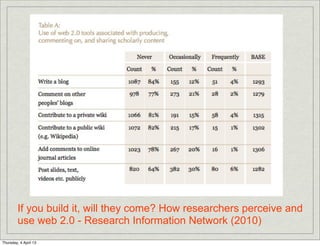
If you build it, will they come? How researchers perceive and
         use web 2.0 - Research Information Network (2010)
Thursday, 4 April 13
Nigel Thrift on emergence of speculative realism
          1.Facilitate activity that goes on ‘beneath the radar’ of
            ‘disciplinary policing’.

          2.Allow established figures to communicate in a more immediate
            way.

          3.Allow researchers to become established more quickly.

          4.They loosen disciplinary boundaries, allowing material to be
            imported more easily from other disciplines.

          5.They make it easier for researchers to communicate, allowing
            the exploration and development of topics that may later come
            to be profoundly important.

          6.New material reaches audiences more rapidly than it would in
            traditional scholarly communication.


Thursday, 4 April 13
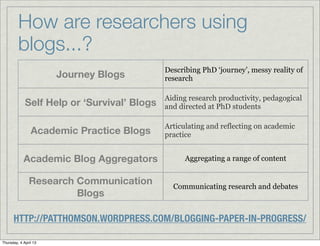
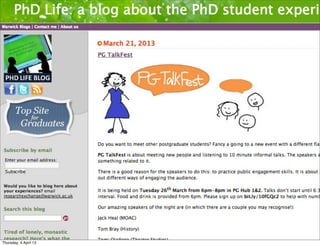
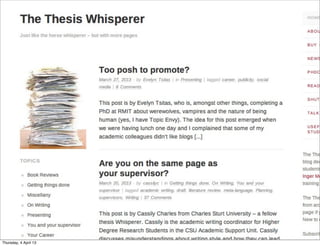
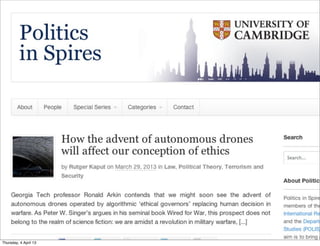
How are researchers using
         blogs...?
                                             Describing PhD ‘journey’, messy reality of
                       Journey Blogs         research

                                             Aiding research productivity, pedagogical
             Self Help or ‘Survival’ Blogs   and directed at PhD students

                                             Articulating and reflecting on academic
                Academic Practice Blogs      practice


            Academic Blog Aggregators              Aggregating a range of content


               Research Communication          Communicating research and debates
                        Blogs

      HTTP://PATTHOMSON.WORDPRESS.COM/BLOGGING-PAPER-IN-PROGRESS/

Thursday, 4 April 13
What sort of blog...?
             “We don’t think single-author blogs are a sustainable
             or genuinely useful model for most academics –
             although all praise to the still many exceptional
             academics who can manage to keep up the
             continuous effort involved. By joining together and
             forming multi-author blogs, academics can mutually
             reinforce each other’s contributions.”

             - Chris Gilson and Patrick Dunleavy


Thursday, 4 April 13
What is ‘publishing’?
         “By publishing we mean simply the communication and broad
         dissemination of knowledge, a function that has become both
         more complex and more important with the introduction and
         rapid evolution of digital and networking technologies. There is
         a seeming limitless range of opportunities for a faculty member
         to distribute his or her work, from setting up a web page or
         blog, to posting an article to a working paper website or
         institutional repository, to including it in a peer-reviewed
         journal or book.”

         -   Laura Brown, Rebecca J. Griffiths, Matthew Rascoff & Kevin Guthrie


Thursday, 4 April 13
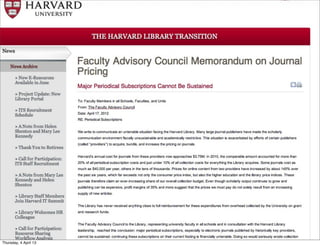
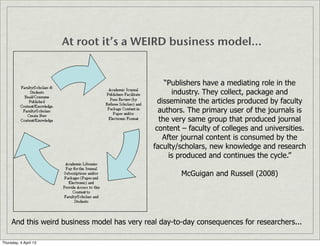
At root it’s a WEIRD business model...


                                                   “Publishers have a mediating role in the
                                                      industry. They collect, package and
                                                 disseminate the articles produced by faculty
                                                 authors. The primary user of the journals is
                                                 the very same group that produced journal
                                                content – faculty of colleges and universities.
                                                   After journal content is consumed by the
                                               faculty/scholars, new knowledge and research
                                                     is produced and continues the cycle.”

                                                       McGuigan and Russell (2008)


     And this weird business model has very real day-to-day consequences for researchers...

Thursday, 4 April 13
“universities have been translated from
             collegial collectivities, supporting intra- and
             inter-psychic freedom for community
             members, to managed power hierarchies
             that govern (a broader spectrum of)
             individuals through techniques of
             accounting, audit and surveillance”
             Boden, R. and Epstein, D. (2011) “A flat earth society? Imagining academic
             freedom”.The Sociological Review, 59:3, pp.478-479


Thursday, 4 April 13
The tension between using social media to
            communicate and using social media because ‘we have
            to these days’

            The tension between marketing/communications and
            research-led use of social media

            The institutional recognition of ‘non-traditional’ digital
            outputs

            The possibility of a ‘new collegiality’ facilitated through
            increasingly autonomous networks

            The changing public role of academics, as well as
            broader ramifications of an extended communicative
            repertoire

Thursday, 4 April 13
FURTHER READING


                LSE Impact Blog - http://blogs.lse.ac.uk/impactofsocialsciences/

                Cameron Neylon- http://cameronneylon.net/

                The Scholarly Kitchen - http://scholarlykitchen.sspnet.org/

                Bjorn Brembs - http://bjoern.brembs.net/

                Stephen Curry - http://occamstypewriter.org/scurry/

                Scholarly Publishing Bundle - http://bundlr.com/b/scholarly-publishing-open-access-
                and-the-academic-spring


                                         @MARK_CARRIGAN
                                      MARK@MARKCARRIGAN.NET
                                       WWW.MARKCARRIGAN.NET
Thursday, 4 April 13

Digital culture

  • 1.
    Academy 2.0? The Emerging Digital Culture within Higher Education Thursday, 4 April 13
  • 2.
    Social Media withinUniversities National organizations - RCUK, AHRC, ESRC, NCRM, professional associations etc University groups Universities Research projects University services Academic departments Individual scholars Thursday, 4 April 13
  • 3.
    So what purposedoes this serve? Enhancing institutional reputation and prestige. Social media engagement coming to be seen as integral to marketing and communications strategies in some institutions. Need to ‘differentiate’ from other institutions in increasingly competitive higher education market. Need to build and sustain relations with students (former and current) and alumni Careful management of reputation integral to this - social media as opportunity AND threat Thursday, 4 April 13
  • 4.
  • 5.
    But how areresearchers using social media...? • Take-up of most institutionally-provided and open web technology tools and applications is low among doctoral students overall • Generation Y doctoral students are more likely than older doctoral students to use technology to assist them in their research • Generation Y doctoral students tend to use technology applications and social media in their research if they augment, and can be easily absorbed into, existing work practices • Levels of use of social media and other applications helpful in retrieving and managing research information are steadily rising among Generation Y doctoral students, but those applications most useful for collaboration and scholarly communications remain among the least used • Fellow students and peers are the major influence on whether or not Generation Y doctoral students decide to use a technology application and are their main source of hands-on help (JISC Researchers of Tomorrow) Thursday, 4 April 13
  • 6.
  • 7.
    If you buildit, will they come? How researchers perceive and use web 2.0 - Research Information Network (2010) Thursday, 4 April 13
  • 8.
    Nigel Thrift onemergence of speculative realism 1.Facilitate activity that goes on ‘beneath the radar’ of ‘disciplinary policing’. 2.Allow established figures to communicate in a more immediate way. 3.Allow researchers to become established more quickly. 4.They loosen disciplinary boundaries, allowing material to be imported more easily from other disciplines. 5.They make it easier for researchers to communicate, allowing the exploration and development of topics that may later come to be profoundly important. 6.New material reaches audiences more rapidly than it would in traditional scholarly communication. Thursday, 4 April 13
  • 9.
    How are researchersusing blogs...? Describing PhD ‘journey’, messy reality of Journey Blogs research Aiding research productivity, pedagogical Self Help or ‘Survival’ Blogs and directed at PhD students Articulating and reflecting on academic Academic Practice Blogs practice Academic Blog Aggregators Aggregating a range of content Research Communication Communicating research and debates Blogs HTTP://PATTHOMSON.WORDPRESS.COM/BLOGGING-PAPER-IN-PROGRESS/ Thursday, 4 April 13
  • 10.
  • 11.
  • 12.
  • 13.
  • 14.
  • 15.
    What sort ofblog...? “We don’t think single-author blogs are a sustainable or genuinely useful model for most academics – although all praise to the still many exceptional academics who can manage to keep up the continuous effort involved. By joining together and forming multi-author blogs, academics can mutually reinforce each other’s contributions.” - Chris Gilson and Patrick Dunleavy Thursday, 4 April 13
  • 16.
    What is ‘publishing’? “By publishing we mean simply the communication and broad dissemination of knowledge, a function that has become both more complex and more important with the introduction and rapid evolution of digital and networking technologies. There is a seeming limitless range of opportunities for a faculty member to distribute his or her work, from setting up a web page or blog, to posting an article to a working paper website or institutional repository, to including it in a peer-reviewed journal or book.” - Laura Brown, Rebecca J. Griffiths, Matthew Rascoff & Kevin Guthrie Thursday, 4 April 13
  • 17.
  • 18.
    At root it’sa WEIRD business model... “Publishers have a mediating role in the industry. They collect, package and disseminate the articles produced by faculty authors. The primary user of the journals is the very same group that produced journal content – faculty of colleges and universities. After journal content is consumed by the faculty/scholars, new knowledge and research is produced and continues the cycle.” McGuigan and Russell (2008) And this weird business model has very real day-to-day consequences for researchers... Thursday, 4 April 13
  • 19.
    “universities have beentranslated from collegial collectivities, supporting intra- and inter-psychic freedom for community members, to managed power hierarchies that govern (a broader spectrum of) individuals through techniques of accounting, audit and surveillance” Boden, R. and Epstein, D. (2011) “A flat earth society? Imagining academic freedom”.The Sociological Review, 59:3, pp.478-479 Thursday, 4 April 13
  • 20.
    The tension betweenusing social media to communicate and using social media because ‘we have to these days’ The tension between marketing/communications and research-led use of social media The institutional recognition of ‘non-traditional’ digital outputs The possibility of a ‘new collegiality’ facilitated through increasingly autonomous networks The changing public role of academics, as well as broader ramifications of an extended communicative repertoire Thursday, 4 April 13
  • 21.
    FURTHER READING LSE Impact Blog - http://blogs.lse.ac.uk/impactofsocialsciences/ Cameron Neylon- http://cameronneylon.net/ The Scholarly Kitchen - http://scholarlykitchen.sspnet.org/ Bjorn Brembs - http://bjoern.brembs.net/ Stephen Curry - http://occamstypewriter.org/scurry/ Scholarly Publishing Bundle - http://bundlr.com/b/scholarly-publishing-open-access- and-the-academic-spring @MARK_CARRIGAN MARK@MARKCARRIGAN.NET WWW.MARKCARRIGAN.NET Thursday, 4 April 13