



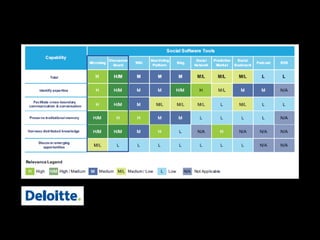
Enterprise Social Software Fostering productivity, innovation and engagement in the knowledge economy thehypertextual.com @cecildijoux
The Knowledge Economy Knowledge Management Innovation Collaboration Engagement
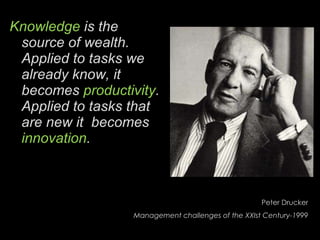
Knowledge  is the source of wealth. Applied to tasks we already know, it becomes  productivity . Applied to tasks that are new it  becomes  innovation . Peter Drucker Management challenges of the XXIst Century-1999
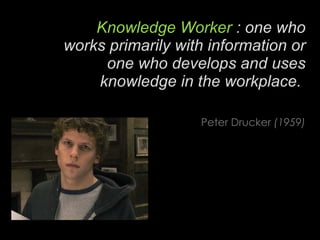
Knowledge Worker  : one who works primarily with information or one who develops and uses knowledge in the workplace.   Peter Drucker  (1959)
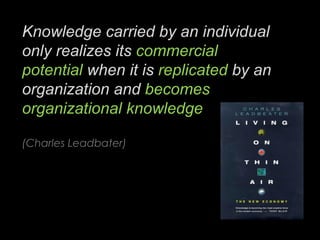
Knowledge carried by an individual only realizes its  commercial potential  when it is  replicated  by an organization and  becomes organizational knowledge (Charles Leadbater)
«  Innovation  is the process that  translates knowledge  into economic growth and social well-being.   » (Australian Research Council)   it also is …
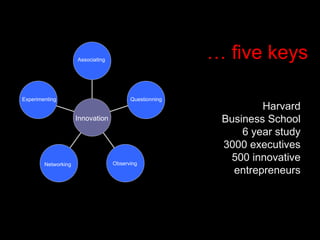
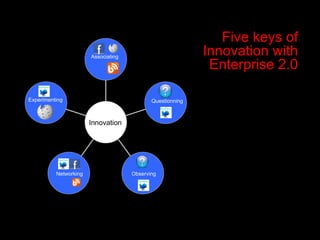
…  five keys Harvard Business School 6 year study 3000 executives 500 innovative entrepreneurs Experimenting Networking Observing Questionning Innovation Associating
Collaboration and Collective Intelligence « Products and organised activities are no longer permanent : only the potential to renew the organisation is.  This process of permanent potential renewal of the organisation is the collective intelligence .» Implementing Collective Intelligence  (V. Lenhardt, C. Rochet – 1997)
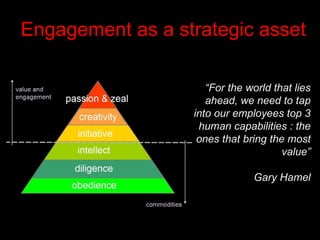
Engagement as a strategic asset “ For the world that lies ahead, we need to tap into our employees top 3 human capabilities : the ones that bring the most value” Gary Hamel
2. Challenges for 21st Century Organisations Knowledge Management Innovation Collaboration Engagement
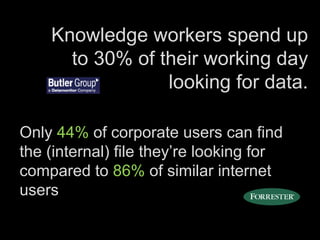
Knowledge workers spend up to 30% of their working day looking for data. Only  44%  of corporate users can find the (internal) file they’re looking for compared to  86%  of similar internet users
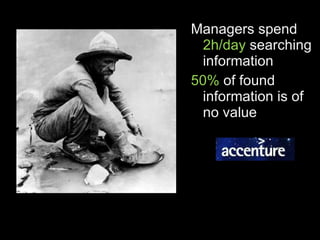
Managers spend  2h/day  searching information 50%  of found information is of no value  Survey 1000 middle managers US/UK – Jan 2007
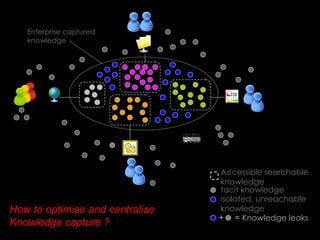
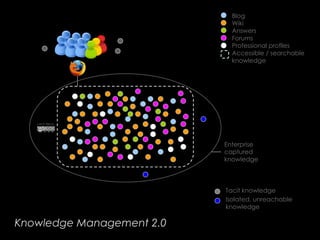
How to optimise and centralise Knowledge capture ?
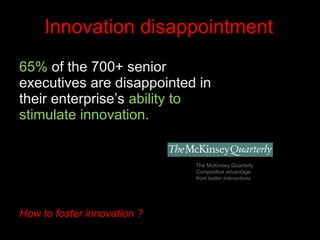
65%  of the 700+ senior executives are disappointed in their enterprise’s  ability to stimulate innovation.  The McKinsey Quarterly Competitive advantage from better interactions Innovation disappointment How to foster innovation ?
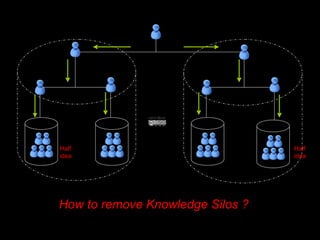
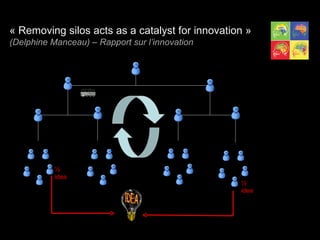
How to remove Knowledge Silos ? Half idea Half idea
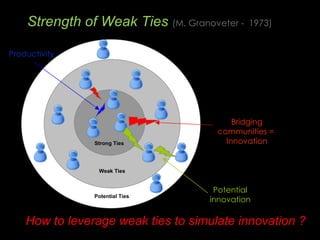
Strength of Weak Ties   (M. Granoveter -  1973) Strong Ties Weak Ties Bridging communities =  Innovation Productivity Potential innovation Potential Ties How to leverage weak ties to simulate innovation ?
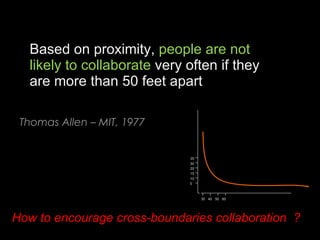
Based on proximity,  people are not likely to collaborate  very often if they are more than 50 feet apart Thomas Allen – MIT, 1977   30  40  50  60   5   10   15   20   30   35   How to encourage cross-boundaries collaboration  ?
25 to 50% of workforce is engaged into knowledge-based collaboration consisting of «  tacit  »  How to capture this knowledge ?
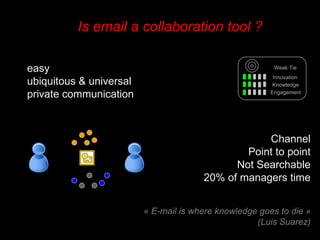
Is email a collaboration tool ? easy  ubiquitous & universal private communication Channel Point to point Not Searchable 20% of managers time Innovation Knowledge Weak Tie Engagement « E-mail is where knowledge goes to die » (Luis Suarez)
Knowledge Workers Post-ideologic Authority : earned as opposed to granted « The web is the operating system of Digital Natives lives. This is the Facebook generation »  (Gary Hamel)  How to bridge the cultural and technological gap ? The Digital Natives conundrum
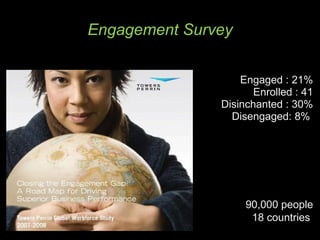
Engaged : 21% Enrolled : 41 Disinchanted : 30% Disengaged: 8%  Engagement Survey 90,000 people 18 countries
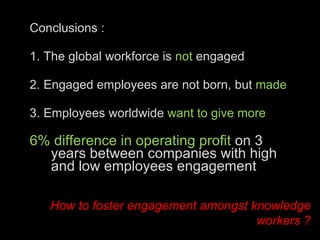
Conclusions : 1. The global workforce is  not  engaged  2. Engaged employees are not born, but  made 3. Employees worldwide  want to give more 6% difference in operating profit  on 3 years between companies with high and low employees engagement How to foster engagement amongst knowledge workers ?
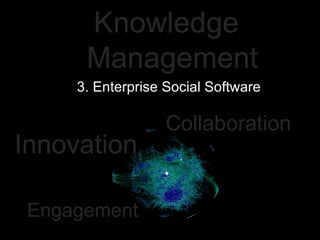
3. Enterprise Social Software Knowledge Management Innovation Collaboration Engagement
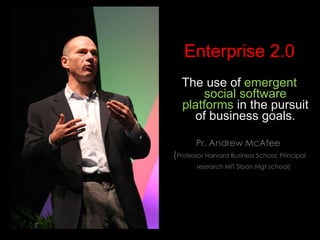
Enterprise 2.0 The use of  emergent social software platforms  in the pursuit of business goals. Pr. Andrew McAfee  ( Professor Harvard Business School, Principal research MIT Sloan Mgt school)
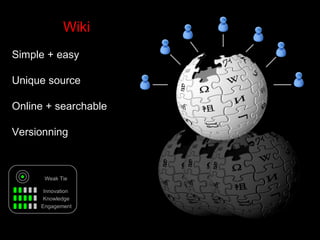
Wiki   Simple + easy Unique source Online + searchable Versionning Innovation Knowledge Weak Tie Engagement
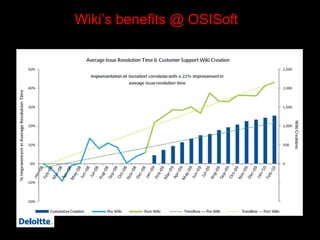
Wiki’s benefits @ OSISoft
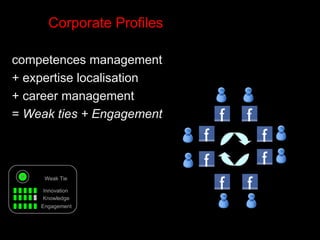
Corporate Profiles competences management + expertise localisation  + career management =  Weak ties + Engagement Innovation Knowledge Weak Tie Engagement
Corporate Profiles @ Booz Allen A greater sense of  individual responsibility People empowered to  manage their identity  in the firm and their  career development . People more likely to  get staffed on a project that reflects the interests and experience  noted in their profile. People likely to find the  right contacts  to  succeed  in their areas of interest.  (Bill Ives)
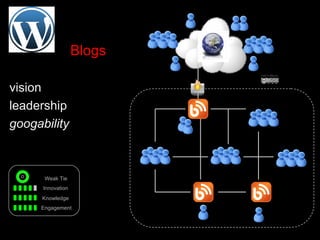
Blogs vision leadership googability Innovation Knowledge Weak Tie Engagement
CFO ideation blog allowed for  conversation and new ideas (60+) emergence . Implementing one of those ideas (gas fuelling in local’s stations as opposed to highway’s) helped  saving 800K€/year Corporate Blogging benefits at OCE
Micro-blogging to follow and be followed + 140 characters + instant communication  =  Weak ties in action – fast ! Innovation Knowledge Weak Tie Engagement
Micro-blogging benefits @ Lippi Problems that used to take  a couple of days  to be fixed (client delivery problems) are now  fixed in 20mns thanks to Twitter .
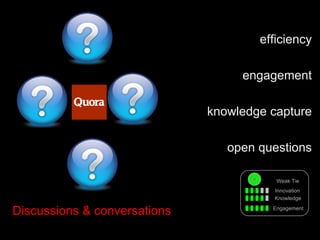
efficiency engagement knowledge capture open questions Discussions & conversations Innovation Knowledge Weak Tie Engagement
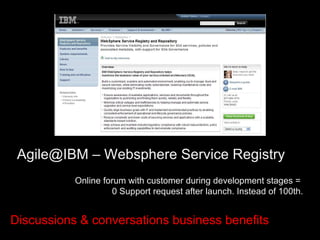
Agile@IBM – Websphere Service Registry  Online forum with customer during development stages =  0 Support request after launch. Instead of 100th. Discussions & conversations business benefits
Video Streaming Innovation Knowledge Weak Tie Engagement
Video Streaming @ Save $US Millions
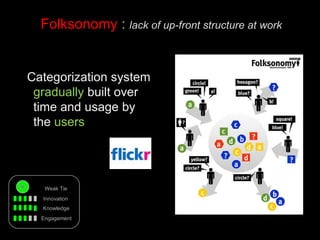
Folksonomy  :   lack of up-front structure at work Categorization system  gradually  built over time and usage by the  users   Innovation Knowledge Weak Tie Engagement
Prediction Market Innovation Knowledge Weak Tie Engagement
Prediction Market benefits Sales prediction accuracy using prediction markets : 99,9% (350+ contributors). Using usual 5 internal experts : < 95% Savings of $USM 10’s by removing stocks and providing appropriate volume of goods to be sold.
4. Social Software Unique Capabilities Knowledge Management Innovation Collaboration Engagement
 
 
« Removing silos acts as a catalyst for innovation »  (Delphine Manceau) – Rapport sur l’innovation ½ idea ½ idea
Five keys of Innovation with Enterprise 2.0 Experimenting Networking Observing Questionning Innovation Associating
Enterprise 2.0 and  engagement   factors for employees  Provides visibility on knowledge worker contribution within enterprise big picture Greater sense of individual responsibility Reduce distance with customers More trusted and engaging leaders :  This new phenomenon is enabling business leaders to regain the trust and credibility they have lost over the last 10 years. That's why social networking is the most important business development of the year (Bill George – Harvard Business School)
5. Business Strategy Knowledge Management Innovation Collaboration Engagement
Underlying trends Social Software Network effects Free and easy Lack of up-front structure Emergence >  Disruptive   technologies
“ Can a firm hope to succeed?  The answer lies in firms being  able to identify, develop and successfully market  emerging, potentially  disruptive technologies  before they overtake the traditional sustaining technology.” Clayton Christensen,  Pr. Harvard Business School
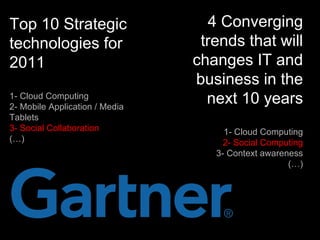
Top 10 Strategic technologies for 2011 1- Cloud Computing 2- Mobile Application / Media Tablets 3- Social Collaboration (…) 4 Converging trends that will changes IT and business in the next 10 years 1- Cloud Computing 2- Social Computing 3- Context awareness (…)
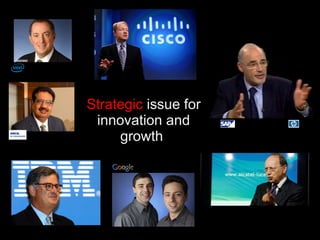
Strategic   issue for innovation and growth
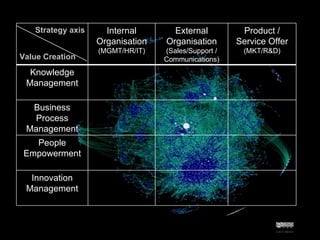
cecil dijoux Strategy axis Value Creation Internal Organisation (MGMT/HR/IT) External Organisation  (Sales/Support / Communications) Product / Service Offer (MKT/R&D) Knowledge Management Business Process Management People Empowerment Innovation Management
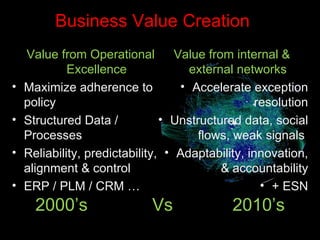
Business Value Creation Value from Operational Excellence Maximize adherence to policy Structured Data / Processes Reliability, predictability, alignment & control ERP / PLM / CRM … Value from internal & external networks Accelerate exception resolution Unstructured data, social flows, weak signals  Adaptability, innovation, & accountability + ESN 2000’s  Vs  2010’s
6. Integration Knowledge Management Innovation Collaboration Engagement
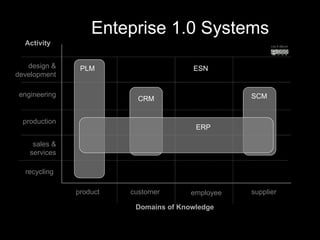
recycling sales & services production engineering design & development PLM CRM SCM product customer employee supplier Domains of Knowledge Activity ESN cecil dijoux ERP Enteprise 1.0 Systems
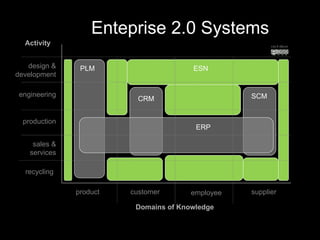
recycling sales & services production engineering design & development PLM CRM SCM product customer employee supplier Domains of Knowledge Activity ESN cecil dijoux ERP Enteprise 2.0 Systems
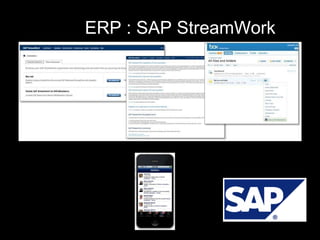
ERP : SAP StreamWork
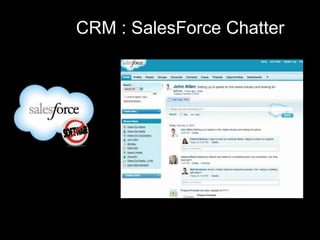
CRM : SalesForce Chatter
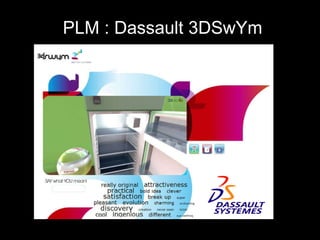
PLM : Dassault 3DSwYm
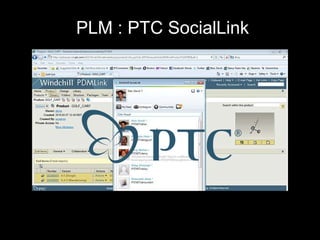
PLM : PTC SocialLink
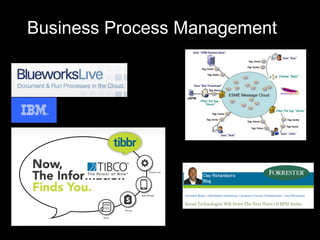
Business Process Management
7. @ Culture Knowledge Management Innovation Collaboration Engagement
Values Meritocracy Entrepreneurship Simplicity Pragmatism Transparency Faith in technology “ The Internet culture is fuelled by the creative ethos : the intersection between California counter-culture and the protestant work ethic”   (R. Florida)
The third level of immersion Open source software Agile PM Methodologies Social Software Platforms
1. Units of knowledge 2. More efficient communication 3. Key for leadership 4. Fosters weak links 5. Provides the bigger picture  5 reasons to bring the Global Conversation into the enterprise
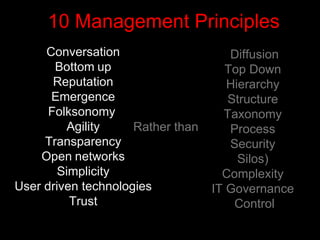
10 Management Principles Conversation Bottom   up Reputation Emergence Folksonomy   Agility Transparency Open   networks Simplicity User driven technologies Trust Diffusion Top Down  Hierarchy  Structure  Taxonomy  Process  Security  Silos)  Complexity  IT Governance  Control Rather than
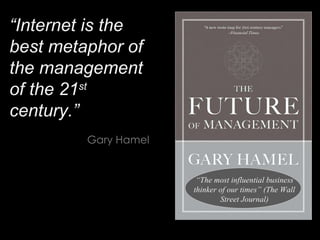
“ Internet is the best metaphor of the management of the 21 st  century.” Gary Hamel “ The most influential business thinker of our times” (The Wall Street Journal)
8. Implementation Knowledge Management Innovation Collaboration Engagement
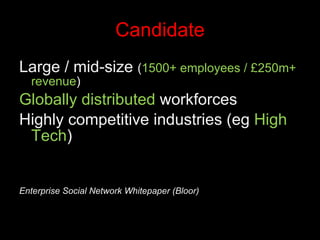
Candidate Large / mid-size  ( 1500+ employees / £250m+ revenue ) Globally distributed  workforces Highly competitive industries (eg  High Tech ) Enterprise Social Network Whitepaper (Bloor)
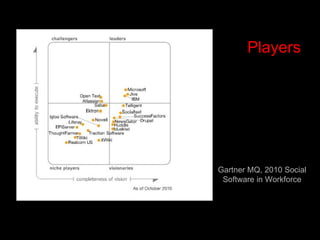
Players Gartner MQ, 2010 Social Software in Workforce
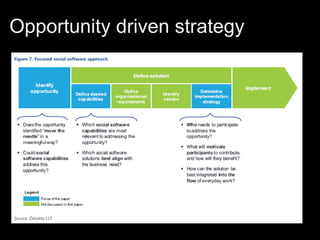
Opportunity driven strategy
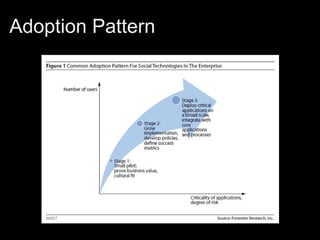
Adoption Pattern
Guidelines Be  transparent Be  judicious  (re. Privacy and security) Write what you  know Perception  is reality  It’s a  conversation Are you adding  value  ? What you write is your  responsibility Create some  excitement Be a  leader  – do not denigrate Screw up ?  Correct  and make it clear you did If you’re not sure,  pause
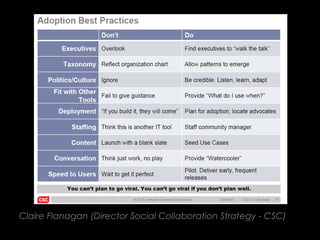
Claire Flanagan (Director Social Collaboration Strategy - CSC)
Candidate Large / mid-size  ( 1500+ employees / £250m+ revenue ) Globally distributed  workforces Highly competitive industries (eg  High Tech ) Enterprise Social Network Whitepaper (Bloor)

Enterprise Social Software

  • 1.
    Enterprise Social SoftwareFostering productivity, innovation and engagement in the knowledge economy thehypertextual.com @cecildijoux
  • 2.
    The Knowledge EconomyKnowledge Management Innovation Collaboration Engagement
  • 3.
    Knowledge isthe source of wealth. Applied to tasks we already know, it becomes productivity . Applied to tasks that are new it becomes innovation . Peter Drucker Management challenges of the XXIst Century-1999
  • 4.
    Knowledge Worker : one who works primarily with information or one who develops and uses knowledge in the workplace. Peter Drucker (1959)
  • 5.
    Knowledge carried byan individual only realizes its commercial potential when it is replicated by an organization and becomes organizational knowledge (Charles Leadbater)
  • 6.
    «  Innovation is the process that translates knowledge into economic growth and social well-being.  » (Australian Research Council) it also is …
  • 7.
    … fivekeys Harvard Business School 6 year study 3000 executives 500 innovative entrepreneurs Experimenting Networking Observing Questionning Innovation Associating
  • 8.
    Collaboration and CollectiveIntelligence « Products and organised activities are no longer permanent : only the potential to renew the organisation is. This process of permanent potential renewal of the organisation is the collective intelligence .» Implementing Collective Intelligence (V. Lenhardt, C. Rochet – 1997)
  • 9.
    Engagement as astrategic asset “ For the world that lies ahead, we need to tap into our employees top 3 human capabilities : the ones that bring the most value” Gary Hamel
  • 10.
    2. Challenges for21st Century Organisations Knowledge Management Innovation Collaboration Engagement
  • 11.
    Knowledge workers spendup to 30% of their working day looking for data. Only 44% of corporate users can find the (internal) file they’re looking for compared to 86% of similar internet users
  • 12.
    Managers spend 2h/day searching information 50% of found information is of no value Survey 1000 middle managers US/UK – Jan 2007
  • 13.
    How to optimiseand centralise Knowledge capture ?
  • 14.
    65% ofthe 700+ senior executives are disappointed in their enterprise’s ability to stimulate innovation. The McKinsey Quarterly Competitive advantage from better interactions Innovation disappointment How to foster innovation ?
  • 15.
    How to removeKnowledge Silos ? Half idea Half idea
  • 16.
    Strength of WeakTies (M. Granoveter - 1973) Strong Ties Weak Ties Bridging communities = Innovation Productivity Potential innovation Potential Ties How to leverage weak ties to simulate innovation ?
  • 17.
    Based on proximity, people are not likely to collaborate very often if they are more than 50 feet apart Thomas Allen – MIT, 1977 30 40 50 60 5 10 15 20 30 35 How to encourage cross-boundaries collaboration ?
  • 18.
    25 to 50%of workforce is engaged into knowledge-based collaboration consisting of «  tacit  » How to capture this knowledge ?
  • 19.
    Is email acollaboration tool ? easy ubiquitous & universal private communication Channel Point to point Not Searchable 20% of managers time Innovation Knowledge Weak Tie Engagement « E-mail is where knowledge goes to die » (Luis Suarez)
  • 20.
    Knowledge Workers Post-ideologicAuthority : earned as opposed to granted « The web is the operating system of Digital Natives lives. This is the Facebook generation » (Gary Hamel) How to bridge the cultural and technological gap ? The Digital Natives conundrum
  • 21.
    Engaged : 21%Enrolled : 41 Disinchanted : 30% Disengaged: 8% Engagement Survey 90,000 people 18 countries
  • 22.
    Conclusions : 1.The global workforce is not engaged 2. Engaged employees are not born, but made 3. Employees worldwide want to give more 6% difference in operating profit on 3 years between companies with high and low employees engagement How to foster engagement amongst knowledge workers ?
  • 23.
    3. Enterprise SocialSoftware Knowledge Management Innovation Collaboration Engagement
  • 24.
    Enterprise 2.0 Theuse of emergent social software platforms in the pursuit of business goals. Pr. Andrew McAfee ( Professor Harvard Business School, Principal research MIT Sloan Mgt school)
  • 25.
    Wiki Simple + easy Unique source Online + searchable Versionning Innovation Knowledge Weak Tie Engagement
  • 26.
  • 27.
    Corporate Profiles competencesmanagement + expertise localisation + career management = Weak ties + Engagement Innovation Knowledge Weak Tie Engagement
  • 28.
    Corporate Profiles @Booz Allen A greater sense of individual responsibility People empowered to manage their identity in the firm and their career development . People more likely to get staffed on a project that reflects the interests and experience noted in their profile. People likely to find the right contacts to succeed in their areas of interest. (Bill Ives)
  • 29.
    Blogs vision leadershipgoogability Innovation Knowledge Weak Tie Engagement
  • 30.
    CFO ideation blogallowed for conversation and new ideas (60+) emergence . Implementing one of those ideas (gas fuelling in local’s stations as opposed to highway’s) helped saving 800K€/year Corporate Blogging benefits at OCE
  • 31.
    Micro-blogging to followand be followed + 140 characters + instant communication = Weak ties in action – fast ! Innovation Knowledge Weak Tie Engagement
  • 32.
    Micro-blogging benefits @Lippi Problems that used to take a couple of days to be fixed (client delivery problems) are now fixed in 20mns thanks to Twitter .
  • 33.
    efficiency engagement knowledgecapture open questions Discussions & conversations Innovation Knowledge Weak Tie Engagement
  • 34.
    Agile@IBM – WebsphereService Registry Online forum with customer during development stages = 0 Support request after launch. Instead of 100th. Discussions & conversations business benefits
  • 35.
    Video Streaming InnovationKnowledge Weak Tie Engagement
  • 36.
    Video Streaming @Save $US Millions
  • 37.
    Folksonomy : lack of up-front structure at work Categorization system gradually built over time and usage by the users Innovation Knowledge Weak Tie Engagement
  • 38.
    Prediction Market InnovationKnowledge Weak Tie Engagement
  • 39.
    Prediction Market benefitsSales prediction accuracy using prediction markets : 99,9% (350+ contributors). Using usual 5 internal experts : < 95% Savings of $USM 10’s by removing stocks and providing appropriate volume of goods to be sold.
  • 40.
    4. Social SoftwareUnique Capabilities Knowledge Management Innovation Collaboration Engagement
  • 41.
  • 42.
  • 43.
    « Removing silos actsas a catalyst for innovation » (Delphine Manceau) – Rapport sur l’innovation ½ idea ½ idea
  • 44.
    Five keys ofInnovation with Enterprise 2.0 Experimenting Networking Observing Questionning Innovation Associating
  • 45.
    Enterprise 2.0 and engagement factors for employees Provides visibility on knowledge worker contribution within enterprise big picture Greater sense of individual responsibility Reduce distance with customers More trusted and engaging leaders : This new phenomenon is enabling business leaders to regain the trust and credibility they have lost over the last 10 years. That's why social networking is the most important business development of the year (Bill George – Harvard Business School)
  • 46.
    5. Business StrategyKnowledge Management Innovation Collaboration Engagement
  • 47.
    Underlying trends SocialSoftware Network effects Free and easy Lack of up-front structure Emergence > Disruptive technologies
  • 48.
    “ Can afirm hope to succeed? The answer lies in firms being able to identify, develop and successfully market emerging, potentially disruptive technologies before they overtake the traditional sustaining technology.” Clayton Christensen, Pr. Harvard Business School
  • 49.
    Top 10 Strategictechnologies for 2011 1- Cloud Computing 2- Mobile Application / Media Tablets 3- Social Collaboration (…) 4 Converging trends that will changes IT and business in the next 10 years 1- Cloud Computing 2- Social Computing 3- Context awareness (…)
  • 50.
    Strategic issue for innovation and growth
  • 51.
    cecil dijoux Strategyaxis Value Creation Internal Organisation (MGMT/HR/IT) External Organisation (Sales/Support / Communications) Product / Service Offer (MKT/R&D) Knowledge Management Business Process Management People Empowerment Innovation Management
  • 52.
    Business Value CreationValue from Operational Excellence Maximize adherence to policy Structured Data / Processes Reliability, predictability, alignment & control ERP / PLM / CRM … Value from internal & external networks Accelerate exception resolution Unstructured data, social flows, weak signals Adaptability, innovation, & accountability + ESN 2000’s Vs 2010’s
  • 53.
    6. Integration KnowledgeManagement Innovation Collaboration Engagement
  • 54.
    recycling sales &services production engineering design & development PLM CRM SCM product customer employee supplier Domains of Knowledge Activity ESN cecil dijoux ERP Enteprise 1.0 Systems
  • 55.
    recycling sales &services production engineering design & development PLM CRM SCM product customer employee supplier Domains of Knowledge Activity ESN cecil dijoux ERP Enteprise 2.0 Systems
  • 56.
    ERP : SAPStreamWork
  • 57.
  • 58.
  • 59.
    PLM : PTCSocialLink
  • 60.
  • 61.
    7. @ CultureKnowledge Management Innovation Collaboration Engagement
  • 62.
    Values Meritocracy EntrepreneurshipSimplicity Pragmatism Transparency Faith in technology “ The Internet culture is fuelled by the creative ethos : the intersection between California counter-culture and the protestant work ethic” (R. Florida)
  • 63.
    The third levelof immersion Open source software Agile PM Methodologies Social Software Platforms
  • 64.
    1. Units ofknowledge 2. More efficient communication 3. Key for leadership 4. Fosters weak links 5. Provides the bigger picture 5 reasons to bring the Global Conversation into the enterprise
  • 65.
    10 Management PrinciplesConversation Bottom up Reputation Emergence Folksonomy Agility Transparency Open networks Simplicity User driven technologies Trust Diffusion Top Down Hierarchy Structure Taxonomy Process Security Silos) Complexity IT Governance Control Rather than
  • 66.
    “ Internet isthe best metaphor of the management of the 21 st century.” Gary Hamel “ The most influential business thinker of our times” (The Wall Street Journal)
  • 67.
    8. Implementation KnowledgeManagement Innovation Collaboration Engagement
  • 68.
    Candidate Large /mid-size ( 1500+ employees / £250m+ revenue ) Globally distributed workforces Highly competitive industries (eg High Tech ) Enterprise Social Network Whitepaper (Bloor)
  • 69.
    Players Gartner MQ,2010 Social Software in Workforce
  • 70.
  • 71.
  • 72.
    Guidelines Be transparent Be judicious (re. Privacy and security) Write what you know Perception is reality It’s a conversation Are you adding value ? What you write is your responsibility Create some excitement Be a leader – do not denigrate Screw up ? Correct and make it clear you did If you’re not sure, pause
  • 73.
    Claire Flanagan (DirectorSocial Collaboration Strategy - CSC)
  • 74.
    Candidate Large /mid-size ( 1500+ employees / £250m+ revenue ) Globally distributed workforces Highly competitive industries (eg High Tech ) Enterprise Social Network Whitepaper (Bloor)