
THE NEXT GENERATION
DATA-CENTRE
Scalable Infrastructure with
Red Hat Enterprise OpenStack Platform
Gavin McDougall
Senior Solution Architect
AGENDA
● I.T. Challenges
● What is OpenStack ?
● Why OpenStack ?
● Why Red Hat ?
● Community Contributions
● Am I ready for OpenStack ?
● What's coming ?
● Supporting Cloud Infrastructure
● Next Steps
● Questions
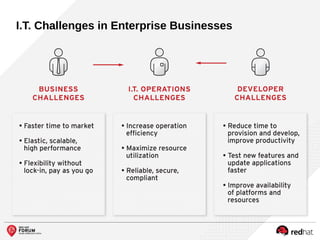
I.T. Challenges in Enterprise Businesses
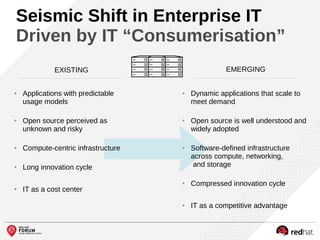
EXISTING EMERGING
● Dynamic applications that scale to
meet demand
● Open source is well understood and
widely adopted
● Software-defined infrastructure
across compute, networking,
and storage
● Compressed innovation cycle
● IT as a competitive advantage
● Applications with predictable
usage models
● Open source perceived as
unknown and risky
● Compute-centric infrastructure
● Long innovation cycle
● IT as a cost center
Seismic Shift in Enterprise IT
Driven by IT “Consumerisation”
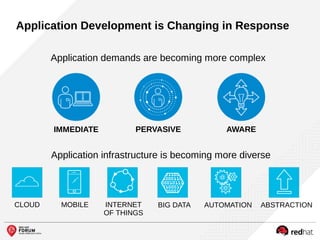
Application demands are becoming more complex
Application infrastructure is becoming more diverse
IMMEDIATE PERVASIVE AWARE
CLOUD MOBILE INTERNET
OF THINGS
BIG DATA AUTOMATION ABSTRACTION
Application Development is Changing in Response
Challenges With A Traditional Infrastructure
● Our data is too large
– We're producing vast amounts of data, exponentially!
– Way past the ability of traditional systems & applications
– Scaling UP no longer works. Scaling OUT is a necessity
● Service requests are too large
– More and more client devices coming online
● Mobile phones, tablets, etc.
– Much harder to maintain service to customers
● Applications weren't written to cope with demand
What is OpenStack?
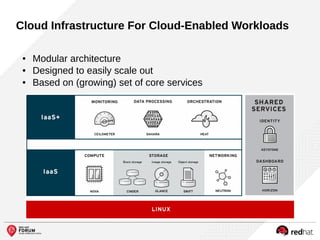
Cloud Infrastructure For Cloud-Enabled Workloads
● Modular architecture
● Designed to easily scale out
● Based on (growing) set of core services
Why OpenStack?
● Brings public cloud-like capabilities into your data-centre
● Provides massive on-demand (scale-out) capacity
– 1,000's → 10,000's → 100k's of VMs
● Removes vendor lock-in
– Open source provides high-degree of flexibility to
customise and interoperate
● Community development = higher “feature velocity”
– Features and functions you need, faster to market
over proprietary software
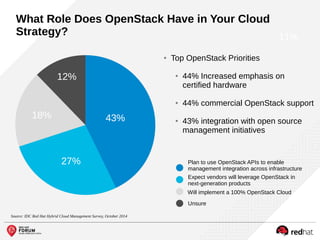
● Top OpenStack Priorities
● 44% Increased emphasis on
certified hardware
● 44% commercial OpenStack support
● 43% integration with open source
management initiatives
Source: IDC Red Hat Hybrid Cloud Management Survey, October 2014
Plan to use OpenStack APIs to enable
management integration across infrastructure
Expect vendors will leverage OpenStack in
next-generation products
Will implement a 100% OpenStack Cloud
Unsure
43%
27%
11%
12%
18%
What Role Does OpenStack Have in Your Cloud
Strategy?
WHY RED HAT ?
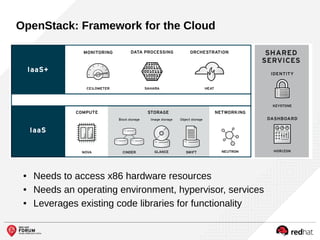
OpenStack: Framework for the Cloud
● Needs to access x86 hardware resources
● Needs an operating environment, hypervisor, services
● Leverages existing code libraries for functionality
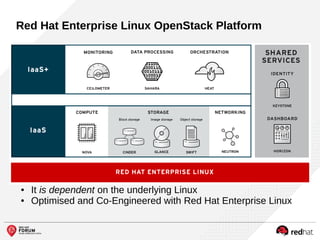
Red Hat Enterprise Linux OpenStack Platform
● It is dependent on the underlying Linux
● Optimised and Co-Engineered with Red Hat Enterprise Linux
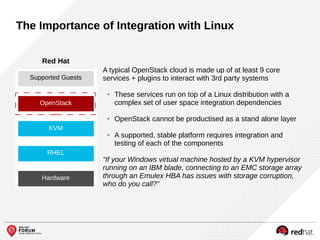
A typical OpenStack cloud is made up of at least 9 core
services + plugins to interact with 3rd party systems
● These services run on top of a Linux distribution with a
complex set of user space integration dependencies
● OpenStack cannot be productised as a stand alone layer
● A supported, stable platform requires integration and
testing of each of the components
“If your Windows virtual machine hosted by a KVM hypervisor
running on an IBM blade, connecting to an EMC storage array
through an Emulex HBA has issues with storage corruption,
who do you call?”
The Importance of Integration with Linux
Red Hat
Supported Guests
OpenStack
KVM
RHEL
Hardware
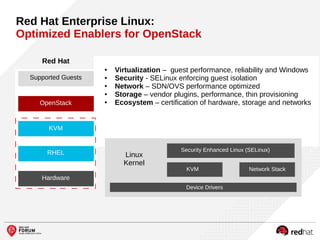
● Virtualization – guest performance, reliability and Windows
● Security - SELinux enforcing guest isolation
● Network – SDN/OVS performance optimized
● Storage – vendor plugins, performance, thin provisioning
● Ecosystem – certification of hardware, storage and networks
Red Hat Enterprise Linux:
Optimized Enablers for OpenStack
Linux
Kernel
Security Enhanced Linux (SELinux)
KVM Network Stack
Device Drivers
Red Hat
Supported Guests
OpenStack
KVM
RHEL
Hardware
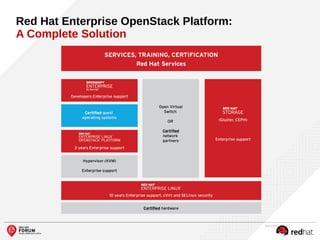
Red Hat Enterprise OpenStack Platform:
A Complete Solution
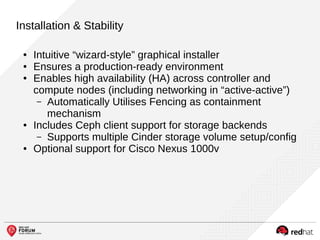
Installation & Stability
● Intuitive “wizard-style” graphical installer
● Ensures a production-ready environment
● Enables high availability (HA) across controller and
compute nodes (including networking in “active-active”)
– Automatically Utilises Fencing as containment
mechanism
● Includes Ceph client support for storage backends
– Supports multiple Cinder storage volume setup/config
● Optional support for Cisco Nexus 1000v
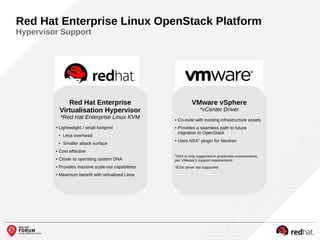
Red Hat Enterprise
Virtualisation Hypervisor
*Red Hat Enterprise Linux KVM
● Lightweight / small footprint
● Less overhead
● Smaller attack surface
● Cost effective
● Closer to operating system DNA
● Provides massive scale-out capabilities
● Maximum benefit with virtualised Linux
VMware vSphere
*vCenter Driver
● Co-exist with existing infrastructure assets
● Provides a seamless path to future
migration to OpenStack
●
Uses NSX1
plugin for Neutron
1
NSX is only supported in production environments,
per VMware's support requirements
*ESXi driver not supported
Red Hat Enterprise Linux OpenStack Platform
Hypervisor Support
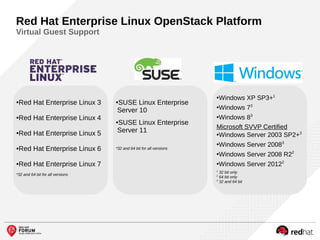
●Red Hat Enterprise Linux 3
●Red Hat Enterprise Linux 4
●Red Hat Enterprise Linux 5
●Red Hat Enterprise Linux 6
●Red Hat Enterprise Linux 7
*32 and 64 bit for all versions
●SUSE Linux Enterprise
Server 10
●SUSE Linux Enterprise
Server 11
*32 and 64 bit for all versions
●
Windows XP SP3+1
●Windows 73
●
Windows 83
Microsoft SVVP Certified
●Windows Server 2003 SP2+3
●
Windows Server 20083
●
Windows Server 2008 R22
●
Windows Server 20122
1
32 bit only
2
64 bit only
3
32 and 64 bit
Red Hat Enterprise Linux OpenStack Platform
Virtual Guest Support
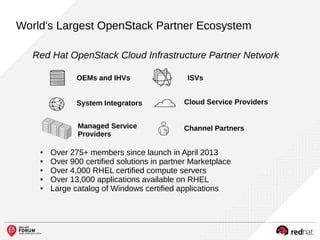
OEMs and IHVs ISVs
Cloud Service ProvidersSystem Integrators
Channel PartnersManaged Service
Providers
● Over 275+ members since launch in April 2013
● Over 900 certified solutions in partner Marketplace
● Over 4,000 RHEL certified compute servers
● Over 13,000 applications available on RHEL
● Large catalog of Windows certified applications
Red Hat OpenStack Cloud Infrastructure Partner Network
World's Largest OpenStack Partner Ecosystem
Why Red Hat Enterprise Linux OpenStack Platform?
● All the value of community OpenStack and...
– Enterprise hardened code
– Co-engineered and integrated with Red Hat Enterprise Linux
– Graphical Installer ensuring production-ready deployment
– 3 year “production phase” software lifecycle
– World-class global support
– Worlds largest OpenStack partner ecosystem
– OpenStack training, certification, and professional services
– Integrated with a trusted solution stack
● Red Hat Enterprise Linux
● Red Hat CloudForms
● Red Hat Enterprise Virtualization
● Red Hat Storage (Ceph and Gluster)
● OpenShift by Red Hat (PaaS)
COMMUNITY
CONTRIBUTIONS
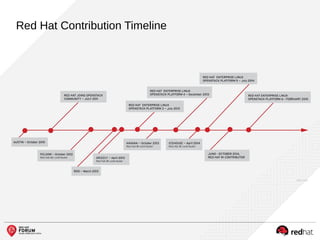
Red Hat Contribution Timeline
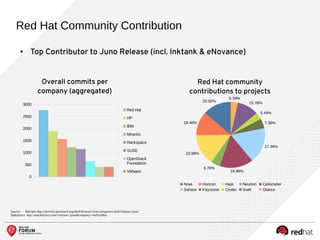
Red Hat Community Contribution
Source: Bitergia http://activity.openstack.org/dash/browser/scm-companies.html?release=juno
Stakalytics http://stackalytics.com/?release=juno&company=red%20hat
● Top Contributor to Juno Release (incl. Inktank & eNovance)
Overall commits per
company (aggregated)
Red Hat community
contributions to projects
0
500
1000
1500
2000
2500
3000
Red Hat
HP
IBM
Mirantis
Rackspace
SUSE
OpenStack
Foundation
VMware
20.92%
18.48%
23.98%
6.76%
24.86%
27.35%
7.38%
5.44%
15.78%
5.39%
Nova Horizon Heat Neutron Ceilometer
Sahara Keystone Cinder Swift Glance
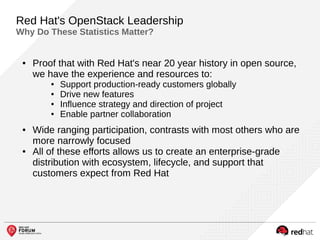
Red Hat's OpenStack Leadership
Why Do These Statistics Matter?
● Proof that with Red Hat's near 20 year history in open source,
we have the experience and resources to:
● Support production-ready customers globally
● Drive new features
● Influence strategy and direction of project
● Enable partner collaboration
● Wide ranging participation, contrasts with most others who are
more narrowly focused
● All of these efforts allows us to create an enterprise-grade
distribution with ecosystem, lifecycle, and support that
customers expect from Red Hat
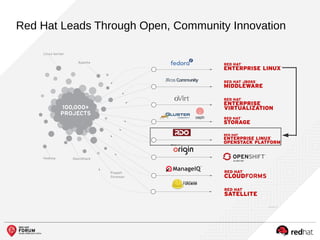
Red Hat Leads Through Open, Community Innovation
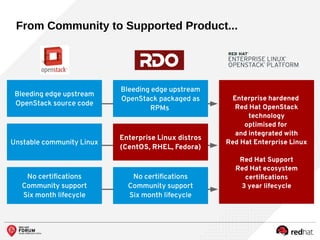
From Community to Supported Product...
Enterprise hardened
Red Hat OpenStack
technology
optimised for
and integrated with
Red Hat Enterprise Linux
Red Hat Support
Red Hat ecosystem
certifications
3 year lifecycle
Bleeding edge upstream
OpenStack source code
Unstable community Linux
No certifications
Community support
Six month lifecycle
Bleeding edge upstream
OpenStack packaged as
RPMs
Enterprise Linux distros
(CentOS, RHEL, Fedora)
No certifications
Community support
Six month lifecycle
OpenStack Release Cadence
● Upstream
– Source code Only
– Releases every 6 months
– 2 to 3 'snapshots' including bug fixes
– No more fixes/snapshots after next release
● RDO
– Follows upstream cadence
– Delivers binaries
OpenStack Release Cadence
● Red Hat Enterprise Linux OpenStack Platform
– 6 Month cadence
– Roughly 2 to 3 months AFTER upstream
● Time to stabilise, certify, backport etc.
– 3 year “production phase” lifecycle
● e.g., Support for Juno ends at the “P” release
– Will continue to increase lifecycle over time
● Based on upstream stability and resources
AM I READY FOR
OPENSTACK ?
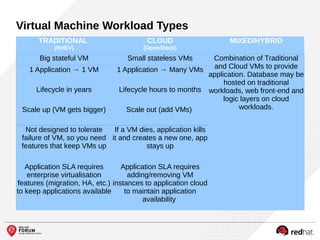
Virtual Machine Workload Types
TRADITIONAL
(RHEV)
CLOUD
(OpenStack)
MIXED/HYBRID
Big stateful VM Small stateless VMs Combination of Traditional
and Cloud VMs to provide
application. Database may be
hosted on traditional
workloads, web front-end and
logic layers on cloud
workloads.
1 Application → 1 VM 1 Application → Many VMs
Lifecycle in years Lifecycle hours to months
Scale up (VM gets bigger) Scale out (add VMs)
Not designed to tolerate
failure of VM, so you need
features that keep VMs up
If a VM dies, application kills
it and creates a new one, app
stays up
Application SLA requires
enterprise virtualisation
features (migration, HA, etc.)
to keep applications available
Application SLA requires
adding/removing VM
instances to application cloud
to maintain application
availability
WHAT'S COMING ?
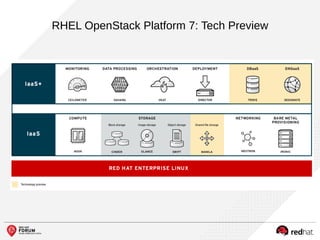
RHEL OpenStack Platform 7: Tech Preview
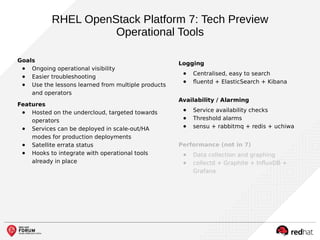
Operational Tools
Goals
● Ongoing operational visibility
● Easier troubleshooting
● Use the lessons learned from multiple products
and operators
Features
● Hosted on the undercloud, targeted towards
operators
● Services can be deployed in scale-out/HA
modes for production deployments
● Satellite errata status
● Hooks to integrate with operational tools
already in place
Logging
● Centralised, easy to search
● fluentd + ElasticSearch + Kibana
Availability / Alarming
● Service availability checks
● Threshold alarms
● sensu + rabbitmq + redis + uchiwa
Performance (not in 7)
● Data collection and graphing
● collectd + Graphite + InfluxDB +
Grafana
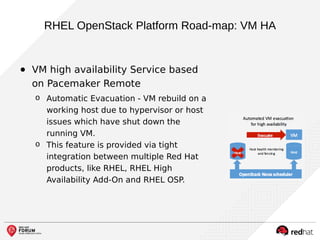
RHEL OpenStack Platform Road-map: VM HA
● VM high availability Service based
on Pacemaker Remote
o Automatic Evacuation - VM rebuild on a
working host due to hypervisor or host
issues which have shut down the
running VM.
o This feature is provided via tight
integration between multiple Red Hat
products, like RHEL, RHEL High
Availability Add-On and RHEL OSP.
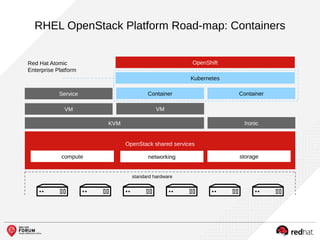
RHEL OpenStack Platform Road-map: Containers
standard hardware
OpenStack shared services
KVM Ironic
VM VM
Service Container Container
Kubernetes
OpenShiftRed Hat Atomic
Enterprise Platform
compute networking storage
SUPPORTING CLOUD
INFRASTRUCTURE
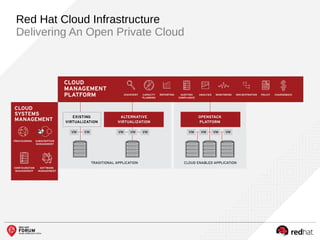
Red Hat Cloud Infrastructure
Delivering An Open Private Cloud
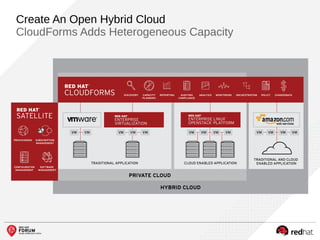
Create An Open Hybrid Cloud
CloudForms Adds Heterogeneous Capacity
STORAGE
NODE
COMPUTE
NODE + + + +
+ + + +
+
+
+
+
+
+
STORAGE APPLIANCE
COMPUTE
NODE +
+
+ + + +
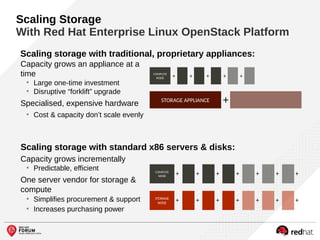
Scaling storage with traditional, proprietary appliances:
Scaling storage with standard x86 servers & disks:
Capacity grows incrementally
●
Predictable, efficient
One server vendor for storage &
compute
●
Simplifies procurement & support
●
Increases purchasing power
Capacity grows an appliance at a
time
●
Large one-time investment
●
Disruptive “forklift” upgrade
Specialised, expensive hardware
●
Cost & capacity don’t scale evenly
Scaling Storage
With Red Hat Enterprise Linux OpenStack Platform
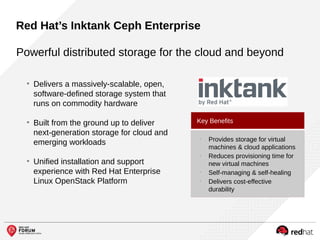
Powerful distributed storage for the cloud and beyond
●
Delivers a massively-scalable, open,
software-defined storage system that
runs on commodity hardware
●
Built from the ground up to deliver
next-generation storage for cloud and
emerging workloads
●
Unified installation and support
experience with Red Hat Enterprise
Linux OpenStack Platform
• Provides storage for virtual
machines & cloud applications
• Reduces provisioning time for
new virtual machines
• Self-managing & self-healing
• Delivers cost-effective
durability
Key Benefits
Red Hat’s Inktank Ceph Enterprise
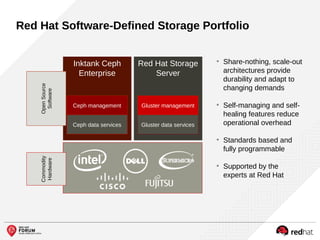
Inktank Ceph
Enterprise
Ceph data services
OpenSource
Software
Commodity
Hardware
Ceph management
Red Hat Storage
Server
Gluster data services
Gluster management
●
Share-nothing, scale-out
architectures provide
durability and adapt to
changing demands
●
Self-managing and self-
healing features reduce
operational overhead
●
Standards based and
fully programmable
●
Supported by the
experts at Red Hat
Red Hat Software-Defined Storage Portfolio
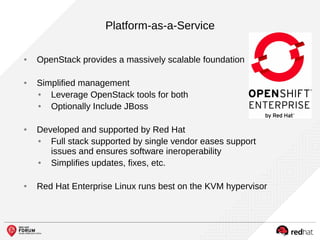
Platform-as-a-Service
● OpenStack provides a massively scalable foundation
● Simplified management
● Leverage OpenStack tools for both
● Optionally Include JBoss
● Developed and supported by Red Hat
● Full stack supported by single vendor eases support
issues and ensures software ineroperability
● Simplifies updates, fixes, etc.
● Red Hat Enterprise Linux runs best on the KVM hypervisor
Red Hat Cloud Services
● Training
– RH318 Red Hat Enterprise Virtualisation Administration
– CL210 Red Hat OpenStack Administration
– CL220R Red Hat CloudForms Administration
– CL310 Red Hat OpenStack Administration II
● Certification
– Red Hat Certified Virtualisation Administrator (RHCVA)
– Red Hat Certificate of Expertise in OpenStack IaaS
– Red Hat Certified Engineer in Red Hat OpenStack
● Consulting
– Red Hat Enterprise Virtualisation Accelerator
– Red Hat Enterprise Linux OpenStack Platform Accelerator
– Red Hat Open IaaS Architecture Service
NEXT STEPS...
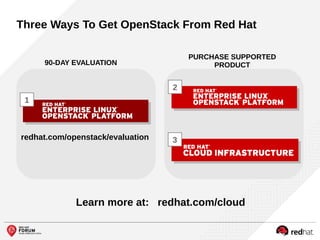
Three Ways To Get OpenStack From Red Hat
2
3
1
PURCHASE SUPPORTED
PRODUCT90-DAY EVALUATION
redhat.com/openstack/evaluation
Learn more at: redhat.com/cloud
QUESTIONS ?
The Next Generation Datacenter

The Next Generation Datacenter

  • 1.
    THE NEXT GENERATION DATA-CENTRE ScalableInfrastructure with Red Hat Enterprise OpenStack Platform Gavin McDougall Senior Solution Architect
  • 2.
    AGENDA ● I.T. Challenges ●What is OpenStack ? ● Why OpenStack ? ● Why Red Hat ? ● Community Contributions ● Am I ready for OpenStack ? ● What's coming ? ● Supporting Cloud Infrastructure ● Next Steps ● Questions
  • 3.
    I.T. Challenges inEnterprise Businesses
  • 4.
    EXISTING EMERGING ● Dynamicapplications that scale to meet demand ● Open source is well understood and widely adopted ● Software-defined infrastructure across compute, networking, and storage ● Compressed innovation cycle ● IT as a competitive advantage ● Applications with predictable usage models ● Open source perceived as unknown and risky ● Compute-centric infrastructure ● Long innovation cycle ● IT as a cost center Seismic Shift in Enterprise IT Driven by IT “Consumerisation”
  • 5.
    Application demands arebecoming more complex Application infrastructure is becoming more diverse IMMEDIATE PERVASIVE AWARE CLOUD MOBILE INTERNET OF THINGS BIG DATA AUTOMATION ABSTRACTION Application Development is Changing in Response
  • 6.
    Challenges With ATraditional Infrastructure ● Our data is too large – We're producing vast amounts of data, exponentially! – Way past the ability of traditional systems & applications – Scaling UP no longer works. Scaling OUT is a necessity ● Service requests are too large – More and more client devices coming online ● Mobile phones, tablets, etc. – Much harder to maintain service to customers ● Applications weren't written to cope with demand
  • 7.
  • 8.
    Cloud Infrastructure ForCloud-Enabled Workloads ● Modular architecture ● Designed to easily scale out ● Based on (growing) set of core services
  • 9.
    Why OpenStack? ● Bringspublic cloud-like capabilities into your data-centre ● Provides massive on-demand (scale-out) capacity – 1,000's → 10,000's → 100k's of VMs ● Removes vendor lock-in – Open source provides high-degree of flexibility to customise and interoperate ● Community development = higher “feature velocity” – Features and functions you need, faster to market over proprietary software
  • 10.
    ● Top OpenStackPriorities ● 44% Increased emphasis on certified hardware ● 44% commercial OpenStack support ● 43% integration with open source management initiatives Source: IDC Red Hat Hybrid Cloud Management Survey, October 2014 Plan to use OpenStack APIs to enable management integration across infrastructure Expect vendors will leverage OpenStack in next-generation products Will implement a 100% OpenStack Cloud Unsure 43% 27% 11% 12% 18% What Role Does OpenStack Have in Your Cloud Strategy?
  • 11.
  • 12.
    OpenStack: Framework forthe Cloud ● Needs to access x86 hardware resources ● Needs an operating environment, hypervisor, services ● Leverages existing code libraries for functionality
  • 13.
    Red Hat EnterpriseLinux OpenStack Platform ● It is dependent on the underlying Linux ● Optimised and Co-Engineered with Red Hat Enterprise Linux
  • 14.
    A typical OpenStackcloud is made up of at least 9 core services + plugins to interact with 3rd party systems ● These services run on top of a Linux distribution with a complex set of user space integration dependencies ● OpenStack cannot be productised as a stand alone layer ● A supported, stable platform requires integration and testing of each of the components “If your Windows virtual machine hosted by a KVM hypervisor running on an IBM blade, connecting to an EMC storage array through an Emulex HBA has issues with storage corruption, who do you call?” The Importance of Integration with Linux Red Hat Supported Guests OpenStack KVM RHEL Hardware
  • 15.
    ● Virtualization –guest performance, reliability and Windows ● Security - SELinux enforcing guest isolation ● Network – SDN/OVS performance optimized ● Storage – vendor plugins, performance, thin provisioning ● Ecosystem – certification of hardware, storage and networks Red Hat Enterprise Linux: Optimized Enablers for OpenStack Linux Kernel Security Enhanced Linux (SELinux) KVM Network Stack Device Drivers Red Hat Supported Guests OpenStack KVM RHEL Hardware
  • 16.
    Red Hat EnterpriseOpenStack Platform: A Complete Solution
  • 17.
    Installation & Stability ●Intuitive “wizard-style” graphical installer ● Ensures a production-ready environment ● Enables high availability (HA) across controller and compute nodes (including networking in “active-active”) – Automatically Utilises Fencing as containment mechanism ● Includes Ceph client support for storage backends – Supports multiple Cinder storage volume setup/config ● Optional support for Cisco Nexus 1000v
  • 18.
    Red Hat Enterprise VirtualisationHypervisor *Red Hat Enterprise Linux KVM ● Lightweight / small footprint ● Less overhead ● Smaller attack surface ● Cost effective ● Closer to operating system DNA ● Provides massive scale-out capabilities ● Maximum benefit with virtualised Linux VMware vSphere *vCenter Driver ● Co-exist with existing infrastructure assets ● Provides a seamless path to future migration to OpenStack ● Uses NSX1 plugin for Neutron 1 NSX is only supported in production environments, per VMware's support requirements *ESXi driver not supported Red Hat Enterprise Linux OpenStack Platform Hypervisor Support
  • 19.
    ●Red Hat EnterpriseLinux 3 ●Red Hat Enterprise Linux 4 ●Red Hat Enterprise Linux 5 ●Red Hat Enterprise Linux 6 ●Red Hat Enterprise Linux 7 *32 and 64 bit for all versions ●SUSE Linux Enterprise Server 10 ●SUSE Linux Enterprise Server 11 *32 and 64 bit for all versions ● Windows XP SP3+1 ●Windows 73 ● Windows 83 Microsoft SVVP Certified ●Windows Server 2003 SP2+3 ● Windows Server 20083 ● Windows Server 2008 R22 ● Windows Server 20122 1 32 bit only 2 64 bit only 3 32 and 64 bit Red Hat Enterprise Linux OpenStack Platform Virtual Guest Support
  • 20.
    OEMs and IHVsISVs Cloud Service ProvidersSystem Integrators Channel PartnersManaged Service Providers ● Over 275+ members since launch in April 2013 ● Over 900 certified solutions in partner Marketplace ● Over 4,000 RHEL certified compute servers ● Over 13,000 applications available on RHEL ● Large catalog of Windows certified applications Red Hat OpenStack Cloud Infrastructure Partner Network World's Largest OpenStack Partner Ecosystem
  • 21.
    Why Red HatEnterprise Linux OpenStack Platform? ● All the value of community OpenStack and... – Enterprise hardened code – Co-engineered and integrated with Red Hat Enterprise Linux – Graphical Installer ensuring production-ready deployment – 3 year “production phase” software lifecycle – World-class global support – Worlds largest OpenStack partner ecosystem – OpenStack training, certification, and professional services – Integrated with a trusted solution stack ● Red Hat Enterprise Linux ● Red Hat CloudForms ● Red Hat Enterprise Virtualization ● Red Hat Storage (Ceph and Gluster) ● OpenShift by Red Hat (PaaS)
  • 22.
  • 23.
  • 24.
    Red Hat CommunityContribution Source: Bitergia http://activity.openstack.org/dash/browser/scm-companies.html?release=juno Stakalytics http://stackalytics.com/?release=juno&company=red%20hat ● Top Contributor to Juno Release (incl. Inktank & eNovance) Overall commits per company (aggregated) Red Hat community contributions to projects 0 500 1000 1500 2000 2500 3000 Red Hat HP IBM Mirantis Rackspace SUSE OpenStack Foundation VMware 20.92% 18.48% 23.98% 6.76% 24.86% 27.35% 7.38% 5.44% 15.78% 5.39% Nova Horizon Heat Neutron Ceilometer Sahara Keystone Cinder Swift Glance
  • 25.
    Red Hat's OpenStackLeadership Why Do These Statistics Matter? ● Proof that with Red Hat's near 20 year history in open source, we have the experience and resources to: ● Support production-ready customers globally ● Drive new features ● Influence strategy and direction of project ● Enable partner collaboration ● Wide ranging participation, contrasts with most others who are more narrowly focused ● All of these efforts allows us to create an enterprise-grade distribution with ecosystem, lifecycle, and support that customers expect from Red Hat
  • 26.
    Red Hat LeadsThrough Open, Community Innovation
  • 27.
    From Community toSupported Product... Enterprise hardened Red Hat OpenStack technology optimised for and integrated with Red Hat Enterprise Linux Red Hat Support Red Hat ecosystem certifications 3 year lifecycle Bleeding edge upstream OpenStack source code Unstable community Linux No certifications Community support Six month lifecycle Bleeding edge upstream OpenStack packaged as RPMs Enterprise Linux distros (CentOS, RHEL, Fedora) No certifications Community support Six month lifecycle
  • 28.
    OpenStack Release Cadence ●Upstream – Source code Only – Releases every 6 months – 2 to 3 'snapshots' including bug fixes – No more fixes/snapshots after next release ● RDO – Follows upstream cadence – Delivers binaries
  • 29.
    OpenStack Release Cadence ●Red Hat Enterprise Linux OpenStack Platform – 6 Month cadence – Roughly 2 to 3 months AFTER upstream ● Time to stabilise, certify, backport etc. – 3 year “production phase” lifecycle ● e.g., Support for Juno ends at the “P” release – Will continue to increase lifecycle over time ● Based on upstream stability and resources
  • 30.
    AM I READYFOR OPENSTACK ?
  • 31.
    Virtual Machine WorkloadTypes TRADITIONAL (RHEV) CLOUD (OpenStack) MIXED/HYBRID Big stateful VM Small stateless VMs Combination of Traditional and Cloud VMs to provide application. Database may be hosted on traditional workloads, web front-end and logic layers on cloud workloads. 1 Application → 1 VM 1 Application → Many VMs Lifecycle in years Lifecycle hours to months Scale up (VM gets bigger) Scale out (add VMs) Not designed to tolerate failure of VM, so you need features that keep VMs up If a VM dies, application kills it and creates a new one, app stays up Application SLA requires enterprise virtualisation features (migration, HA, etc.) to keep applications available Application SLA requires adding/removing VM instances to application cloud to maintain application availability
  • 32.
  • 33.
    RHEL OpenStack Platform7: Tech Preview
  • 34.
    RHEL OpenStack Platform7: Tech Preview Operational Tools Goals ● Ongoing operational visibility ● Easier troubleshooting ● Use the lessons learned from multiple products and operators Features ● Hosted on the undercloud, targeted towards operators ● Services can be deployed in scale-out/HA modes for production deployments ● Satellite errata status ● Hooks to integrate with operational tools already in place Logging ● Centralised, easy to search ● fluentd + ElasticSearch + Kibana Availability / Alarming ● Service availability checks ● Threshold alarms ● sensu + rabbitmq + redis + uchiwa Performance (not in 7) ● Data collection and graphing ● collectd + Graphite + InfluxDB + Grafana
  • 35.
    RHEL OpenStack PlatformRoad-map: VM HA ● VM high availability Service based on Pacemaker Remote o Automatic Evacuation - VM rebuild on a working host due to hypervisor or host issues which have shut down the running VM. o This feature is provided via tight integration between multiple Red Hat products, like RHEL, RHEL High Availability Add-On and RHEL OSP.
  • 36.
    RHEL OpenStack PlatformRoad-map: Containers standard hardware OpenStack shared services KVM Ironic VM VM Service Container Container Kubernetes OpenShiftRed Hat Atomic Enterprise Platform compute networking storage
  • 37.
  • 38.
    Red Hat CloudInfrastructure Delivering An Open Private Cloud
  • 39.
    Create An OpenHybrid Cloud CloudForms Adds Heterogeneous Capacity
  • 40.
    STORAGE NODE COMPUTE NODE + ++ + + + + + + + + + + + STORAGE APPLIANCE COMPUTE NODE + + + + + + Scaling storage with traditional, proprietary appliances: Scaling storage with standard x86 servers & disks: Capacity grows incrementally ● Predictable, efficient One server vendor for storage & compute ● Simplifies procurement & support ● Increases purchasing power Capacity grows an appliance at a time ● Large one-time investment ● Disruptive “forklift” upgrade Specialised, expensive hardware ● Cost & capacity don’t scale evenly Scaling Storage With Red Hat Enterprise Linux OpenStack Platform
  • 41.
    Powerful distributed storagefor the cloud and beyond ● Delivers a massively-scalable, open, software-defined storage system that runs on commodity hardware ● Built from the ground up to deliver next-generation storage for cloud and emerging workloads ● Unified installation and support experience with Red Hat Enterprise Linux OpenStack Platform • Provides storage for virtual machines & cloud applications • Reduces provisioning time for new virtual machines • Self-managing & self-healing • Delivers cost-effective durability Key Benefits Red Hat’s Inktank Ceph Enterprise
  • 42.
    Inktank Ceph Enterprise Ceph dataservices OpenSource Software Commodity Hardware Ceph management Red Hat Storage Server Gluster data services Gluster management ● Share-nothing, scale-out architectures provide durability and adapt to changing demands ● Self-managing and self- healing features reduce operational overhead ● Standards based and fully programmable ● Supported by the experts at Red Hat Red Hat Software-Defined Storage Portfolio
  • 43.
    Platform-as-a-Service ● OpenStack providesa massively scalable foundation ● Simplified management ● Leverage OpenStack tools for both ● Optionally Include JBoss ● Developed and supported by Red Hat ● Full stack supported by single vendor eases support issues and ensures software ineroperability ● Simplifies updates, fixes, etc. ● Red Hat Enterprise Linux runs best on the KVM hypervisor
  • 44.
    Red Hat CloudServices ● Training – RH318 Red Hat Enterprise Virtualisation Administration – CL210 Red Hat OpenStack Administration – CL220R Red Hat CloudForms Administration – CL310 Red Hat OpenStack Administration II ● Certification – Red Hat Certified Virtualisation Administrator (RHCVA) – Red Hat Certificate of Expertise in OpenStack IaaS – Red Hat Certified Engineer in Red Hat OpenStack ● Consulting – Red Hat Enterprise Virtualisation Accelerator – Red Hat Enterprise Linux OpenStack Platform Accelerator – Red Hat Open IaaS Architecture Service
  • 45.
  • 46.
    Three Ways ToGet OpenStack From Red Hat 2 3 1 PURCHASE SUPPORTED PRODUCT90-DAY EVALUATION redhat.com/openstack/evaluation Learn more at: redhat.com/cloud
  • 48.