10/28/2024
1
Artificial Intelligence
Reasoning and Knowledge Representation
Lecture # 2
Fall 2024
By. Dr. Shahzad Ashraf
Associate Professor
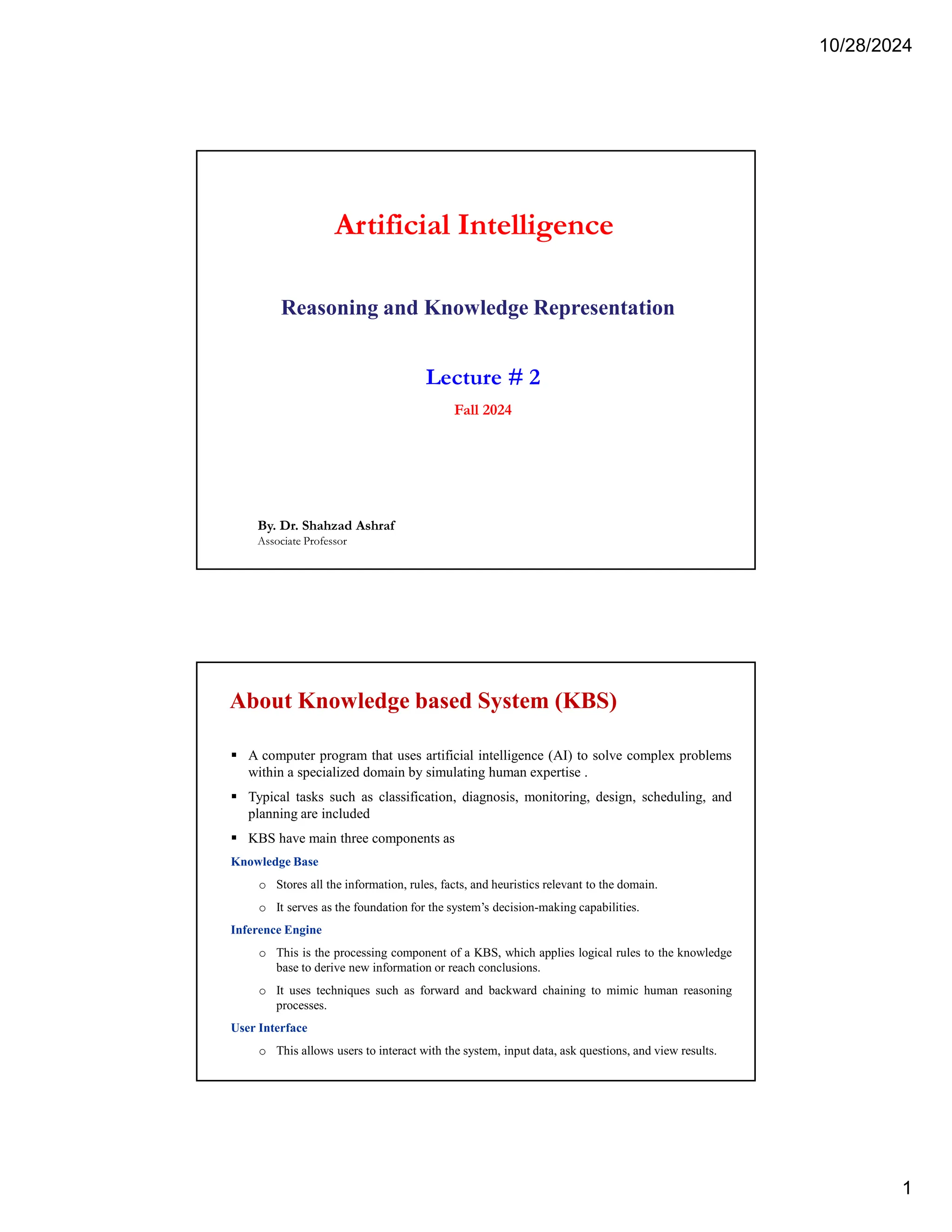
About Knowledge based System (KBS)
 A computer program that uses artificial intelligence (AI) to solve complex problems
within a specialized domain by simulating human expertise .
 Typical tasks such as classification, diagnosis, monitoring, design, scheduling, and
planning are included
 KBS have main three components as
Knowledge Base
o Stores all the information, rules, facts, and heuristics relevant to the domain.
o It serves as the foundation for the system’s decision-making capabilities.
Inference Engine
o This is the processing component of a KBS, which applies logical rules to the knowledge
base to derive new information or reach conclusions.
o It uses techniques such as forward and backward chaining to mimic human reasoning
processes.
User Interface
o This allows users to interact with the system, input data, ask questions, and view results.
10/28/2024
2
Introduction to Reasoning and
Knowledge Representation (KR, KRR)
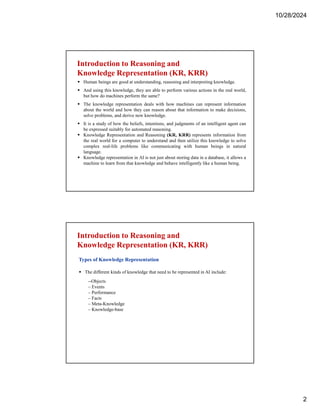
 Human beings are good at understanding, reasoning and interpreting knowledge.
 And using this knowledge, they are able to perform various actions in the real world,
but how do machines perform the same?
 The knowledge representation deals with how machines can represent information
about the world and how they can reason about that information to make decisions,
solve problems, and derive new knowledge.
 It is a study of how the beliefs, intentions, and judgments of an intelligent agent can
be expressed suitably for automated reasoning.
 Knowledge Representation and Reasoning (KR, KRR) represents information from
the real world for a computer to understand and then utilize this knowledge to solve
complex real-life problems like communicating with human beings in natural
language.
 Knowledge representation in AI is not just about storing data in a database, it allows a
machine to learn from that knowledge and behave intelligently like a human being.
Introduction to Reasoning and
Knowledge Representation (KR, KRR)
Types of Knowledge Representation
 The different kinds of knowledge that need to be represented in AI include:
--Objects
– Events
– Performance
– Facts
– Meta-Knowledge
– Knowledge-base
10/28/2024
3
Introduction to Reasoning and
Knowledge Representation (KR, KRR)
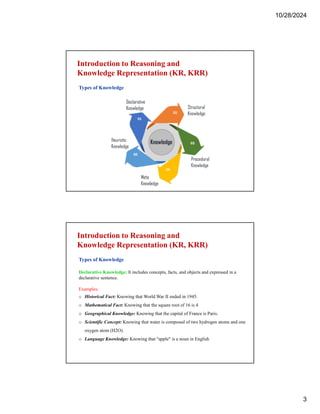
Types of Knowledge
Introduction to Reasoning and
Knowledge Representation (KR, KRR)
Types of Knowledge
Declarative Knowledge: It includes concepts, facts, and objects and expressed in a
declarative sentence.
Examples:
o Historical Fact: Knowing that World War II ended in 1945.
o Mathematical Fact: Knowing that the square root of 16 is 4
o Geographical Knowledge: Knowing that the capital of France is Paris.
o Scientific Concept: Knowing that water is composed of two hydrogen atoms and one
oxygen atom (H2O).
o Language Knowledge: Knowing that "apple" is a noun in English
10/28/2024
4
Introduction to Reasoning and
Knowledge Representation (KR, KRR)
Types of Knowledge
Structural Knowledge: It is a basic problem-solving knowledge that describes the
relationship between concepts and objects. refers to the understanding of how different
pieces of knowledge are related to each other. It involves recognizing the connections,
patterns, and frameworks that link various concepts, facts, or ideas.
Examples:
o Concept Maps: Understanding how different concepts within a subject, like biology,
are related. Such as, knowing how the concepts of cell, organ, tissue, and organism
are interrelated within the hierarchy of biological organization.
o Cause-and-Effect Relationships: Understanding how an economic policy change can
lead to inflation or deflation. This involves recognizing the cause (policy change) and
the effects (economic conditions).
o Network Diagrams in Computer Science: Understanding how different components
of a computer network are connected, including servers, routers, and clients, and how
data flows between them.
Introduction to Reasoning and
Knowledge Representation (KR, KRR)
Types of Knowledge
Procedural Knowledge: This is responsible for knowing how to do something and
includes rules, strategies, procedures, etc.
Examples:
o Driving a Car: Knowing how to operate a vehicle, including how to start the engine,
shift gears, steer, brake, and follow traffic rules.
o Cooking a Recipe: Understanding the steps involved in preparing a specific dish,
such as chopping ingredients, mixing them in the right order, and cooking them at the
correct temperature.
o Conducting a Scientific Experiment: Following a step-by-step procedure to test a
hypothesis, including setting up equipment, collecting data, and analyzing results.
10/28/2024
5
Introduction to Reasoning and
Knowledge Representation (KR, KRR)
Types of Knowledge
Meta Knowledge: It defines knowledge about other types of Knowledge.
Examples:
o Awareness of Learning Styles: Knowing whether you learn better through visual aids,
reading, or hands-on experience. For instance, recognizing that you understand
concepts more easily when you draw diagrams rather than just reading text.
o Self-Monitoring: Being aware of when you don’t fully understand a concept and
recognizing the need to review the material again or seek help. Such as, realizing that
you're confused during a lecture and deciding to ask questions or revisit the topic
later.
o Strategic Planning: Knowing which study techniques work best for you, such as
breaking down a large project into smaller tasks and scheduling regular study sessions
instead of cramming the night before an exam.
Introduction to Reasoning and
Knowledge Representation (KR, KRR)
Types of Knowledge
Heuristic Knowledge: It defines knowledge about other types of Knowledge. Unlike
algorithms, which provide a step-by-step procedure to guarantee a solution, heuristics
offer a more flexible and faster way to reach a satisfactory solution, often through trial
and error or by relying on intuition.
Examples:
o Trial and Error: When assembling furniture without following the instructions, you
might try different pieces together until they fit, rather than reading through the entire
manual.
o Rule of Thumb: "Measure twice, cut once" is a common heuristic in carpentry,
advising careful planning before taking irreversible actions.
o Educated Guess: In multiple-choice tests, you might eliminate obviously wrong
answers first to increase the chances of guessing correctly among the remaining
options.
10/28/2024
6
Introduction to Reasoning and
Knowledge Representation (KR, KRR)
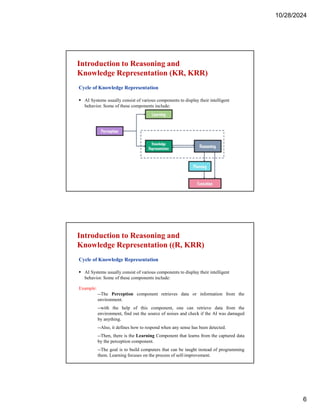
Cycle of Knowledge Representation
 AI Systems usually consist of various components to display their intelligent
behavior. Some of these components include:
Introduction to Reasoning and
Knowledge Representation ((R, KRR)
Cycle of Knowledge Representation
 AI Systems usually consist of various components to display their intelligent
behavior. Some of these components include:
Example:
--The Perception component retrieves data or information from the
environment.
--with the help of this component, one can retrieve data from the
environment, find out the source of noises and check if the AI was damaged
by anything.
--Also, it defines how to respond when any sense has been detected.
--Then, there is the Learning Component that learns from the captured data
by the perception component.
--The goal is to build computers that can be taught instead of programming
them. Learning focuses on the process of self-improvement.
10/28/2024
7
Introduction to Reasoning and
Knowledge Representation ((R, KRR)
Cycle of Knowledge Representation
Example:
--In order to learn new things, the system requires knowledge
acquisition, inference, acquisition of heuristics, faster searches, etc.
--The main component in the cycle is Knowledge Representation and
Reasoning which shows the human like intelligence in the machines.
--Knowledge representation is all about understanding intelligence.
--Instead of trying to understand or build brains from the bottom up, its goal
is to understand and build intelligent behavior from the top-down and focus
on what an agent needs to know in order to behave intelligently.
--Also, it defines how automated reasoning procedures can make this
knowledge available as needed.
--The Planning and Execution components depend on the analysis of
knowledge representation and reasoning.
Introduction to Reasoning and
Knowledge Representation (KR, KRR)
Cycle of Knowledge Representation
Example:
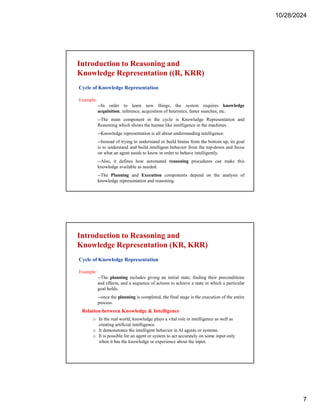
--The planning includes giving an initial state, finding their preconditions
and effects, and a sequence of actions to achieve a state in which a particular
goal holds.
--once the planning is completed, the final stage is the execution of the entire
process.
Relation between Knowledge & Intelligence
o In the real world, knowledge plays a vital role in intelligence as well as
creating artificial intelligence.
o It demonstrates the intelligent behavior in AI agents or systems.
o It is possible for an agent or system to act accurately on some input only
when it has the knowledge or experience about the input.
10/28/2024
8
Introduction to Reasoning and
Knowledge Representation (KR, KRR)
Relation between Knowledge & Intelligence
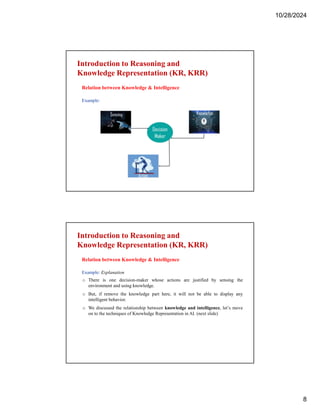
Example:
Introduction to Reasoning and
Knowledge Representation (KR, KRR)
Relation between Knowledge & Intelligence
Example: Explanation
o There is one decision-maker whose actions are justified by sensing the
environment and using knowledge.
o But, if remove the knowledge part here, it will not be able to display any
intelligent behavior.
o We discussed the relationship between knowledge and intelligence, let’s move
on to the techniques of Knowledge Representation in AI. (next slide)
10/28/2024
9
Introduction to Reasoning and
Knowledge Representation (KR, KRR)
Knowledge representation in AI
Introduction to Reasoning and
Knowledge Representation (KR, KRR)
Knowledge representation in AI
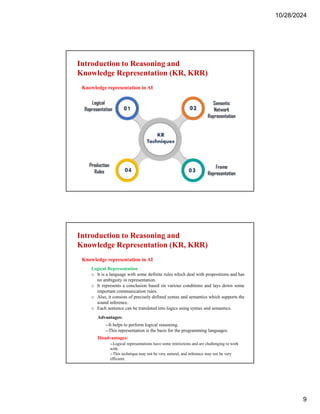
Logical Representation
o It is a language with some definite rules which deal with propositions and has
no ambiguity in representation.
o It represents a conclusion based on various conditions and lays down some
important communication rules.
o Also, it consists of precisely defined syntax and semantics which supports the
sound inference.
o Each sentence can be translated into logics using syntax and semantics.
Advantages:
--It helps to perform logical reasoning.
--This representation is the basis for the programming languages.
Disadvantages:
--Logical representations have some restrictions and are challenging to work
with.
--This technique may not be very natural, and inference may not be very
efficient.
10/28/2024
10
Introduction to Reasoning and
Knowledge Representation (KR, KRR)
Knowledge representation in AI
Semantic Network Representation
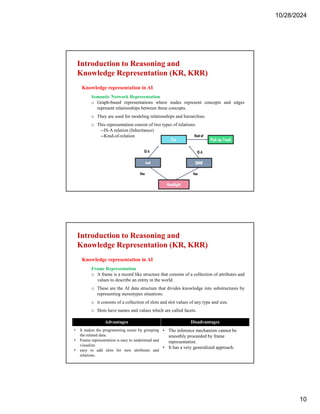
o Graph-based representations where nodes represent concepts and edges
represent relationships between these concepts.
o They are used for modeling relationships and hierarchies.
o This representation consist of two types of relations:
--IS-A relation (Inheritance)
--Kind-of-relation
Introduction to Reasoning and
Knowledge Representation (KR, KRR)
Knowledge representation in AI
Frame Representation
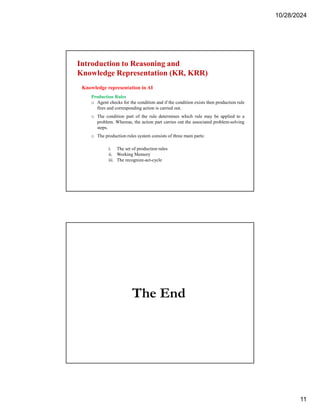
o A frame is a record like structure that consists of a collection of attributes and
values to describe an entity in the world.
o These are the AI data structure that divides knowledge into substructures by
representing stereotypes situations.
o it consists of a collection of slots and slot values of any type and size.
o Slots have names and values which are called facets.
Advantages Disadvantages
• It makes the programming easier by grouping
the related data.
• Frame representation is easy to understand and
visualize.
• easy to add slots for new attributes and
relations.
• The inference mechanism cannot be
smoothly proceeded by frame
representation.
• It has a very generalized approach.
10/28/2024
11
Introduction to Reasoning and
Knowledge Representation (KR, KRR)
Knowledge representation in AI
Production Rules
o Agent checks for the condition and if the condition exists then production rule
fires and corresponding action is carried out.
o The condition part of the rule determines which rule may be applied to a
problem. Whereas, the action part carries out the associated problem-solving
steps.
o The production rules system consists of three main parts:
i. The set of production rules
ii. Working Memory
iii. The recognize-act-cycle
The End

Lecture 2-Introduction to Reasoning and Knowledge Representation.pdf

  • 1.
    10/28/2024 1 Artificial Intelligence Reasoning andKnowledge Representation Lecture # 2 Fall 2024 By. Dr. Shahzad Ashraf Associate Professor About Knowledge based System (KBS)  A computer program that uses artificial intelligence (AI) to solve complex problems within a specialized domain by simulating human expertise .  Typical tasks such as classification, diagnosis, monitoring, design, scheduling, and planning are included  KBS have main three components as Knowledge Base o Stores all the information, rules, facts, and heuristics relevant to the domain. o It serves as the foundation for the system’s decision-making capabilities. Inference Engine o This is the processing component of a KBS, which applies logical rules to the knowledge base to derive new information or reach conclusions. o It uses techniques such as forward and backward chaining to mimic human reasoning processes. User Interface o This allows users to interact with the system, input data, ask questions, and view results.
  • 2.
    10/28/2024 2 Introduction to Reasoningand Knowledge Representation (KR, KRR)  Human beings are good at understanding, reasoning and interpreting knowledge.  And using this knowledge, they are able to perform various actions in the real world, but how do machines perform the same?  The knowledge representation deals with how machines can represent information about the world and how they can reason about that information to make decisions, solve problems, and derive new knowledge.  It is a study of how the beliefs, intentions, and judgments of an intelligent agent can be expressed suitably for automated reasoning.  Knowledge Representation and Reasoning (KR, KRR) represents information from the real world for a computer to understand and then utilize this knowledge to solve complex real-life problems like communicating with human beings in natural language.  Knowledge representation in AI is not just about storing data in a database, it allows a machine to learn from that knowledge and behave intelligently like a human being. Introduction to Reasoning and Knowledge Representation (KR, KRR) Types of Knowledge Representation  The different kinds of knowledge that need to be represented in AI include: --Objects – Events – Performance – Facts – Meta-Knowledge – Knowledge-base
  • 3.
    10/28/2024 3 Introduction to Reasoningand Knowledge Representation (KR, KRR) Types of Knowledge Introduction to Reasoning and Knowledge Representation (KR, KRR) Types of Knowledge Declarative Knowledge: It includes concepts, facts, and objects and expressed in a declarative sentence. Examples: o Historical Fact: Knowing that World War II ended in 1945. o Mathematical Fact: Knowing that the square root of 16 is 4 o Geographical Knowledge: Knowing that the capital of France is Paris. o Scientific Concept: Knowing that water is composed of two hydrogen atoms and one oxygen atom (H2O). o Language Knowledge: Knowing that "apple" is a noun in English
  • 4.
    10/28/2024 4 Introduction to Reasoningand Knowledge Representation (KR, KRR) Types of Knowledge Structural Knowledge: It is a basic problem-solving knowledge that describes the relationship between concepts and objects. refers to the understanding of how different pieces of knowledge are related to each other. It involves recognizing the connections, patterns, and frameworks that link various concepts, facts, or ideas. Examples: o Concept Maps: Understanding how different concepts within a subject, like biology, are related. Such as, knowing how the concepts of cell, organ, tissue, and organism are interrelated within the hierarchy of biological organization. o Cause-and-Effect Relationships: Understanding how an economic policy change can lead to inflation or deflation. This involves recognizing the cause (policy change) and the effects (economic conditions). o Network Diagrams in Computer Science: Understanding how different components of a computer network are connected, including servers, routers, and clients, and how data flows between them. Introduction to Reasoning and Knowledge Representation (KR, KRR) Types of Knowledge Procedural Knowledge: This is responsible for knowing how to do something and includes rules, strategies, procedures, etc. Examples: o Driving a Car: Knowing how to operate a vehicle, including how to start the engine, shift gears, steer, brake, and follow traffic rules. o Cooking a Recipe: Understanding the steps involved in preparing a specific dish, such as chopping ingredients, mixing them in the right order, and cooking them at the correct temperature. o Conducting a Scientific Experiment: Following a step-by-step procedure to test a hypothesis, including setting up equipment, collecting data, and analyzing results.
  • 5.
    10/28/2024 5 Introduction to Reasoningand Knowledge Representation (KR, KRR) Types of Knowledge Meta Knowledge: It defines knowledge about other types of Knowledge. Examples: o Awareness of Learning Styles: Knowing whether you learn better through visual aids, reading, or hands-on experience. For instance, recognizing that you understand concepts more easily when you draw diagrams rather than just reading text. o Self-Monitoring: Being aware of when you don’t fully understand a concept and recognizing the need to review the material again or seek help. Such as, realizing that you're confused during a lecture and deciding to ask questions or revisit the topic later. o Strategic Planning: Knowing which study techniques work best for you, such as breaking down a large project into smaller tasks and scheduling regular study sessions instead of cramming the night before an exam. Introduction to Reasoning and Knowledge Representation (KR, KRR) Types of Knowledge Heuristic Knowledge: It defines knowledge about other types of Knowledge. Unlike algorithms, which provide a step-by-step procedure to guarantee a solution, heuristics offer a more flexible and faster way to reach a satisfactory solution, often through trial and error or by relying on intuition. Examples: o Trial and Error: When assembling furniture without following the instructions, you might try different pieces together until they fit, rather than reading through the entire manual. o Rule of Thumb: "Measure twice, cut once" is a common heuristic in carpentry, advising careful planning before taking irreversible actions. o Educated Guess: In multiple-choice tests, you might eliminate obviously wrong answers first to increase the chances of guessing correctly among the remaining options.
  • 6.
    10/28/2024 6 Introduction to Reasoningand Knowledge Representation (KR, KRR) Cycle of Knowledge Representation  AI Systems usually consist of various components to display their intelligent behavior. Some of these components include: Introduction to Reasoning and Knowledge Representation ((R, KRR) Cycle of Knowledge Representation  AI Systems usually consist of various components to display their intelligent behavior. Some of these components include: Example: --The Perception component retrieves data or information from the environment. --with the help of this component, one can retrieve data from the environment, find out the source of noises and check if the AI was damaged by anything. --Also, it defines how to respond when any sense has been detected. --Then, there is the Learning Component that learns from the captured data by the perception component. --The goal is to build computers that can be taught instead of programming them. Learning focuses on the process of self-improvement.
  • 7.
    10/28/2024 7 Introduction to Reasoningand Knowledge Representation ((R, KRR) Cycle of Knowledge Representation Example: --In order to learn new things, the system requires knowledge acquisition, inference, acquisition of heuristics, faster searches, etc. --The main component in the cycle is Knowledge Representation and Reasoning which shows the human like intelligence in the machines. --Knowledge representation is all about understanding intelligence. --Instead of trying to understand or build brains from the bottom up, its goal is to understand and build intelligent behavior from the top-down and focus on what an agent needs to know in order to behave intelligently. --Also, it defines how automated reasoning procedures can make this knowledge available as needed. --The Planning and Execution components depend on the analysis of knowledge representation and reasoning. Introduction to Reasoning and Knowledge Representation (KR, KRR) Cycle of Knowledge Representation Example: --The planning includes giving an initial state, finding their preconditions and effects, and a sequence of actions to achieve a state in which a particular goal holds. --once the planning is completed, the final stage is the execution of the entire process. Relation between Knowledge & Intelligence o In the real world, knowledge plays a vital role in intelligence as well as creating artificial intelligence. o It demonstrates the intelligent behavior in AI agents or systems. o It is possible for an agent or system to act accurately on some input only when it has the knowledge or experience about the input.
  • 8.
    10/28/2024 8 Introduction to Reasoningand Knowledge Representation (KR, KRR) Relation between Knowledge & Intelligence Example: Introduction to Reasoning and Knowledge Representation (KR, KRR) Relation between Knowledge & Intelligence Example: Explanation o There is one decision-maker whose actions are justified by sensing the environment and using knowledge. o But, if remove the knowledge part here, it will not be able to display any intelligent behavior. o We discussed the relationship between knowledge and intelligence, let’s move on to the techniques of Knowledge Representation in AI. (next slide)
  • 9.
    10/28/2024 9 Introduction to Reasoningand Knowledge Representation (KR, KRR) Knowledge representation in AI Introduction to Reasoning and Knowledge Representation (KR, KRR) Knowledge representation in AI Logical Representation o It is a language with some definite rules which deal with propositions and has no ambiguity in representation. o It represents a conclusion based on various conditions and lays down some important communication rules. o Also, it consists of precisely defined syntax and semantics which supports the sound inference. o Each sentence can be translated into logics using syntax and semantics. Advantages: --It helps to perform logical reasoning. --This representation is the basis for the programming languages. Disadvantages: --Logical representations have some restrictions and are challenging to work with. --This technique may not be very natural, and inference may not be very efficient.
  • 10.
    10/28/2024 10 Introduction to Reasoningand Knowledge Representation (KR, KRR) Knowledge representation in AI Semantic Network Representation o Graph-based representations where nodes represent concepts and edges represent relationships between these concepts. o They are used for modeling relationships and hierarchies. o This representation consist of two types of relations: --IS-A relation (Inheritance) --Kind-of-relation Introduction to Reasoning and Knowledge Representation (KR, KRR) Knowledge representation in AI Frame Representation o A frame is a record like structure that consists of a collection of attributes and values to describe an entity in the world. o These are the AI data structure that divides knowledge into substructures by representing stereotypes situations. o it consists of a collection of slots and slot values of any type and size. o Slots have names and values which are called facets. Advantages Disadvantages • It makes the programming easier by grouping the related data. • Frame representation is easy to understand and visualize. • easy to add slots for new attributes and relations. • The inference mechanism cannot be smoothly proceeded by frame representation. • It has a very generalized approach.
  • 11.
    10/28/2024 11 Introduction to Reasoningand Knowledge Representation (KR, KRR) Knowledge representation in AI Production Rules o Agent checks for the condition and if the condition exists then production rule fires and corresponding action is carried out. o The condition part of the rule determines which rule may be applied to a problem. Whereas, the action part carries out the associated problem-solving steps. o The production rules system consists of three main parts: i. The set of production rules ii. Working Memory iii. The recognize-act-cycle The End