UNSTABLE KNEE
POST KNEE DISLOCATION
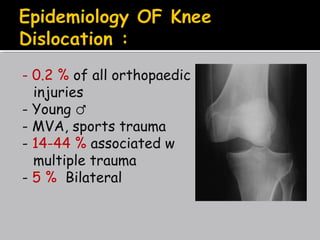
- 0.2 % of all orthopaedic
injuries
- Young ♂
- MVA, sports trauma
- 14-44 % associated w
multiple trauma
- 5 % Bilateral
vascular injury
5-15% in all dislocations
40-50% in anterior/posterior dislocations
 due to tethering at the politeal fossa
▪ proximal - fibrous tunnel at the adductor hiatus
▪ distal - fibrous tunnel at soleus muscle
 nerve injury
 usually common peroneal nerve injury (25%)
 tibial nerve injury is less common
 fractures
 present in 60%
 tibia and femur most common
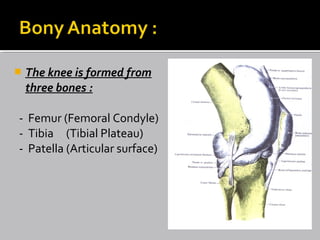
 The knee is formed from
three bones :
- Femur (Femoral Condyle)
- Tibia (Tibial Plateau)
- Patella (Articular surface)
 Anterior Cruciate Ligament (ACL)
 Posterior Cruciate Ligament (PCL)
 Lateral Collateral Ligament (LCL)
 Popliteofibular Ligament / Posterior Lateral
Corner (PLC)
 Medial Collateral Ligament (MCL)
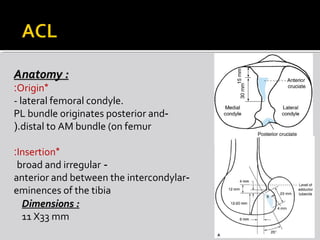
Anatomy :Anatomy :
*Origin:
- lateral femoral condyle.
-PL bundle originates posterior and
distal to AM bundle (on femur(.
*Insertion:
-broad and irregular
-anterior and between the intercondylar
eminences of the tibia
Dimensions :Dimensions :
11 X33 mm
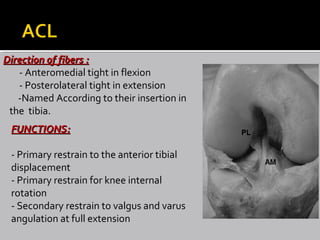
FUNCTIONS:FUNCTIONS:
- Primary restrain to the anterior tibial
displacement
- Primary restrain for knee internal
rotation
- Secondary restrain to valgus and varus
angulation at full extension
Direction of fibers :Direction of fibers :
- Anteromedial tight in flexion
- Posterolateral tight in extension
-Named According to their insertion in
the tibia.
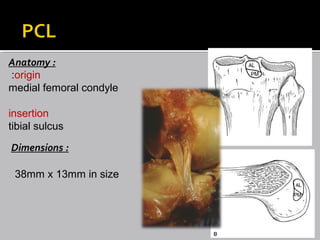
Anatomy :Anatomy :
origin:
medial femoral condyle
insertion
tibial sulcus
Dimensions :Dimensions :
38mm x 13mm in size
Direction of fibers :Direction of fibers :
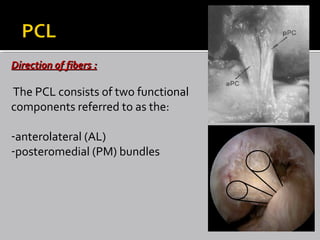
The PCL consists of two functional
components referred to as the:
-anterolateral (AL)
-posteromedial (PM) bundles
fUNCTIONS:fUNCTIONS:
oPrimary restraint to posterior tibial translation .
oSecondary restraint to varus and valgus forces.
o Secondary restraint to torsional forces.
o Interacts with the ACL to form “Four bar cruciate
linkage system”.
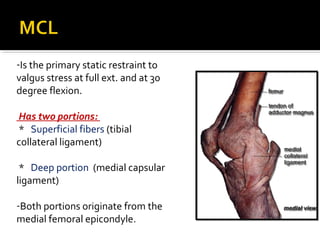
-Is the primary static restraint to
valgus stress at full ext. and at 30
degree flexion.
Has two portions:
* Superficial fibers (tibial
collateral ligament)
* Deep portion (medial capsular
ligament)
-Both portions originate from the
medial femoral epicondyle.
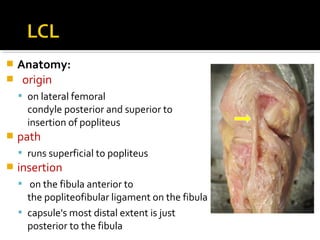
 Anatomy:
 origin
 on lateral femoral
condyle posterior and superior to
insertion of popliteus
 path
 runs superficial to popliteus
 insertion
 on the fibula anterior to
the popliteofibular ligament on the fibula
 capsule's most distal extent is just
posterior to the fibula
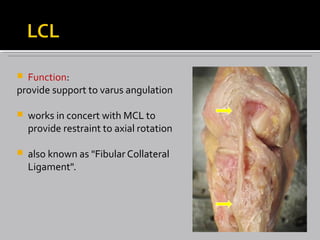
 Function:
provide support to varus angulation
 works in concert with MCL to
provide restraint to axial rotation
 also known as "Fibular Collateral
Ligament".
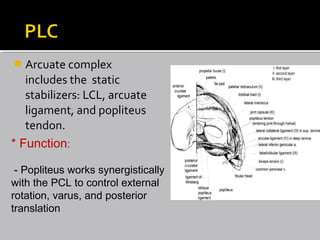
 Arcuate complex
includes the static
stabilizers: LCL, arcuate
ligament, and popliteus
tendon.
* Function:
- Popliteus works synergistically
with the PCL to control external
rotation, varus, and posterior
translation
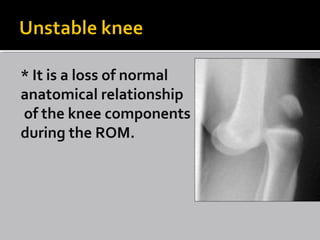
* It is a loss of normal
anatomical relationship
of the knee components
during the ROM.
It is a serious injury which can have long-term
adverse effects which may impair the
patient’s return to physical employment and
recreational activity.
Valgus + External Rotation is the
commonest medial side injury,
respectively;
1]. MCL then Medial capsule
2]. ACL
3]. MM = “O'DONOGHUE UNHAPPY
TRIAD”
Valgus + External Rotation is the
commonest medial side injury,
respectively;
1]. MCL then Medial capsule
2]. ACL
3]. MM = “O'DONOGHUE UNHAPPY
TRIAD”
Varus + Internal injury of lat ligaments of
the knee;
1]. LCL then lateral capsule
2]. ACL
3]. Arcuate complex
4]. Popliteus tendon
5]. ITB
6]. Biceps femoris
7]. Common peroneal nerve,
Varus + Internal injury of lat ligaments of
the knee;
1]. LCL then lateral capsule
2]. ACL
3]. Arcuate complex
4]. Popliteus tendon
5]. ITB
6]. Biceps femoris
7]. Common peroneal nerve,
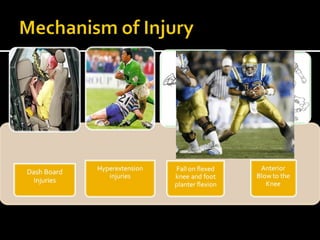
HYPEREXTENSION mechanism:
1]. ACL
2]. PCL & posterior capsule
HYPEREXTENSION mechanism:
1]. ACL
2]. PCL & posterior capsule
• ANTERO-POSTERIOR
DISPLACEMENT: e.g. dashboard
accident:
1]. ACL or
2]. PCL
• ANTERO-POSTERIOR
DISPLACEMENT: e.g. dashboard
accident:
1]. ACL or
2]. PCL
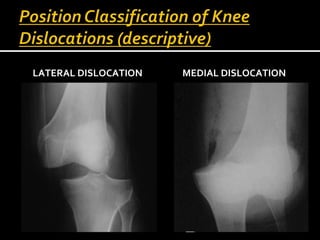
LATERAL DISLOCATION MEDIAL DISLOCATION
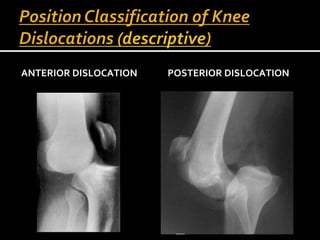
ANTERIOR DISLOCATION POSTERIOR DISLOCATION
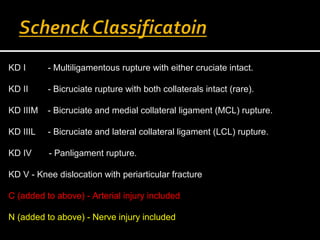
KD I - Multiligamentous rupture with either cruciate intact.
KD II - Bicruciate rupture with both collaterals intact (rare(.
KD IIIM - Bicruciate and medial collateral ligament (MCL( rupture.
KD IIIL - Bicruciate and lateral collateral ligament (LCL( rupture.
KD IV - Panligament rupture.
KD V - Knee dislocation with periarticular fracture
C (added to above( - Arterial injury included
N (added to above( - Nerve injury included
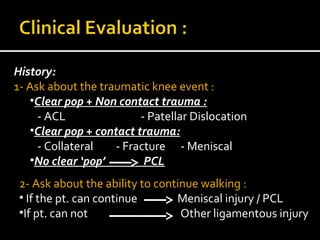
History:
1- Ask about the traumatic knee event :
•Clear pop + Non contact trauma :
- ACL - Patellar Dislocation
•Clear pop + contact trauma:
- Collateral - Fracture - Meniscal
•No clear ‘pop’ PCL
2- Ask about the ability to continue walking :
• If the pt. can continue Meniscal injury / PCL
•If pt. can not Other ligamentous injury
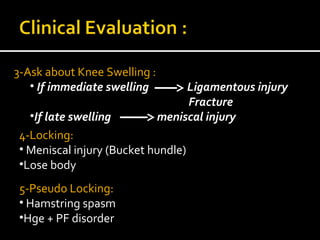
3-Ask about Knee Swelling :
• If immediate swelling Ligamentous injury
Fracture
•If late swelling meniscal injury
4-Locking:
• Meniscal injury (Bucket hundle)
•Lose body
5-Pseudo Locking:
• Hamstring spasm
•Hge + PF disorder
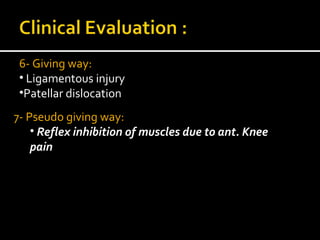
7- Pseudo giving way:
• Reflex inhibition of muscles due to ant. Knee
pain
6- Giving way:
• Ligamentous injury
•Patellar dislocation
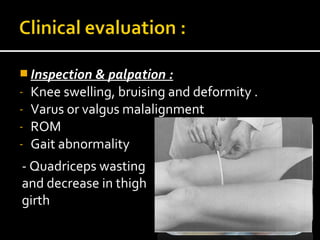
 Inspection & palpation :
- Knee swelling, bruising and deformity .
- Varus or valgus malalignment
- ROM
- Gait abnormality
- Quadriceps wasting
and decrease in thigh
girth
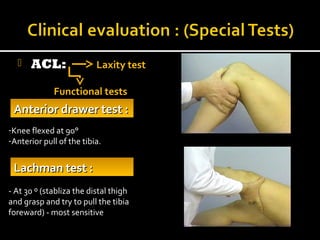
 ACL:
-Knee flexed at 90°
-Anterior pull of the tibia.
Anterior drawer test :Anterior drawer test :Anterior drawer test :Anterior drawer test :
- At 30 º (stabliza the distal thigh
and grasp and try to pull the tibia
foreward) - most sensitive
Lachman test :Lachman test :Lachman test :Lachman test :
Laxity test
Functional tests
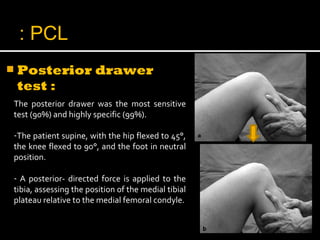
 Posterior drawer
test :
The posterior drawer was the most sensitive
test (90%) and highly specific (99%).
-The patient supine, with the hip flexed to 45°,
the knee flexed to 90°, and the foot in neutral
position.
- A posterior- directed force is applied to the
tibia, assessing the position of the medial tibial
plateau relative to the medial femoral condyle.
PCL:
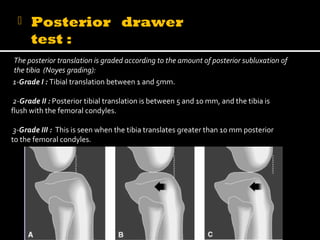
 Posterior drawer
test :
The posterior translation is graded according to the amount of posterior subluxation of
the tibia (Noyes grading):
1-Grade I : Tibial translation between 1 and 5mm.
2-Grade II : Posterior tibial translation is between 5 and 10 mm, and the tibia is
flush with the femoral condyles.
3-Grade III : This is seen when the tibia translates greater than 10 mm posterior
to the femoral condyles.
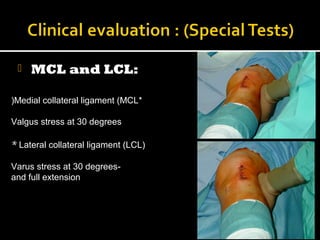
 MCL and LCL:
*Medial collateral ligament (MCL(
Valgus stress at 30 degrees
* Lateral collateral ligament (LCL(
-Varus stress at 30 degrees
and full extension
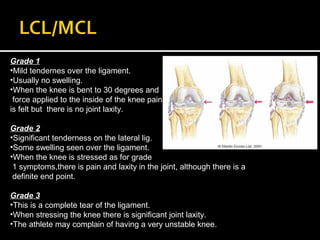
Grade 1
•Mild tendernes over the ligament.
•Usually no swelling.
•When the knee is bent to 30 degrees and
force applied to the inside of the knee pain
is felt but there is no joint laxity.
Grade 2
•Significant tenderness on the lateral lig.
•Some swelling seen over the ligament.
•When the knee is stressed as for grade
1 symptoms,there is pain and laxity in the joint, although there is a
definite end point.
Grade 3
•This is a complete tear of the ligament.
•When stressing the knee there is significant joint laxity.
•The athlete may complain of having a very unstable knee.
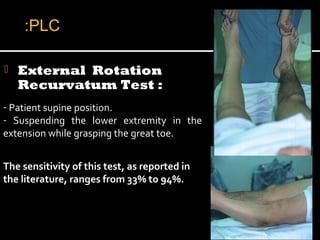
- Patient supine position.
- Suspending the lower extremity in the
extension while grasping the great toe.
The sensitivity of this test, as reported in
the literature, ranges from 33% to 94%.
 External Rotation
Recurvatum Test :
PLC:
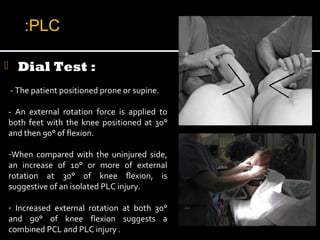
 Dial Test :
- The patient positioned prone or supine.
- An external rotation force is applied to
both feet with the knee positioned at 30°
and then 90° of flexion.
-When compared with the uninjured side,
an increase of 10° or more of external
rotation at 30° of knee flexion, is
suggestive of an isolated PLC injury.
- Increased external rotation at both 30°
and 90° of knee flexion suggests a
combined PCL and PLC injury .
PLC:
 Combined Ligament Examination
 LCL/PLC and cruciate
▪ Increased varus in full extension and at 30 degrees.
 MCL and cruciate
▪ Increased valgus in full extension and at 30 degrees.
 PLC and PCL
▪ Increased tibial external rotation at 30 and 90 degrees.
▪ Increased posterior tibial translation at 30 and 90 degrees.
 Stability in full extension
▪ Excludes significant PCL or capsular injury.
-Priority is to rule out vascular injury on exam both before and
after reduction serial examinations are mandatory.
- Palpate the dorsalis pedis and posterior tibial pulses
if pulses are present and normal ,
>> it does not indicate absence of arterial injury.
* collateral circulation can mask a complete politeal artery
occlusion.
-Measure Ankle-Brachial Index (ABI(
-
if ABI >0.9 >>>> then monitor with serial examination
if ABI <0.9 >>>> arterial duplex ultrasound or CT angiography
-If pulses are absent or diminished confirm that the knee joint is reduced
or perform immediate reduction and reassessment .
- Immediate surgical exploration if pulses are still absent following
reduction
ischemia time >8 hours has amputation rates as high as 86%
- If pulses present after reduction then measure ABI then consider
observation vs. angiography
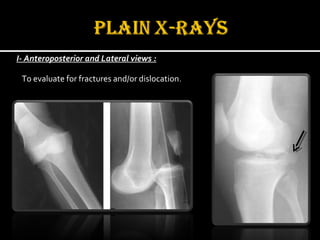
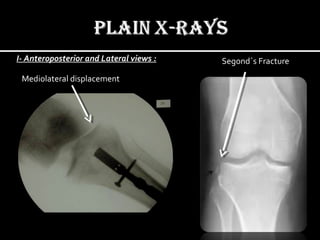
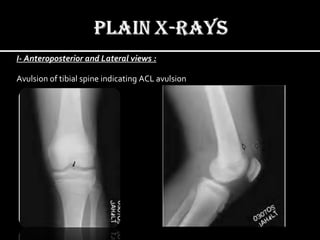
I- Anteroposterior and Lateral views :
To evaluate for fractures and/or dislocation.
I- Anteroposterior and Lateral views :
Mediolateral displacement
Segond`s Fracture
I- Anteroposterior and Lateral views :
Avulsion of tibial spine indicating ACL avulsion
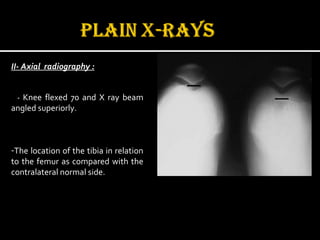
II- Axial radiography :
- Knee flexed 70 and X ray beam
angled superiorly.
-The location of the tibia in relation
to the femur as compared with the
contralateral normal side.
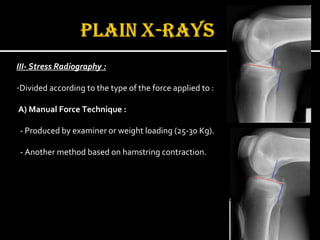
III- Stress Radiography :
-Divided according to the type of the force applied to :
A) Manual Force Technique :
- Produced by examiner or weight loading (25-30 Kg).
- Another method based on hamstring contraction.
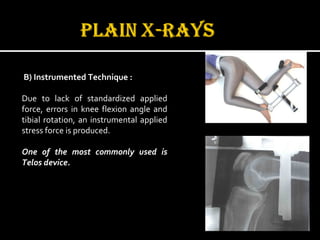
B) Instrumented Technique :
Due to lack of standardized applied
force, errors in knee flexion angle and
tibial rotation, an instrumental applied
stress force is produced.
One of the most commonly used is
Telos device.
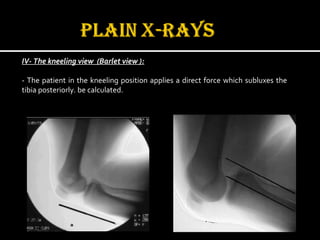
IV- The kneeling view (Barlet view ):
- The patient in the kneeling position applies a direct force which subluxes the
tibia posteriorly. be calculated.
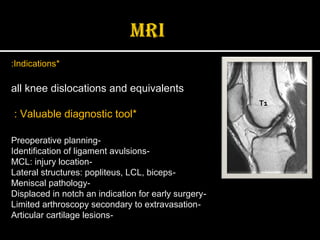
T1
*Indications:
all knee dislocations and equivalents
*Valuable diagnostic tool:
-Preoperative planning
-Identification of ligament avulsions
-MCL: injury location
-Lateral structures: popliteus, LCL, biceps
-Meniscal pathology
-Displaced in notch an indication for early surgery
-Limited arthroscopy secondary to extravasation
-Articular cartilage lesions
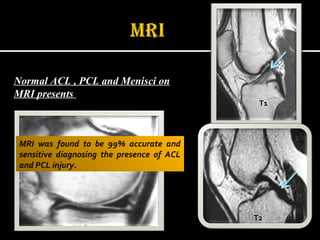
Normal ACL , PCL and Menisci on
MRI presents
T1
T2
MRI was found to be 99% accurate and
sensitive diagnosing the presence of ACL
and PCL injury.
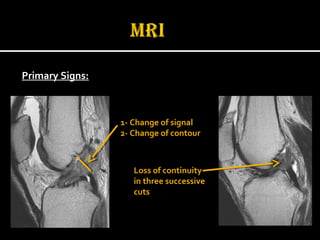
Primary Signs:
1- Change of signal
2- Change of contour
Loss of continuityLoss of continuity
in three successivein three successive
cutscuts
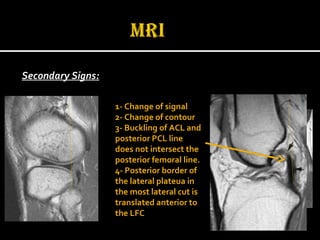
Secondary Signs:
1- Change of signal
2- Change of contour
3- Buckling of ACL and3- Buckling of ACL and
posterior PCL lineposterior PCL line
does not intersect thedoes not intersect the
posterior femoral line.posterior femoral line.
4- Posterior border of
the lateral plateua in
the most lateral cut is
translated anterior to
the LFC
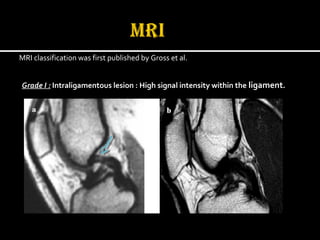
MRI classification was first published by Gross et al.
Grade I : Intraligamentous lesion : High signal intensity within the ligament.
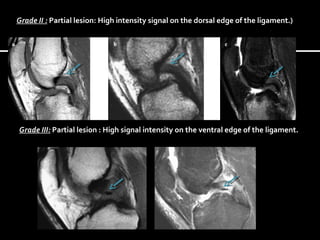
Grade II : Partial lesion: High intensity signal on the dorsal edge of the ligament.)
Grade III: Partial lesion : High signal intensity on the ventral edge of the ligament.
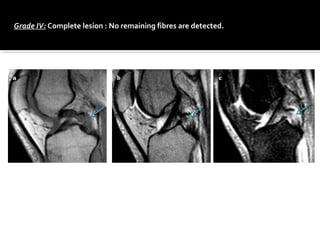
Grade IV: Complete lesion : No remaining fibres are detected.
 The role of diagnostic arthroscopy isThe role of diagnostic arthroscopy is
debatable as history taking, clinicaldebatable as history taking, clinical
examination and MRI are sufficient forexamination and MRI are sufficient for
diagnosis.diagnosis.
 But other surgeons state that arthroscopy canBut other surgeons state that arthroscopy can
provide further information which is useful.provide further information which is useful.
 Arthroscopy is done 2 to 3 weeks after injury.Arthroscopy is done 2 to 3 weeks after injury.
 reduce knee and re-examine vascular status considered
an orthopedic emergency.
 splint knee in 20-30 degrees of flexion .
 confirm reduction is held with repeat radiographs in
brace/splint.
 vascular consult indicated if :
 if arterial injury confirmed by arterial duplex ultrasound or CT angiography
 pulses are absent or diminished following reduction
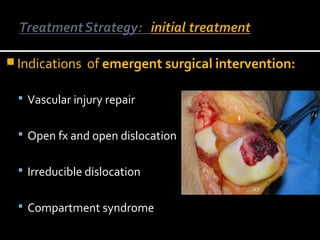
 Indications of emergent surgical intervention:
 Vascular injury repair
 Open fx and open dislocation
 Irreducible dislocation
 Compartment syndrome
- Stable knee.
- Painless knee.
- Full ROM.
- Return to pre-injury level. of activity
 Most authors recommend repair of the torn
structures.
 Non-operative treatment has been associated
with poor results.
 Period of immobilization
 A shorter period leads to improved motion and
residual laxity.
 A longer period leads to improved stability and
limited motion.
 Recent clinical series have reported better
results with operative treatment.
 No prospective, controlled, randomized trials
of comparable injuries have been reported.
 Once stiffness occurs, it is very difficult to
treat.
 Complete PLC disruption is best treated with
early open repair.
 Late reconstruction is difficult.
 Reconstitution of the PCL is important.
 It allows tibiofemoral positioning.
 Collateral and ACL surgery evolves around PCL
reconstitution.
 ACL reconstruction before PCL treatment is never
indicated.
ACL + MCL (class I knee dislocation)
 MCL: predictable healing
 Cylinder cast immobilization in extension for 2
weeks
 Hinged brace permitting to range of motion
 Delayed ACL reconstruction
▪ Motion restored
▪ Residual laxity and desired activity level
 ACL + LCL/PLC (class I knee dislocation)
 Delayed surgery at 14 days
▪ Capsular healing
▪ Identification of lateral structures
 Arthroscopic ACL: femoral fixation
▪ Instruments and experience with open techniques
▪ Femoral fixation
 Tibial fixation/ACL tensioned after LCL/PLC
 Open posterolateral repair/reconstruction
 ACL + PLC (class II knee dislocation)
 Collateral ligaments intact
 Hinged brace and early range of motion
▪ Extension stop at 0 degrees
 Arthroscopic reconstruction after 6 weeks
▪ PCL only in most cases
▪ ACL/PCL limited to high-demand patient
 Sedentary individuals: no surgery
 ACL + PLC + MCL (class IIIM knee dislocation)
 Immobilization in extension
 Early surgery (2 weeks)
▪ Examination under anesthesia and limited diagnostic
arthroscopy (MRI)
▪ Single straight medial parapatellar incision
▪ Open PCL reconstruction or repair
▪ MCL repair
 ACL + PLC + LCL/PLC (class IIIL knee dislocation)
 Immobilization in extension
 Delayed surgery at 14 days
▪ Diagnostic arthroscopy
▪ Arthroscopic or open PCL
▪ Open LCL/PLC
 Incisions critical: avoidance of the midline
▪ PCL: medial (open or arthroscopic)
▪ Straight posterolateral
- STIFFNESS
• Most concerning problem
• EARLY ROM is CRUCIAL
• Occurs with both nonoperative & operative treatment
• High velocity, Multiple injured, Head injury: HIGH RISK
• HO may not be present
• VERY DIFFICULT TO TREAT
• Think of early MUA (6 weeks) if no progress with
aggressive PT
- Instability – Residual Laxity
• Nonoperative tx
• Failure of reconstruction
• Easier to treat than stiffness
- Compartment syndrome
• Capsule torn: Be very careful with arthroscopy
- Iatrogenic vascular /nerve injury
Outcomes
35 patients, 2-10 yrs f/u
19 acute, 16 chronic
Reconstruction/repair of ALL injuries
Good outcomes (Lysholm, Tegner, HSS)
No difference between acute and chronic
Conclusion:
Combined repair/reconstruction provides
reliable outcome
Fanelli GC 2002Fanelli GC 2002
31 patients, 2-6 yrs f/u
Reconstruction/repair of ALL injuries
19 operated ≤3 weeks, 12 patients >3 weeks
Higher subjective scores and better
objective stability in acutely treated group
Mostly uncomplicated LOW energy (!)
Conclusion: ROM same, Stability BETTER in
ACUTELY treated
Harner CD 2004Harner CD 2004
85 patients, 2-9 yrs f/u
No difference acute vs. chronic
surgery
WORSE outcome in HIGH energy
WORSE outcome in KD-IV (all 4
ligaments Injured)
Selective arteriography based on
serial exam is SAFE
87% grade II-IV arthritis compared
to 36% on uninjured side Engebretsen L 2009Engebretsen L 2009
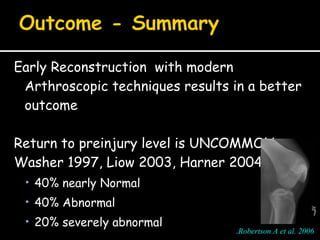
Early Reconstruction with modern
Arthroscopic techniques results in a better
outcome
Return to preinjury level is UNCOMMON
Washer 1997, Liow 2003, Harner 2004,
• 40% nearly Normal
• 40% Abnormal
• 20% severely abnormal
Robertson A et al. 2006Robertson A et al. 2006..
Case Examples
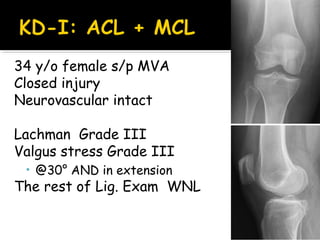
34 y/o female s/p MVA
Closed injury
Neurovascular intact
Lachman Grade III
Valgus stress Grade III
• @30° AND in extension
The rest of Lig. Exam WNL
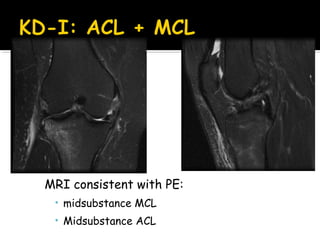
MRI consistent with PE:
• midsubstance MCL
• Midsubstance ACL
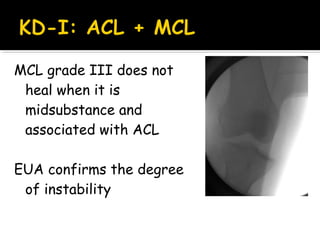
MCL grade III does not
heal when it is
midsubstance and
associated with ACL
EUA confirms the degree
of instability
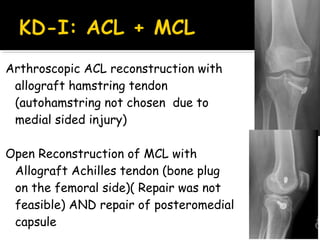
Arthroscopic ACL reconstruction with
allograft hamstring tendon
(autohamstring not chosen due to
medial sided injury)
Open Reconstruction of MCL with
Allograft Achilles tendon (bone plug
on the femoral side)( Repair was not
feasible) AND repair of posteromedial
capsule
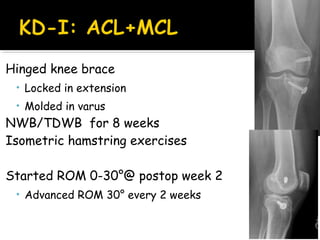
Hinged knee brace
• Locked in extension
• Molded in varus
NWB/TDWB for 8 weeks
Isometric hamstring exercises
Started ROM 0-30°@ postop week 2
• Advanced ROM 30° every 2 weeks
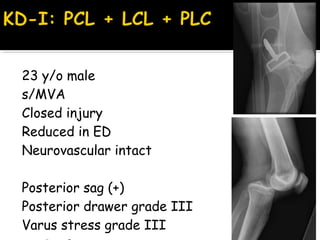
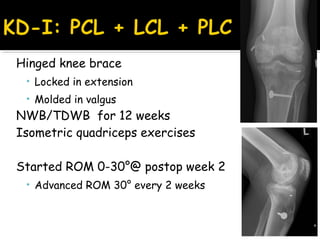
23 y/o male
s/MVA
Closed injury
Reduced in ED
Neurovascular intact
Posterior sag (+)
Posterior drawer grade III
Varus stress grade III
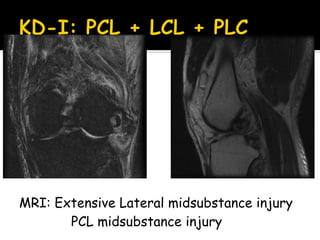
MRI: Extensive Lateral midsubstance injury
PCL midsubstance injury
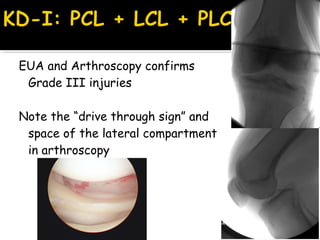
EUA and Arthroscopy confirms
Grade III injuries
Note the “drive through sign” and
space of the lateral compartment
in arthroscopy
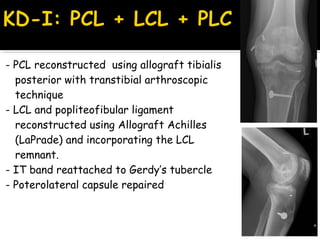
- PCL reconstructed using allograft tibialis
posterior with transtibial arthroscopic
technique
- LCL and popliteofibular ligament
reconstructed using Allograft Achilles
(LaPrade) and incorporating the LCL
remnant.
- IT band reattached to Gerdy’s tubercle
- Poterolateral capsule repaired
Hinged knee brace
• Locked in extension
• Molded in valgus
NWB/TDWB for 12 weeks
Isometric quadriceps exercises
Started ROM 0-30°@ postop week 2
• Advanced ROM 30° every 2 weeks
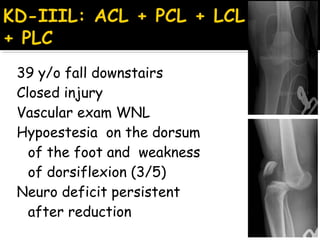
39 y/o fall downstairs
Closed injury
Vascular exam WNL
Hypoestesia on the dorsum
of the foot and weakness
of dorsiflexion (3/5)
Neuro deficit persistent
after reduction
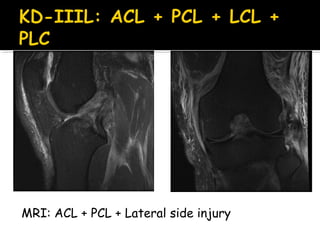
MRI: ACL + PCL + Lateral side injury
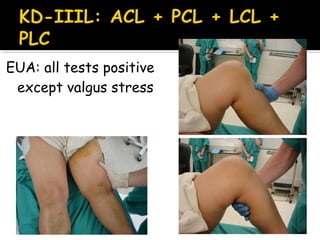
EUA: all tests positive
except valgus stress
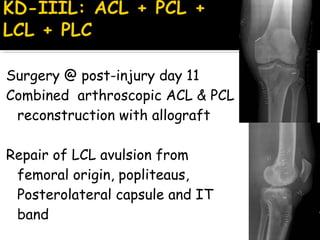
Surgery @ post-injury day 11
Combined arthroscopic ACL & PCL
reconstruction with allograft
Repair of LCL avulsion from
femoral origin, popliteaus,
Posterolateral capsule and IT
band
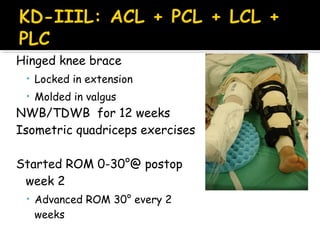
Hinged knee brace
• Locked in extension
• Molded in valgus
NWB/TDWB for 12 weeks
Isometric quadriceps exercises
Started ROM 0-30°@ postop
week 2
• Advanced ROM 30° every 2
weeks
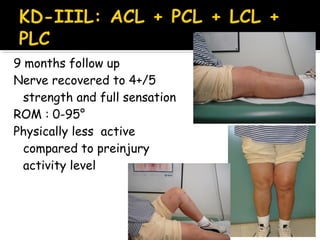
9 months follow up
Nerve recovered to 4+/5
strength and full sensation
ROM : 0-95°
Physically less active
compared to preinjury
activity level
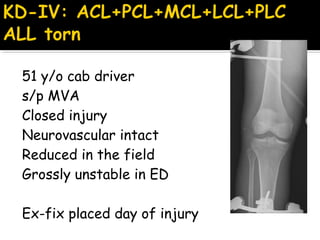
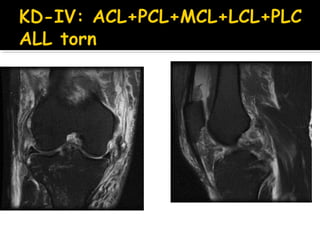
51 y/o cab driver
s/p MVA
Closed injury
Neurovascular intact
Reduced in the field
Grossly unstable in ED
Ex-fix placed day of injury
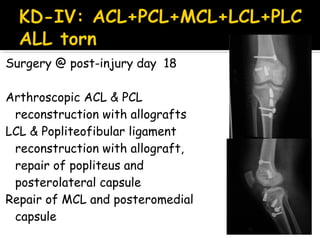
Surgery @ post-injury day 18
Arthroscopic ACL & PCL
reconstruction with allografts
LCL & Popliteofibular ligament
reconstruction with allograft,
repair of popliteus and
posterolateral capsule
Repair of MCL and posteromedial
capsule
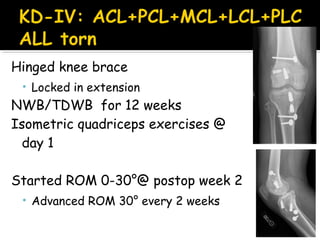
Hinged knee brace
• Locked in extension
NWB/TDWB for 12 weeks
Isometric quadriceps exercises @
day 1
Started ROM 0-30°@ postop week 2
• Advanced ROM 30° every 2 weeks
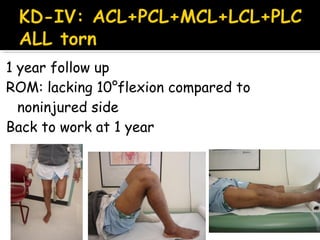
1 year follow up
ROM: lacking 10°flexion compared to
noninjured side
Back to work at 1 year
Do not MISS Vascular Injury
- Evaluate the severity of injury
- ALL unstable knees are NOT the same
- EUA is key in decision making for treatment
PLAN, PLAN, PLAN before surgery
Stiffness is major problem
Return to Previous Activity Level is
UNCOMMON
KNEE INJURIES

KNEE INJURIES

  • 1.
  • 2.
    - 0.2 %of all orthopaedic injuries - Young ♂ - MVA, sports trauma - 14-44 % associated w multiple trauma - 5 % Bilateral
  • 3.
    vascular injury 5-15% inall dislocations 40-50% in anterior/posterior dislocations  due to tethering at the politeal fossa ▪ proximal - fibrous tunnel at the adductor hiatus ▪ distal - fibrous tunnel at soleus muscle  nerve injury  usually common peroneal nerve injury (25%)  tibial nerve injury is less common  fractures  present in 60%  tibia and femur most common
  • 4.
     The kneeis formed from three bones : - Femur (Femoral Condyle) - Tibia (Tibial Plateau) - Patella (Articular surface)
  • 5.
     Anterior CruciateLigament (ACL)  Posterior Cruciate Ligament (PCL)  Lateral Collateral Ligament (LCL)  Popliteofibular Ligament / Posterior Lateral Corner (PLC)  Medial Collateral Ligament (MCL)
  • 6.
    Anatomy :Anatomy : *Origin: -lateral femoral condyle. -PL bundle originates posterior and distal to AM bundle (on femur(. *Insertion: -broad and irregular -anterior and between the intercondylar eminences of the tibia Dimensions :Dimensions : 11 X33 mm
  • 7.
    FUNCTIONS:FUNCTIONS: - Primary restrainto the anterior tibial displacement - Primary restrain for knee internal rotation - Secondary restrain to valgus and varus angulation at full extension Direction of fibers :Direction of fibers : - Anteromedial tight in flexion - Posterolateral tight in extension -Named According to their insertion in the tibia.
  • 8.
    Anatomy :Anatomy : origin: medialfemoral condyle insertion tibial sulcus Dimensions :Dimensions : 38mm x 13mm in size
  • 9.
    Direction of fibers:Direction of fibers : The PCL consists of two functional components referred to as the: -anterolateral (AL) -posteromedial (PM) bundles
  • 10.
    fUNCTIONS:fUNCTIONS: oPrimary restraint toposterior tibial translation . oSecondary restraint to varus and valgus forces. o Secondary restraint to torsional forces. o Interacts with the ACL to form “Four bar cruciate linkage system”.
  • 11.
    -Is the primarystatic restraint to valgus stress at full ext. and at 30 degree flexion. Has two portions: * Superficial fibers (tibial collateral ligament) * Deep portion (medial capsular ligament) -Both portions originate from the medial femoral epicondyle.
  • 13.
     Anatomy:  origin on lateral femoral condyle posterior and superior to insertion of popliteus  path  runs superficial to popliteus  insertion  on the fibula anterior to the popliteofibular ligament on the fibula  capsule's most distal extent is just posterior to the fibula
  • 14.
     Function: provide supportto varus angulation  works in concert with MCL to provide restraint to axial rotation  also known as "Fibular Collateral Ligament".
  • 15.
     Arcuate complex includesthe static stabilizers: LCL, arcuate ligament, and popliteus tendon. * Function: - Popliteus works synergistically with the PCL to control external rotation, varus, and posterior translation
  • 16.
    * It isa loss of normal anatomical relationship of the knee components during the ROM.
  • 17.
    It is aserious injury which can have long-term adverse effects which may impair the patient’s return to physical employment and recreational activity.
  • 19.
    Valgus + ExternalRotation is the commonest medial side injury, respectively; 1]. MCL then Medial capsule 2]. ACL 3]. MM = “O'DONOGHUE UNHAPPY TRIAD” Valgus + External Rotation is the commonest medial side injury, respectively; 1]. MCL then Medial capsule 2]. ACL 3]. MM = “O'DONOGHUE UNHAPPY TRIAD” Varus + Internal injury of lat ligaments of the knee; 1]. LCL then lateral capsule 2]. ACL 3]. Arcuate complex 4]. Popliteus tendon 5]. ITB 6]. Biceps femoris 7]. Common peroneal nerve, Varus + Internal injury of lat ligaments of the knee; 1]. LCL then lateral capsule 2]. ACL 3]. Arcuate complex 4]. Popliteus tendon 5]. ITB 6]. Biceps femoris 7]. Common peroneal nerve,
  • 20.
    HYPEREXTENSION mechanism: 1]. ACL 2].PCL & posterior capsule HYPEREXTENSION mechanism: 1]. ACL 2]. PCL & posterior capsule • ANTERO-POSTERIOR DISPLACEMENT: e.g. dashboard accident: 1]. ACL or 2]. PCL • ANTERO-POSTERIOR DISPLACEMENT: e.g. dashboard accident: 1]. ACL or 2]. PCL
  • 21.
  • 22.
  • 23.
    KD I -Multiligamentous rupture with either cruciate intact. KD II - Bicruciate rupture with both collaterals intact (rare(. KD IIIM - Bicruciate and medial collateral ligament (MCL( rupture. KD IIIL - Bicruciate and lateral collateral ligament (LCL( rupture. KD IV - Panligament rupture. KD V - Knee dislocation with periarticular fracture C (added to above( - Arterial injury included N (added to above( - Nerve injury included
  • 24.
    History: 1- Ask aboutthe traumatic knee event : •Clear pop + Non contact trauma : - ACL - Patellar Dislocation •Clear pop + contact trauma: - Collateral - Fracture - Meniscal •No clear ‘pop’ PCL 2- Ask about the ability to continue walking : • If the pt. can continue Meniscal injury / PCL •If pt. can not Other ligamentous injury
  • 25.
    3-Ask about KneeSwelling : • If immediate swelling Ligamentous injury Fracture •If late swelling meniscal injury 4-Locking: • Meniscal injury (Bucket hundle) •Lose body 5-Pseudo Locking: • Hamstring spasm •Hge + PF disorder
  • 26.
    7- Pseudo givingway: • Reflex inhibition of muscles due to ant. Knee pain 6- Giving way: • Ligamentous injury •Patellar dislocation
  • 27.
     Inspection &palpation : - Knee swelling, bruising and deformity . - Varus or valgus malalignment - ROM - Gait abnormality - Quadriceps wasting and decrease in thigh girth
  • 28.
     ACL: -Knee flexedat 90° -Anterior pull of the tibia. Anterior drawer test :Anterior drawer test :Anterior drawer test :Anterior drawer test : - At 30 º (stabliza the distal thigh and grasp and try to pull the tibia foreward) - most sensitive Lachman test :Lachman test :Lachman test :Lachman test : Laxity test Functional tests
  • 29.
     Posterior drawer test: The posterior drawer was the most sensitive test (90%) and highly specific (99%). -The patient supine, with the hip flexed to 45°, the knee flexed to 90°, and the foot in neutral position. - A posterior- directed force is applied to the tibia, assessing the position of the medial tibial plateau relative to the medial femoral condyle. PCL:
  • 30.
     Posterior drawer test: The posterior translation is graded according to the amount of posterior subluxation of the tibia (Noyes grading): 1-Grade I : Tibial translation between 1 and 5mm. 2-Grade II : Posterior tibial translation is between 5 and 10 mm, and the tibia is flush with the femoral condyles. 3-Grade III : This is seen when the tibia translates greater than 10 mm posterior to the femoral condyles.
  • 31.
     MCL andLCL: *Medial collateral ligament (MCL( Valgus stress at 30 degrees * Lateral collateral ligament (LCL( -Varus stress at 30 degrees and full extension
  • 32.
    Grade 1 •Mild tendernesover the ligament. •Usually no swelling. •When the knee is bent to 30 degrees and force applied to the inside of the knee pain is felt but there is no joint laxity. Grade 2 •Significant tenderness on the lateral lig. •Some swelling seen over the ligament. •When the knee is stressed as for grade 1 symptoms,there is pain and laxity in the joint, although there is a definite end point. Grade 3 •This is a complete tear of the ligament. •When stressing the knee there is significant joint laxity. •The athlete may complain of having a very unstable knee.
  • 33.
    - Patient supineposition. - Suspending the lower extremity in the extension while grasping the great toe. The sensitivity of this test, as reported in the literature, ranges from 33% to 94%.  External Rotation Recurvatum Test : PLC:
  • 34.
     Dial Test: - The patient positioned prone or supine. - An external rotation force is applied to both feet with the knee positioned at 30° and then 90° of flexion. -When compared with the uninjured side, an increase of 10° or more of external rotation at 30° of knee flexion, is suggestive of an isolated PLC injury. - Increased external rotation at both 30° and 90° of knee flexion suggests a combined PCL and PLC injury . PLC:
  • 35.
     Combined LigamentExamination  LCL/PLC and cruciate ▪ Increased varus in full extension and at 30 degrees.  MCL and cruciate ▪ Increased valgus in full extension and at 30 degrees.  PLC and PCL ▪ Increased tibial external rotation at 30 and 90 degrees. ▪ Increased posterior tibial translation at 30 and 90 degrees.  Stability in full extension ▪ Excludes significant PCL or capsular injury.
  • 36.
    -Priority is torule out vascular injury on exam both before and after reduction serial examinations are mandatory. - Palpate the dorsalis pedis and posterior tibial pulses if pulses are present and normal , >> it does not indicate absence of arterial injury. * collateral circulation can mask a complete politeal artery occlusion.
  • 37.
    -Measure Ankle-Brachial Index(ABI( - if ABI >0.9 >>>> then monitor with serial examination if ABI <0.9 >>>> arterial duplex ultrasound or CT angiography -If pulses are absent or diminished confirm that the knee joint is reduced or perform immediate reduction and reassessment . - Immediate surgical exploration if pulses are still absent following reduction ischemia time >8 hours has amputation rates as high as 86% - If pulses present after reduction then measure ABI then consider observation vs. angiography
  • 39.
    I- Anteroposterior andLateral views : To evaluate for fractures and/or dislocation.
  • 40.
    I- Anteroposterior andLateral views : Mediolateral displacement Segond`s Fracture
  • 41.
    I- Anteroposterior andLateral views : Avulsion of tibial spine indicating ACL avulsion
  • 42.
    II- Axial radiography: - Knee flexed 70 and X ray beam angled superiorly. -The location of the tibia in relation to the femur as compared with the contralateral normal side.
  • 43.
    III- Stress Radiography: -Divided according to the type of the force applied to : A) Manual Force Technique : - Produced by examiner or weight loading (25-30 Kg). - Another method based on hamstring contraction.
  • 44.
    B) Instrumented Technique: Due to lack of standardized applied force, errors in knee flexion angle and tibial rotation, an instrumental applied stress force is produced. One of the most commonly used is Telos device.
  • 45.
    IV- The kneelingview (Barlet view ): - The patient in the kneeling position applies a direct force which subluxes the tibia posteriorly. be calculated.
  • 46.
    T1 *Indications: all knee dislocationsand equivalents *Valuable diagnostic tool: -Preoperative planning -Identification of ligament avulsions -MCL: injury location -Lateral structures: popliteus, LCL, biceps -Meniscal pathology -Displaced in notch an indication for early surgery -Limited arthroscopy secondary to extravasation -Articular cartilage lesions
  • 47.
    Normal ACL ,PCL and Menisci on MRI presents T1 T2 MRI was found to be 99% accurate and sensitive diagnosing the presence of ACL and PCL injury.
  • 48.
    Primary Signs: 1- Changeof signal 2- Change of contour Loss of continuityLoss of continuity in three successivein three successive cutscuts
  • 49.
    Secondary Signs: 1- Changeof signal 2- Change of contour 3- Buckling of ACL and3- Buckling of ACL and posterior PCL lineposterior PCL line does not intersect thedoes not intersect the posterior femoral line.posterior femoral line. 4- Posterior border of the lateral plateua in the most lateral cut is translated anterior to the LFC
  • 50.
    MRI classification wasfirst published by Gross et al. Grade I : Intraligamentous lesion : High signal intensity within the ligament.
  • 51.
    Grade II :Partial lesion: High intensity signal on the dorsal edge of the ligament.) Grade III: Partial lesion : High signal intensity on the ventral edge of the ligament.
  • 52.
    Grade IV: Completelesion : No remaining fibres are detected.
  • 53.
     The roleof diagnostic arthroscopy isThe role of diagnostic arthroscopy is debatable as history taking, clinicaldebatable as history taking, clinical examination and MRI are sufficient forexamination and MRI are sufficient for diagnosis.diagnosis.  But other surgeons state that arthroscopy canBut other surgeons state that arthroscopy can provide further information which is useful.provide further information which is useful.  Arthroscopy is done 2 to 3 weeks after injury.Arthroscopy is done 2 to 3 weeks after injury.
  • 55.
     reduce kneeand re-examine vascular status considered an orthopedic emergency.  splint knee in 20-30 degrees of flexion .  confirm reduction is held with repeat radiographs in brace/splint.  vascular consult indicated if :  if arterial injury confirmed by arterial duplex ultrasound or CT angiography  pulses are absent or diminished following reduction
  • 56.
     Indications ofemergent surgical intervention:  Vascular injury repair  Open fx and open dislocation  Irreducible dislocation  Compartment syndrome
  • 57.
    - Stable knee. -Painless knee. - Full ROM. - Return to pre-injury level. of activity
  • 58.
     Most authorsrecommend repair of the torn structures.  Non-operative treatment has been associated with poor results.  Period of immobilization  A shorter period leads to improved motion and residual laxity.  A longer period leads to improved stability and limited motion.
  • 59.
     Recent clinicalseries have reported better results with operative treatment.  No prospective, controlled, randomized trials of comparable injuries have been reported.  Once stiffness occurs, it is very difficult to treat.  Complete PLC disruption is best treated with early open repair.  Late reconstruction is difficult.
  • 60.
     Reconstitution ofthe PCL is important.  It allows tibiofemoral positioning.  Collateral and ACL surgery evolves around PCL reconstitution.  ACL reconstruction before PCL treatment is never indicated.
  • 61.
    ACL + MCL(class I knee dislocation)  MCL: predictable healing  Cylinder cast immobilization in extension for 2 weeks  Hinged brace permitting to range of motion  Delayed ACL reconstruction ▪ Motion restored ▪ Residual laxity and desired activity level
  • 62.
     ACL +LCL/PLC (class I knee dislocation)  Delayed surgery at 14 days ▪ Capsular healing ▪ Identification of lateral structures  Arthroscopic ACL: femoral fixation ▪ Instruments and experience with open techniques ▪ Femoral fixation  Tibial fixation/ACL tensioned after LCL/PLC  Open posterolateral repair/reconstruction
  • 63.
     ACL +PLC (class II knee dislocation)  Collateral ligaments intact  Hinged brace and early range of motion ▪ Extension stop at 0 degrees  Arthroscopic reconstruction after 6 weeks ▪ PCL only in most cases ▪ ACL/PCL limited to high-demand patient  Sedentary individuals: no surgery
  • 64.
     ACL +PLC + MCL (class IIIM knee dislocation)  Immobilization in extension  Early surgery (2 weeks) ▪ Examination under anesthesia and limited diagnostic arthroscopy (MRI) ▪ Single straight medial parapatellar incision ▪ Open PCL reconstruction or repair ▪ MCL repair
  • 65.
     ACL +PLC + LCL/PLC (class IIIL knee dislocation)  Immobilization in extension  Delayed surgery at 14 days ▪ Diagnostic arthroscopy ▪ Arthroscopic or open PCL ▪ Open LCL/PLC  Incisions critical: avoidance of the midline ▪ PCL: medial (open or arthroscopic) ▪ Straight posterolateral
  • 66.
    - STIFFNESS • Mostconcerning problem • EARLY ROM is CRUCIAL • Occurs with both nonoperative & operative treatment • High velocity, Multiple injured, Head injury: HIGH RISK • HO may not be present • VERY DIFFICULT TO TREAT • Think of early MUA (6 weeks) if no progress with aggressive PT
  • 67.
    - Instability –Residual Laxity • Nonoperative tx • Failure of reconstruction • Easier to treat than stiffness - Compartment syndrome • Capsule torn: Be very careful with arthroscopy - Iatrogenic vascular /nerve injury
  • 68.
  • 69.
    35 patients, 2-10yrs f/u 19 acute, 16 chronic Reconstruction/repair of ALL injuries Good outcomes (Lysholm, Tegner, HSS) No difference between acute and chronic Conclusion: Combined repair/reconstruction provides reliable outcome Fanelli GC 2002Fanelli GC 2002
  • 70.
    31 patients, 2-6yrs f/u Reconstruction/repair of ALL injuries 19 operated ≤3 weeks, 12 patients >3 weeks Higher subjective scores and better objective stability in acutely treated group Mostly uncomplicated LOW energy (!) Conclusion: ROM same, Stability BETTER in ACUTELY treated Harner CD 2004Harner CD 2004
  • 71.
    85 patients, 2-9yrs f/u No difference acute vs. chronic surgery WORSE outcome in HIGH energy WORSE outcome in KD-IV (all 4 ligaments Injured) Selective arteriography based on serial exam is SAFE 87% grade II-IV arthritis compared to 36% on uninjured side Engebretsen L 2009Engebretsen L 2009
  • 72.
    Early Reconstruction withmodern Arthroscopic techniques results in a better outcome Return to preinjury level is UNCOMMON Washer 1997, Liow 2003, Harner 2004, • 40% nearly Normal • 40% Abnormal • 20% severely abnormal Robertson A et al. 2006Robertson A et al. 2006..
  • 73.
  • 74.
    34 y/o females/p MVA Closed injury Neurovascular intact Lachman Grade III Valgus stress Grade III • @30° AND in extension The rest of Lig. Exam WNL
  • 75.
    MRI consistent withPE: • midsubstance MCL • Midsubstance ACL
  • 76.
    MCL grade IIIdoes not heal when it is midsubstance and associated with ACL EUA confirms the degree of instability
  • 77.
    Arthroscopic ACL reconstructionwith allograft hamstring tendon (autohamstring not chosen due to medial sided injury) Open Reconstruction of MCL with Allograft Achilles tendon (bone plug on the femoral side)( Repair was not feasible) AND repair of posteromedial capsule
  • 78.
    Hinged knee brace •Locked in extension • Molded in varus NWB/TDWB for 8 weeks Isometric hamstring exercises Started ROM 0-30°@ postop week 2 • Advanced ROM 30° every 2 weeks
  • 79.
    23 y/o male s/MVA Closedinjury Reduced in ED Neurovascular intact Posterior sag (+) Posterior drawer grade III Varus stress grade III
  • 80.
    MRI: Extensive Lateralmidsubstance injury PCL midsubstance injury
  • 81.
    EUA and Arthroscopyconfirms Grade III injuries Note the “drive through sign” and space of the lateral compartment in arthroscopy
  • 82.
    - PCL reconstructedusing allograft tibialis posterior with transtibial arthroscopic technique - LCL and popliteofibular ligament reconstructed using Allograft Achilles (LaPrade) and incorporating the LCL remnant. - IT band reattached to Gerdy’s tubercle - Poterolateral capsule repaired
  • 83.
    Hinged knee brace •Locked in extension • Molded in valgus NWB/TDWB for 12 weeks Isometric quadriceps exercises Started ROM 0-30°@ postop week 2 • Advanced ROM 30° every 2 weeks
  • 84.
    39 y/o falldownstairs Closed injury Vascular exam WNL Hypoestesia on the dorsum of the foot and weakness of dorsiflexion (3/5) Neuro deficit persistent after reduction
  • 85.
    MRI: ACL +PCL + Lateral side injury
  • 86.
    EUA: all testspositive except valgus stress
  • 87.
    Surgery @ post-injuryday 11 Combined arthroscopic ACL & PCL reconstruction with allograft Repair of LCL avulsion from femoral origin, popliteaus, Posterolateral capsule and IT band
  • 88.
    Hinged knee brace •Locked in extension • Molded in valgus NWB/TDWB for 12 weeks Isometric quadriceps exercises Started ROM 0-30°@ postop week 2 • Advanced ROM 30° every 2 weeks
  • 89.
    9 months followup Nerve recovered to 4+/5 strength and full sensation ROM : 0-95° Physically less active compared to preinjury activity level
  • 90.
    51 y/o cabdriver s/p MVA Closed injury Neurovascular intact Reduced in the field Grossly unstable in ED Ex-fix placed day of injury
  • 92.
    Surgery @ post-injuryday 18 Arthroscopic ACL & PCL reconstruction with allografts LCL & Popliteofibular ligament reconstruction with allograft, repair of popliteus and posterolateral capsule Repair of MCL and posteromedial capsule
  • 93.
    Hinged knee brace •Locked in extension NWB/TDWB for 12 weeks Isometric quadriceps exercises @ day 1 Started ROM 0-30°@ postop week 2 • Advanced ROM 30° every 2 weeks
  • 94.
    1 year followup ROM: lacking 10°flexion compared to noninjured side Back to work at 1 year
  • 95.
    Do not MISSVascular Injury - Evaluate the severity of injury - ALL unstable knees are NOT the same - EUA is key in decision making for treatment PLAN, PLAN, PLAN before surgery Stiffness is major problem Return to Previous Activity Level is UNCOMMON