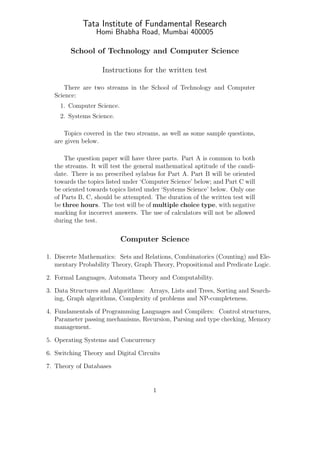
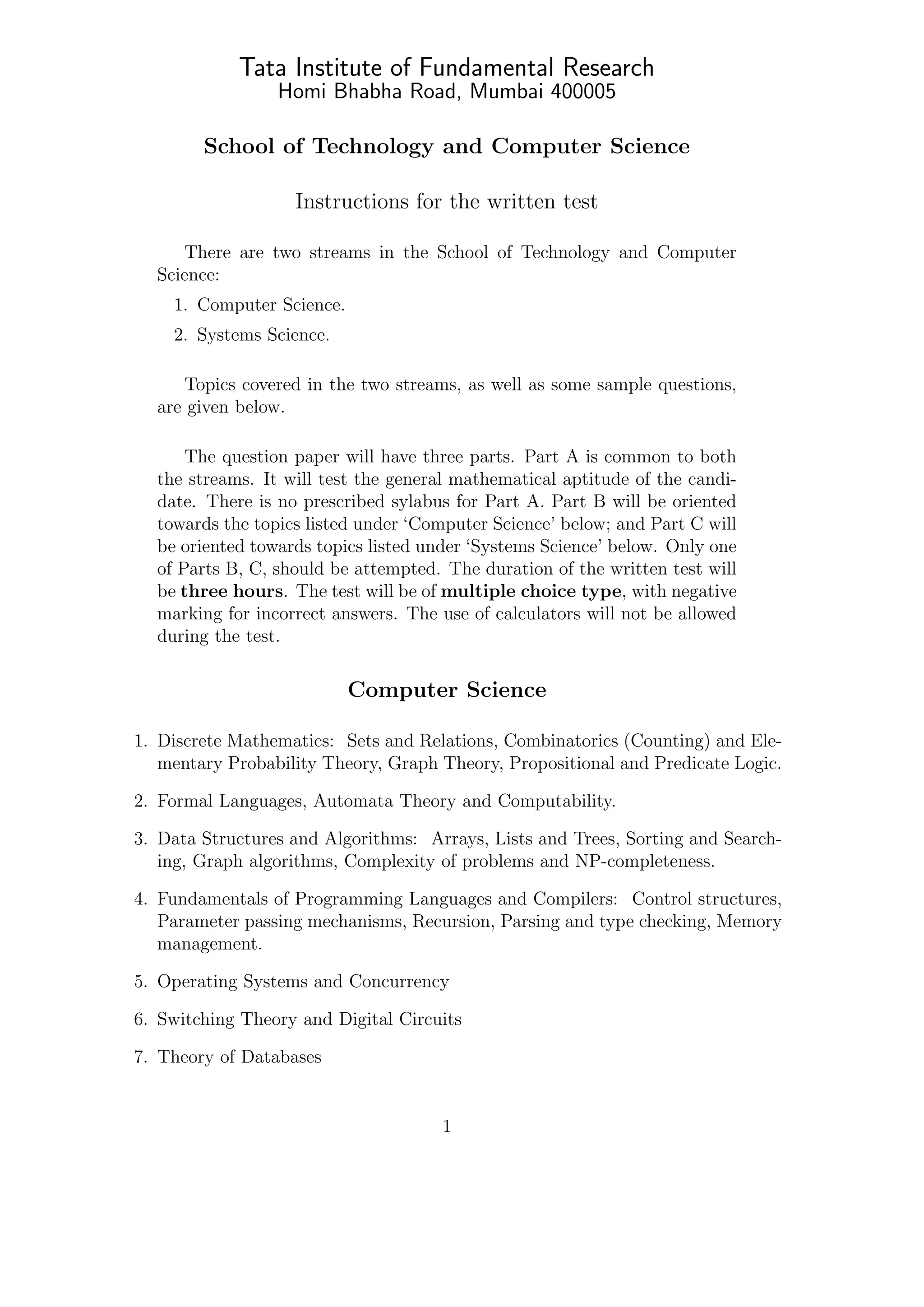
Tata Institute of Fundamental Research
                 Homi Bhabha Road, Mumbai 400005

        School of Technology and Computer Science

                   Instructions for the written test

     There are two streams in the School of Technology and Computer
  Science:
    1. Computer Science.
    2. Systems Science.

      Topics covered in the two streams, as well as some sample questions,
  are given below.

      The question paper will have three parts. Part A is common to both
  the streams. It will test the general mathematical aptitude of the candi-
  date. There is no prescribed sylabus for Part A. Part B will be oriented
  towards the topics listed under ‘Computer Science’ below; and Part C will
  be oriented towards topics listed under ‘Systems Science’ below. Only one
  of Parts B, C, should be attempted. The duration of the written test will
  be three hours. The test will be of multiple choice type, with negative
  marking for incorrect answers. The use of calculators will not be allowed
  during the test.

                           Computer Science

1. Discrete Mathematics: Sets and Relations, Combinatorics (Counting) and Ele-
   mentary Probability Theory, Graph Theory, Propositional and Predicate Logic.

2. Formal Languages, Automata Theory and Computability.

3. Data Structures and Algorithms: Arrays, Lists and Trees, Sorting and Search-
   ing, Graph algorithms, Complexity of problems and NP-completeness.

4. Fundamentals of Programming Languages and Compilers: Control structures,
   Parameter passing mechanisms, Recursion, Parsing and type checking, Memory
   management.

5. Operating Systems and Concurrency

6. Switching Theory and Digital Circuits

7. Theory of Databases


                                     1
Sample Questions [Computer Science]

1. A function f : {0, 1}n → {0, 1} is called symmetric if for every x1 , x2 , . . . , xn ∈
   {0, 1} and every permutation σ of {1, 2, . . . , n}, we have

                        f (x1 , x2 , . . . , xn ) = f (xσ(1) , xσ(2) , . . . , xσ(n) ).

   The number of such symmetric functions is:
                                   n                  n
   (a) 2n+1    (b) 2n      (c) 22 /n!         (d) 22        (e) n!

2. Let r, s and t be regular expressions. Which of the following is wrong?
   (a) (r + s)∗ = (r∗ s∗ )∗ (b) r(s + t) = rs + rt
   (c) (r + s)∗ = (s + r)∗ (d) (rs + r)∗ r = r(sr + r)∗                        (e) All are correct.

3. Consider the following program
   x:=0; y:=1; z:=1;
   while y <= N do
   begin
   x:=x+1; y:=y+z+2; z:=z+2;
   end
   Which of the following holds on termination of the program?
                                   √
   (a) (x + 1)2 = N        (b) x = N
   (c) x2 = N      (d) x2 ≤ N < (x + 1)2      (e) x2 < N ≤ (x + 1)2 .

4. The maximum height of a rooted binary tree (all nodes have either two children
   or none) with N nodes is
   (a) N (b) log N (c) (N − 1)/2 (d) (N 2 )/2 (e) N (N − 1)/2.

5. If a graph G has n vertices and m edges then the depth first traversal of G can
   be carried out in time
   (a) O(n + m)                              (b) O(nm) but not O(n + m)
   (c) O(n2 ) but not O(n + m)                (d) O(n)       (e) O(m)

                                  Systems Science

1. Engineering Mathematics: Complex Analysis, Linear Algebra, Elementary Nu-
   merical Analysis, Basic Optimization Theory and Algorithms, Introduction to
   Probability Theory and Statistics.

2. Electrical and Computer Sciences: Introduction to Signals and Linear Systems
   Analysis, Control Systems, Digital Signal Processing, Basic Circuit Theory,
   Introduction to Digital Communications, Digital Computer Fundamentals, In-
   troduction to Computer Programming.


                                                  2
Sample Questions [Systems Science]

1. The probability density of a random variable is
                            f (x) = ax2 exp−kx (k > 0, 0 ≤ x ≤ ∞)
   Then, the coefficient a equals
   (a) k 3 /2           (b) k 3          (c) k 2          (d) k         (e) 2k/π.
2. Discrete sequences x(n) is non-zero for 0 ≤ n ≤ Nx and y(n) for 0 ≤ n ≤ Ny .
   The sequence z(n) is obtained by convolving x(n) and y(n). z(n) assumes
   nonzero values for N1 ≤ n ≤ N2 , where N1 and N2 can be expressed in terms
   of Nx and Ny as,
    (a)   N1    = 0; N2 = M AX(Nx , Ny )
    (b)   N1    = Nx ; N2 = Ny
    (c)   N1    = M IN (Nx , Ny ); N2 = Nx + Ny
    (d)   N1    = 0; N2 = Nx + Ny
    (e)   N1    = M IN (Nx , Ny ); N2 = M AX(Nx , Ny )
3. This is a portion of FORTRAN-77 program for assigning values to a N × N
   matrix A:
   DO I=1,N
          DO J=I,N
                  A(I,J) = ABS(I−J)+1
          ENDDO
   ENDDO
   What is the matrix A called ?
   (a) Anti-symmetric             (b) Sparse         (c) Upper triangular       (d) Toeplitz
   (e) Irregular.
4. logb (logb x) equals
    (a)   (ln ln x − ln ln b)/ ln b
    (b)   (ln x − ln b)/ ln b
    (c)   (ln ln x − ln ln b)
    (d)   (ln x − ln b)/[(ln x)(ln b)]
    (e)   None of the Above.
5. The Laplace Transform G(s) of the transfer function of a linear time invariant
   system is given by
                                               1
                                G(s) =
                                         (s + a)2 + b2
   For the system to be stable it is necessary that
   (a) a < 0        (b) a ≥ 0       (c) a = b       (d) b = 0     (e) a = −b.


                                                3

Paper computer

  • 1.
    Tata Institute ofFundamental Research Homi Bhabha Road, Mumbai 400005 School of Technology and Computer Science Instructions for the written test There are two streams in the School of Technology and Computer Science: 1. Computer Science. 2. Systems Science. Topics covered in the two streams, as well as some sample questions, are given below. The question paper will have three parts. Part A is common to both the streams. It will test the general mathematical aptitude of the candi- date. There is no prescribed sylabus for Part A. Part B will be oriented towards the topics listed under ‘Computer Science’ below; and Part C will be oriented towards topics listed under ‘Systems Science’ below. Only one of Parts B, C, should be attempted. The duration of the written test will be three hours. The test will be of multiple choice type, with negative marking for incorrect answers. The use of calculators will not be allowed during the test. Computer Science 1. Discrete Mathematics: Sets and Relations, Combinatorics (Counting) and Ele- mentary Probability Theory, Graph Theory, Propositional and Predicate Logic. 2. Formal Languages, Automata Theory and Computability. 3. Data Structures and Algorithms: Arrays, Lists and Trees, Sorting and Search- ing, Graph algorithms, Complexity of problems and NP-completeness. 4. Fundamentals of Programming Languages and Compilers: Control structures, Parameter passing mechanisms, Recursion, Parsing and type checking, Memory management. 5. Operating Systems and Concurrency 6. Switching Theory and Digital Circuits 7. Theory of Databases 1
  • 2.
    Sample Questions [ComputerScience] 1. A function f : {0, 1}n → {0, 1} is called symmetric if for every x1 , x2 , . . . , xn ∈ {0, 1} and every permutation σ of {1, 2, . . . , n}, we have f (x1 , x2 , . . . , xn ) = f (xσ(1) , xσ(2) , . . . , xσ(n) ). The number of such symmetric functions is: n n (a) 2n+1 (b) 2n (c) 22 /n! (d) 22 (e) n! 2. Let r, s and t be regular expressions. Which of the following is wrong? (a) (r + s)∗ = (r∗ s∗ )∗ (b) r(s + t) = rs + rt (c) (r + s)∗ = (s + r)∗ (d) (rs + r)∗ r = r(sr + r)∗ (e) All are correct. 3. Consider the following program x:=0; y:=1; z:=1; while y <= N do begin x:=x+1; y:=y+z+2; z:=z+2; end Which of the following holds on termination of the program? √ (a) (x + 1)2 = N (b) x = N (c) x2 = N (d) x2 ≤ N < (x + 1)2 (e) x2 < N ≤ (x + 1)2 . 4. The maximum height of a rooted binary tree (all nodes have either two children or none) with N nodes is (a) N (b) log N (c) (N − 1)/2 (d) (N 2 )/2 (e) N (N − 1)/2. 5. If a graph G has n vertices and m edges then the depth first traversal of G can be carried out in time (a) O(n + m) (b) O(nm) but not O(n + m) (c) O(n2 ) but not O(n + m) (d) O(n) (e) O(m) Systems Science 1. Engineering Mathematics: Complex Analysis, Linear Algebra, Elementary Nu- merical Analysis, Basic Optimization Theory and Algorithms, Introduction to Probability Theory and Statistics. 2. Electrical and Computer Sciences: Introduction to Signals and Linear Systems Analysis, Control Systems, Digital Signal Processing, Basic Circuit Theory, Introduction to Digital Communications, Digital Computer Fundamentals, In- troduction to Computer Programming. 2
  • 3.
    Sample Questions [SystemsScience] 1. The probability density of a random variable is f (x) = ax2 exp−kx (k > 0, 0 ≤ x ≤ ∞) Then, the coefficient a equals (a) k 3 /2 (b) k 3 (c) k 2 (d) k (e) 2k/π. 2. Discrete sequences x(n) is non-zero for 0 ≤ n ≤ Nx and y(n) for 0 ≤ n ≤ Ny . The sequence z(n) is obtained by convolving x(n) and y(n). z(n) assumes nonzero values for N1 ≤ n ≤ N2 , where N1 and N2 can be expressed in terms of Nx and Ny as, (a) N1 = 0; N2 = M AX(Nx , Ny ) (b) N1 = Nx ; N2 = Ny (c) N1 = M IN (Nx , Ny ); N2 = Nx + Ny (d) N1 = 0; N2 = Nx + Ny (e) N1 = M IN (Nx , Ny ); N2 = M AX(Nx , Ny ) 3. This is a portion of FORTRAN-77 program for assigning values to a N × N matrix A: DO I=1,N DO J=I,N A(I,J) = ABS(I−J)+1 ENDDO ENDDO What is the matrix A called ? (a) Anti-symmetric (b) Sparse (c) Upper triangular (d) Toeplitz (e) Irregular. 4. logb (logb x) equals (a) (ln ln x − ln ln b)/ ln b (b) (ln x − ln b)/ ln b (c) (ln ln x − ln ln b) (d) (ln x − ln b)/[(ln x)(ln b)] (e) None of the Above. 5. The Laplace Transform G(s) of the transfer function of a linear time invariant system is given by 1 G(s) = (s + a)2 + b2 For the system to be stable it is necessary that (a) a < 0 (b) a ≥ 0 (c) a = b (d) b = 0 (e) a = −b. 3