The 5 Kingdoms
By Aubrey C and Hemi B
Animals
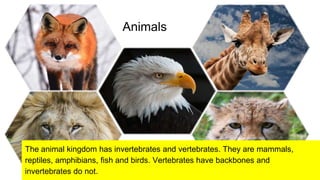
The animal kingdom has invertebrates and vertebrates. They are mammals,
reptiles, amphibians, fish and birds. Vertebrates have backbones and
invertebrates do not.
Bacteria
Typically a few micrometres in length, bacteria have a number of shapes, ranging
from spheres to rods and spirals.There is blue and green bacteria in the picture.
Bacteria is a one celled organism.
Fungi
Fungi examples are molds and yeast and mushrooms. Fungi are found in about
any habitat in the world. 99,000 species of fungi are known.
Plants
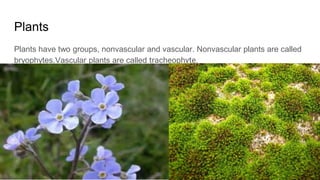
Plants have two groups, nonvascular and vascular. Nonvascular plants are called
bryophytes.Vascular plants are called tracheophyte.
Protists
Protist is an informal term for any eukaryotic organism that is not an animal, plant
or fungi. The protists do not form a natural group, or clade, but are often grouped
together for convenience, like algae or invertebrates.
Kingdoms

Kingdoms

  • 1.
    The 5 Kingdoms ByAubrey C and Hemi B
  • 2.
    Animals The animal kingdomhas invertebrates and vertebrates. They are mammals, reptiles, amphibians, fish and birds. Vertebrates have backbones and invertebrates do not.
  • 3.
    Bacteria Typically a fewmicrometres in length, bacteria have a number of shapes, ranging from spheres to rods and spirals.There is blue and green bacteria in the picture. Bacteria is a one celled organism.
  • 4.
    Fungi Fungi examples aremolds and yeast and mushrooms. Fungi are found in about any habitat in the world. 99,000 species of fungi are known.
  • 5.
    Plants Plants have twogroups, nonvascular and vascular. Nonvascular plants are called bryophytes.Vascular plants are called tracheophyte.
  • 6.
    Protists Protist is aninformal term for any eukaryotic organism that is not an animal, plant or fungi. The protists do not form a natural group, or clade, but are often grouped together for convenience, like algae or invertebrates.