Rick Vaz  Dean, Interdisciplinary and Global Studies Worcester Polytechnic Institute [email_address] Preparing the Engineer of the Future, Part 1: Project Work Across the Curriculum
Life and Work in the 21 st  Century Rapid change Scientific and technological Societal, political, economic Evolving demands  Flexibility, adaptability Working across boundaries Understanding connections Rethinking educational goals Technological competence Broad skills and perspectives Creative problem solving Effective leadership
Institutional Profile of WPI Private, founded in 1865 3000 undergraduates, 1100 graduate students, 230 FTE faculty Most students major in engineering, science, or management  $12M research + 25 PhDs annually Project-based curriculum since 1970 WPI sends more engineering & science students abroad than any other US college or university
The WPI Plan (1970) A Faculty-Led Revolution No required courses!  Three degree-required projects  Focus on outcomes and abilities 7-week terms, non-punitive grading The Vision: “Technological humanists” Developing a broad perspective Integrating theory and practice  Addressing societal needs  Considering the impacts of technology Understanding and working with others
WPI Plan Degree Requirements, 1970 2 nd  year: Humanities and Arts Sufficiency 3 credit hour capstone in chosen area Research paper, musical composition, etc. 3 rd  year: Interactive Qualifying Project 9 credit hours, interdisciplinary Examine social implications of technology 4 th  year: Major Qualifying Project 9 credit hours, in major field Senior design or research problem 4 th  year:  Competency Exam Solve a problem in 72 hours Defend to board of faculty
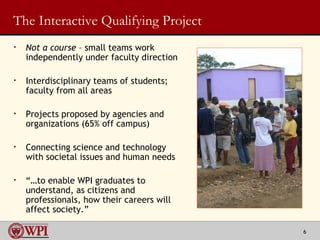
The Interactive Qualifying Project Not a course  – small teams work independently under faculty direction  Interdisciplinary teams of students;  faculty from all areas Projects proposed by agencies and organizations (65% off campus) Connecting science and technology with societal issues and human needs “… to enable WPI graduates to understand, as citizens and professionals, how their careers will affect society.”
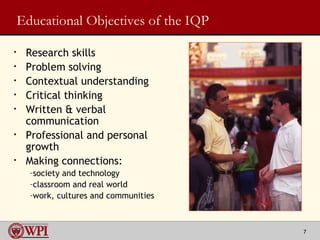
Educational Objectives of the IQP Research skills  Problem solving Contextual understanding Critical thinking Written & verbal communication Professional and personal growth Making connections: society and technology classroom and real world work, cultures and communities
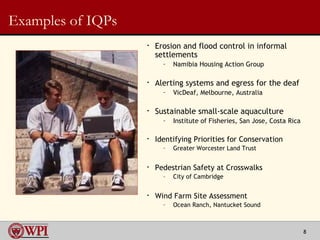
Examples of IQPs Erosion and flood control in informal settlements Namibia Housing Action Group Alerting systems and egress for the deaf VicDeaf, Melbourne, Australia Sustainable small-scale aquaculture  Institute of Fisheries, San Jose, Costa Rica Identifying Priorities for Conservation Greater Worcester Land Trust Pedestrian Safety at Crosswalks  City of Cambridge Wind Farm Site Assessment  Ocean Ranch, Nantucket Sound
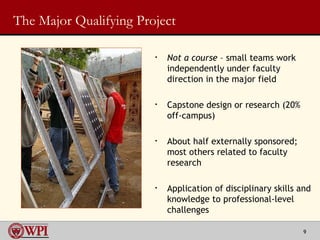
The Major Qualifying Project Not a course  – small teams work independently under faculty direction in the major field  Capstone design or research (20% off-campus) About half externally sponsored; most others related to faculty research Application of disciplinary skills and knowledge to professional-level challenges
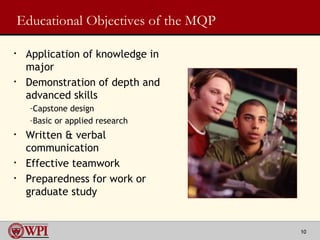
Educational Objectives of the MQP Application of knowledge in major Demonstration of depth and advanced skills Capstone design  Basic or applied research Written & verbal communication Effective teamwork Preparedness for work or graduate study
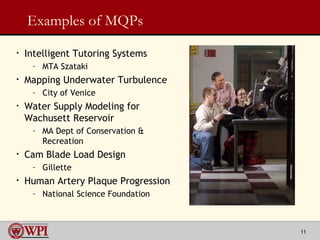
Examples of MQPs Intelligent Tutoring Systems MTA Szataki Mapping Underwater Turbulence City of Venice Water Supply Modeling for Wachusett Reservoir MA Dept of Conservation & Recreation Cam Blade Load Design Gillette Human Artery Plaque Progression National Science Foundation
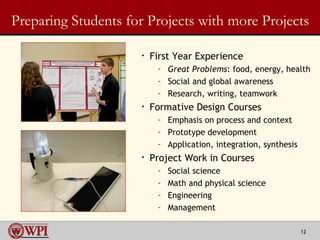
Preparing Students for Projects with more Projects First Year Experience Great Problems : food, energy, health Social and global awareness Research, writing, teamwork Formative Design Courses Emphasis on process and context Prototype development Application, integration, synthesis Project Work in Courses Social science Math and physical science Engineering Management
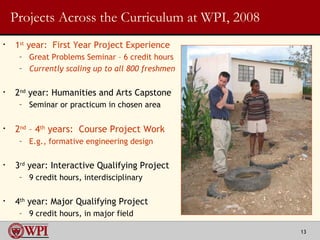
Projects Across the Curriculum at WPI, 2008 1 st  year:  First Year Project Experience Great Problems Seminar – 6 credit hours Currently scaling up to all 800 freshmen 2 nd  year: Humanities and Arts Capstone Seminar or practicum in chosen area 2 nd  – 4 th  years:  Course Project Work E.g., formative engineering design 3 rd  year: Interactive Qualifying Project 9 credit hours, interdisciplinary 4 th  year: Major Qualifying Project 9 credit hours, in major field
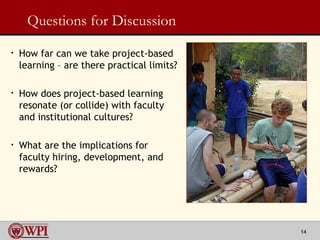
Questions for Discussion How far can we take project-based learning – are there practical limits? How does project-based learning resonate (or collide) with faculty and institutional cultures? What are the implications for faculty hiring, development, and rewards?
For More Information http://www.wpi.edu [email_address]

Preparing the Engineer of the Future, Part I: Projects across the Curriculum

  • 1.
    Rick Vaz Dean, Interdisciplinary and Global Studies Worcester Polytechnic Institute [email_address] Preparing the Engineer of the Future, Part 1: Project Work Across the Curriculum
  • 2.
    Life and Workin the 21 st Century Rapid change Scientific and technological Societal, political, economic Evolving demands Flexibility, adaptability Working across boundaries Understanding connections Rethinking educational goals Technological competence Broad skills and perspectives Creative problem solving Effective leadership
  • 3.
    Institutional Profile ofWPI Private, founded in 1865 3000 undergraduates, 1100 graduate students, 230 FTE faculty Most students major in engineering, science, or management $12M research + 25 PhDs annually Project-based curriculum since 1970 WPI sends more engineering & science students abroad than any other US college or university
  • 4.
    The WPI Plan(1970) A Faculty-Led Revolution No required courses! Three degree-required projects Focus on outcomes and abilities 7-week terms, non-punitive grading The Vision: “Technological humanists” Developing a broad perspective Integrating theory and practice Addressing societal needs Considering the impacts of technology Understanding and working with others
  • 5.
    WPI Plan DegreeRequirements, 1970 2 nd year: Humanities and Arts Sufficiency 3 credit hour capstone in chosen area Research paper, musical composition, etc. 3 rd year: Interactive Qualifying Project 9 credit hours, interdisciplinary Examine social implications of technology 4 th year: Major Qualifying Project 9 credit hours, in major field Senior design or research problem 4 th year: Competency Exam Solve a problem in 72 hours Defend to board of faculty
  • 6.
    The Interactive QualifyingProject Not a course – small teams work independently under faculty direction Interdisciplinary teams of students; faculty from all areas Projects proposed by agencies and organizations (65% off campus) Connecting science and technology with societal issues and human needs “… to enable WPI graduates to understand, as citizens and professionals, how their careers will affect society.”
  • 7.
    Educational Objectives ofthe IQP Research skills Problem solving Contextual understanding Critical thinking Written & verbal communication Professional and personal growth Making connections: society and technology classroom and real world work, cultures and communities
  • 8.
    Examples of IQPsErosion and flood control in informal settlements Namibia Housing Action Group Alerting systems and egress for the deaf VicDeaf, Melbourne, Australia Sustainable small-scale aquaculture Institute of Fisheries, San Jose, Costa Rica Identifying Priorities for Conservation Greater Worcester Land Trust Pedestrian Safety at Crosswalks City of Cambridge Wind Farm Site Assessment Ocean Ranch, Nantucket Sound
  • 9.
    The Major QualifyingProject Not a course – small teams work independently under faculty direction in the major field Capstone design or research (20% off-campus) About half externally sponsored; most others related to faculty research Application of disciplinary skills and knowledge to professional-level challenges
  • 10.
    Educational Objectives ofthe MQP Application of knowledge in major Demonstration of depth and advanced skills Capstone design Basic or applied research Written & verbal communication Effective teamwork Preparedness for work or graduate study
  • 11.
    Examples of MQPsIntelligent Tutoring Systems MTA Szataki Mapping Underwater Turbulence City of Venice Water Supply Modeling for Wachusett Reservoir MA Dept of Conservation & Recreation Cam Blade Load Design Gillette Human Artery Plaque Progression National Science Foundation
  • 12.
    Preparing Students forProjects with more Projects First Year Experience Great Problems : food, energy, health Social and global awareness Research, writing, teamwork Formative Design Courses Emphasis on process and context Prototype development Application, integration, synthesis Project Work in Courses Social science Math and physical science Engineering Management
  • 13.
    Projects Across theCurriculum at WPI, 2008 1 st year: First Year Project Experience Great Problems Seminar – 6 credit hours Currently scaling up to all 800 freshmen 2 nd year: Humanities and Arts Capstone Seminar or practicum in chosen area 2 nd – 4 th years: Course Project Work E.g., formative engineering design 3 rd year: Interactive Qualifying Project 9 credit hours, interdisciplinary 4 th year: Major Qualifying Project 9 credit hours, in major field
  • 14.
    Questions for DiscussionHow far can we take project-based learning – are there practical limits? How does project-based learning resonate (or collide) with faculty and institutional cultures? What are the implications for faculty hiring, development, and rewards?
  • 15.
    For More Informationhttp://www.wpi.edu [email_address]