Critical Reviews of TV Science
Documentaries
Jon Scott

School of
Biological Sciences
Aims
To encourage students to:
• think critically about and analyse documentary
material presented in the media
• research the background to the documentary
• as a group discuss their views about the
programme
• work as a group to prepare and deliver an oral
presentation
• critically evaluate the presentations of the other
groups
Exercise Brief
• Working in Groups (4 or 5 students)
• Provided with a DVD of a recent TV programme
on a Neuroscience topic – sourced via TRILT
• Provided with the Marking Scheme
• 3 weeks preparation time
• Required to present a 15 minute critical review of
the programme
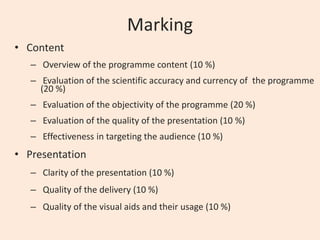
Marking
• Content
– Overview of the programme content (10 %)

– Evaluation of the scientific accuracy and currency of the programme
(20 %)
– Evaluation of the objectivity of the programme (20 %)
– Evaluation of the quality of the presentation (10 %)

– Effectiveness in targeting the audience (10 %)

• Presentation
– Clarity of the presentation (10 %)

– Quality of the delivery (10 %)
– Quality of the visual aids and their usage (10 %)
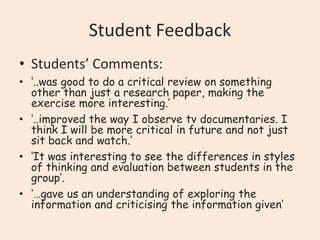
Student Feedback
• Students’ Comments:
• ‘..was good to do a critical review on something
other than just a research paper, making the
exercise more interesting.’
• ‘..improved the way I observe tv documentaries. I
think I will be more critical in future and not just
sit back and watch.’
• ‘It was interesting to see the differences in styles
of thinking and evaluation between students in the
group’.
• ‘…gave us an understanding of exploring the
information and criticising the information given’
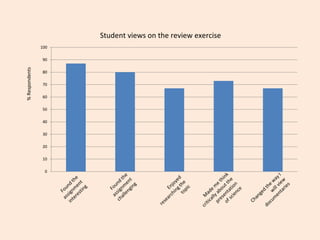
Student views on the review exercise
100

% Respondents

90
80
70
60
50
40

30
20
10
0

Critical reviews of TV science documentaries

  • 1.
    Critical Reviews ofTV Science Documentaries Jon Scott School of Biological Sciences
  • 2.
    Aims To encourage studentsto: • think critically about and analyse documentary material presented in the media • research the background to the documentary • as a group discuss their views about the programme • work as a group to prepare and deliver an oral presentation • critically evaluate the presentations of the other groups
  • 3.
    Exercise Brief • Workingin Groups (4 or 5 students) • Provided with a DVD of a recent TV programme on a Neuroscience topic – sourced via TRILT • Provided with the Marking Scheme • 3 weeks preparation time • Required to present a 15 minute critical review of the programme
  • 4.
    Marking • Content – Overviewof the programme content (10 %) – Evaluation of the scientific accuracy and currency of the programme (20 %) – Evaluation of the objectivity of the programme (20 %) – Evaluation of the quality of the presentation (10 %) – Effectiveness in targeting the audience (10 %) • Presentation – Clarity of the presentation (10 %) – Quality of the delivery (10 %) – Quality of the visual aids and their usage (10 %)
  • 5.
    Student Feedback • Students’Comments: • ‘..was good to do a critical review on something other than just a research paper, making the exercise more interesting.’ • ‘..improved the way I observe tv documentaries. I think I will be more critical in future and not just sit back and watch.’ • ‘It was interesting to see the differences in styles of thinking and evaluation between students in the group’. • ‘…gave us an understanding of exploring the information and criticising the information given’
  • 6.
    Student views onthe review exercise 100 % Respondents 90 80 70 60 50 40 30 20 10 0