Information Literacy
Instruction in Libraries

   Dr. Khalid Mahmood
  University of the Punjab


                             1
21st Century “Survival Literacies”       (Unesco)


1.   Basic or Core functional literacy fluencies of
     reading, writing, oralcy and numeracy
2.   Computer Literacy
3.   Media Literacy
4.   Distance Education and E-Learning
5.   Cultural Literacy
6.   Information Literacy

                                                    2
Information Literacy:        Definition


A mean to “empower people in all walks of life to
  seek, evaluate, use and create information
  effectively to achieve their personal, social,
  occupational and educational goals” (Unesco)

A set of abilities requiring individuals to “recognize
  when information is needed and have the
  ability to locate, evaluate, and use
  effectively the needed information” (ACRL)


                                                         3
IL-Related Terms
   Information fluency – Capability or mastering of
    information competencies
   User education – Global approach to teach information
    access to users
   Library instruction – Focuses on library skills
   Bibliographic instruction – User training on
    information search and retrieval
   Information competencies – Compound skills and
    goals of information literacy
   Information skills – Focuses on information abilities
   Development of information skills – Process of
    facilitating information skills
                                                            4
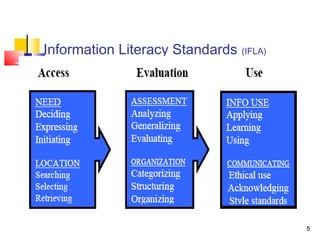
Information Literacy Standards   (IFLA)


                                          5
Stages of Information Literacy Life Cycle            (Unesco)


1.   Realize that a need or problem exists that requires
     information its satisfactory resolution.
2.   Know how to accurately identify and define the
     information needed to meet the need, solve the problem,
     or make the decision.
3.   Know how to determine whether the needed information
     exists or not, and if it does not, know how to create, or
     cause to be created the unavailable information (also
     referred to as “creating new knowledge”).
4.   Know how to find the needed information if you have
     determined that it does, indeed, exist.
5.   Know how to create, or cause to be created, unavailable
     information that you need; sometimes called “creating
     new knowledge.”
                                                                6
Stages of Information Literacy Life Cycle           (Unesco)


6.    Know how to fully understand found information, or know
      where to go for help if needed to understand it.
7.    Know how to organize, analyze, interpret and evaluate
      information, including source reliability.
8.    Know how to communicate and present the information
      to others in appropriate and usable formats and
      mediums.
9.    Know how to utilize the information to solve a problem,
      make a decision or meet a need.
10.   Know how to preserve, store, reuse, record and archive
      information for future use.
11.   Know how to dispose of information no longer needed,
      and safeguard information that should be protected.

                                                               7
IL Competency Standards for Higher
Education (ACRL)
The information literate student…

1.   determines the nature and extent of the information
     needed.
2.   accesses needed information effectively and efficiently.
3.   evaluates information and its sources critically and
     incorporates selected information into his or her
     knowledge base and value system.
4.   uses information effectively to accomplish a specific
     purpose.
5.   understands many of the economic, legal, and social
     issues surrounding the use of information and accesses
     and uses information ethically and legally.

                                                            8
IL Standards (Australia / New Zealand)
The information literate person

1.    recognizes the need for information and determines
      the nature and extent of the information needed
2.    finds needed information effectively and efficiently
3.    critically evaluates information and the information
      seeking process
4.    manages information collected or generated
5.    applies prior and new information to construct new
      concepts or create new understandings
6.    uses information with understanding and
      acknowledges cultural, ethical, economic, legal, and
      social issues surrounding the use of information
                                                             9
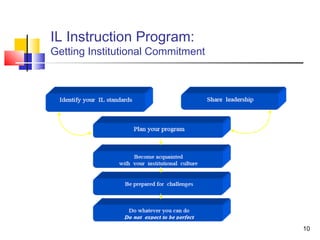
IL Instruction Program:
Getting Institutional Commitment


                                   10
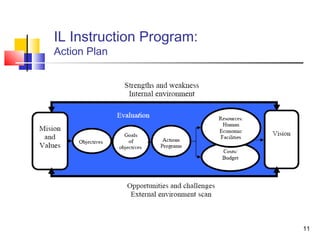
IL Instruction Program:
Action Plan


                          11
IL Instruction Program:
    Instruction Management


    Part of regular faculty/school courses
    Independent curricular courses
    Extra-curricular courses
    Independent short courses
    Courses for faculty/teachers
    Online information literacy instruction


                                               12
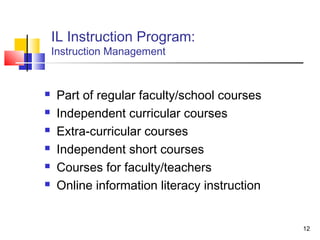
IL Resources: ACRL


                     13
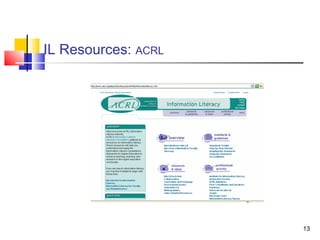
IL Resources: IFLA


                     14
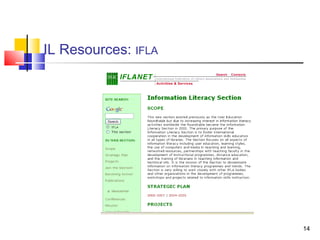
IL Resources: Unesco


                       15
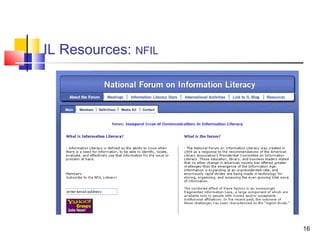
IL Resources: NFIL


                     16
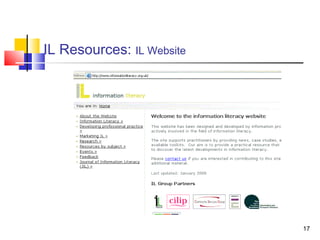
IL Resources: IL Website


                           17
Thanks for your patience


                           18

Information literacy instruction in libraries

  • 1.
    Information Literacy Instruction inLibraries Dr. Khalid Mahmood University of the Punjab 1
  • 2.
    21st Century “SurvivalLiteracies” (Unesco) 1. Basic or Core functional literacy fluencies of reading, writing, oralcy and numeracy 2. Computer Literacy 3. Media Literacy 4. Distance Education and E-Learning 5. Cultural Literacy 6. Information Literacy 2
  • 3.
    Information Literacy: Definition A mean to “empower people in all walks of life to seek, evaluate, use and create information effectively to achieve their personal, social, occupational and educational goals” (Unesco) A set of abilities requiring individuals to “recognize when information is needed and have the ability to locate, evaluate, and use effectively the needed information” (ACRL) 3
  • 4.
    IL-Related Terms  Information fluency – Capability or mastering of information competencies  User education – Global approach to teach information access to users  Library instruction – Focuses on library skills  Bibliographic instruction – User training on information search and retrieval  Information competencies – Compound skills and goals of information literacy  Information skills – Focuses on information abilities  Development of information skills – Process of facilitating information skills 4
  • 5.
  • 6.
    Stages of InformationLiteracy Life Cycle (Unesco) 1. Realize that a need or problem exists that requires information its satisfactory resolution. 2. Know how to accurately identify and define the information needed to meet the need, solve the problem, or make the decision. 3. Know how to determine whether the needed information exists or not, and if it does not, know how to create, or cause to be created the unavailable information (also referred to as “creating new knowledge”). 4. Know how to find the needed information if you have determined that it does, indeed, exist. 5. Know how to create, or cause to be created, unavailable information that you need; sometimes called “creating new knowledge.” 6
  • 7.
    Stages of InformationLiteracy Life Cycle (Unesco) 6. Know how to fully understand found information, or know where to go for help if needed to understand it. 7. Know how to organize, analyze, interpret and evaluate information, including source reliability. 8. Know how to communicate and present the information to others in appropriate and usable formats and mediums. 9. Know how to utilize the information to solve a problem, make a decision or meet a need. 10. Know how to preserve, store, reuse, record and archive information for future use. 11. Know how to dispose of information no longer needed, and safeguard information that should be protected. 7
  • 8.
    IL Competency Standardsfor Higher Education (ACRL) The information literate student… 1. determines the nature and extent of the information needed. 2. accesses needed information effectively and efficiently. 3. evaluates information and its sources critically and incorporates selected information into his or her knowledge base and value system. 4. uses information effectively to accomplish a specific purpose. 5. understands many of the economic, legal, and social issues surrounding the use of information and accesses and uses information ethically and legally. 8
  • 9.
    IL Standards (Australia/ New Zealand) The information literate person 1. recognizes the need for information and determines the nature and extent of the information needed 2. finds needed information effectively and efficiently 3. critically evaluates information and the information seeking process 4. manages information collected or generated 5. applies prior and new information to construct new concepts or create new understandings 6. uses information with understanding and acknowledges cultural, ethical, economic, legal, and social issues surrounding the use of information 9
  • 10.
    IL Instruction Program: GettingInstitutional Commitment 10
  • 11.
  • 12.
    IL Instruction Program: Instruction Management  Part of regular faculty/school courses  Independent curricular courses  Extra-curricular courses  Independent short courses  Courses for faculty/teachers  Online information literacy instruction 12
  • 13.
  • 14.
  • 15.
  • 16.
  • 17.
    IL Resources: ILWebsite 17
  • 18.
    Thanks for yourpatience 18