Key-Aggregate Cryptosystem
for Scalable Data Sharing in Cloud Storage
A PROJECT REPORT ON
Submitted by:
N.SRAVAN NAIDU 114P1A0533
ABSTRACT
Data sharing is an important functionality in cloud storage. In this article, we show how to securely, efficiently, and
flexibly share data with others in cloud storage. We describe new public-key cryptosystems which produce constant-
size cipher texts such that efficient delegation of decryption rights for any set of cipher texts are possible. The novelty
is that one can aggregate any set of secret keys and make them as compact as a single key, but encompassing the
power of all the keys being aggregated. In other words, the secret key holder can release a constant-size aggregate key
for flexible choices of cipher text set in cloud storage, but the other encrypted files outside the set remain confidential.
This compact aggregate key can be conveniently sent to others or be stored in a smart card with very limited secure
storage. We provide formal security analysis of our schemes in the standard model. We also describe other application
of our schemes. In particular, our schemes give the first public-key patient-controlled encryption for flexible
hierarchy, which was yet to be known.
ARCHITECTURE
Existing System
 Encryption keys also come with two flavors — symmetric key , asymmetric (public) key.
 when Alice wants the data to be originated from a third party, she has to give the encryptor
her secret key; obviously, this is not always desirable.
 A cryptographic solution, with proven security relied on number-theoretic assumptions is
more desirable, whenever the user is not perfectly happy with trusting the security of the VM
or the honesty of the technical staff.
 These users are motivated to encrypt their data with their own keys before uploading them to
the server.
DISADVANTAGES OF EXISTING SYSTEM
 Un trusted server cannot share the data freely to anyone.
 No guarantee on the correctness of transformation of data done by the cloud server.
 The costs and complexities involved generally increase with the number of the decryption keys to be shared.
 The encryption key and decryption key are different in publickey encryption.
 Unexpected privilege escalation will expose all.
 It is not efficient.
 Shared data will not be secure.
PROPOSED SYSTEM
• We solve this problem by introducing a special type of public-key encryption which we call key-aggregate cryptosystem
(KAC).
• In KAC, users encrypt a message not only under a public-key, but also under an identifier of cipher text called class.
• The key owner holds a master-secret called master-secret key, which can be used to extract secret keys for different classes.
• The extracted key can be an aggregate key which is as compact as a secret key for a single class, but aggregates the power of
many such keys, i.e., the decryption power for any subset of cipher text classes.
• More importantly, the extracted key have can be an aggregate key which is as compact as a secret key for a single class, but
aggregates the power of many such keys, i.e., the decryption power for any subset of cipher text classes
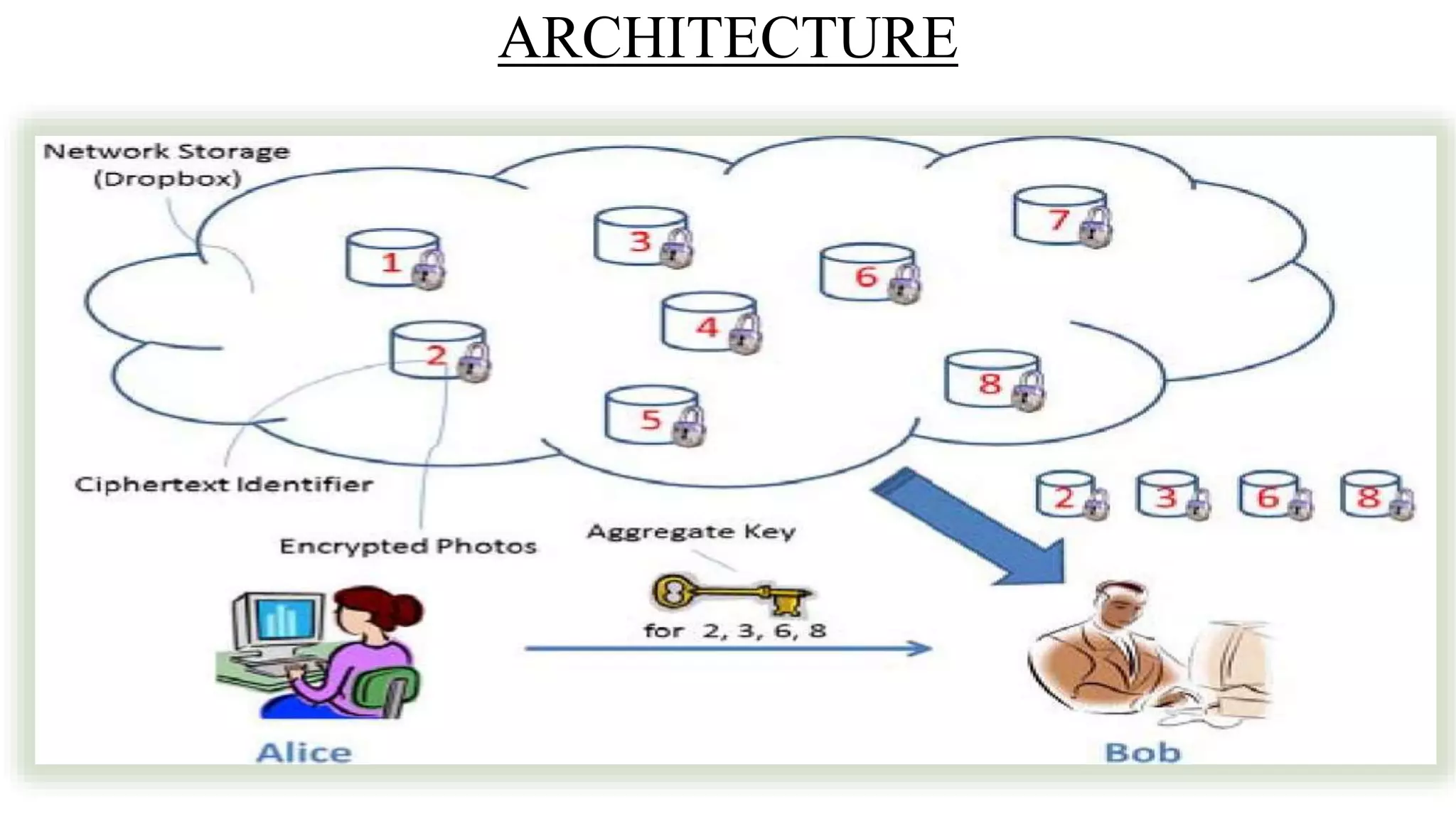
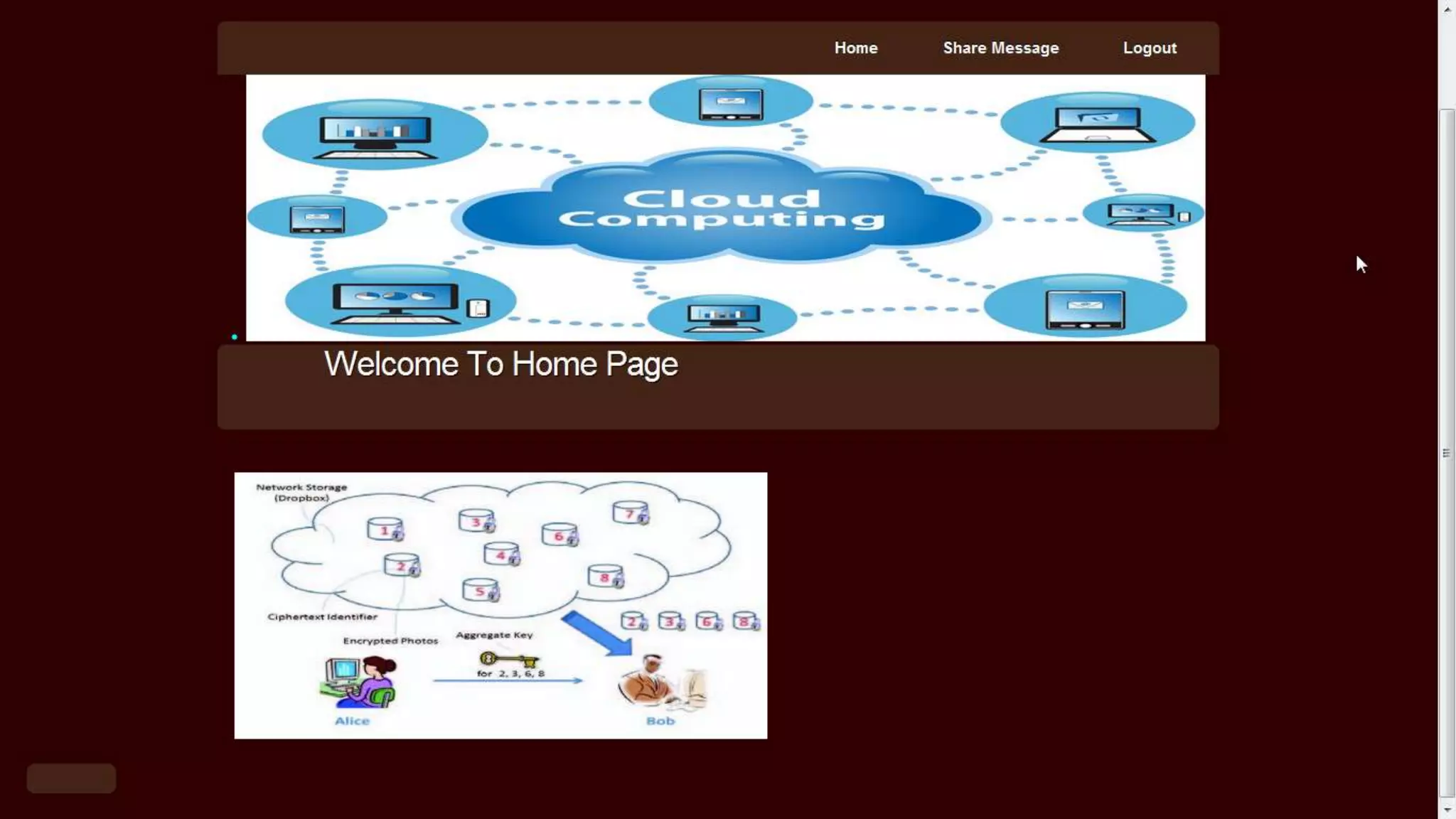
• With our solution, Alice can simply send Bob a single aggregate key via a secure e-mail. Bob can download the encrypted
photos from Alice’s Dropbox space and then use this aggregate key to decrypt these encrypted photos.
ADVANTAGES OF PROPOSED SYSTEM
• It is more secure.
• Decryption key should be sent via a secure channel and kept secret.
• It is an efficient public-key encryption scheme which supports flexible delegation.
• The extracted key have can be an aggregate key which is as compact as a secret key for a single class.
• The delegation of decryption can be efficiently implemented with the aggregate key.
With our solution, Alice can simply send Bob a single aggregate key via a secure
e-mail. Bob can download the encrypted files from Alice’s Dropbox space and
then use this aggregate key to decrypt these encrypted files
H/W & S/W REQUIREMENTS
HARDWARE REQUIREMENTS
• Processor - intel i3
• Ram - 1GB
• Hard Disk - 500GB
SOFTWARE REQUIREMENTS
• Operating System : Windows 07
• Application Server : Tomcat5.0/6.X
• Front End : HTML, Java, Jsp
• Scripts : JavaScript.
• Server side Script : Java Server Pages.
• Database : Mysql
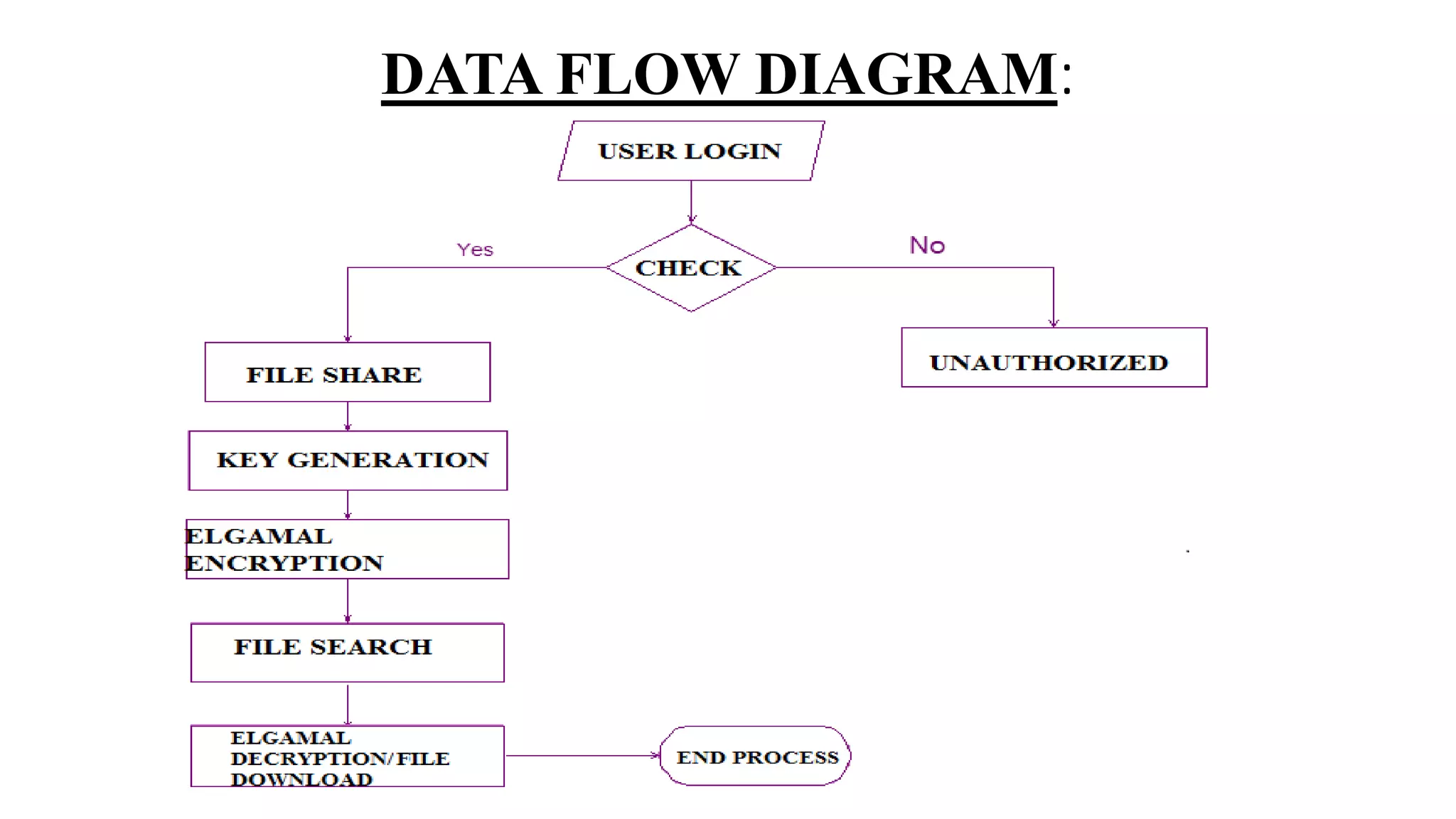
DATA FLOW DIAGRAM:
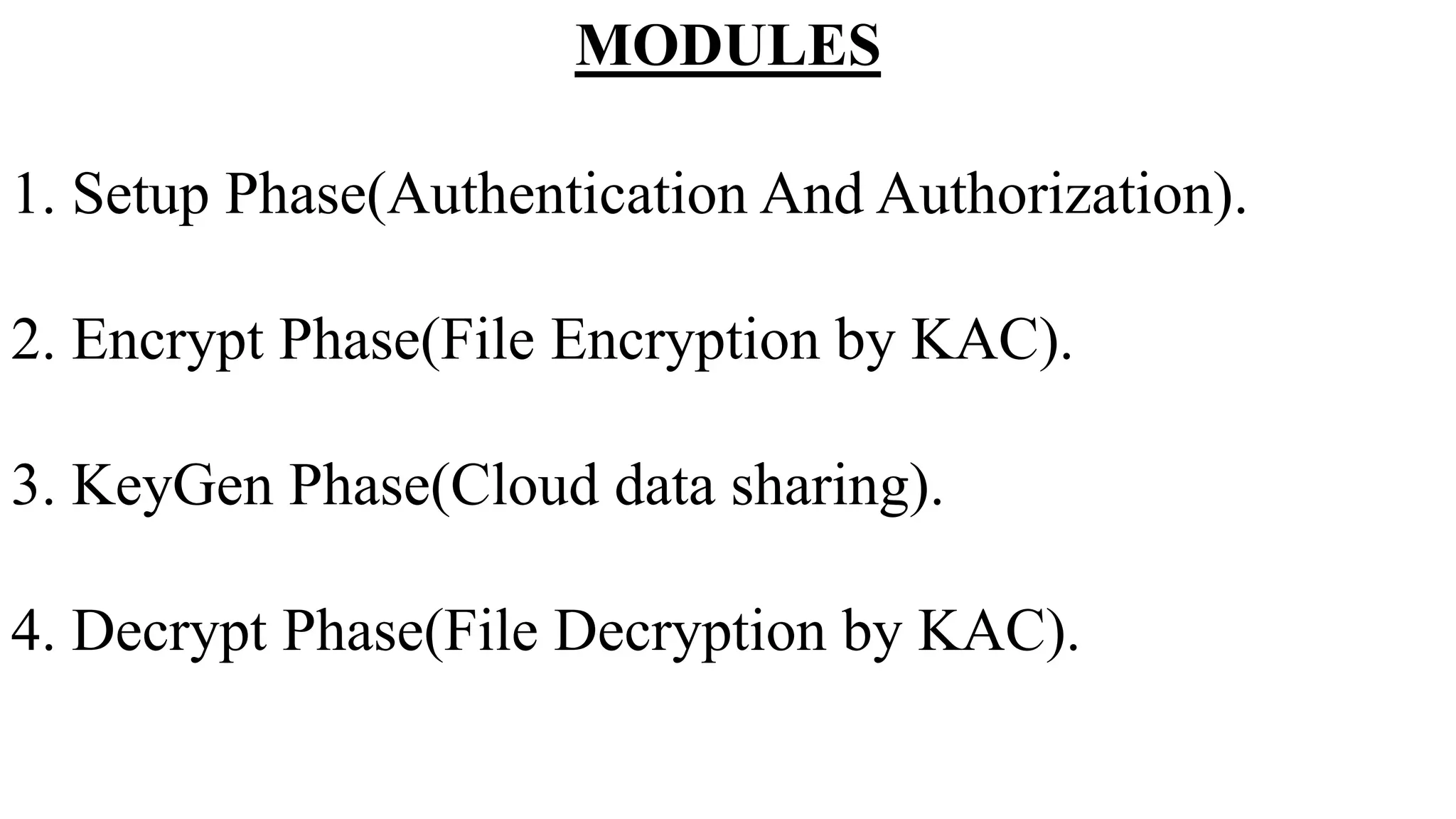
MODULES
1. Setup Phase(Authentication And Authorization).
2. Encrypt Phase(File Encryption by KAC).
3. KeyGen Phase(Cloud data sharing).
4. Decrypt Phase(File Decryption by KAC).
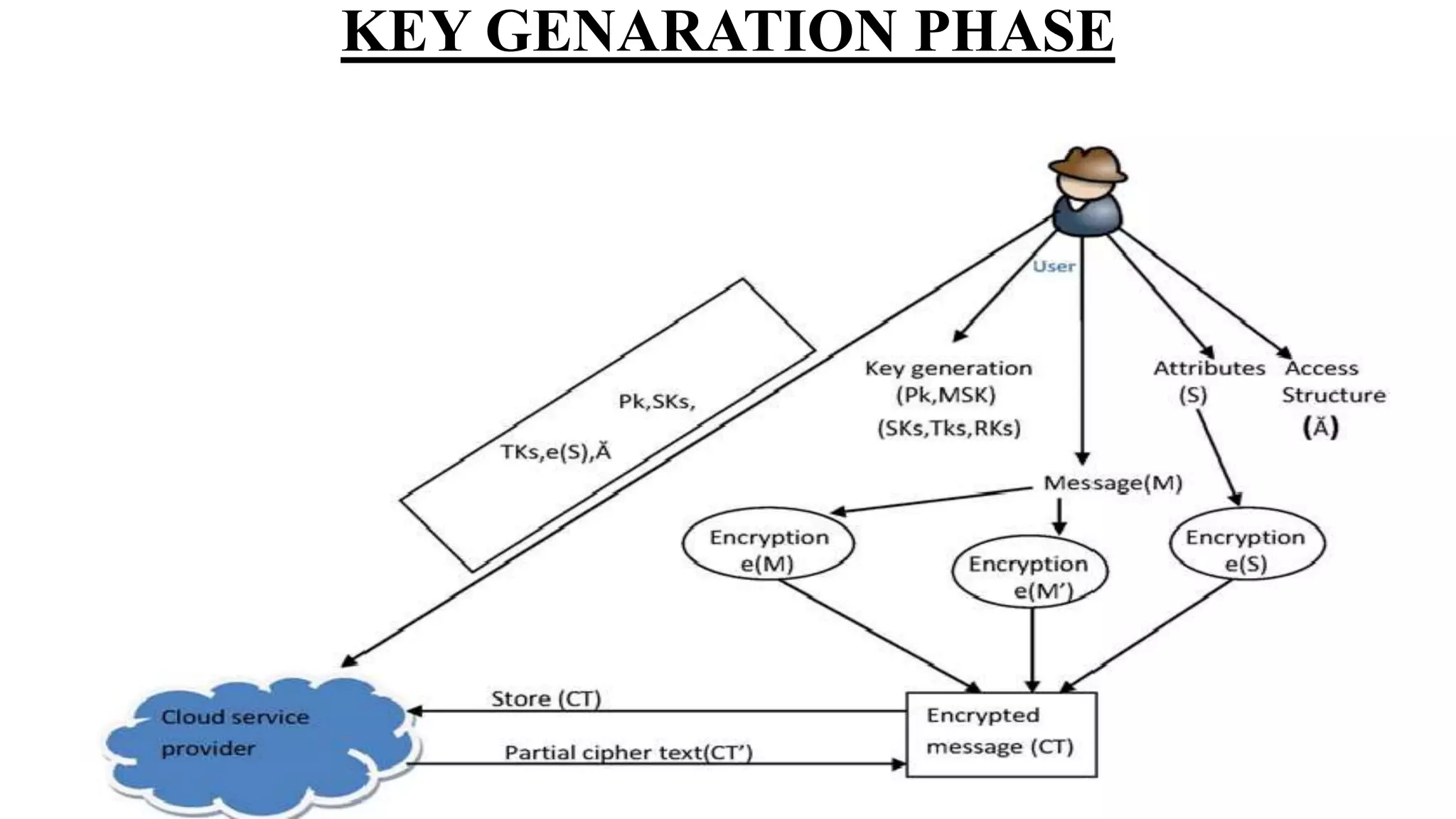
KEY GENARATION PHASE
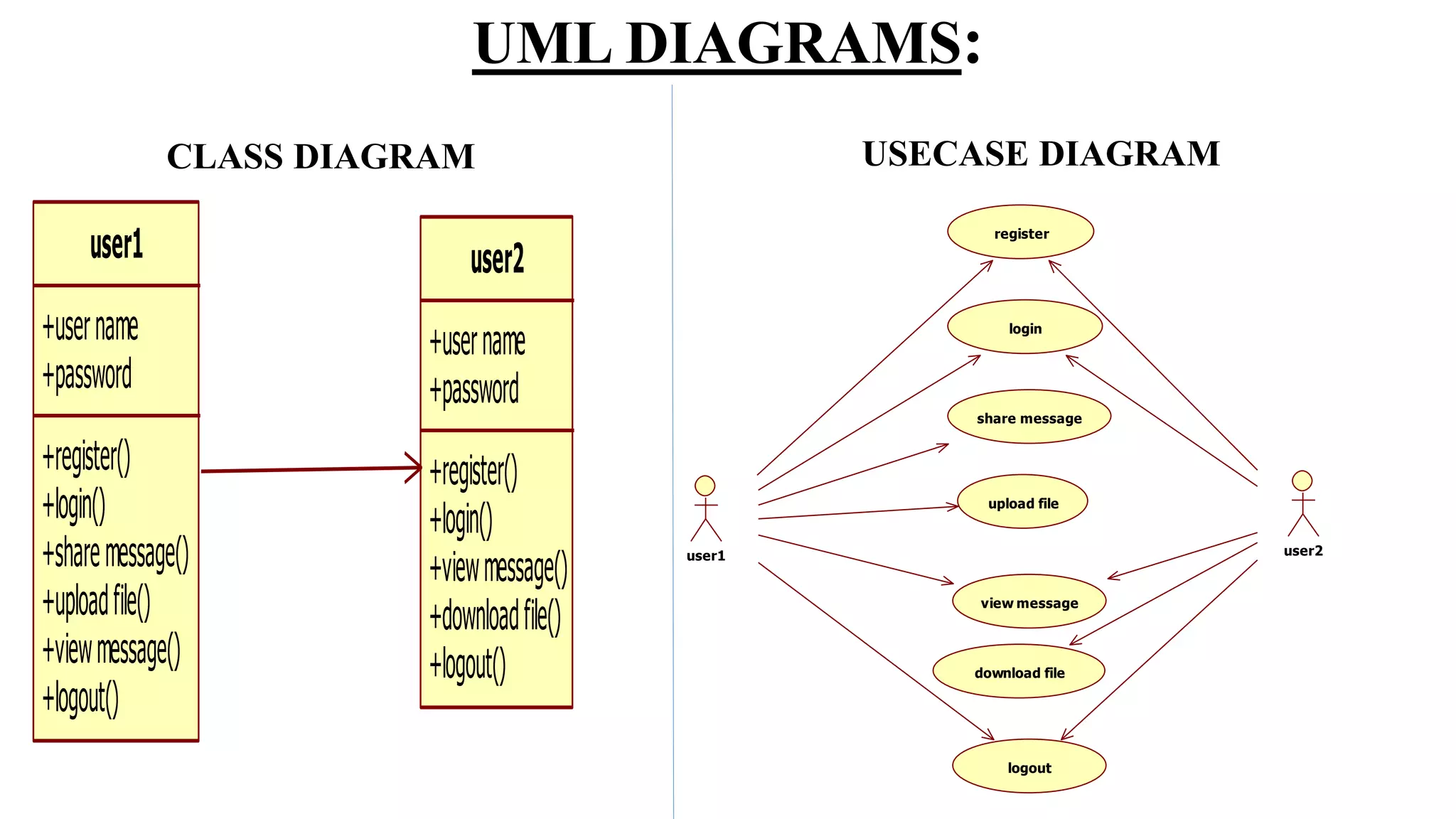
UML DIAGRAMS:
user1
+username
+password
+register()
+login()
+sharemessage()
+uploadfile()
+viewmessage()
+logout()
user2
+username
+password
+register()
+login()
+viewmessage()
+downloadfile()
+logout()
user1 user2
register
login
share message
upload file
view message
download file
logout
CLASS DIAGRAM USECASE DIAGRAM
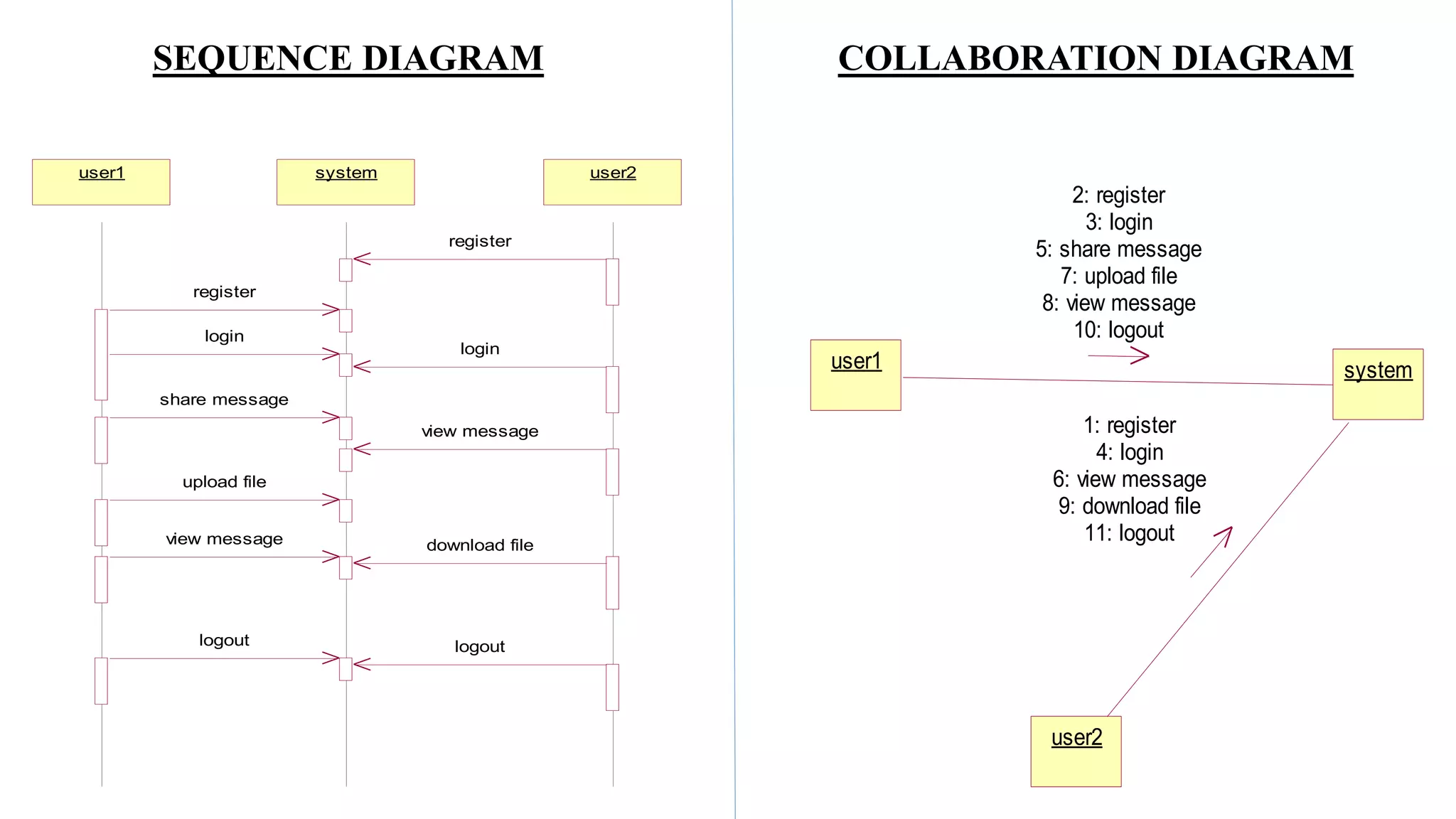
user1 system user2
register
register
login
login
share message
view message
upload file
view message download file
logout logout
user1 system
user2
1: register
2: register
3: login
4: login
5: share message
6: view message
7: upload file
8: view message
9: download file
10: logout
11: logout
SEQUENCE DIAGRAM COLLABORATION DIAGRAM
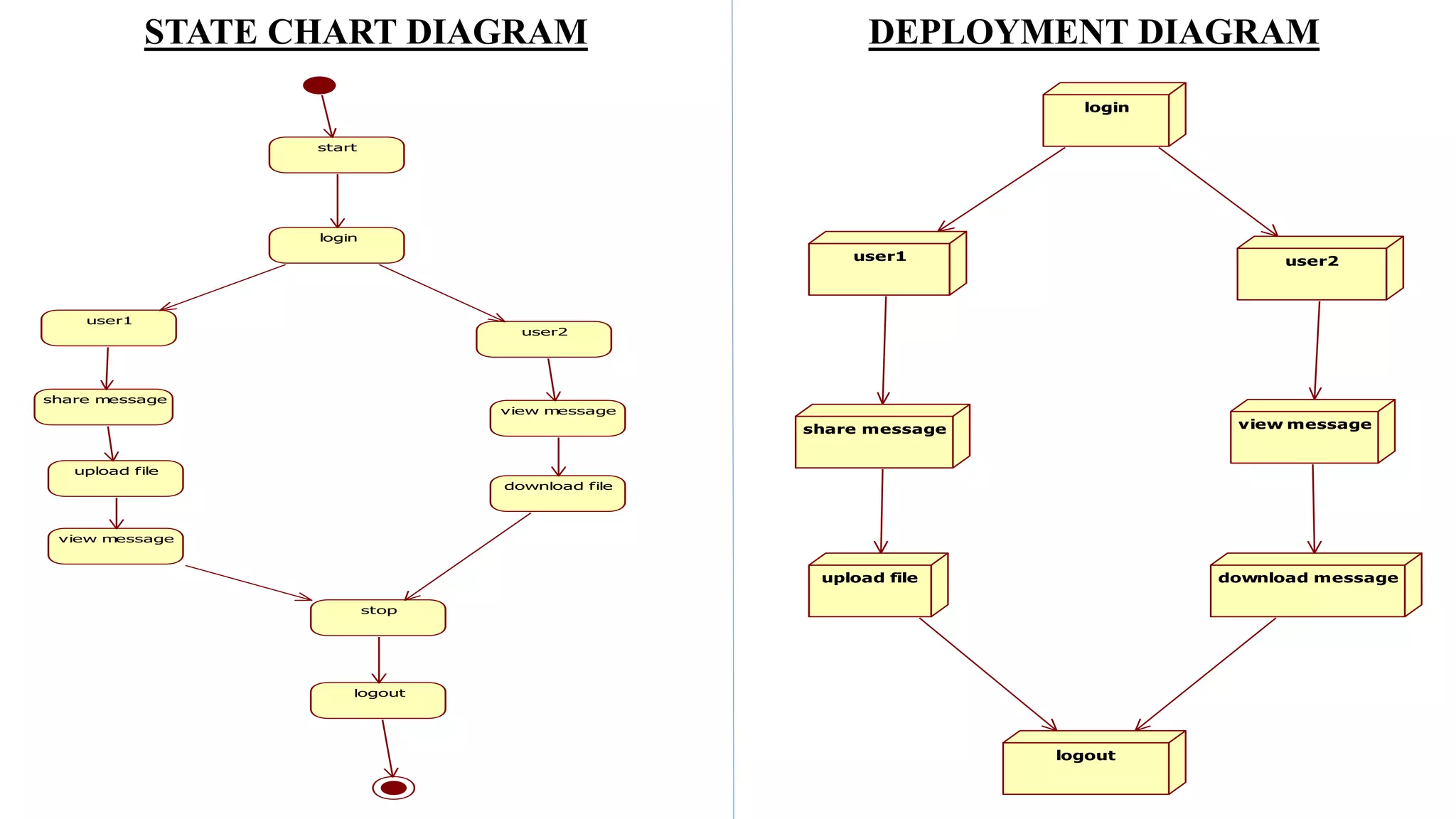
start
login
user1
user2
share message
upload file
view message
stop
logout
view message
download file
login
user1 user2
share message view message
upload file
logout
download message
STATE CHART DIAGRAM DEPLOYMENT DIAGRAM
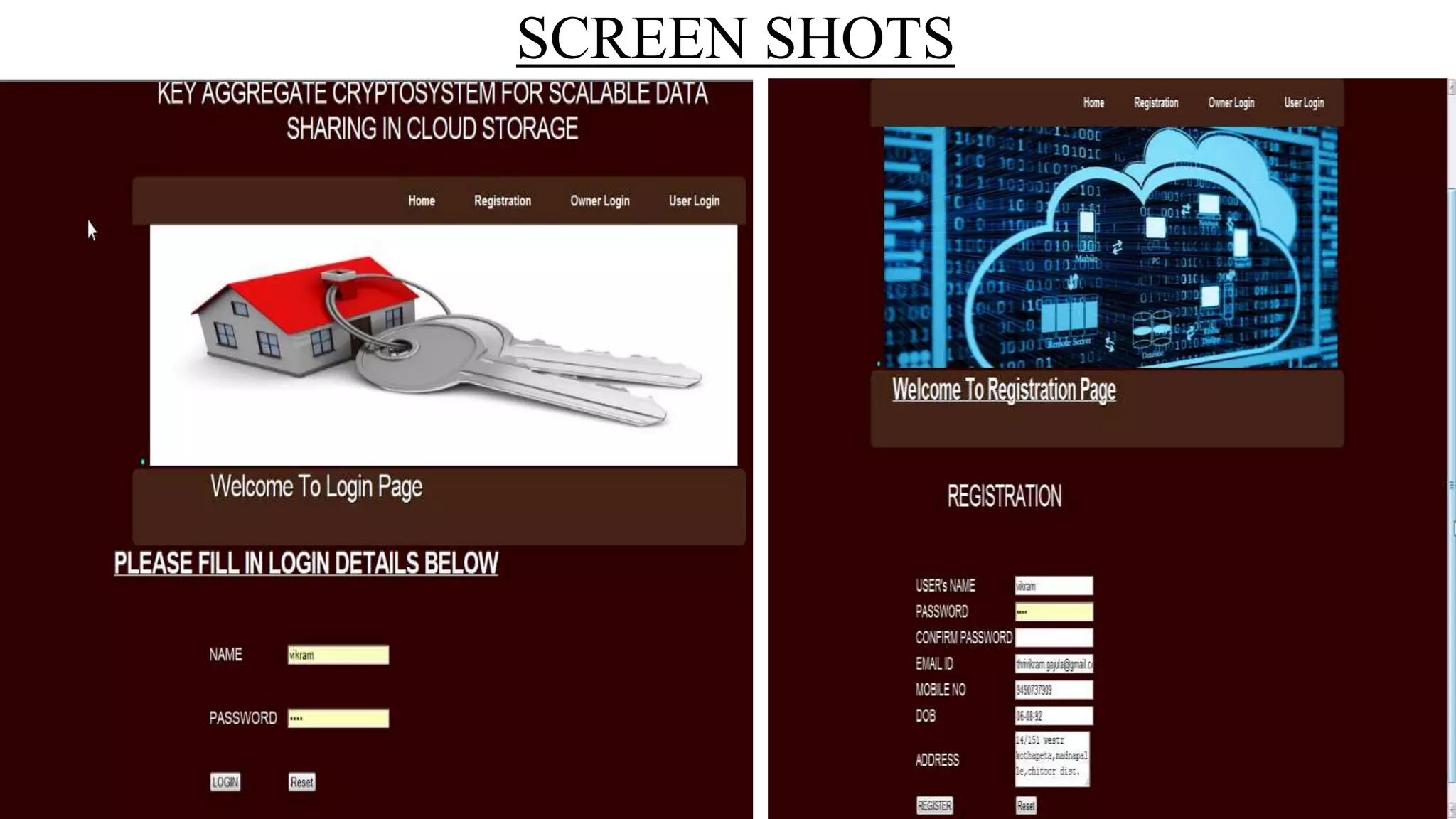
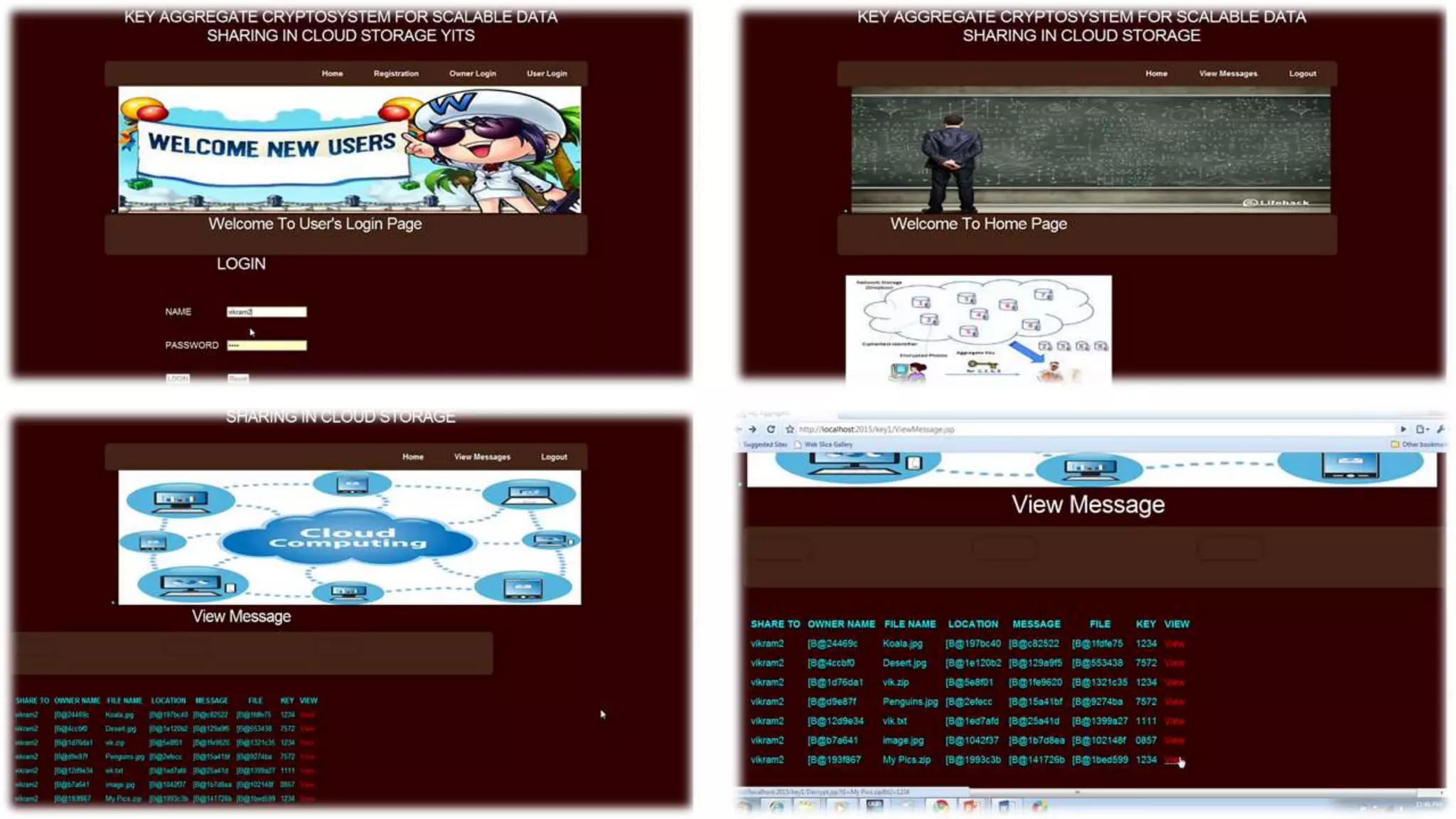
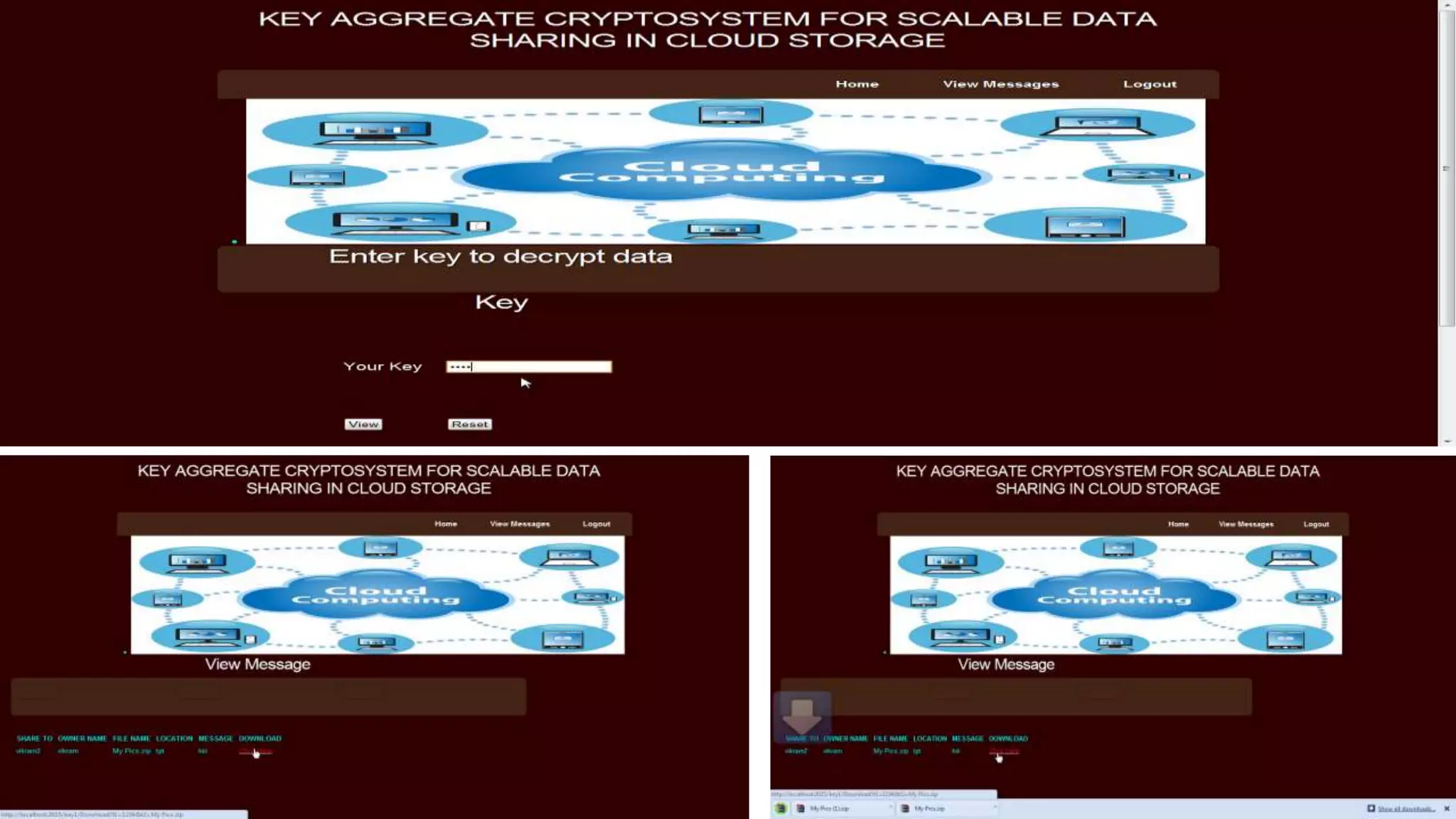
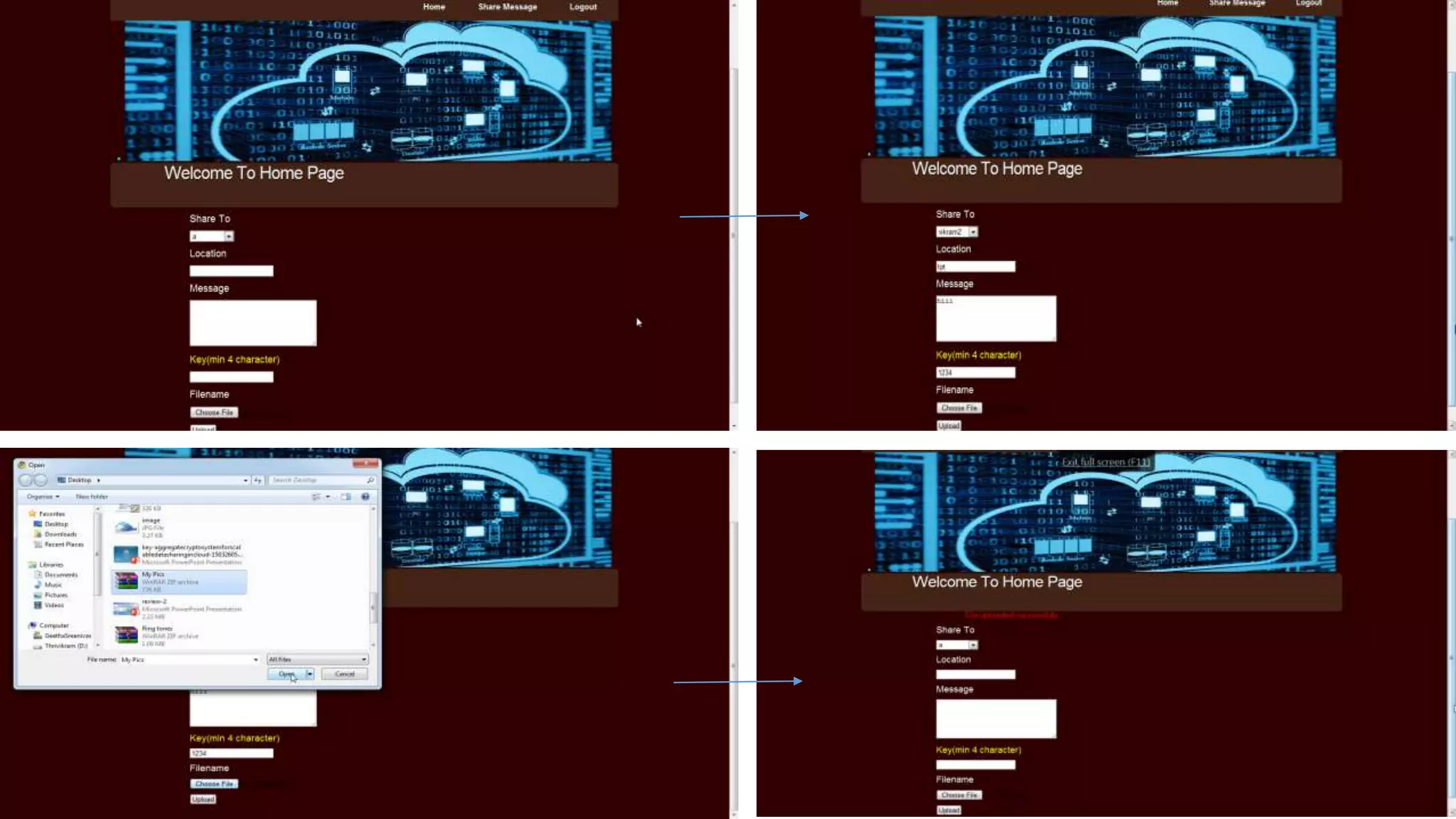
SCREEN SHOTS
CONCLUSION
 “compress” secret keys in public-key cryptosystems which support delegation of secret keys for different cipher
text classes in cloud storage.
 No matter which one among the power set of classes, the delegate can always get an aggregate key of constant
size. How to protect users’ data privacy is a central question of cloud storage.
 With more mathematical tools, cryptographic schemes are getting more versatile and often involve multiple keys
for a single application.
 In this article, we consider how to
 Our approach is more flexible than hierarchical key assignment which can only save spaces if all key-holders
share a similar set of privileges.

key aggregate cryptosystem for scalable data sharing in cloud

  • 1.
    Key-Aggregate Cryptosystem for ScalableData Sharing in Cloud Storage A PROJECT REPORT ON Submitted by: N.SRAVAN NAIDU 114P1A0533
  • 2.
    ABSTRACT Data sharing isan important functionality in cloud storage. In this article, we show how to securely, efficiently, and flexibly share data with others in cloud storage. We describe new public-key cryptosystems which produce constant- size cipher texts such that efficient delegation of decryption rights for any set of cipher texts are possible. The novelty is that one can aggregate any set of secret keys and make them as compact as a single key, but encompassing the power of all the keys being aggregated. In other words, the secret key holder can release a constant-size aggregate key for flexible choices of cipher text set in cloud storage, but the other encrypted files outside the set remain confidential. This compact aggregate key can be conveniently sent to others or be stored in a smart card with very limited secure storage. We provide formal security analysis of our schemes in the standard model. We also describe other application of our schemes. In particular, our schemes give the first public-key patient-controlled encryption for flexible hierarchy, which was yet to be known.
  • 3.
  • 4.
    Existing System  Encryptionkeys also come with two flavors — symmetric key , asymmetric (public) key.  when Alice wants the data to be originated from a third party, she has to give the encryptor her secret key; obviously, this is not always desirable.  A cryptographic solution, with proven security relied on number-theoretic assumptions is more desirable, whenever the user is not perfectly happy with trusting the security of the VM or the honesty of the technical staff.  These users are motivated to encrypt their data with their own keys before uploading them to the server.
  • 5.
    DISADVANTAGES OF EXISTINGSYSTEM  Un trusted server cannot share the data freely to anyone.  No guarantee on the correctness of transformation of data done by the cloud server.  The costs and complexities involved generally increase with the number of the decryption keys to be shared.  The encryption key and decryption key are different in publickey encryption.  Unexpected privilege escalation will expose all.  It is not efficient.  Shared data will not be secure.
  • 6.
    PROPOSED SYSTEM • Wesolve this problem by introducing a special type of public-key encryption which we call key-aggregate cryptosystem (KAC). • In KAC, users encrypt a message not only under a public-key, but also under an identifier of cipher text called class. • The key owner holds a master-secret called master-secret key, which can be used to extract secret keys for different classes. • The extracted key can be an aggregate key which is as compact as a secret key for a single class, but aggregates the power of many such keys, i.e., the decryption power for any subset of cipher text classes. • More importantly, the extracted key have can be an aggregate key which is as compact as a secret key for a single class, but aggregates the power of many such keys, i.e., the decryption power for any subset of cipher text classes • With our solution, Alice can simply send Bob a single aggregate key via a secure e-mail. Bob can download the encrypted photos from Alice’s Dropbox space and then use this aggregate key to decrypt these encrypted photos.
  • 7.
    ADVANTAGES OF PROPOSEDSYSTEM • It is more secure. • Decryption key should be sent via a secure channel and kept secret. • It is an efficient public-key encryption scheme which supports flexible delegation. • The extracted key have can be an aggregate key which is as compact as a secret key for a single class. • The delegation of decryption can be efficiently implemented with the aggregate key. With our solution, Alice can simply send Bob a single aggregate key via a secure e-mail. Bob can download the encrypted files from Alice’s Dropbox space and then use this aggregate key to decrypt these encrypted files
  • 8.
    H/W & S/WREQUIREMENTS HARDWARE REQUIREMENTS • Processor - intel i3 • Ram - 1GB • Hard Disk - 500GB SOFTWARE REQUIREMENTS • Operating System : Windows 07 • Application Server : Tomcat5.0/6.X • Front End : HTML, Java, Jsp • Scripts : JavaScript. • Server side Script : Java Server Pages. • Database : Mysql
  • 9.
  • 10.
    MODULES 1. Setup Phase(AuthenticationAnd Authorization). 2. Encrypt Phase(File Encryption by KAC). 3. KeyGen Phase(Cloud data sharing). 4. Decrypt Phase(File Decryption by KAC).
  • 11.
  • 12.
  • 13.
    user1 system user2 register register login login sharemessage view message upload file view message download file logout logout user1 system user2 1: register 2: register 3: login 4: login 5: share message 6: view message 7: upload file 8: view message 9: download file 10: logout 11: logout SEQUENCE DIAGRAM COLLABORATION DIAGRAM
  • 14.
    start login user1 user2 share message upload file viewmessage stop logout view message download file login user1 user2 share message view message upload file logout download message STATE CHART DIAGRAM DEPLOYMENT DIAGRAM
  • 16.
  • 21.
    CONCLUSION  “compress” secretkeys in public-key cryptosystems which support delegation of secret keys for different cipher text classes in cloud storage.  No matter which one among the power set of classes, the delegate can always get an aggregate key of constant size. How to protect users’ data privacy is a central question of cloud storage.  With more mathematical tools, cryptographic schemes are getting more versatile and often involve multiple keys for a single application.  In this article, we consider how to  Our approach is more flexible than hierarchical key assignment which can only save spaces if all key-holders share a similar set of privileges.