Ketone Bodies Estimation In Urine
By Dipstick Method
Prepared By Sheraz Ayub
2nd Semester BS Optometry
Source: Sir Nauman Lecture
contents
• Ketone bodies
• Why the Test is performed?
• SPECIMEN COLLECTION AND PREPARATION
• Principle of urine dipstick
• DIRECTION FOR USE
• Interpretation
Ketone bodies
• Ketone is a name for a specific elemental structure in
organic chemistry.
• A ketone consists of a single bond to two CH3 or R
groups with a double bond to an oxygen molecule.
• Ketone bodies or simply ketones are substances
produced by the liver during gluconeogenesis
Continue…
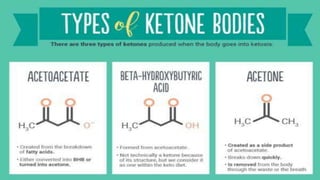
• The three main ketone bodies are acetoacetate
(AcAc) and 3-beta-hydroxybutyrate (3HB), while
acetone is the third, and least abundant, ketone
body.
• The relative proportion of ketone bodies present in
blood may vary from 78% (β-hydroxybutyric acid) to
20% (acetoacetic acid) and 2% (acetone).
Continue…
• Ketones build up when the body needs to break down fats and
fatty acids to use as fuel.
• This is most likely to occur when the body does not get
enough sugar or carbohydrates.
• This may be due to diabetic ketoacidosis (DKA).
• DKA is a life-threatening problem that affects people with
diabetes.
• It occurs when the body cannot use sugar (glucose) as a fuel
source because there is no insulin or not enough insulin.
• Fat is used for fuel instead of carbohydrates.
Why the Test is performed?
• Ketone testing is most often done if you have type 1
diabetes and:
• Your blood sugar is higher than 240 milligrams per
deciliter (mg/dl)
• Nausea or vomiting occur
• Pain in the abdomen
• Ketone testing may also be done if you have an illness
such as pneumonia, heart attack, or stroke
• Nausea or vomiting that does not go away.
Continue…
• Urine Reagent Strips can be used in general
evaluation of health, and aids in the diagnosis and
monitoring of metabolic or systemic diseases that
affect kidney function, endocrine disorders and
diseases or disorders of the urinary tract.
SPECIMEN COLLECTION AND PREPARATION:
• A urine specimen must be collected in a clean and dry container and tested as
soon as possible.
• Do not centrifuge.
• The use of urine preservatives is not recommended.
• If testing cannot be done within an hour after voiding, refrigerate the specimen
immediately and let it return to room temperature before testing.
• Prolonged storage of unpreserved urine at room temperature may result in
microbial proliferation with resultant changes in pH. A shift to alkaline pH may
cause false positive results with the protein test area.
• Urine containing glucose may decrease, as organisms metabolize the glucose.
Principle of urine dipstick:
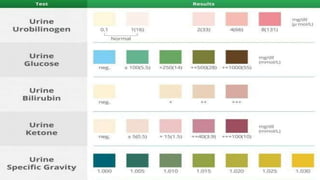
• This test is based on ketones reacting with
nitroprusside and acetoacetic acid to produce a color
change ranging from light pink or cream color for
negative results to a darker pink or purple color for
positive results.
DIRECTION FOR USE:
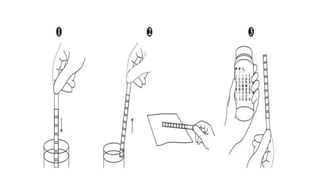
• Remove the strip from the closed canister and use it as soon as possible.
• Immediately close the canister tightly after removing the required number
of strip(s).
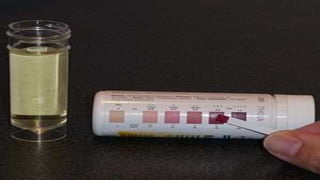
• Completely immerse the reagent areas of the strip in fresh, well-mixed
urine and immediately remove the strip to avoid dissolving the reagents.
• While removing the strip from the urine, run the edge of the strip against
the rim of the urine container to remove excess urine.
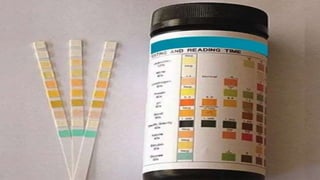
• Compare the reagent areas to the corresponding color blocks on the
canister label at the specified times. Hold the strip close to the color
blocks and match carefully.
Interpretation:
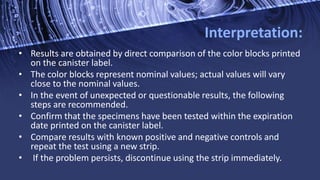
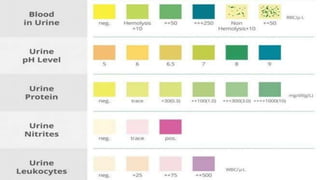
• Results are obtained by direct comparison of the color blocks printed
on the canister label.
• The color blocks represent nominal values; actual values will vary
close to the nominal values.
• In the event of unexpected or questionable results, the following
steps are recommended.
• Confirm that the specimens have been tested within the expiration
date printed on the canister label.
• Compare results with known positive and negative controls and
repeat the test using a new strip.
• If the problem persists, discontinue using the strip immediately.
Ketone Bodies Estimation in Urine.biochemistry.pptx

Ketone Bodies Estimation in Urine.biochemistry.pptx

  • 1.
    Ketone Bodies EstimationIn Urine By Dipstick Method Prepared By Sheraz Ayub 2nd Semester BS Optometry Source: Sir Nauman Lecture
  • 2.
    contents • Ketone bodies •Why the Test is performed? • SPECIMEN COLLECTION AND PREPARATION • Principle of urine dipstick • DIRECTION FOR USE • Interpretation
  • 3.
    Ketone bodies • Ketoneis a name for a specific elemental structure in organic chemistry. • A ketone consists of a single bond to two CH3 or R groups with a double bond to an oxygen molecule. • Ketone bodies or simply ketones are substances produced by the liver during gluconeogenesis
  • 4.
    Continue… • The threemain ketone bodies are acetoacetate (AcAc) and 3-beta-hydroxybutyrate (3HB), while acetone is the third, and least abundant, ketone body. • The relative proportion of ketone bodies present in blood may vary from 78% (β-hydroxybutyric acid) to 20% (acetoacetic acid) and 2% (acetone).
  • 5.
    Continue… • Ketones buildup when the body needs to break down fats and fatty acids to use as fuel. • This is most likely to occur when the body does not get enough sugar or carbohydrates. • This may be due to diabetic ketoacidosis (DKA). • DKA is a life-threatening problem that affects people with diabetes. • It occurs when the body cannot use sugar (glucose) as a fuel source because there is no insulin or not enough insulin. • Fat is used for fuel instead of carbohydrates.
  • 7.
    Why the Testis performed? • Ketone testing is most often done if you have type 1 diabetes and: • Your blood sugar is higher than 240 milligrams per deciliter (mg/dl) • Nausea or vomiting occur • Pain in the abdomen • Ketone testing may also be done if you have an illness such as pneumonia, heart attack, or stroke • Nausea or vomiting that does not go away.
  • 8.
    Continue… • Urine ReagentStrips can be used in general evaluation of health, and aids in the diagnosis and monitoring of metabolic or systemic diseases that affect kidney function, endocrine disorders and diseases or disorders of the urinary tract.
  • 9.
    SPECIMEN COLLECTION ANDPREPARATION: • A urine specimen must be collected in a clean and dry container and tested as soon as possible. • Do not centrifuge. • The use of urine preservatives is not recommended. • If testing cannot be done within an hour after voiding, refrigerate the specimen immediately and let it return to room temperature before testing. • Prolonged storage of unpreserved urine at room temperature may result in microbial proliferation with resultant changes in pH. A shift to alkaline pH may cause false positive results with the protein test area. • Urine containing glucose may decrease, as organisms metabolize the glucose.
  • 10.
    Principle of urinedipstick: • This test is based on ketones reacting with nitroprusside and acetoacetic acid to produce a color change ranging from light pink or cream color for negative results to a darker pink or purple color for positive results.
  • 11.
    DIRECTION FOR USE: •Remove the strip from the closed canister and use it as soon as possible. • Immediately close the canister tightly after removing the required number of strip(s). • Completely immerse the reagent areas of the strip in fresh, well-mixed urine and immediately remove the strip to avoid dissolving the reagents. • While removing the strip from the urine, run the edge of the strip against the rim of the urine container to remove excess urine. • Compare the reagent areas to the corresponding color blocks on the canister label at the specified times. Hold the strip close to the color blocks and match carefully.
  • 14.
    Interpretation: • Results areobtained by direct comparison of the color blocks printed on the canister label. • The color blocks represent nominal values; actual values will vary close to the nominal values. • In the event of unexpected or questionable results, the following steps are recommended. • Confirm that the specimens have been tested within the expiration date printed on the canister label. • Compare results with known positive and negative controls and repeat the test using a new strip. • If the problem persists, discontinue using the strip immediately.