Linux Driver Model
“web woven by a spider on drugs”
Greg Kroah-Hartman
gregkh@linuxfoundation.org
github.com/gregkh/presentation-driver-model
You don’t need to know this.
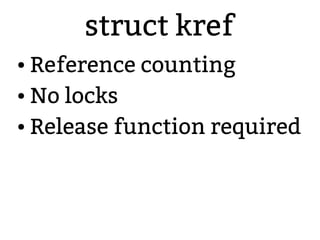
struct kref
● Reference counting
● No locks
● Release function required
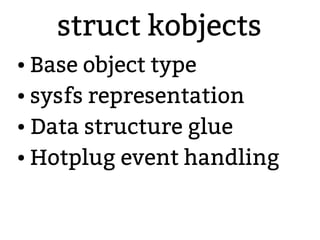
struct kobjects
● Base object type
● sysfs representation
● Data structure glue
● Hotplug event handling
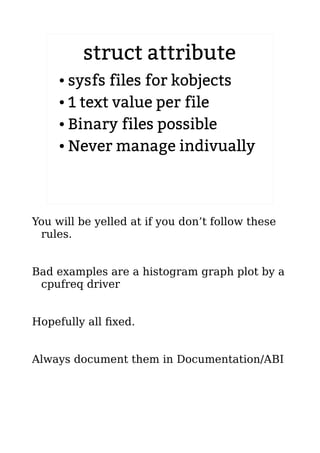
struct attribute
● sysfs files for kobjects
● 1 text value per file
● Binary files possible
● Never manage indivually
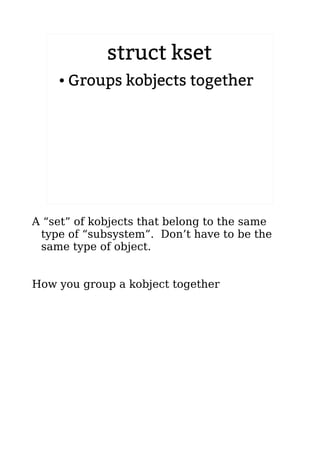
struct kset
● Groups kobjects together
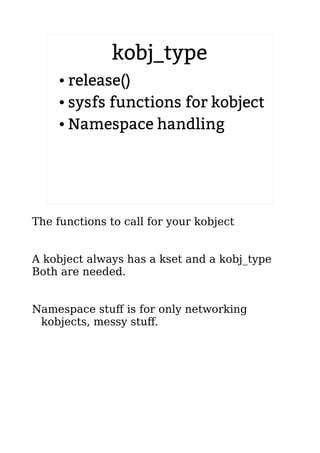
kobj_type
● release()
● sysfs functions for kobject
● Namespace handling
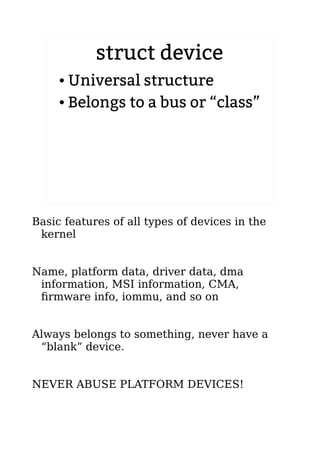
struct device
● Universal structure
● Belongs to a bus or “class”
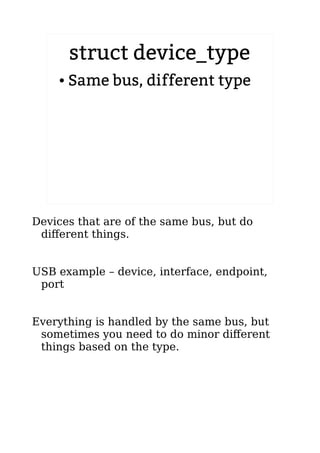
struct device_type
● Same bus, different type
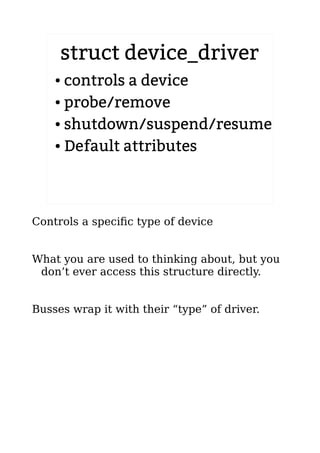
struct device_driver
● controls a device
● probe/remove
● shutdown/suspend/resume
● Default attributes
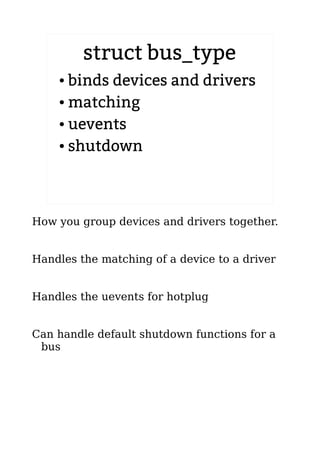
struct bus_type
● binds devices and drivers
● matching
● uevents
● shutdown
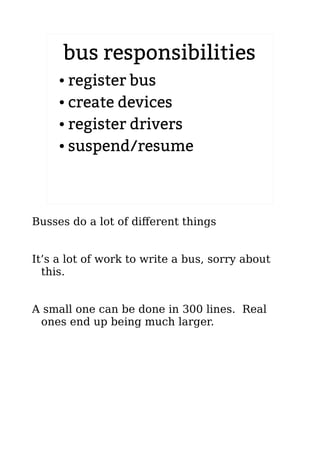
bus responsibilities
● register bus
● create devices
● register drivers
● suspend/resume
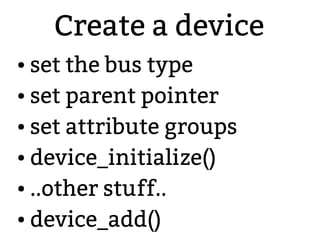
Create a device
● set the bus type
● set parent pointer
● set attribute groups
● device_initialize()
● ..other stuff..
● device_add()
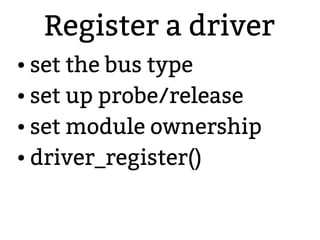
Register a driver
● set the bus type
● set up probe/release
● set module ownership
● driver_register()
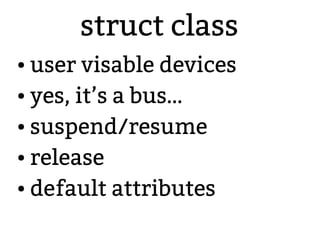
struct class
● user visable devices
● yes, it’s a bus…
● suspend/resume
● release
● default attributes
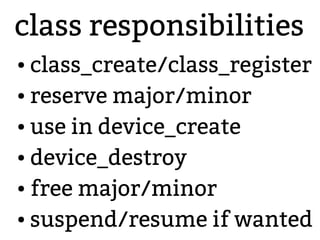
class responsibilities
● class_create/class_register
● reserve major/minor
● use in device_create
● device_destroy
● free major/minor
● suspend/resume if wanted
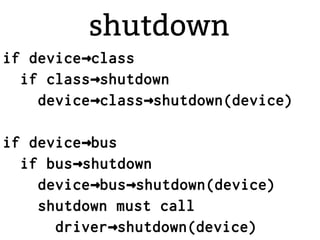
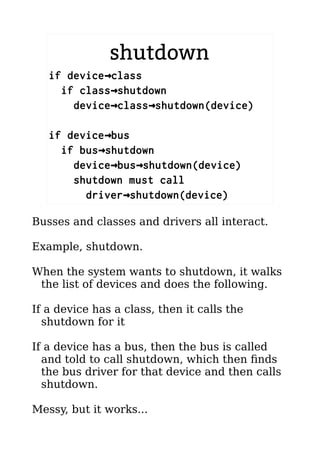
shutdown
if device class→
if class shutdown→
device class shutdown(device)→ →
if device bus→
if bus shutdown→
device bus shutdown(device)→ →
shutdown must call
driver shutdown(device)→
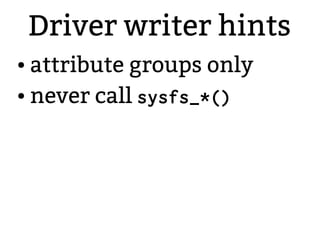
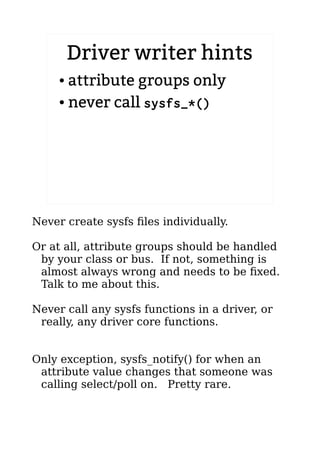
Driver writer hints
● attribute groups only
● never call sysfs_*()
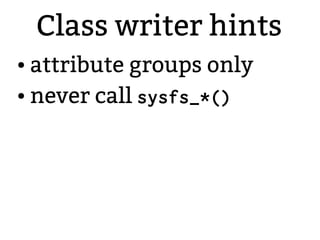
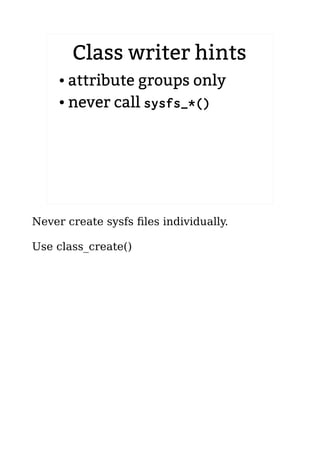
Class writer hints
● attribute groups only
● never call sysfs_*()
Bus writer hints
● My sincere appologies
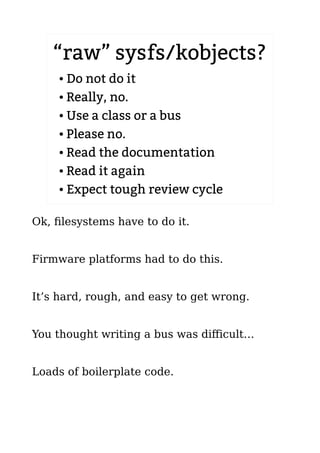
“raw” sysfs/kobjects?
● Do not do it
● Really, no.
● Use a class or a bus
● Please no.
● Read the documentation
● Read it again
● Expect tough review cycle
github.com/gregkh/presentation-driver-model
Linux Driver Model
“web woven by a spider on drugs”
Greg Kroah-Hartman
gregkh@linuxfoundation.org
github.com/gregkh/presentation-driver-model
Subtitle is LWN quote
In 2.4 all subsystems were isolated and did
things their own way. After adding hotplug
support to the second subsystem, I figured
this needed to change
Pat Mochel wanted to get suspend/resume to
work, I wanted persistant device naming.
By the time 2.6 came out, we had naming
solved, still working on suspend/resume…
You don’t need to know this.
No driver write should have to mess with the
driver core at all.
Well, minor things, see my last slide.
It’s a complex mess, is a whole chapter in
LDD3, and there are parts of the kernel
code that I keep forgetting and having to
relearn at times.
Messy stuff.
struct kref
● Reference counting
● No locks
● Release function required
Don’t ever do your own reference counting
Kref is “proven” correct
Use it
You need a lock outside of the object, it must
be there
If no release function, why are you doing
reference counting?
struct kobjects
● Base object type
● sysfs representation
● Data structure glue
● Hotplug event handling
Handles all of the basic housekeeping for
kernel objects
Handles all of the links to other kobjects, the
heiarchy and other good stuff. Solid
functions that are known good.
Created out of the development process by Al
Viro during the driver core development and
was originally used in char devices
NEVER touch the kobject in a char device
structure, it doesn’t do what you think it
does.
struct attribute
● sysfs files for kobjects
● 1 text value per file
● Binary files possible
● Never manage indivually
You will be yelled at if you don’t follow these
rules.
Bad examples are a histogram graph plot by a
cpufreq driver
Hopefully all fixed.
Always document them in Documentation/ABI
struct kset
● Groups kobjects together
A “set” of kobjects that belong to the same
type of “subsystem”. Don’t have to be the
same type of object.
How you group a kobject together
kobj_type
● release()
● sysfs functions for kobject
● Namespace handling
The functions to call for your kobject
A kobject always has a kset and a kobj_type
Both are needed.
Namespace stuff is for only networking
kobjects, messy stuff.
struct device
● Universal structure
● Belongs to a bus or “class”
Basic features of all types of devices in the
kernel
Name, platform data, driver data, dma
information, MSI information, CMA,
firmware info, iommu, and so on
Always belongs to something, never have a
“blank” device.
NEVER ABUSE PLATFORM DEVICES!
struct device_type
● Same bus, different type
Devices that are of the same bus, but do
different things.
USB example – device, interface, endpoint,
port
Everything is handled by the same bus, but
sometimes you need to do minor different
things based on the type.
struct device_driver
● controls a device
● probe/remove
● shutdown/suspend/resume
● Default attributes
Controls a specific type of device
What you are used to thinking about, but you
don’t ever access this structure directly.
Busses wrap it with their “type” of driver.
struct bus_type
● binds devices and drivers
● matching
● uevents
● shutdown
How you group devices and drivers together.
Handles the matching of a device to a driver
Handles the uevents for hotplug
Can handle default shutdown functions for a
bus
bus responsibilities
● register bus
● create devices
● register drivers
● suspend/resume
Busses do a lot of different things
It’s a lot of work to write a bus, sorry about
this.
A small one can be done in 300 lines. Real
ones end up being much larger.
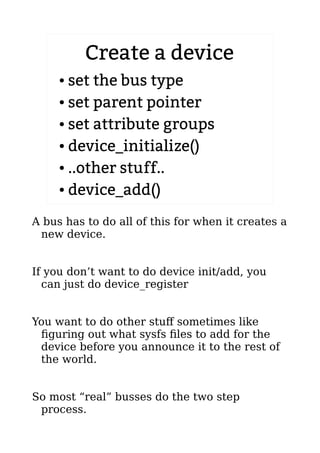
Create a device
● set the bus type
● set parent pointer
● set attribute groups
● device_initialize()
● ..other stuff..
● device_add()
A bus has to do all of this for when it creates a
new device.
If you don’t want to do device init/add, you
can just do device_register
You want to do other stuff sometimes like
figuring out what sysfs files to add for the
device before you announce it to the rest of
the world.
So most “real” busses do the two step
process.
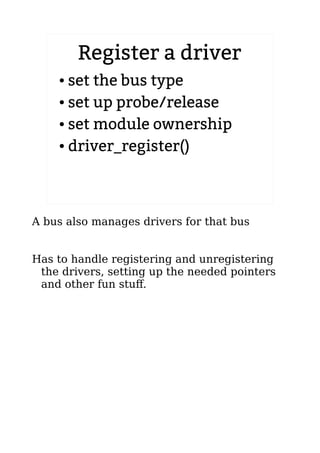
Register a driver
● set the bus type
● set up probe/release
● set module ownership
● driver_register()
A bus also manages drivers for that bus
Has to handle registering and unregistering
the drivers, setting up the needed pointers
and other fun stuff.
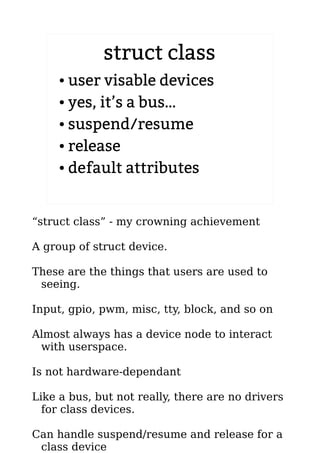
struct class
● user visable devices
● yes, it’s a bus…
● suspend/resume
● release
● default attributes
“struct class” - my crowning achievement
A group of struct device.
These are the things that users are used to
seeing.
Input, gpio, pwm, misc, tty, block, and so on
Almost always has a device node to interact
with userspace.
Is not hardware-dependant
Like a bus, but not really, there are no drivers
for class devices.
Can handle suspend/resume and release for a
class device
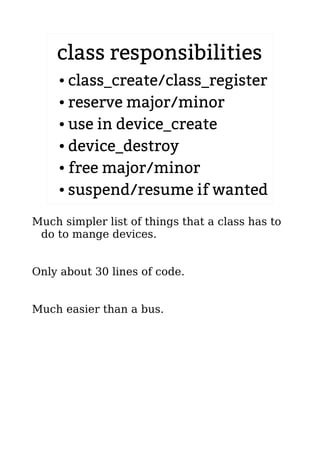
class responsibilities
● class_create/class_register
● reserve major/minor
● use in device_create
● device_destroy
● free major/minor
● suspend/resume if wanted
Much simpler list of things that a class has to
do to mange devices.
Only about 30 lines of code.
Much easier than a bus.
shutdown
if device class→
if class shutdown→
device class shutdown(device)→ →
if device bus→
if bus shutdown→
device bus shutdown(device)→ →
shutdown must call
driver shutdown(device)→
Busses and classes and drivers all interact.
Example, shutdown.
When the system wants to shutdown, it walks
the list of devices and does the following.
If a device has a class, then it calls the
shutdown for it
If a device has a bus, then the bus is called
and told to call shutdown, which then finds
the bus driver for that device and then calls
shutdown.
Messy, but it works...
Driver writer hints
● attribute groups only
● never call sysfs_*()
Never create sysfs files individually.
Or at all, attribute groups should be handled
by your class or bus. If not, something is
almost always wrong and needs to be fixed.
Talk to me about this.
Never call any sysfs functions in a driver, or
really, any driver core functions.
Only exception, sysfs_notify() for when an
attribute value changes that someone was
calling select/poll on. Pretty rare.
Class writer hints
● attribute groups only
● never call sysfs_*()
Never create sysfs files individually.
Use class_create()
Bus writer hints
● My sincere appologies
It’s not easy, I know.
More can be done to make it easier. Help is
always appreciated, been on my TODO list
for over 5 years.
We add about 1-2 new busses every kernel
release so there’s almost always some
kernel devloper mad at me.
“raw” sysfs/kobjects?
● Do not do it
● Really, no.
● Use a class or a bus
● Please no.
● Read the documentation
● Read it again
● Expect tough review cycle
Ok, filesystems have to do it.
Firmware platforms had to do this.
It’s hard, rough, and easy to get wrong.
You thought writing a bus was difficult…
Loads of boilerplate code.
github.com/gregkh/presentation-driver-model
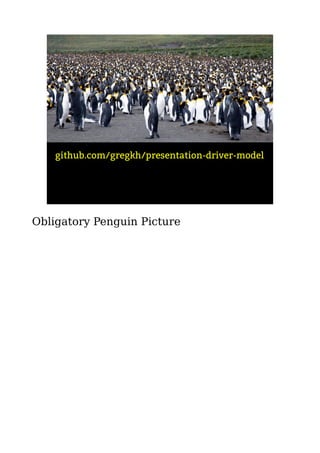
Obligatory Penguin Picture
Kernel Recipes 2016 -

Kernel Recipes 2016 -

  • 1.
    Linux Driver Model “webwoven by a spider on drugs” Greg Kroah-Hartman gregkh@linuxfoundation.org github.com/gregkh/presentation-driver-model
  • 2.
    You don’t needto know this.
  • 3.
    struct kref ● Referencecounting ● No locks ● Release function required
  • 4.
    struct kobjects ● Baseobject type ● sysfs representation ● Data structure glue ● Hotplug event handling
  • 5.
    struct attribute ● sysfsfiles for kobjects ● 1 text value per file ● Binary files possible ● Never manage indivually
  • 6.
    struct kset ● Groupskobjects together
  • 7.
    kobj_type ● release() ● sysfsfunctions for kobject ● Namespace handling
  • 8.
    struct device ● Universalstructure ● Belongs to a bus or “class”
  • 9.
    struct device_type ● Samebus, different type
  • 10.
    struct device_driver ● controlsa device ● probe/remove ● shutdown/suspend/resume ● Default attributes
  • 11.
    struct bus_type ● bindsdevices and drivers ● matching ● uevents ● shutdown
  • 12.
    bus responsibilities ● registerbus ● create devices ● register drivers ● suspend/resume
  • 13.
    Create a device ●set the bus type ● set parent pointer ● set attribute groups ● device_initialize() ● ..other stuff.. ● device_add()
  • 14.
    Register a driver ●set the bus type ● set up probe/release ● set module ownership ● driver_register()
  • 15.
    struct class ● uservisable devices ● yes, it’s a bus… ● suspend/resume ● release ● default attributes
  • 16.
    class responsibilities ● class_create/class_register ●reserve major/minor ● use in device_create ● device_destroy ● free major/minor ● suspend/resume if wanted
  • 17.
    shutdown if device class→ ifclass shutdown→ device class shutdown(device)→ → if device bus→ if bus shutdown→ device bus shutdown(device)→ → shutdown must call driver shutdown(device)→
  • 18.
    Driver writer hints ●attribute groups only ● never call sysfs_*()
  • 19.
    Class writer hints ●attribute groups only ● never call sysfs_*()
  • 20.
    Bus writer hints ●My sincere appologies
  • 21.
    “raw” sysfs/kobjects? ● Donot do it ● Really, no. ● Use a class or a bus ● Please no. ● Read the documentation ● Read it again ● Expect tough review cycle
  • 22.
  • 24.
    Linux Driver Model “webwoven by a spider on drugs” Greg Kroah-Hartman gregkh@linuxfoundation.org github.com/gregkh/presentation-driver-model Subtitle is LWN quote In 2.4 all subsystems were isolated and did things their own way. After adding hotplug support to the second subsystem, I figured this needed to change Pat Mochel wanted to get suspend/resume to work, I wanted persistant device naming. By the time 2.6 came out, we had naming solved, still working on suspend/resume…
  • 25.
    You don’t needto know this. No driver write should have to mess with the driver core at all. Well, minor things, see my last slide. It’s a complex mess, is a whole chapter in LDD3, and there are parts of the kernel code that I keep forgetting and having to relearn at times. Messy stuff.
  • 26.
    struct kref ● Referencecounting ● No locks ● Release function required Don’t ever do your own reference counting Kref is “proven” correct Use it You need a lock outside of the object, it must be there If no release function, why are you doing reference counting?
  • 27.
    struct kobjects ● Baseobject type ● sysfs representation ● Data structure glue ● Hotplug event handling Handles all of the basic housekeeping for kernel objects Handles all of the links to other kobjects, the heiarchy and other good stuff. Solid functions that are known good. Created out of the development process by Al Viro during the driver core development and was originally used in char devices NEVER touch the kobject in a char device structure, it doesn’t do what you think it does.
  • 28.
    struct attribute ● sysfsfiles for kobjects ● 1 text value per file ● Binary files possible ● Never manage indivually You will be yelled at if you don’t follow these rules. Bad examples are a histogram graph plot by a cpufreq driver Hopefully all fixed. Always document them in Documentation/ABI
  • 29.
    struct kset ● Groupskobjects together A “set” of kobjects that belong to the same type of “subsystem”. Don’t have to be the same type of object. How you group a kobject together
  • 30.
    kobj_type ● release() ● sysfsfunctions for kobject ● Namespace handling The functions to call for your kobject A kobject always has a kset and a kobj_type Both are needed. Namespace stuff is for only networking kobjects, messy stuff.
  • 31.
    struct device ● Universalstructure ● Belongs to a bus or “class” Basic features of all types of devices in the kernel Name, platform data, driver data, dma information, MSI information, CMA, firmware info, iommu, and so on Always belongs to something, never have a “blank” device. NEVER ABUSE PLATFORM DEVICES!
  • 32.
    struct device_type ● Samebus, different type Devices that are of the same bus, but do different things. USB example – device, interface, endpoint, port Everything is handled by the same bus, but sometimes you need to do minor different things based on the type.
  • 33.
    struct device_driver ● controlsa device ● probe/remove ● shutdown/suspend/resume ● Default attributes Controls a specific type of device What you are used to thinking about, but you don’t ever access this structure directly. Busses wrap it with their “type” of driver.
  • 34.
    struct bus_type ● bindsdevices and drivers ● matching ● uevents ● shutdown How you group devices and drivers together. Handles the matching of a device to a driver Handles the uevents for hotplug Can handle default shutdown functions for a bus
  • 35.
    bus responsibilities ● registerbus ● create devices ● register drivers ● suspend/resume Busses do a lot of different things It’s a lot of work to write a bus, sorry about this. A small one can be done in 300 lines. Real ones end up being much larger.
  • 36.
    Create a device ●set the bus type ● set parent pointer ● set attribute groups ● device_initialize() ● ..other stuff.. ● device_add() A bus has to do all of this for when it creates a new device. If you don’t want to do device init/add, you can just do device_register You want to do other stuff sometimes like figuring out what sysfs files to add for the device before you announce it to the rest of the world. So most “real” busses do the two step process.
  • 37.
    Register a driver ●set the bus type ● set up probe/release ● set module ownership ● driver_register() A bus also manages drivers for that bus Has to handle registering and unregistering the drivers, setting up the needed pointers and other fun stuff.
  • 38.
    struct class ● uservisable devices ● yes, it’s a bus… ● suspend/resume ● release ● default attributes “struct class” - my crowning achievement A group of struct device. These are the things that users are used to seeing. Input, gpio, pwm, misc, tty, block, and so on Almost always has a device node to interact with userspace. Is not hardware-dependant Like a bus, but not really, there are no drivers for class devices. Can handle suspend/resume and release for a class device
  • 39.
    class responsibilities ● class_create/class_register ●reserve major/minor ● use in device_create ● device_destroy ● free major/minor ● suspend/resume if wanted Much simpler list of things that a class has to do to mange devices. Only about 30 lines of code. Much easier than a bus.
  • 40.
    shutdown if device class→ ifclass shutdown→ device class shutdown(device)→ → if device bus→ if bus shutdown→ device bus shutdown(device)→ → shutdown must call driver shutdown(device)→ Busses and classes and drivers all interact. Example, shutdown. When the system wants to shutdown, it walks the list of devices and does the following. If a device has a class, then it calls the shutdown for it If a device has a bus, then the bus is called and told to call shutdown, which then finds the bus driver for that device and then calls shutdown. Messy, but it works...
  • 41.
    Driver writer hints ●attribute groups only ● never call sysfs_*() Never create sysfs files individually. Or at all, attribute groups should be handled by your class or bus. If not, something is almost always wrong and needs to be fixed. Talk to me about this. Never call any sysfs functions in a driver, or really, any driver core functions. Only exception, sysfs_notify() for when an attribute value changes that someone was calling select/poll on. Pretty rare.
  • 42.
    Class writer hints ●attribute groups only ● never call sysfs_*() Never create sysfs files individually. Use class_create()
  • 43.
    Bus writer hints ●My sincere appologies It’s not easy, I know. More can be done to make it easier. Help is always appreciated, been on my TODO list for over 5 years. We add about 1-2 new busses every kernel release so there’s almost always some kernel devloper mad at me.
  • 44.
    “raw” sysfs/kobjects? ● Donot do it ● Really, no. ● Use a class or a bus ● Please no. ● Read the documentation ● Read it again ● Expect tough review cycle Ok, filesystems have to do it. Firmware platforms had to do this. It’s hard, rough, and easy to get wrong. You thought writing a bus was difficult… Loads of boilerplate code.
  • 45.