Linux Device Drivers
Preview Write a device driver for a pseudo stack device Linux character device type supports the following operations Open: only one is allowed. Write: writes an char string to top of the device stack. Error if stack is empty Read: reads  an item from top of the device stack. Error if stack is empty Release: release the device  Install with LKM.  Test: It will be a dedicated standalone machine in the lab. Root password may be given out. If you mess up, you have to re-install !!!
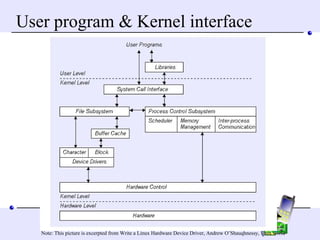
User program & Kernel interface Note: This picture is excerpted from Write a Linux Hardware Device Driver, Andrew O’Shauqhnessy, Unix world
Linux Device Drivers A set of API subroutines (typically system calls) interface to hardware Hide implementation and hardware-specific details from a user program Typically uses a file interface metaphor Device is a special file
Loadable Kernel Module (LKM) A new kernel module can be added on the fly (while OS is still running) LKMs are often called “kernel modules” They are not user program
Types of LKM Device drivers  Filesystem driver (one for ext2, MSDOS FAT16, 32, NFS) System calls Network Drivers TTY line disciplines. special terminal devices.  Executable interpreters.
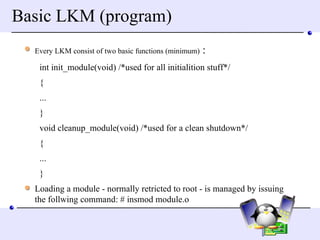
Basic LKM (program) Every LKM consist of two basic functions (minimum)  : int init_module(void) /*used for all initialition stuff*/  {  ...  }  void cleanup_module(void) /*used for a clean shutdown*/  {  ...  }  Loading a module - normally retricted to root - is managed by issuing the follwing command: # insmod module.o
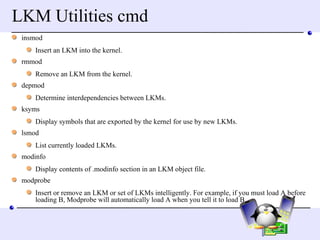
LKM Utilities cmd insmod  Insert an LKM into the kernel. rmmod  Remove an LKM from the kernel. depmod  Determine interdependencies between LKMs. ksyms  Display symbols that are exported by the kernel for use by new LKMs. lsmod  List currently loaded LKMs. modinfo  Display contents of .modinfo section in an LKM object file. modprobe  Insert or remove an LKM or set of LKMs intelligently. For example, if you must load A before loading B, Modprobe will automatically load A when you tell it to load B.
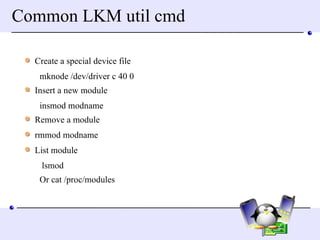
Common LKM util cmd Create a special device file mknode /dev/driver c 40 0  Insert a new module insmod modname Remove a module rmmod modname List module lsmod Or cat /proc/modules
Linux Device Drivers (continued) Manage data flow between a user program and devices A self-contained component (add/remove from kernel) A user can access the device via file name in /dev , e.g. /dev/lp0
General implementation steps Understand the device characteristic and supported commands. Map device specific operations to unix file operation Select the device name (user interface) Namespace (2-3 characters, /dev/lp0) (optional) select a major number and minor (a device special file creation) for VFS interface Mapping the number to right device sub-routines Implement file interface subroutines Compile the device driver Install the device driver module with loadable kernel module (LKM) or Rebuild (compile) the kernel
Read/write (I/O) Polling (or synchronous) Interrupt based
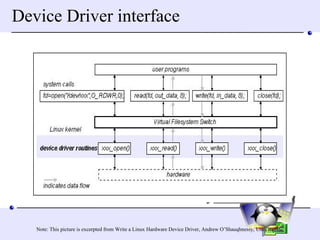
Device Driver interface Note: This picture is excerpted from Write a Linux Hardware Device Driver, Andrew O’Shauqhnessy, Unix world
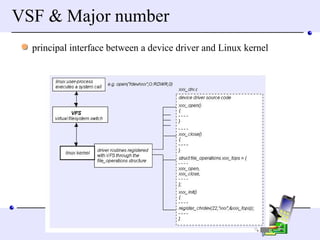
VSF & Major number principal interface between a device driver and Linux kernel
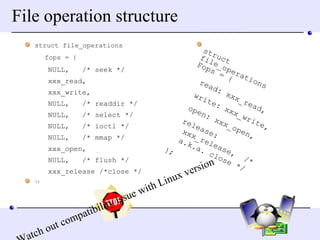
File operation structure struct file_operations  fops = { NULL,  /* seek */ xxx_read, xxx_write, NULL,  /* readdir */ NULL,  /* select */ NULL,  /* ioctl */ NULL,  /* mmap */ xxx_open, NULL,  /* flush */ xxx_release /*close */ }; Watch out compatibility issue with Linux version struct file_operations  Fops = { read: xxx_read, write: xxx_write, open: xxx_open, release: xxx_release,  /* a.k.a. close */ };
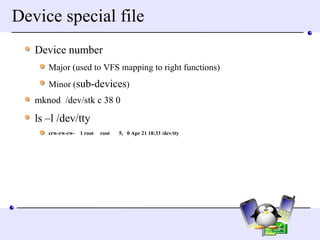
Device special file Device number Major (used to VFS mapping to right functions) Minor ( sub-devices ) mknod  /dev/stk c 38 0 ls –l /dev/tty crw-rw-rw-  1 root  root  5,  0 Apr 21 18:33 /dev/tty
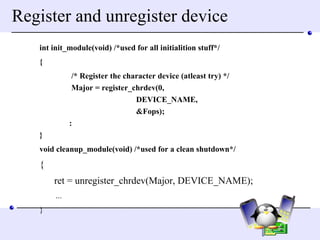
Register and unregister device int init_module(void) /*used for all initialition stuff*/  {  /* Register the character device (atleast try) */ Major = register_chrdev(0, DEVICE_NAME, &Fops); : }  void cleanup_module(void) /*used for a clean shutdown*/  { ret = unregister_chrdev(Major, DEVICE_NAME); ...  }
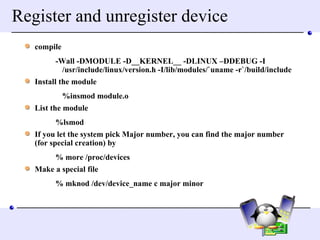
Register and unregister device compile -Wall -DMODULE -D__KERNEL__ -DLINUX –DDEBUG -I /usr/include/linux/version.h -I/lib/modules/`uname -r`/build/include Install the module %insmod module.o  List the module %lsmod If you let the system pick Major number, you can find the major number (for special creation) by % more /proc/devices Make a special file  % mknod /dev/device_name c major minor
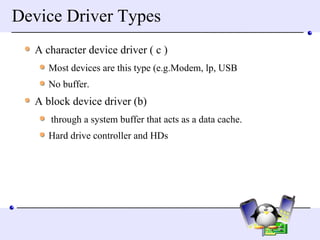
Device Driver Types A character device driver ( c ) Most devices are this type (e.g.Modem, lp, USB No buffer.  A block device driver (b) through a system buffer that acts as a data cache.  Hard drive controller and HDs
Implementation Assuming that your device name is Xxx Xxx_init() initialize the device when OS is booted Xxx_open() open a device  Xxx_read() read from kernel memory  Xxx_write() write  Xxx_release() clean-up (close) init_module() cleanup_module()
kernel functions add_timer()  Causes a function to be executed when a given amount of time has passed  cli()  Prevents interrupts from being acknowledged  end_request()  Called when a request has been satisfied or aborted  free_irq()  Frees an IRQ previously acquired with request_irq() or irqaction()  get_user*()  Allows a driver to access data in user space, a memory area distinct from the kernel  kfree*()  Frees memory previously allocated with kmalloc()  kmalloc()  Allocates a chunk of memory no larger than 4096 bytes.  MAJOR()  Reports the major device number for a device.  MINOR()  Reports the minor device number for a device.
kernel functions memcpy_*fs()  Copies chunks of memory between user space and kernel space  outb(), outb_p()  Writes a byte to a port. Here, outb() goes as fast as it can, while outb_p() pauses before returning.  printk()  A version of printf() for the kernel.  put_user*()  Allows a driver to write data in user space.  register_*dev()  Registers a device with the kernel.  by the matching *sleep_on() function.
Kerenel funcs contd… request_irq()  Requests an IRQ from the kernel, and, if successful, installs an IRQ interrupt handler.  *sleep_on()  Sleeps on an event, puts a wait_queue entry in the list so that the process can be awakened on that event.  sti()  Allows interrupts to be acknowledged.  wake_up*()  Wakes up a process that has been put to sleep
Pitfalls Using standard libraries : can only use kernel functions, which are the functions you can see in /proc/ksyms.        Disabling interrupts  You might need to do this for a short time and that is OK, but if you don't enable them afterwards, your system will be stuck  Changes from version to version
Resources Linux Kernel API: http://kernelnewbies.org/documents/kdoc/kernel-api/linuxkernelapi.html Kernel development tool  http://www.jungo.com/products.html Linux Device Drivers 3rd Edition by Rubini & Corbet, O'Reilly  Pub, ISBN 0-596-00008-1

Linuxdd[1]

  • 1.
  • 2.
    Preview Write adevice driver for a pseudo stack device Linux character device type supports the following operations Open: only one is allowed. Write: writes an char string to top of the device stack. Error if stack is empty Read: reads an item from top of the device stack. Error if stack is empty Release: release the device Install with LKM. Test: It will be a dedicated standalone machine in the lab. Root password may be given out. If you mess up, you have to re-install !!!
  • 3.
    User program &Kernel interface Note: This picture is excerpted from Write a Linux Hardware Device Driver, Andrew O’Shauqhnessy, Unix world
  • 4.
    Linux Device DriversA set of API subroutines (typically system calls) interface to hardware Hide implementation and hardware-specific details from a user program Typically uses a file interface metaphor Device is a special file
  • 5.
    Loadable Kernel Module(LKM) A new kernel module can be added on the fly (while OS is still running) LKMs are often called “kernel modules” They are not user program
  • 6.
    Types of LKMDevice drivers Filesystem driver (one for ext2, MSDOS FAT16, 32, NFS) System calls Network Drivers TTY line disciplines. special terminal devices. Executable interpreters.
  • 7.
    Basic LKM (program)Every LKM consist of two basic functions (minimum) : int init_module(void) /*used for all initialition stuff*/ { ... } void cleanup_module(void) /*used for a clean shutdown*/ { ... } Loading a module - normally retricted to root - is managed by issuing the follwing command: # insmod module.o
  • 8.
    LKM Utilities cmdinsmod Insert an LKM into the kernel. rmmod Remove an LKM from the kernel. depmod Determine interdependencies between LKMs. ksyms Display symbols that are exported by the kernel for use by new LKMs. lsmod List currently loaded LKMs. modinfo Display contents of .modinfo section in an LKM object file. modprobe Insert or remove an LKM or set of LKMs intelligently. For example, if you must load A before loading B, Modprobe will automatically load A when you tell it to load B.
  • 9.
    Common LKM utilcmd Create a special device file mknode /dev/driver c 40 0 Insert a new module insmod modname Remove a module rmmod modname List module lsmod Or cat /proc/modules
  • 10.
    Linux Device Drivers(continued) Manage data flow between a user program and devices A self-contained component (add/remove from kernel) A user can access the device via file name in /dev , e.g. /dev/lp0
  • 11.
    General implementation stepsUnderstand the device characteristic and supported commands. Map device specific operations to unix file operation Select the device name (user interface) Namespace (2-3 characters, /dev/lp0) (optional) select a major number and minor (a device special file creation) for VFS interface Mapping the number to right device sub-routines Implement file interface subroutines Compile the device driver Install the device driver module with loadable kernel module (LKM) or Rebuild (compile) the kernel
  • 12.
    Read/write (I/O) Polling(or synchronous) Interrupt based
  • 13.
    Device Driver interfaceNote: This picture is excerpted from Write a Linux Hardware Device Driver, Andrew O’Shauqhnessy, Unix world
  • 14.
    VSF & Majornumber principal interface between a device driver and Linux kernel
  • 15.
    File operation structurestruct file_operations fops = { NULL, /* seek */ xxx_read, xxx_write, NULL, /* readdir */ NULL, /* select */ NULL, /* ioctl */ NULL, /* mmap */ xxx_open, NULL, /* flush */ xxx_release /*close */ }; Watch out compatibility issue with Linux version struct file_operations Fops = { read: xxx_read, write: xxx_write, open: xxx_open, release: xxx_release, /* a.k.a. close */ };
  • 16.
    Device special fileDevice number Major (used to VFS mapping to right functions) Minor ( sub-devices ) mknod /dev/stk c 38 0 ls –l /dev/tty crw-rw-rw- 1 root root 5, 0 Apr 21 18:33 /dev/tty
  • 17.
    Register and unregisterdevice int init_module(void) /*used for all initialition stuff*/ { /* Register the character device (atleast try) */ Major = register_chrdev(0, DEVICE_NAME, &Fops); : } void cleanup_module(void) /*used for a clean shutdown*/ { ret = unregister_chrdev(Major, DEVICE_NAME); ... }
  • 18.
    Register and unregisterdevice compile -Wall -DMODULE -D__KERNEL__ -DLINUX –DDEBUG -I /usr/include/linux/version.h -I/lib/modules/`uname -r`/build/include Install the module %insmod module.o List the module %lsmod If you let the system pick Major number, you can find the major number (for special creation) by % more /proc/devices Make a special file % mknod /dev/device_name c major minor
  • 19.
    Device Driver TypesA character device driver ( c ) Most devices are this type (e.g.Modem, lp, USB No buffer. A block device driver (b) through a system buffer that acts as a data cache. Hard drive controller and HDs
  • 20.
    Implementation Assuming thatyour device name is Xxx Xxx_init() initialize the device when OS is booted Xxx_open() open a device Xxx_read() read from kernel memory Xxx_write() write Xxx_release() clean-up (close) init_module() cleanup_module()
  • 21.
    kernel functions add_timer() Causes a function to be executed when a given amount of time has passed cli() Prevents interrupts from being acknowledged end_request() Called when a request has been satisfied or aborted free_irq() Frees an IRQ previously acquired with request_irq() or irqaction() get_user*() Allows a driver to access data in user space, a memory area distinct from the kernel kfree*() Frees memory previously allocated with kmalloc() kmalloc() Allocates a chunk of memory no larger than 4096 bytes. MAJOR() Reports the major device number for a device. MINOR() Reports the minor device number for a device.
  • 22.
    kernel functions memcpy_*fs() Copies chunks of memory between user space and kernel space outb(), outb_p() Writes a byte to a port. Here, outb() goes as fast as it can, while outb_p() pauses before returning. printk() A version of printf() for the kernel. put_user*() Allows a driver to write data in user space. register_*dev() Registers a device with the kernel. by the matching *sleep_on() function.
  • 23.
    Kerenel funcs contd…request_irq() Requests an IRQ from the kernel, and, if successful, installs an IRQ interrupt handler. *sleep_on() Sleeps on an event, puts a wait_queue entry in the list so that the process can be awakened on that event. sti() Allows interrupts to be acknowledged. wake_up*() Wakes up a process that has been put to sleep
  • 24.
    Pitfalls Using standardlibraries : can only use kernel functions, which are the functions you can see in /proc/ksyms.       Disabling interrupts You might need to do this for a short time and that is OK, but if you don't enable them afterwards, your system will be stuck Changes from version to version
  • 25.
    Resources Linux KernelAPI: http://kernelnewbies.org/documents/kdoc/kernel-api/linuxkernelapi.html Kernel development tool http://www.jungo.com/products.html Linux Device Drivers 3rd Edition by Rubini & Corbet, O'Reilly  Pub, ISBN 0-596-00008-1