www.uscsinstitute.org
© 2024. United States Cybersecurity Institute (USCSI ). All Rights Reserved.
®
When it comes to securing a network, authentication is one of the most important things that takes the limelight. It
ensures that only authorized personnel have access to systems or specific resources.
Of course, there are several other methods that also exist that help with secure authentication, Kerberos stands out
from all other authentication methods and is one of the most widely used protocols.
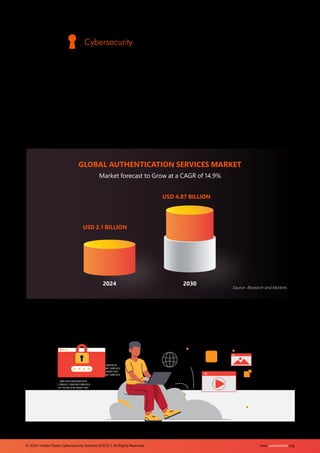
According to Research and Markets, the global authentication service market stands at $2.10 billion in 2024 and is
expected to grow at a CAGR of 14.94% to reach a market size of $4.87 billion by 2030.
www.uscsinstitute.org
© 2024. United States Cybersecurity Institute (USCSI ). All Rights Reserved.
®
In this comprehensive guide, we will go through the intricate concepts of Kerberos Authentication overlooking their
features, benefits, workings, and more.
GLOBAL AUTHENTICATION SERVICES MARKET
Market forecast to Grow at a CAGR of 14.9%
USD 2.1 BILLION
2024 2030
USD 4.87 BILLION
Source- Research and Markets
WHAT IS
KERBEROS?
Kerberos is one of the most popular and widely used network authentication protocols that helps to validate
professionals’ and systems’ identity before granting them access. It was developed by the Massachusetts Institute of
Technology (MIT). It works on the principle of ticket-based authentication and leverages the Key Distribution Center
(KDC), a trusted third-party server for the authentication process.
Kerberos authentication works on a simple principle of symmetric key cryptography.
COMPONENTS
OF KERBEROS
www.uscsinstitute.org
© 2024. United States Cybersecurity Institute (USCSI ). All Rights Reserved.
®
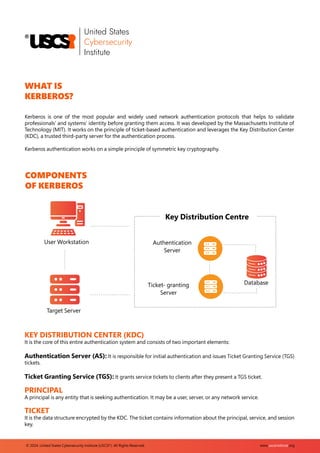
Database
Authentication
Server
Ticket- granting
Server
Key Distribution Centre
User Workstation
Target Server
KEY DISTRIBUTION CENTER (KDC)
It is the core of this entire authentication system and consists of two important elements:
Authentication Server (AS): It is responsible for initial authentication and issues Ticket Granting Service (TGS)
tickets.
Ticket Granting Service (TGS): It grants service tickets to clients after they present a TGS ticket.
PRINCIPAL
A principal is any entity that is seeking authentication. It may be a user, server, or any network service.
TICKET
It is the data structure encrypted by the KDC. The ticket contains information about the principal, service, and session
key.
www.uscsinstitute.org
© 2024. United States Cybersecurity Institute (USCSI ). All Rights Reserved.
®
WORKING OF KERBEROS
AUTHENTICATION
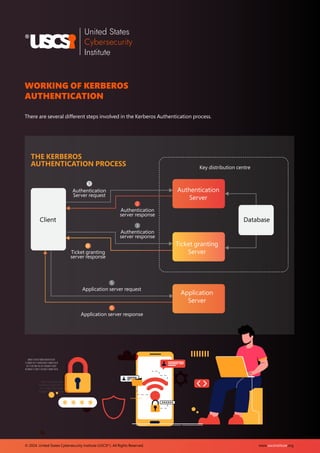
There are several different steps involved in the Kerberos Authentication process.
THE KERBEROS
AUTHENTICATION PROCESS
Client
Authentication
Server
Ticket granting
Server
Application
Server
Database
Authentication
Server request
1
Authentication
server response
Key distribution centre
2
Authentication
server response
3
Ticket granting
server response
4
Application server request
5
Application server response
5
www.uscsinstitute.org
© 2024. United States Cybersecurity Institute (USCSI ). All Rights Reserved.
®
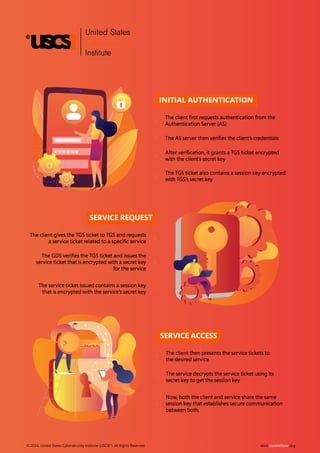
INITIAL AUTHENTICATION
The client first requests authentication from the
Authentication Server (AS)
The AS server then verifies the client’s credentials
The TGS ticket also contains a session key encrypted
with TGS’s secret key
After verification, it grants a TGS ticket encrypted
with the client’s secret key
SERVICE ACCESS
The client then presents the service tickets to
the desired service
The service decrypts the service ticket using its
secret key to get the session key
SERVICE REQUEST
The client gives the TGS ticket to TGS and requests
a service ticket related to a specific service
The GDS verifies the TGS ticket and issues the
service ticket that is encrypted with a secret key
for the service
The service ticket issued contains a session key
that is encrypted with the service’s secret key
Now, both the client and service share the same
session key that establishes secure communication
between both.
www.uscsinstitute.org
© 2024. United States Cybersecurity Institute (USCSI ). All Rights Reserved.
®
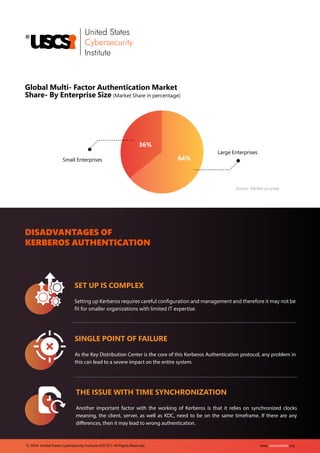
DID YOU
KNOW?
Organizations are actively employing Multifactor
Authentication to secure their data and infrastructure.
Here’s the share of businesses using MFA.
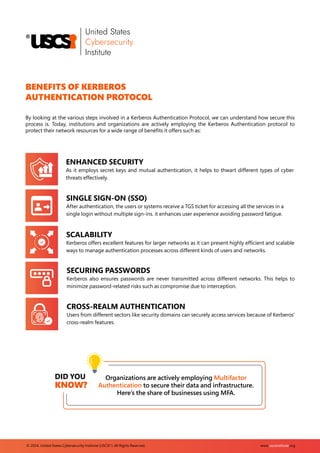
BENEFITS OF KERBEROS
AUTHENTICATION PROTOCOL
By looking at the various steps involved in a Kerberos Authentication Protocol, we can understand how secure this
process is. Today, institutions and organizations are actively employing the Kerberos Authentication protocol to
protect their network resources for a wide range of benefits it offers such as:
2
3
4
5
ENHANCED SECURITY
As it employs secret keys and mutual authentication, it helps to thwart different types of cyber
threats effectively.
SINGLE SIGN-ON (SSO)
After authentication, the users or systems receive a TGS ticket for accessing all the services in a
single login without multiple sign-ins. it enhances user experience avoiding password fatigue.
SCALABILITY
Kerberos offers excellent features for larger networks as it can present highly efficient and scalable
ways to manage authentication processes across different kinds of users and networks.
SECURING PASSWORDS
Kerberos also ensures passwords are never transmitted across different networks. This helps to
minimize password-related risks such as compromise due to interception.
CROSS-REALM AUTHENTICATION
Users from different sectors like security domains can securely access services because of Kerberos’
cross-realm features.
www.uscsinstitute.org
© 2024. United States Cybersecurity Institute (USCSI ). All Rights Reserved.
®
DISADVANTAGES OF
KERBEROS AUTHENTICATION
SET UP IS COMPLEX
Setting up Kerberos requires careful configuration and management and therefore it may not be
fit for smaller organizations with limited IT expertise.
SINGLE POINT OF FAILURE
As the Key Distribution Center is the core of this Kerberos Authentication protocol, any problem in
this can lead to a severe impact on the entire system.
THE ISSUE WITH TIME SYNCHRONIZATION
Another important factor with the working of Kerberos is that it relies on synchronized clocks
meaning, the client, server, as well as KDC, need to be on the same timeframe. If there are any
differences, then it may lead to wrong authentication.
Global Multi- Factor Authentication Market
Share- By Enterprise Size (Market Share in percentage)
Source- Market.us scoop
36%
64%
Small Enterprises
Large Enterprises
www.uscsinstitute.org
© 2024. United States Cybersecurity Institute (USCSI ). All Rights Reserved.
®
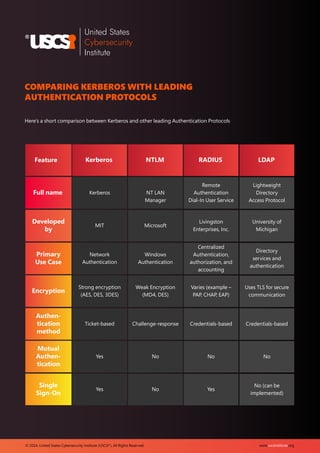
COMPARING KERBEROS WITH LEADING
AUTHENTICATION PROTOCOLS
Here’s a short comparison between Kerberos and other leading Authentication Protocols
Feature Kerberos NTLM RADIUS LDAP
Full name
Developed
by
Primary
Use Case
Encryption
Authen-
tication
method
Mutual
Authen-
tication
Single
Sign-On
Kerberos NT LAN
Manager
Remote
Authentication
Dial-In User Service
Lightweight
Directory
Access Protocol
University of
Michigan
Directory
services and
authentication
Uses TLS for secure
communication
Credentials-based
No (can be
implemented)
Livingston
Enterprises, Inc.
Centralized
Authentication,
authorization, and
accounting
Varies (example –
PAP, CHAP, EAP)
Credentials-based
No No
Microsoft
Windows
Authentication
Weak Encryption
(MD4, DES)
Challenge-response
No
No
MIT
Network
Authentication
Strong encryption
(AES, DES, 3DES)
Ticket-based
Yes
Yes Yes
www.uscsinstitute.org
© 2024. United States Cybersecurity Institute (USCSI ). All Rights Reserved.
®
HOW SECURE
IS KERBEROS?
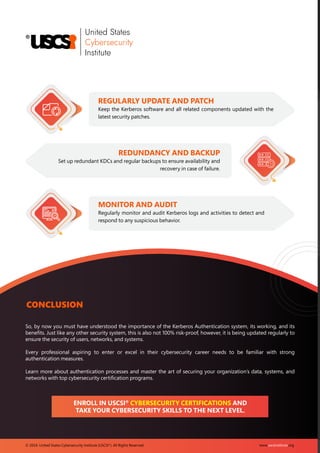
Industries and organizations across the globe use it considering highly secure authentication protocol. And
undoubtedly, it is among the best as well. However, no secure authentication system is completely hack-proof.
There exist ways to breach the security of Kerberos like:
PASS-THE-KEY ATTACK
Where attackers can impersonate clients and use their credentials
PASS-THE-TICKET ATTACK
In this, attackers gain and use the ticket received through KDC
GOLDEN TICKET ATTACK
Attackers can use Windows domain controllers and create client
credentials.
As mentioned above, no security systems are 100% safe and since Kerberos has been in the world of authentication for
quite a long time now, hackers have developed various ways to hack this authentication system. They can either forge
tickets, make repeated attempts to guess passwords, or even use malware to break the encryption.
SECURING KERBEROS
BEST PRACTICES
USE STRONG PASSWORDS
Ensure that users have strong, complex passwords to reduce the risk of
password guessing attacks.
IMPLEMENT TIME SYNCHRONIZATION
Use Network Time Protocol (NTP) to synchronize clocks across all devices
in the network.
www.uscsinstitute.org
© 2024. United States Cybersecurity Institute (USCSI ). All Rights Reserved.
®
CONCLUSION
So, by now you must have understood the importance of the Kerberos Authentication system, its working, and its
benefits. Just like any other security system, this is also not 100% risk-proof, however, it is being updated regularly to
ensure the security of users, networks, and systems.
Every professional aspiring to enter or excel in their cybersecurity career needs to be familiar with strong
authentication measures.
Learn more about authentication processes and master the art of securing your organization’s data, systems, and
networks with top cybersecurity certification programs.
ENROLL IN USCSI®
CYBERSECURITY CERTIFICATIONS AND
TAKE YOUR CYBERSECURITY SKILLS TO THE NEXT LEVEL.
REGULARLY UPDATE AND PATCH
Keep the Kerberos software and all related components updated with the
latest security patches.
REDUNDANCY AND BACKUP
Set up redundant KDCs and regular backups to ensure availability and
recovery in case of failure.
MONITOR AND AUDIT
Regularly monitor and audit Kerberos logs and activities to detect and
respond to any suspicious behavior.
REGISTER NOW
ENROLL TODAY
TO BECOME
CERTIFIED
CYBERSECURITY
PROFESSIONAL
About USCSI®
LOCATIONS
info@uscs .org | www.uscs .org
institute institute
Arizona
1345 E. Chandler BLVD.,
Suite 111-D Phoenix,
AZ 85048,
info.az@uscsinstitute.org
Connecticut
Connecticut 680 E Main Street
#699, Stamford, CT 06901
info.ct@uscsinstitute.org
Illinois
1 East Erie St, Suite 525
Chicago, IL 60611
info.il@uscsinstitute.org
Singapore
No 7 Temasek Boulevard#12-07
Suntec Tower One, Singapore, 038987
Singapore, info.sg@uscsinstitute.org
United Kingdom
29 Whitmore Road, Whitnash
Learmington Spa, Warwickshire,
United Kingdom CV312JQ
info.uk@uscsinstitute.org
The United States Cybersecurity Institute (USCSI®
)
is a world-renowned cybersecurity certification
body offering the best-in-the-world certifications
for students and professionals around the globe
across industries. Whethera beginner looking to
step on cybersecurity career path or a seasoned
expert, it validates their cybersecurity expertise
to ace this domain.

How to Secure Your Network with Kerberos Authentication | USCSI®

  • 1.
    www.uscsinstitute.org © 2024. UnitedStates Cybersecurity Institute (USCSI ). All Rights Reserved. ®
  • 2.
    When it comesto securing a network, authentication is one of the most important things that takes the limelight. It ensures that only authorized personnel have access to systems or specific resources. Of course, there are several other methods that also exist that help with secure authentication, Kerberos stands out from all other authentication methods and is one of the most widely used protocols. According to Research and Markets, the global authentication service market stands at $2.10 billion in 2024 and is expected to grow at a CAGR of 14.94% to reach a market size of $4.87 billion by 2030. www.uscsinstitute.org © 2024. United States Cybersecurity Institute (USCSI ). All Rights Reserved. ® In this comprehensive guide, we will go through the intricate concepts of Kerberos Authentication overlooking their features, benefits, workings, and more. GLOBAL AUTHENTICATION SERVICES MARKET Market forecast to Grow at a CAGR of 14.9% USD 2.1 BILLION 2024 2030 USD 4.87 BILLION Source- Research and Markets
  • 3.
    WHAT IS KERBEROS? Kerberos isone of the most popular and widely used network authentication protocols that helps to validate professionals’ and systems’ identity before granting them access. It was developed by the Massachusetts Institute of Technology (MIT). It works on the principle of ticket-based authentication and leverages the Key Distribution Center (KDC), a trusted third-party server for the authentication process. Kerberos authentication works on a simple principle of symmetric key cryptography. COMPONENTS OF KERBEROS www.uscsinstitute.org © 2024. United States Cybersecurity Institute (USCSI ). All Rights Reserved. ® Database Authentication Server Ticket- granting Server Key Distribution Centre User Workstation Target Server KEY DISTRIBUTION CENTER (KDC) It is the core of this entire authentication system and consists of two important elements: Authentication Server (AS): It is responsible for initial authentication and issues Ticket Granting Service (TGS) tickets. Ticket Granting Service (TGS): It grants service tickets to clients after they present a TGS ticket. PRINCIPAL A principal is any entity that is seeking authentication. It may be a user, server, or any network service. TICKET It is the data structure encrypted by the KDC. The ticket contains information about the principal, service, and session key.
  • 4.
    www.uscsinstitute.org © 2024. UnitedStates Cybersecurity Institute (USCSI ). All Rights Reserved. ® WORKING OF KERBEROS AUTHENTICATION There are several different steps involved in the Kerberos Authentication process. THE KERBEROS AUTHENTICATION PROCESS Client Authentication Server Ticket granting Server Application Server Database Authentication Server request 1 Authentication server response Key distribution centre 2 Authentication server response 3 Ticket granting server response 4 Application server request 5 Application server response 5
  • 5.
    www.uscsinstitute.org © 2024. UnitedStates Cybersecurity Institute (USCSI ). All Rights Reserved. ® INITIAL AUTHENTICATION The client first requests authentication from the Authentication Server (AS) The AS server then verifies the client’s credentials The TGS ticket also contains a session key encrypted with TGS’s secret key After verification, it grants a TGS ticket encrypted with the client’s secret key SERVICE ACCESS The client then presents the service tickets to the desired service The service decrypts the service ticket using its secret key to get the session key SERVICE REQUEST The client gives the TGS ticket to TGS and requests a service ticket related to a specific service The GDS verifies the TGS ticket and issues the service ticket that is encrypted with a secret key for the service The service ticket issued contains a session key that is encrypted with the service’s secret key Now, both the client and service share the same session key that establishes secure communication between both.
  • 6.
    www.uscsinstitute.org © 2024. UnitedStates Cybersecurity Institute (USCSI ). All Rights Reserved. ® DID YOU KNOW? Organizations are actively employing Multifactor Authentication to secure their data and infrastructure. Here’s the share of businesses using MFA. BENEFITS OF KERBEROS AUTHENTICATION PROTOCOL By looking at the various steps involved in a Kerberos Authentication Protocol, we can understand how secure this process is. Today, institutions and organizations are actively employing the Kerberos Authentication protocol to protect their network resources for a wide range of benefits it offers such as: 2 3 4 5 ENHANCED SECURITY As it employs secret keys and mutual authentication, it helps to thwart different types of cyber threats effectively. SINGLE SIGN-ON (SSO) After authentication, the users or systems receive a TGS ticket for accessing all the services in a single login without multiple sign-ins. it enhances user experience avoiding password fatigue. SCALABILITY Kerberos offers excellent features for larger networks as it can present highly efficient and scalable ways to manage authentication processes across different kinds of users and networks. SECURING PASSWORDS Kerberos also ensures passwords are never transmitted across different networks. This helps to minimize password-related risks such as compromise due to interception. CROSS-REALM AUTHENTICATION Users from different sectors like security domains can securely access services because of Kerberos’ cross-realm features.
  • 7.
    www.uscsinstitute.org © 2024. UnitedStates Cybersecurity Institute (USCSI ). All Rights Reserved. ® DISADVANTAGES OF KERBEROS AUTHENTICATION SET UP IS COMPLEX Setting up Kerberos requires careful configuration and management and therefore it may not be fit for smaller organizations with limited IT expertise. SINGLE POINT OF FAILURE As the Key Distribution Center is the core of this Kerberos Authentication protocol, any problem in this can lead to a severe impact on the entire system. THE ISSUE WITH TIME SYNCHRONIZATION Another important factor with the working of Kerberos is that it relies on synchronized clocks meaning, the client, server, as well as KDC, need to be on the same timeframe. If there are any differences, then it may lead to wrong authentication. Global Multi- Factor Authentication Market Share- By Enterprise Size (Market Share in percentage) Source- Market.us scoop 36% 64% Small Enterprises Large Enterprises
  • 8.
    www.uscsinstitute.org © 2024. UnitedStates Cybersecurity Institute (USCSI ). All Rights Reserved. ® COMPARING KERBEROS WITH LEADING AUTHENTICATION PROTOCOLS Here’s a short comparison between Kerberos and other leading Authentication Protocols Feature Kerberos NTLM RADIUS LDAP Full name Developed by Primary Use Case Encryption Authen- tication method Mutual Authen- tication Single Sign-On Kerberos NT LAN Manager Remote Authentication Dial-In User Service Lightweight Directory Access Protocol University of Michigan Directory services and authentication Uses TLS for secure communication Credentials-based No (can be implemented) Livingston Enterprises, Inc. Centralized Authentication, authorization, and accounting Varies (example – PAP, CHAP, EAP) Credentials-based No No Microsoft Windows Authentication Weak Encryption (MD4, DES) Challenge-response No No MIT Network Authentication Strong encryption (AES, DES, 3DES) Ticket-based Yes Yes Yes
  • 9.
    www.uscsinstitute.org © 2024. UnitedStates Cybersecurity Institute (USCSI ). All Rights Reserved. ® HOW SECURE IS KERBEROS? Industries and organizations across the globe use it considering highly secure authentication protocol. And undoubtedly, it is among the best as well. However, no secure authentication system is completely hack-proof. There exist ways to breach the security of Kerberos like: PASS-THE-KEY ATTACK Where attackers can impersonate clients and use their credentials PASS-THE-TICKET ATTACK In this, attackers gain and use the ticket received through KDC GOLDEN TICKET ATTACK Attackers can use Windows domain controllers and create client credentials. As mentioned above, no security systems are 100% safe and since Kerberos has been in the world of authentication for quite a long time now, hackers have developed various ways to hack this authentication system. They can either forge tickets, make repeated attempts to guess passwords, or even use malware to break the encryption. SECURING KERBEROS BEST PRACTICES USE STRONG PASSWORDS Ensure that users have strong, complex passwords to reduce the risk of password guessing attacks. IMPLEMENT TIME SYNCHRONIZATION Use Network Time Protocol (NTP) to synchronize clocks across all devices in the network.
  • 10.
    www.uscsinstitute.org © 2024. UnitedStates Cybersecurity Institute (USCSI ). All Rights Reserved. ® CONCLUSION So, by now you must have understood the importance of the Kerberos Authentication system, its working, and its benefits. Just like any other security system, this is also not 100% risk-proof, however, it is being updated regularly to ensure the security of users, networks, and systems. Every professional aspiring to enter or excel in their cybersecurity career needs to be familiar with strong authentication measures. Learn more about authentication processes and master the art of securing your organization’s data, systems, and networks with top cybersecurity certification programs. ENROLL IN USCSI® CYBERSECURITY CERTIFICATIONS AND TAKE YOUR CYBERSECURITY SKILLS TO THE NEXT LEVEL. REGULARLY UPDATE AND PATCH Keep the Kerberos software and all related components updated with the latest security patches. REDUNDANCY AND BACKUP Set up redundant KDCs and regular backups to ensure availability and recovery in case of failure. MONITOR AND AUDIT Regularly monitor and audit Kerberos logs and activities to detect and respond to any suspicious behavior.
  • 11.
    REGISTER NOW ENROLL TODAY TOBECOME CERTIFIED CYBERSECURITY PROFESSIONAL About USCSI® LOCATIONS info@uscs .org | www.uscs .org institute institute Arizona 1345 E. Chandler BLVD., Suite 111-D Phoenix, AZ 85048, info.az@uscsinstitute.org Connecticut Connecticut 680 E Main Street #699, Stamford, CT 06901 info.ct@uscsinstitute.org Illinois 1 East Erie St, Suite 525 Chicago, IL 60611 info.il@uscsinstitute.org Singapore No 7 Temasek Boulevard#12-07 Suntec Tower One, Singapore, 038987 Singapore, info.sg@uscsinstitute.org United Kingdom 29 Whitmore Road, Whitnash Learmington Spa, Warwickshire, United Kingdom CV312JQ info.uk@uscsinstitute.org The United States Cybersecurity Institute (USCSI® ) is a world-renowned cybersecurity certification body offering the best-in-the-world certifications for students and professionals around the globe across industries. Whethera beginner looking to step on cybersecurity career path or a seasoned expert, it validates their cybersecurity expertise to ace this domain.