Threat Modeling For
Secure Software Design
2016 Central Ohio InfoSec Summit
March 29, 2016
Robert Hurlbut
RobertHurlbut.com • @RobertHurlbut
Robert Hurlbut
• Software Security Consultant,
Architect, andTrainer
• Owner / President of Robert Hurlbut Consulting Services
• Microsoft MVP – Developer Security 2005-2009, 2015
• (ISC)2 CSSLP 2014-2017
• Speaker at user groups, conferences, and other training
events
• Contacts
• Web Site: https://roberthurlbut.com
• LinkedIn: https://www.linkedin.com/in/roberthurlbut
• Twitter: @RobertHurlbut
• Email: robert at roberthurlbut.com
© 2016 Robert Hurlbut Consulting Services
Secure Software Design
Building secure systems is difficult
Design is key
Build appropriate security
through secure design
But, how?
© 2016 Robert Hurlbut Consulting Services
Secure Software Design
Breakdowns in secure design:
GitHub Mass Assignment
Jeep Cherokee Hack
Target Breach
© 2016 Robert Hurlbut Consulting Services
What is threat modeling?
Something we all do in our personal
lives …
... when we lock our doors to our
house
... when we lock the windows
... when we lock the doors to our car
© 2016 Robert Hurlbut Consulting Services
What is threat modeling?
When we think ahead of what could
go wrong, weigh the risks, and act
accordingly we are “threat modeling”
© 2016 Robert Hurlbut Consulting Services
Threat modeling helps …
Bridge gaps between builders,
breakers, and defenders:
Helps builders focus on security features
Helps breakers know most critical attack
surfaces
Helps defenders understand critical attack
patterns
Helps many areas security / business
© 2016 Robert Hurlbut Consulting Services
Where does threat modeling fit?
One of the application security tools
– but different
We know about penetration testing,
fuzzing, analysis / code reviews,
detection (lots of automated tools)
Threat modeling is a tool for secure
system and software design (not
automated)© 2016 Robert Hurlbut Consulting Services
What is threat modeling?
Threat modeling is:
Process of understanding your
system and potential threats
against your system
© 2016 Robert Hurlbut Consulting Services
What is threat modeling?
Threat model includes:
understanding of your system,
identified threat(s),
probability of threat(s),
potential harm or impact, and
priority and plan for mitigating
the threat(s) based on risk
© 2016 Robert Hurlbut Consulting Services
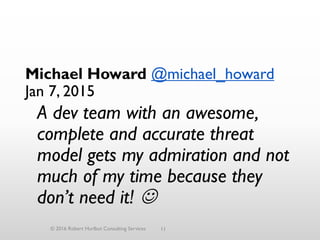
11
Michael Howard @michael_howard
Jan 7, 2015
A dev team with an awesome,
complete and accurate threat
model gets my admiration and not
much of my time because they
don’t need it! 
© 2016 Robert Hurlbut Consulting Services
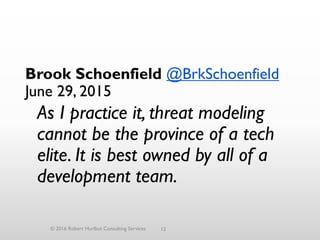
12
Brook Schoenfield @BrkSchoenfield
June 29, 2015
As I practice it, threat modeling
cannot be the province of a tech
elite. It is best owned by all of a
development team.
© 2016 Robert Hurlbut Consulting Services
Definitions
Threat Agent
Someone (or a process) who
could do harm to a system
(also adversary or attacker)
© 2016 Robert Hurlbut Consulting Services
Definitions
Threat
An adversary’s goal
© 2016 Robert Hurlbut Consulting Services
Definitions
Vulnerability
A flaw in the system that could
help a threat agent realize a
threat
© 2016 Robert Hurlbut Consulting Services
Definitions
Attack
When a motivated and
sufficiently skilled threat agent
takes advantage of a
vulnerability
© 2016 Robert Hurlbut Consulting Services
Definitions
Asset
Something of value to valid
users and adversaries alike
© 2016 Robert Hurlbut Consulting Services
When?
Make threat modeling first priority:
In SDLC – Requirements and
Design phase
Threat modeling uncovers new
requirements
Agile Sprint Planning
© 2016 Robert Hurlbut Consulting Services
When?
What if we didn’t?
It’s not too late to start threat
modeling (generally)
It will be more difficult to
change major design decisions
Do it anyway!
© 2016 Robert Hurlbut Consulting Services
TypicalThreat Modeling Session
Gather documentation
Gather your team:
Developers, QA, Architects, Project Managers, Business
Stakeholders (not one person’s job!)
Understand business goals and technical goals
(threat modeling must support goals, not other way around)
Agree on meeting date(s) and time(s)
Plan on 1-2 hour focused sessions at a time
Important: Be honest, leave ego at the door, no
blaming!
© 2016 Robert Hurlbut Consulting Services
SimpleTools
Whiteboard
Visio (or equivalent) for diagraming
Word (or equivalent) or Excel (or
equivalent) for documenting
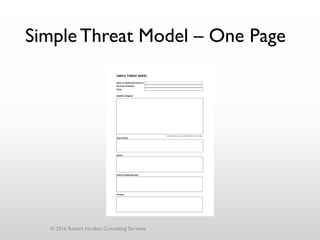
Look at Dinis Cruz’ Simple Threat
Model One Page Template
http://blog.diniscruz.com/2016/03/simple-
threat-model-template-good-place.html
© 2016 Robert Hurlbut Consulting Services
SimpleThreat Model – One Page
© 2016 Robert Hurlbut Consulting Services
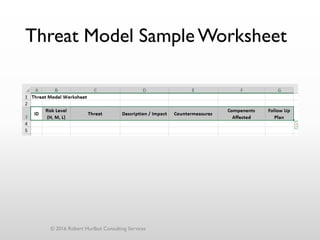
Threat Model SampleWorksheet
© 2016 Robert Hurlbut Consulting Services
Review Security Principles*
1. Secure the weakest link
2. Defend in depth
3. Fail securely
4. Grant least privilege
5. Separate privileges
6. Economize mechanisms
© 2016 Robert Hurlbut Consulting Services
(* Securing Software Design is Hard, blog post by Gary McGraw, January, 2013)
Review Security Principles*
7. Do not share mechanisms
8. Be reluctant to trust
9.Assume your secrets are not safe
10. Mediate completely
11. Make security usable
12. Promote privacy
13. Use your resources
© 2016 Robert Hurlbut Consulting Services
(* Securing Software Design is Hard, blog post by Gary McGraw, January, 2013)
IEEE Computer Society’s Center
for Secure Design
Take a look at:
© 2016 Robert Hurlbut Consulting Services
http://www.computer.org/cms/CYBSI/docs/Top-10-Flaws.pdf
Threat Modeling Process
1. Draw your picture – understand
the system and the data flows
2. Identify threats through answers
to questions
3. Determine mitigations and risks
4. Follow through
© 2016 Robert Hurlbut Consulting Services
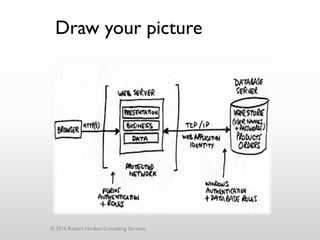
Draw your picture
© 2016 Robert Hurlbut Consulting Services
Understand the system
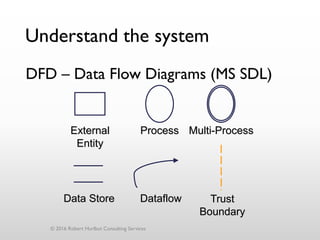
DFD – Data Flow Diagrams (MS SDL)
External
Entity
Process Multi-Process
Data Store Dataflow Trust
Boundary
© 2016 Robert Hurlbut Consulting Services
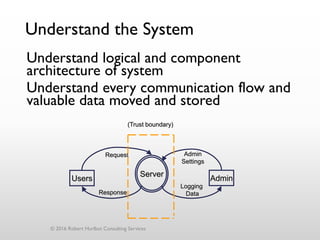
Understand the System
Server
Users Admin
Request
Response
Admin
Settings
Logging
Data
© 2016 Robert Hurlbut Consulting Services
(Trust boundary)
Understand logical and component
architecture of system
Understand every communication flow and
valuable data moved and stored
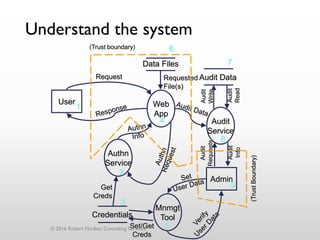
Understand the system
User
Admin
Authn
Service
Audit
Service
Web
App
Mnmgt
ToolCredentials
Data Files
Audit DataRequest
Set/Get
Creds
Requested
File(s)
Audit
Requests
Audit
Info
Audit
Read
Audit
Write
Get
Creds
1
2
3
4
5
6
7
8
9
(Trust boundary)
(TrustBoundary)
© 2016 Robert Hurlbut Consulting Services
Understand the system
User
Admin
Authn
Service
Audit
Service
Web
App
Mnmgt
ToolCredentials
Data Files
Audit DataRequest
Set/Get
Creds
Requested
File(s)
Audit
Requests
Audit
Info
Audit
Read
Audit
Write
Get
Creds
1
2
3
4
5
6
7
8
9
(Trust boundary)
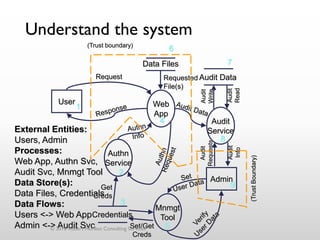
External Entities:
Users, Admin
Processes:
Web App, Authn Svc,
Audit Svc, Mnmgt Tool
Data Store(s):
Data Files, Credentials
Data Flows:
Users <-> Web App
Admin <-> Audit Svc
(TrustBoundary)
© 2016 Robert Hurlbut Consulting Services
Your threat model now consists
of …
1. Diagram / understanding of your
system and the data flows
© 2016 Robert Hurlbut Consulting Services
Identify threats
Most important part of threat modeling (and most
difficult)
Attack Trees (Bruce Schneier - Slide deck)
Threat Libraries (CAPEC, OWASP Top 10, SANS Top
25)
Checklists (OWASP Application SecurityVerification
Standard (ASVS), OWASP Proactive Controls 2016))
Use Cases / Misuse Cases
Games: Elevation of Privilege (EoP), OWASP
Cornucopia
STRIDE
P.A.S.T.A. – Process for Attack Simulation and Threat
Analysis (combining STRIDE + Attacks + Risk Analyses)
© 2016 Robert Hurlbut Consulting Services 34
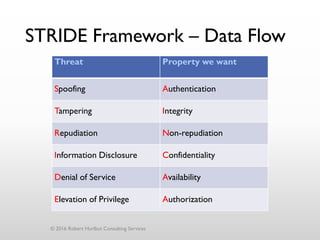
STRIDE Framework – Data Flow
Threat Property we want
Spoofing Authentication
Tampering Integrity
Repudiation Non-repudiation
Information Disclosure Confidentiality
Denial of Service Availability
Elevation of Privilege Authorization
© 2016 Robert Hurlbut Consulting Services
36
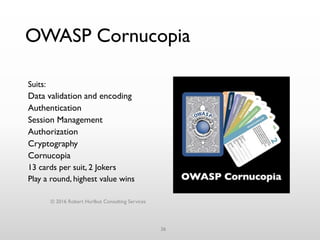
OWASP Cornucopia
Suits:
Data validation and encoding
Authentication
Session Management
Authorization
Cryptography
Cornucopia
13 cards per suit, 2 Jokers
Play a round, highest value wins
© 2016 Robert Hurlbut Consulting Services
IdentifyThreats – Functional
Input and data validation
Authentication
Authorization
Configuration management
Sensitive data
© 2016 Robert Hurlbut Consulting Services
IdentifyThreats – Functional
Session management
Cryptography
Parameter manipulation
Exception management
Auditing and logging
© 2016 Robert Hurlbut Consulting Services
IdentityThreats - Ask Questions
Who would be interested in the
application and its data (threat agents)?
What are the goals (assets)?
What are attack methods for the
system we are building?
Are there any attack surfaces exposed -
data flows (input/output) we are
missing?
© 2016 Robert Hurlbut Consulting Services
IdentityThreats – Ask Questions
How is authentication handled between
callers and services?
What about authorization?
Are we sending data in the open?
Are we using cryptography properly?
Is there logging? What is stored?
Etc.
© 2016 Robert Hurlbut Consulting Services
One of the best questions …
Is there anything
keeping you up at
night worrying about
this system?
© 2016 Robert Hurlbut Consulting Services
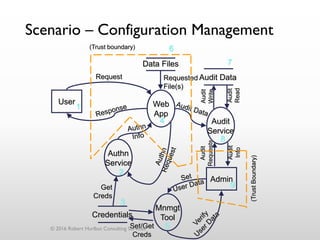
Scenario – Configuration Management
User
Admin
Authn
Service
Audit
Service
Web
App
Mnmgt
ToolCredentials
Data Files
Audit DataRequest
Set/Get
Creds
Requested
File(s)
Audit
Requests
Audit
Info
Audit
Read
Audit
Write
Get
Creds
1
2
3
4
5
6
7
8
9
(Trust boundary)
(TrustBoundary)
© 2016 Robert Hurlbut Consulting Services
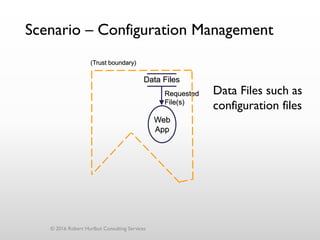
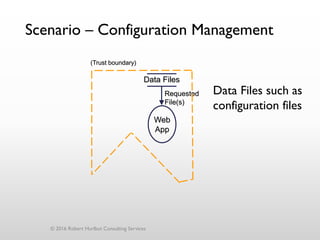
Scenario – Configuration Management
Web
App
Data Files
Requested
File(s)
(Trust boundary)
© 2016 Robert Hurlbut Consulting Services
Data Files such as
configuration files
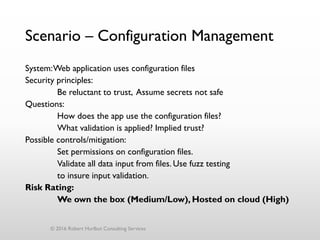
Scenario – Configuration Management
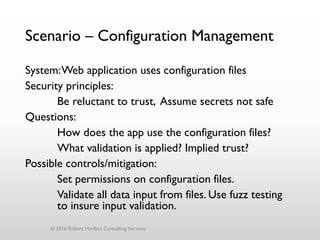
System:Web application uses configuration files
Security principles:
Be reluctant to trust, Assume secrets not safe
Questions:
How does the app use the configuration files?
What validation is applied? Implied trust?
Possible controls/mitigation:
Set permissions on configuration files.
Validate all data input from files. Use fuzz testing
to insure input validation.
© 2016 Robert Hurlbut Consulting Services
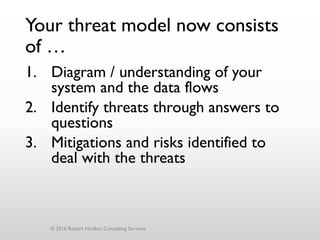
Your threat model now consists
of …
1. Diagram / understanding of your
system and the data flows
2. Identify threats through answers to
questions
© 2016 Robert Hurlbut Consulting Services
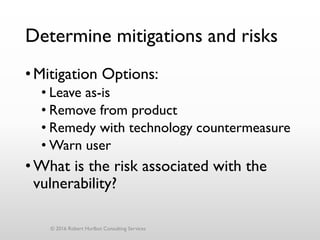
•Mitigation Options:
• Leave as-is
• Remove from product
• Remedy with technology countermeasure
• Warn user
•What is the risk associated with the
vulnerability?
Determine mitigations and risks
© 2016 Robert Hurlbut Consulting Services
Determine mitigations and risks
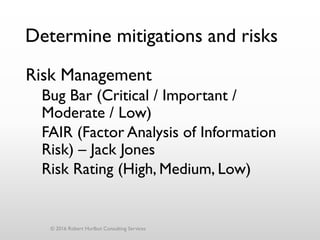
Risk Management
Bug Bar (Critical / Important /
Moderate / Low)
FAIR (Factor Analysis of Information
Risk) – Jack Jones
Risk Rating (High, Medium, Low)
© 2016 Robert Hurlbut Consulting Services
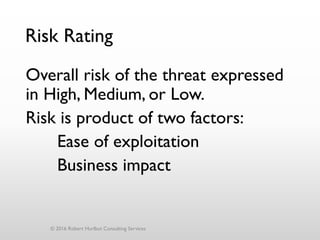
Risk Rating
Overall risk of the threat expressed
in High, Medium, or Low.
Risk is product of two factors:
Ease of exploitation
Business impact
© 2016 Robert Hurlbut Consulting Services
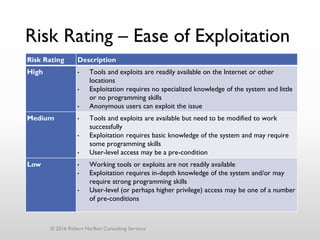
Risk Rating – Ease of Exploitation
© 2016 Robert Hurlbut Consulting Services
Risk Rating Description
High • Tools and exploits are readily available on the Internet or other
locations
• Exploitation requires no specialized knowledge of the system and little
or no programming skills
• Anonymous users can exploit the issue
Medium • Tools and exploits are available but need to be modified to work
successfully
• Exploitation requires basic knowledge of the system and may require
some programming skills
• User-level access may be a pre-condition
Low • Working tools or exploits are not readily available
• Exploitation requires in-depth knowledge of the system and/or may
require strong programming skills
• User-level (or perhaps higher privilege) access may be one of a number
of pre-conditions
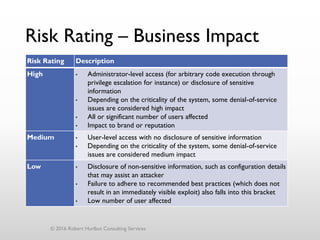
Risk Rating – Business Impact
© 2016 Robert Hurlbut Consulting Services
Risk Rating Description
High • Administrator-level access (for arbitrary code execution through
privilege escalation for instance) or disclosure of sensitive
information
• Depending on the criticality of the system, some denial-of-service
issues are considered high impact
• All or significant number of users affected
• Impact to brand or reputation
Medium • User-level access with no disclosure of sensitive information
• Depending on the criticality of the system, some denial-of-service
issues are considered medium impact
Low • Disclosure of non-sensitive information, such as configuration details
that may assist an attacker
• Failure to adhere to recommended best practices (which does not
result in an immediately visible exploit) also falls into this bracket
• Low number of user affected
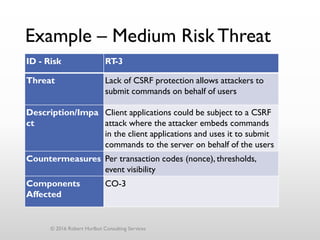
Example – Medium Risk Threat
© 2016 Robert Hurlbut Consulting Services
ID - Risk RT-3
Threat Lack of CSRF protection allows attackers to
submit commands on behalf of users
Description/Impa
ct
Client applications could be subject to a CSRF
attack where the attacker embeds commands
in the client applications and uses it to submit
commands to the server on behalf of the users
Countermeasures Per transaction codes (nonce), thresholds,
event visibility
Components
Affected
CO-3
Scenario – Configuration Management
Web
App
Data Files
Requested
File(s)
(Trust boundary)
© 2016 Robert Hurlbut Consulting Services
Data Files such as
configuration files
Scenario – Configuration Management
System:Web application uses configuration files
Security principles:
Be reluctant to trust, Assume secrets not safe
Questions:
How does the app use the configuration files?
What validation is applied? Implied trust?
Possible controls/mitigation:
Set permissions on configuration files.
Validate all data input from files. Use fuzz testing
to insure input validation.
Risk Rating:
We own the box (Medium/Low), Hosted on cloud (High)
© 2016 Robert Hurlbut Consulting Services
Your threat model now consists
of …
1. Diagram / understanding of your
system and the data flows
2. Identify threats through answers to
questions
3. Mitigations and risks identified to
deal with the threats
© 2016 Robert Hurlbut Consulting Services
Follow through
Document what you found and decisions
you make
File bugs or new requirements
Verify bugs fixed and new requirements
implemented
Did we miss anything? Review again
Anything new? Review again
© 2016 Robert Hurlbut Consulting Services
Your threat model now consists
of …
1. Diagram / understanding of your system
and the data flows
2. Identify threats through answers to
questions
3. Mitigations and risks identified to deal
with the threats
4. Follow through
A living threat model!
© 2016 Robert Hurlbut Consulting Services
Your challenge
Use threat modeling for:
secure design before new
features
driving your testing and other
review activities
understanding bigger picture
© 2016 Robert Hurlbut Consulting Services
Resources - Books
Threat Modeling: Designing for Security
Adam Shostack
Securing Systems:Applied Architecture and Threat
Models
Brook S.E. Schoenfield
Risk Centric Threat Modeling: Process for Attack
Simulation and Threat Analysis
Marco Morana andTony UcedaVelez
Measuring and Managing Information Risk:A FAIR
Approach
Jack Jones and Jack Freund
© 2016 Robert Hurlbut Consulting Services
Resources - Tools
MicrosoftThreat ModelingTool 2016
http://www.microsoft.com/en-us/download/details.aspx?id=49168
Threat Modeler Tool 3.0
http://myappsecurity.com
© 2016 Robert Hurlbut Consulting Services
Resources - Tools
AttackTrees – Bruce Schneier on Security
https://www.schneier.com/attacktrees.pdf
Elevation of Privilege (EoP) Game
http://www.microsoft.com/en-us/download/details.aspx?id=20303
OWASP Cornucopia
https://www.owasp.org/index.php/OWASP_Cornucopia
OWASP Application SecurityVerification
Standard (ASVS)
https://www.owasp.org/index.php/Category:OWASP_Application_Security_Verification_Standard_Pro
ject
OWASP Proactive Controls 2016
https://www.owasp.org/index.php/OWASP_Proactive_Controls
© 2016 Robert Hurlbut Consulting Services 60
Questions?
Contacts
Web Site: https://roberthurlbut.com
LinkedIn: https://www.linkedin.com/in/roberthurlbut
Twitter: @RobertHurlbut
Email: robert at roberthurlbut.com
© 2016 Robert Hurlbut Consulting Services

Robert Hurlbut - Threat Modeling for Secure Software Design

  • 1.
    Threat Modeling For SecureSoftware Design 2016 Central Ohio InfoSec Summit March 29, 2016 Robert Hurlbut RobertHurlbut.com • @RobertHurlbut
  • 2.
    Robert Hurlbut • SoftwareSecurity Consultant, Architect, andTrainer • Owner / President of Robert Hurlbut Consulting Services • Microsoft MVP – Developer Security 2005-2009, 2015 • (ISC)2 CSSLP 2014-2017 • Speaker at user groups, conferences, and other training events • Contacts • Web Site: https://roberthurlbut.com • LinkedIn: https://www.linkedin.com/in/roberthurlbut • Twitter: @RobertHurlbut • Email: robert at roberthurlbut.com © 2016 Robert Hurlbut Consulting Services
  • 3.
    Secure Software Design Buildingsecure systems is difficult Design is key Build appropriate security through secure design But, how? © 2016 Robert Hurlbut Consulting Services
  • 4.
    Secure Software Design Breakdownsin secure design: GitHub Mass Assignment Jeep Cherokee Hack Target Breach © 2016 Robert Hurlbut Consulting Services
  • 5.
    What is threatmodeling? Something we all do in our personal lives … ... when we lock our doors to our house ... when we lock the windows ... when we lock the doors to our car © 2016 Robert Hurlbut Consulting Services
  • 6.
    What is threatmodeling? When we think ahead of what could go wrong, weigh the risks, and act accordingly we are “threat modeling” © 2016 Robert Hurlbut Consulting Services
  • 7.
    Threat modeling helps… Bridge gaps between builders, breakers, and defenders: Helps builders focus on security features Helps breakers know most critical attack surfaces Helps defenders understand critical attack patterns Helps many areas security / business © 2016 Robert Hurlbut Consulting Services
  • 8.
    Where does threatmodeling fit? One of the application security tools – but different We know about penetration testing, fuzzing, analysis / code reviews, detection (lots of automated tools) Threat modeling is a tool for secure system and software design (not automated)© 2016 Robert Hurlbut Consulting Services
  • 9.
    What is threatmodeling? Threat modeling is: Process of understanding your system and potential threats against your system © 2016 Robert Hurlbut Consulting Services
  • 10.
    What is threatmodeling? Threat model includes: understanding of your system, identified threat(s), probability of threat(s), potential harm or impact, and priority and plan for mitigating the threat(s) based on risk © 2016 Robert Hurlbut Consulting Services
  • 11.
    11 Michael Howard @michael_howard Jan7, 2015 A dev team with an awesome, complete and accurate threat model gets my admiration and not much of my time because they don’t need it!  © 2016 Robert Hurlbut Consulting Services
  • 12.
    12 Brook Schoenfield @BrkSchoenfield June29, 2015 As I practice it, threat modeling cannot be the province of a tech elite. It is best owned by all of a development team. © 2016 Robert Hurlbut Consulting Services
  • 13.
    Definitions Threat Agent Someone (ora process) who could do harm to a system (also adversary or attacker) © 2016 Robert Hurlbut Consulting Services
  • 14.
    Definitions Threat An adversary’s goal ©2016 Robert Hurlbut Consulting Services
  • 15.
    Definitions Vulnerability A flaw inthe system that could help a threat agent realize a threat © 2016 Robert Hurlbut Consulting Services
  • 16.
    Definitions Attack When a motivatedand sufficiently skilled threat agent takes advantage of a vulnerability © 2016 Robert Hurlbut Consulting Services
  • 17.
    Definitions Asset Something of valueto valid users and adversaries alike © 2016 Robert Hurlbut Consulting Services
  • 18.
    When? Make threat modelingfirst priority: In SDLC – Requirements and Design phase Threat modeling uncovers new requirements Agile Sprint Planning © 2016 Robert Hurlbut Consulting Services
  • 19.
    When? What if wedidn’t? It’s not too late to start threat modeling (generally) It will be more difficult to change major design decisions Do it anyway! © 2016 Robert Hurlbut Consulting Services
  • 20.
    TypicalThreat Modeling Session Gatherdocumentation Gather your team: Developers, QA, Architects, Project Managers, Business Stakeholders (not one person’s job!) Understand business goals and technical goals (threat modeling must support goals, not other way around) Agree on meeting date(s) and time(s) Plan on 1-2 hour focused sessions at a time Important: Be honest, leave ego at the door, no blaming! © 2016 Robert Hurlbut Consulting Services
  • 21.
    SimpleTools Whiteboard Visio (or equivalent)for diagraming Word (or equivalent) or Excel (or equivalent) for documenting Look at Dinis Cruz’ Simple Threat Model One Page Template http://blog.diniscruz.com/2016/03/simple- threat-model-template-good-place.html © 2016 Robert Hurlbut Consulting Services
  • 22.
    SimpleThreat Model –One Page © 2016 Robert Hurlbut Consulting Services
  • 23.
    Threat Model SampleWorksheet ©2016 Robert Hurlbut Consulting Services
  • 24.
    Review Security Principles* 1.Secure the weakest link 2. Defend in depth 3. Fail securely 4. Grant least privilege 5. Separate privileges 6. Economize mechanisms © 2016 Robert Hurlbut Consulting Services (* Securing Software Design is Hard, blog post by Gary McGraw, January, 2013)
  • 25.
    Review Security Principles* 7.Do not share mechanisms 8. Be reluctant to trust 9.Assume your secrets are not safe 10. Mediate completely 11. Make security usable 12. Promote privacy 13. Use your resources © 2016 Robert Hurlbut Consulting Services (* Securing Software Design is Hard, blog post by Gary McGraw, January, 2013)
  • 26.
    IEEE Computer Society’sCenter for Secure Design Take a look at: © 2016 Robert Hurlbut Consulting Services http://www.computer.org/cms/CYBSI/docs/Top-10-Flaws.pdf
  • 27.
    Threat Modeling Process 1.Draw your picture – understand the system and the data flows 2. Identify threats through answers to questions 3. Determine mitigations and risks 4. Follow through © 2016 Robert Hurlbut Consulting Services
  • 28.
    Draw your picture ©2016 Robert Hurlbut Consulting Services
  • 29.
    Understand the system DFD– Data Flow Diagrams (MS SDL) External Entity Process Multi-Process Data Store Dataflow Trust Boundary © 2016 Robert Hurlbut Consulting Services
  • 30.
    Understand the System Server UsersAdmin Request Response Admin Settings Logging Data © 2016 Robert Hurlbut Consulting Services (Trust boundary) Understand logical and component architecture of system Understand every communication flow and valuable data moved and stored
  • 31.
    Understand the system User Admin Authn Service Audit Service Web App Mnmgt ToolCredentials DataFiles Audit DataRequest Set/Get Creds Requested File(s) Audit Requests Audit Info Audit Read Audit Write Get Creds 1 2 3 4 5 6 7 8 9 (Trust boundary) (TrustBoundary) © 2016 Robert Hurlbut Consulting Services
  • 32.
    Understand the system User Admin Authn Service Audit Service Web App Mnmgt ToolCredentials DataFiles Audit DataRequest Set/Get Creds Requested File(s) Audit Requests Audit Info Audit Read Audit Write Get Creds 1 2 3 4 5 6 7 8 9 (Trust boundary) External Entities: Users, Admin Processes: Web App, Authn Svc, Audit Svc, Mnmgt Tool Data Store(s): Data Files, Credentials Data Flows: Users <-> Web App Admin <-> Audit Svc (TrustBoundary) © 2016 Robert Hurlbut Consulting Services
  • 33.
    Your threat modelnow consists of … 1. Diagram / understanding of your system and the data flows © 2016 Robert Hurlbut Consulting Services
  • 34.
    Identify threats Most importantpart of threat modeling (and most difficult) Attack Trees (Bruce Schneier - Slide deck) Threat Libraries (CAPEC, OWASP Top 10, SANS Top 25) Checklists (OWASP Application SecurityVerification Standard (ASVS), OWASP Proactive Controls 2016)) Use Cases / Misuse Cases Games: Elevation of Privilege (EoP), OWASP Cornucopia STRIDE P.A.S.T.A. – Process for Attack Simulation and Threat Analysis (combining STRIDE + Attacks + Risk Analyses) © 2016 Robert Hurlbut Consulting Services 34
  • 35.
    STRIDE Framework –Data Flow Threat Property we want Spoofing Authentication Tampering Integrity Repudiation Non-repudiation Information Disclosure Confidentiality Denial of Service Availability Elevation of Privilege Authorization © 2016 Robert Hurlbut Consulting Services
  • 36.
    36 OWASP Cornucopia Suits: Data validationand encoding Authentication Session Management Authorization Cryptography Cornucopia 13 cards per suit, 2 Jokers Play a round, highest value wins © 2016 Robert Hurlbut Consulting Services
  • 37.
    IdentifyThreats – Functional Inputand data validation Authentication Authorization Configuration management Sensitive data © 2016 Robert Hurlbut Consulting Services
  • 38.
    IdentifyThreats – Functional Sessionmanagement Cryptography Parameter manipulation Exception management Auditing and logging © 2016 Robert Hurlbut Consulting Services
  • 39.
    IdentityThreats - AskQuestions Who would be interested in the application and its data (threat agents)? What are the goals (assets)? What are attack methods for the system we are building? Are there any attack surfaces exposed - data flows (input/output) we are missing? © 2016 Robert Hurlbut Consulting Services
  • 40.
    IdentityThreats – AskQuestions How is authentication handled between callers and services? What about authorization? Are we sending data in the open? Are we using cryptography properly? Is there logging? What is stored? Etc. © 2016 Robert Hurlbut Consulting Services
  • 41.
    One of thebest questions … Is there anything keeping you up at night worrying about this system? © 2016 Robert Hurlbut Consulting Services
  • 42.
    Scenario – ConfigurationManagement User Admin Authn Service Audit Service Web App Mnmgt ToolCredentials Data Files Audit DataRequest Set/Get Creds Requested File(s) Audit Requests Audit Info Audit Read Audit Write Get Creds 1 2 3 4 5 6 7 8 9 (Trust boundary) (TrustBoundary) © 2016 Robert Hurlbut Consulting Services
  • 43.
    Scenario – ConfigurationManagement Web App Data Files Requested File(s) (Trust boundary) © 2016 Robert Hurlbut Consulting Services Data Files such as configuration files
  • 44.
    Scenario – ConfigurationManagement System:Web application uses configuration files Security principles: Be reluctant to trust, Assume secrets not safe Questions: How does the app use the configuration files? What validation is applied? Implied trust? Possible controls/mitigation: Set permissions on configuration files. Validate all data input from files. Use fuzz testing to insure input validation. © 2016 Robert Hurlbut Consulting Services
  • 45.
    Your threat modelnow consists of … 1. Diagram / understanding of your system and the data flows 2. Identify threats through answers to questions © 2016 Robert Hurlbut Consulting Services
  • 46.
    •Mitigation Options: • Leaveas-is • Remove from product • Remedy with technology countermeasure • Warn user •What is the risk associated with the vulnerability? Determine mitigations and risks © 2016 Robert Hurlbut Consulting Services
  • 47.
    Determine mitigations andrisks Risk Management Bug Bar (Critical / Important / Moderate / Low) FAIR (Factor Analysis of Information Risk) – Jack Jones Risk Rating (High, Medium, Low) © 2016 Robert Hurlbut Consulting Services
  • 48.
    Risk Rating Overall riskof the threat expressed in High, Medium, or Low. Risk is product of two factors: Ease of exploitation Business impact © 2016 Robert Hurlbut Consulting Services
  • 49.
    Risk Rating –Ease of Exploitation © 2016 Robert Hurlbut Consulting Services Risk Rating Description High • Tools and exploits are readily available on the Internet or other locations • Exploitation requires no specialized knowledge of the system and little or no programming skills • Anonymous users can exploit the issue Medium • Tools and exploits are available but need to be modified to work successfully • Exploitation requires basic knowledge of the system and may require some programming skills • User-level access may be a pre-condition Low • Working tools or exploits are not readily available • Exploitation requires in-depth knowledge of the system and/or may require strong programming skills • User-level (or perhaps higher privilege) access may be one of a number of pre-conditions
  • 50.
    Risk Rating –Business Impact © 2016 Robert Hurlbut Consulting Services Risk Rating Description High • Administrator-level access (for arbitrary code execution through privilege escalation for instance) or disclosure of sensitive information • Depending on the criticality of the system, some denial-of-service issues are considered high impact • All or significant number of users affected • Impact to brand or reputation Medium • User-level access with no disclosure of sensitive information • Depending on the criticality of the system, some denial-of-service issues are considered medium impact Low • Disclosure of non-sensitive information, such as configuration details that may assist an attacker • Failure to adhere to recommended best practices (which does not result in an immediately visible exploit) also falls into this bracket • Low number of user affected
  • 51.
    Example – MediumRisk Threat © 2016 Robert Hurlbut Consulting Services ID - Risk RT-3 Threat Lack of CSRF protection allows attackers to submit commands on behalf of users Description/Impa ct Client applications could be subject to a CSRF attack where the attacker embeds commands in the client applications and uses it to submit commands to the server on behalf of the users Countermeasures Per transaction codes (nonce), thresholds, event visibility Components Affected CO-3
  • 52.
    Scenario – ConfigurationManagement Web App Data Files Requested File(s) (Trust boundary) © 2016 Robert Hurlbut Consulting Services Data Files such as configuration files
  • 53.
    Scenario – ConfigurationManagement System:Web application uses configuration files Security principles: Be reluctant to trust, Assume secrets not safe Questions: How does the app use the configuration files? What validation is applied? Implied trust? Possible controls/mitigation: Set permissions on configuration files. Validate all data input from files. Use fuzz testing to insure input validation. Risk Rating: We own the box (Medium/Low), Hosted on cloud (High) © 2016 Robert Hurlbut Consulting Services
  • 54.
    Your threat modelnow consists of … 1. Diagram / understanding of your system and the data flows 2. Identify threats through answers to questions 3. Mitigations and risks identified to deal with the threats © 2016 Robert Hurlbut Consulting Services
  • 55.
    Follow through Document whatyou found and decisions you make File bugs or new requirements Verify bugs fixed and new requirements implemented Did we miss anything? Review again Anything new? Review again © 2016 Robert Hurlbut Consulting Services
  • 56.
    Your threat modelnow consists of … 1. Diagram / understanding of your system and the data flows 2. Identify threats through answers to questions 3. Mitigations and risks identified to deal with the threats 4. Follow through A living threat model! © 2016 Robert Hurlbut Consulting Services
  • 57.
    Your challenge Use threatmodeling for: secure design before new features driving your testing and other review activities understanding bigger picture © 2016 Robert Hurlbut Consulting Services
  • 58.
    Resources - Books ThreatModeling: Designing for Security Adam Shostack Securing Systems:Applied Architecture and Threat Models Brook S.E. Schoenfield Risk Centric Threat Modeling: Process for Attack Simulation and Threat Analysis Marco Morana andTony UcedaVelez Measuring and Managing Information Risk:A FAIR Approach Jack Jones and Jack Freund © 2016 Robert Hurlbut Consulting Services
  • 59.
    Resources - Tools MicrosoftThreatModelingTool 2016 http://www.microsoft.com/en-us/download/details.aspx?id=49168 Threat Modeler Tool 3.0 http://myappsecurity.com © 2016 Robert Hurlbut Consulting Services
  • 60.
    Resources - Tools AttackTrees– Bruce Schneier on Security https://www.schneier.com/attacktrees.pdf Elevation of Privilege (EoP) Game http://www.microsoft.com/en-us/download/details.aspx?id=20303 OWASP Cornucopia https://www.owasp.org/index.php/OWASP_Cornucopia OWASP Application SecurityVerification Standard (ASVS) https://www.owasp.org/index.php/Category:OWASP_Application_Security_Verification_Standard_Pro ject OWASP Proactive Controls 2016 https://www.owasp.org/index.php/OWASP_Proactive_Controls © 2016 Robert Hurlbut Consulting Services 60
  • 61.
    Questions? Contacts Web Site: https://roberthurlbut.com LinkedIn:https://www.linkedin.com/in/roberthurlbut Twitter: @RobertHurlbut Email: robert at roberthurlbut.com © 2016 Robert Hurlbut Consulting Services