Apache Milagro
(incubating)
Brian Spector, Co Founder / CEO, MIRACL
Co Founder, Apache Milagro (incubating)
To Secure the Future of the Web
Apache Milagro: A Distributed Cryptosystem
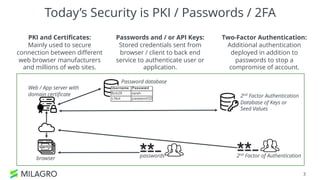
PKI and Certificates:
Mainly used to secure
connection between different
web browser manufacturers
and millions of web sites.
Today’s Security is PKI / Passwords / 2FA
3
Passwords and / or API Keys:
Stored credentials sent from
browser / client to back end
service to authenticate user or
application.
Two-Factor Authentication:
Additional authentication
deployed in addition to
passwords to stop a
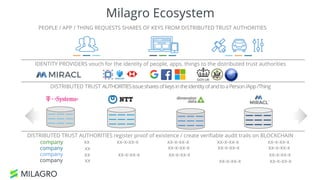
compromise of account.
passwordsbrowser
Password database
2nd
Factor of Authentication
Bob
Web / App server with
domain certificate
Username
Bob28
v.Noir
Alice_467
Sarah.h!
Samsam10
sunnykid1
Password
sarah
password123
linkedin
facebook1
hello
Pass1!
Email
Bob28@ho
Vince.noir
Alice.h@g
S.hard@g
Sam@yah
sunny@ma
2nd
Factor Authentication
Database of Keys or
Seed Values
Public Key Infrastructure (PKI) Refresher
4
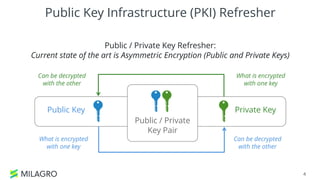
Public / Private
Key Pair
Public Key Private Key
What is encrypted
with one key
Can be decrypted
with the other
Can be decrypted
with the other
What is encrypted
with one key
Public / Private Key Refresher:
Current state of the art is Asymmetric Encryption (Public and Private Keys)
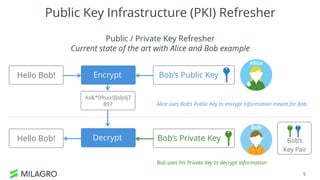
Public / Private Key Refresher
Current state of the art with Alice and Bob example
5
Hello Bob! Encrypt Bob’s Public Key
As&*09sxx!jljsljslj7
897 Alice uses Bob’s Public Key to encrypt information meant for Bob
DecryptHello Bob! Bob’s Private Key Bob’s
Key Pair
Alice
Bob
Bob uses his Private Key to decrypt information
Public Key Infrastructure (PKI) Refresher
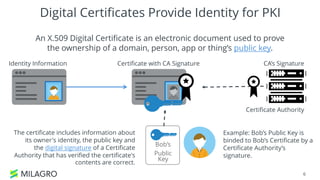
An X.509 Digital Certificate is an electronic document used to prove
the ownership of a domain, person, app or thing’s public key.
Digital Certificates Provide Identity for PKI
6
Example: Bob’s Public Key is
binded to Bob’s Certificate by a
Certificate Authority’s
signature.
Bob’s
Public
Key
Bob
The certificate includes information about
its owner's identity, the public key and
the digital signature of a Certificate
Authority that has verified the certificate's
contents are correct.
Certificate Authority
Identity Information CA’s SignatureCertificate with CA Signature
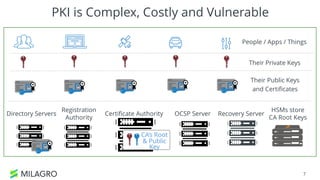
PKI is Complex, Costly and Vulnerable
7
Alice
Certificate Authority
Registration
Authority
Recovery Server
CA’s Root
& Public
Key
Their Private Keys
People / Apps / Things
OCSP Server
Their Public Keys
and Certificates
HSMs store
CA Root Keys
Directory Servers
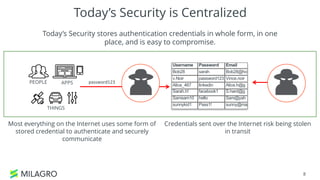
Today’s Security is Centralized
8
PEOPLE
THINGS
APPS
Username
Bob28
v.Noir
Alice_467
Sarah.h!
Samsam10
sunnykid1
Password
sarah
password123
linkedin
facebook1
hello
Pass1!
Email
Bob28@ho
Vince.noir
Alice.h@g
S.hard@g
Sam@yah
sunny@ma
password123
Credentials sent over the Internet risk being stolen
in transit
Most everything on the Internet uses some form of
stored credential to authenticate and securely
communicate
Today’s Security stores authentication credentials in whole form, in one
place, and is easy to compromise.
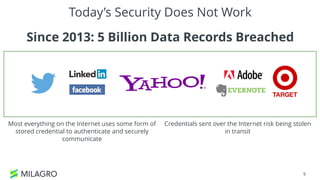
Today’s Security Does Not Work
9
Since 2013: 5 Billion Data Records Breached
Credentials sent over the Internet risk being stolen
in transit
Most everything on the Internet uses some form of
stored credential to authenticate and securely
communicate
10
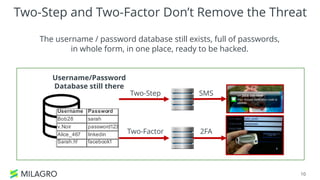
The username / password database still exists, full of passwords,
in whole form, in one place, ready to be hacked.
Two-Step and Two-Factor Don’t Remove the Threat
SMS
2FA
Username/Password
Database still there
Two-Step
Two-Factor
Username
Bob28
v.Noir
Alice_467
Sarah.h!
Samsam10
sunnykid1
Password
sarah
password123
linkedin
facebook1
hello
Pass1!
Email
Bob28@ho
Vince.noir
Alice.h@g
S.hard@g
Sam@yah
sunny@ma
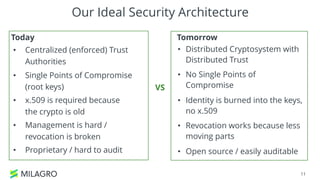
Our Ideal Security Architecture
11
• Centralized (enforced) Trust
Authorities
• Single Points of Compromise
(root keys)
• x.509 is required because
the crypto is old
• Management is hard /
revocation is broken
• Proprietary / hard to audit
VS
• Distributed Cryptosystem with
Distributed Trust
• No Single Points of
Compromise
• Identity is burned into the keys,
no x.509
• Revocation works because less
moving parts
• Open source / easily auditable
Today Tomorrow
Multi-Factor Authentication and TLS
Extend Trust based on your needs
Revoke Trust based on your environments
Scale Trust to Mobile, IoT, and apps
Apache Milagro: A Distributed Cryptosystem
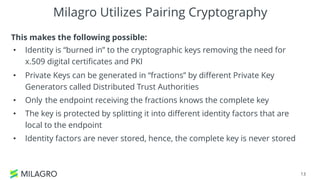
Milagro Utilizes Pairing Cryptography
13
• Identity is “burned in” to the cryptographic keys removing the need for
x.509 digital certificates and PKI
• Private Keys can be generated in “fractions” by different Private Key
Generators called Distributed Trust Authorities
• Only the endpoint receiving the fractions knows the complete key
• The key is protected by splitting it into different identity factors that are
local to the endpoint
• Identity factors are never stored, hence, the complete key is never stored
This makes the following possible:
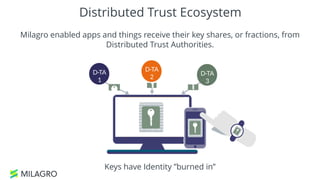
Milagro enabled apps and things receive their key shares, or fractions, from
Distributed Trust Authorities.
Distributed Trust Ecosystem
D-TA
2
D-TA
3
D-TA
1
Keys have Identity ”burned in”
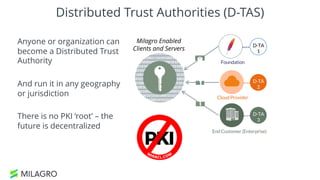
Distributed Trust Authorities (D-TAS)
End Customer (Enterprise)
D-TA
1
D-TA
2
D-TA
3
Foundation
Cloud Provider
Milagro Enabled
Clients and Servers
Anyone or organization can
become a Distributed Trust
Authority
And run it in any geography
or jurisdiction
There is no PKI ‘root’ – the
future is decentralized
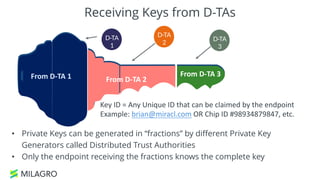
Receiving Keys from D-TAs
From	D-TA	1 From	D-TA	2
D-TA
2
D-TA
3
D-TA
1
From	D-TA	3
• Private Keys can be generated in “fractions” by different Private Key
Generators called Distributed Trust Authorities
• Only the endpoint receiving the fractions knows the complete key
Key	ID	=	Any	Unique	ID	that	can	be	claimed	by	the	endpoint
Example:	brian@miracl.com OR	Chip	ID	#98934879847,	etc.
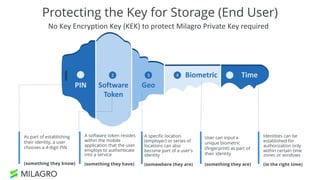
Protecting the Key for Storage (End User)
21
Software
Token
PIN
3
Geo
4 Biometric 5 Time
As part of establishing
their identity, a user
chooses a 4-digit PIN
(something they know)
A software token resides
within the mobile
application that the user
employs to authenticate
into a service
(something they have)
A specific location
(employer) or series of
locations can also
become part of a user’s
identity
(somewhere they are)
User can input a
unique biometric
(fingerprint) as part of
their identity
(something they are)
Identities can be
established for
authorization only
within certain time
zones or windows
(in the right time)
No	Key	Encryption	Key	(KEK)	to	protect	Milagro	Private	Key	required
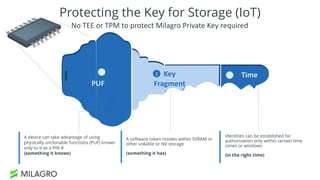
Protecting the Key for Storage (IoT)
21
Key	
FragmentPUF
5 Time
A device can take advantage of using
physically unclonable functions (PUF) known
only to it as a PIN #
(something it knows)
A software token resides within SVRAM or
other voliatile or NV storage
(something it has)
Identities can be established for
authorization only within certain time
zones or windows
(in the right time)
No	TEE	or	TPM	to	protect	Milagro	Private	Key	required
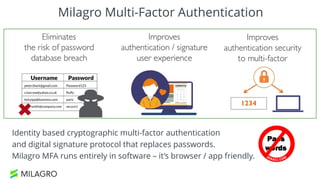
Identity based cryptographic multi-factor authentication
and digital signature protocol that replaces passwords.
Milagro MFA runs entirely in software – it’s browser / app friendly.
Milagro Multi-Factor Authentication
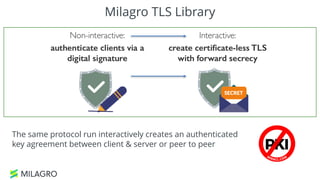
Milagro TLS Library
The same protocol run interactively creates an authenticated
key agreement between client & server or peer to peer
21
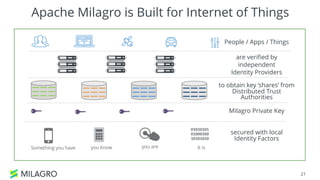
Apache Milagro is Built for Internet of Things
Alic
e
are verified by
independent
Identity Providers
Milagro Private Key
People / Apps / Things
secured with local
Identity Factors
Something you have you know you are It is
to obtain key ‘shares’ from
Distributed Trust
Authorities
Milagro Ecosystem
DISTRIBUTED TRUST AUTHORITIESissuesharesofkeysintheidentityofandtoaPerson/App/Thing
DISTRIBUTED TRUST AUTHORITIES register proof of existence / create verifiable audit trails on BLOCKCHAIN
PEOPLE / APP / THING REQUESTS SHARES OF KEYS FROM DISTRIBUTED TRUST AUTHORITIES
company
company
company
company
xx xx-x-xx-x xx-x-xx-x xx-x-xx-x xx-x-xx-x
xx xx-x-xx-x xx-x-xx-x xx-x-xx-x
xx xx-x-xx-x xx-x-xx-x
IDENTITY PROVIDERS vouch for the identity of people, apps, things to the distributed trust authorities
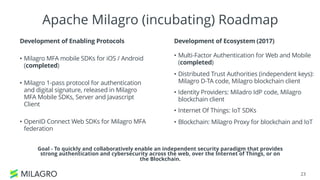
Apache Milagro (incubating) Roadmap
23
Development of Ecosystem (2017)
• Multi-Factor Authentication for Web and Mobile
(completed)
• Distributed Trust Authorities (independent keys):
Milagro D-TA code, Milagro blockchain client
• Identity Providers: Miladro IdP code, Milagro
blockchain client
• Internet Of Things: IoT SDKs
• Blockchain: Milagro Proxy for blockchain and IoT
Development of Enabling Protocols
• Milagro MFA mobile SDKs for iOS / Android
(completed)
• Milagro 1-pass protocol for authentication
and digital signature, released in Milagro
MFA Mobile SDKs, Server and Javascript
Client
• OpenID Connect Web SDKs for Milagro MFA
federation
Goal - To quickly and collaboratively enable an independent security paradigm that provides
strong authentication and cybersecurity across the web, over the Internet of Things, or on
the Blockchain.
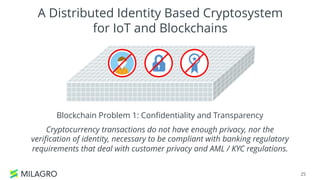
25
A Distributed Identity Based Cryptosystem
for IoT and Blockchains
Blockchain Problem 1: Confidentiality and Transparency
Cryptocurrency transactions do not have enough privacy, nor the
verification of identity, necessary to be compliant with banking regulatory
requirements that deal with customer privacy and AML / KYC regulations.
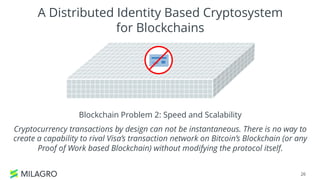
26
A Distributed Identity Based Cryptosystem
for Blockchains
Blockchain Problem 2: Speed and Scalability
Cryptocurrency transactions by design can not be instantaneous. There is no way to
create a capability to rival Visa’s transaction network on Bitcoin’s Blockchain (or any
Proof of Work based Blockchain) without modifying the protocol itself.
27
A Distributed Identity Based Cryptosystem
for Blockchains
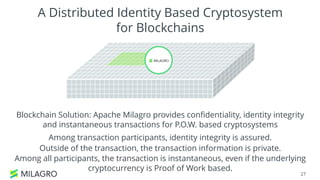
Blockchain Solution: Apache Milagro provides confidentiality, identity integrity
and instantaneous transactions for P.O.W. based cryptosystems
Among transaction participants, identity integrity is assured.
Outside of the transaction, the transaction information is private.
Among all participants, the transaction is instantaneous, even if the underlying
cryptocurrency is Proof of Work based.
28
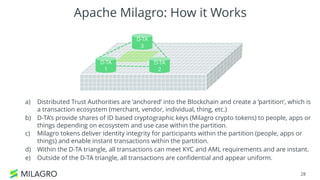
Apache Milagro: How it Works
D-TA
1
D-TA
2
D-TA
3
a) Distributed Trust Authorities are ‘anchored’ into the Blockchain and create a ‘partition’, which is
a transaction ecosystem (merchant, vendor, individual, thing, etc.)
b) D-TA’s provide shares of ID based cryptographic keys (Milagro crypto tokens) to people, apps or
things depending on ecosystem and use case within the partition.
c) Milagro tokens deliver identity integrity for participants within the partition (people, apps or
things) and enable instant transactions within the partition.
d) Within the D-TA triangle, all transactions can meet KYC and AML requirements and are instant.
e) Outside of the D-TA triangle, all transactions are confidential and appear uniform.

Apache Milagro Presentation at ApacheCon Europe 2016

  • 1.
    Apache Milagro (incubating) Brian Spector,Co Founder / CEO, MIRACL Co Founder, Apache Milagro (incubating)
  • 2.
    To Secure theFuture of the Web Apache Milagro: A Distributed Cryptosystem
  • 3.
    PKI and Certificates: Mainlyused to secure connection between different web browser manufacturers and millions of web sites. Today’s Security is PKI / Passwords / 2FA 3 Passwords and / or API Keys: Stored credentials sent from browser / client to back end service to authenticate user or application. Two-Factor Authentication: Additional authentication deployed in addition to passwords to stop a compromise of account. passwordsbrowser Password database 2nd Factor of Authentication Bob Web / App server with domain certificate Username Bob28 v.Noir Alice_467 Sarah.h! Samsam10 sunnykid1 Password sarah password123 linkedin facebook1 hello Pass1! Email Bob28@ho Vince.noir Alice.h@g S.hard@g Sam@yah sunny@ma 2nd Factor Authentication Database of Keys or Seed Values
  • 4.
    Public Key Infrastructure(PKI) Refresher 4 Public / Private Key Pair Public Key Private Key What is encrypted with one key Can be decrypted with the other Can be decrypted with the other What is encrypted with one key Public / Private Key Refresher: Current state of the art is Asymmetric Encryption (Public and Private Keys)
  • 5.
    Public / PrivateKey Refresher Current state of the art with Alice and Bob example 5 Hello Bob! Encrypt Bob’s Public Key As&*09sxx!jljsljslj7 897 Alice uses Bob’s Public Key to encrypt information meant for Bob DecryptHello Bob! Bob’s Private Key Bob’s Key Pair Alice Bob Bob uses his Private Key to decrypt information Public Key Infrastructure (PKI) Refresher
  • 6.
    An X.509 DigitalCertificate is an electronic document used to prove the ownership of a domain, person, app or thing’s public key. Digital Certificates Provide Identity for PKI 6 Example: Bob’s Public Key is binded to Bob’s Certificate by a Certificate Authority’s signature. Bob’s Public Key Bob The certificate includes information about its owner's identity, the public key and the digital signature of a Certificate Authority that has verified the certificate's contents are correct. Certificate Authority Identity Information CA’s SignatureCertificate with CA Signature
  • 7.
    PKI is Complex,Costly and Vulnerable 7 Alice Certificate Authority Registration Authority Recovery Server CA’s Root & Public Key Their Private Keys People / Apps / Things OCSP Server Their Public Keys and Certificates HSMs store CA Root Keys Directory Servers
  • 8.
    Today’s Security isCentralized 8 PEOPLE THINGS APPS Username Bob28 v.Noir Alice_467 Sarah.h! Samsam10 sunnykid1 Password sarah password123 linkedin facebook1 hello Pass1! Email Bob28@ho Vince.noir Alice.h@g S.hard@g Sam@yah sunny@ma password123 Credentials sent over the Internet risk being stolen in transit Most everything on the Internet uses some form of stored credential to authenticate and securely communicate Today’s Security stores authentication credentials in whole form, in one place, and is easy to compromise.
  • 9.
    Today’s Security DoesNot Work 9 Since 2013: 5 Billion Data Records Breached Credentials sent over the Internet risk being stolen in transit Most everything on the Internet uses some form of stored credential to authenticate and securely communicate
  • 10.
    10 The username /password database still exists, full of passwords, in whole form, in one place, ready to be hacked. Two-Step and Two-Factor Don’t Remove the Threat SMS 2FA Username/Password Database still there Two-Step Two-Factor Username Bob28 v.Noir Alice_467 Sarah.h! Samsam10 sunnykid1 Password sarah password123 linkedin facebook1 hello Pass1! Email Bob28@ho Vince.noir Alice.h@g S.hard@g Sam@yah sunny@ma
  • 11.
    Our Ideal SecurityArchitecture 11 • Centralized (enforced) Trust Authorities • Single Points of Compromise (root keys) • x.509 is required because the crypto is old • Management is hard / revocation is broken • Proprietary / hard to audit VS • Distributed Cryptosystem with Distributed Trust • No Single Points of Compromise • Identity is burned into the keys, no x.509 • Revocation works because less moving parts • Open source / easily auditable Today Tomorrow
  • 12.
    Multi-Factor Authentication andTLS Extend Trust based on your needs Revoke Trust based on your environments Scale Trust to Mobile, IoT, and apps Apache Milagro: A Distributed Cryptosystem
  • 13.
    Milagro Utilizes PairingCryptography 13 • Identity is “burned in” to the cryptographic keys removing the need for x.509 digital certificates and PKI • Private Keys can be generated in “fractions” by different Private Key Generators called Distributed Trust Authorities • Only the endpoint receiving the fractions knows the complete key • The key is protected by splitting it into different identity factors that are local to the endpoint • Identity factors are never stored, hence, the complete key is never stored This makes the following possible:
  • 14.
    Milagro enabled appsand things receive their key shares, or fractions, from Distributed Trust Authorities. Distributed Trust Ecosystem D-TA 2 D-TA 3 D-TA 1 Keys have Identity ”burned in”
  • 15.
    Distributed Trust Authorities(D-TAS) End Customer (Enterprise) D-TA 1 D-TA 2 D-TA 3 Foundation Cloud Provider Milagro Enabled Clients and Servers Anyone or organization can become a Distributed Trust Authority And run it in any geography or jurisdiction There is no PKI ‘root’ – the future is decentralized
  • 16.
    Receiving Keys fromD-TAs From D-TA 1 From D-TA 2 D-TA 2 D-TA 3 D-TA 1 From D-TA 3 • Private Keys can be generated in “fractions” by different Private Key Generators called Distributed Trust Authorities • Only the endpoint receiving the fractions knows the complete key Key ID = Any Unique ID that can be claimed by the endpoint Example: brian@miracl.com OR Chip ID #98934879847, etc.
  • 17.
    Protecting the Keyfor Storage (End User) 21 Software Token PIN 3 Geo 4 Biometric 5 Time As part of establishing their identity, a user chooses a 4-digit PIN (something they know) A software token resides within the mobile application that the user employs to authenticate into a service (something they have) A specific location (employer) or series of locations can also become part of a user’s identity (somewhere they are) User can input a unique biometric (fingerprint) as part of their identity (something they are) Identities can be established for authorization only within certain time zones or windows (in the right time) No Key Encryption Key (KEK) to protect Milagro Private Key required
  • 18.
    Protecting the Keyfor Storage (IoT) 21 Key FragmentPUF 5 Time A device can take advantage of using physically unclonable functions (PUF) known only to it as a PIN # (something it knows) A software token resides within SVRAM or other voliatile or NV storage (something it has) Identities can be established for authorization only within certain time zones or windows (in the right time) No TEE or TPM to protect Milagro Private Key required
  • 19.
    Identity based cryptographicmulti-factor authentication and digital signature protocol that replaces passwords. Milagro MFA runs entirely in software – it’s browser / app friendly. Milagro Multi-Factor Authentication
  • 20.
    Milagro TLS Library Thesame protocol run interactively creates an authenticated key agreement between client & server or peer to peer
  • 21.
    21 Apache Milagro isBuilt for Internet of Things Alic e are verified by independent Identity Providers Milagro Private Key People / Apps / Things secured with local Identity Factors Something you have you know you are It is to obtain key ‘shares’ from Distributed Trust Authorities
  • 22.
    Milagro Ecosystem DISTRIBUTED TRUSTAUTHORITIESissuesharesofkeysintheidentityofandtoaPerson/App/Thing DISTRIBUTED TRUST AUTHORITIES register proof of existence / create verifiable audit trails on BLOCKCHAIN PEOPLE / APP / THING REQUESTS SHARES OF KEYS FROM DISTRIBUTED TRUST AUTHORITIES company company company company xx xx-x-xx-x xx-x-xx-x xx-x-xx-x xx-x-xx-x xx xx-x-xx-x xx-x-xx-x xx-x-xx-x xx xx-x-xx-x xx-x-xx-x xx-x-xx-x xx xx-x-xx-x xx-x-xx-x IDENTITY PROVIDERS vouch for the identity of people, apps, things to the distributed trust authorities
  • 23.
    Apache Milagro (incubating)Roadmap 23 Development of Ecosystem (2017) • Multi-Factor Authentication for Web and Mobile (completed) • Distributed Trust Authorities (independent keys): Milagro D-TA code, Milagro blockchain client • Identity Providers: Miladro IdP code, Milagro blockchain client • Internet Of Things: IoT SDKs • Blockchain: Milagro Proxy for blockchain and IoT Development of Enabling Protocols • Milagro MFA mobile SDKs for iOS / Android (completed) • Milagro 1-pass protocol for authentication and digital signature, released in Milagro MFA Mobile SDKs, Server and Javascript Client • OpenID Connect Web SDKs for Milagro MFA federation Goal - To quickly and collaboratively enable an independent security paradigm that provides strong authentication and cybersecurity across the web, over the Internet of Things, or on the Blockchain.
  • 25.
    25 A Distributed IdentityBased Cryptosystem for IoT and Blockchains Blockchain Problem 1: Confidentiality and Transparency Cryptocurrency transactions do not have enough privacy, nor the verification of identity, necessary to be compliant with banking regulatory requirements that deal with customer privacy and AML / KYC regulations.
  • 26.
    26 A Distributed IdentityBased Cryptosystem for Blockchains Blockchain Problem 2: Speed and Scalability Cryptocurrency transactions by design can not be instantaneous. There is no way to create a capability to rival Visa’s transaction network on Bitcoin’s Blockchain (or any Proof of Work based Blockchain) without modifying the protocol itself.
  • 27.
    27 A Distributed IdentityBased Cryptosystem for Blockchains Blockchain Solution: Apache Milagro provides confidentiality, identity integrity and instantaneous transactions for P.O.W. based cryptosystems Among transaction participants, identity integrity is assured. Outside of the transaction, the transaction information is private. Among all participants, the transaction is instantaneous, even if the underlying cryptocurrency is Proof of Work based.
  • 28.
    28 Apache Milagro: Howit Works D-TA 1 D-TA 2 D-TA 3 a) Distributed Trust Authorities are ‘anchored’ into the Blockchain and create a ‘partition’, which is a transaction ecosystem (merchant, vendor, individual, thing, etc.) b) D-TA’s provide shares of ID based cryptographic keys (Milagro crypto tokens) to people, apps or things depending on ecosystem and use case within the partition. c) Milagro tokens deliver identity integrity for participants within the partition (people, apps or things) and enable instant transactions within the partition. d) Within the D-TA triangle, all transactions can meet KYC and AML requirements and are instant. e) Outside of the D-TA triangle, all transactions are confidential and appear uniform.