NASA PM Challenge 2010


  Program Planning & Control
Handbooks – Guides to Excellence


                  Ken Poole
                  NASA/MSFC/CS40 PP&A Team
                  256-544-2419


                                             Used with Permission
Contents

1. Purpose of This Session
2. Background
  •   What are PP&C Handbooks?
  •   Why are PP&C Handbooks Needed?
  •   Who are the Handbook POC’s?
  •   When were the Handbooks Developed?
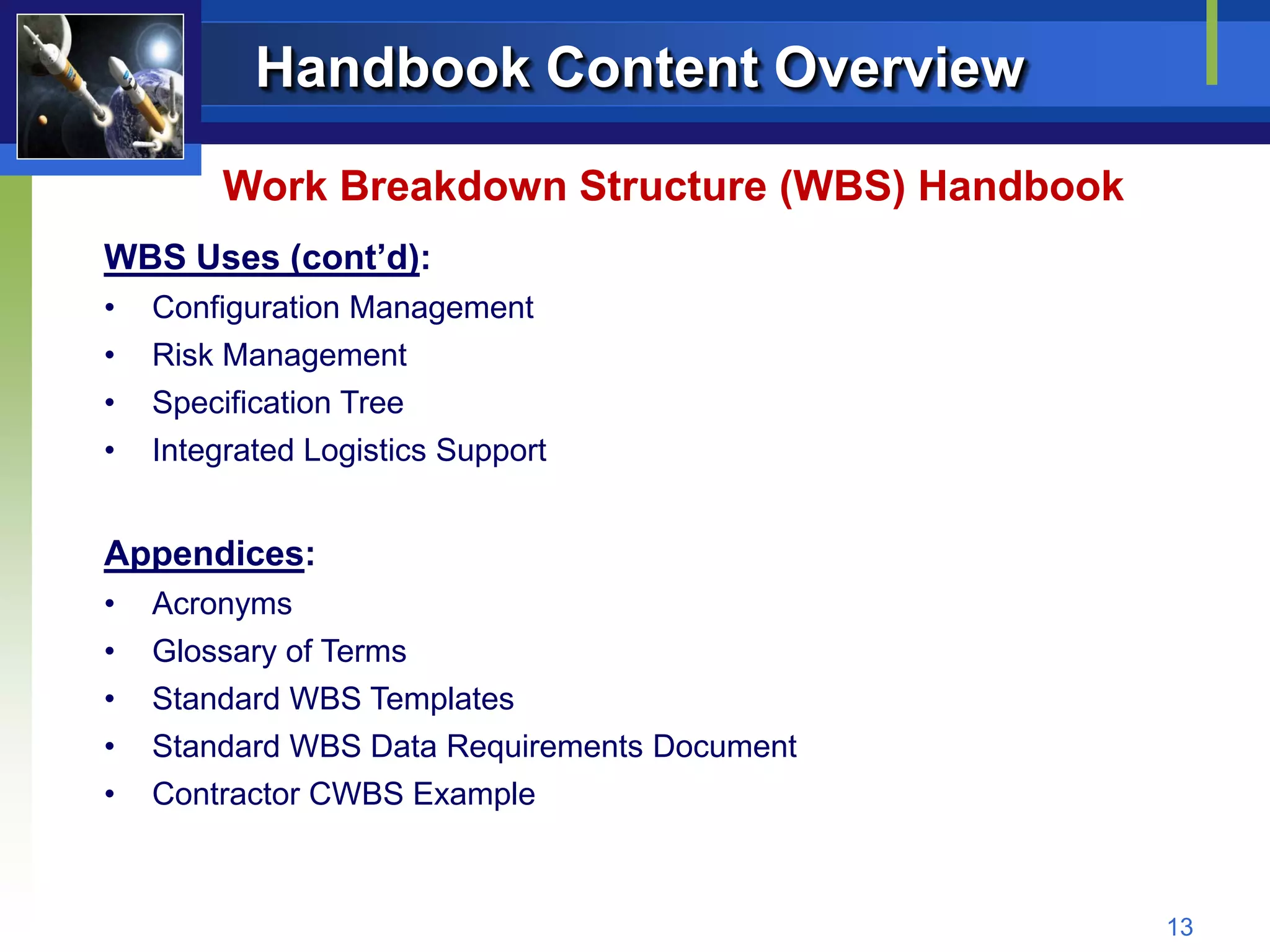
  •   Where Can I Get The PP&C Handbooks?
3. Handbook Content Overview
  •   WBS Handbook
  •   Schedule Management Handbook
  •   Integrated Baseline Review (IBR) Handbook
  •   CAM Handbook for EVM
4. Questions?

                                                  1
Purpose of This Session


To share an awareness of the guidance and
supporting “help” material that has been
developed by NASA and is available to all
Civil Servant and Contractor personnel for
use in improving the Agency’s capability for
managing and controlling programs/projects.


                                               2
Background

What are PP&C Handbooks?
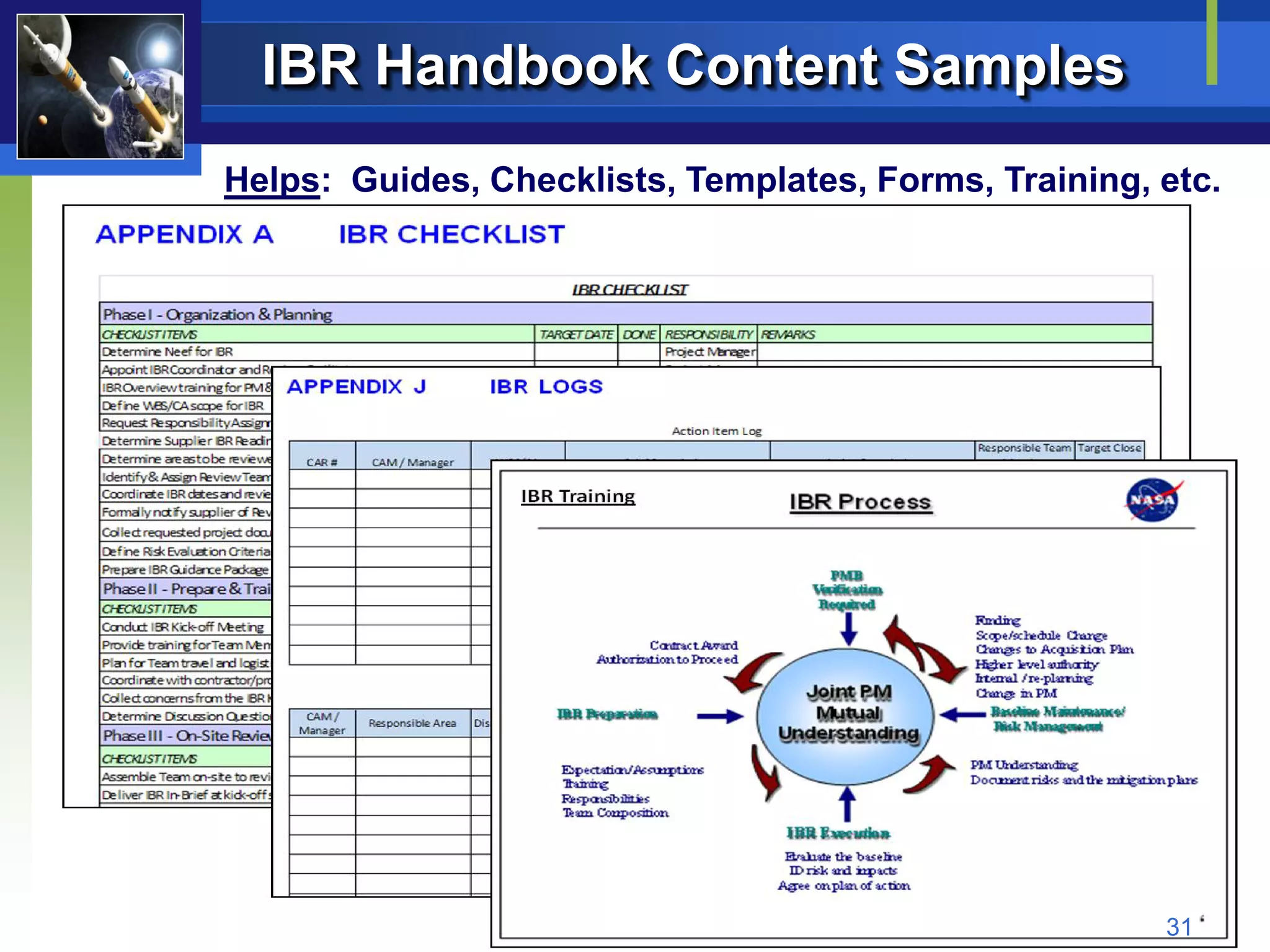
• “How to” guides for key Agency Program Planning and
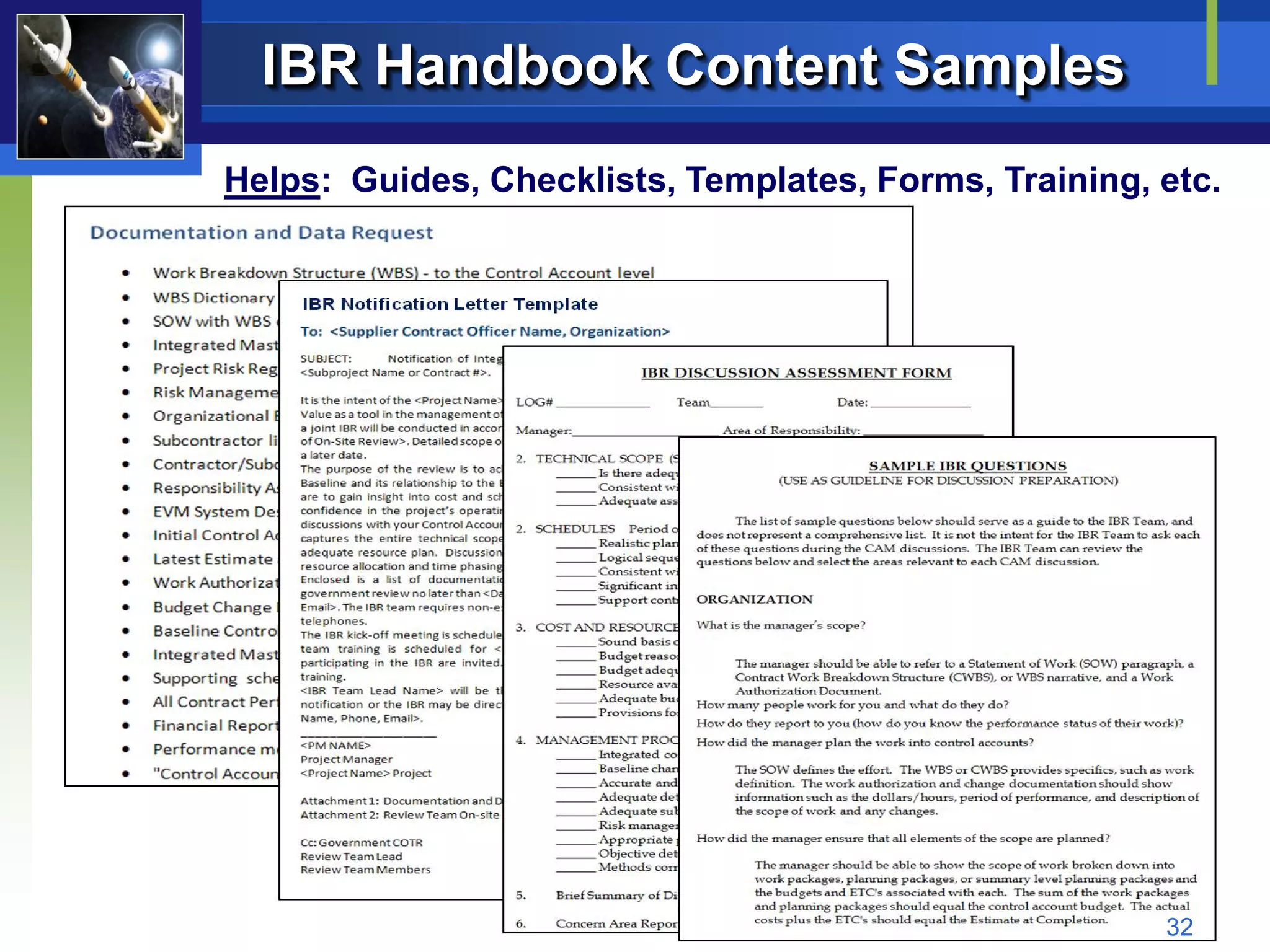
  Control (PP&C) processes
      Work Breakdown Structure (WBS)
      Schedule Management
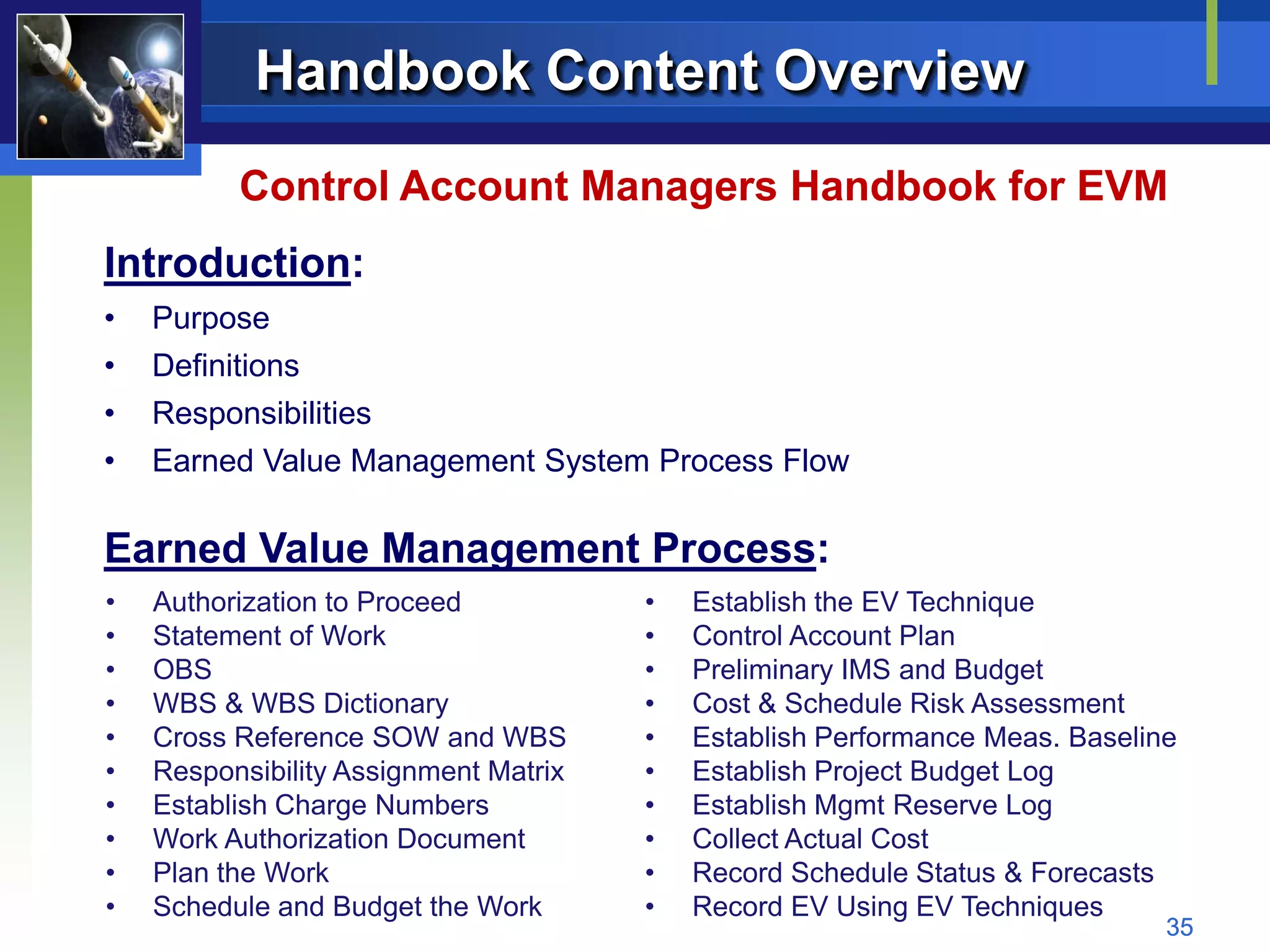
      Integrated Baseline Reviews (IBRs)
      Control Account Manager (CAM) Activities for EVM
• “Best practices” for PP&C

They are Not …
• Requirements documents

                                                          3
Background

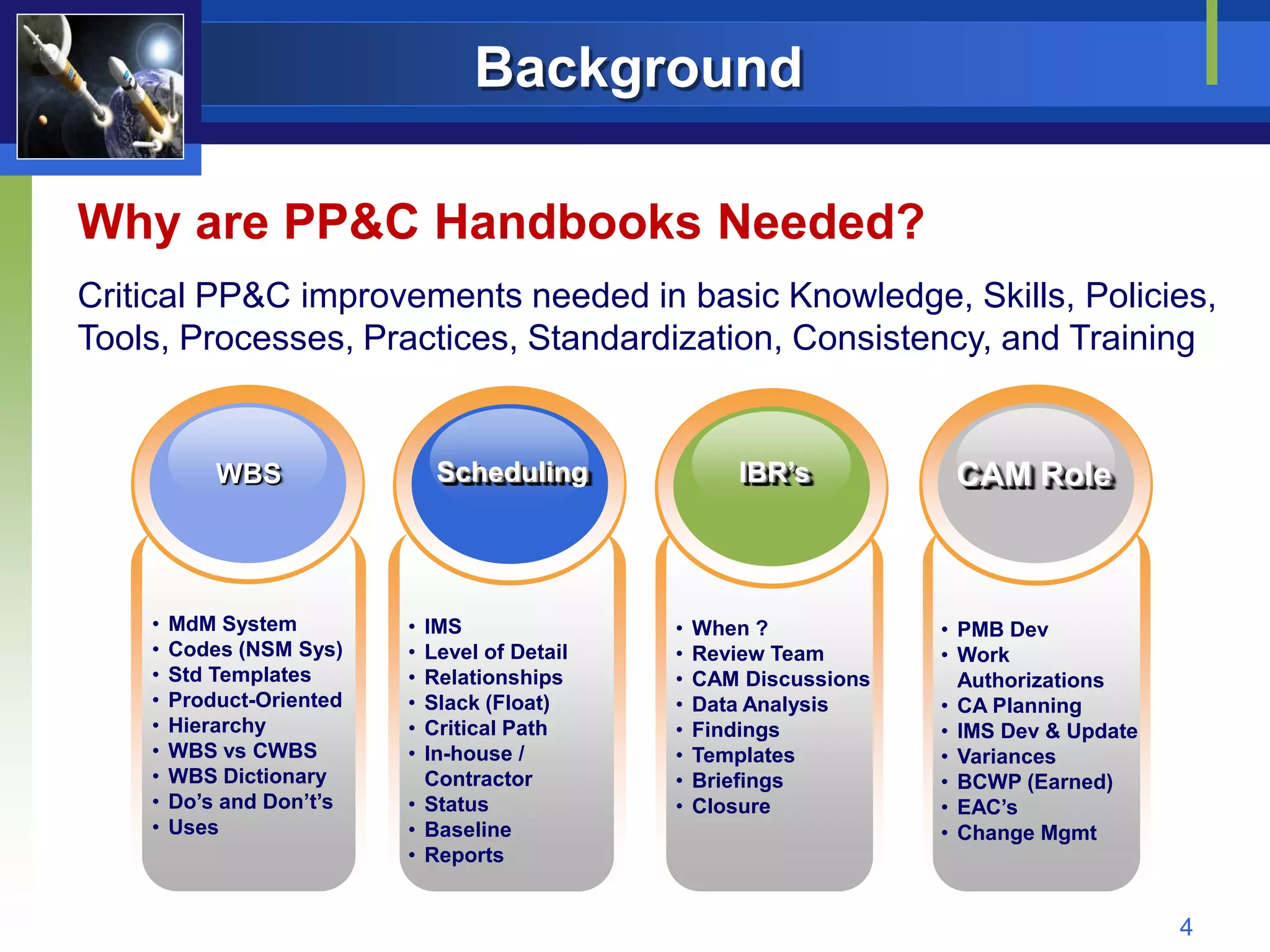
Why are PP&C Handbooks Needed?
Critical PP&C improvements needed in basic Knowledge, Skills, Policies,
Tools, Processes, Practices, Standardization, Consistency, and Training


            WBS                Scheduling             IBR’s           CAM Role


    •   MdM System         • IMS               •   When ?            • PMB Dev
    •   Codes (NSM Sys)    • Level of Detail   •   Review Team       • Work
    •   Std Templates      • Relationships     •   CAM Discussions     Authorizations
    •   Product-Oriented   • Slack (Float)     •   Data Analysis     • CA Planning
    •   Hierarchy          • Critical Path     •   Findings          • IMS Dev & Update
    •   WBS vs CWBS        • In-house /        •   Templates         • Variances
    •   WBS Dictionary       Contractor        •   Briefings         • BCWP (Earned)
    •   Do’s and Don’t’s   • Status            •   Closure           • EAC’s
    •   Uses               • Baseline                                • Change Mgmt
                           • Reports


                                                                                          4
Background

Who are the Handbook POC’s?
• NASA Work Breakdown Structure (WBS) Handbook
   Ken Poole – MSFC (256-544-2419)

• NASA Schedule Management Handbook
   Ken Poole – MSFC (256-544-2419)

• NASA Integrated Baseline Review (IBR) Handbook
   Kristen Kehrer – KSC (321-867-3691)

• NASA Control Account Manager (CAM) Guide for EVM
   Greg Smith – MSFC (256-603-5807)

                                                   5
Background

When were the Handbooks Developed?
• PP&C Handbooks conceived by the “Old” Agency EVM
  Focal Point Council (Early 2004)
• Mature drafts of the NASA Schedule Management
  Handbook and the NASA IBR Handbook were available
  on the NASA EVM website (Fall 2006)
• Final Agency reviews for formal issuance were put on hold
  due to NPR 7120.5D updates and changes in OCE
  management at NASA HQ (From late 2006 - early 2008)
• Handbook effort was resumed and expanded by the “New”
  EVM Working Group (June 2008)

                                                         6
Background

When were the Handbooks Developed? (cont’d)
• Additional PP&C Handbooks initiated:
    Work Breakdown Structure (WBS) Handbook (June
     2008)
    Control Account Manager’s (CAM) Handbook for EVM
     (April 2009)
• Final Agency review and update for formal issuance late
  2009 – early 2010 (for Schedule Mgmt, WBS, and IBR
  Handbooks only)
• Final review of CAM Guide for EVM (Spring 2010)
• NASA CAM Guide for EVM Handbook formal issuance
  (Summer 2010)
                                                            7
Background


Where Can I Get the PP&C Handbooks?
• Contact the appropriate POC (see page 5)
• Download from the NASA EVM website:

 http://evm.nasa.gov/handbooks.html


                                             8
Handbook Content Overview


 WBS Handbook
Content Overview


                            9
Handbook Content Overview

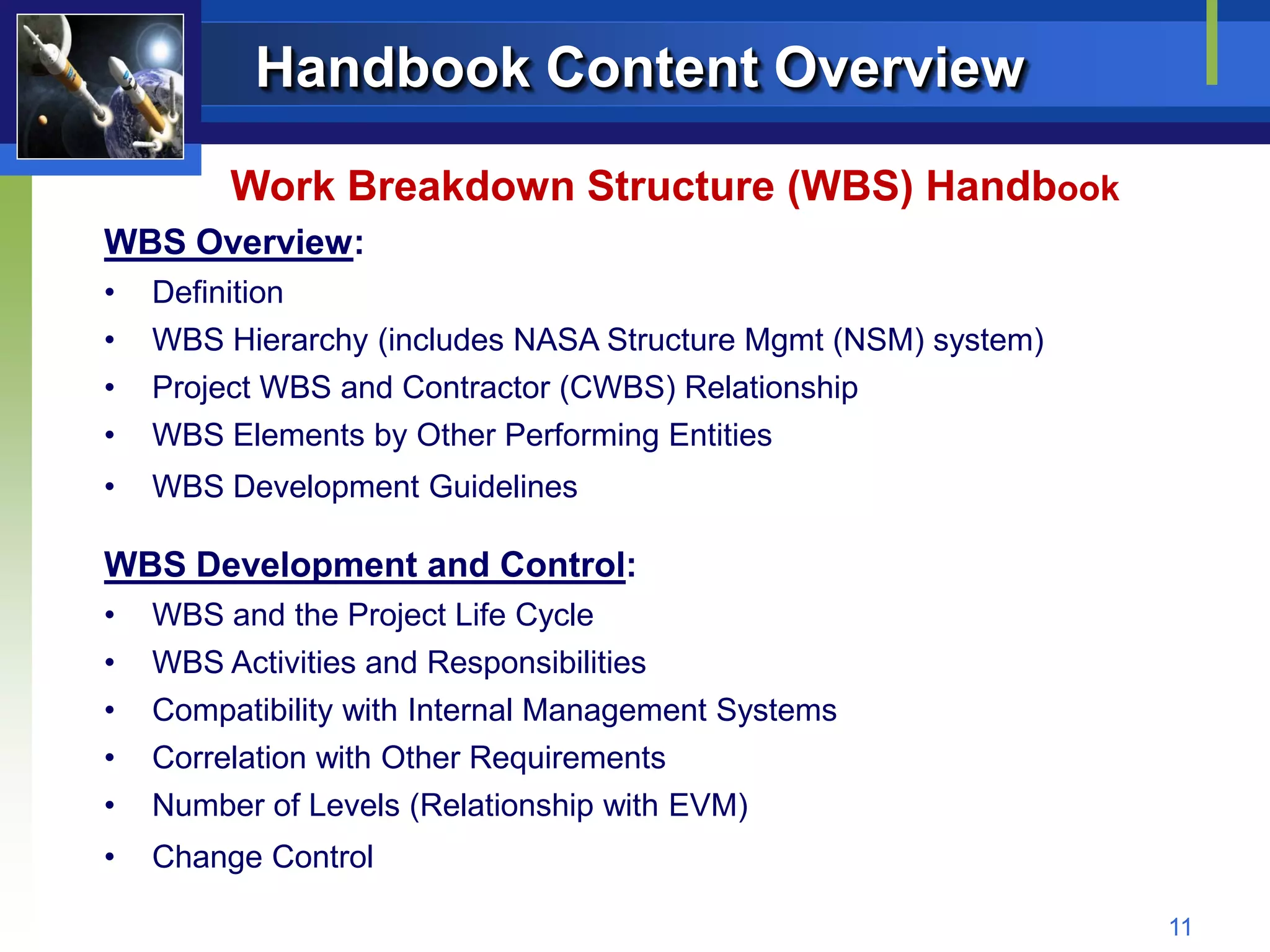
         Work Breakdown Structure (WBS) Handbook
Policy:
NPR 7120.5 (NID), NASA Space Flight Program & Project Management Requirements
NPR 7120.7, NASA Information Technology & Institutional Infrastructure Program &
            Project Management Requirements
NPR 7120.8, NASA Research & Technology Program & Project Mgmt Requirements


1. The WBS and WBS Dictionary requirements contained in the above
   documents apply to all types of NASA programs and projects
   depending on the product line involved.
2. Projects must use NASA’s standard Level 1&2 WBS templates.
3. It is the responsibility of each Project Manager and their project team
   to ensure that the WBS requirements are adhered to throughout the
   life of the project.


                                                                                   10
Handbook Content Overview

         Work Breakdown Structure (WBS) Handbook
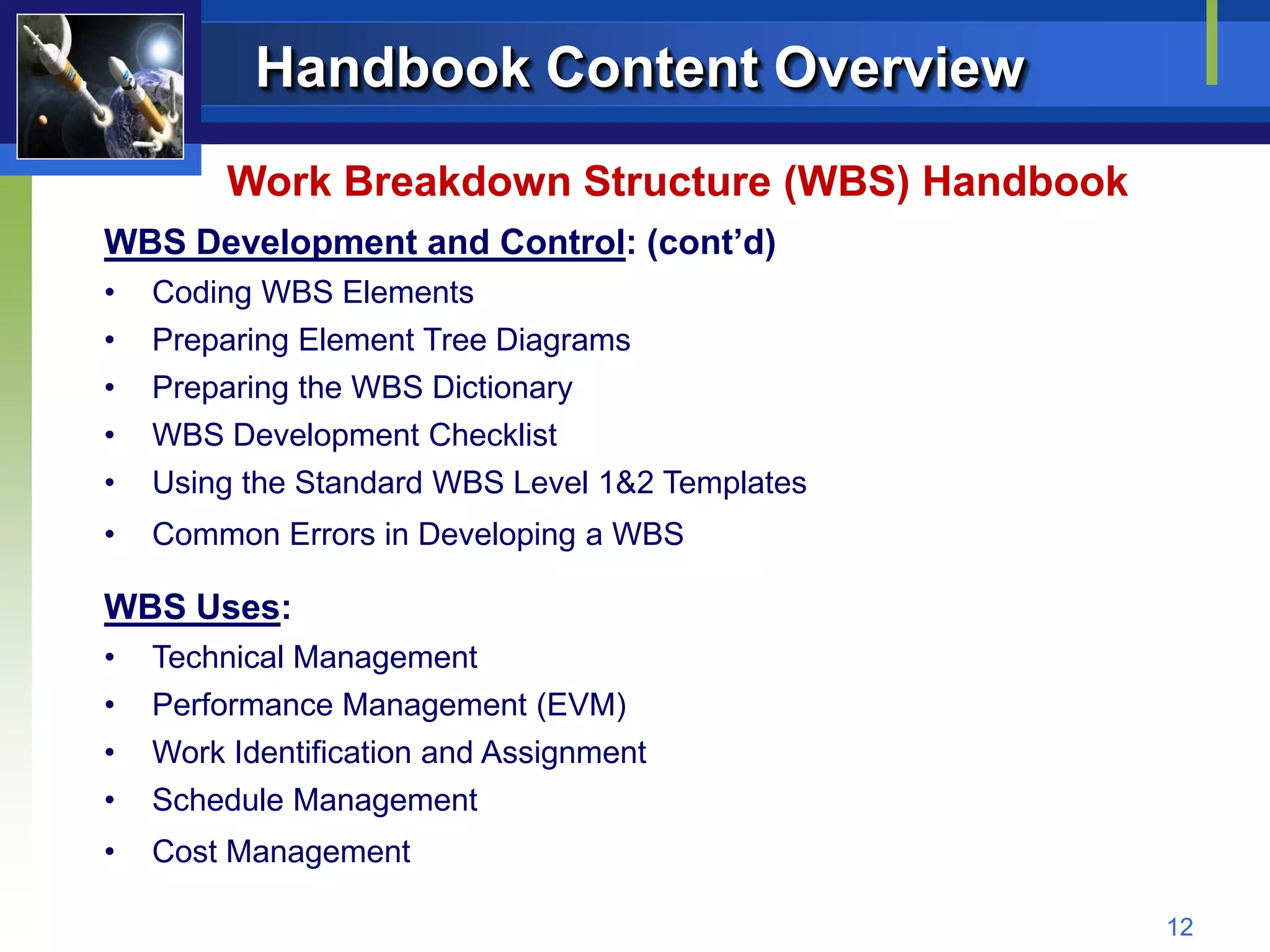
WBS Overview:
•   Definition
•   WBS Hierarchy (includes NASA Structure Mgmt (NSM) system)
•   Project WBS and Contractor (CWBS) Relationship
•   WBS Elements by Other Performing Entities
•   WBS Development Guidelines

WBS Development and Control:
•   WBS and the Project Life Cycle
•   WBS Activities and Responsibilities
•   Compatibility with Internal Management Systems
•   Correlation with Other Requirements
•   Number of Levels (Relationship with EVM)
•   Change Control

                                                                11
Handbook Content Overview
         Work Breakdown Structure (WBS) Handbook
WBS Development and Control: (cont’d)
•   Coding WBS Elements
•   Preparing Element Tree Diagrams
•   Preparing the WBS Dictionary
•   WBS Development Checklist
•   Using the Standard WBS Level 1&2 Templates
•   Common Errors in Developing a WBS

WBS Uses:
•   Technical Management
•   Performance Management (EVM)
•   Work Identification and Assignment
•   Schedule Management
•   Cost Management

                                                   12
Handbook Content Overview

         Work Breakdown Structure (WBS) Handbook
WBS Uses (cont’d):
•   Configuration Management
•   Risk Management
•   Specification Tree
•   Integrated Logistics Support


Appendices:
•   Acronyms
•   Glossary of Terms
•   Standard WBS Templates
•   Standard WBS Data Requirements Document
•   Contractor CWBS Example


                                                   13
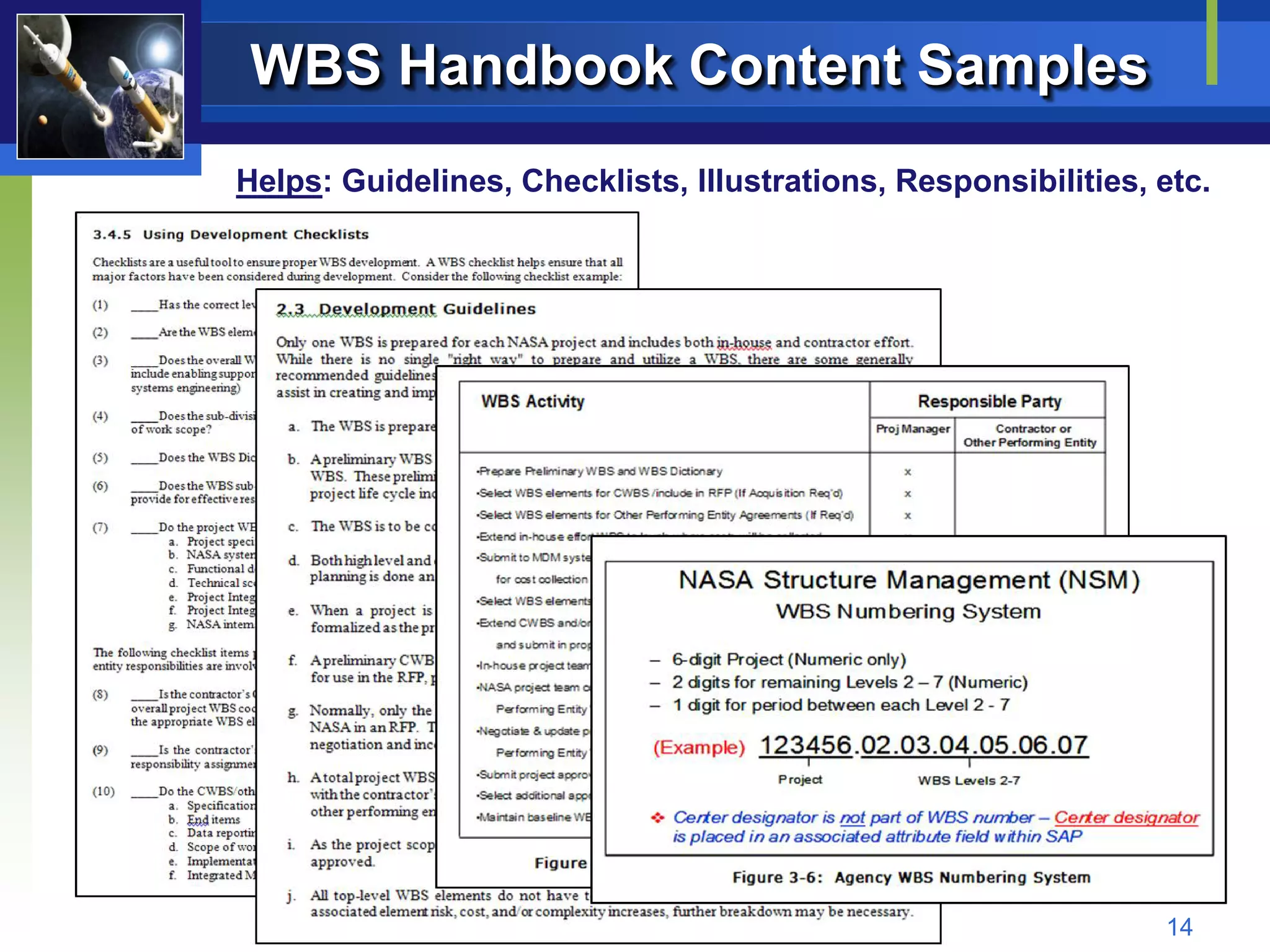
WBS Handbook Content Samples
Helps: Guidelines, Checklists, Illustrations, Responsibilities, etc.


                                                                14
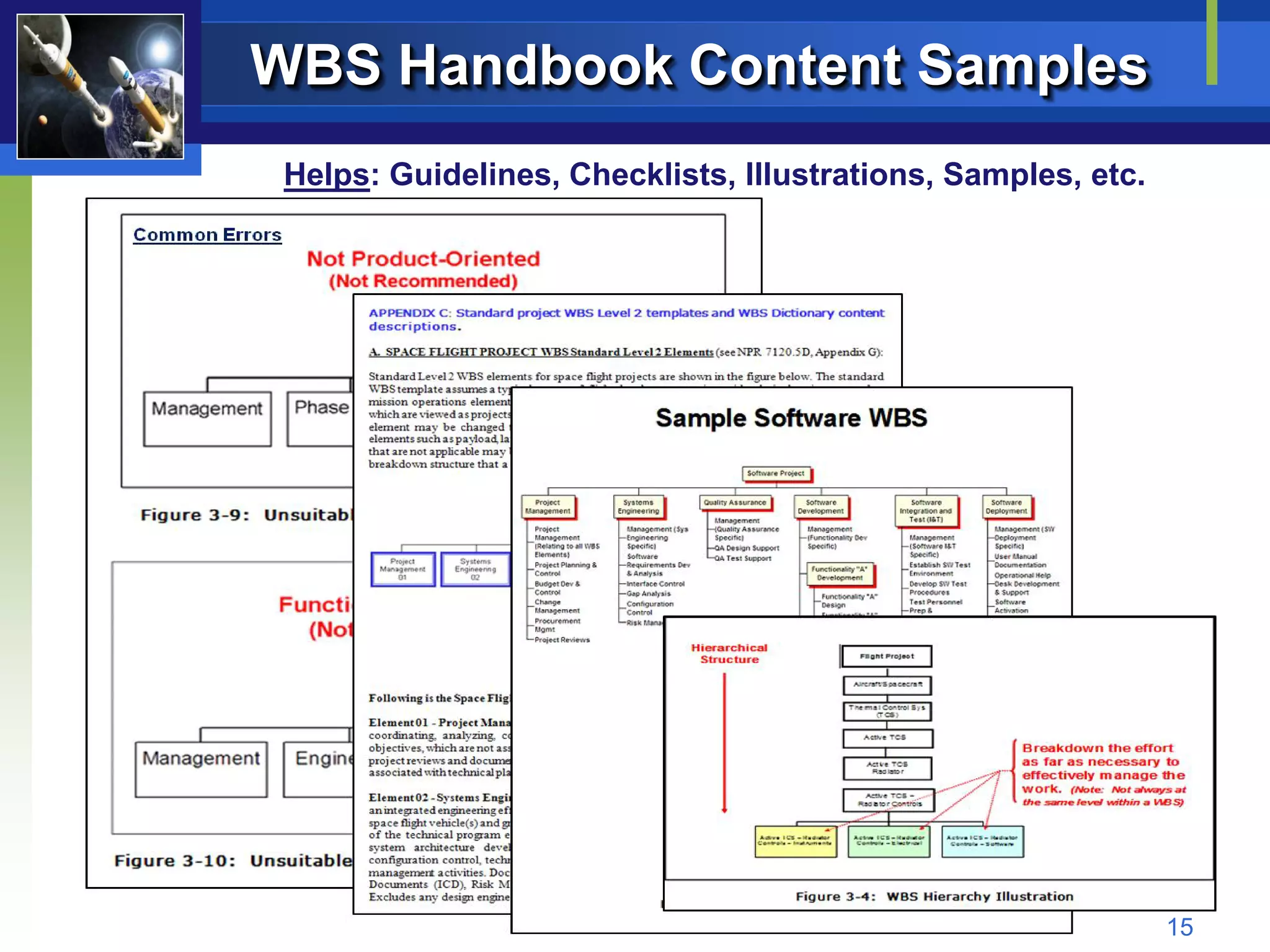
WBS Handbook Content Samples
 Helps: Guidelines, Checklists, Illustrations, Samples, etc.


                                                               15
Handbook Content Overview


Schedule Mgmt Handbook
   Content Overview


                              16
Handbook Content Overview

            NASA Schedule Management Handbook
Policy:
NPR 7120.5 (NID), NASA Space Flight Program & Project Management Requirements
NPR 7120.7, NASA Information Technology & Institutional Infrastructure Program &
            Project Management Requirements
NPR 7120.8, NASA Research & Technology Program & Project Mgmt Requirements

1. Sound schedule management requires the establishment, utilization, and
   control of a baseline master schedule and its derivative schedules.
2. An Integrated Master Schedule (IMS) provides the framework for time
   phasing and coordinating all project efforts into a master plan to ensure
   that objectives are accomplished within project or program commitments.

3. It is the responsibility of each Project Manager and their project team to
   ensure that the schedule management requirements are adhered to
   throughout the life of the project.
                                                                                   17
Handbook Content Overview

          NASA Schedule Management Handbook
Schedule Management Overview:
•   Schedule Management Approach
•   Roles and Responsibilities
•   Contractor Schedules and Coordination
•   In-house Schedules and Coordination
•   External Organizations Schedules and Coordination
•   Schedule Training


Schedule Management Tool Considerations:
•   Functional Capabilities
•   Interface Capabilities
•   Technical Capabilities


                                                        18
Handbook Content Overview
         NASA Schedule Management Handbook
Pre-Schedule Development:
•   Assignment of Project Planner/Scheduler
•   Program/Project Scope
•   Project Work Breakdown Structure (WBS)
•   Project Organizational Breakdown Structure (OBS)
•   Project Funding
•   Project Documentation
•   Baseline Change Log
•   Schedule Requirements

Integrated Master Schedule Development:
•   Data Input and Arrangement


                                                       19
Handbook Content Overview
         NASA Schedule Management Handbook
Integrated Master Schedule Development (cont’d):
•   Task/Activity Definition
•   Task/Activity Sequencing
•   Duration Estimating
•   Resource Planning
•   Schedule Margin Planning
•   Establishing the IMS Baseline


Status Updates and Schedule Maintenance:
•   Status Update Accounting
•   Schedule Maintenance
•   Schedule Data Back-up and Archive


                                                   20
Handbook Content Overview
         NASA Schedule Management Handbook
Schedule Assessment and Analysis:
•   Levels of Insight
•   Schedule Logic Credibility Health Check
•   Critical Path Identification and Analysis
•   Schedule Performance Trend Analysis
•   Baseline vs. Current Comparison and Analysis
•   Schedule Margin Assessment
•   Validate Cost/Schedule Correlation
•   Cost/Schedule Risk Assessment (C/SRA) & Joint Confidence Levels (JCL)
•   Duration Compression
•   Earned Value Schedule Analysis

Schedule Control:
•   Baseline Content
                                                                      21
Handbook Content Overview
          NASA Schedule Management Handbook
Schedule Control (cont’d):
•   Baseline Control Process
•   Re-planning
•   Re-baselining
•   Current Schedule Control

Schedule Reporting:
•   Management Summary
•   Detailed Logic Network
•   Critical Path Identification
•   Total Slack Report
•   Schedule Risk
•   Schedule Margin Metrics
•   Performance Trends
                                              22
Handbook Content Overview
          NASA Schedule Management Handbook
Schedule Data and Lessons Learned Archival:
•   Schedule Archives
•   Lessons Learned
•   Historical Narrative
•   Data Statistics

Appendices:
•   Acronyms
•   Glossary of Terms
•   Data Requirements Descriptions (DRD)
•   Schedule Training Topics
•   Schedule Management Reference Card
•   Schedule Management Plan Template
•   Schedule Assessment Checklist
                                              23
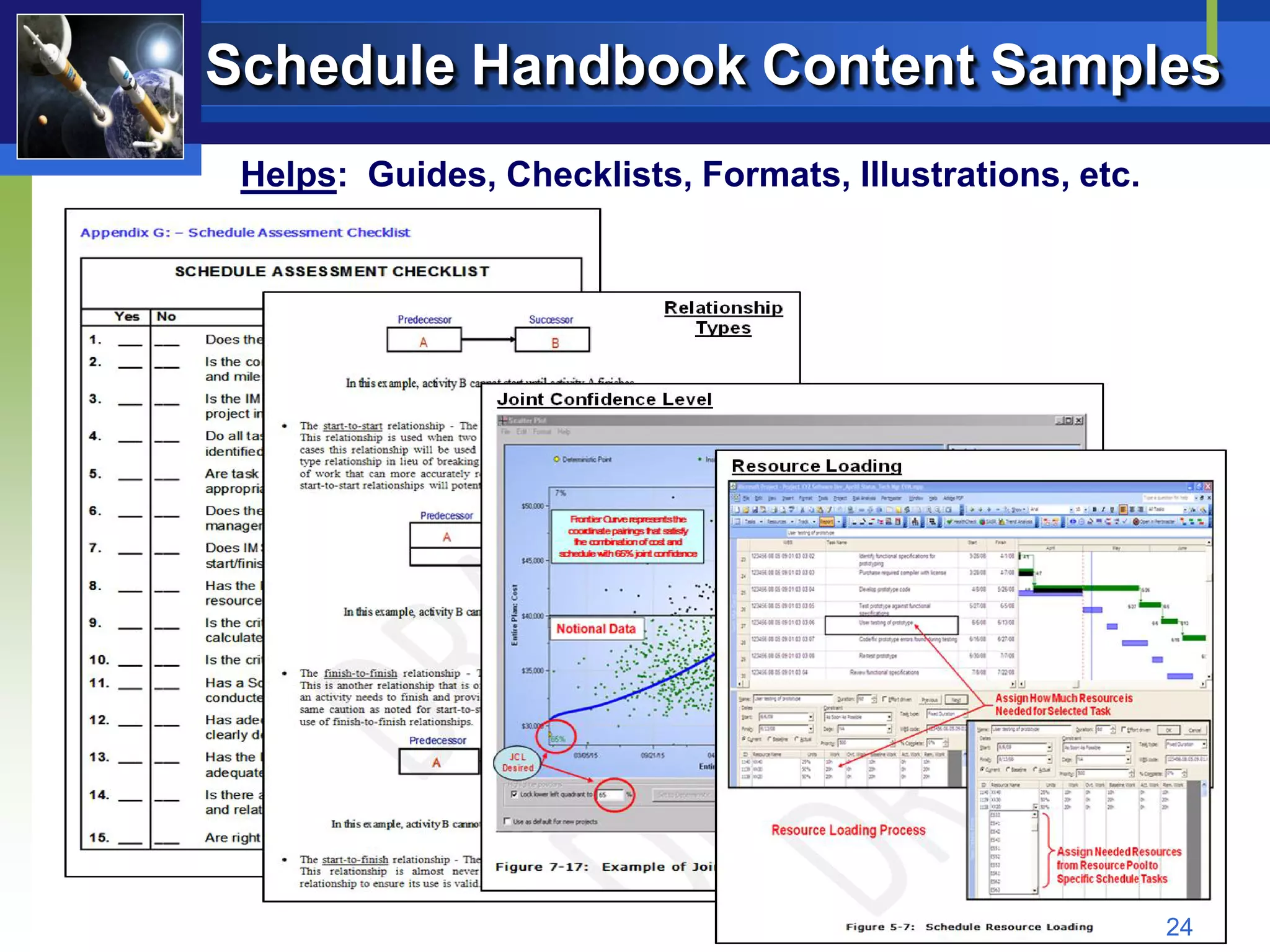
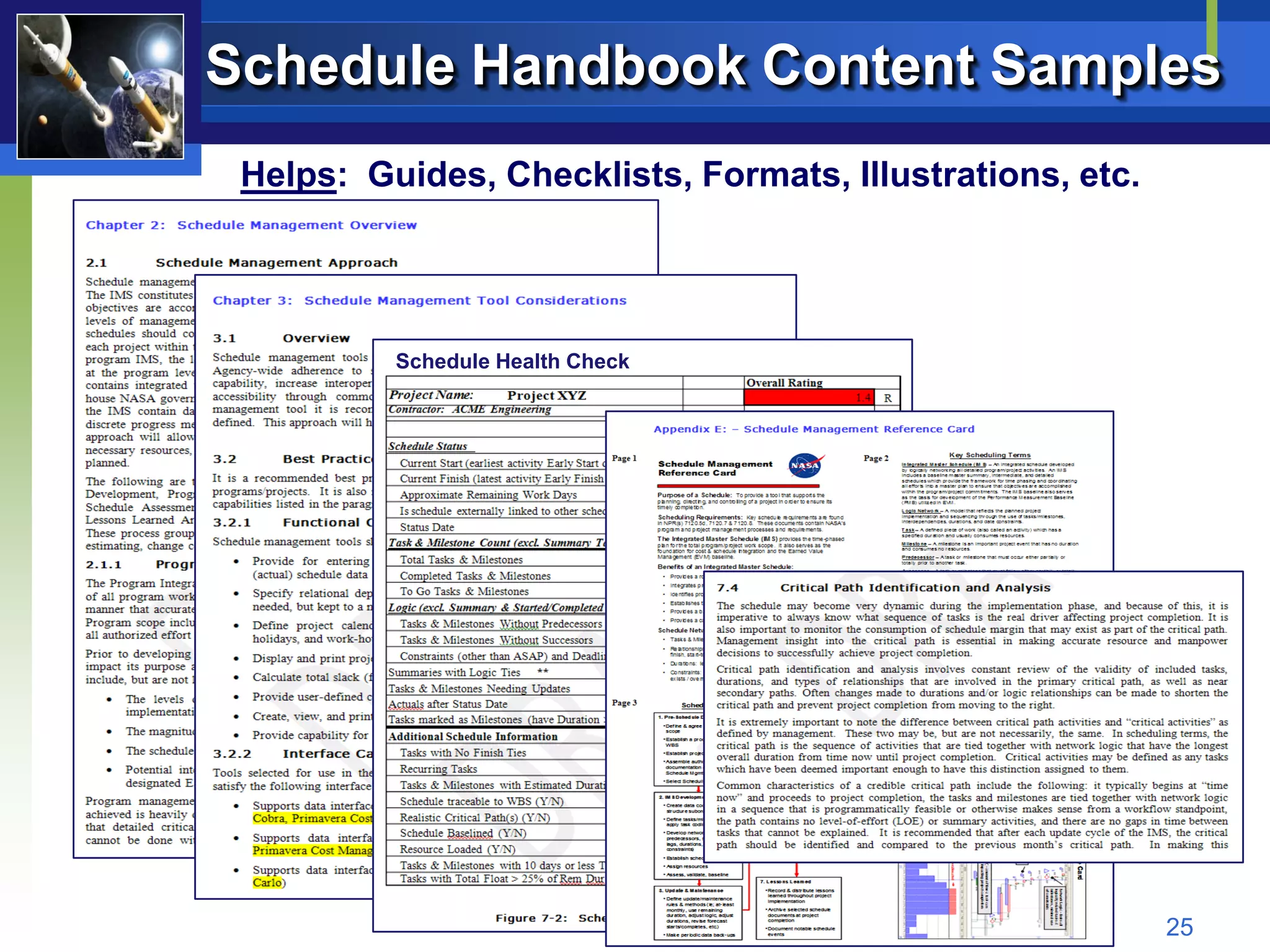
Schedule Handbook Content Samples
 Helps: Guides, Checklists, Formats, Illustrations, etc.


                                                           24
Schedule Handbook Content Samples
 Helps: Guides, Checklists, Formats, Illustrations, etc.


          Schedule Health Check


                                                           25
Handbook Content Overview


 IBR Handbook
Content Overview


                            26
Handbook Content Overview
         NASA Integrated Baseline Review (IBR) Handbook
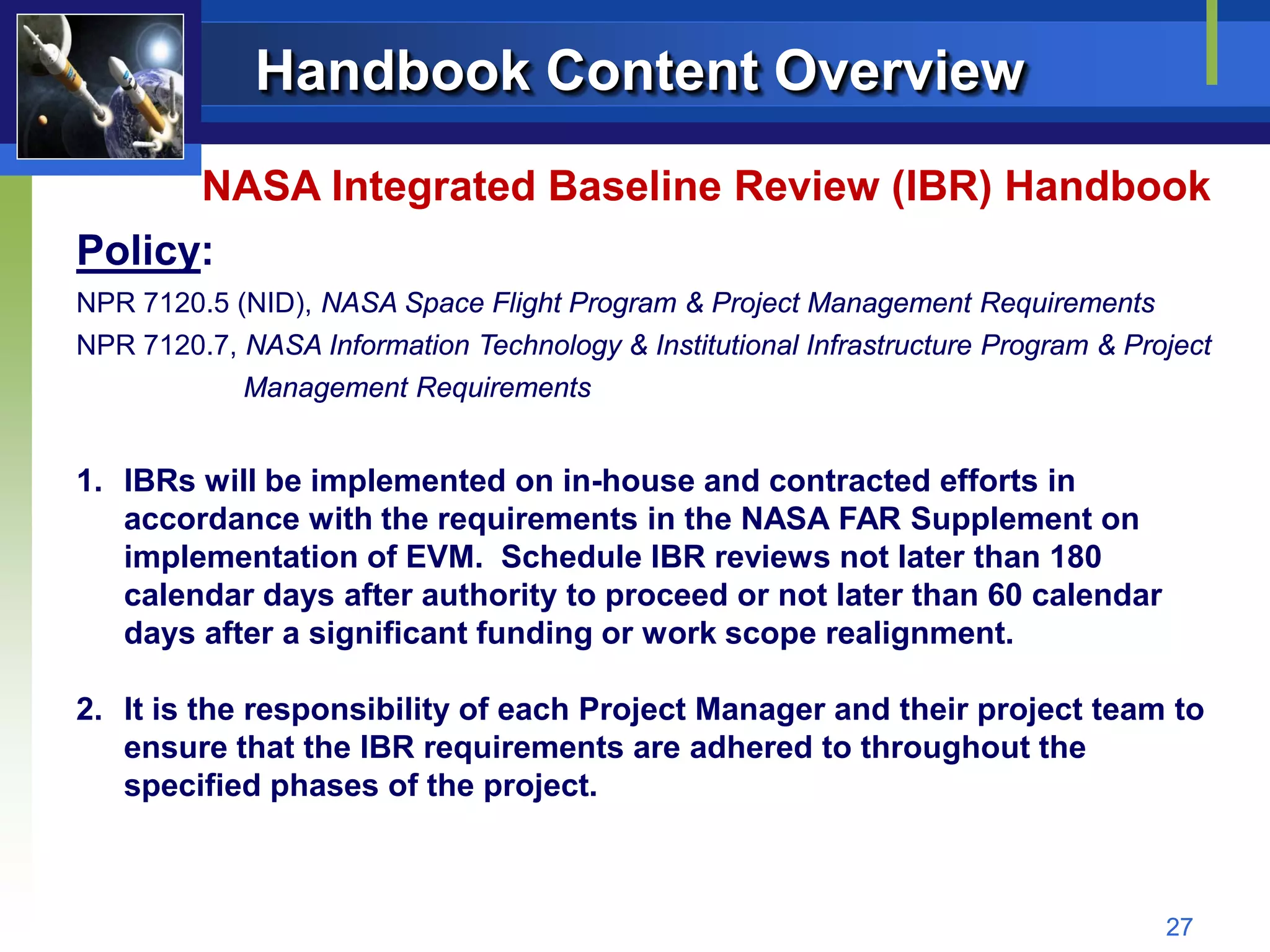
Policy:
NPR 7120.5 (NID), NASA Space Flight Program & Project Management Requirements
NPR 7120.7, NASA Information Technology & Institutional Infrastructure Program & Project
            Management Requirements


1. IBRs will be implemented on in-house and contracted efforts in
   accordance with the requirements in the NASA FAR Supplement on
   implementation of EVM. Schedule IBR reviews not later than 180
   calendar days after authority to proceed or not later than 60 calendar
   days after a significant funding or work scope realignment.

2. It is the responsibility of each Project Manager and their project team to
   ensure that the IBR requirements are adhered to throughout the
   specified phases of the project.


                                                                                    27
Handbook Content Overview
       NASA Integrated Baseline Review (IBR) Handbook
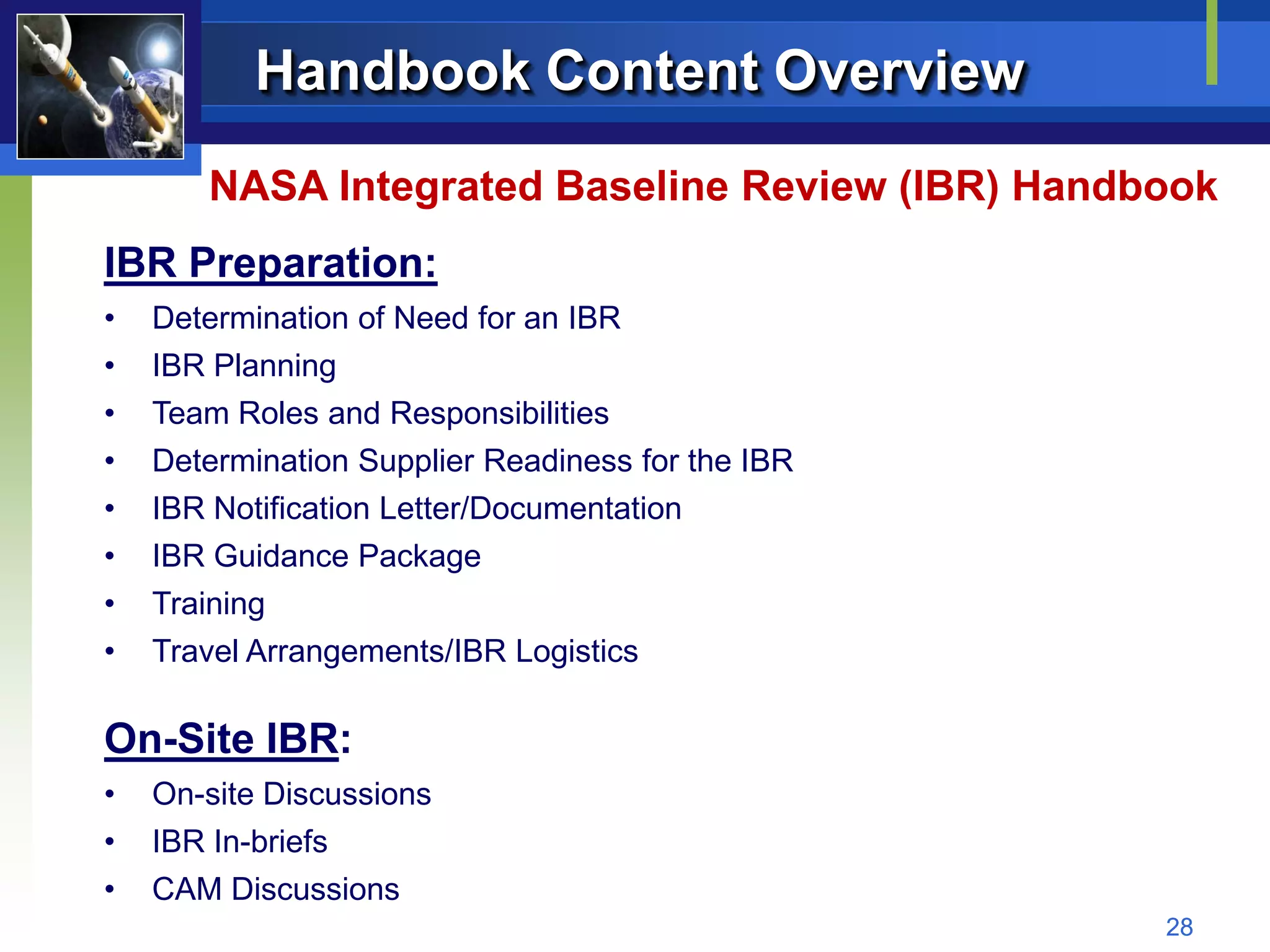
IBR Preparation:
•   Determination of Need for an IBR
•   IBR Planning
•   Team Roles and Responsibilities
•   Determination Supplier Readiness for the IBR
•   IBR Notification Letter/Documentation
•   IBR Guidance Package
•   Training
•   Travel Arrangements/IBR Logistics

On-Site IBR:
•   On-site Discussions
•   IBR In-briefs
•   CAM Discussions
                                                   28
Handbook Content Overview
       NASA Integrated Baseline Review (IBR) Handbook
On-Site IBR (cont’d):
•   CAM Discussion Guidelines
•   IBR Documentation and Forms
•   IBR Out-briefs

IBR Closeout:
•   Reporting Results of the IBR
•   Tracking Concerns
•   IBR Closeout Letter
•   Lessons learned

Appendices:
•   IBR Checklist
•   Proposed Statement of Work Input
                                                  29
Handbook Content Overview
       NASA Integrated Baseline Review (IBR) Handbook
Appendices (cont’d):
•   Responsibility Assignment Matrix (RAM) - Sample
•   IBR Notification Letter Template
•   IBR Guidance Package
•   IBR Training
•   IBR In-brief Template
•   Documentation and Data Trace Evaluation Template
•   IBR Logs
•   Out-brief Samples
•   IBR Letter of Findings Template
•   IBR Report
•   IBR Closure Notification Letter Template
•   Glossary
•   CxP Candidate Risk Assessment Form
                                                       30
IBR Handbook Content Samples
Helps: Guides, Checklists, Templates, Forms, Training, etc.


                                                       31
IBR Handbook Content Samples
Helps: Guides, Checklists, Templates, Forms, Training, etc.


                                                       32
Handbook Content Overview


 CAM Handbook
Content Overview


                            33
Handbook Content Overview
           Control Account Managers Handbook for EVM
Policy:
NPR 7120.5 (NID), NASA Space Flight Program & Project Management Requirements
NPR 7120.7, NASA Information Technology & Institutional Infrastructure Program & Project
             Management Requirements

As a minimum, EVM principles, as defined by ANSI/EIA-748, Earned Value Management
Systems, apply from KDP C through KDP E, if the project's life-cycle cost is at or
greater than $20M. The EVM principles include the following:
  1) Plan all work scope for the project from inception to completion
  2) Break down and assign the work scope to a responsible person for control of technical,
      schedule, and cost objectives
  3) Integrate work scope, schedule, and cost into a Performance Measurement Baseline
      against which accomplishments may be measured and changes controlled
  4) Use actual cost incurred and recorded in accomplishing the work performed
  5) Objectively assess accomplishments at the work performance level
  6) Analyze variances, forecast impacts, and prepare EACs based on performance to date
  7) Use EVMS information in the organization’s management processes
Note: A CAM has the primary role in implementing the above EVM principles

                                                                                     34
Handbook Content Overview
          Control Account Managers Handbook for EVM
Introduction:
•   Purpose
•   Definitions
•   Responsibilities
•   Earned Value Management System Process Flow

Earned Value Management Process:
•   Authorization to Proceed           •   Establish the EV Technique
•   Statement of Work                  •   Control Account Plan
•   OBS                                •   Preliminary IMS and Budget
•   WBS & WBS Dictionary               •   Cost & Schedule Risk Assessment
•   Cross Reference SOW and WBS        •   Establish Performance Meas. Baseline
•   Responsibility Assignment Matrix   •   Establish Project Budget Log
•   Establish Charge Numbers           •   Establish Mgmt Reserve Log
•   Work Authorization Document        •   Collect Actual Cost
•   Plan the Work                      •   Record Schedule Status & Forecasts
•   Schedule and Budget the Work       •   Record EV Using EV Techniques
                                                                              35
Handbook Content Overview
          Control Account Managers Handbook for EVM
Earned Value Management Process (cont’d):
•   Update the IMS                    •   Management Action
•   Determine EV Performance Data     •   Internal Re-planning Required?
•   Variance Analysis                 •   Change Request
•   Threshold Tripped?                •   Management Reserve Applied
•   Variance Analysis Report          •   Reconcile Budget Log & Mgmt Reserve Log
•   Update Forecast (Cost & Sched)

Cost Performance Reports (CPR):
•   Format 1 (by WBS)
•   Format 2 (by OBS)
•   Format 3 (baseline)
•   Format 4 (Staffing)
•   Format 5 (Variance Explanation)


                                                                           36
Handbook Content Overview
         Control Account Managers Handbook for EVM
EVM System Surveillance:

Earned Value Management System Reviews:
•   Progress Assistance Visits
•   Validation Reviews
•   Integrated Baseline Reviews
•   Reviews for Cause

Appendices:
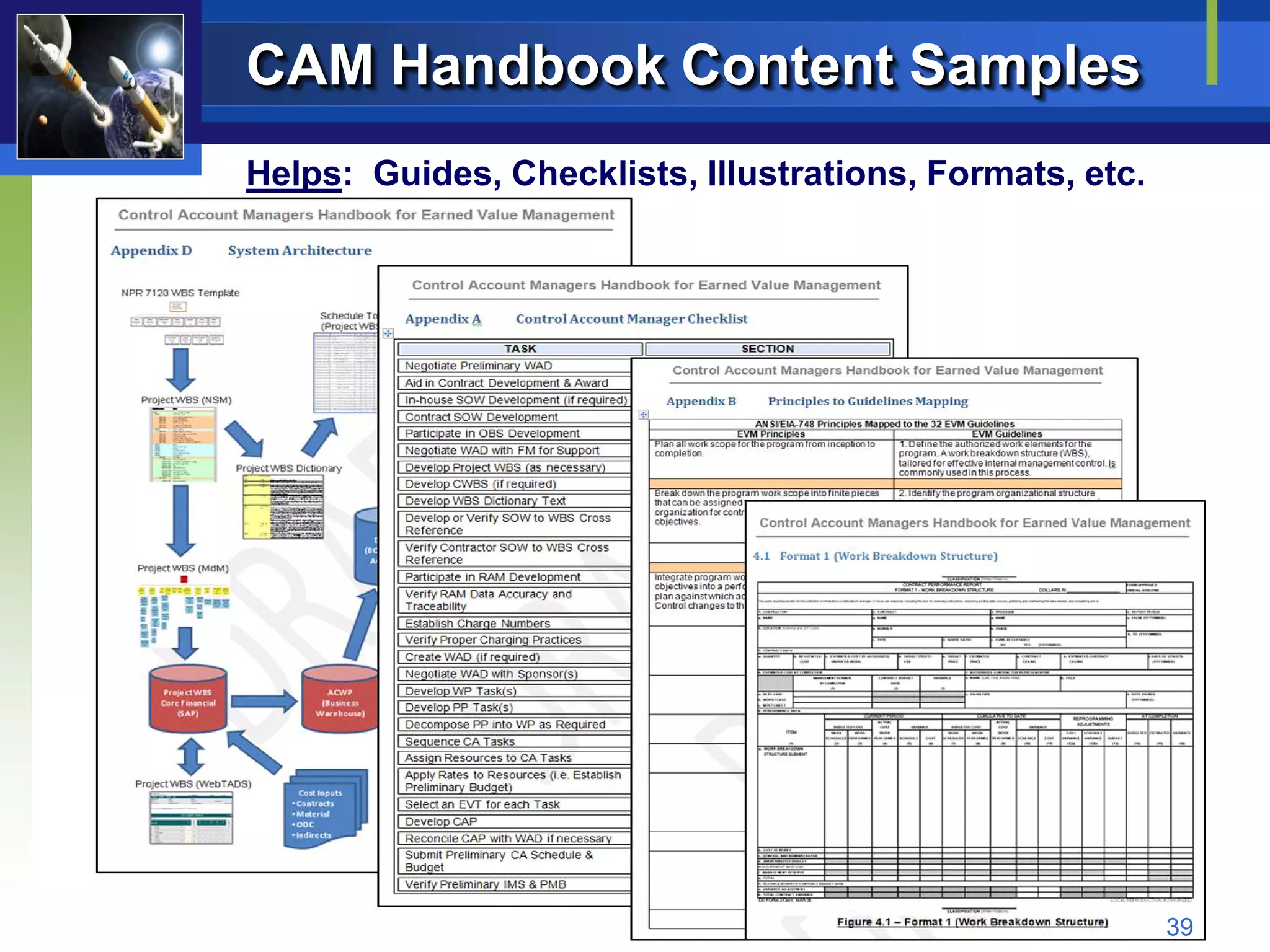
•   Control Account Manager Checklist
•   Principles to Guidelines Mapping
•   Data Requirements Documents
•   System Architecture
•   Control Account Manager’s Notebook
                                                 37
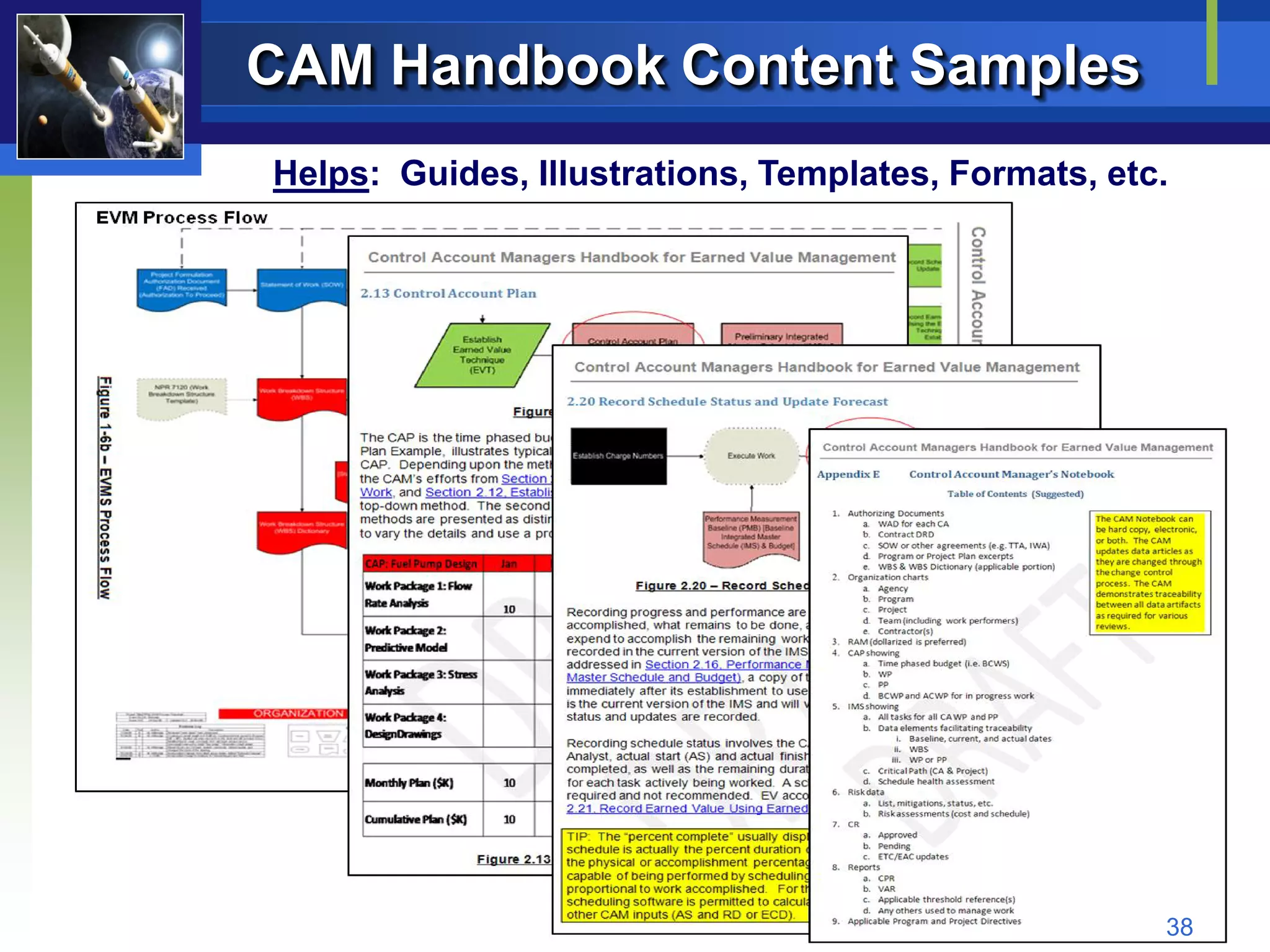
CAM Handbook Content Samples
Helps: Guides, Illustrations, Templates, Formats, etc.


                                                     38
CAM Handbook Content Samples
Helps: Guides, Checklists, Illustrations, Formats, etc.


                                                          39
Handbook Content Overview


     Questions?


                            40

Ken poole

  • 1.
    NASA PM Challenge2010 Program Planning & Control Handbooks – Guides to Excellence Ken Poole NASA/MSFC/CS40 PP&A Team 256-544-2419 Used with Permission
  • 2.
    Contents 1. Purpose ofThis Session 2. Background • What are PP&C Handbooks? • Why are PP&C Handbooks Needed? • Who are the Handbook POC’s? • When were the Handbooks Developed? • Where Can I Get The PP&C Handbooks? 3. Handbook Content Overview • WBS Handbook • Schedule Management Handbook • Integrated Baseline Review (IBR) Handbook • CAM Handbook for EVM 4. Questions? 1
  • 3.
    Purpose of ThisSession To share an awareness of the guidance and supporting “help” material that has been developed by NASA and is available to all Civil Servant and Contractor personnel for use in improving the Agency’s capability for managing and controlling programs/projects. 2
  • 4.
    Background What are PP&CHandbooks? • “How to” guides for key Agency Program Planning and Control (PP&C) processes  Work Breakdown Structure (WBS)  Schedule Management  Integrated Baseline Reviews (IBRs)  Control Account Manager (CAM) Activities for EVM • “Best practices” for PP&C They are Not … • Requirements documents 3
  • 5.
    Background Why are PP&CHandbooks Needed? Critical PP&C improvements needed in basic Knowledge, Skills, Policies, Tools, Processes, Practices, Standardization, Consistency, and Training WBS Scheduling IBR’s CAM Role • MdM System • IMS • When ? • PMB Dev • Codes (NSM Sys) • Level of Detail • Review Team • Work • Std Templates • Relationships • CAM Discussions Authorizations • Product-Oriented • Slack (Float) • Data Analysis • CA Planning • Hierarchy • Critical Path • Findings • IMS Dev & Update • WBS vs CWBS • In-house / • Templates • Variances • WBS Dictionary Contractor • Briefings • BCWP (Earned) • Do’s and Don’t’s • Status • Closure • EAC’s • Uses • Baseline • Change Mgmt • Reports 4
  • 6.
    Background Who are theHandbook POC’s? • NASA Work Breakdown Structure (WBS) Handbook  Ken Poole – MSFC (256-544-2419) • NASA Schedule Management Handbook  Ken Poole – MSFC (256-544-2419) • NASA Integrated Baseline Review (IBR) Handbook  Kristen Kehrer – KSC (321-867-3691) • NASA Control Account Manager (CAM) Guide for EVM  Greg Smith – MSFC (256-603-5807) 5
  • 7.
    Background When were theHandbooks Developed? • PP&C Handbooks conceived by the “Old” Agency EVM Focal Point Council (Early 2004) • Mature drafts of the NASA Schedule Management Handbook and the NASA IBR Handbook were available on the NASA EVM website (Fall 2006) • Final Agency reviews for formal issuance were put on hold due to NPR 7120.5D updates and changes in OCE management at NASA HQ (From late 2006 - early 2008) • Handbook effort was resumed and expanded by the “New” EVM Working Group (June 2008) 6
  • 8.
    Background When were theHandbooks Developed? (cont’d) • Additional PP&C Handbooks initiated:  Work Breakdown Structure (WBS) Handbook (June 2008)  Control Account Manager’s (CAM) Handbook for EVM (April 2009) • Final Agency review and update for formal issuance late 2009 – early 2010 (for Schedule Mgmt, WBS, and IBR Handbooks only) • Final review of CAM Guide for EVM (Spring 2010) • NASA CAM Guide for EVM Handbook formal issuance (Summer 2010) 7
  • 9.
    Background Where Can IGet the PP&C Handbooks? • Contact the appropriate POC (see page 5) • Download from the NASA EVM website: http://evm.nasa.gov/handbooks.html 8
  • 10.
    Handbook Content Overview WBS Handbook Content Overview 9
  • 11.
    Handbook Content Overview Work Breakdown Structure (WBS) Handbook Policy: NPR 7120.5 (NID), NASA Space Flight Program & Project Management Requirements NPR 7120.7, NASA Information Technology & Institutional Infrastructure Program & Project Management Requirements NPR 7120.8, NASA Research & Technology Program & Project Mgmt Requirements 1. The WBS and WBS Dictionary requirements contained in the above documents apply to all types of NASA programs and projects depending on the product line involved. 2. Projects must use NASA’s standard Level 1&2 WBS templates. 3. It is the responsibility of each Project Manager and their project team to ensure that the WBS requirements are adhered to throughout the life of the project. 10
  • 12.
    Handbook Content Overview Work Breakdown Structure (WBS) Handbook WBS Overview: • Definition • WBS Hierarchy (includes NASA Structure Mgmt (NSM) system) • Project WBS and Contractor (CWBS) Relationship • WBS Elements by Other Performing Entities • WBS Development Guidelines WBS Development and Control: • WBS and the Project Life Cycle • WBS Activities and Responsibilities • Compatibility with Internal Management Systems • Correlation with Other Requirements • Number of Levels (Relationship with EVM) • Change Control 11
  • 13.
    Handbook Content Overview Work Breakdown Structure (WBS) Handbook WBS Development and Control: (cont’d) • Coding WBS Elements • Preparing Element Tree Diagrams • Preparing the WBS Dictionary • WBS Development Checklist • Using the Standard WBS Level 1&2 Templates • Common Errors in Developing a WBS WBS Uses: • Technical Management • Performance Management (EVM) • Work Identification and Assignment • Schedule Management • Cost Management 12
  • 14.
    Handbook Content Overview Work Breakdown Structure (WBS) Handbook WBS Uses (cont’d): • Configuration Management • Risk Management • Specification Tree • Integrated Logistics Support Appendices: • Acronyms • Glossary of Terms • Standard WBS Templates • Standard WBS Data Requirements Document • Contractor CWBS Example 13
  • 15.
    WBS Handbook ContentSamples Helps: Guidelines, Checklists, Illustrations, Responsibilities, etc. 14
  • 16.
    WBS Handbook ContentSamples Helps: Guidelines, Checklists, Illustrations, Samples, etc. 15
  • 17.
    Handbook Content Overview ScheduleMgmt Handbook Content Overview 16
  • 18.
    Handbook Content Overview NASA Schedule Management Handbook Policy: NPR 7120.5 (NID), NASA Space Flight Program & Project Management Requirements NPR 7120.7, NASA Information Technology & Institutional Infrastructure Program & Project Management Requirements NPR 7120.8, NASA Research & Technology Program & Project Mgmt Requirements 1. Sound schedule management requires the establishment, utilization, and control of a baseline master schedule and its derivative schedules. 2. An Integrated Master Schedule (IMS) provides the framework for time phasing and coordinating all project efforts into a master plan to ensure that objectives are accomplished within project or program commitments. 3. It is the responsibility of each Project Manager and their project team to ensure that the schedule management requirements are adhered to throughout the life of the project. 17
  • 19.
    Handbook Content Overview NASA Schedule Management Handbook Schedule Management Overview: • Schedule Management Approach • Roles and Responsibilities • Contractor Schedules and Coordination • In-house Schedules and Coordination • External Organizations Schedules and Coordination • Schedule Training Schedule Management Tool Considerations: • Functional Capabilities • Interface Capabilities • Technical Capabilities 18
  • 20.
    Handbook Content Overview NASA Schedule Management Handbook Pre-Schedule Development: • Assignment of Project Planner/Scheduler • Program/Project Scope • Project Work Breakdown Structure (WBS) • Project Organizational Breakdown Structure (OBS) • Project Funding • Project Documentation • Baseline Change Log • Schedule Requirements Integrated Master Schedule Development: • Data Input and Arrangement 19
  • 21.
    Handbook Content Overview NASA Schedule Management Handbook Integrated Master Schedule Development (cont’d): • Task/Activity Definition • Task/Activity Sequencing • Duration Estimating • Resource Planning • Schedule Margin Planning • Establishing the IMS Baseline Status Updates and Schedule Maintenance: • Status Update Accounting • Schedule Maintenance • Schedule Data Back-up and Archive 20
  • 22.
    Handbook Content Overview NASA Schedule Management Handbook Schedule Assessment and Analysis: • Levels of Insight • Schedule Logic Credibility Health Check • Critical Path Identification and Analysis • Schedule Performance Trend Analysis • Baseline vs. Current Comparison and Analysis • Schedule Margin Assessment • Validate Cost/Schedule Correlation • Cost/Schedule Risk Assessment (C/SRA) & Joint Confidence Levels (JCL) • Duration Compression • Earned Value Schedule Analysis Schedule Control: • Baseline Content 21
  • 23.
    Handbook Content Overview NASA Schedule Management Handbook Schedule Control (cont’d): • Baseline Control Process • Re-planning • Re-baselining • Current Schedule Control Schedule Reporting: • Management Summary • Detailed Logic Network • Critical Path Identification • Total Slack Report • Schedule Risk • Schedule Margin Metrics • Performance Trends 22
  • 24.
    Handbook Content Overview NASA Schedule Management Handbook Schedule Data and Lessons Learned Archival: • Schedule Archives • Lessons Learned • Historical Narrative • Data Statistics Appendices: • Acronyms • Glossary of Terms • Data Requirements Descriptions (DRD) • Schedule Training Topics • Schedule Management Reference Card • Schedule Management Plan Template • Schedule Assessment Checklist 23
  • 25.
    Schedule Handbook ContentSamples Helps: Guides, Checklists, Formats, Illustrations, etc. 24
  • 26.
    Schedule Handbook ContentSamples Helps: Guides, Checklists, Formats, Illustrations, etc. Schedule Health Check 25
  • 27.
    Handbook Content Overview IBR Handbook Content Overview 26
  • 28.
    Handbook Content Overview NASA Integrated Baseline Review (IBR) Handbook Policy: NPR 7120.5 (NID), NASA Space Flight Program & Project Management Requirements NPR 7120.7, NASA Information Technology & Institutional Infrastructure Program & Project Management Requirements 1. IBRs will be implemented on in-house and contracted efforts in accordance with the requirements in the NASA FAR Supplement on implementation of EVM. Schedule IBR reviews not later than 180 calendar days after authority to proceed or not later than 60 calendar days after a significant funding or work scope realignment. 2. It is the responsibility of each Project Manager and their project team to ensure that the IBR requirements are adhered to throughout the specified phases of the project. 27
  • 29.
    Handbook Content Overview NASA Integrated Baseline Review (IBR) Handbook IBR Preparation: • Determination of Need for an IBR • IBR Planning • Team Roles and Responsibilities • Determination Supplier Readiness for the IBR • IBR Notification Letter/Documentation • IBR Guidance Package • Training • Travel Arrangements/IBR Logistics On-Site IBR: • On-site Discussions • IBR In-briefs • CAM Discussions 28
  • 30.
    Handbook Content Overview NASA Integrated Baseline Review (IBR) Handbook On-Site IBR (cont’d): • CAM Discussion Guidelines • IBR Documentation and Forms • IBR Out-briefs IBR Closeout: • Reporting Results of the IBR • Tracking Concerns • IBR Closeout Letter • Lessons learned Appendices: • IBR Checklist • Proposed Statement of Work Input 29
  • 31.
    Handbook Content Overview NASA Integrated Baseline Review (IBR) Handbook Appendices (cont’d): • Responsibility Assignment Matrix (RAM) - Sample • IBR Notification Letter Template • IBR Guidance Package • IBR Training • IBR In-brief Template • Documentation and Data Trace Evaluation Template • IBR Logs • Out-brief Samples • IBR Letter of Findings Template • IBR Report • IBR Closure Notification Letter Template • Glossary • CxP Candidate Risk Assessment Form 30
  • 32.
    IBR Handbook ContentSamples Helps: Guides, Checklists, Templates, Forms, Training, etc. 31
  • 33.
    IBR Handbook ContentSamples Helps: Guides, Checklists, Templates, Forms, Training, etc. 32
  • 34.
    Handbook Content Overview CAM Handbook Content Overview 33
  • 35.
    Handbook Content Overview Control Account Managers Handbook for EVM Policy: NPR 7120.5 (NID), NASA Space Flight Program & Project Management Requirements NPR 7120.7, NASA Information Technology & Institutional Infrastructure Program & Project Management Requirements As a minimum, EVM principles, as defined by ANSI/EIA-748, Earned Value Management Systems, apply from KDP C through KDP E, if the project's life-cycle cost is at or greater than $20M. The EVM principles include the following: 1) Plan all work scope for the project from inception to completion 2) Break down and assign the work scope to a responsible person for control of technical, schedule, and cost objectives 3) Integrate work scope, schedule, and cost into a Performance Measurement Baseline against which accomplishments may be measured and changes controlled 4) Use actual cost incurred and recorded in accomplishing the work performed 5) Objectively assess accomplishments at the work performance level 6) Analyze variances, forecast impacts, and prepare EACs based on performance to date 7) Use EVMS information in the organization’s management processes Note: A CAM has the primary role in implementing the above EVM principles 34
  • 36.
    Handbook Content Overview Control Account Managers Handbook for EVM Introduction: • Purpose • Definitions • Responsibilities • Earned Value Management System Process Flow Earned Value Management Process: • Authorization to Proceed • Establish the EV Technique • Statement of Work • Control Account Plan • OBS • Preliminary IMS and Budget • WBS & WBS Dictionary • Cost & Schedule Risk Assessment • Cross Reference SOW and WBS • Establish Performance Meas. Baseline • Responsibility Assignment Matrix • Establish Project Budget Log • Establish Charge Numbers • Establish Mgmt Reserve Log • Work Authorization Document • Collect Actual Cost • Plan the Work • Record Schedule Status & Forecasts • Schedule and Budget the Work • Record EV Using EV Techniques 35
  • 37.
    Handbook Content Overview Control Account Managers Handbook for EVM Earned Value Management Process (cont’d): • Update the IMS • Management Action • Determine EV Performance Data • Internal Re-planning Required? • Variance Analysis • Change Request • Threshold Tripped? • Management Reserve Applied • Variance Analysis Report • Reconcile Budget Log & Mgmt Reserve Log • Update Forecast (Cost & Sched) Cost Performance Reports (CPR): • Format 1 (by WBS) • Format 2 (by OBS) • Format 3 (baseline) • Format 4 (Staffing) • Format 5 (Variance Explanation) 36
  • 38.
    Handbook Content Overview Control Account Managers Handbook for EVM EVM System Surveillance: Earned Value Management System Reviews: • Progress Assistance Visits • Validation Reviews • Integrated Baseline Reviews • Reviews for Cause Appendices: • Control Account Manager Checklist • Principles to Guidelines Mapping • Data Requirements Documents • System Architecture • Control Account Manager’s Notebook 37
  • 39.
    CAM Handbook ContentSamples Helps: Guides, Illustrations, Templates, Formats, etc. 38
  • 40.
    CAM Handbook ContentSamples Helps: Guides, Checklists, Illustrations, Formats, etc. 39
  • 41.