Cost and Schedule Integration:              
                      g
      An Industry Update
      2nd Annual Acumen Summit
        September 18‐19, 2012
              Hotel ZaZa
              Hotel ZaZa
             Houston, TX
Outline
•   Speaker Introductions
•   Government  Contracting Perspective
    Government Contracting Perspective
•   Commercial Contracting Update
•   Conclusion 


                                          2
Introductions
• Michael R. Nosbisch, CCC, PSP
   – PT&C Vice President and EVMS Practice Lead
      • Personally brokered partnership with Acumen in 2011
   – 2011‐2012 AACE International President
• Glen B. Alleman
   – PT&C, Program Performance Management
   –M b
     Member of NDIA Risk and Opportunity Board  
              f NDIA Ri k d O     t it B d


                                                              3
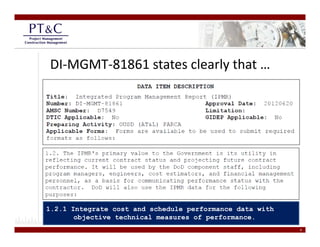
DI‐MGMT‐81861 states clearly that …


1.2.1 Integrate cost and schedule performance data with
       objective technical measures of performance.
                                                          4
Government Contracting Perspective


                                     5
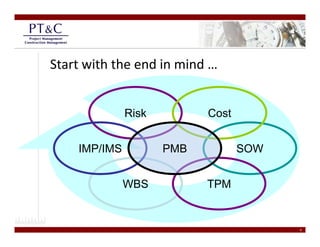
Start with the end in mind …


              Risk         Cost


    IMP/IMS          PMB          SOW


              WBS          TPM


                                        6
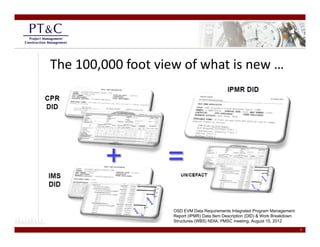
The 100,000 foot view of what is new …


                    OSD EVM Data Requirements Integrated Program Management
                    Report (IPMR) Data Item Description (DID) & Work Breakdown
                    Structures (WBS) NDIA, PMSC meeting, August 15, 2012

                                                                                 7
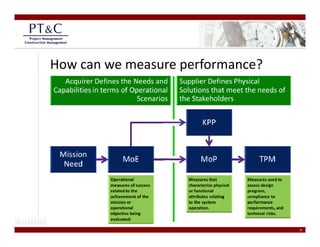
How can we measure performance?


                                  8
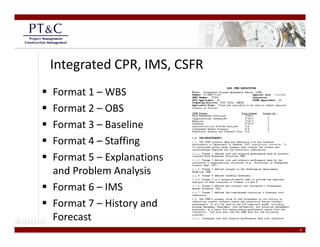
Integrated CPR, IMS, CSFR
Format 1 – WBS
Format 2 –
Format 2 OBS
Format 3 – Baseline
Format 4 –
Format 4 Staffing
Format 5 – Explanations 
and Problem Analysis
and Problem Analysis
Format 6 – IMS
Format 7 – Hi t
F     t 7 History and 
                     d
Forecast
                            9
One Big Hitter – Variance Analysis
• Formal variances are limited to a total of 15 WBS Elements.
• Two methods allowed for determining which variances are 
  addressed
       – Top 15 WBS Elements approach
       – Allows for Government selection approach or a defined 
         contractor process that covers all aspects (current, cumulative 
                    p                         p     (       ,
         and at‐complete)
• Allows contractor or government to temporarily increase the 
  number of reported variances to cover emerging tread(s)
               p                             g g       ()
• Linked Formats 1–4 and 6 discussions to Format 5
       – Significant Format 6 changes.  Require SRA, Health Assessment 
         and drivers as applicable
         and drivers as applicable
• Reconcile Best/Worst/Most Likely EAC
Integrated Program Management Report (IPMR) DID Training, 31 July 2012, Robert Loop, NAVY CEVM.
                                                                                                  10
The IMS has one new format …
• The Integrated Master Schedule (IMS) had been a 
  separate deliverable with its own DID
       – Now merged with the CPR as Format 6 in the IPMR
       – IMS analysis requirements will be submitted as part of Format 5
• Added significant language to eliminate most needs for 
  statement of work clarification
       – Defined minimum level of subcontractor integration
       – Reached agreement on the definition of Schedule Margin and 
         Schedule Visibility Tasks (SVTs)
       – Required disclosing of justification for Leads Lags and most
         Required disclosing of justification for Leads, Lags and most 
         Constraints
       – Defined minimum fields
       – Expanded when SRA is required and how it is reported
           p                        q                      p


Integrated Program Management Report (IPMR) DID Training, 31 July 2012, Robert Loop, NAVY CEVM.
                                                                                                  11
Format 6
• Consistency with Format 1 Addressed
       – Included “The WBS numbering system in the IMS must be 
         consistent with the Format 1 structure.”
• Schedule Margin 
       – Allowed before program events. §3.7.2.4.
• Critical & Driving Paths
  Critical & Driving Paths 
       – Included  definition that tasks with “0” or negative total 
         float are not by default the critical path §3.7.1.3.5.9.
       – Driving path and interim milestones defined (not in 2005
         Driving path and interim milestones defined (not in 2005 
         IMS DID) §3.7.1.3.5.8.
       – Excessive constraints and incomplete, incorrect, or overly 
                                              §
         constrained logic shall be avoided.§3.7.1.3.5.9.
                        g

Integrated Program Management Report (IPMR) DID Training, 31 July 2012, Robert Loop, NAVY CEVM.
                                                                                                  12
Format 6 (cont’d)
• Relationships & Float 
       – All non‐constrained discrete tasks/activities/milestones 
         shall have at least one predecessor and successor, except 
                                 p                               p
         the start and end of the program or interim delivery
• Subcontractor Integration
       – Subcontractor discrete work shall be incorporated as tasks 
                                                    p
         within the prime IMS at a level necessary for a realistic 
         critical path
• Calendars
       – The IMS shall contain all calendars that define working and 
         nonworking time periods or other information that may 
         impact the schedule


Integrated Program Management Report (IPMR) DID Training, 31 July 2012, Robert Loop, NAVY CEVM.
                                                                                                  13
New Format 7
• New requirement not in CPR DID, but similar 
  information was previously required by the EVM 
  Central Repository (called historical file)
  Central Repository (called historical file)
• Time phased BCWS, BCWP, ACWP, ETC from contract 
  award to completion as applicable
• Must reconcile with Format 1 BAC and EAC for the 
  month submitted
• Due as a minimum annually at the same time as
  Due as a minimum annually, at the same time as 
  other Formats.  Recommend quarterly according to 
  the government fiscal calendar.  
• Purpose to support Government planning cycle 
Integrated Program Management Report (IPMR) DID Training, 31 July 2012, Robert Loop, NAVY CEVM.
                                                                                                  14
Commercial Contracting Perspective


                                     15
Commercial Contracting Perspective
•   General Observations
•   The Contractors Side
    The Contractors’ Side
•   The Owners’ Side 
•   Recommended Practice(s) 


                                     16
General Observations
• Commercial contracting environment much more 
  reliant on FFP/FUP contract types for large projects
   – Cost and performance risk “transferred” from owners to 
     contractors
   – Nuances will exist between different project delivery 
                                          p j            y
     methods 
• Schedules usually integrated with cost only when 
  contractually required as basis for pay applications 
            ll      i d b i f                li i
   – Formalizes requirement to perform monthly updates
   – Often times leads to secondary “field schedule”
     Often times leads to secondary  field schedule


                                                               17
The Contractors’ Side
• Parsons Corporation
  – A current Acumen customer
  –BBegan as engineering‐specific, now full scope design‐
                 i    i      ifi       f ll       d i
    build/EPC contractor
     • Specializes in first of a kind, one of a kind projects
  – Three primary business units
     • Parsons Government Services (formerly PI&T)
     • Parsons Environment & Infrastructure
       Parsons Environment & Infrastructure
         – Commercial Technology
         – Water & Infrastructure
     • Transportation Group
       Transportation Group 


                                                                18
The Contractors’ Side
• Summary of Parsons Requirements
  1. Hierarchical Work Breakdown Structure (WBS) and 
     WBS Dictionary
     • Unique WBS numbers assigned to the lowest level elements 
       of the WBS
     • One responsible individual for each WBS element (one 
       person can manage multiple WBS elements)
  2. Metrics identified for consistently establishing 
  2 Metrics identified for consistently establishing
     physical progress
     • Budgets match the structure and detail of the metrics used 
       for physical progress
       f    h i l


                                                                     19
The Contractors’ Side
• Summary of Parsons Requirements (cont’d)
   3. Logic‐based schedules that identify the sequence of work 
      and significant task relationships
        d i ifi t t k l ti hi
      • WBS reflected within schedule so that activities can be 
        associated with specific control accounts
   4. Time‐phased budget baselines (i.e. overlay or budget‐load 
      the schedule)
      • Both cost and revenue required to generate cash flow curve 
                                    q         g
        for large projects during proposal review
      • Level‐of‐effort activities are identified and isolated in a 
        separate control account


                                                                       20
The Contractors’ Side
• Summary of Parsons Requirements (cont’d)
  5. Baseline plan is controlled 
     • Prevent unauthorized changes
     • Ensure that authorized changes are immediately 
       incorporated
            p
  6. Monthly or more frequent comparison of progress 
     and costs to the baselines  
     • C l l i
       Calculation of cost and schedule variances and indexes, with 
                    f        d h d l       i         di d       ih
       explanations provided for significant variances  
     • Corrective actions implemented as appropriate


                                                                       21
The Owners’ Side
• Orange County Sanitation District
   – Responsible for safely collecting, treating and disposing the 
     wastewater generated by 2.5 million people living in a 479‐
     wastewater generated by 2 5 million people living in a 479
     square‐mile area of central and northwest Orange County (CA)
   – Ongoing Capital Improvements Program comprised of multiple 
     rehabilitation and expansion projects totaling app. $3 billion
     rehabilitation and expansion projects totaling app $3 billion
       • Most projects are FFP, design‐bid‐build
• OCSD Scheduling Specification Review
   – Submittal/acceptance of baseline schedule 
      • Required for full payment of mobilization line item 
      • $300K or 10% of line item
        $


                                                                      22
The Owners’ Side
• OCSD Scheduling Specification Review (cont’d)
   – Cost loading of activities
      • Required on all discrete work activities
        Required on all discrete work activities
            – Not procurement and submittal preparation/review (except for 
              baseline schedule) 
       • Cost loading should be equal to value of contract price (revenue)
         Cost loading should be equal to value of contract price (revenue)
            – Not required to be integrated with resource loading (crew‐
              based) 
            – Overhead/profit prorated and added to each activity
              Overhead/profit prorated and added to each activity
            – Cost (revenue) curve required as separate submittal
            – Schedule updates used as basis for progress payments, but not 
                        y
              exclusively


                                                                               23
Recommended Practice(s)
• Contractors’ Side
   – If internal decision is made to cost load schedule, should be 
     performed at summary (control account) level only
     performed at summary (control account) level only
       • Should not be integrated with resource loading to allow for more 
         flexibility
   – In addition to initial cash flow curve generated by cost loaded
     In addition to initial cash flow curve generated by cost loaded 
     schedule, “earned value” curves should be developed
       • Based on what has been approved (“earned revenue”) for monthly 
         progress payment
         progress payment
       • Facilitates trend for how much work is required on monthly basis to 
         complete in accordance with forecasted date in CPM schedule   


                                                                                24
Recommended Practice(s)
• Owners’ Side
  – Specifying cost (revenue) loading  as basis of progress 
    payments helps to ensure timely schedule updates
     • Should also specify that each discrete activity be subdivided 
       into “substantial completion” and “final completion” to 
                             p                       p
       prevent widespread out‐of‐sequence progress
     • Should allow for overhead/profit to be loaded outside of 
       discrete activities
         – Also, should be loaded in activity with fixed duration equal to 
           contractual PoP (not hammocked over entire schedule)
         – Will allow contractor to recover overhead/profit as originally 
           planned, lessening cash flow impact of delays/claims   


                                                                              25
Conclusion and Questions

• mike.nosbisch@ptcinc.com
• glen.alleman@niwotridge.com
   l    ll    @ i    id


                                26

Acumen presentation (final)

  • 1.
    Cost and Schedule Integration:               g An Industry Update 2nd Annual Acumen Summit September 18‐19, 2012 Hotel ZaZa Hotel ZaZa Houston, TX
  • 2.
    Outline • Speaker Introductions • Government  Contracting Perspective Government Contracting Perspective • Commercial Contracting Update • Conclusion  2
  • 3.
    Introductions • Michael R. Nosbisch, CCC, PSP – PT&C Vice President and EVMS Practice Lead • Personally brokered partnership with Acumen in 2011 – 2011‐2012 AACE International President • Glen B. Alleman – PT&C, Program Performance Management –M b Member of NDIA Risk and Opportunity Board   f NDIA Ri k d O t it B d 3
  • 4.
    DI‐MGMT‐81861 states clearly that … 1.2.1 Integrate costand schedule performance data with objective technical measures of performance. 4
  • 5.
  • 6.
    Start with the end in mind … Risk Cost IMP/IMS PMB SOW WBS TPM 6
  • 7.
    The 100,000 foot view of what is new … OSD EVM Data Requirements Integrated Program Management Report (IPMR) Data Item Description (DID) & Work Breakdown Structures (WBS) NDIA, PMSC meeting, August 15, 2012 7
  • 8.
  • 9.
    Integrated CPR, IMS, CSFR Format 1 – WBS Format 2 – Format 2OBS Format 3 – Baseline Format 4 – Format 4 Staffing Format 5 – Explanations  and Problem Analysis and Problem Analysis Format 6 – IMS Format 7 – Hi t F t 7 History and  d Forecast 9
  • 10.
    One Big Hitter – Variance Analysis • Formal variances are limited to a total of 15 WBS Elements. •Two methods allowed for determining which variances are  addressed – Top 15 WBS Elements approach – Allows for Government selection approach or a defined  contractor process that covers all aspects (current, cumulative  p p ( , and at‐complete) • Allows contractor or government to temporarily increase the  number of reported variances to cover emerging tread(s) p g g () • Linked Formats 1–4 and 6 discussions to Format 5 – Significant Format 6 changes.  Require SRA, Health Assessment  and drivers as applicable and drivers as applicable • Reconcile Best/Worst/Most Likely EAC Integrated Program Management Report (IPMR) DID Training, 31 July 2012, Robert Loop, NAVY CEVM. 10
  • 11.
    The IMS has one new format … • The Integrated Master Schedule (IMS) had been a  separate deliverable with its own DID – Now merged with the CPR as Format 6 in the IPMR – IMS analysis requirements will be submitted as part of Format 5 • Added significant language to eliminate most needs for  statement of work clarification – Defined minimum level of subcontractor integration – Reached agreement on the definition of Schedule Margin and  Schedule Visibility Tasks (SVTs) – Required disclosing of justification for Leads Lags and most Required disclosing of justification for Leads, Lags and most  Constraints – Defined minimum fields – Expanded when SRA is required and how it is reported p q p Integrated Program Management Report (IPMR) DID Training, 31 July 2012, Robert Loop, NAVY CEVM. 11
  • 12.
    Format 6 • Consistency with Format 1 Addressed – Included “The WBS numbering system in the IMS must be  consistent with the Format 1 structure.” • Schedule Margin  – Allowed before program events. §3.7.2.4. • Critical & Driving Paths Critical & Driving Paths  – Included  definition that tasks with “0” or negative total  float are not by default the critical path §3.7.1.3.5.9. – Driving path and interim milestones defined (not in 2005 Driving path and interim milestones defined (not in 2005  IMS DID) §3.7.1.3.5.8. – Excessive constraints and incomplete, incorrect, or overly  § constrained logic shall be avoided.§3.7.1.3.5.9. g Integrated Program Management Report (IPMR) DID Training, 31 July 2012, Robert Loop, NAVY CEVM. 12
  • 13.
    Format 6 (cont’d) • Relationships & Float  – All non‐constrained discrete tasks/activities/milestones  shall have at least one predecessor and successor, except  p p the start and end of the program or interim delivery • Subcontractor Integration – Subcontractor discrete work shall be incorporated as tasks  p within the prime IMS at a level necessary for a realistic  critical path • Calendars – The IMS shall contain all calendars that define working and  nonworking time periods or other information that may  impact the schedule Integrated Program Management Report (IPMR) DID Training, 31 July 2012, Robert Loop, NAVY CEVM. 13
  • 14.
    New Format 7 • New requirement not in CPR DID, but similar  information was previously required by the EVM  Central Repository (called historical file) Central Repository (called historical file) • Time phased BCWS, BCWP, ACWP, ETC from contract  award to completion as applicable • Must reconcile with Format 1 BAC and EAC for the  month submitted • Due as a minimum annually at the same time as Due as a minimum annually, at the same time as  other Formats.  Recommend quarterly according to  the government fiscal calendar.   • Purpose to support Government planning cycle  Integrated Program Management Report (IPMR) DID Training, 31 July 2012, Robert Loop, NAVY CEVM. 14
  • 15.
  • 16.
    Commercial Contracting Perspective • General Observations • The Contractors Side The Contractors’ Side • The Owners’ Side  • Recommended Practice(s)  16
  • 17.
    General Observations • Commercial contracting environment much more  reliant on FFP/FUP contract types for large projects – Cost and performance risk “transferred” from owners to  contractors – Nuances will exist between different project delivery  p j y methods  • Schedules usually integrated with cost only when  contractually required as basis for pay applications  ll i d b i f li i – Formalizes requirement to perform monthly updates – Often times leads to secondary “field schedule” Often times leads to secondary  field schedule 17
  • 18.
    The Contractors’ Side • Parsons Corporation – A current Acumen customer –BBegan as engineering‐specific, now full scope design‐ i i ifi f ll d i build/EPC contractor • Specializes in first of a kind, one of a kind projects – Three primary business units • Parsons Government Services (formerly PI&T) • Parsons Environment & Infrastructure Parsons Environment & Infrastructure – Commercial Technology – Water & Infrastructure • Transportation Group Transportation Group  18
  • 19.
    The Contractors’ Side • Summary of Parsons Requirements 1. Hierarchical Work Breakdown Structure (WBS) and  WBS Dictionary • Unique WBS numbers assigned to the lowest level elements  of the WBS • One responsible individual for each WBS element (one  person can manage multiple WBS elements) 2. Metrics identified for consistently establishing  2 Metrics identified for consistently establishing physical progress • Budgets match the structure and detail of the metrics used  for physical progress f h i l 19
  • 20.
    The Contractors’ Side • Summary of Parsons Requirements (cont’d) 3. Logic‐based schedules that identify the sequence of work  and significant task relationships d i ifi t t k l ti hi • WBS reflected within schedule so that activities can be  associated with specific control accounts 4. Time‐phased budget baselines (i.e. overlay or budget‐load  the schedule) • Both cost and revenue required to generate cash flow curve  q g for large projects during proposal review • Level‐of‐effort activities are identified and isolated in a  separate control account 20
  • 21.
    The Contractors’ Side • Summary of Parsons Requirements (cont’d) 5. Baseline plan is controlled  • Prevent unauthorized changes • Ensure that authorized changes are immediately  incorporated p 6. Monthly or more frequent comparison of progress  and costs to the baselines   • C l l i Calculation of cost and schedule variances and indexes, with  f d h d l i di d ih explanations provided for significant variances   • Corrective actions implemented as appropriate 21
  • 22.
    The Owners’ Side • Orange County Sanitation District – Responsible for safely collecting, treating and disposing the  wastewater generated by 2.5 million people living in a 479‐ wastewater generated by 2 5 million people living in a 479 square‐mile area of central and northwest Orange County (CA) – Ongoing Capital Improvements Program comprised of multiple  rehabilitation and expansion projects totaling app. $3 billion rehabilitation and expansion projects totaling app $3 billion • Most projects are FFP, design‐bid‐build • OCSD Scheduling Specification Review – Submittal/acceptance of baseline schedule  • Required for full payment of mobilization line item  • $300K or 10% of line item $ 22
  • 23.
    The Owners’ Side • OCSD Scheduling Specification Review (cont’d) – Cost loading of activities • Required on all discrete work activities Required on all discrete work activities – Not procurement and submittal preparation/review (except for  baseline schedule)  • Cost loading should be equal to value of contract price (revenue) Cost loading should be equal to value of contract price (revenue) – Not required to be integrated with resource loading (crew‐ based)  – Overhead/profit prorated and added to each activity Overhead/profit prorated and added to each activity – Cost (revenue) curve required as separate submittal – Schedule updates used as basis for progress payments, but not  y exclusively 23
  • 24.
    Recommended Practice(s) • Contractors’ Side – If internal decision is made to cost load schedule, should be  performed at summary (control account) level only performed at summary (control account) level only • Should not be integrated with resource loading to allow for more  flexibility – In addition to initial cash flow curve generated by cost loaded In addition to initial cash flow curve generated by cost loaded  schedule, “earned value” curves should be developed • Based on what has been approved (“earned revenue”) for monthly  progress payment progress payment • Facilitates trend for how much work is required on monthly basis to  complete in accordance with forecasted date in CPM schedule    24
  • 25.
    Recommended Practice(s) • Owners’ Side – Specifying cost (revenue) loading  as basis of progress  payments helps to ensure timely schedule updates • Should also specify that each discrete activity be subdivided  into “substantial completion” and “final completion” to  p p prevent widespread out‐of‐sequence progress • Should allow for overhead/profit to be loaded outside of  discrete activities – Also, should be loaded in activity with fixed duration equal to  contractual PoP (not hammocked over entire schedule) – Will allow contractor to recover overhead/profit as originally  planned, lessening cash flow impact of delays/claims    25
  • 26.