Living in the Virtual Conference Room

The Quest for Effective          3/5/2009
Collaboration from              PM Challenge 2009
coast-to-coast
                                 Kevin Ingoldsby
                                   Young Lee
                                  Feb 25, 2009
Virtual Collaboration Team

 ♦ The Coast-to-Coast, Nation-wide Ground and Mission Operations (GMO)
   Systems Integration Group (SIG) was initially formed in early 2006
 ♦ Since then, this team has undergone several transformations including
   leadership changes, membership turnovers, organizational transfer, mission
   creep and scope growth.
 ♦ Throughout this growth and turmoil, the one constant, which has contributed to
   many successes of the SIG, has been the team’s reliance and skill at
   harnessing the virtual collaboration tools, which were made available to the
   team by the Constellation Program.
 ♦ One of the critical challenges of maintaining the team’s high performance is
   “keeping everyone on the same page” to promote effective communication and
   shared information.

           This session will discuss how the team has combined electronic mail, telecons
           & virtual on-line meeting tools, and an evolving Web 2.0 collaboration Wiki site
           to meet the GMO SIG’s needs building synergy in a small team to provide high-
           performance results.


3/5/2009                                                                                      2
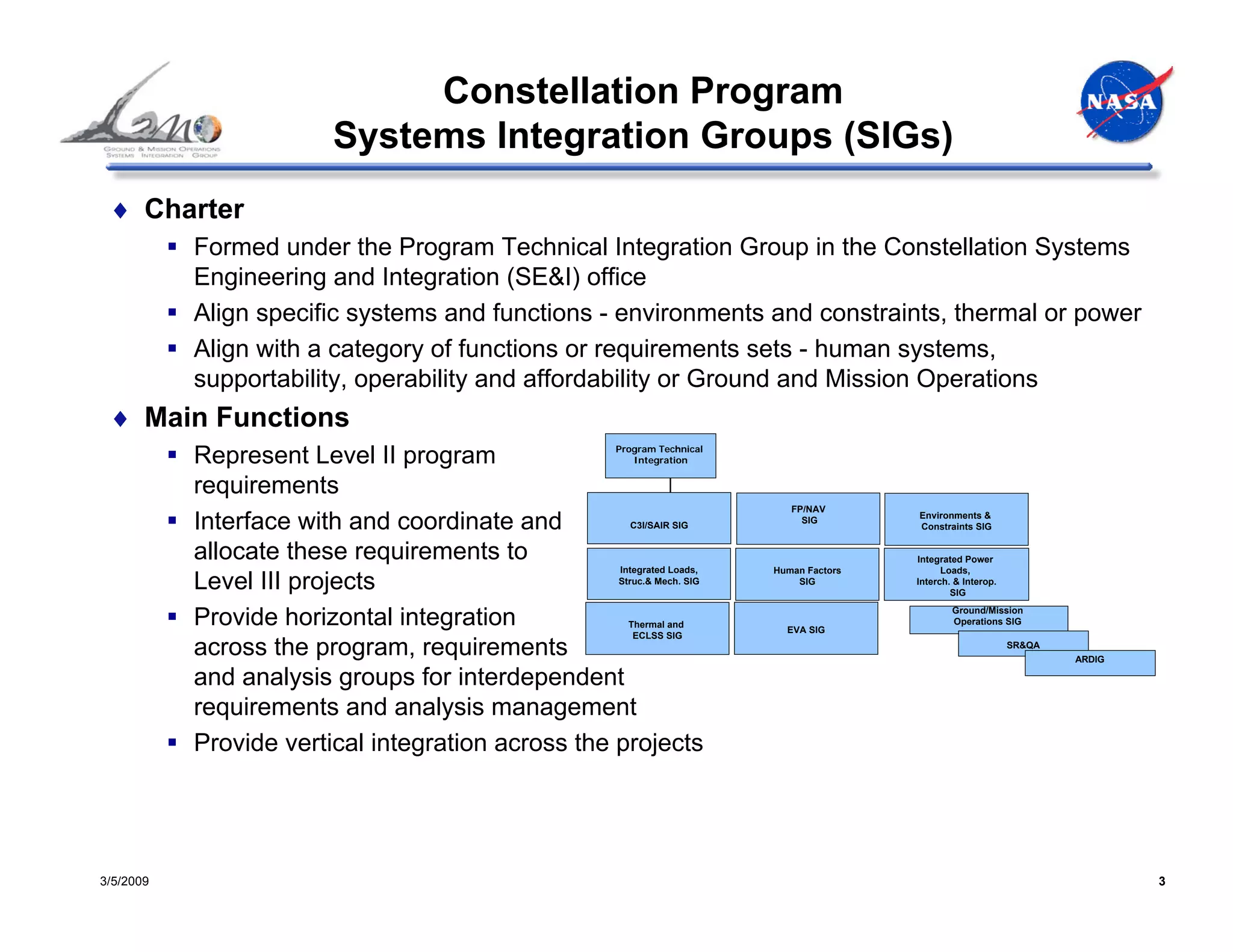
Constellation Program
                        Systems Integration Groups (SIGs)
 ♦ Charter
           Formed under the Program Technical Integration Group in the Constellation Systems
           Engineering and Integration (SE&I) office
           Align specific systems and functions - environments and constraints, thermal or power
           Align with a category of functions or requirements sets - human systems,
           supportability, operability and affordability or Ground and Mission Operations
 ♦ Main Functions
                                                  Program Technical
           Represent Level II program                Integration


           requirements
                                                                          FP/NAV
           Interface with and coordinate and         C3I/SAIR SIG
                                                                            SIG
                                                                                       Environments &
                                                                                       Constraints SIG


           allocate these requirements to                                              Integrated Power
                                                   Integrated Loads,   Human Factors         Loads,
           Level III projects                      Struc.& Mech. SIG       SIG         Interch. & Interop.
                                                                                               SIG
                                                                                               Ground/Mission
           Provide horizontal integration            Thermal and
                                                                         EVA SIG
                                                                                               Operations SIG
                                                      ECLSS SIG
           across the program, requirements                                                                  SR&QA
                                                                                                                     ARDIG

           and analysis groups for interdependent
           requirements and analysis management
           Provide vertical integration across the projects


3/5/2009                                                                                                                     3
Ground and Mission Operations
                          Systems Integration Group
 ♦ Responsible for the formulation, maturation and verification of
   Operational-focused System Requirements for the Constellation
   Program.
           Kennedy Space Center (KSC) – 3.0
            Ground Operations:
            • Vehicle Assembly, Integrated Test,
              Launch and Recovery
           Johnson Space Center (JSC) – 2.0
            Mission Operations for Plan-Train-Fly:
            • Mission Control Center
            • Planning Systems, Simulators and Trainers
           Jet Propulsion Laboratory (JPL) – 2.0
            In-Space and Concurrent Operations:
            • Operations Analysis, Systems Integration,
              Operations Architecture


3/5/2009                                                             4
Team History

 ♦ Formed at initial Program SE&I Face-to-Face meetings in Houston
           One of 13 groups forming core group to formulate Architecture-Level system
           requirements for Cx Program
           Initial title – “Ground Operations/Mission Operations/Training and Execution”
           Also known as “Team #9” <the number lives on…>
           Co-lead by JSC and KSC reps
 ♦ Program SRR – Autumn 2006
           JSC co-lead changed
           Team acquired our very own Telecon and WebX numbers
           Daily Telecons
           Engineering by spreadsheet
           Known as “GOMO” – sometimes called “MOGO” <we hated that one…>
 ♦ Stretch Requirements Formulation
           KSC co-lead change
           Intense 6-month period of TIMs, virtual meetings, Change request drafting, comment
           review & disposition, Technical coordination, final all-day program control board
           decisions
           This effort melded the team and matured its members
           Organizational reporting structure changed (SE&I to OI)


3/5/2009                                                                                        5
Maturing the Team Dynamics

 ♦ Post Stretch season of Project SRRs
           Major Program Milestones
            • Program and Project System Definition Reviews (SDR)
            • Integrated Stack TIM (IS TIM)
            • Program, Project and Element-level Preliminary Design Reviews (PDR)

           New JSC-Co lead
 ♦ Integrated Stack TIM
           Two weeks of intense activity
           GMO arrived on the big stage
           Responsible for 10 of 42 splinter sessions to resolve technical issues
           between Flight and Ground Projects
 ♦ SDR to PDR
           Team stabilizes
           Working routine and battle rhythm matures
           Time at last for reflection


3/5/2009                                                                            6
GMO Organizational Events

 ♦ Held the first GMO “Virtual Retreat” in 2007 via Telecon
           Focused on internal processes
           Established vision & mission statement
           Drafted SIG charter and team member roles/responsibilities
 ♦ Held GMO “Face-to-Face Retreat” in 2008 at JPL
           Focused on clarifying and evaluating SIG’s job by identifying and
           implementing improvements with the goal of increased team’s job
           satisfaction, increased task productivity that brings increased value to
           the Constellation Program


3/5/2009                                                                              7
GMO SIG Challenges

 ♦ Meeting Organizational Expectations with Limited Resources
           Finding ways to meet two major Level II organizations’ priorities
            • Operations Test and Integration Office (OT&I)
                 − Operations Engineering Entity to Flight Operations focused org
                 − Direct reporting and funding source
            •   Systems Engineering and Integration Office (SE&I)
                 − Operations Team Entity to Systems Engineering focused org
                 − Pseudo SE&I team
           Major Program Architectural System Requirement Owner
            • Program and project Milestone reviews

            • Project level Technical Design Assessments
            • Manage Trade Studies and Analysis
            • System Requirement Verification and Validation Planning

            • Leadership in resolving Integrated Program/Project Issues
            • Evolving Constellation “Communities of Practice” leadership


3/5/2009                                                                            8
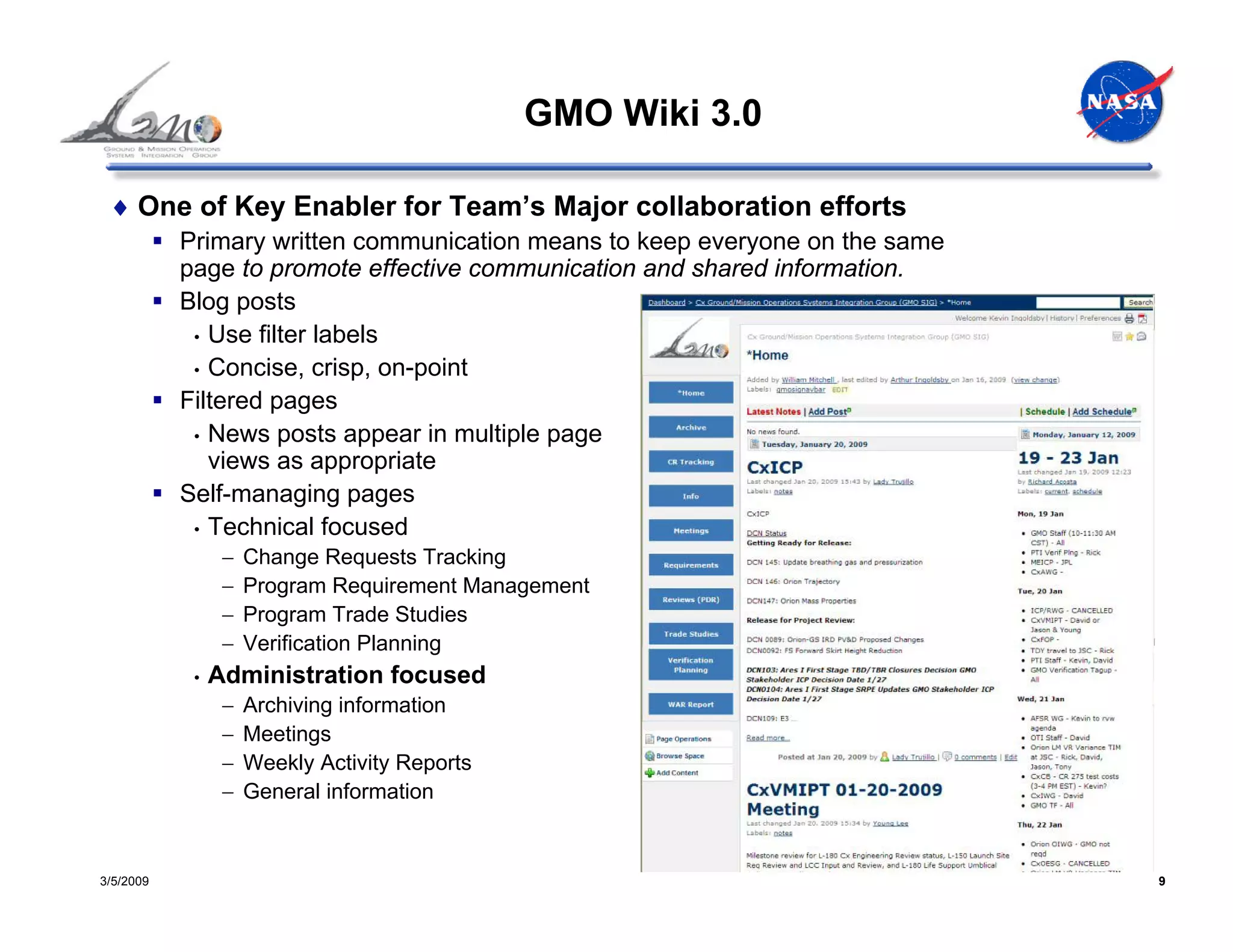
GMO Wiki 3.0

 ♦ One of Key Enabler for Team’s Major collaboration efforts
           Primary written communication means to keep everyone on the same
           page to promote effective communication and shared information.
           Blog posts
            • Use filter labels
            • Concise, crisp, on-point
           Filtered pages
            • News posts appear in multiple page
              views as appropriate
           Self-managing pages
            • Technical focused
                 −   Change Requests Tracking
                 −   Program Requirement Management
                 −   Program Trade Studies
                 −   Verification Planning
            •   Administration focused
                 −   Archiving information
                 −   Meetings
                 −   Weekly Activity Reports
                 −   General information


3/5/2009                                                                      9
Telecons

 ♦ Agendas
           Meeting Invitations should include Purpose, Time Estimate and topic lists
           Time should be adhered to allow stakeholders to participate when needed
           Strive for advance notice (pop-ups happen, but cannot become routine)
 ♦ Scheduling
           Be aware of your membership’s lives
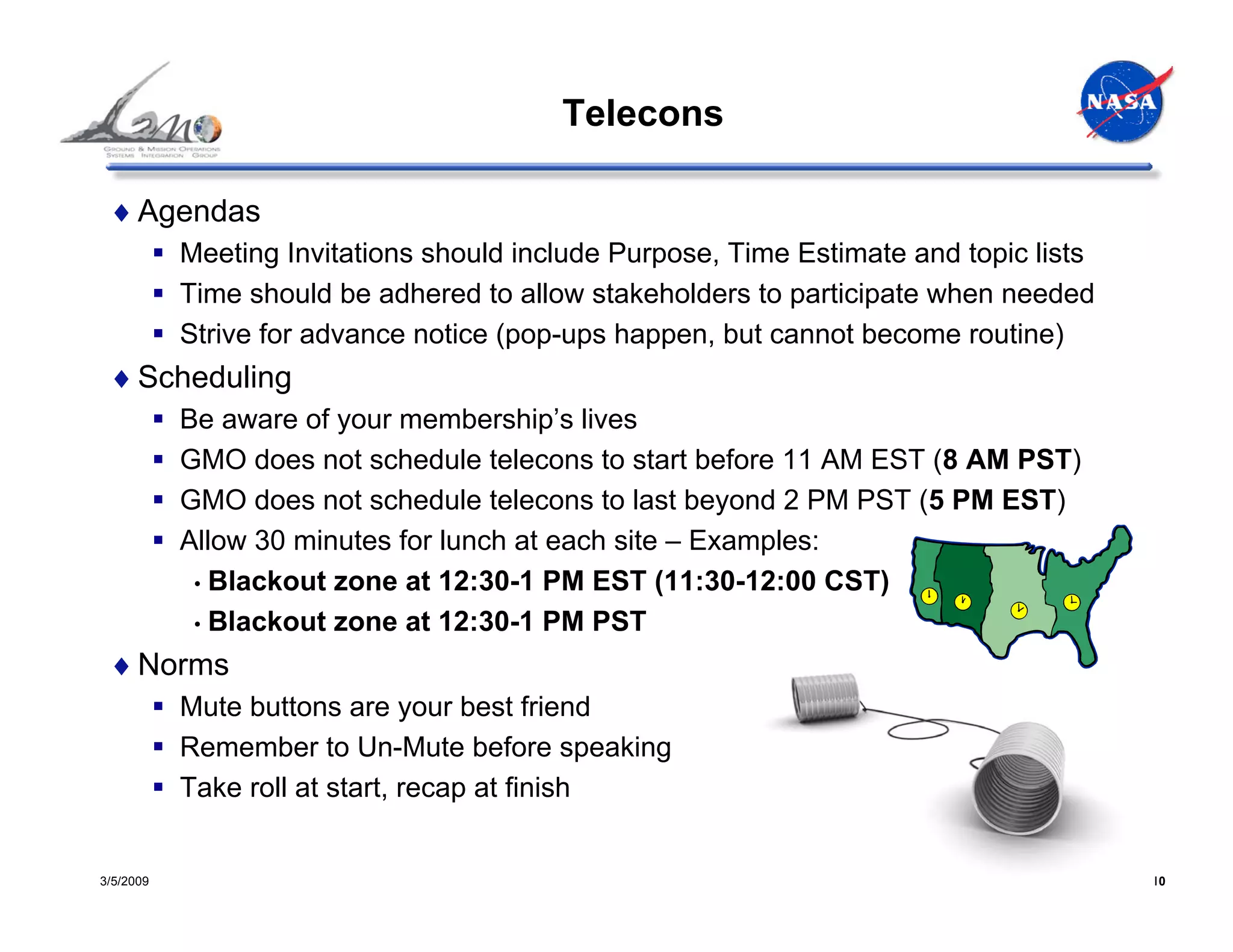
           GMO does not schedule telecons to start before 11 AM EST (8 AM PST)
           GMO does not schedule telecons to last beyond 2 PM PST (5 PM EST)
           Allow 30 minutes for lunch at each site – Examples:
            • Blackout zone at 12:30-1 PM EST (11:30-12:00 CST)
            • Blackout zone at 12:30-1 PM PST

 ♦ Norms
           Mute buttons are your best friend
           Remember to Un-Mute before speaking
           Take roll at start, recap at finish


3/5/2009                                                                               10
Virtual Meetings


 ♦ WebX setup
           Get information out
           Start 5 minutes early
           Do not post Host Key codes
           in invites
           Desktop sharing font size and
           screen size for readability
 ♦ Accompanying Telecon
           Do not post leader pass-codes in invites
           Some attendees will use, if they disconnect early,
           telecon will drop for ALL


 ♦ Norms
           Use the Chat feature with care –
           WebX defaults to all in your 1st reply


3/5/2009                                                        11
Electronic mail

 ♦ Distribution Lists
           Do not abuse Distribution Lists
           Keep lists current – many changes
           can occur
           Pick the correct list
 ♦ Forwarding
           Make sure if you intend to forward
           an attachment that it will ACTUALLY
           make the trip
           Trim excess lines if possible
 ♦ Attachments
           File larger than 2 Mbytes? Consider posting to
           server and sending a link instead
           Encryption required for SBU materials – better to
           send link to Windchill container
 ♦ Replies
           Reply All when everyone needs to read it
           Replying to sender only breaks the
           communication to others addressed
3/5/2009                                                       12
Travel

 ♦ Planning
           Allow time for remote travelers
           Don’t start before 1 PM at destination
           on a Monday
           Coast-to-coast considerations – don’t
           drive “Oh-Dark-Thirty” flight
           departures times on west coast
           participants
 ♦ Purpose
           Virtual works, but can’t yet match the
           interpersonal exchange
           Try to hold a retreat-like event each
           year if budget and schedule allow


3/5/2009                                            13
Program Boards & Panels

 ♦ Coverage
           Constellation Program is in it’s “springtime”
           – the blossoming of dozens of panels and
           working groups
           Plan for coverage – check agenda topics,
           time and materials
           Right-size – only send enough people to
           cover your responsibilities
           Be selective – drop unproductive meetings
 ♦ Reporting
           GMO uses live Wiki posts to report near
           real-time notes
           Post attachments and use commenting
           dialog for follow-up
           Post follow-up summary notes while your
           impressions are still fresh


3/5/2009                                                   14
Team Building

 ♦ Awards
           Recognition is crucial to team morale
           Create a team award
           Use program award programs for more significant
           accomplishments
           Document awards and publicize them
 ♦ Graphics
           A team logo creates identity
           Build a consistent “team brand” identity in web,
           documents and presentations
 ♦ Apparel
           Shirts, hats, t-shirts etc.
           Keep it fresh – make available to all new members
 ♦ Meals
           During travel – arrange for a social evening to build
           networking of members
           Don’t over-schedule, allow for flexible individual plans


3/5/2009                                                              15
Needs – Evolving with the program

 ♦ Reorganizations
           Re-orgs are an annual way of life in large projects
           Get information early, share with team as much as possible
           Uncertainty creates tension – don’t allow communication voids to fester
 ♦ Changing responsibilities
           Priorities change – plan to adjust
 ♦ Training
           Individual development actions
           Team learning for tools and techniques
 ♦ Transitions
           Turnover in personnel
           Growth from within
           Build your second team


3/5/2009                                                                             16
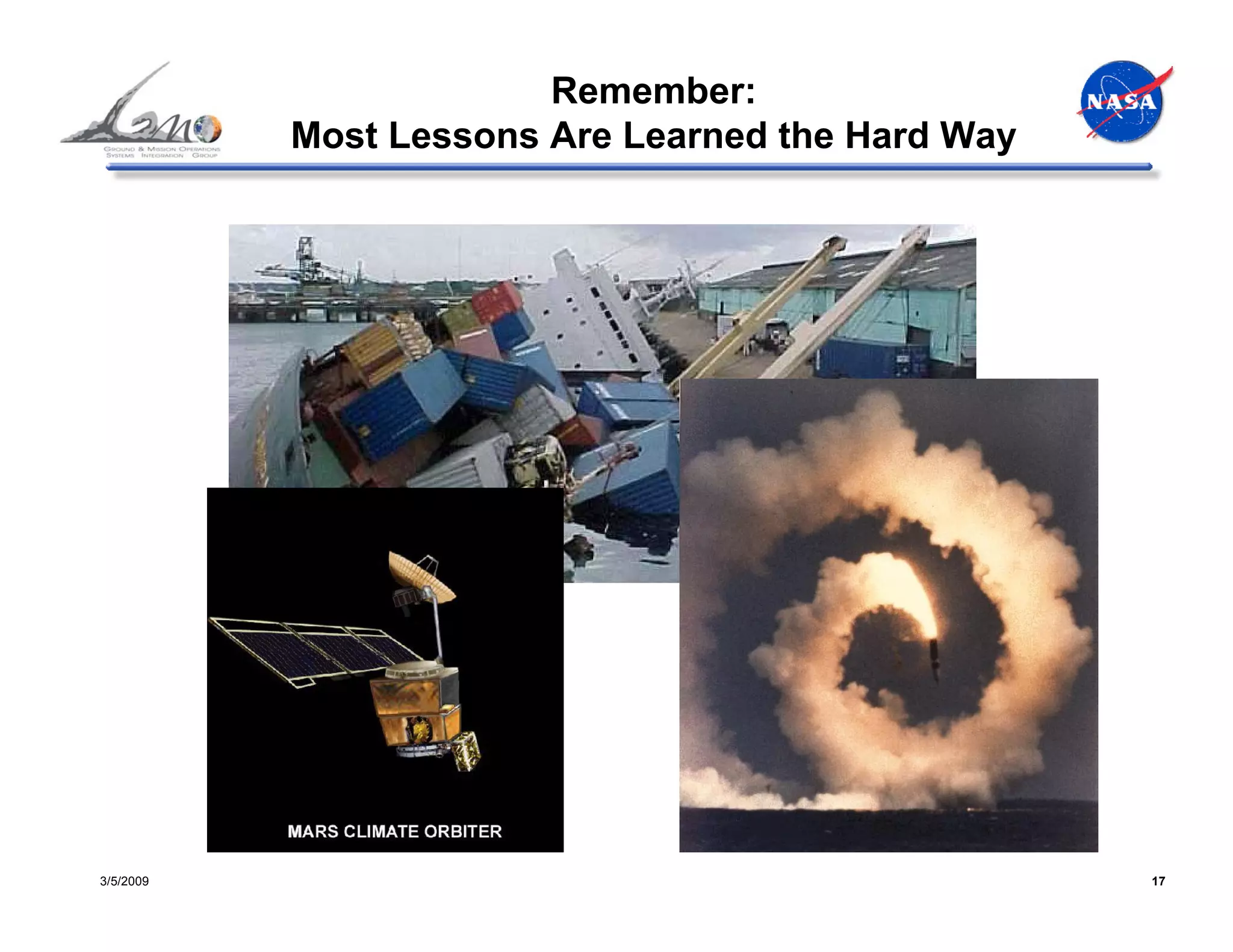
Remember:
           Most Lessons Are Learned the Hard Way


3/5/2009                                           17

Ingoldsby.k.lee.y

  • 1.
    Living in theVirtual Conference Room The Quest for Effective 3/5/2009 Collaboration from PM Challenge 2009 coast-to-coast Kevin Ingoldsby Young Lee Feb 25, 2009
  • 2.
    Virtual Collaboration Team ♦ The Coast-to-Coast, Nation-wide Ground and Mission Operations (GMO) Systems Integration Group (SIG) was initially formed in early 2006 ♦ Since then, this team has undergone several transformations including leadership changes, membership turnovers, organizational transfer, mission creep and scope growth. ♦ Throughout this growth and turmoil, the one constant, which has contributed to many successes of the SIG, has been the team’s reliance and skill at harnessing the virtual collaboration tools, which were made available to the team by the Constellation Program. ♦ One of the critical challenges of maintaining the team’s high performance is “keeping everyone on the same page” to promote effective communication and shared information. This session will discuss how the team has combined electronic mail, telecons & virtual on-line meeting tools, and an evolving Web 2.0 collaboration Wiki site to meet the GMO SIG’s needs building synergy in a small team to provide high- performance results. 3/5/2009 2
  • 3.
    Constellation Program Systems Integration Groups (SIGs) ♦ Charter Formed under the Program Technical Integration Group in the Constellation Systems Engineering and Integration (SE&I) office Align specific systems and functions - environments and constraints, thermal or power Align with a category of functions or requirements sets - human systems, supportability, operability and affordability or Ground and Mission Operations ♦ Main Functions Program Technical Represent Level II program Integration requirements FP/NAV Interface with and coordinate and C3I/SAIR SIG SIG Environments & Constraints SIG allocate these requirements to Integrated Power Integrated Loads, Human Factors Loads, Level III projects Struc.& Mech. SIG SIG Interch. & Interop. SIG Ground/Mission Provide horizontal integration Thermal and EVA SIG Operations SIG ECLSS SIG across the program, requirements SR&QA ARDIG and analysis groups for interdependent requirements and analysis management Provide vertical integration across the projects 3/5/2009 3
  • 4.
    Ground and MissionOperations Systems Integration Group ♦ Responsible for the formulation, maturation and verification of Operational-focused System Requirements for the Constellation Program. Kennedy Space Center (KSC) – 3.0 Ground Operations: • Vehicle Assembly, Integrated Test, Launch and Recovery Johnson Space Center (JSC) – 2.0 Mission Operations for Plan-Train-Fly: • Mission Control Center • Planning Systems, Simulators and Trainers Jet Propulsion Laboratory (JPL) – 2.0 In-Space and Concurrent Operations: • Operations Analysis, Systems Integration, Operations Architecture 3/5/2009 4
  • 5.
    Team History ♦Formed at initial Program SE&I Face-to-Face meetings in Houston One of 13 groups forming core group to formulate Architecture-Level system requirements for Cx Program Initial title – “Ground Operations/Mission Operations/Training and Execution” Also known as “Team #9” <the number lives on…> Co-lead by JSC and KSC reps ♦ Program SRR – Autumn 2006 JSC co-lead changed Team acquired our very own Telecon and WebX numbers Daily Telecons Engineering by spreadsheet Known as “GOMO” – sometimes called “MOGO” <we hated that one…> ♦ Stretch Requirements Formulation KSC co-lead change Intense 6-month period of TIMs, virtual meetings, Change request drafting, comment review & disposition, Technical coordination, final all-day program control board decisions This effort melded the team and matured its members Organizational reporting structure changed (SE&I to OI) 3/5/2009 5
  • 6.
    Maturing the TeamDynamics ♦ Post Stretch season of Project SRRs Major Program Milestones • Program and Project System Definition Reviews (SDR) • Integrated Stack TIM (IS TIM) • Program, Project and Element-level Preliminary Design Reviews (PDR) New JSC-Co lead ♦ Integrated Stack TIM Two weeks of intense activity GMO arrived on the big stage Responsible for 10 of 42 splinter sessions to resolve technical issues between Flight and Ground Projects ♦ SDR to PDR Team stabilizes Working routine and battle rhythm matures Time at last for reflection 3/5/2009 6
  • 7.
    GMO Organizational Events ♦ Held the first GMO “Virtual Retreat” in 2007 via Telecon Focused on internal processes Established vision & mission statement Drafted SIG charter and team member roles/responsibilities ♦ Held GMO “Face-to-Face Retreat” in 2008 at JPL Focused on clarifying and evaluating SIG’s job by identifying and implementing improvements with the goal of increased team’s job satisfaction, increased task productivity that brings increased value to the Constellation Program 3/5/2009 7
  • 8.
    GMO SIG Challenges ♦ Meeting Organizational Expectations with Limited Resources Finding ways to meet two major Level II organizations’ priorities • Operations Test and Integration Office (OT&I) − Operations Engineering Entity to Flight Operations focused org − Direct reporting and funding source • Systems Engineering and Integration Office (SE&I) − Operations Team Entity to Systems Engineering focused org − Pseudo SE&I team Major Program Architectural System Requirement Owner • Program and project Milestone reviews • Project level Technical Design Assessments • Manage Trade Studies and Analysis • System Requirement Verification and Validation Planning • Leadership in resolving Integrated Program/Project Issues • Evolving Constellation “Communities of Practice” leadership 3/5/2009 8
  • 9.
    GMO Wiki 3.0 ♦ One of Key Enabler for Team’s Major collaboration efforts Primary written communication means to keep everyone on the same page to promote effective communication and shared information. Blog posts • Use filter labels • Concise, crisp, on-point Filtered pages • News posts appear in multiple page views as appropriate Self-managing pages • Technical focused − Change Requests Tracking − Program Requirement Management − Program Trade Studies − Verification Planning • Administration focused − Archiving information − Meetings − Weekly Activity Reports − General information 3/5/2009 9
  • 10.
    Telecons ♦ Agendas Meeting Invitations should include Purpose, Time Estimate and topic lists Time should be adhered to allow stakeholders to participate when needed Strive for advance notice (pop-ups happen, but cannot become routine) ♦ Scheduling Be aware of your membership’s lives GMO does not schedule telecons to start before 11 AM EST (8 AM PST) GMO does not schedule telecons to last beyond 2 PM PST (5 PM EST) Allow 30 minutes for lunch at each site – Examples: • Blackout zone at 12:30-1 PM EST (11:30-12:00 CST) • Blackout zone at 12:30-1 PM PST ♦ Norms Mute buttons are your best friend Remember to Un-Mute before speaking Take roll at start, recap at finish 3/5/2009 10
  • 11.
    Virtual Meetings ♦WebX setup Get information out Start 5 minutes early Do not post Host Key codes in invites Desktop sharing font size and screen size for readability ♦ Accompanying Telecon Do not post leader pass-codes in invites Some attendees will use, if they disconnect early, telecon will drop for ALL ♦ Norms Use the Chat feature with care – WebX defaults to all in your 1st reply 3/5/2009 11
  • 12.
    Electronic mail ♦Distribution Lists Do not abuse Distribution Lists Keep lists current – many changes can occur Pick the correct list ♦ Forwarding Make sure if you intend to forward an attachment that it will ACTUALLY make the trip Trim excess lines if possible ♦ Attachments File larger than 2 Mbytes? Consider posting to server and sending a link instead Encryption required for SBU materials – better to send link to Windchill container ♦ Replies Reply All when everyone needs to read it Replying to sender only breaks the communication to others addressed 3/5/2009 12
  • 13.
    Travel ♦ Planning Allow time for remote travelers Don’t start before 1 PM at destination on a Monday Coast-to-coast considerations – don’t drive “Oh-Dark-Thirty” flight departures times on west coast participants ♦ Purpose Virtual works, but can’t yet match the interpersonal exchange Try to hold a retreat-like event each year if budget and schedule allow 3/5/2009 13
  • 14.
    Program Boards &Panels ♦ Coverage Constellation Program is in it’s “springtime” – the blossoming of dozens of panels and working groups Plan for coverage – check agenda topics, time and materials Right-size – only send enough people to cover your responsibilities Be selective – drop unproductive meetings ♦ Reporting GMO uses live Wiki posts to report near real-time notes Post attachments and use commenting dialog for follow-up Post follow-up summary notes while your impressions are still fresh 3/5/2009 14
  • 15.
    Team Building ♦Awards Recognition is crucial to team morale Create a team award Use program award programs for more significant accomplishments Document awards and publicize them ♦ Graphics A team logo creates identity Build a consistent “team brand” identity in web, documents and presentations ♦ Apparel Shirts, hats, t-shirts etc. Keep it fresh – make available to all new members ♦ Meals During travel – arrange for a social evening to build networking of members Don’t over-schedule, allow for flexible individual plans 3/5/2009 15
  • 16.
    Needs – Evolvingwith the program ♦ Reorganizations Re-orgs are an annual way of life in large projects Get information early, share with team as much as possible Uncertainty creates tension – don’t allow communication voids to fester ♦ Changing responsibilities Priorities change – plan to adjust ♦ Training Individual development actions Team learning for tools and techniques ♦ Transitions Turnover in personnel Growth from within Build your second team 3/5/2009 16
  • 17.
    Remember: Most Lessons Are Learned the Hard Way 3/5/2009 17