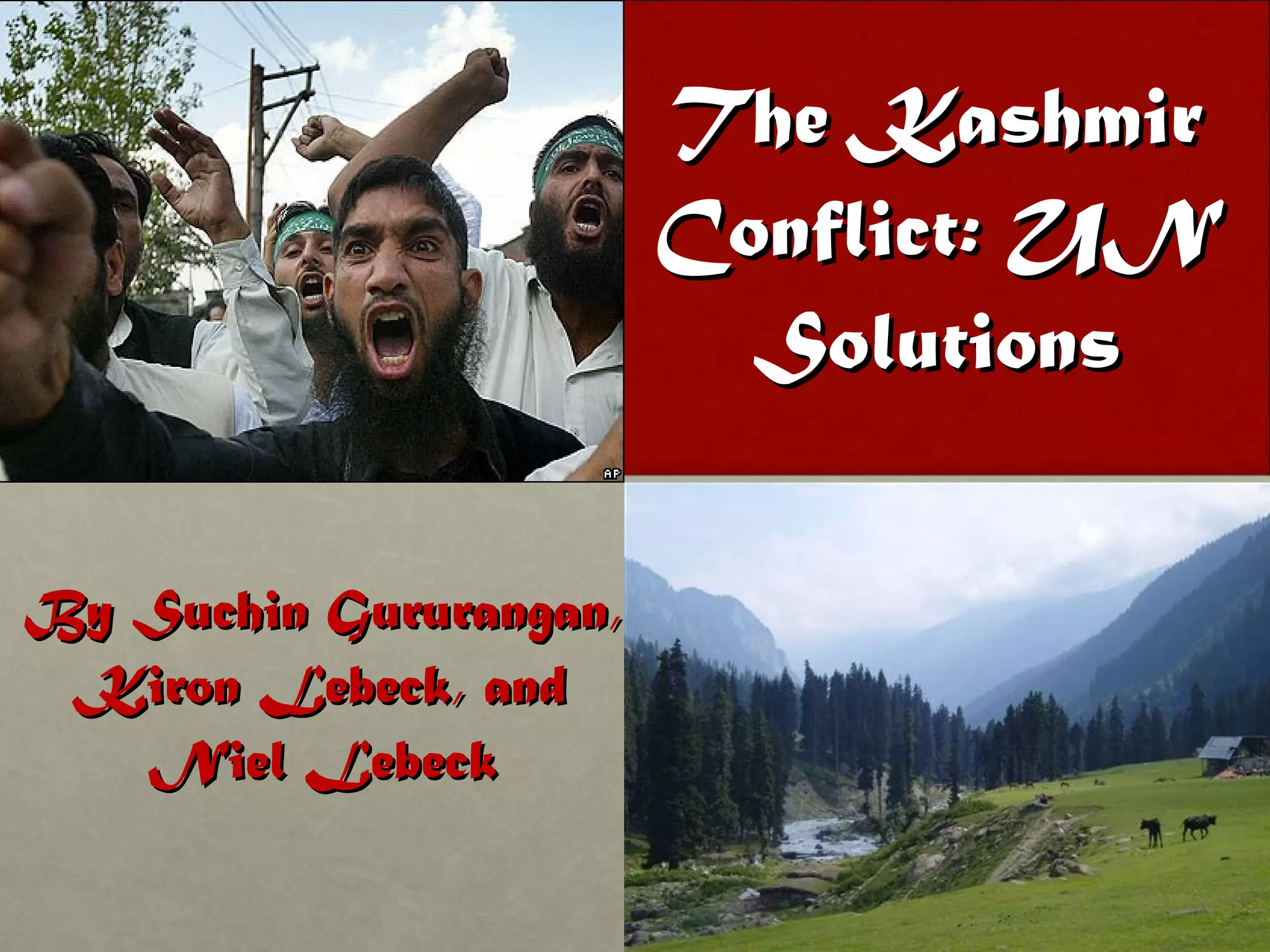
The Kashmir Conflict: UN Solutions By Suchin Gururangan, Kiron Lebeck, and Niel Lebeck
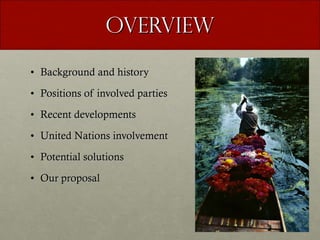
Overview Background and history Positions of involved parties Recent developments United Nations involvement Potential solutions Our proposal
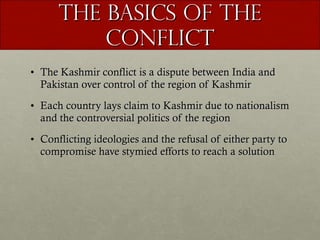
The Basics of the Conflict The Kashmir conflict is a dispute between India and Pakistan over control of the region of Kashmir Each country lays claim to Kashmir due to nationalism and the controversial politics of the region Conflicting ideologies and the refusal of either party to compromise have stymied efforts to reach a solution
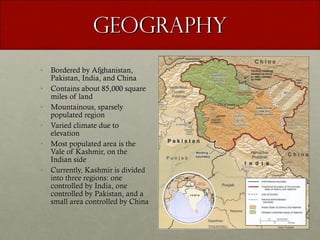
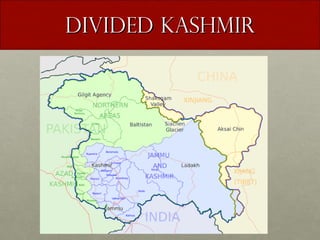
Geography Bordered by Afghanistan, Pakistan, India, and China Contains about 85,000 square miles of land Mountainous, sparsely populated region Varied climate due to elevation Most populated area is the Vale of Kashmir, on the Indian side  Currently, Kashmir is divided into three regions: one controlled by India, one controlled by Pakistan, and a small area controlled by China
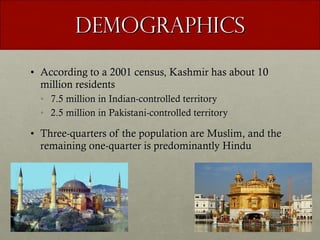
Demographics According to a 2001 census, Kashmir has about 10 million residents 7.5 million in Indian-controlled territory 2.5 million in Pakistani-controlled territory Three-quarters of the population are Muslim, and the remaining one-quarter is predominantly Hindu
History of  Occupation and  Conflict Great Britain controlled India from 1612 until 1947 Under British rule, Kashmir was a princely state—it was directly ruled by a maharaja that answered to the British 1947-India gains independence from Britain The independence agreement partitions India into two nations, India and Pakistan The Maharaja of Kashmir accedes his province to India, prompting war between India and Pakistan 1948 – UN Security Council passes resolution 47, mandating a ceasefire along the Line of Control (LOC) and paving the way for a potential plebiscite 1957-India declares all of Kashmir a state of the Indian Union 1965 – Alleged infiltration attempts by Pakistan instigate a second Indo-Pakistani war in Kashmir 1989 –  Militancy in the region escalates 1999 – Pakistani forces cross the LOC, and India responds by declaring war 2005 – India and Pakistan agree to a new ceasefire
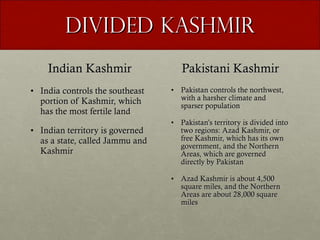
Divided Kashmir Indian Kashmir India controls the southeast portion of Kashmir, which has the most fertile land Indian territory is governed as a state, called Jammu and Kashmir Pakistani Kashmir Pakistan controls the northwest, with a harsher climate and sparser population Pakistan’s territory is divided into two regions: Azad Kashmir, or free Kashmir, which has its own government, and the Northern Areas, which are governed directly by Pakistan Azad Kashmir is about 4,500 square miles, and the Northern Areas are about 28,000 square miles
Divided kashmir
India’s Positions The accession of Kashmir to India is legally indisputable Religion is irrelevant in determining control of Kashmir—a large Muslim community supported the accession of Kashmir to India The Pakistani sponsorship of terrorism in Kashmir disrupts the democratic process in the region International intervention is out of the question, as Kashmir is strictly India’s affair
Pakistan’s Positions Kashmir rightfully belongs to Pakistan due to their religious and economic ties Pakistan does not provide material aid to any terrorists or insurgents in Kashmir In accordance with the UN Security Council, Pakistan considers India’s claim to Kashmir invalid The Kashmiri people should be allowed to choose between Pakistani and Indian control through a plebiscite
Kashmir’s Positions Kashmiris overwhelmingly favor independence A poll conducted in the Kashmiri capital of Srinagar in 2007 revealed that 87% of Kashmiris desire independence, 7% favor Indian rule, and 3% prefer Pakistani control Kashmiris oppose Indian rule due to the restrictions placed on them by Indian security forces and alleged human rights abuses by the Indian government
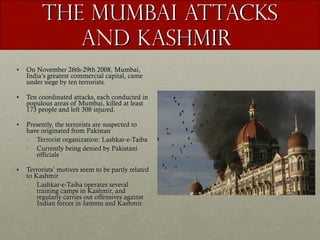
The Mumbai Attacks and Kashmir  On November 26th-29th 2008, Mumbai, India’s greatest commercial capital, came under siege by ten terrorists. Ten coordinated attacks, each conducted in populous areas of Mumbai, killed at least 173 people and left 308 injured.  Presently, the terrorists are suspected to have originated from Pakistan Terrorist organization: Lashkar-e-Taiba Currently being denied by Pakistani officials Terrorists’ motives seem to be partly related to Kashmir Lashkar-e-Taiba operates several training camps in Kashmir, and regularly carries out offensives against Indian forces in Jammu and Kashmir.
The Mumbai Attacks and Kashmir  These atrocities highlight the need for settlement of the Kashmir conflict to ensure lasting cooperation between India and Pakistan Collaboration between these two nations could help combat extremism The Mumbai attacks have engendered a rapid increase in tensions among Pakistani and Indian officials who are already engulfed in mutual distrust India has accused Pakistan’s Inter-service Intelligence (ISI) of training and giving intelligence to Lashkar-e-Taiba as well as other terrorist organizations in Pakistan  Pakistan insists that it only gives the rebels in Kashmir diplomatic and moral support, not material aid or training. The symbol of Lashkar-e-Taiba
The War on Terror and Kashmir Centered in the Middle East, but spread over multiple continents An international conflict led by the United States, United Kingdom, and NATO forces against Islamic terrorism in response to the September 11 th  attacks in the United States Objectives include Securing American borders Preventing activities of international terrorist networks Ending state sponsorship of terrorism Preventing re-emergence of terrorism abroad . United States presence in Central/South Asia and alliances with Pakistan and India in the War on Terror increase American ability to intervene in the Indo-Pakistani Peace Process Pakistan’s emergence as a United States partner on the War on Terror Pressure by Washington resulted in the banning of Lashkar-e-Taiba and Jaish-e-Muhammad in Kashmir US donates about 1 billion dollars in military aid to Islamabad each year Many factors contribute to Pakistani insecurity:  US presence in Afghanistan (Western Border) Indian presence on the Eastern Border Deep intelligence ties between India, Afghanistan, and the US
Musharraf and Ali Zardari: Pakistan’s Political Leadership Pervez Musharaff (2001-2008) Proposed a four point solution to Kashmir: - gradual demilitarization - greater autonomy, but no independence - no changes to the region's borders - joint supervision mechanism or UN mandate over region Banned Lashkar-e-Taiba and Jaish-e-Muhammad after they were accused of orchestrating an attack against the Indian Parliament The ban’s impact was superficial and did little to hinder insurgency in Kashmir Asif Ali Zardari (Incumbent) Determined to normalize trade and political relations with India Offered to “set Kashmir issue aside”  Has no support from Pakistani military on the issue Despite his determination, the president has stated that he is ready to “thwart any aggression from the East” if need be
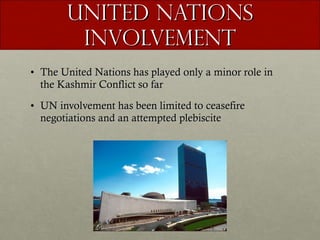
United Nations Involvement The United Nations has played only a minor role in the Kashmir Conflict so far UN involvement has been limited to ceasefire negotiations and an attempted plebiscite
UN-Brokered Ceasefires During the 1948 Indo-Pakistani War, the UN Security Council passed Resolutions 39 and 47, establishing the creation of a United Nations Commission on India and Pakistan (UNCIP) UNCIP then passed resolutions calling for a ceasefire across the Line of Control The Security Council also brokered a ceasefire in the Indo-Pakistani War of 1965 and enforced it with Resolution 211
The Plebiscite After the Indo-Pakistani War of 1948, UNCIP established the framework for a plebiscite  to decide the future status of Kashmir The plebiscite would offer Kashmiris a choice between Indian and Pakistani rule Both Indian and Pakistani governments initially agreed to the plebiscite Since 1948, the plebiscite has been repeatedly delayed The Indian government claims that a requirement of Pakistani militant withdrawal has not been met, blaming Pakistan for the delay  The Pakistani government maintains its innocence and desire for the plebiscite, putting the blame on India
Initial Steps The United Nations must take a more proactive role in resolving the  Kashmir Conflict The United Nations must first encourage the normalization of relations between India and Pakistan Encourage sharing of intelligence and increased cooperation in combating extremism Provide economic incentives to foster bilateral trade Create a commission to investigate and prevent state-sponsored terrorism in both nations Provide peacekeeping troops to secure the borders of India, Pakistan, and Kashmir and to prevent the movement of militants
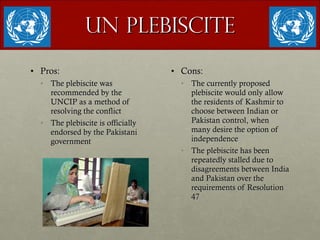
UN Plebiscite Pros: The plebiscite was recommended by the UNCIP as a method of resolving the conflict The plebiscite is officially endorsed by the Pakistani government Cons: The currently proposed plebiscite would only allow the residents of Kashmir to choose between Indian or Pakistan control, when many desire the option of independence The plebiscite has been repeatedly stalled due to disagreements between India and Pakistan over the requirements of Resolution 47
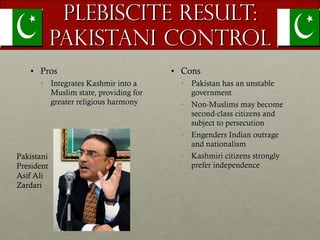
Plebiscite Result: Pakistani Control Pros Integrates Kashmir into a Muslim state, providing for greater religious harmony Cons Pakistan has an unstable government Non-Muslims may become second-class citizens and subject to persecution Engenders Indian outrage and nationalism Kashmiri citizens strongly prefer independence  Pakistani President Asif Ali Zardari
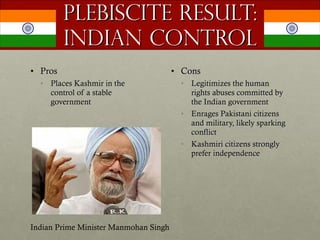
Plebiscite Result: Indian Control Pros Places Kashmir in the control of a stable government Cons Legitimizes the human rights abuses committed by the Indian government Enrages Pakistani citizens and military, likely sparking conflict Kashmiri citizens strongly prefer independence  Indian Prime Minister Manmohan Singh
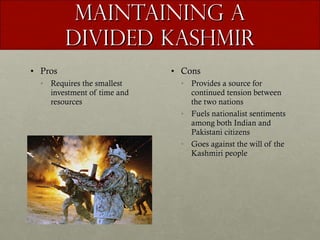
Maintaining a Divided Kashmir Pros Requires the smallest investment of time and resources Cons Provides a source for continued tension between the two nations Fuels nationalist sentiments among both Indian and Pakistani citizens Goes against the will of the Kashmiri people
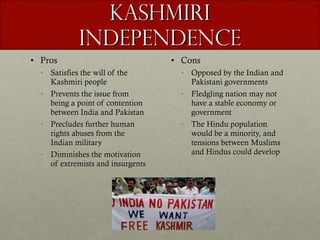
Kashmiri Independence Pros Satisfies the will of the Kashmiri people Prevents the issue from being a point of contention between India and Pakistan Precludes further human rights abuses from the Indian military Diminishes the motivation of extremists and insurgents Cons Opposed by the Indian and Pakistani governments Fledgling nation may not have a stable economy or government The Hindu population would be a minority, and tensions between Muslims and Hindus could develop
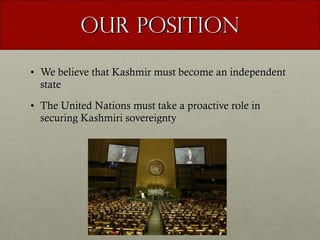
Our Position We believe that Kashmir must become an independent state The United Nations must take a proactive role in securing Kashmiri sovereignty
A Proposal for a Solution Establish a Kashmiri Sovereignty Commission (KSC) The commission would first determine the viability of Kashmiri independence in terms of economic and political stability The commission would then hold a referendum in Kashmir confirming the people’s desire for independence  2. Considering the results of the referendum, introduce a resolution urging the global community to support Kashmiri sovereignty 3. Use support from the global community to persuade India and Pakistan to recognize Kashmir as an independent nation 4. Draft a resolution in the Security Council recognizing Kashmir as a sovereign state and calling for demilitarization of the region 5. Establish a UN transitional government in Kashmir to develop infrastructure and security 6.Hold elections for an independent, parliamentary government
A Proposal for A Solution This proposal is contingent on the participation of member nations in creating the necessary resolutions and commissions If India and Pakistan fail to recognize Kashmir as independent, more forceful action could be taken; Kosovo provides a precedent In this proposal, the United Nations acts as the medium used to achieve a lasting solution for the conflict
Conclusion Greater understanding of this conflict---history and developments The necessity of resolving this conflict, as well as potential solutions  The important role that the UN has in mediating the situation
THE END
Bibliography Sengupta, Somini. &quot;Kashmiris Weary of Violence Fight Back by Voting.&quot;  The New York Times. 20 Dec. 2008. 10 Jan. 2009 <http://www.nytimes.com/2008/12/20/world/asia/20kashmir.html?_r=1>. Map of Kashmir. Digital image.  Wikimedia. 10 Jan. 2009 <http://upload.wikimedia.org/wikipedia/commons/thumb/8/84/Kashmir_map_big.jpg/522px-Kashmir_map_big.jpg>. &quot;A Comprehensive Note on Jammu and Kashmir.&quot;  Embassy of India, Washington D.C. Ed. Indian Embassy. Indian Embassy. 10 Jan. 2009 <http://www.indianembassy.org/policy/Kashmir/Kashmir_MEA/Indian_Position.html>. Ahmed, Wajahat. &quot;Kashmir and the United Nations.&quot;  Countercurrents.org. 27 Aug. 2008. 10 Jan. 2009 <http://www.countercurrents.org/ahmad270808.htm>. &quot;Geography of Kashmir.&quot;  30 March 2008.  HowStuffWorks.com. <http://geography.howstuffworks.com/middle-east/geography-of-kashmir.htm>  19 January 2009. Angry rioters. Digital image. BBC. 10 Jan. 2009 <http://newsimg.bbc.co.uk/media/images/42093000/jpg/_42093952_kashmir-ap416.jpg>. Kashmir mountain range. Digital image.  Paulseagypsy. 10 Jan. 2009 <http://paulseagypsy.files.wordpress.com/2007/09/s1030353-custom.jpg>. Hagia Sophia. Digital image.  Academic.evergreen.edu. 10 Jan. 2009 <http://academic.evergreen.edu/curricular/silkroads/06/Istanbulimages/Istanbul-Hagia-Sophia.jpg>. Hindu temple. Digital image.  Photobucket. 10 Jan. 2009 <http://i266.photobucket.com/albums/ii268/dipambu/2008/MONTH3_2008/TEMPLE_UNUSUALS_9.jpg>. Kashmir map. Digital image.  Fravahr.org. 10 Jan. 2009 <http://www.fravahr.org/IMG/gif/Kashmir_map.gif>. Taj Mahal Hotel in Mumbai. Digital image. 10 Jan. 2009 <http://www.cbc.ca/gfx/images/news/photos/2008/11/27/mumbai-taj-cp-5904057.jpg>. The Symbol of Lashkar-e-Taiba. Digital image.  International Terrorist Symbols Database. 10 Jan. 2009 <http://www.adl.org/terrorism/symbols/lashkaretaiba.asp>. &quot;Kashmir- The History.&quot;  Pakistani Mission to the United Nations. 10 Jan. 2009 <http://www.pakun.org/kashmir/history.php>. &quot;Kashmir Independence Only way Out.&quot;  The Hindu. 16 Aug. 2001. 10 Jan. 2009 <http://www.hindu.com/2001/08/16/stories/0216000c.htm>. &quot;Majority in Kashmir Valley Want Independence: poll.&quot;  Reuters. 13 Aug. 2007. 10 Jan. 2009 <http://www.reuters.com/article/worldNews/idUSDEL29179620070813>. Muslim woman voting. Digital image. 10 Jan. 2009 <http://msnbcmedia2.msn.com/j/msnbc/Components/Photos/040420/040420_indiaElection_hmed_4p.hmedium.jpg>
Bibliography (continued) Pakistani flag. Digital image. 10 Jan. 2009 <http://www.idp-europe.org/pic/pakistan_flag.jpg>. United Nations Symbol. Digital image. 10 Jan. 2009 <http://www.lassosoft.com/Company/Lasso/logo_UN.gif>. Indian Flag. Digital image. 10 Jan. 2009 <http://www.britishcouncil.org.br/champions/blog/upload/06052008074302_India_flag.gif>. Image of gunfire and wounded soldier. Digital image. 10 Jan. 2009 <https://secure.sky.com/images/skymovies/pics/10093949.jpg>. Angry protestor with large beard. Digital image. 10 Jan. 2009 <http://snappedshot.com/uploads/Parody/capt.bb53b30e82e34d6b87ae51d853725e46.india_kashmir_protest_rmx105.jpg>. http://www.september11news.com/Nov10ABushUN4.jpg United Nations Building. Digital image. 26 Jan. 2009  http://endtimesworldnews.punt.nl/upload/united_nations.jpg . Kashmiri flower seller on boat. Digital image. 26 Jan. 2009 <http://www.stevemccurry.com/content/photos/KASHMIR-10016.jpg>. Handshake. Digital image. 26 Jan. 2009 <http://hgis.biz/images/handshake.jpg>.
Bibliography (continued) &quot;BBC NEWS  | South Asia  | Kashmir's forgotten plebiscite.&quot;  BBC NEWS | News Front Page. 17 Jan. 2002. BBC News. 20 Jan. 2009 <http://news.bbc.co.uk/2/hi/south_asia/1766582.stm>.  Crossette, Barbara. &quot;Pakistan Asks U.N. Council For Action On Kashmir  - New York Times.&quot; NY Times. 30 May 2002. The New York Times. 20 Jan. 2009 <http://query.nytimes.com/gst/fullpage.html?res=9E00E6D71E3BF933A05756C0A9649C8B63>. Ferraro, Vincent. &quot;UN Proposal on Kashmir, 22 December, 1949.&quot; Mount Holyoke College, South Hadley, Massachusetts. Mount Holyoke College. 20 Jan. 2009 <http://www.mtholyoke.edu/acad/intrel/uncom3.htm>.  &quot;Kashmir in the United Nations.&quot; The Kashmiri-Canadian Council Home Page. The Kashmiri-Canadian Council. 20 Jan. 2009 <http://www.kashmiri-cc.ca/un/>. &quot;Pakistan May Relent on Kashmir Demand  - New York Times.&quot; NY Times. 19 Dec. 2003. The New York Times. 20 Jan. 2009 <http://query.nytimes.com/gst/fullpage.html?res=9C02EFDE143FF93AA25751C1A9659C8B63>. &quot;UNMOGIP: United Nations Military Observer Group in India and Pakistan.&quot; Welcome to the UN. It's your world. 2005. United Nations. 20 Jan. 2009 <http://www.un.org/Depts/

The kashmir conflict

  • 1.
    The Kashmir Conflict:UN Solutions By Suchin Gururangan, Kiron Lebeck, and Niel Lebeck
  • 2.
    Overview Background andhistory Positions of involved parties Recent developments United Nations involvement Potential solutions Our proposal
  • 3.
    The Basics ofthe Conflict The Kashmir conflict is a dispute between India and Pakistan over control of the region of Kashmir Each country lays claim to Kashmir due to nationalism and the controversial politics of the region Conflicting ideologies and the refusal of either party to compromise have stymied efforts to reach a solution
  • 4.
    Geography Bordered byAfghanistan, Pakistan, India, and China Contains about 85,000 square miles of land Mountainous, sparsely populated region Varied climate due to elevation Most populated area is the Vale of Kashmir, on the Indian side Currently, Kashmir is divided into three regions: one controlled by India, one controlled by Pakistan, and a small area controlled by China
  • 5.
    Demographics According toa 2001 census, Kashmir has about 10 million residents 7.5 million in Indian-controlled territory 2.5 million in Pakistani-controlled territory Three-quarters of the population are Muslim, and the remaining one-quarter is predominantly Hindu
  • 6.
    History of Occupation and Conflict Great Britain controlled India from 1612 until 1947 Under British rule, Kashmir was a princely state—it was directly ruled by a maharaja that answered to the British 1947-India gains independence from Britain The independence agreement partitions India into two nations, India and Pakistan The Maharaja of Kashmir accedes his province to India, prompting war between India and Pakistan 1948 – UN Security Council passes resolution 47, mandating a ceasefire along the Line of Control (LOC) and paving the way for a potential plebiscite 1957-India declares all of Kashmir a state of the Indian Union 1965 – Alleged infiltration attempts by Pakistan instigate a second Indo-Pakistani war in Kashmir 1989 – Militancy in the region escalates 1999 – Pakistani forces cross the LOC, and India responds by declaring war 2005 – India and Pakistan agree to a new ceasefire
  • 7.
    Divided Kashmir IndianKashmir India controls the southeast portion of Kashmir, which has the most fertile land Indian territory is governed as a state, called Jammu and Kashmir Pakistani Kashmir Pakistan controls the northwest, with a harsher climate and sparser population Pakistan’s territory is divided into two regions: Azad Kashmir, or free Kashmir, which has its own government, and the Northern Areas, which are governed directly by Pakistan Azad Kashmir is about 4,500 square miles, and the Northern Areas are about 28,000 square miles
  • 8.
  • 9.
    India’s Positions Theaccession of Kashmir to India is legally indisputable Religion is irrelevant in determining control of Kashmir—a large Muslim community supported the accession of Kashmir to India The Pakistani sponsorship of terrorism in Kashmir disrupts the democratic process in the region International intervention is out of the question, as Kashmir is strictly India’s affair
  • 10.
    Pakistan’s Positions Kashmirrightfully belongs to Pakistan due to their religious and economic ties Pakistan does not provide material aid to any terrorists or insurgents in Kashmir In accordance with the UN Security Council, Pakistan considers India’s claim to Kashmir invalid The Kashmiri people should be allowed to choose between Pakistani and Indian control through a plebiscite
  • 11.
    Kashmir’s Positions Kashmirisoverwhelmingly favor independence A poll conducted in the Kashmiri capital of Srinagar in 2007 revealed that 87% of Kashmiris desire independence, 7% favor Indian rule, and 3% prefer Pakistani control Kashmiris oppose Indian rule due to the restrictions placed on them by Indian security forces and alleged human rights abuses by the Indian government
  • 12.
    The Mumbai Attacksand Kashmir On November 26th-29th 2008, Mumbai, India’s greatest commercial capital, came under siege by ten terrorists. Ten coordinated attacks, each conducted in populous areas of Mumbai, killed at least 173 people and left 308 injured. Presently, the terrorists are suspected to have originated from Pakistan Terrorist organization: Lashkar-e-Taiba Currently being denied by Pakistani officials Terrorists’ motives seem to be partly related to Kashmir Lashkar-e-Taiba operates several training camps in Kashmir, and regularly carries out offensives against Indian forces in Jammu and Kashmir.
  • 13.
    The Mumbai Attacksand Kashmir These atrocities highlight the need for settlement of the Kashmir conflict to ensure lasting cooperation between India and Pakistan Collaboration between these two nations could help combat extremism The Mumbai attacks have engendered a rapid increase in tensions among Pakistani and Indian officials who are already engulfed in mutual distrust India has accused Pakistan’s Inter-service Intelligence (ISI) of training and giving intelligence to Lashkar-e-Taiba as well as other terrorist organizations in Pakistan Pakistan insists that it only gives the rebels in Kashmir diplomatic and moral support, not material aid or training. The symbol of Lashkar-e-Taiba
  • 14.
    The War onTerror and Kashmir Centered in the Middle East, but spread over multiple continents An international conflict led by the United States, United Kingdom, and NATO forces against Islamic terrorism in response to the September 11 th attacks in the United States Objectives include Securing American borders Preventing activities of international terrorist networks Ending state sponsorship of terrorism Preventing re-emergence of terrorism abroad . United States presence in Central/South Asia and alliances with Pakistan and India in the War on Terror increase American ability to intervene in the Indo-Pakistani Peace Process Pakistan’s emergence as a United States partner on the War on Terror Pressure by Washington resulted in the banning of Lashkar-e-Taiba and Jaish-e-Muhammad in Kashmir US donates about 1 billion dollars in military aid to Islamabad each year Many factors contribute to Pakistani insecurity: US presence in Afghanistan (Western Border) Indian presence on the Eastern Border Deep intelligence ties between India, Afghanistan, and the US
  • 15.
    Musharraf and AliZardari: Pakistan’s Political Leadership Pervez Musharaff (2001-2008) Proposed a four point solution to Kashmir: - gradual demilitarization - greater autonomy, but no independence - no changes to the region's borders - joint supervision mechanism or UN mandate over region Banned Lashkar-e-Taiba and Jaish-e-Muhammad after they were accused of orchestrating an attack against the Indian Parliament The ban’s impact was superficial and did little to hinder insurgency in Kashmir Asif Ali Zardari (Incumbent) Determined to normalize trade and political relations with India Offered to “set Kashmir issue aside” Has no support from Pakistani military on the issue Despite his determination, the president has stated that he is ready to “thwart any aggression from the East” if need be
  • 16.
    United Nations InvolvementThe United Nations has played only a minor role in the Kashmir Conflict so far UN involvement has been limited to ceasefire negotiations and an attempted plebiscite
  • 17.
    UN-Brokered Ceasefires Duringthe 1948 Indo-Pakistani War, the UN Security Council passed Resolutions 39 and 47, establishing the creation of a United Nations Commission on India and Pakistan (UNCIP) UNCIP then passed resolutions calling for a ceasefire across the Line of Control The Security Council also brokered a ceasefire in the Indo-Pakistani War of 1965 and enforced it with Resolution 211
  • 18.
    The Plebiscite Afterthe Indo-Pakistani War of 1948, UNCIP established the framework for a plebiscite to decide the future status of Kashmir The plebiscite would offer Kashmiris a choice between Indian and Pakistani rule Both Indian and Pakistani governments initially agreed to the plebiscite Since 1948, the plebiscite has been repeatedly delayed The Indian government claims that a requirement of Pakistani militant withdrawal has not been met, blaming Pakistan for the delay The Pakistani government maintains its innocence and desire for the plebiscite, putting the blame on India
  • 19.
    Initial Steps TheUnited Nations must take a more proactive role in resolving the Kashmir Conflict The United Nations must first encourage the normalization of relations between India and Pakistan Encourage sharing of intelligence and increased cooperation in combating extremism Provide economic incentives to foster bilateral trade Create a commission to investigate and prevent state-sponsored terrorism in both nations Provide peacekeeping troops to secure the borders of India, Pakistan, and Kashmir and to prevent the movement of militants
  • 20.
    UN Plebiscite Pros:The plebiscite was recommended by the UNCIP as a method of resolving the conflict The plebiscite is officially endorsed by the Pakistani government Cons: The currently proposed plebiscite would only allow the residents of Kashmir to choose between Indian or Pakistan control, when many desire the option of independence The plebiscite has been repeatedly stalled due to disagreements between India and Pakistan over the requirements of Resolution 47
  • 21.
    Plebiscite Result: PakistaniControl Pros Integrates Kashmir into a Muslim state, providing for greater religious harmony Cons Pakistan has an unstable government Non-Muslims may become second-class citizens and subject to persecution Engenders Indian outrage and nationalism Kashmiri citizens strongly prefer independence Pakistani President Asif Ali Zardari
  • 22.
    Plebiscite Result: IndianControl Pros Places Kashmir in the control of a stable government Cons Legitimizes the human rights abuses committed by the Indian government Enrages Pakistani citizens and military, likely sparking conflict Kashmiri citizens strongly prefer independence Indian Prime Minister Manmohan Singh
  • 23.
    Maintaining a DividedKashmir Pros Requires the smallest investment of time and resources Cons Provides a source for continued tension between the two nations Fuels nationalist sentiments among both Indian and Pakistani citizens Goes against the will of the Kashmiri people
  • 24.
    Kashmiri Independence ProsSatisfies the will of the Kashmiri people Prevents the issue from being a point of contention between India and Pakistan Precludes further human rights abuses from the Indian military Diminishes the motivation of extremists and insurgents Cons Opposed by the Indian and Pakistani governments Fledgling nation may not have a stable economy or government The Hindu population would be a minority, and tensions between Muslims and Hindus could develop
  • 25.
    Our Position Webelieve that Kashmir must become an independent state The United Nations must take a proactive role in securing Kashmiri sovereignty
  • 26.
    A Proposal fora Solution Establish a Kashmiri Sovereignty Commission (KSC) The commission would first determine the viability of Kashmiri independence in terms of economic and political stability The commission would then hold a referendum in Kashmir confirming the people’s desire for independence 2. Considering the results of the referendum, introduce a resolution urging the global community to support Kashmiri sovereignty 3. Use support from the global community to persuade India and Pakistan to recognize Kashmir as an independent nation 4. Draft a resolution in the Security Council recognizing Kashmir as a sovereign state and calling for demilitarization of the region 5. Establish a UN transitional government in Kashmir to develop infrastructure and security 6.Hold elections for an independent, parliamentary government
  • 27.
    A Proposal forA Solution This proposal is contingent on the participation of member nations in creating the necessary resolutions and commissions If India and Pakistan fail to recognize Kashmir as independent, more forceful action could be taken; Kosovo provides a precedent In this proposal, the United Nations acts as the medium used to achieve a lasting solution for the conflict
  • 28.
    Conclusion Greater understandingof this conflict---history and developments The necessity of resolving this conflict, as well as potential solutions The important role that the UN has in mediating the situation
  • 29.
  • 30.
    Bibliography Sengupta, Somini.&quot;Kashmiris Weary of Violence Fight Back by Voting.&quot; The New York Times. 20 Dec. 2008. 10 Jan. 2009 <http://www.nytimes.com/2008/12/20/world/asia/20kashmir.html?_r=1>. Map of Kashmir. Digital image. Wikimedia. 10 Jan. 2009 <http://upload.wikimedia.org/wikipedia/commons/thumb/8/84/Kashmir_map_big.jpg/522px-Kashmir_map_big.jpg>. &quot;A Comprehensive Note on Jammu and Kashmir.&quot; Embassy of India, Washington D.C. Ed. Indian Embassy. Indian Embassy. 10 Jan. 2009 <http://www.indianembassy.org/policy/Kashmir/Kashmir_MEA/Indian_Position.html>. Ahmed, Wajahat. &quot;Kashmir and the United Nations.&quot; Countercurrents.org. 27 Aug. 2008. 10 Jan. 2009 <http://www.countercurrents.org/ahmad270808.htm>. &quot;Geography of Kashmir.&quot;  30 March 2008.  HowStuffWorks.com. <http://geography.howstuffworks.com/middle-east/geography-of-kashmir.htm>  19 January 2009. Angry rioters. Digital image. BBC. 10 Jan. 2009 <http://newsimg.bbc.co.uk/media/images/42093000/jpg/_42093952_kashmir-ap416.jpg>. Kashmir mountain range. Digital image. Paulseagypsy. 10 Jan. 2009 <http://paulseagypsy.files.wordpress.com/2007/09/s1030353-custom.jpg>. Hagia Sophia. Digital image. Academic.evergreen.edu. 10 Jan. 2009 <http://academic.evergreen.edu/curricular/silkroads/06/Istanbulimages/Istanbul-Hagia-Sophia.jpg>. Hindu temple. Digital image. Photobucket. 10 Jan. 2009 <http://i266.photobucket.com/albums/ii268/dipambu/2008/MONTH3_2008/TEMPLE_UNUSUALS_9.jpg>. Kashmir map. Digital image. Fravahr.org. 10 Jan. 2009 <http://www.fravahr.org/IMG/gif/Kashmir_map.gif>. Taj Mahal Hotel in Mumbai. Digital image. 10 Jan. 2009 <http://www.cbc.ca/gfx/images/news/photos/2008/11/27/mumbai-taj-cp-5904057.jpg>. The Symbol of Lashkar-e-Taiba. Digital image. International Terrorist Symbols Database. 10 Jan. 2009 <http://www.adl.org/terrorism/symbols/lashkaretaiba.asp>. &quot;Kashmir- The History.&quot; Pakistani Mission to the United Nations. 10 Jan. 2009 <http://www.pakun.org/kashmir/history.php>. &quot;Kashmir Independence Only way Out.&quot; The Hindu. 16 Aug. 2001. 10 Jan. 2009 <http://www.hindu.com/2001/08/16/stories/0216000c.htm>. &quot;Majority in Kashmir Valley Want Independence: poll.&quot; Reuters. 13 Aug. 2007. 10 Jan. 2009 <http://www.reuters.com/article/worldNews/idUSDEL29179620070813>. Muslim woman voting. Digital image. 10 Jan. 2009 <http://msnbcmedia2.msn.com/j/msnbc/Components/Photos/040420/040420_indiaElection_hmed_4p.hmedium.jpg>
  • 31.
    Bibliography (continued) Pakistaniflag. Digital image. 10 Jan. 2009 <http://www.idp-europe.org/pic/pakistan_flag.jpg>. United Nations Symbol. Digital image. 10 Jan. 2009 <http://www.lassosoft.com/Company/Lasso/logo_UN.gif>. Indian Flag. Digital image. 10 Jan. 2009 <http://www.britishcouncil.org.br/champions/blog/upload/06052008074302_India_flag.gif>. Image of gunfire and wounded soldier. Digital image. 10 Jan. 2009 <https://secure.sky.com/images/skymovies/pics/10093949.jpg>. Angry protestor with large beard. Digital image. 10 Jan. 2009 <http://snappedshot.com/uploads/Parody/capt.bb53b30e82e34d6b87ae51d853725e46.india_kashmir_protest_rmx105.jpg>. http://www.september11news.com/Nov10ABushUN4.jpg United Nations Building. Digital image. 26 Jan. 2009 http://endtimesworldnews.punt.nl/upload/united_nations.jpg . Kashmiri flower seller on boat. Digital image. 26 Jan. 2009 <http://www.stevemccurry.com/content/photos/KASHMIR-10016.jpg>. Handshake. Digital image. 26 Jan. 2009 <http://hgis.biz/images/handshake.jpg>.
  • 32.
    Bibliography (continued) &quot;BBCNEWS | South Asia | Kashmir's forgotten plebiscite.&quot; BBC NEWS | News Front Page. 17 Jan. 2002. BBC News. 20 Jan. 2009 <http://news.bbc.co.uk/2/hi/south_asia/1766582.stm>. Crossette, Barbara. &quot;Pakistan Asks U.N. Council For Action On Kashmir - New York Times.&quot; NY Times. 30 May 2002. The New York Times. 20 Jan. 2009 <http://query.nytimes.com/gst/fullpage.html?res=9E00E6D71E3BF933A05756C0A9649C8B63>. Ferraro, Vincent. &quot;UN Proposal on Kashmir, 22 December, 1949.&quot; Mount Holyoke College, South Hadley, Massachusetts. Mount Holyoke College. 20 Jan. 2009 <http://www.mtholyoke.edu/acad/intrel/uncom3.htm>. &quot;Kashmir in the United Nations.&quot; The Kashmiri-Canadian Council Home Page. The Kashmiri-Canadian Council. 20 Jan. 2009 <http://www.kashmiri-cc.ca/un/>. &quot;Pakistan May Relent on Kashmir Demand - New York Times.&quot; NY Times. 19 Dec. 2003. The New York Times. 20 Jan. 2009 <http://query.nytimes.com/gst/fullpage.html?res=9C02EFDE143FF93AA25751C1A9659C8B63>. &quot;UNMOGIP: United Nations Military Observer Group in India and Pakistan.&quot; Welcome to the UN. It's your world. 2005. United Nations. 20 Jan. 2009 <http://www.un.org/Depts/