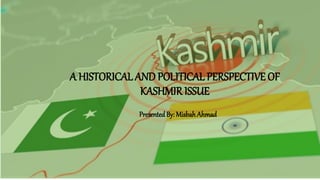
A HISTORICAL AND POLITICAL PERSPECTIVE OF
KASHMIRISSUE
PresentedBy: Misbah Ahmad
Origins of the Kashmir Problem
• In 1947, British India divided into India and Pakistan.
• Princely states could join either or remain independent.
• Indian Independence Act created both.
• Paramountcy ended, giving states choice.
• Mountbatten considered geography and interests.
• Kashmir's Maharaja initially sought independence but joined India
amidst conflict.
• Mountbatten promised plebiscite once order restored.
Early History
• Buddhism flourished in Kashmir under Ashoka,
promoted by Kanishka.
• Brief Hunnic rule followed by Ujjain Empire led
by Vikramaditya. Hindu rulers established a
dynasty blending Hinduism and Buddhism, led
by King Lalitaditya from 697 to 738 AD.
The beginning of Muslim rule
• Muslim rule in Kashmir began in 1339 with
Rianchin Shah's conversion to Islam.
• Shah Mir of Swat ended Hindu rule,
initiating a period marked by political,
intellectual, and spiritual changes favoring
Islam.
• Shahabuddin restored peace and
expanded territory.
• Zain-ul-Abidin ruled until 1470. Mughal
rule began with Emperor Akbar's conquest
in 1586, lasting until 1752.
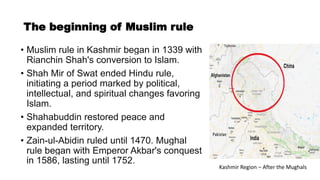
Kashmir Region – After the Mughals
The Sikh rule
• Guru Nanak's visit linked Sikhs to Kashmir.
• Under Guru Gobind Singh, Sikhs fought the Mughals.
• Ranjeet Singh aimed to control Kashmir with Afghan Shah Mahmood.
• Sikhs ruled Kashmir from 1814, marked by oppression, fueling
Kashmiri discontent.
The Treaty of Amritsar
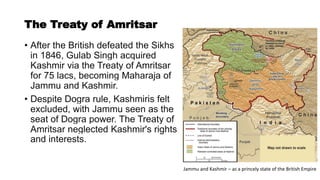
• After the British defeated the Sikhs
in 1846, Gulab Singh acquired
Kashmir via the Treaty of Amritsar
for 75 lacs, becoming Maharaja of
Jammu and Kashmir.
• Despite Dogra rule, Kashmiris felt
excluded, with Jammu seen as the
seat of Dogra power. The Treaty of
Amritsar neglected Kashmir's rights
and interests.
Jammu and Kashmir – as a princely state of the British Empire
Dogra’s
• Under Maharaja Hari Singh in the 1930s, Kashmiris felt
oppressed. "Kashmir for Kashmiris" movement led by Sheikh
Muhammad Abdullah emerged, sparking clashes and protests
against the Maharaja's rule.
• Major incidents in 1931, like interruptions during Eid prayers
and desecration of the Quran, fueled Muslim discontent against
religious interference and persecution.
Partition of the Sub-Continent
• Mountbatten Plan: June 3, 1947, set
independence for the Indian
subcontinent on August 15, 1947.
• Kashmir welcomed Pakistan, desired
freedom from Dogra rule.
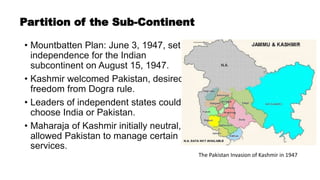
• Leaders of independent states could
choose India or Pakistan.
• Maharaja of Kashmir initially neutral,
allowed Pakistan to manage certain
services.
The Pakistan Invasion of Kashmir in 1947
Accession to India
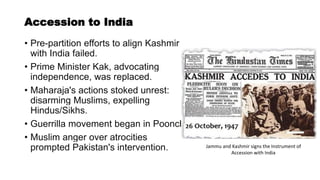
• Pre-partition efforts to align Kashmir
with India failed.
• Prime Minister Kak, advocating
independence, was replaced.
• Maharaja's actions stoked unrest:
disarming Muslims, expelling
Hindus/Sikhs.
• Guerrilla movement began in Poonch.
• Muslim anger over atrocities
prompted Pakistan's intervention. Jammu and Kashmir signs the Instrument of
Accession with India
The Genesis of the Issue
• Kashmir issue: Arising from 1947 partition of British India into
Pakistan and India.
• Mountbatten advised princely states to decide accession based on
geography and people's wishes.
• Kashmir's Maharaja sought independence, but its ties with Pakistan,
with a Muslim majority, complicated matters.
• Resentment grew due to Mountbatten's role, including the inclusion
of Gurdaspur, providing India with a land route to Kashmir.
Kashmir’s accession to India not
acceptable to Pakistan
• India claims Kashmir based on the Maharaja's accession, but
Pakistan disputes its legitimacy due to questions about the
Maharaja's authority and circumstances.
• The accession letter and India's acknowledgment are
considered invalid reasons for Kashmir's integration into India.
Kashmir Issue – External Disputes
• Since 1947, Kashmir has been a
conflict zone between India and
Pakistan, leading to wars.
• Pakistan claims Kashmir, and China
also asserts claims over parts of the
region, including Aksai Chin.
• India lost a war with China in 1962
over these territories.
• Pakistan ceded the Trans-Karakoram
Tract to China, further complicating
the situation.
Kashmir Issue – External Disputes
Kashmir Issue – Internal Disputes
• Article 370 grants Jammu and Kashmir special status, offering greater
autonomy.
• Unique constitution, selective application of Indian laws, and
property ownership restrictions for non-Kashmiri Indians are key
features.
• Views on revocation differ: some see it as hindering integration, while
others, especially Kashmiris, see it as insufficient autonomy.
Urge for Peace
• Initially, support for militancy, but now leaning
towards peace.
• Government in talks with separatist groups seeking
to renegotiate Kashmir's relationship with India
rather than pushing for independence.
Conclusions
• Kashmir's history: ruled by Muslims, Sikhs, Afghans, and
Dogras.
• Maharaja Gulab Singh's rule sparked resistance.
• During partition, he chose India amid conflict.
• Legitimacy of accession debated, Kashmiri voices ignored.
• Priority: Kashmiri aspirations for lasting solution.
A historical and political perspective of Kashmir issue