Rabab Salama
Clinical and Chemical Pathology Consultant
HCQM Specialist
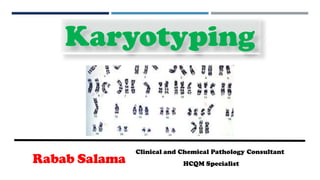
Karyotyping
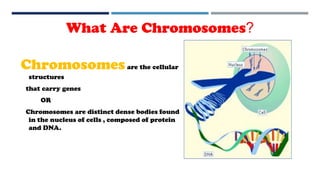
What Are Chromosomes?
Chromosomesare the cellular
structures
that carry genes
OR
Chromosomes are distinct dense bodies found
in the nucleus of cells , composed of protein
and DNA.
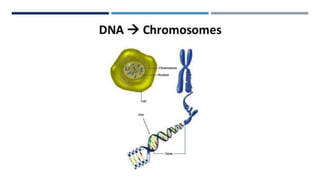
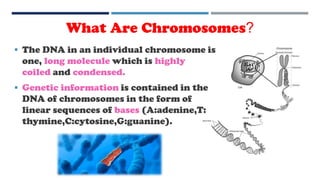
 The DNA in an individual chromosome is
one, long molecule which is highly
coiled and condensed.
 Genetic information is contained in the
DNA of chromosomes in the form of
linear sequences of bases (A:adenine,T:
thymine,C:cytosine,G:guanine).
What Are Chromosomes?
DNA ( Deoxyribonucleic acid)
&RNA (Ribonucleic acid)
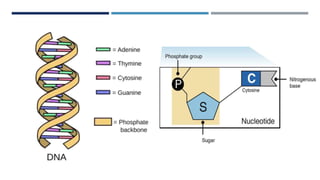
 In DNA the sugar is deoxyribose and the bases are
Adenine (A), Cytocine (C), Guanine (G) and Thymine
(T).
 Nucleotides are linked to one another by
phosphodiester bonds to form DNA polymer or
polynucleotide.
DNA ( Deoxyribonucleic acid)
&RNA (Ribonucleic acid)
 DNA is a double stranded, two polynucleotide being
wound around one another to form double helix.
 The double helix is held together by hydrogen bonds
between the base components of the nucleotide s of
the two strands.
The base pairing rules that:
1. A base-pairs with T.
2. G base- pairs with C
DNA ( Deoxyribonucleic acid)
&RNA (Ribonucleic acid)
DNA ( Deoxyribonucleic acid)
&RNA (Ribonucleic acid)
 So the two DNA molecules in the double
helix have complementary sequences.
 In the RNA the sugar is ribose and the
thymine base is replaced by the uracil
(U).
 RNA is usually single stranded.
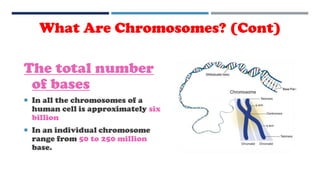
The total number
of bases
 In all the chromosomes of a
human cell is approximately six
billion
 In an individual chromosome
range from 50 to 250 million
base.
What Are Chromosomes? (Cont)
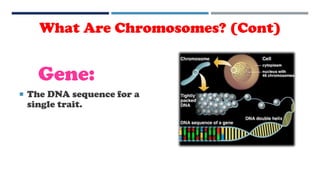
Gene:
 The DNA sequence for a
single trait.
What Are Chromosomes? (Cont)
Gene:
 Each chromosome contains a few
thousand genes.
 The estimate for the number of genes in
humans are thought to be between
30,000 and 40,000 genes.
What Are Chromosomes? (Cont)
Gene:
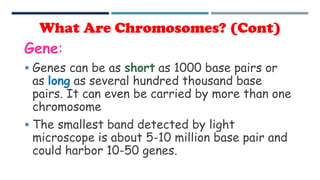
 Genes can be as short as 1000 base pairs or
as long as several hundred thousand base
pairs. It can even be carried by more than one
chromosome
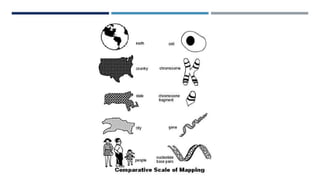
 The smallest band detected by light
microscope is about 5-10 million base pair and
could harbor 10-50 genes.
What Are Chromosomes? (Cont)
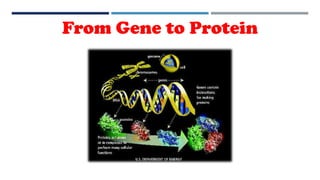
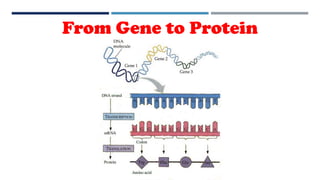
From Gene to Protein
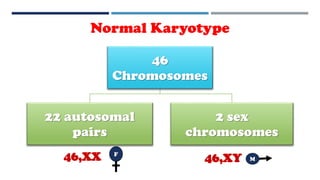
46
Chromosomes
22 autosomal
pairs
2 sex
chromosomes
Normal Karyotype
46,XY46,XX F
M
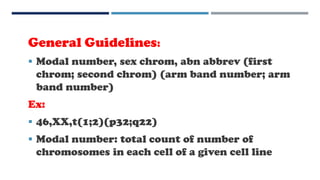
General Guidelines:
 Modal number, sex chrom, abn abbrev (first
chrom; second chrom) (arm band number; arm
band number)
Ex:
 46,XX,t(1;2)(p32;q22)
 Modal number: total count of number of
chromosomes in each cell of a given cell line
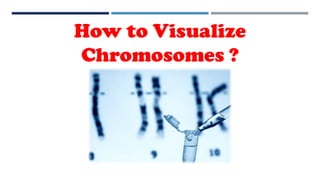
How to Visualize
Chromosomes ?
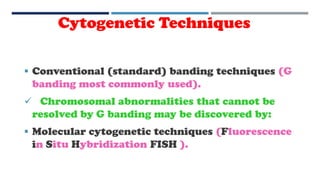
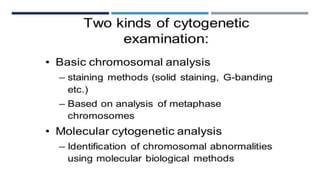
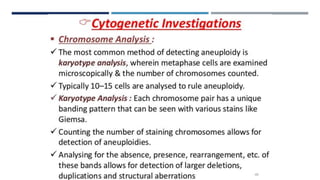
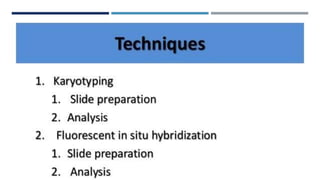
Cytogenetic Techniques
 Conventional (standard) banding techniques (G
banding most commonly used).
 Chromosomal abnormalities that cannot be
resolved by G banding may be discovered by:
 Molecular cytogenetic techniques (Fluorescence
in Situ Hybridization FISH ).
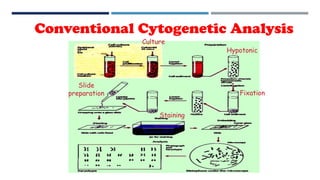
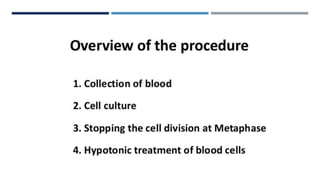
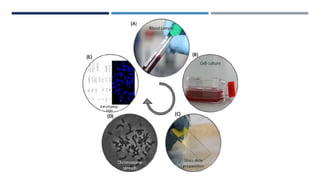
Conventional Cytogenetic Analysis
Culture
Hypotonic
Fixation
Slide
preparation
Staining
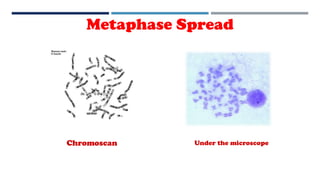
Metaphase Spread
Under the microscopeChromoscan
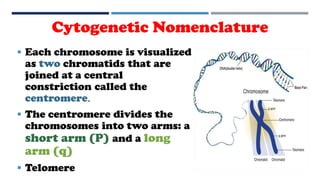
Cytogenetic Nomenclature
 Each chromosome is visualized
as two chromatids that are
joined at a central
constriction called the
centromere.
 The centromere divides the
chromosomes into two arms: a
short arm (P) and a long
arm (q)
 Telomere
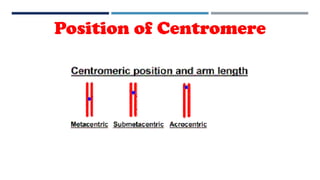
Position of Centromere
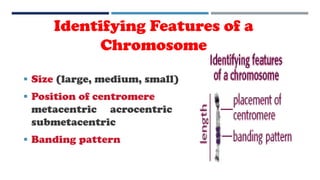
Identifying Features of a
Chromosome
 Size (large, medium, small)
 Position of centromere
metacentric acrocentric
submetacentric
 Banding pattern
Banding Techniques
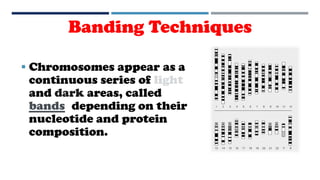
 Chromosomes appear as a
continuous series of light
and dark areas, called
bands depending on their
nucleotide and protein
composition.
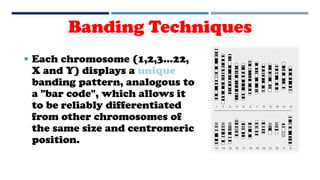
 Each chromosome (1,2,3...22,
X and Y) displays a unique
banding pattern, analogous to
a "bar code", which allows it
to be reliably differentiated
from other chromosomes of
the same size and centromeric
position.
Banding Techniques
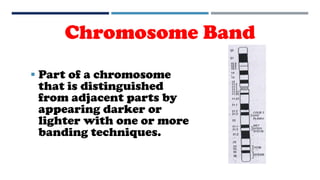
Chromosome Band
 Part of a chromosome
that is distinguished
from adjacent parts by
appearing darker or
lighter with one or more
banding techniques.
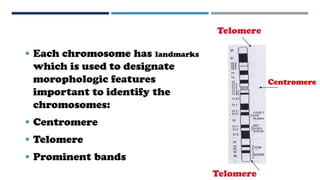
 Each chromosome has landmarks
which is used to designate
morophologic features
important to identify the
chromosomes:
 Centromere
 Telomere
 Prominent bands
Telomere
Telomere
Centromere
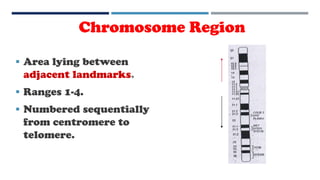
Chromosome Region
 Area lying between
adjacent landmarks.
 Ranges 1-4.
 Numbered sequentially
from centromere to
telomere.
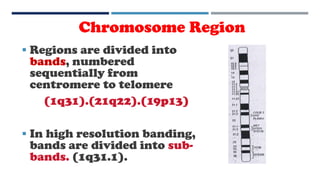
 Regions are divided into
bands, numbered
sequentially from
centromere to telomere
(1q31).(21q22).(19p13)
 In high resolution banding,
bands are divided into sub-
bands. (1q31.1).
Chromosome Region
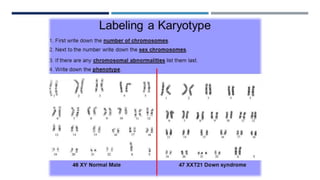
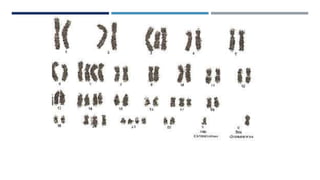
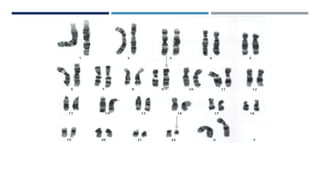
A Karyotype
 Arrangement of chromosomes from a
particular cell, the largest chromosomes
are first and the smallest ones are last.
 It is a description of the number and
structure of the chromosomes.
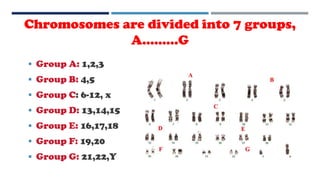
Chromosomes are divided into 7 groups,
A………G
 Group A: 1,2,3
 Group B: 4,5
 Group C: 6-12, x
 Group D: 13,14,15
 Group E: 16,17,18
 Group F: 19,20
 Group G: 21,22,Y
Chromosomal Abnormalities
 Numerical:A karyotype with
abnormal No. of chromosomes.
 Structural:Alterations in the
structure of chromosomes.
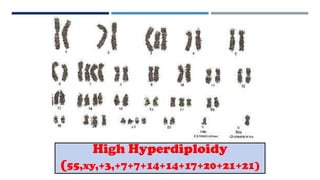
Hyperdiploid: more than 46 chromosomes.
Low Hyperdiploidy (47-50) Childhood ALL
High Hyperdiploidy (51-60) Childhood ALL
Near Tetraploidy
Near Triploidy
Numerical Abnormalities
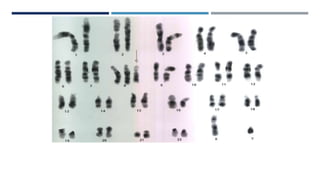
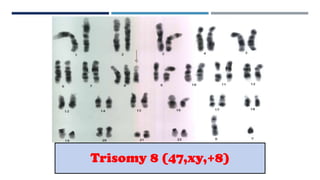
• Trisomy: gain of one copy (47,xy,+8)
The obvious molecular consequence of a trisomy is
the presence of an additional copy of all of the
genetic material on a chromosome.
• Tetrasomy: gain of two copies
Numerical Abnormalities
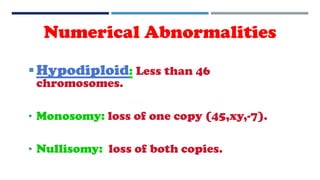
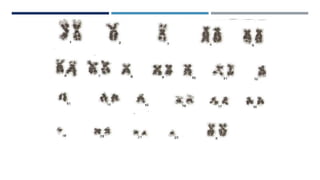
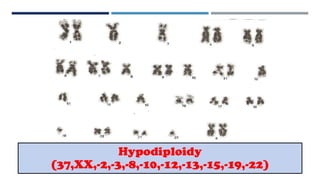
Hypodiploid: Less than 46
chromosomes.
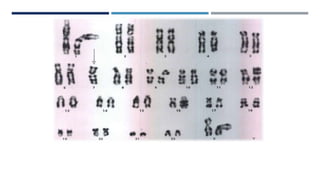
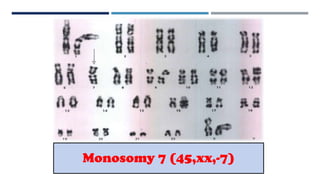
• Monosomy: loss of one copy (45,xy,-7).
• Nullisomy: loss of both copies.
Numerical Abnormalities
High Hyperdiploidy
(55,xy,+3,+7+7+14+14+17+20+21+21)
Trisomy 8 (47,xy,+8)
Hypodiploidy
(37,XX,-2,-3,-8,-10,-12,-13,-15,-19,-22)
Monosomy 7 (45,xx,-7)
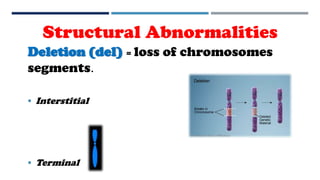
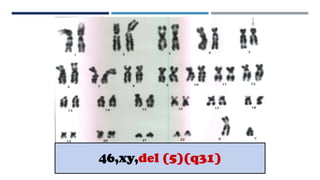
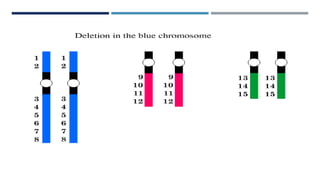
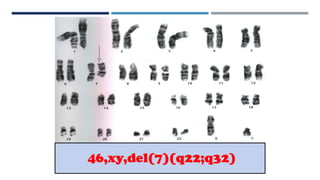
Deletion (del) = loss of chromosomes
segments.
 Interstitial
 Terminal
Structural Abnormalities
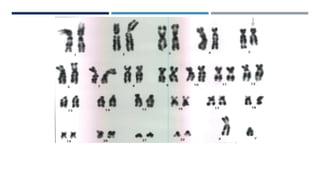
46,xy,del (5)(q31)
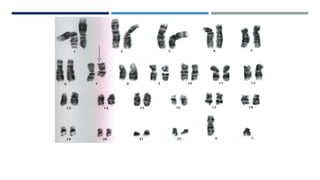
46,xy,del(7)(q22;q32)
Translocation
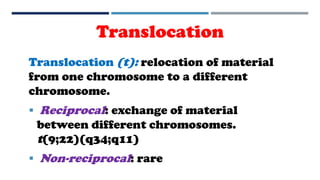
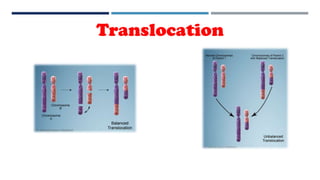
Translocation (t): relocation of material
from one chromosome to a different
chromosome.
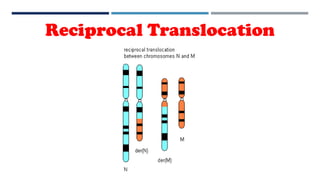
 Reciprocal: exchange of material
between different chromosomes.
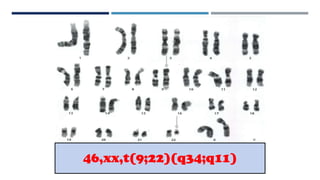
t(9;22)(q34;q11)
 Non-reciprocal: rare
Reciprocal Translocation
Translocation
46,xx,t(9;22)(q34;q11)
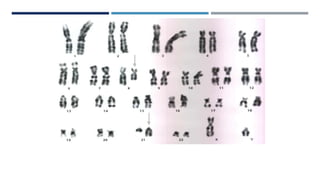
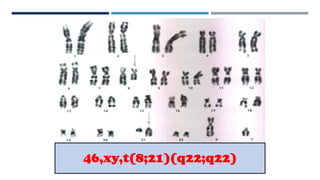
46,xy,t(8;21)(q22;q22)
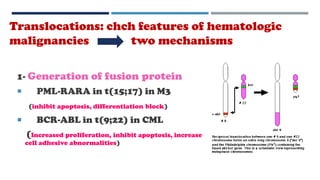
Translocations: chch features of hematologic
malignancies two mechanisms
1- Generation of fusion protein
 PML-RARA in t(15;17) in M3
(inhibit apoptosis, differentiation block)
 BCR-ABL in t(9;22) in CML
(Increased proliferation, inhibit apoptosis, increase
cell adhesive abnormalities)
Inversion
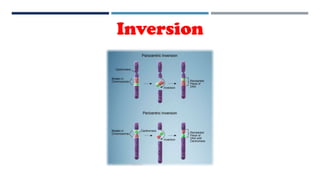
Inversion (inv): it is 180o rotation of a
chromosome segment
 Pericentric
 Paracentric
Inversion
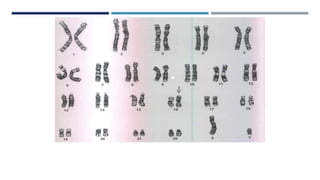
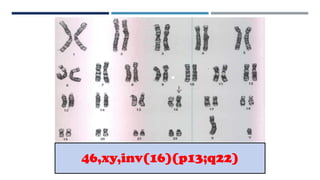
46,xy,inv(16)(p13;q22)
Isochromosome
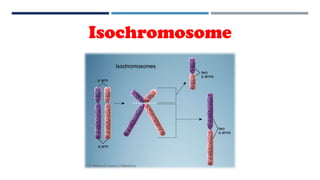
 Isochromosome (i): Two identical chromosome
arms positioned as mirror images of each other
[i(17q)]
 Isochromosome formation leads to both loss and
gain of genetic material
 i(17q) consists of two chromosome 17 long arms,
without short arms. Cells with i(17q) generally also
have one normal chromosome 17; thus, they have one
copy of 17p and three copies of 17q.
Isochromosome
 Diploid cell: A cell with a normal
complement of structurally normal
chromosomes.
 Pseudodiploid cell: A cell with 46
chromosomes but with numerical
chromosomal abnormality (e.g. loss of
one chromosome & gain of another) or
structural abnormality.
 Aneuploid cell: Cell with abnormal
number of chromosomes.
Karyotyping
Karyotyping

Karyotyping

  • 1.
    Rabab Salama Clinical andChemical Pathology Consultant HCQM Specialist Karyotyping
  • 2.
    What Are Chromosomes? Chromosomesarethe cellular structures that carry genes OR Chromosomes are distinct dense bodies found in the nucleus of cells , composed of protein and DNA.
  • 4.
     The DNAin an individual chromosome is one, long molecule which is highly coiled and condensed.  Genetic information is contained in the DNA of chromosomes in the form of linear sequences of bases (A:adenine,T: thymine,C:cytosine,G:guanine). What Are Chromosomes?
  • 6.
    DNA ( Deoxyribonucleicacid) &RNA (Ribonucleic acid)  In DNA the sugar is deoxyribose and the bases are Adenine (A), Cytocine (C), Guanine (G) and Thymine (T).  Nucleotides are linked to one another by phosphodiester bonds to form DNA polymer or polynucleotide.
  • 7.
    DNA ( Deoxyribonucleicacid) &RNA (Ribonucleic acid)  DNA is a double stranded, two polynucleotide being wound around one another to form double helix.  The double helix is held together by hydrogen bonds between the base components of the nucleotide s of the two strands.
  • 8.
    The base pairingrules that: 1. A base-pairs with T. 2. G base- pairs with C DNA ( Deoxyribonucleic acid) &RNA (Ribonucleic acid)
  • 9.
    DNA ( Deoxyribonucleicacid) &RNA (Ribonucleic acid)  So the two DNA molecules in the double helix have complementary sequences.  In the RNA the sugar is ribose and the thymine base is replaced by the uracil (U).  RNA is usually single stranded.
  • 10.
    The total number ofbases  In all the chromosomes of a human cell is approximately six billion  In an individual chromosome range from 50 to 250 million base. What Are Chromosomes? (Cont)
  • 11.
    Gene:  The DNAsequence for a single trait. What Are Chromosomes? (Cont)
  • 12.
    Gene:  Each chromosomecontains a few thousand genes.  The estimate for the number of genes in humans are thought to be between 30,000 and 40,000 genes. What Are Chromosomes? (Cont)
  • 13.
    Gene:  Genes canbe as short as 1000 base pairs or as long as several hundred thousand base pairs. It can even be carried by more than one chromosome  The smallest band detected by light microscope is about 5-10 million base pair and could harbor 10-50 genes. What Are Chromosomes? (Cont)
  • 14.
    From Gene toProtein
  • 15.
    From Gene toProtein
  • 17.
  • 18.
    General Guidelines:  Modalnumber, sex chrom, abn abbrev (first chrom; second chrom) (arm band number; arm band number) Ex:  46,XX,t(1;2)(p32;q22)  Modal number: total count of number of chromosomes in each cell of a given cell line
  • 19.
  • 20.
    Cytogenetic Techniques  Conventional(standard) banding techniques (G banding most commonly used).  Chromosomal abnormalities that cannot be resolved by G banding may be discovered by:  Molecular cytogenetic techniques (Fluorescence in Situ Hybridization FISH ).
  • 24.
  • 27.
    Metaphase Spread Under themicroscopeChromoscan
  • 28.
    Cytogenetic Nomenclature  Eachchromosome is visualized as two chromatids that are joined at a central constriction called the centromere.  The centromere divides the chromosomes into two arms: a short arm (P) and a long arm (q)  Telomere
  • 29.
  • 30.
    Identifying Features ofa Chromosome  Size (large, medium, small)  Position of centromere metacentric acrocentric submetacentric  Banding pattern
  • 31.
    Banding Techniques  Chromosomesappear as a continuous series of light and dark areas, called bands depending on their nucleotide and protein composition.
  • 32.
     Each chromosome(1,2,3...22, X and Y) displays a unique banding pattern, analogous to a "bar code", which allows it to be reliably differentiated from other chromosomes of the same size and centromeric position. Banding Techniques
  • 33.
    Chromosome Band  Partof a chromosome that is distinguished from adjacent parts by appearing darker or lighter with one or more banding techniques.
  • 34.
     Each chromosomehas landmarks which is used to designate morophologic features important to identify the chromosomes:  Centromere  Telomere  Prominent bands Telomere Telomere Centromere
  • 35.
    Chromosome Region  Arealying between adjacent landmarks.  Ranges 1-4.  Numbered sequentially from centromere to telomere.
  • 36.
     Regions aredivided into bands, numbered sequentially from centromere to telomere (1q31).(21q22).(19p13)  In high resolution banding, bands are divided into sub- bands. (1q31.1). Chromosome Region
  • 37.
    A Karyotype  Arrangementof chromosomes from a particular cell, the largest chromosomes are first and the smallest ones are last.  It is a description of the number and structure of the chromosomes.
  • 38.
    Chromosomes are dividedinto 7 groups, A………G  Group A: 1,2,3  Group B: 4,5  Group C: 6-12, x  Group D: 13,14,15  Group E: 16,17,18  Group F: 19,20  Group G: 21,22,Y
  • 39.
    Chromosomal Abnormalities  Numerical:Akaryotype with abnormal No. of chromosomes.  Structural:Alterations in the structure of chromosomes.
  • 40.
    Hyperdiploid: more than46 chromosomes. Low Hyperdiploidy (47-50) Childhood ALL High Hyperdiploidy (51-60) Childhood ALL Near Tetraploidy Near Triploidy Numerical Abnormalities
  • 41.
    • Trisomy: gainof one copy (47,xy,+8) The obvious molecular consequence of a trisomy is the presence of an additional copy of all of the genetic material on a chromosome. • Tetrasomy: gain of two copies Numerical Abnormalities
  • 42.
    Hypodiploid: Less than46 chromosomes. • Monosomy: loss of one copy (45,xy,-7). • Nullisomy: loss of both copies. Numerical Abnormalities
  • 45.
  • 47.
  • 49.
  • 51.
  • 52.
    Deletion (del) =loss of chromosomes segments.  Interstitial  Terminal Structural Abnormalities
  • 54.
  • 57.
  • 58.
    Translocation Translocation (t): relocationof material from one chromosome to a different chromosome.  Reciprocal: exchange of material between different chromosomes. t(9;22)(q34;q11)  Non-reciprocal: rare
  • 59.
  • 60.
  • 62.
  • 64.
  • 65.
    Translocations: chch featuresof hematologic malignancies two mechanisms 1- Generation of fusion protein  PML-RARA in t(15;17) in M3 (inhibit apoptosis, differentiation block)  BCR-ABL in t(9;22) in CML (Increased proliferation, inhibit apoptosis, increase cell adhesive abnormalities)
  • 66.
    Inversion Inversion (inv): itis 180o rotation of a chromosome segment  Pericentric  Paracentric
  • 67.
  • 69.
  • 70.
    Isochromosome  Isochromosome (i):Two identical chromosome arms positioned as mirror images of each other [i(17q)]  Isochromosome formation leads to both loss and gain of genetic material  i(17q) consists of two chromosome 17 long arms, without short arms. Cells with i(17q) generally also have one normal chromosome 17; thus, they have one copy of 17p and three copies of 17q.
  • 71.
  • 72.
     Diploid cell:A cell with a normal complement of structurally normal chromosomes.  Pseudodiploid cell: A cell with 46 chromosomes but with numerical chromosomal abnormality (e.g. loss of one chromosome & gain of another) or structural abnormality.  Aneuploid cell: Cell with abnormal number of chromosomes.