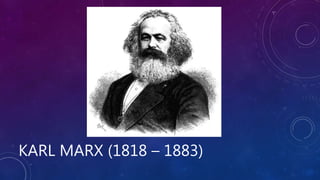
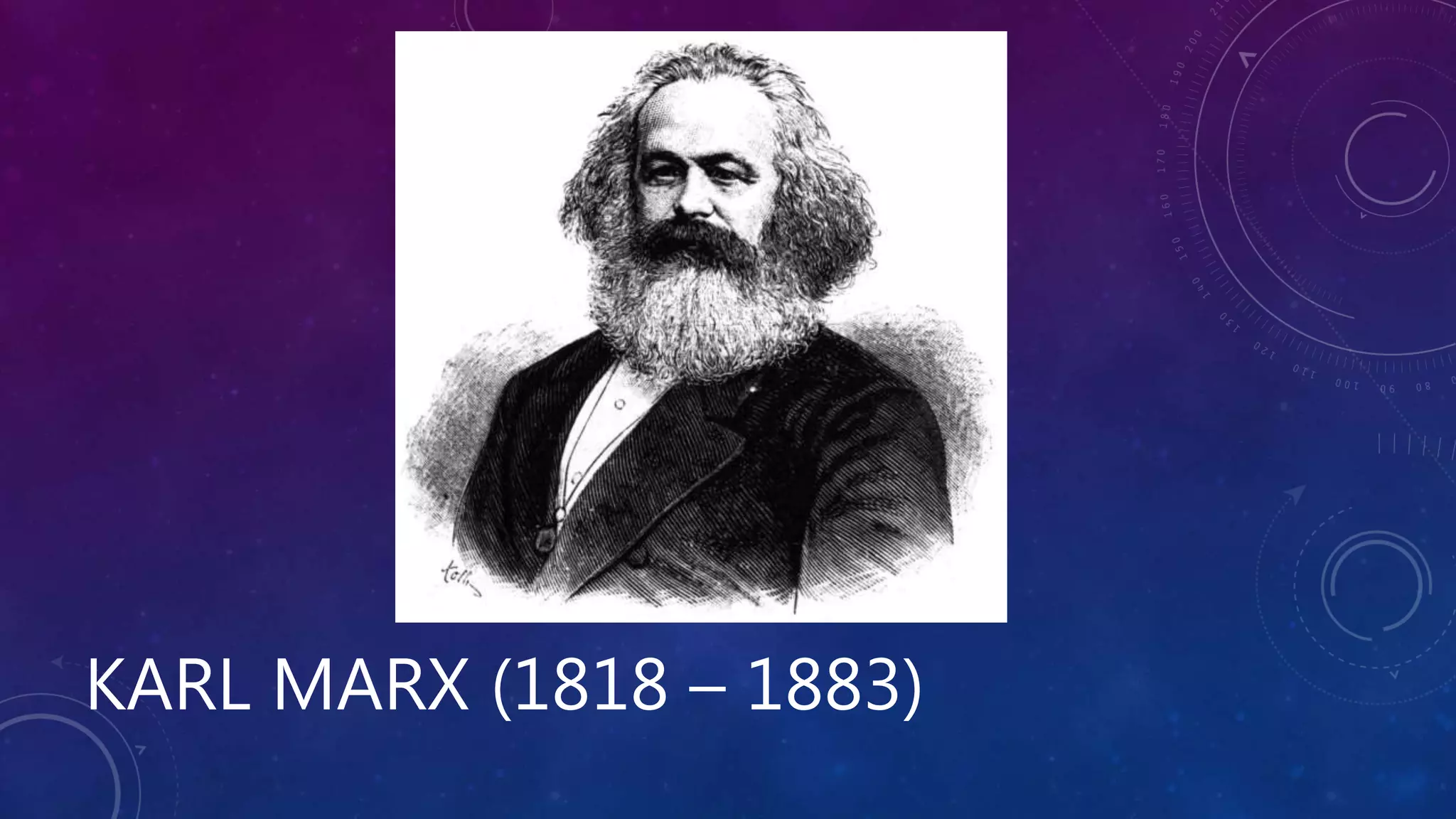
KARL MARX (1818 – 1883)
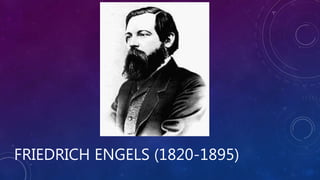
FRIEDRICH ENGELS (1820-1895)
MARXISM
IT ORIGINATES FROM THE MID-TO-LATE
19TH CENTURY WORKS OF GERMAN
PHILOSOPHERS KARL MARX AND
FRIEDRICH ENGELS.
Is a social, political and
economic philosophy that
examines the effect of
capitalism on labor,
productivity and economic
development.
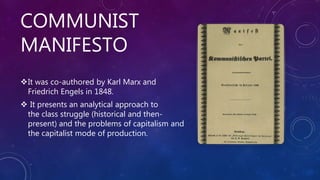
COMMUNIST
MANIFESTO
It was co-authored by Karl Marx and
Friedrich Engels in 1848.
 It presents an analytical approach to
the class struggle (historical and then-
present) and the problems of capitalism and
the capitalist mode of production.
ANOTHER…
CENTRAL TO MARX’S THINKING
Social Conflict
Class Conflict or Class
Struggle
The struggle between segments of
society over valued resources.
The conflict between entire classes
over the distribution of a society’s
wealth and power.
Industrial
Revolution
• The period from about 1760 to
sometime between 1820 and
1840
• Began in Great Britain
 From hand production
to machines
 New chemical
manufacturing
 New iron production
processes
 Improves efficiency of
power
 The increasing use of
steam power
 The development of
machine tools
 The rise of the factories
CAPITALISM
CAPITALIST
An economic and political
system in which a country's
trade and industry are
controlled by private
owners for profit, rather
than by the state.
A person who owns and
operates factories and other
businesses in pursuit of
profits.
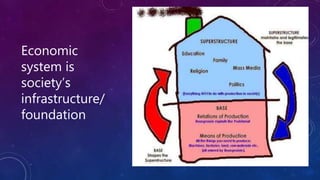
Economic
system is
society’s
infrastructure/
foundation
INDUSTRIAL CAPITALISM
IN EUROPE
It turned a small part of the population into
capitalist.
Capitalism turns most of the population into
industrial workers called Proletarians
Capitalist production always ends up creating
conflict between capitalist and workers.
It produces Alienation
Socialism
a political and economic theory of social organization that
advocates that the means of production, distribution, and
exchange should be owned or regulated by the community
as a whole.
Communism
a political theory derived from Karl Marx, advocating class
war and leading to a society in which all property is
publicly owned and each person works and is paid
according to their abilities and needs.
MARX’S THEORIES
Labors can develop…
Class Consciousness
False Consciousness
Awareness of one's place in a
system of social classes
A way of thinking that prevents a
person from perceiving the true
nature of their social or economic
situation.
ACCORDING TO MARX……
“ It is not ‘people’ who make society unequal,
it is the system of capitalist production and
hurts people by hiding the real cause of their
problems.”
ALIENATION
“The experience of isolation and
misery resulting from
powerlessness.”
4 WAYS CAPITALISM ALIENATES WORKERS
Alienation from the act of working: Workers are replaced
by/turned into machines.
Alienation from the product of work: Workers’ products
belongs to the capitalists who sell it for profit.
Alienation from other workers: Industrial capitalism creates
competition in work that prevents bond in the community.
Alienation from human potential: Capitalism prevents workers
to develop their best qualities as human beings.
MARX’S IDEAS TO END THE CAPITALISM
1.Industrial workers must become aware of their
oppression under a capitalist system and realize that
capitalism is the cause of their oppression.
2.The proletariat must organize and act to address
their problems. This means that they develop their
class consciousness, “workers’ recognition of
themselves as a class unified in opposition to
capitalist and ultimately to capitalism itself.”
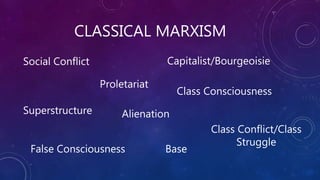
CLASSICAL MARXISM
Social Conflict
Class Conflict/Class
Struggle
Class Consciousness
False Consciousness
Alienation
Proletariat
Superstructure
Base
Capitalist/Bourgeoisie
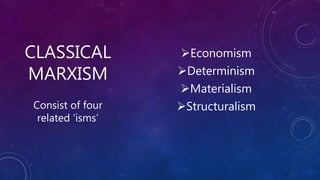
CLASSICAL
MARXISM
Economism
Determinism
Materialism
StructuralismConsist of four
related ‘isms’
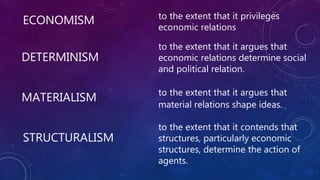
ECONOMISM to the extent that it privileges
economic relations
DETERMINISM
to the extent that it argues that
economic relations determine social
and political relation.
MATERIALISM to the extent that it argues that
material relations shape ideas.
STRUCTURALISM
to the extent that it contends that
structures, particularly economic
structures, determine the action of
agents.
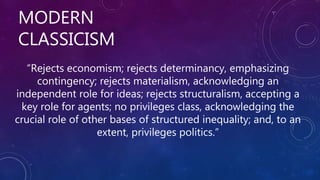
MODERN
CLASSICISM
“Rejects economism; rejects determinancy, emphasizing
contingency; rejects materialism, acknowledging an
independent role for ideas; rejects structuralism, accepting a
key role for agents; no privileges class, acknowledging the
crucial role of other bases of structured inequality; and, to an
extent, privileges politics.”
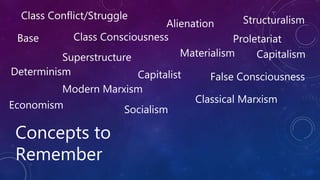
Concepts to
Remember
Class Conflict/Struggle
Class Consciousness
Capitalist
Capitalism
Alienation
False ConsciousnessDeterminism
Economism
Materialism
Structuralism
Modern Marxism
Proletariat
Classical Marxism
Superstructure
Base
Socialism

Marxism

  • 1.
    KARL MARX (1818– 1883)
  • 2.
  • 3.
    MARXISM IT ORIGINATES FROMTHE MID-TO-LATE 19TH CENTURY WORKS OF GERMAN PHILOSOPHERS KARL MARX AND FRIEDRICH ENGELS.
  • 4.
    Is a social,political and economic philosophy that examines the effect of capitalism on labor, productivity and economic development.
  • 5.
    COMMUNIST MANIFESTO It was co-authoredby Karl Marx and Friedrich Engels in 1848.  It presents an analytical approach to the class struggle (historical and then- present) and the problems of capitalism and the capitalist mode of production.
  • 6.
    ANOTHER… CENTRAL TO MARX’STHINKING Social Conflict Class Conflict or Class Struggle The struggle between segments of society over valued resources. The conflict between entire classes over the distribution of a society’s wealth and power.
  • 7.
    Industrial Revolution • The periodfrom about 1760 to sometime between 1820 and 1840 • Began in Great Britain  From hand production to machines  New chemical manufacturing  New iron production processes  Improves efficiency of power  The increasing use of steam power  The development of machine tools  The rise of the factories
  • 8.
    CAPITALISM CAPITALIST An economic andpolitical system in which a country's trade and industry are controlled by private owners for profit, rather than by the state. A person who owns and operates factories and other businesses in pursuit of profits.
  • 9.
  • 10.
    INDUSTRIAL CAPITALISM IN EUROPE Itturned a small part of the population into capitalist. Capitalism turns most of the population into industrial workers called Proletarians Capitalist production always ends up creating conflict between capitalist and workers. It produces Alienation
  • 11.
    Socialism a political andeconomic theory of social organization that advocates that the means of production, distribution, and exchange should be owned or regulated by the community as a whole. Communism a political theory derived from Karl Marx, advocating class war and leading to a society in which all property is publicly owned and each person works and is paid according to their abilities and needs.
  • 12.
    MARX’S THEORIES Labors candevelop… Class Consciousness False Consciousness Awareness of one's place in a system of social classes A way of thinking that prevents a person from perceiving the true nature of their social or economic situation.
  • 13.
    ACCORDING TO MARX…… “It is not ‘people’ who make society unequal, it is the system of capitalist production and hurts people by hiding the real cause of their problems.”
  • 14.
    ALIENATION “The experience ofisolation and misery resulting from powerlessness.”
  • 15.
    4 WAYS CAPITALISMALIENATES WORKERS Alienation from the act of working: Workers are replaced by/turned into machines. Alienation from the product of work: Workers’ products belongs to the capitalists who sell it for profit. Alienation from other workers: Industrial capitalism creates competition in work that prevents bond in the community. Alienation from human potential: Capitalism prevents workers to develop their best qualities as human beings.
  • 16.
    MARX’S IDEAS TOEND THE CAPITALISM 1.Industrial workers must become aware of their oppression under a capitalist system and realize that capitalism is the cause of their oppression. 2.The proletariat must organize and act to address their problems. This means that they develop their class consciousness, “workers’ recognition of themselves as a class unified in opposition to capitalist and ultimately to capitalism itself.”
  • 17.
    CLASSICAL MARXISM Social Conflict ClassConflict/Class Struggle Class Consciousness False Consciousness Alienation Proletariat Superstructure Base Capitalist/Bourgeoisie
  • 18.
  • 19.
    ECONOMISM to theextent that it privileges economic relations DETERMINISM to the extent that it argues that economic relations determine social and political relation. MATERIALISM to the extent that it argues that material relations shape ideas. STRUCTURALISM to the extent that it contends that structures, particularly economic structures, determine the action of agents.
  • 20.
    MODERN CLASSICISM “Rejects economism; rejectsdeterminancy, emphasizing contingency; rejects materialism, acknowledging an independent role for ideas; rejects structuralism, accepting a key role for agents; no privileges class, acknowledging the crucial role of other bases of structured inequality; and, to an extent, privileges politics.”
  • 21.
    Concepts to Remember Class Conflict/Struggle ClassConsciousness Capitalist Capitalism Alienation False ConsciousnessDeterminism Economism Materialism Structuralism Modern Marxism Proletariat Classical Marxism Superstructure Base Socialism