Content
 HUMAN POTENTIAL
 LABOR
 ALIENATION
 STRUCTURE OF CAPITALIST
SOCIETY
 CRITICISM
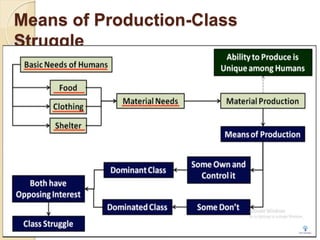
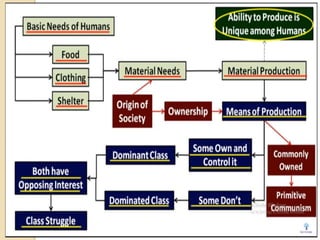
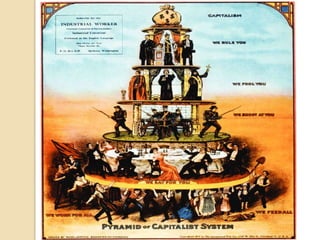
Means of Production-Class
Struggle
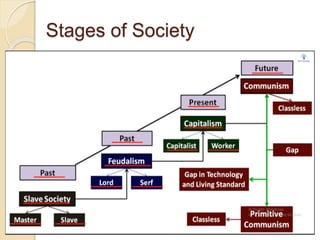
Stages of Society
Human Potential
 Marx often used the term species
being.
 By this he meant the potentials and
powers that are uniquely human and
that distinguish humans from other
species.
Labor
 Labor is a process in which both man and nature
participate.
 There is a relation between man and nature.
 The objectification of our purpose
Process in which we create external objects out of
our internal thoughts objectification.
Our labor creates something in reality that previously
existed only in our imagination. Our production reflects our
purpose.
 Labor is material
Our Labor works with material aspects of nature
(e.g. raising fruits and vegetables, cutting down trees for
wood)
 The transformation of our human nature
Marx believed that this labor does not just transform
the material aspects of nature but also transforms us,
including our needs, our consciousness, and our
human nature.
 Labor is in response to our needs but it transforms
our needs
Satisfaction of needs Creation of new needs
Production of cars creation of highways
Capitalism
“An economic and political system in which a
country's trade and industry are controlled by
private owners for profit, rather than by the state.”
People and companies make most of the decisions,
and own most of the property. ... The means of
production are largely or entirely privately owned
(by individuals or companies) and operated for
profit.
Alienation
The relation between labor and human nature is
spoiled by capitalism. He calls this perverted
relation alienation.
Labor is no more an expression of our purpose.
Instead, we labor in accordance with the purpose of
the capitalist who hires and pays us.
i.e. earning money not an expression of human
capabilities.
Because our labor is not our own, it no longer
transforms us.
Instead we are alienated from our labor and therefore
alienated from our true human nature.
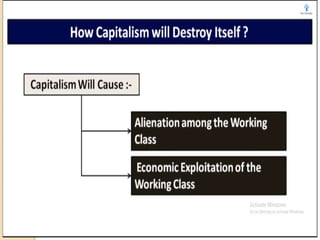
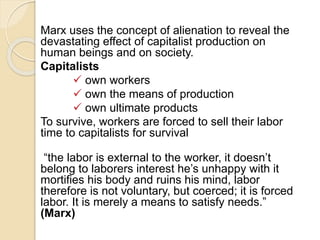
Marx uses the concept of alienation to reveal the
devastating effect of capitalist production on
human beings and on society.
Capitalists
 own workers
 own the means of production
 own ultimate products
To survive, workers are forced to sell their labor
time to capitalists for survival
“the labor is external to the worker, it doesn’t
belong to laborers interest he’s unhappy with it
mortifies his body and ruins his mind, labor
therefore is not voluntary, but coerced; it is forced
labor. It is merely a means to satisfy needs.”
(Marx)
Types of Alienation
Alienation
From
Coworkers
Productive
Activity
Product
Human
Potential
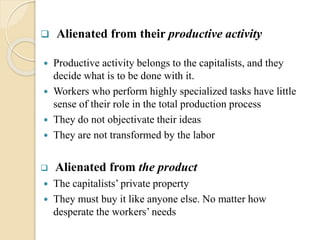
 Alienated from their productive activity
 Productive activity belongs to the capitalists, and they
decide what is to be done with it.
 Workers who perform highly specialized tasks have little
sense of their role in the total production process
 They do not objectivate their ideas
 They are not transformed by the labor
 Alienated from the product
 The capitalists’ private property
 They must buy it like anyone else. No matter how
desperate the workers’ needs
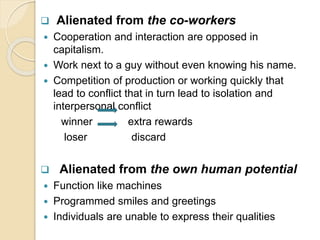
 Alienated from the co-workers
 Cooperation and interaction are opposed in
capitalism.
 Work next to a guy without even knowing his name.
 Competition of production or working quickly that
lead to conflict that in turn lead to isolation and
interpersonal conflict
winner extra rewards
loser discard
 Alienated from the own human potential
 Function like machines
 Programmed smiles and greetings
 Individuals are unable to express their qualities
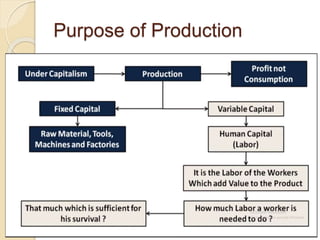
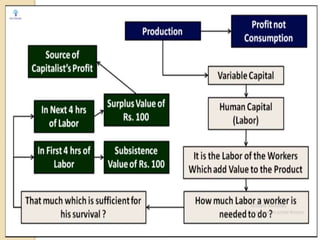
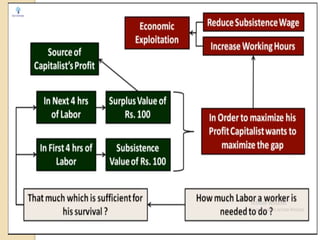
Purpose of Production
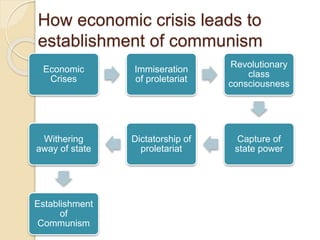
How economic crisis leads to
establishment of communism
Economic
Crises
Immiseration
of proletariat
Revolutionary
class
consciousness
Capture of
state power
Dictatorship of
proletariat
Withering
away of state
Establishment
of
Communism
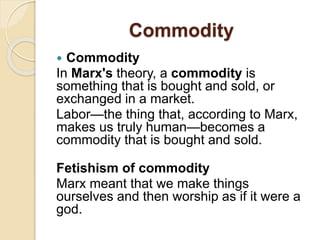
Commodity
 Commodity
In Marx's theory, a commodity is
something that is bought and sold, or
exchanged in a market.
Labor—the thing that, according to Marx,
makes us truly human—becomes a
commodity that is bought and sold.
Fetishism of commodity
Marx meant that we make things
ourselves and then worship as if it were a
god.
Criticisms
 The failure of communist societies and their
turn to a more capitalistically oriented
economy.
 Marx’s theory places the proletariat at the
heart of the social change leading to
communism, the proletariat has rarely
assumed this leading position and often is
among the groups that are most opposed to
communism.
 The missing dimension of gender.
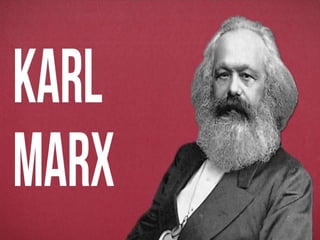
Karl Marx

Karl Marx

  • 2.
    Content  HUMAN POTENTIAL LABOR  ALIENATION  STRUCTURE OF CAPITALIST SOCIETY  CRITICISM
  • 3.
  • 5.
  • 6.
    Human Potential  Marxoften used the term species being.  By this he meant the potentials and powers that are uniquely human and that distinguish humans from other species.
  • 7.
    Labor  Labor isa process in which both man and nature participate.  There is a relation between man and nature.  The objectification of our purpose Process in which we create external objects out of our internal thoughts objectification. Our labor creates something in reality that previously existed only in our imagination. Our production reflects our purpose.  Labor is material Our Labor works with material aspects of nature (e.g. raising fruits and vegetables, cutting down trees for wood)
  • 8.
     The transformationof our human nature Marx believed that this labor does not just transform the material aspects of nature but also transforms us, including our needs, our consciousness, and our human nature.  Labor is in response to our needs but it transforms our needs Satisfaction of needs Creation of new needs Production of cars creation of highways
  • 9.
    Capitalism “An economic andpolitical system in which a country's trade and industry are controlled by private owners for profit, rather than by the state.” People and companies make most of the decisions, and own most of the property. ... The means of production are largely or entirely privately owned (by individuals or companies) and operated for profit.
  • 12.
    Alienation The relation betweenlabor and human nature is spoiled by capitalism. He calls this perverted relation alienation. Labor is no more an expression of our purpose. Instead, we labor in accordance with the purpose of the capitalist who hires and pays us. i.e. earning money not an expression of human capabilities. Because our labor is not our own, it no longer transforms us. Instead we are alienated from our labor and therefore alienated from our true human nature.
  • 13.
    Marx uses theconcept of alienation to reveal the devastating effect of capitalist production on human beings and on society. Capitalists  own workers  own the means of production  own ultimate products To survive, workers are forced to sell their labor time to capitalists for survival “the labor is external to the worker, it doesn’t belong to laborers interest he’s unhappy with it mortifies his body and ruins his mind, labor therefore is not voluntary, but coerced; it is forced labor. It is merely a means to satisfy needs.” (Marx)
  • 14.
  • 15.
     Alienated fromtheir productive activity  Productive activity belongs to the capitalists, and they decide what is to be done with it.  Workers who perform highly specialized tasks have little sense of their role in the total production process  They do not objectivate their ideas  They are not transformed by the labor  Alienated from the product  The capitalists’ private property  They must buy it like anyone else. No matter how desperate the workers’ needs
  • 16.
     Alienated fromthe co-workers  Cooperation and interaction are opposed in capitalism.  Work next to a guy without even knowing his name.  Competition of production or working quickly that lead to conflict that in turn lead to isolation and interpersonal conflict winner extra rewards loser discard  Alienated from the own human potential  Function like machines  Programmed smiles and greetings  Individuals are unable to express their qualities
  • 17.
  • 21.
    How economic crisisleads to establishment of communism Economic Crises Immiseration of proletariat Revolutionary class consciousness Capture of state power Dictatorship of proletariat Withering away of state Establishment of Communism
  • 22.
    Commodity  Commodity In Marx'stheory, a commodity is something that is bought and sold, or exchanged in a market. Labor—the thing that, according to Marx, makes us truly human—becomes a commodity that is bought and sold. Fetishism of commodity Marx meant that we make things ourselves and then worship as if it were a god.
  • 24.
    Criticisms  The failureof communist societies and their turn to a more capitalistically oriented economy.  Marx’s theory places the proletariat at the heart of the social change leading to communism, the proletariat has rarely assumed this leading position and often is among the groups that are most opposed to communism.  The missing dimension of gender.