Horney


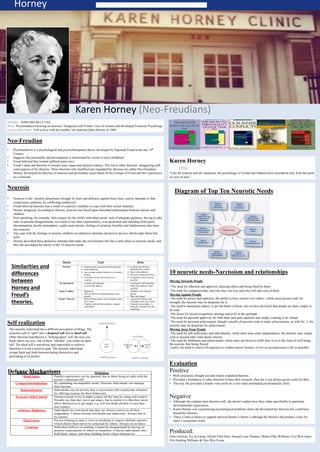
                                                              Karen Horney (Neo-Freudians)
Birthday: 16/09/1885-04/12/1952
Work: Psychoanalyst focusing on neurosis. Disagreed with Freud’s view of women and developed Feminine Psychology
Relationship Status: Fell in love with her brother, but married Osker Horney in 1909.


Neo-Freudian
•      Psychoanalysis is a psychological and psychotherapeutic theory developed by Sigmund Freud in the late 19th
       Century.
•      Suggests that personality and development is determined by events in early childhood
•      Freud believed that women suffered penis envy                                                                                               Karen Horney
•      Freud’s ideas and theories of women were vague and lacked evidence. This led to other theorists’ disagreeing with
       some aspects of his theories. These theorists who modified and expanded his theories are called Neo-Freudians                                      1926
•      Horney developed her theories of neurosis and personality types based on her critique of Freud and her experiences                          “Like all sciences and all valuations, the psychology of women has hitherto been considered only from the point
       as a clinician.                                                                                                                             of view of men.”


Neurosis
                                                                                                                                                       Diagram of Top Ten Neurotic Needs
•      Neurosis is the “psychic disturbance brought by fears and defences against these fears, and by attempts to find
       compromise solutions for conflicting tendencies”
•      Freud believed neurosis was a result of a person’s inability to cope with their sexual impulses
•      Horney disagreed. According to Horney, neurosis was based upon disturbed relationships between parents and
       children.
•      Poor parenting, for example, little respect for the child's individual needs, lack of adequate guidance, having to take
       sides in parental disagreements, too much or too little responsibility, over-protection and shielding from peers,
       discrimination, hostile atmosphere, could cause anxiety (feeling of isolation, hostility and helplessness) that turns
       into neurosis
•      Top cope with the feelings of anxiety, children use defensive attitudes (protective devices which make them feel
       safe)
•      Horney described these defensive attitudes that make the environment feel like a safer place as neurotic needs- and
       thus she developed her theory of the 10 neurotic needs.


                                              Theories                           Freud                                    Horney

     Similarities and                         Neurosis          Instinctual drives determined biologically.
                                                                Deny problems.
                                                                                                                 Feelings and attitudes
                                                                                                                  determined by culture.

     differences                                                Ego concept without initiative or executive
                                                                 powers.
                                                                                                                 Deal with problems.
                                                                                                                 Driven by emotional forces.
                                                                                                                                                   10 neurotic needs-Narcissism and relationships
                                                                Convulsive drives but not driven to             Compulsive drives but are
     between                                Psychoanalysis
                                                                 neurosis.
                                                                Avoids self-realisation.
                                                                                                                  neurotic.
                                                                                                                 Looking for self-realisation
                                                                                                                                                   Moving Towards People

     Horney and                                                 Love for the analyst.                           Help from analyst to deal
                                                                                                                  with life.
                                                                                                                                                   -The need for affection and approval; pleasing others and being liked by them.
                                           Inner Conflicts        Repressed.                                    Abilities to be a decent         -The want for companionship; one who they can love and who will take care of them.
     Freud’s                                                      Did not believe in human goodness and
                                                                   growth.
                                                                                                                  person.
                                                                                                                 Man can change.
                                                                                                                                                   Moving Against People
                                           Freud’s Theories       Believed that primary and secondary penis-    Agreed that primary and          -The need for power and authority; the ability to have control over others—while most persons look for
     theories.                                                 
                                                                   envy exists.
                                                                   Feminity derived from primary, original,
                                                                                                                  secondary penis-envy exists.
                                                                                                                 Feminity was primary. A
                                                                                                                                                   strength, the neurotic may be desperate for it.
                                                                   masculinity.                                   little girl is female from the   -The need to manipulate others; to get the better of them; also to have the belief that people are there simply to
                                                                                                                  beginning.
                                                                                                                                                   be used.
                                                                                                                                                   -The desire for social recognition; prestige and to be in the spotlight.
                                                                                                                                                   -The need for personal approval; for both inner and outer qualities and simply wanting to be valued.
Self realization                                                                                                                                   -The need for personal achievement; though virtually all persons wish to make achievements, as with No. 3, the
                                                                                                                                                   neurotic may be desperate for achievement.
    The neurotic individual has a different perception of things. The                                                                              Moving Away from People
    neurotics self is "split" into a despised self and an ideal self.                                                                              -The need for self-sufficiency and individuality; while most want some independence, the neurotic may simply
    Other theorists hypothesise a "looking-glass" self, the way you                                                                                wish to discard other individuals entirely.
    think others see you. Out of these "shoulds“ you create an ideal                                                                               -The need for fulfilment and achievement; while some are driven to fulfil their lives in the form of well being,
    self. The ideal self is unrealistic and impossible to achieve,                                                                                 the neurotic fear being flawed.
    therefore it is not a positive goal. The neurotic individual                                                                                   -Lastly, the need to restrict life practices to within narrow borders; to live as inconspicuous a life as possible
    swings back and forth between hating themselves and
    pretending to be perfect.

                                                                                                                                                   Evaluation
Defense Mechanisms
   Defence Mechanisms                                                 Definition
                                                                                                                                                   Positive
               Blind Spots             Painful experiences can be ignored, due to them being at odds with the                                      • Well structured, thought out and clearly explained theories.
                                       person’s idealised self.                                                                                    • Provided a foundation to other theorists to base their research, (but she is not always given credit for this).
        Compartmentalisation           By separating incompatible needs, Neurotic Individuals can manage                                           • The way she provided a female view point on a very male dominated psychoanalytic field.
                                       their anxiety.
             Rationalisation           Individuals can rid anxiety that is associated with a particular situation
                                       by offering excuses for their behaviour.
         Excessive Self-Control        Emotion needs to be in under control all the time by using self-control.                                    Negative
                                       Proudly say that they never get angry, but in reality it is that they never
                                                                                                                                                   • Although she explains here theories well, she doesn't explain how they relate specifically to particular
                                       allow themselves to get angry e.g. will not drink alcohol in case they
                                       lose control.                                                                                                 developmental experiences.
          Arbitrary Rightness          Individuals are convinced that they are always correct in all their                                         • Karen Horney was experiencing psychological problems when she developed her theories this could have
                                       judgements. Cannot tolerate self-doubt and indecision. Always has to                                          biased her theories.
                                       be correct.                                                                                                 • There is little evidence to support and test Horney’s theory’s although the theories did produce a bias for
               Elusiveness             Person refusing to take a view on anything or express definite opinion-                                       other’s researchers work.
                                       which allows them not to be criticised by others. Always sit on fence.
                Cynicism               Individual believes in nothing. Cannot be disappointed by having no
                                       positive expectations of others or situations. Criticise individuals who
                                       hold these values, and deny holding moral values themselves.
                                                                                                                                                   Produced:
                                                                                                                                                   Guto Gwilym, Ivy Jo Lucas, Delyth Elliw Kerr, Sioned Leisa Thomas, Meleri Fflur Williams, Ceri Wyn Jones,
                                                                                                                                                   Elin Harding Williams & Elen Wyn Evans.

Karen horney poster

  • 1.
    Horney Karen Horney (Neo-Freudians) Birthday: 16/09/1885-04/12/1952 Work: Psychoanalyst focusing on neurosis. Disagreed with Freud’s view of women and developed Feminine Psychology Relationship Status: Fell in love with her brother, but married Osker Horney in 1909. Neo-Freudian • Psychoanalysis is a psychological and psychotherapeutic theory developed by Sigmund Freud in the late 19th Century. • Suggests that personality and development is determined by events in early childhood • Freud believed that women suffered penis envy Karen Horney • Freud’s ideas and theories of women were vague and lacked evidence. This led to other theorists’ disagreeing with some aspects of his theories. These theorists who modified and expanded his theories are called Neo-Freudians 1926 • Horney developed her theories of neurosis and personality types based on her critique of Freud and her experiences “Like all sciences and all valuations, the psychology of women has hitherto been considered only from the point as a clinician. of view of men.” Neurosis Diagram of Top Ten Neurotic Needs • Neurosis is the “psychic disturbance brought by fears and defences against these fears, and by attempts to find compromise solutions for conflicting tendencies” • Freud believed neurosis was a result of a person’s inability to cope with their sexual impulses • Horney disagreed. According to Horney, neurosis was based upon disturbed relationships between parents and children. • Poor parenting, for example, little respect for the child's individual needs, lack of adequate guidance, having to take sides in parental disagreements, too much or too little responsibility, over-protection and shielding from peers, discrimination, hostile atmosphere, could cause anxiety (feeling of isolation, hostility and helplessness) that turns into neurosis • Top cope with the feelings of anxiety, children use defensive attitudes (protective devices which make them feel safe) • Horney described these defensive attitudes that make the environment feel like a safer place as neurotic needs- and thus she developed her theory of the 10 neurotic needs. Theories Freud Horney Similarities and Neurosis  Instinctual drives determined biologically.  Deny problems.  Feelings and attitudes determined by culture. differences  Ego concept without initiative or executive powers.  Deal with problems.  Driven by emotional forces. 10 neurotic needs-Narcissism and relationships  Convulsive drives but not driven to  Compulsive drives but are between Psychoanalysis neurosis.  Avoids self-realisation. neurotic.  Looking for self-realisation Moving Towards People Horney and  Love for the analyst.  Help from analyst to deal with life. -The need for affection and approval; pleasing others and being liked by them. Inner Conflicts  Repressed.  Abilities to be a decent -The want for companionship; one who they can love and who will take care of them. Freud’s  Did not believe in human goodness and growth. person.  Man can change. Moving Against People Freud’s Theories  Believed that primary and secondary penis-  Agreed that primary and -The need for power and authority; the ability to have control over others—while most persons look for theories.  envy exists. Feminity derived from primary, original, secondary penis-envy exists.  Feminity was primary. A strength, the neurotic may be desperate for it. masculinity. little girl is female from the -The need to manipulate others; to get the better of them; also to have the belief that people are there simply to beginning. be used. -The desire for social recognition; prestige and to be in the spotlight. -The need for personal approval; for both inner and outer qualities and simply wanting to be valued. Self realization -The need for personal achievement; though virtually all persons wish to make achievements, as with No. 3, the neurotic may be desperate for achievement. The neurotic individual has a different perception of things. The Moving Away from People neurotics self is "split" into a despised self and an ideal self. -The need for self-sufficiency and individuality; while most want some independence, the neurotic may simply Other theorists hypothesise a "looking-glass" self, the way you wish to discard other individuals entirely. think others see you. Out of these "shoulds“ you create an ideal -The need for fulfilment and achievement; while some are driven to fulfil their lives in the form of well being, self. The ideal self is unrealistic and impossible to achieve, the neurotic fear being flawed. therefore it is not a positive goal. The neurotic individual -Lastly, the need to restrict life practices to within narrow borders; to live as inconspicuous a life as possible swings back and forth between hating themselves and pretending to be perfect. Evaluation Defense Mechanisms Defence Mechanisms Definition Positive Blind Spots Painful experiences can be ignored, due to them being at odds with the • Well structured, thought out and clearly explained theories. person’s idealised self. • Provided a foundation to other theorists to base their research, (but she is not always given credit for this). Compartmentalisation By separating incompatible needs, Neurotic Individuals can manage • The way she provided a female view point on a very male dominated psychoanalytic field. their anxiety. Rationalisation Individuals can rid anxiety that is associated with a particular situation by offering excuses for their behaviour. Excessive Self-Control Emotion needs to be in under control all the time by using self-control. Negative Proudly say that they never get angry, but in reality it is that they never • Although she explains here theories well, she doesn't explain how they relate specifically to particular allow themselves to get angry e.g. will not drink alcohol in case they lose control. developmental experiences. Arbitrary Rightness Individuals are convinced that they are always correct in all their • Karen Horney was experiencing psychological problems when she developed her theories this could have judgements. Cannot tolerate self-doubt and indecision. Always has to biased her theories. be correct. • There is little evidence to support and test Horney’s theory’s although the theories did produce a bias for Elusiveness Person refusing to take a view on anything or express definite opinion- other’s researchers work. which allows them not to be criticised by others. Always sit on fence. Cynicism Individual believes in nothing. Cannot be disappointed by having no positive expectations of others or situations. Criticise individuals who hold these values, and deny holding moral values themselves. Produced: Guto Gwilym, Ivy Jo Lucas, Delyth Elliw Kerr, Sioned Leisa Thomas, Meleri Fflur Williams, Ceri Wyn Jones, Elin Harding Williams & Elen Wyn Evans.