The Coconut Tree
By: Charmaine Navarro
BSBA –MM 3-2
Background
∗ Origin
∗ Found in Tropical Countries Like Philippines

∗ Scientific name : Cocos nucifera
∗ Known as “ The Tree Of Life”
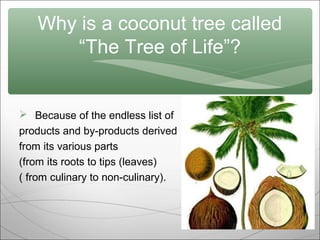
Why is a coconut tree called
“The Tree of Life”?

 Because of the endless list of
products and by-products derived
from its various parts
(from its roots to tips (leaves)
( from culinary to non-culinary).
Parts of the coconut tree and its
corresponding benefits
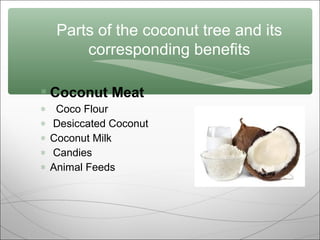
 Coconut Meat
∗
∗
∗
∗
∗

Coco Flour
Desiccated Coconut
Coconut Milk
Candies
Animal Feeds
Parts of the coconut tree and its
corresponding benefits
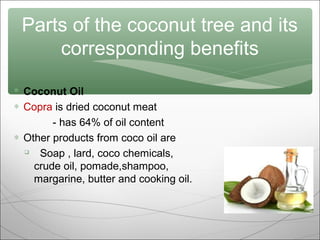
 Coconut Oil
∗ Copra is dried coconut meat
- has 64% of oil content
∗ Other products from coco oil are

Soap , lard, coco chemicals,
crude oil, pomade,shampoo,
margarine, butter and cooking oil.
Parts of the coconut tree and its
corresponding benefits
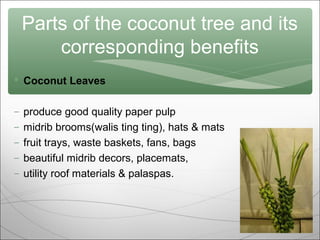
 Coconut Leaves
–
–
–
–
–

produce good quality paper pulp
midrib brooms(walis ting ting), hats & mats
fruit trays, waste baskets, fans, bags
beautiful midrib decors, placemats,
utility roof materials & palaspas.
Parts of the coconut tree and its
corresponding benefits
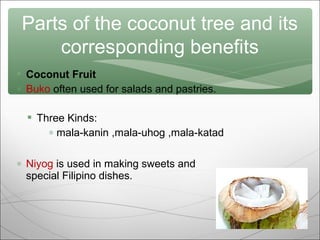
 Coconut Fruit
∗ Buko often used for salads and pastries.
 Three Kinds:
∗ mala-kanin ,mala-uhog ,mala-katad
∗ Niyog is used in making sweets and
special Filipino dishes.
Parts of the coconut tree and its
corresponding benefits
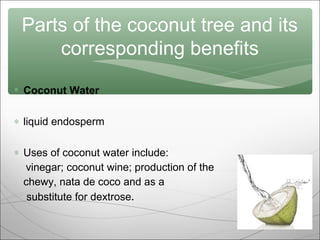
 Coconut Water
∗ liquid endosperm
∗ Uses of coconut water include:
vinegar; coconut wine; production of the
chewy, nata de coco and as a
substitute for dextrose.
Parts of the coconut tree and its
corresponding benefits
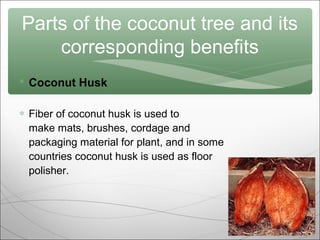
 Coconut Husk
∗ Fiber of coconut husk is used to
make mats, brushes, cordage and
packaging material for plant, and in some
countries coconut husk is used as floor
polisher.
Parts of the coconut tree and its
corresponding benefits
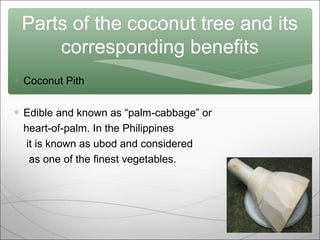
∗ Coconut Pith
∗ Edible and known as “palm-cabbage” or
heart-of-palm. In the Philippines
it is known as ubod and considered
as one of the finest vegetables.
Parts of the coconut tree and its
corresponding benefits
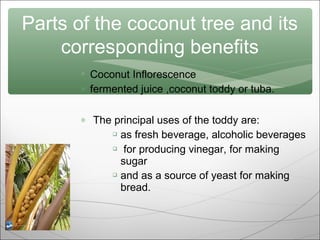
 Coconut Inflorescence
∗ fermented juice ,coconut toddy or tuba.
∗ The principal uses of the toddy are:
 as fresh beverage, alcoholic beverages
 for producing vinegar, for making
sugar
 and as a source of yeast for making
bread.
Parts of the coconut tree and its
corresponding benefits
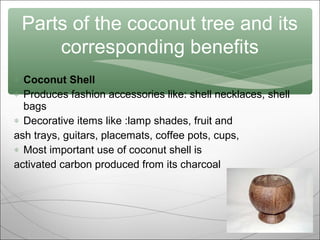
∗ Coconut Shell
∗ Produces fashion accessories like: shell necklaces, shell
bags
∗ Decorative items like :lamp shades, fruit and
ash trays, guitars, placemats, coffee pots, cups,
∗ Most important use of coconut shell is
activated carbon produced from its charcoal
Parts of the coconut tree and its
corresponding benefits
 Coconut Roots
∗ Coconut roots are used as beverage,
dye, mouthwash, and medicine for
dysentery (formerly known as flux).
∗ frayed-out piece of root can also
be used as toothbrush.
Parts of the coconut tree and its
corresponding benefits
 Coconut Trunks
∗ its hardy and durable wood is used
for building small bridges
∗ It is also used to make benches
tables, carvings, picture frames, tables,
tool boxes ,pulp paper and construction
materials, among others.
Thank you!

Coconut.tree ppt

  • 1.
    The Coconut Tree By:Charmaine Navarro BSBA –MM 3-2
  • 2.
    Background ∗ Origin ∗ Foundin Tropical Countries Like Philippines ∗ Scientific name : Cocos nucifera ∗ Known as “ The Tree Of Life”
  • 3.
    Why is acoconut tree called “The Tree of Life”?  Because of the endless list of products and by-products derived from its various parts (from its roots to tips (leaves) ( from culinary to non-culinary).
  • 4.
    Parts of thecoconut tree and its corresponding benefits  Coconut Meat ∗ ∗ ∗ ∗ ∗ Coco Flour Desiccated Coconut Coconut Milk Candies Animal Feeds
  • 5.
    Parts of thecoconut tree and its corresponding benefits  Coconut Oil ∗ Copra is dried coconut meat - has 64% of oil content ∗ Other products from coco oil are  Soap , lard, coco chemicals, crude oil, pomade,shampoo, margarine, butter and cooking oil.
  • 6.
    Parts of thecoconut tree and its corresponding benefits  Coconut Leaves – – – – – produce good quality paper pulp midrib brooms(walis ting ting), hats & mats fruit trays, waste baskets, fans, bags beautiful midrib decors, placemats, utility roof materials & palaspas.
  • 7.
    Parts of thecoconut tree and its corresponding benefits  Coconut Fruit ∗ Buko often used for salads and pastries.  Three Kinds: ∗ mala-kanin ,mala-uhog ,mala-katad ∗ Niyog is used in making sweets and special Filipino dishes.
  • 8.
    Parts of thecoconut tree and its corresponding benefits  Coconut Water ∗ liquid endosperm ∗ Uses of coconut water include: vinegar; coconut wine; production of the chewy, nata de coco and as a substitute for dextrose.
  • 9.
    Parts of thecoconut tree and its corresponding benefits  Coconut Husk ∗ Fiber of coconut husk is used to make mats, brushes, cordage and packaging material for plant, and in some countries coconut husk is used as floor polisher.
  • 10.
    Parts of thecoconut tree and its corresponding benefits ∗ Coconut Pith ∗ Edible and known as “palm-cabbage” or heart-of-palm. In the Philippines it is known as ubod and considered as one of the finest vegetables.
  • 11.
    Parts of thecoconut tree and its corresponding benefits  Coconut Inflorescence ∗ fermented juice ,coconut toddy or tuba. ∗ The principal uses of the toddy are:  as fresh beverage, alcoholic beverages  for producing vinegar, for making sugar  and as a source of yeast for making bread.
  • 12.
    Parts of thecoconut tree and its corresponding benefits ∗ Coconut Shell ∗ Produces fashion accessories like: shell necklaces, shell bags ∗ Decorative items like :lamp shades, fruit and ash trays, guitars, placemats, coffee pots, cups, ∗ Most important use of coconut shell is activated carbon produced from its charcoal
  • 13.
    Parts of thecoconut tree and its corresponding benefits  Coconut Roots ∗ Coconut roots are used as beverage, dye, mouthwash, and medicine for dysentery (formerly known as flux). ∗ frayed-out piece of root can also be used as toothbrush.
  • 14.
    Parts of thecoconut tree and its corresponding benefits  Coconut Trunks ∗ its hardy and durable wood is used for building small bridges ∗ It is also used to make benches tables, carvings, picture frames, tables, tool boxes ,pulp paper and construction materials, among others.
  • 15.