Copyright © 2015 Active Education
peped.org/philosophicalinvestigatio
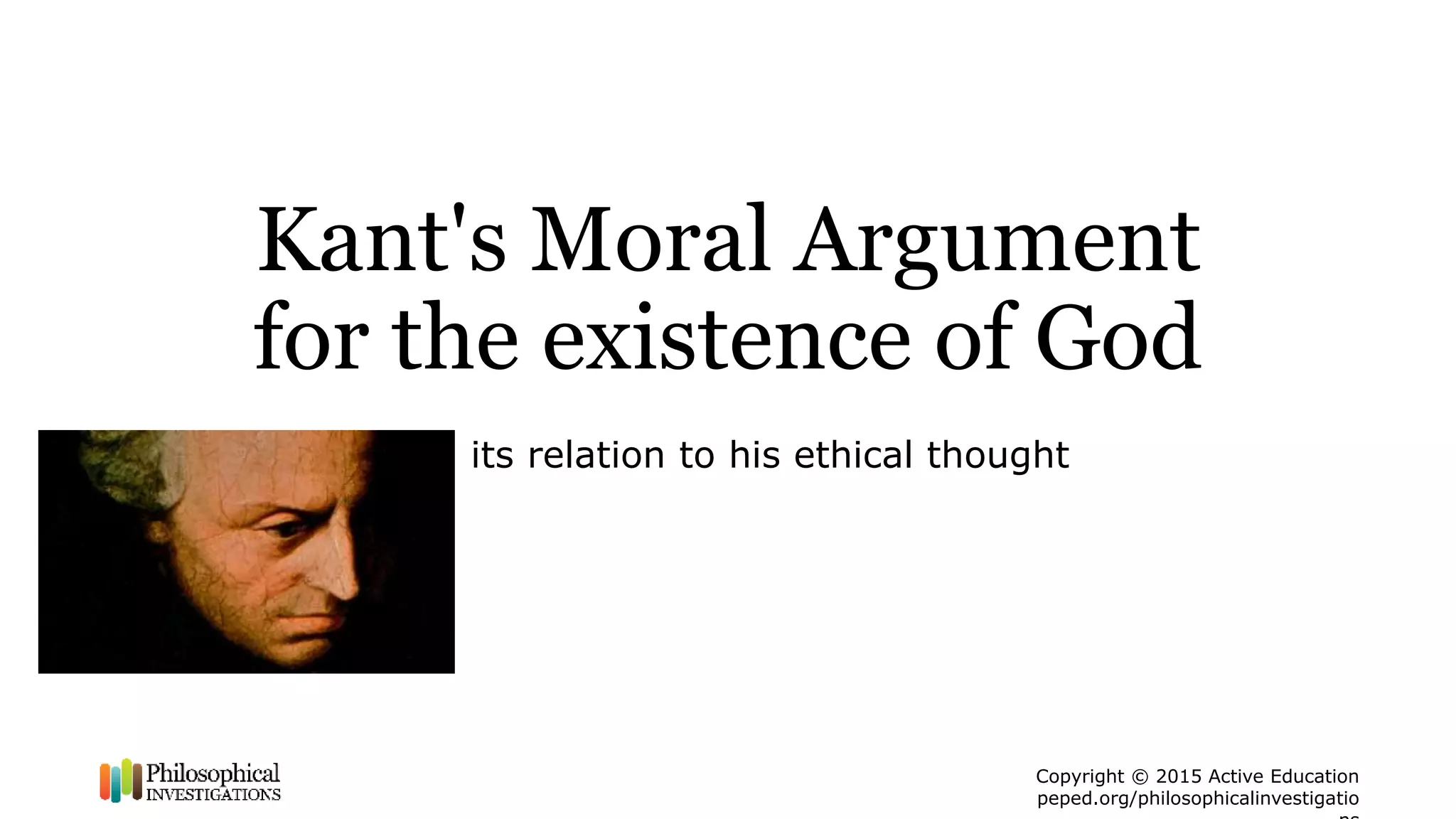
Kant's Moral Argument
for the existence of God
And its relation to his ethical thought
Copyright © 2015 Active Education
peped.org/philosophicalinvestigatio
In a nutshell
• The 'argument' is found in the Critique of Pure Reason and the
Groundwork for the Metaphysics of Morals
• It is often described as a priori, inductive as it needs no experience.
• It is difficult to divorce this from Kant's general system of ethics.
• Ought implies can
• The moral world must be achievable
• But it isn't in this life
• Therefore the moral world must be a future one (eschatological)
• There must be a distribution of happiness to the extent we are worthy to be happy
• This needs a wise regent to arbitrate. (i.e. God)
• God is, therefore, a necessary postulate of pure, practical reason
• God gives morality its telos but does not invent it.
Copyright © 2015 Active Education
peped.org/philosophicalinvestigatio
Types of statements and reasoning
• Before we can understand Kant’s moral
argument, we must understand his view of
reason:
• Kant seems to have a high and optimistic view
of human reason. Indeed, it is axiomatic for
his philosophical and ethical arguments that
humans are able to discover truth using their
reason.
• His cosmology places humans with one foot
in the “phenomenal” realm – inhabited by
animals, driven by desire, and one in the
“noumenal” realm – inhabited by God and
angels, driven by reason. Thus, we are
"amphibious" (as Prof. Douglas Hedley
writes)
• Kant identifies different kinds of
propositions:
Phenomenal
Realm –
animals -
driven by
instinct
Noumenal Realm –
God/Angels -
driven by reason
humans
Copyright © 2015 Active Education
peped.org/philosophicalinvestigatio
a posteriori and a priori
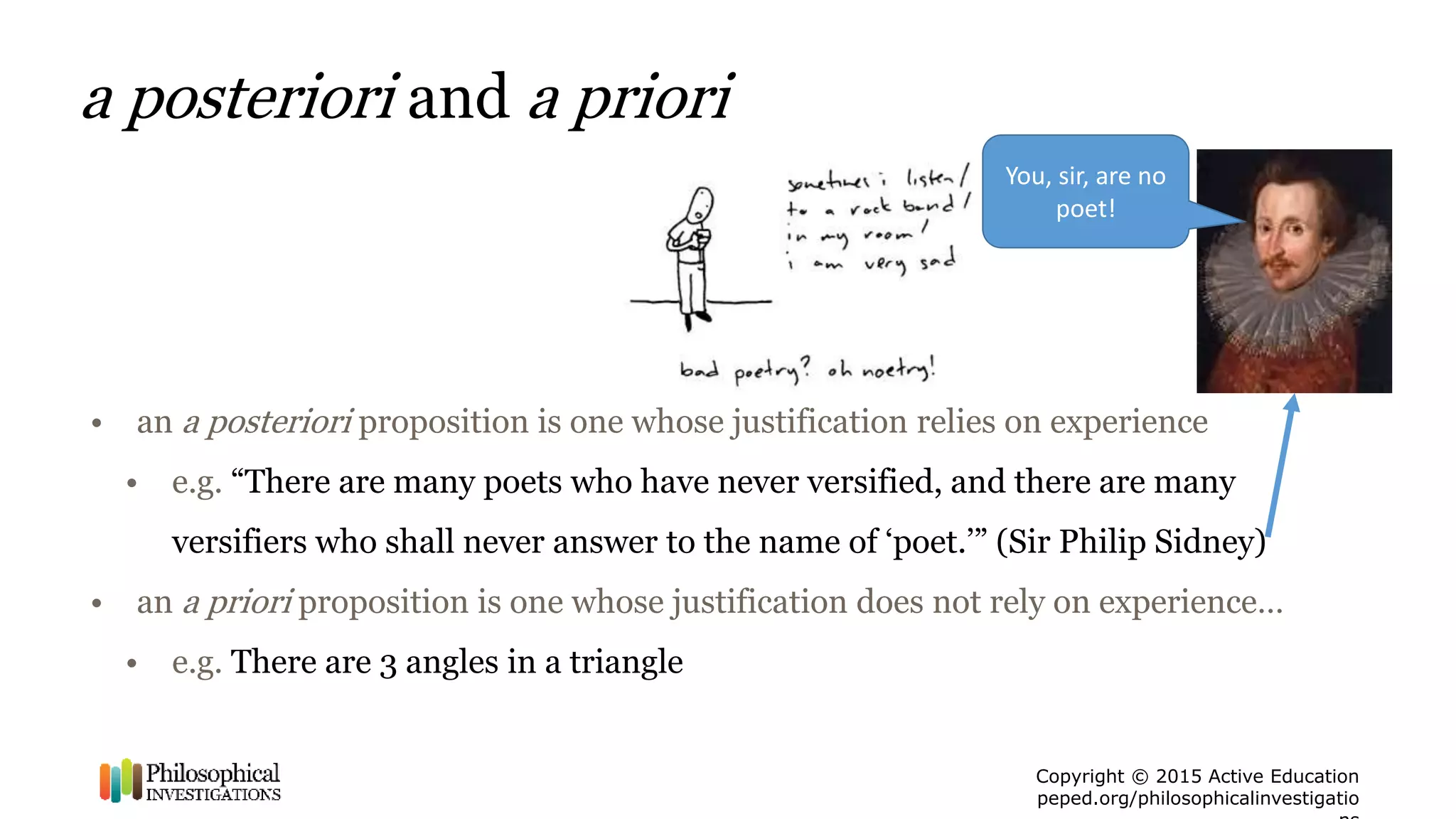
• an a posteriori proposition is one whose justification relies on experience
• e.g. “There are many poets who have never versified, and there are many
versifiers who shall never answer to the name of ‘poet.’” (Sir Philip Sidney)
• an a priori proposition is one whose justification does not rely on experience…
• e.g. There are 3 angles in a triangle
You, sir, are no
poet!
Copyright © 2015 Active Education
peped.org/philosophicalinvestigatio
Analytic and synthetic statements
• Analytic = The subject concepts contain the predicate* concept.
• E,g, the concept of a bachelor contains the notion of being unmarried [unless you’re talking
about a Bachelor of Arts]
• Thus true or false by definition “all bodies are extended” (i.e. occupy space).
• Synthetic = The subject concepts do not contain the predicate concept:
• the concept of a rich bachelor does not contain notion of his desiring a wife . [cf Pride and
Prejudice!]
• Thus true or false empirically e.g. “All bodies are heavy.”
• Question: “all unicorns are white” – analytic or synthetic?
*A predicate is something that is being attributed to a subject, such as the sharpness of a
knife or the wisdom of the fool.
NB Ayer seems to use the terms Analytic & Synthetic slightly differently in the 20th Century
Copyright © 2015 Active Education
peped.org/philosophicalinvestigatio
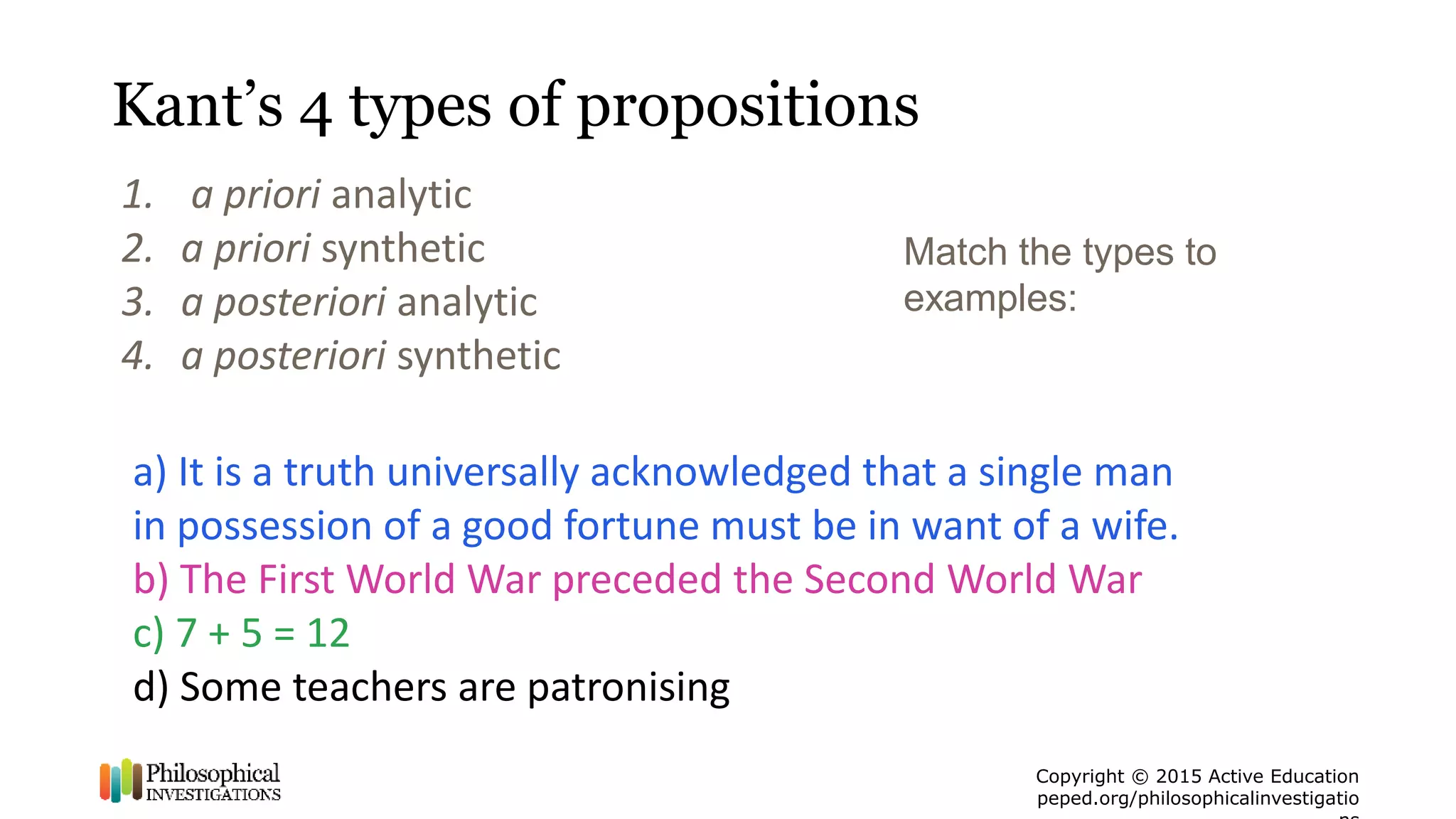
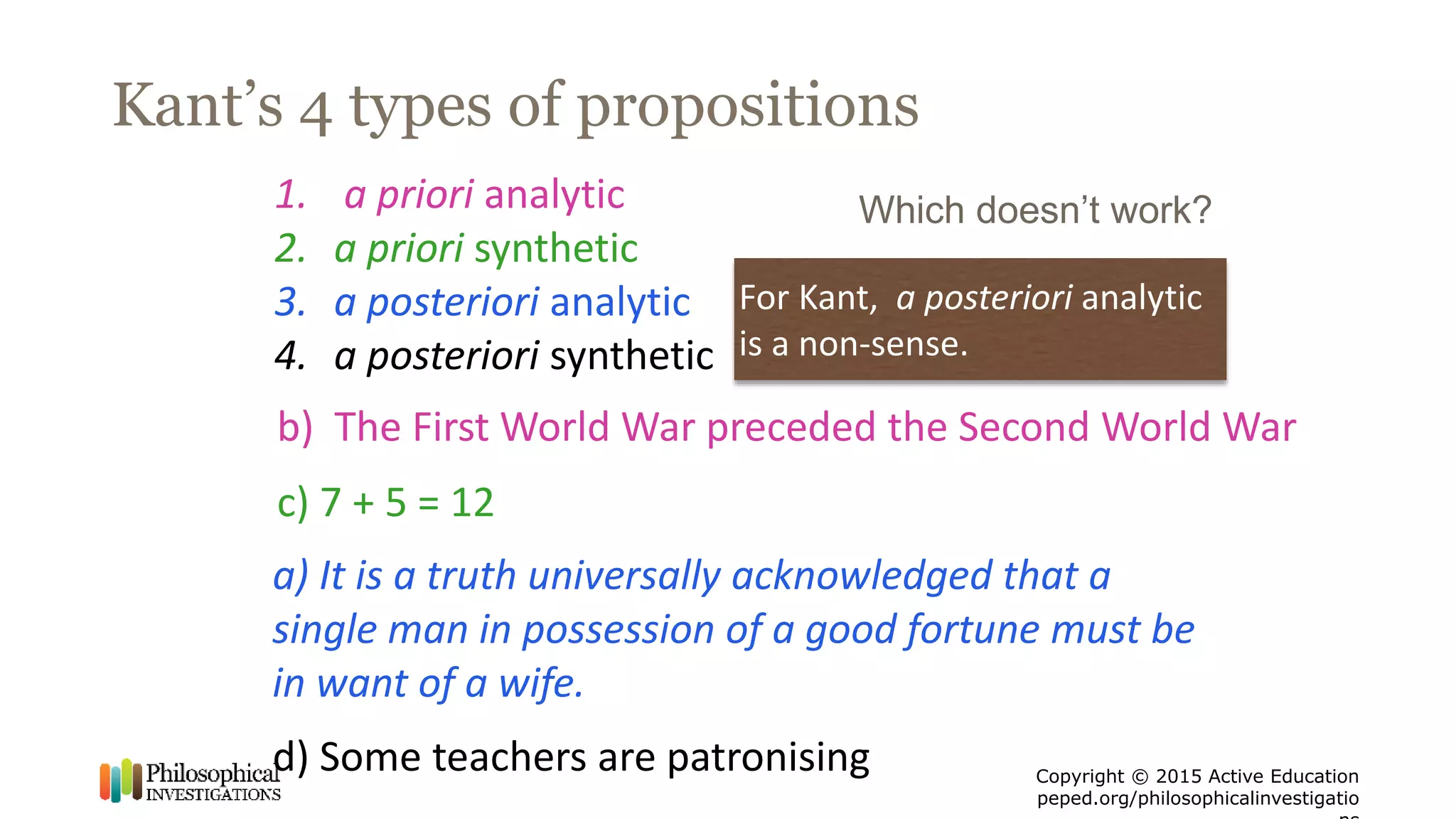
Kant’s 4 types of propositions
1. a priori analytic
2. a priori synthetic
3. a posteriori analytic
4. a posteriori synthetic
a) It is a truth universally acknowledged that a single man
in possession of a good fortune must be in want of a wife.
b) The First World War preceded the Second World War
c) 7 + 5 = 12
d) Some teachers are patronising
Match the types to
examples:
Copyright © 2015 Active Education
peped.org/philosophicalinvestigatio
Kant’s 4 types of propositions
1. a priori analytic
2. a priori synthetic
3. a posteriori analytic
4. a posteriori synthetic
d) Some teachers are patronising
Which doesn’t work?
a) It is a truth universally acknowledged that a
single man in possession of a good fortune must be
in want of a wife.
b) The First World War preceded the Second World War
c) 7 + 5 = 12
For Kant, a posteriori analytic
is a non-sense.
Copyright © 2015 Active Education
peped.org/philosophicalinvestigatio
a priori synthetic
• In an a priori synthetic proposition, new information is learned that is not contained in
statements themselves.
• In Kant’s example of 5+7=12, the concept of 12 is not contained, separately, within the
concept of 5 or 7, yet we do not need experience of 5 and 7 things to work out that
5+7=12
• Kantian ethics is a priori, synthetic (without experience, but the predicate is not
contained within the subject)
• E.g. “Lying is unethical” – the predicate unethical is not contained within the concept of
lying, but we do not have to experience lying to work out that it is unethical.
Copyright © 2015 Active Education
peped.org/philosophicalinvestigatio
Kant’s 3 Questions
The Doctrine of Method, Chapter 2, §2 in Kant’s Critique of Pure Reason poses
the following three questions:
1. What can I know?
• This is speculative reasoning and
is concerned with epistemology
2. What should I do?
• This is practical reasoning and
concerned with morality
3. What may I hope?
• This is practical and
speculative and concerned with
our telos.
Copyright © 2015 Active Education
peped.org/philosophicalinvestigatio
What may I hope?
• “All hope concerns happiness.”
• This is "the satisfaction of all our inclinations"
• Humans can hope to be happy to the extent they are worthy of
happiness.
• Kant then identifies three laws we tend to follow:
• The law prudence, the law of nature and the moral law
Copyright © 2015 Active Education
peped.org/philosophicalinvestigatio
The law of prudence
• Doing something in order to achieve some end “from the motive of
happiness.”
• E.g I will revise because it might help me pass my exam
• Sounds like Bentham!
• Kant recognises that we are often driven by this law.
• His example: we sometimes decide not to lie because we realise that we
might not be trusted in the future if found out – it would not benefit us in
the future and thus is not prudent.
• However this is stupid because we cannot be certain what will make us
happy. "[Man] is not capable of determining with complete certainty, in
accordance with any principle, what will make him truly happy, because
omniscience would be required for that."
• This is not moral !
Copyright © 2015 Active Education
peped.org/philosophicalinvestigatio
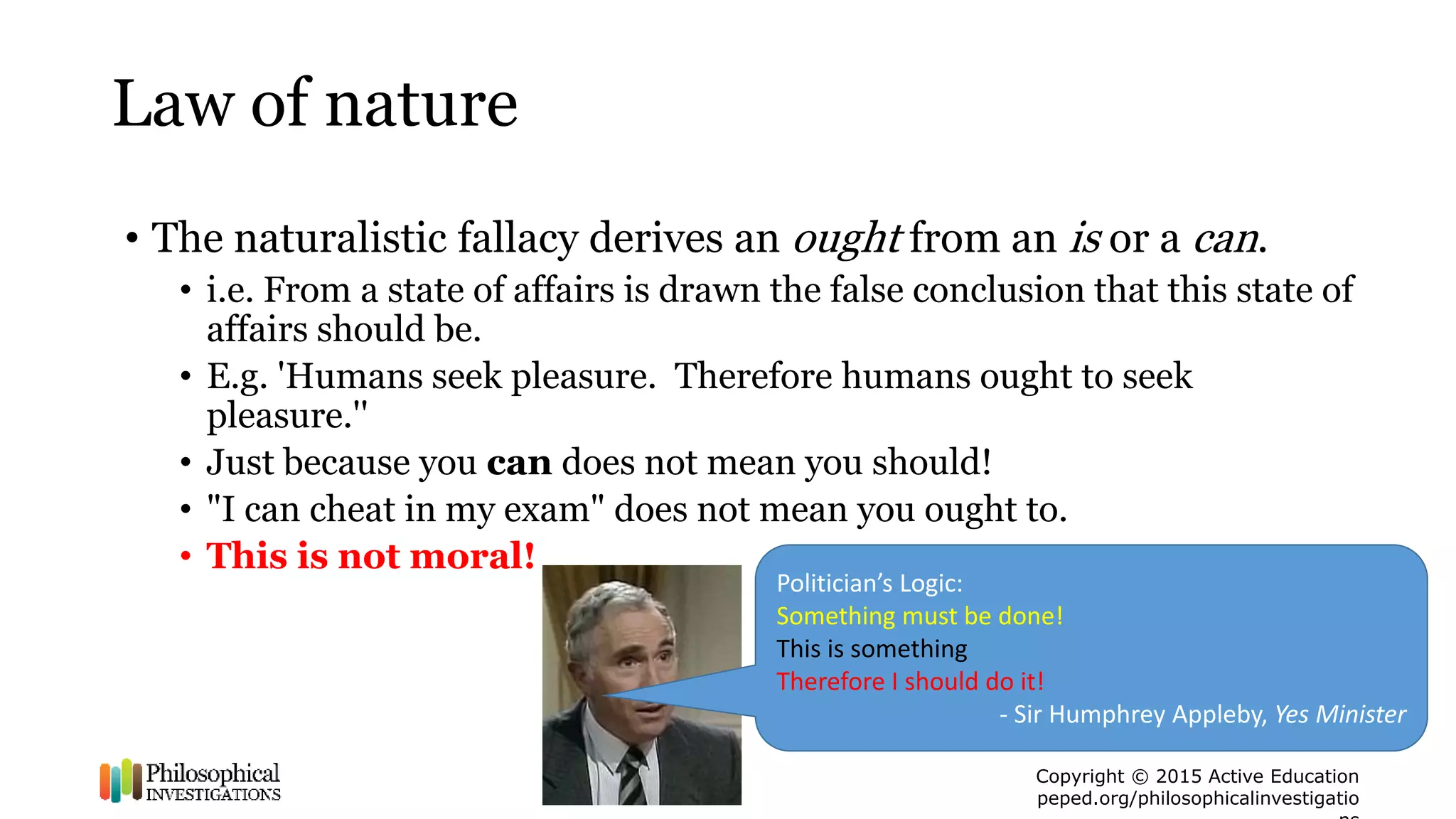
Law of nature
• The naturalistic fallacy derives an ought from an is or a can.
• i.e. From a state of affairs is drawn the false conclusion that this state of
affairs should be.
• E.g. 'Humans seek pleasure. Therefore humans ought to seek
pleasure.''
• Just because you can does not mean you should!
• "I can cheat in my exam" does not mean you ought to.
• This is not moral!
Politician’s Logic:
Something must be done!
This is something
Therefore I should do it!
- Sir Humphrey Appleby, Yes Minister
Copyright © 2015 Active Education
peped.org/philosophicalinvestigatio
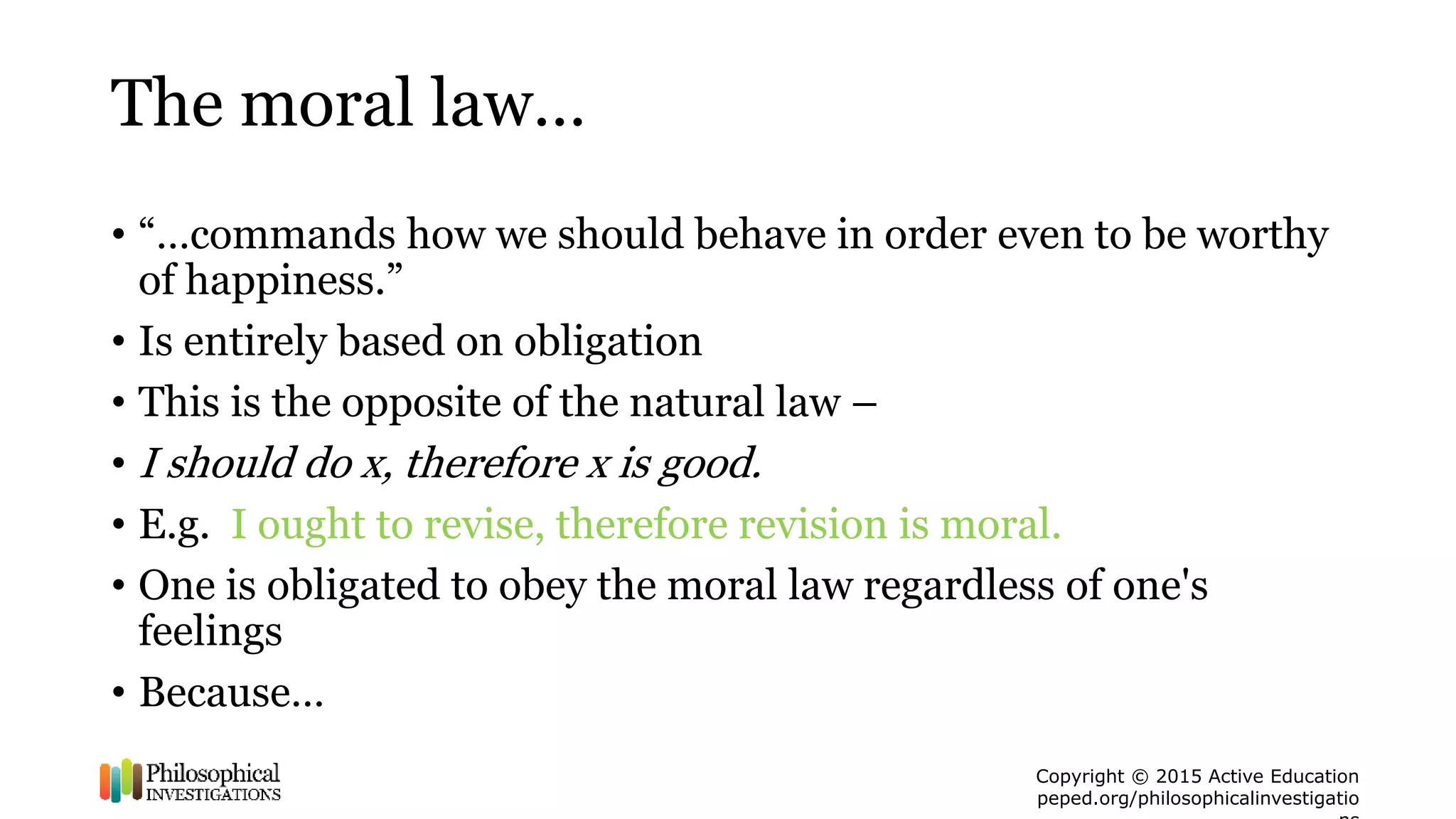
The moral law…
• “…commands how we should behave in order even to be worthy
of happiness.”
• Is entirely based on obligation
• This is the opposite of the natural law –
• I should do x, therefore x is good.
• E.g. I ought to revise, therefore revision is moral.
• One is obligated to obey the moral law regardless of one's
feelings
• Because…
Copyright © 2015 Active Education
peped.org/philosophicalinvestigatio
The good will
• Is the only consistently good thing.
• i.e. The will to do what one must do is always good.
"The good will is good not through what it effects or
accomplishes, not through its efficacy for attaining any intended
end, but only through its willing, i.e., good in itself"
(Groundwork, Preface)
• Wanting to help others is not consistently good (helping a
criminal to evade justice)
• Compare to Aquinas' idea of synderesis and the desire to do
good and avoid evil
Copyright © 2015 Active Education
peped.org/philosophicalinvestigatio
Difference with three laws
Law of prudence Law of nature Moral law
I should not cheat on my partner
because I might get found out.
I feel like cheating on my partner so
I should
I should be faithful to my partner
I should kill this armed bandit
before he kills me
I must not lie
I could steal this unicycle and get
away on it
Add to the table with further examples
Copyright © 2015 Active Education
peped.org/philosophicalinvestigatio
Imperfect and holy wills
• Because our wills are imperfect, there is no
necessary relationship between moral truths/laws
and our will.
• Nothing compels us to moral action from the fact of
the moral truths.
• E.g. We might reason that being kind to people is
good but that doesn't compel us to be kind to people
• Thus we need an imperative to direct our wills.
• E.g "Be kind to people"
• However a holy will, such as God's, is wholly in
accordance with moral truths and therefore needs
no imperatives.
• God is not a moral agent
Moral
truths
Copyright © 2015 Active Education
peped.org/philosophicalinvestigatio
Ought implies can
• If we are to be obliged to do something, it must be possible for
us to do.
• We cannot be obliged to fly out of a window since cannot do it!
• I ought to do the washing up
• It must be possible for me to do so.
• However, it is not always possible to be moral in this world
For since [moral precepts] command that these actions ought to happen,
they must also be able to happen, and there must therefore be possible a
special kind of systematic unity, namely the moral.
Copyright © 2015 Active Education
peped.org/philosophicalinvestigatio
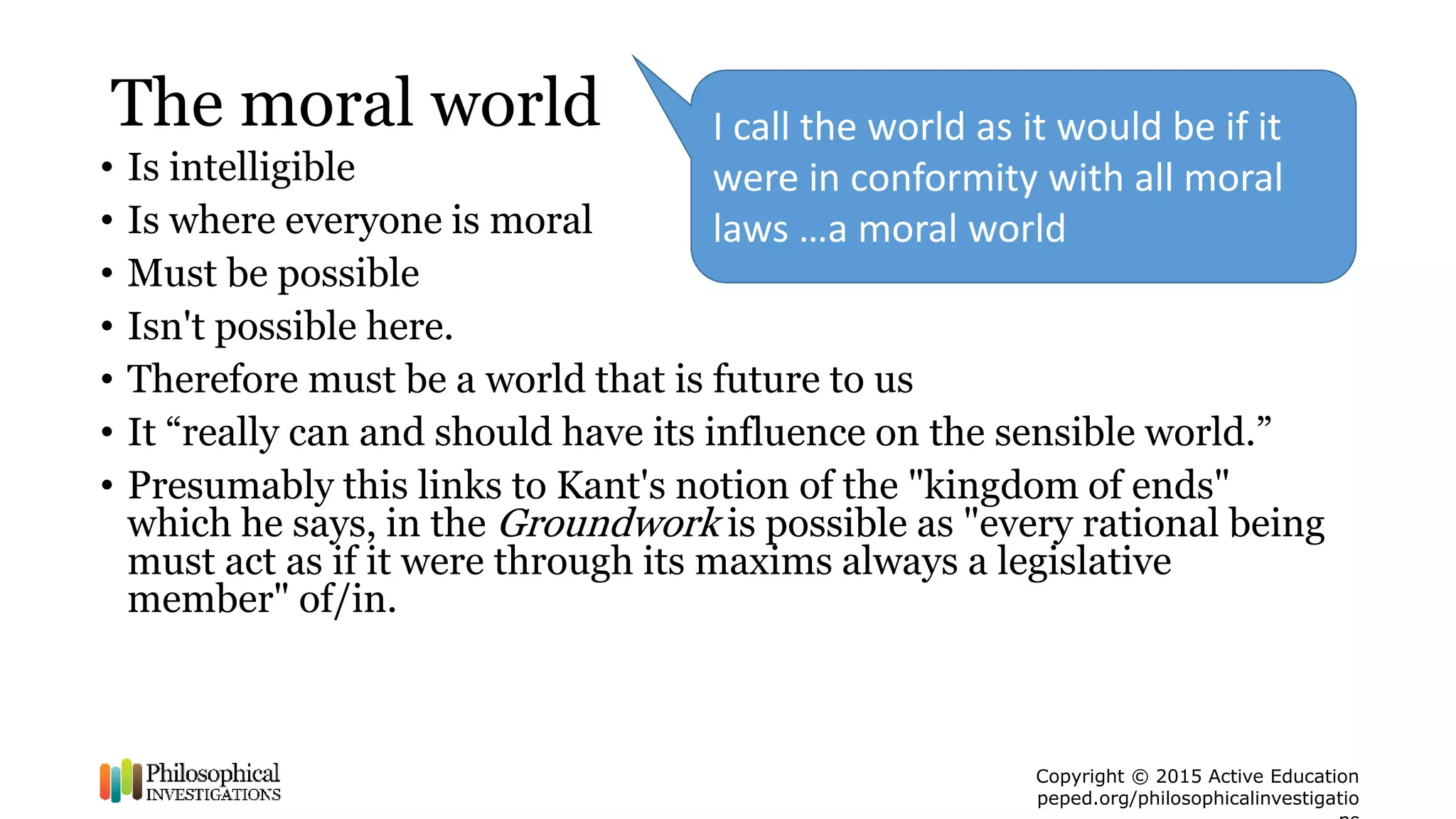
The moral world
• Is intelligible
• Is where everyone is moral
• Must be possible
• Isn't possible here.
• Therefore must be a world that is future to us
• It “really can and should have its influence on the sensible world.”
• Presumably this links to Kant's notion of the "kingdom of ends"
which he says, in the Groundwork is possible as "every rational being
must act as if it were through its maxims always a legislative
member" of/in.
I call the world as it would be if it
were in conformity with all moral
laws …a moral world
Copyright © 2015 Active Education
peped.org/philosophicalinvestigatio
Self-rewarding morality
• Kant suggests that, in the moral world, “freedom, partly moved
and partly restricted by moral laws would itself be the cause of
the general happiness.”
• Rational beings would be the “authors of their own enduring
welfare” as well as that of others.
• However, this “rests on the condition that everyone do what he
should.”
• This clearly hasn’t happened yet!
When everyone autonomously
acts according to the moral law,
they will be happy
Copyright © 2015 Active Education
peped.org/philosophicalinvestigatio
Summum bonum – the highest good
• “I call the idea of such an intelligence, in which the morally most
perfect will, combined with the highest blessedness, is the cause
of all happiness in the world, insofar as it stands in exact
relation with morality, the ideal of the highest good.”
• This highest good is the end, or aim of all morality then – its
telos.
• Again, this goes back to Kant’s idea of the moral world.
Copyright © 2015 Active Education
peped.org/philosophicalinvestigatio
The necessary postulation
i.e. We must postulate the existence of God and an eschatological
moral world if we are to be obligated to do anything and if there is to
be a distribution of happiness to the extent that we are worthy of
happiness.
Although the senses do not present us with anything except a world of
appearances, we must assume the moral world to be a consequences of
our conduct in the sensible world; and since the latter does not offer such
a connection to us, we must assume the former to be a world that is future
for us. Thus God and a future life are two presuppositions that are not to
be separated from the obligation that pure reason imposes on us in
accordance with principle of that very same reason.”
Copyright © 2015 Active Education
peped.org/philosophicalinvestigatio
God – the wise regent
• In order for happiness to be “distributed precisely in
accordance with morality” it must be done so by a “wise
author and regent.”
• A (weak) analogy might be that of a teacher distributing
grades to students based on their performance in a test.
• Everyone regards moral laws as commands
• Disobeying these carries a threat
• Obeying them carries a promise.
• “This, however, they could not do if they did not lie in a necessary
being, as the highest good, which alone can make possible such a
purposive unity.”
• i.e. God gives the moral law its purpose
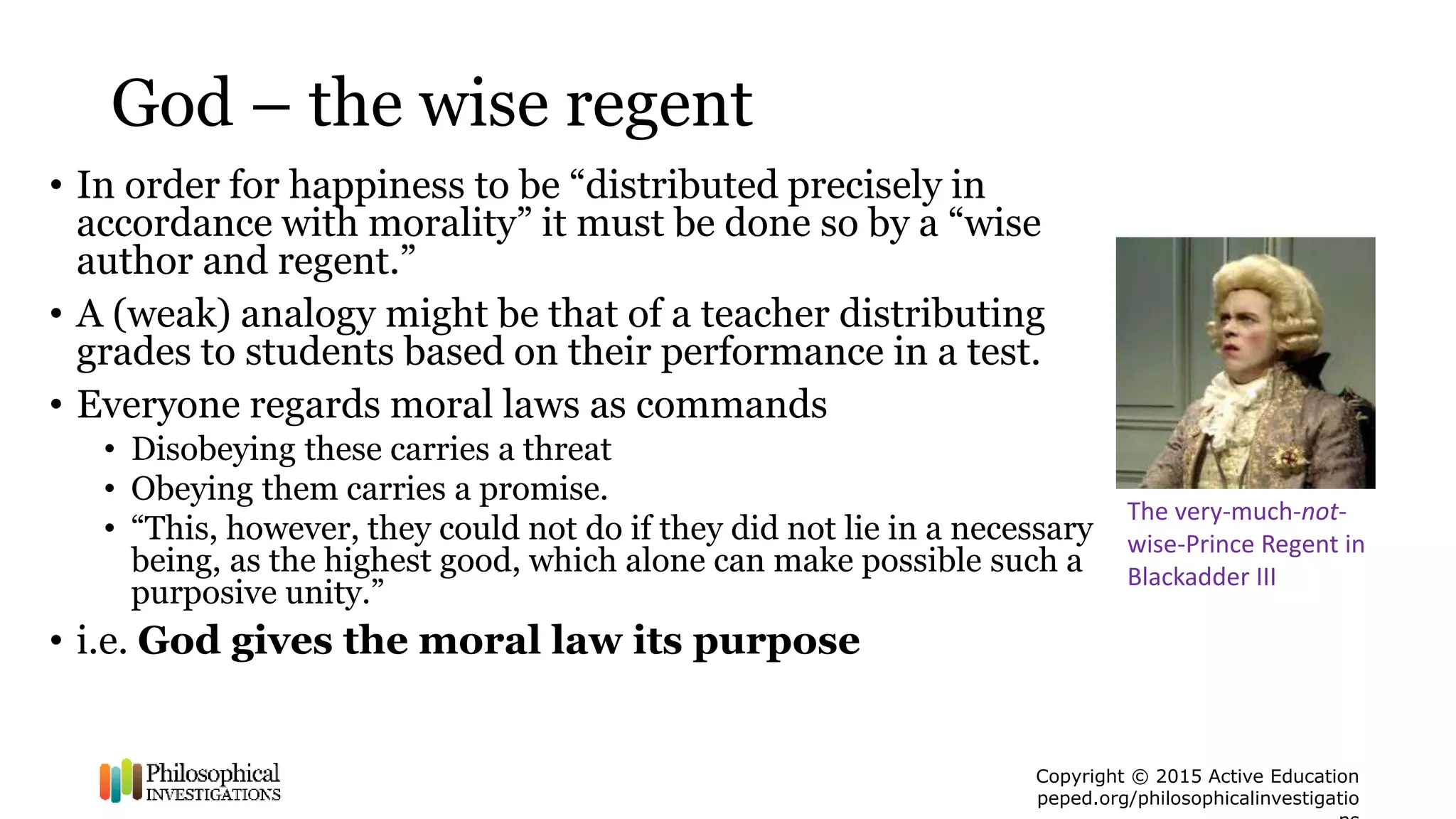
The very-much-not-
wise-Prince Regent in
Blackadder III
Copyright © 2015 Active Education
peped.org/philosophicalinvestigatio
Nature of God
• In order for morality to achieve its unified end, the wise regent must be a
single, rational, perfect will – or else there would be disunity
• "for how, with different wills should we find complete unity of ends?"
• This solves one of the problems Hume identified with the teleological and
cosmological arguments in his question, why not more than one designer (or
efficient cause).
• Omnipotent – "so that nature and its relation to morality and nature may
be subject to it"
• Omniscient – "that it may know the most secret springs of our sentiments
and their moral worth" – .i.e. so the goodness of our wills can be judged
• Omnipresent – so it can be near to effect justice
• Eternal – so it may never fail.
Copyright © 2015 Active Education
peped.org/philosophicalinvestigatio
If there were no God…
• Morality would not achieve its end
• “Without a God and a world that is now not visible
to us but is hoped for, the majestic ideas of morality
are, to be sure, objects of approbation and
admiration, but not incentives."
• “Thus happiness in exact proportion with the
morality of rational beings, through which they are
worthy of it, alone constitutes the highest good."
Copyright © 2015 Active Education
peped.org/philosophicalinvestigatio
Common misconceptions with the moral
argument
• “Kant argues we should act morally to be worthy of happiness.”
• NO! We do not act morally to gain brownie points – to be worthy of happiness.
This is not moral and goes against the deontological nature of his ethical theory.
• Indeed, by acting to make yourself worthy of happiness you would not be
worthy of happiness!
• That it takes the form of a deductive argument
• God is a necessary postulate. He must be assumed but cannot be proven.
• Remember Kant rejects the cosmological argument (mostly for its basis on the
ontological argument). He also rejects natural theology.
• Speculative reason cannot bring us to God.
• “God determines what the moral law is.”
• NO! (see the next slide)
Copyright © 2015 Active Education
peped.org/philosophicalinvestigatio
Kant vs Euthyphro
• Kant clearly rejects the horn of the dilemma that states things are good
because God commands them.
• He also says that, having arrived at the conclusion that there must be a God,
we do not forget the process of moral reasoning and revert back to some sort
of divine command theory.
• If we merely followed divine commands, morality would be heteronomous, not
autonomous.
• Remember one of the problems in the original Euthyphro dialogue was that in
a polytheistic system the gods disagree. Poseidon hates Odysseus but Athene
loves him. Thus why what is pious cannot be merely what is beloved by the
gods. But, for Kant there is only one God.
We will not regard things to be obligatory because they are divine
commands but rather we will regard them to be divine
commands because we are internally obligated to them.
“Are things pious because they are loved by the gods,
or do the gods love them because they are pious?” -
Socrates to Euthyphro in Plato’s Euthyphro
Copyright © 2015 Active Education
peped.org/philosophicalinvestigatio
A Caveat
• Having arrived at the necessary postulation of God, we cannot
then start from God and work backwards – in some sort of
Divine Command Theory.
• “Now when practical reason has attained this high point, namely the
concept of a single original being as the highest good, it must not
undertake to start out from this concept and derive the moral laws
themselves from it.”
• It was “these [moral] laws alone whose inner practical necessity led us
to the presupposition of a self-sufficient cause or a wise world-regent in
order to give effect to these laws.”

Kant's Moral Argument for the existence of God

  • 1.
    Copyright © 2015Active Education peped.org/philosophicalinvestigatio Kant's Moral Argument for the existence of God And its relation to his ethical thought
  • 2.
    Copyright © 2015Active Education peped.org/philosophicalinvestigatio In a nutshell • The 'argument' is found in the Critique of Pure Reason and the Groundwork for the Metaphysics of Morals • It is often described as a priori, inductive as it needs no experience. • It is difficult to divorce this from Kant's general system of ethics. • Ought implies can • The moral world must be achievable • But it isn't in this life • Therefore the moral world must be a future one (eschatological) • There must be a distribution of happiness to the extent we are worthy to be happy • This needs a wise regent to arbitrate. (i.e. God) • God is, therefore, a necessary postulate of pure, practical reason • God gives morality its telos but does not invent it.
  • 3.
    Copyright © 2015Active Education peped.org/philosophicalinvestigatio Types of statements and reasoning • Before we can understand Kant’s moral argument, we must understand his view of reason: • Kant seems to have a high and optimistic view of human reason. Indeed, it is axiomatic for his philosophical and ethical arguments that humans are able to discover truth using their reason. • His cosmology places humans with one foot in the “phenomenal” realm – inhabited by animals, driven by desire, and one in the “noumenal” realm – inhabited by God and angels, driven by reason. Thus, we are "amphibious" (as Prof. Douglas Hedley writes) • Kant identifies different kinds of propositions: Phenomenal Realm – animals - driven by instinct Noumenal Realm – God/Angels - driven by reason humans
  • 4.
    Copyright © 2015Active Education peped.org/philosophicalinvestigatio a posteriori and a priori • an a posteriori proposition is one whose justification relies on experience • e.g. “There are many poets who have never versified, and there are many versifiers who shall never answer to the name of ‘poet.’” (Sir Philip Sidney) • an a priori proposition is one whose justification does not rely on experience… • e.g. There are 3 angles in a triangle You, sir, are no poet!
  • 5.
    Copyright © 2015Active Education peped.org/philosophicalinvestigatio Analytic and synthetic statements • Analytic = The subject concepts contain the predicate* concept. • E,g, the concept of a bachelor contains the notion of being unmarried [unless you’re talking about a Bachelor of Arts] • Thus true or false by definition “all bodies are extended” (i.e. occupy space). • Synthetic = The subject concepts do not contain the predicate concept: • the concept of a rich bachelor does not contain notion of his desiring a wife . [cf Pride and Prejudice!] • Thus true or false empirically e.g. “All bodies are heavy.” • Question: “all unicorns are white” – analytic or synthetic? *A predicate is something that is being attributed to a subject, such as the sharpness of a knife or the wisdom of the fool. NB Ayer seems to use the terms Analytic & Synthetic slightly differently in the 20th Century
  • 6.
    Copyright © 2015Active Education peped.org/philosophicalinvestigatio Kant’s 4 types of propositions 1. a priori analytic 2. a priori synthetic 3. a posteriori analytic 4. a posteriori synthetic a) It is a truth universally acknowledged that a single man in possession of a good fortune must be in want of a wife. b) The First World War preceded the Second World War c) 7 + 5 = 12 d) Some teachers are patronising Match the types to examples:
  • 7.
    Copyright © 2015Active Education peped.org/philosophicalinvestigatio Kant’s 4 types of propositions 1. a priori analytic 2. a priori synthetic 3. a posteriori analytic 4. a posteriori synthetic d) Some teachers are patronising Which doesn’t work? a) It is a truth universally acknowledged that a single man in possession of a good fortune must be in want of a wife. b) The First World War preceded the Second World War c) 7 + 5 = 12 For Kant, a posteriori analytic is a non-sense.
  • 8.
    Copyright © 2015Active Education peped.org/philosophicalinvestigatio a priori synthetic • In an a priori synthetic proposition, new information is learned that is not contained in statements themselves. • In Kant’s example of 5+7=12, the concept of 12 is not contained, separately, within the concept of 5 or 7, yet we do not need experience of 5 and 7 things to work out that 5+7=12 • Kantian ethics is a priori, synthetic (without experience, but the predicate is not contained within the subject) • E.g. “Lying is unethical” – the predicate unethical is not contained within the concept of lying, but we do not have to experience lying to work out that it is unethical.
  • 9.
    Copyright © 2015Active Education peped.org/philosophicalinvestigatio Kant’s 3 Questions The Doctrine of Method, Chapter 2, §2 in Kant’s Critique of Pure Reason poses the following three questions: 1. What can I know? • This is speculative reasoning and is concerned with epistemology 2. What should I do? • This is practical reasoning and concerned with morality 3. What may I hope? • This is practical and speculative and concerned with our telos.
  • 10.
    Copyright © 2015Active Education peped.org/philosophicalinvestigatio What may I hope? • “All hope concerns happiness.” • This is "the satisfaction of all our inclinations" • Humans can hope to be happy to the extent they are worthy of happiness. • Kant then identifies three laws we tend to follow: • The law prudence, the law of nature and the moral law
  • 11.
    Copyright © 2015Active Education peped.org/philosophicalinvestigatio The law of prudence • Doing something in order to achieve some end “from the motive of happiness.” • E.g I will revise because it might help me pass my exam • Sounds like Bentham! • Kant recognises that we are often driven by this law. • His example: we sometimes decide not to lie because we realise that we might not be trusted in the future if found out – it would not benefit us in the future and thus is not prudent. • However this is stupid because we cannot be certain what will make us happy. "[Man] is not capable of determining with complete certainty, in accordance with any principle, what will make him truly happy, because omniscience would be required for that." • This is not moral !
  • 12.
    Copyright © 2015Active Education peped.org/philosophicalinvestigatio Law of nature • The naturalistic fallacy derives an ought from an is or a can. • i.e. From a state of affairs is drawn the false conclusion that this state of affairs should be. • E.g. 'Humans seek pleasure. Therefore humans ought to seek pleasure.'' • Just because you can does not mean you should! • "I can cheat in my exam" does not mean you ought to. • This is not moral! Politician’s Logic: Something must be done! This is something Therefore I should do it! - Sir Humphrey Appleby, Yes Minister
  • 13.
    Copyright © 2015Active Education peped.org/philosophicalinvestigatio The moral law… • “…commands how we should behave in order even to be worthy of happiness.” • Is entirely based on obligation • This is the opposite of the natural law – • I should do x, therefore x is good. • E.g. I ought to revise, therefore revision is moral. • One is obligated to obey the moral law regardless of one's feelings • Because…
  • 14.
    Copyright © 2015Active Education peped.org/philosophicalinvestigatio The good will • Is the only consistently good thing. • i.e. The will to do what one must do is always good. "The good will is good not through what it effects or accomplishes, not through its efficacy for attaining any intended end, but only through its willing, i.e., good in itself" (Groundwork, Preface) • Wanting to help others is not consistently good (helping a criminal to evade justice) • Compare to Aquinas' idea of synderesis and the desire to do good and avoid evil
  • 15.
    Copyright © 2015Active Education peped.org/philosophicalinvestigatio Difference with three laws Law of prudence Law of nature Moral law I should not cheat on my partner because I might get found out. I feel like cheating on my partner so I should I should be faithful to my partner I should kill this armed bandit before he kills me I must not lie I could steal this unicycle and get away on it Add to the table with further examples
  • 16.
    Copyright © 2015Active Education peped.org/philosophicalinvestigatio Imperfect and holy wills • Because our wills are imperfect, there is no necessary relationship between moral truths/laws and our will. • Nothing compels us to moral action from the fact of the moral truths. • E.g. We might reason that being kind to people is good but that doesn't compel us to be kind to people • Thus we need an imperative to direct our wills. • E.g "Be kind to people" • However a holy will, such as God's, is wholly in accordance with moral truths and therefore needs no imperatives. • God is not a moral agent Moral truths
  • 17.
    Copyright © 2015Active Education peped.org/philosophicalinvestigatio Ought implies can • If we are to be obliged to do something, it must be possible for us to do. • We cannot be obliged to fly out of a window since cannot do it! • I ought to do the washing up • It must be possible for me to do so. • However, it is not always possible to be moral in this world For since [moral precepts] command that these actions ought to happen, they must also be able to happen, and there must therefore be possible a special kind of systematic unity, namely the moral.
  • 18.
    Copyright © 2015Active Education peped.org/philosophicalinvestigatio The moral world • Is intelligible • Is where everyone is moral • Must be possible • Isn't possible here. • Therefore must be a world that is future to us • It “really can and should have its influence on the sensible world.” • Presumably this links to Kant's notion of the "kingdom of ends" which he says, in the Groundwork is possible as "every rational being must act as if it were through its maxims always a legislative member" of/in. I call the world as it would be if it were in conformity with all moral laws …a moral world
  • 19.
    Copyright © 2015Active Education peped.org/philosophicalinvestigatio Self-rewarding morality • Kant suggests that, in the moral world, “freedom, partly moved and partly restricted by moral laws would itself be the cause of the general happiness.” • Rational beings would be the “authors of their own enduring welfare” as well as that of others. • However, this “rests on the condition that everyone do what he should.” • This clearly hasn’t happened yet! When everyone autonomously acts according to the moral law, they will be happy
  • 20.
    Copyright © 2015Active Education peped.org/philosophicalinvestigatio Summum bonum – the highest good • “I call the idea of such an intelligence, in which the morally most perfect will, combined with the highest blessedness, is the cause of all happiness in the world, insofar as it stands in exact relation with morality, the ideal of the highest good.” • This highest good is the end, or aim of all morality then – its telos. • Again, this goes back to Kant’s idea of the moral world.
  • 21.
    Copyright © 2015Active Education peped.org/philosophicalinvestigatio The necessary postulation i.e. We must postulate the existence of God and an eschatological moral world if we are to be obligated to do anything and if there is to be a distribution of happiness to the extent that we are worthy of happiness. Although the senses do not present us with anything except a world of appearances, we must assume the moral world to be a consequences of our conduct in the sensible world; and since the latter does not offer such a connection to us, we must assume the former to be a world that is future for us. Thus God and a future life are two presuppositions that are not to be separated from the obligation that pure reason imposes on us in accordance with principle of that very same reason.”
  • 22.
    Copyright © 2015Active Education peped.org/philosophicalinvestigatio God – the wise regent • In order for happiness to be “distributed precisely in accordance with morality” it must be done so by a “wise author and regent.” • A (weak) analogy might be that of a teacher distributing grades to students based on their performance in a test. • Everyone regards moral laws as commands • Disobeying these carries a threat • Obeying them carries a promise. • “This, however, they could not do if they did not lie in a necessary being, as the highest good, which alone can make possible such a purposive unity.” • i.e. God gives the moral law its purpose The very-much-not- wise-Prince Regent in Blackadder III
  • 23.
    Copyright © 2015Active Education peped.org/philosophicalinvestigatio Nature of God • In order for morality to achieve its unified end, the wise regent must be a single, rational, perfect will – or else there would be disunity • "for how, with different wills should we find complete unity of ends?" • This solves one of the problems Hume identified with the teleological and cosmological arguments in his question, why not more than one designer (or efficient cause). • Omnipotent – "so that nature and its relation to morality and nature may be subject to it" • Omniscient – "that it may know the most secret springs of our sentiments and their moral worth" – .i.e. so the goodness of our wills can be judged • Omnipresent – so it can be near to effect justice • Eternal – so it may never fail.
  • 24.
    Copyright © 2015Active Education peped.org/philosophicalinvestigatio If there were no God… • Morality would not achieve its end • “Without a God and a world that is now not visible to us but is hoped for, the majestic ideas of morality are, to be sure, objects of approbation and admiration, but not incentives." • “Thus happiness in exact proportion with the morality of rational beings, through which they are worthy of it, alone constitutes the highest good."
  • 25.
    Copyright © 2015Active Education peped.org/philosophicalinvestigatio Common misconceptions with the moral argument • “Kant argues we should act morally to be worthy of happiness.” • NO! We do not act morally to gain brownie points – to be worthy of happiness. This is not moral and goes against the deontological nature of his ethical theory. • Indeed, by acting to make yourself worthy of happiness you would not be worthy of happiness! • That it takes the form of a deductive argument • God is a necessary postulate. He must be assumed but cannot be proven. • Remember Kant rejects the cosmological argument (mostly for its basis on the ontological argument). He also rejects natural theology. • Speculative reason cannot bring us to God. • “God determines what the moral law is.” • NO! (see the next slide)
  • 26.
    Copyright © 2015Active Education peped.org/philosophicalinvestigatio Kant vs Euthyphro • Kant clearly rejects the horn of the dilemma that states things are good because God commands them. • He also says that, having arrived at the conclusion that there must be a God, we do not forget the process of moral reasoning and revert back to some sort of divine command theory. • If we merely followed divine commands, morality would be heteronomous, not autonomous. • Remember one of the problems in the original Euthyphro dialogue was that in a polytheistic system the gods disagree. Poseidon hates Odysseus but Athene loves him. Thus why what is pious cannot be merely what is beloved by the gods. But, for Kant there is only one God. We will not regard things to be obligatory because they are divine commands but rather we will regard them to be divine commands because we are internally obligated to them. “Are things pious because they are loved by the gods, or do the gods love them because they are pious?” - Socrates to Euthyphro in Plato’s Euthyphro
  • 27.
    Copyright © 2015Active Education peped.org/philosophicalinvestigatio A Caveat • Having arrived at the necessary postulation of God, we cannot then start from God and work backwards – in some sort of Divine Command Theory. • “Now when practical reason has attained this high point, namely the concept of a single original being as the highest good, it must not undertake to start out from this concept and derive the moral laws themselves from it.” • It was “these [moral] laws alone whose inner practical necessity led us to the presupposition of a self-sufficient cause or a wise world-regent in order to give effect to these laws.”