Lecture notes on Immanuel Kant's Critique of Pure Reason 
Delivered by Peter Rickman during Autumn 1995 
Preface 
Immanuel Kant’s Critique of Pure 
Reason introduces his critical 
philosophy. His philosophical 
approach is ‘critical’ in the sense 
that he is making a critical analysis 
of the power and limits of our mind 
and our ability to understand the 
world we find ourselves in. As 
such, Kant is the founder of a 
philosophical tradition of critical 
analysis that has included many 
other important philosophers since, 
such as Schopenhauer and 
Wittgenstein. 
I found Peter Rickman’s lecture 
series, delivered in 1995 at the City 
University in London UK, on the 
Critique of Pure Reason of 
immense value in trying to 
understand Kant’s work. It is my 
view that Kant’s work is so subtle 
and revolutionary that one needs 
the guidance of a good teacher to 
properly appreciate it and to avoid 
the common misunderstandings. 
Since I had these notes in 
electronic form, I thought they may 
be of benefit to others so I have 
published them here. I thank Peter 
Rickman for his permission to 
make the notes available and for 
his helpful comments and 
suggestions. I hope they may help 
others who are trying to understand 
Kant’s great work and answer 
some of the riddles of philosophy. 
These are my notes of the lectures, 
so I should make it clear that any 
flaws and errors in them are mine. 
If you spot any, I can be contacted 
at the email address below. 
Tony Bellotti, January 2006 
ag_bellotti@yahoo.co.uk
Contents 
Preface 
Lecture 1: INTRODUCTION 
· The Text 
· Historical Background 
· Key Concepts 
(1) The Aesthetics and 
Intuition 
(2) Kant’s Copernican 
Revolution 
(3) The Nature of 
Knowledge 
(4) Synthetic A priori 
Statements 
(5) Phenomena and 
Noumena 
Lecture 2: TRANSCENDENTAL 
KNOWLEDGE 
· The Transcendental 
Deduction 
· Pure and Empirical 
Knowledge 
· The Forms of Space and 
Time 
Lecture 3: LOGIC 
· Logical methods 
· The Synthesis of Concepts 
· The Categories 
Lecture 4: DEDUCTION OF THE 
CATEGORIES 
· Stages of Understanding 
· Method for Deducing the 
Categories 
· Transcendental Synthesis of 
Apperception 
Lecture 5: CONCEPTS AND 
OBJECTS 
· The Cognitive and Empirical 
‘I’ 
· The Limits of the Categories 
· Objects 
Lecture 6: APPLICATION OF THE 
CATEGORIES 
· The Limits of the 
Possibilities of Experience 
· Faculties of Cognition 
· The Schematism of the Pure 
Concepts of Understanding 
Lectures 7 & 8: THE ANALOGIES 
· Introduction 
· The Refutation of Idealism 
Lecture 9: NOUMENA 
Bibliography
Lecture 1: INTRODUCTION 
The Text 
In these lecture notes, we shall 
examine the ideas in Immanuel 
Kant’s groundbreaking 
philosophical work, the Critique of 
Pure Reason. Kant published this 
work as a first edition in 1781, but 
followed it up in 1787 with a 
substantially revised second 
edition. Norman Kemp Smith's 
translation (1929) is the 
recommended text for English 
readers. It contains the full text 
from both editions and includes a 
standard indexing of the works 
using A and B page numbers for 
the first and second edition 
respectively. 
This course will deal mostly with 
that part of the work called the 
Transcendental Analytic. This 
section is considered to be the 
most important part of the book. 
However, it should be noted that it 
is far from the only important part. 
There is some difficulty in 
translating from the original old 
eighteenth century German that 
Kant used. Additionally, Kant's 
particular writing style can be 
awkward and difficult to 
understand. He tends to be very 
exact and to carefully qualify his 
statements. This can lead to 
problems when reading the 
Critique. 
Kant uses some words in a very 
specialized and technical sense. 
For example, the words ‘form’, 
‘intuition’ and ‘synthesis’ all have a 
special meaning. The reader 
should bear this in mind when 
reading the Critique. 
Kant worked on the contents of the 
Critique of Pure Reason over a 
period of ten years, gathering 
dispersed notes and papers across 
that time. After these ten years 
Kant seemed to be concerned that 
he was getting old and that he may 
not complete his philosophical work 
before he died. Thus he spent just 
a single year putting all his notes 
and thoughts together in the 
Critique of Pure Reason. Some 
have considered the overall work to 
be a little divergent. Also, the 
quality of Kant's writing seems to 
have suffered because he felt 
rushed. 
Even though Kant's writing style 
may be difficult, it is generally 
accepted that the concepts and 
ideas behind his words are full of 
clarity. Goethe is quoted as having 
said of Kant's work that reading it 
was like "walking into a lighted 
room". Many critics have found 
flaws with the Critique of Pure
Reason, yet it remains a watershed 
in the history of philosophy. 
Historical Background 
It should be remembered that the 
work of a philosopher is both 
personal and a product of and 
response to the age within which 
he or she lives. 
Kant was born in 1724 in East 
Prussia during a time of war, the 
son of a poor saddler. His family 
were of protestant Scottish 
descent. Because of his low 
background, Kant struggled his 
way into his position at the 
University of Königsberg. He first 
joined the university in 1740 as a 
student, from 1746 he was a 
private tutor, became an assistant 
lecturer in 1755 and in 1770 a 
professor. He died in 1804. He 
spent his whole life in Königsberg. 
He lived most of his life whilst 
Frederick the Great reigned as 
King of Prussia. Frederick the 
Great was considered an 
enlightened autocrat, encouraging 
free-thought and philosophical 
speculation. 
Kant was described by others as a 
happy and witty man throughout his 
life. His lectures were entertaining 
and very popular. On the other 
hand, Kant was a bachelor who 
lived a mechanical life and required 
punctuality in all his engagements. 
He was also very health-conscious. 
Kant wrote many essays on natural 
philosophy prior to the Critique, but 
it was the Critique that made his 
reputation as a great philosopher. 
The first edition of the Critique of 
Pure Reason was published in 
1781. After this date, Kant wrote 
several other important books 
including the Critique of Practical 
Reason. 
When Kant was writing the Critique 
of Pure Reason he was very much 
aware of the works of philosophers 
before him. Much of the book is 
addressed to the works of Hume, 
Berkeley and Locke, delivering a 
refutation of their empirical 
philosophies. In particular, the 
second edition offers a refutation of 
idealism. Kant's main goal in this 
work was to demonstrate that 
empiricism and rationalism - i.e. the 
sense and the reason - both 
necessarily complement each 
other.
Key Concepts 
1. The Aesthetics and Intuition 
The first part of the Critique 
contains an analysis of the 
Aesthetics. This word, as 
commonly used, has only an 
approximate meaning to that 
intended by Kant. Although we 
usually use it to mean an 
appreciation of beauty and love of 
the arts, Kant never intended this 
particular meaning. In the Critique 
of Pure Reason, aesthetics simply 
refers to the study of the senses as 
directly given through perception. 
Kant divides the aesthetic into two 
parts: an intuitive aspect and a 
conceptual aspect. That is, any 
sense perception is given as raw 
sense data, but organised and 
understood through 
conceptualization. 
The word ‘intuition’ does not have 
the meaning we usually attach to it 
as instinctive knowledge. In Kant’s 
technical sense, ‘intuition’ means 
the reception of raw sense data of 
an experience, prior to the 
application of any concept. 
‘Intuition’ is the accepted English 
translation of the German 
‘Anschauung’ which gives a much 
better sense of Kant’s usage as a 
‘view’ or a ‘looking at’. 
Intuition is intended to refer to that 
which is just given: the state of just 
observing something, without any 
conceptualization of the data. 
There is no other intended meaning 
behind the use of this word. 
2. Kant's Copernican Revolution 
One of the key consequences of 
Kant's philosophy is his Copernican 
Revolution. This is mentioned in 
the preface to the second edition 
(although nowhere else). 
Copernicus was a sixteenth century 
astronomer who suggested 
replacing the old Ptolemaic 
astronomic model, where the Sun 
and all the heavenly bodies are 
viewed as orbiting about the Earth, 
with the new model where the 
planets, including Earth, are viewed 
as orbiting the Sun. This new 
model turns out to be the far 
simpler and more accurate model 
and eventually overturned the 
Ptolemaic model in science. 
Although, in its day, it was a 
revolutionary theory and 
Copernicus was much condemned 
by the Church in Rome. 
Kant's parallel theory was to view 
the human mind not as a passive 
vessel that experiences events, but 
rather as active in cognition. So, 
instead of viewing the mind as the 
passive centre of observation, Kant
viewed the mind as an active 
participator in observation. More 
radically, the consequence of this 
theory was that the mind creates 
and shapes its experiences. The 
world that we know is very much a 
product of the organizing effort of 
the mind. How Kant arrived at 
these conclusions will be explored 
in this series of lectures. 
3. The Nature of Knowledge 
Another word which is given only 
an approximate English translation 
is Understanding from the German 
‘Verstand’. Kant intended this word 
to refer simply to the use of reason 
and concepts in knowledge. 
Kant's approach to the analysis of 
knowledge is based very much on 
common sense. He did not believe 
there was any value in doubting our 
observations. If we see a tree, 
then we see a tree. There is no 
doubting it. Thus Kant believed 
that to postulate sceptical theories, 
such as there is really no external 
world, was a bottomless pit that 
discredits philosophy. 
Kant argued that we cannot 
seriously doubt our knowledge. 
The real task is to explore what is 
involved in having knowledge. 
Kant looked to discover the 
conditions that must be fulfilled for 
us to have knowledge. He saw this 
as an analytic problem that could 
be solved by reason. 
Kant asks if any of our knowledge 
has a privileged position. For 
example, our notion of causality 
between events in the universe 
seems to be presupposed. That is, 
it is a notion about the universe, yet 
it does not need to be shown to be 
true by empirical evidence. 
According to Kant, it seems to be 
necessarily true that every event 
must have a cause. 
Kant categorized our knowledge as 
follows: 
· A statement is analytic if the 
predicate of the subject is 
contained in the subject. 
For example, tautologies are 
analytic statements. For 
example, ‘every bachelor is 
unmarried’ is true since the 
predicate ‘unmarried’ is 
contained in the subject 
‘bachelor’. 
· If a statement is not analytic, 
then the predicate of the 
statement says something 
new about the subject, thus 
we call such statements 
synthetic. 
· A statement is true a priori if 
its truth is determined before
experience, or without 
reference to experience. 
· A statement is true a 
posteriori if its truth follows 
after experience. That is, its 
truth can only be determined 
with reference to empirical 
evidence. 
All analytic statements are a priori 
on the grounds that they are logical 
truths that are true regardless of 
our experience. They do not 
require empirical evidence to be 
proved. 
All a posteriori statements are 
synthetic, as they provide added 
information from experience, which 
was not there prior to the 
experience. So, for example, if I 
observe a particular chair is red 
then this is synthetic as the 
predicate 'is red' is not in the notion 
of the subject 'chair'. 
The question remains, however, 
whether there are any synthetic 
statements that are a priori. Kant 
argued that there are and gives the 
idea of causality as an example of 
this. 
4. Synthetic A Priori Statements 
Kant argued that philosophy was at 
its most interesting when dealing 
with synthetic a priori statements. 
In fact, philosophy must be 
synthetic a priori. 
This was counter to the views of 
many empiricists of the time. 
Hume denied that synthetic a priori 
statements were possible. 
However, Kant challenged this by 
arguing that ironically Hume's 
denial is itself synthetic a priori (this 
argument anticipated the similar 
argument used against the logical 
positivist Verification Principle later 
this century: how do you verify the 
Verification Principle?). 
Kant argued that the synthetic a 
priori was essential because it was 
a part of our cognitive equipment. 
Synthetic a priori truths are those 
essential truths that are necessary 
conditions for knowledge to be 
possible at all. 
This is where Kant's Copernican 
Revolution comes in. The mind is 
active in knowledge, and the 
synthetic a priori is how we have 
that active role. 
5. Phenomena and Noumena 
The phenomenal world refers to the 
world as it appears to each of us 
from our own personal 
perspective. For Kant, the real 
world is just this phenomenal world 
that we perceive and 
conceptualize.
We can broaden our perspective to 
the general human point of view, 
and it is from this position that we 
have an appreciation for the notion 
of objectivity. The objective world 
is constructed from our human and 
cultural consensus and shared 
knowledge. Yet ultimately, we 
cannot break out of our own 
individual perspective. We always 
perceive our world from our own 
individual point of view. 
The phenomenal world is in 
contrast to what Kant calls the 
noumenal world consisting of 
things-in-themselves that exist for 
themselves independently of our 
perceiving them. The thing-in-itself 
is the thing beyond our experience, 
yet it is what our phenomenal 
knowledge is about. 
Kant argues that we can never 
know this noumenal world. It is 
forever out of our reach because 
we cannot step out of our 
perspective on the world. 
A consequence of Kant's theory of 
phenomena and noumena is that 
the world we know and live in is the 
phenomenal world that our own 
minds organize and synthesize 
from the multiplicity of data. If I see 
a tree, then that tree exists 
because it can be seen (and 
touched, etc.). It is essentially 
phenomenal, not noumenal. Kant 
supposes a thing-in-itself, beyond 
our experience, which gives rise to 
the phenomenon of the tree, but we 
cannot call this a tree-in-itself since 
the application of concepts such as 
‘tree’ is limited to phenomena. 
Beyond our own experience, their 
application makes no sense. There 
can be no tree-in-itself. 
Thus the limits of the world are only 
as limited as my ability to actively 
conceptualize and understand the 
world. This is reminiscent of the 
line "I never had the blues until I 
knew the words". 
We have only touched the surface 
of this topic. More will be said 
about the noumenal world in later 
lectures. 
Lecture 2: 
TRANSCENDENTAL 
KNOWLEDGE 
The Transcendental Deduction 
The transcendental deduction is a 
method which is characteristic of 
Kant's arguments in the Critique of 
Pure Reason. 
By the word transcendent, Kant 
means that which is beyond 
experience. By transcendental he 
intends knowledge about our 
having knowledge, or "our mode of
cognition". Thus the two words 
have slightly different meanings for 
Kant. 
The transcendental deduction is a 
logical deduction from the two 
premises 
(1) Only if A then B, 
(2) B 
from which we can infer 
(3) A. 
Kant uses this syllogism to deduce 
the necessary conditions of 
experience. Thus premise (2) 
denotes our having an experience 
and premise (1) is the necessary 
condition for having that 
experience. Since both are true, 
the transcendental element A in 
step (3) must follow. 
Kant uses this method to discover 
the nature of knowledge or that 
which is pre-supposed in our 
having knowledge. 
It is important to understand that 
Kant’s method is deductive. It does 
not involve psychological analysis, 
which is empirical, at least in the 
modern sense. Since part of 
Kant’s task is to discover the 
faculties of human understanding, it 
is tempting to refer to Kant’s 
philosophy as a ‘transcendental 
psychology’, but this would be 
misleading. Philosophy cannot 
make use of empirical methods as 
this would lead to a vicious circle. 
That is, since we are trying to 
discover and justify how we come 
to have empirical knowledge, it is 
no use trying to use empirical 
knowledge to do this. 
An example of transcendental 
deduction, given by Kant, is the 
necessity of the unity of the self 
across experience. That is, only if 
there is a single unified observer 
across the whole of an experience, 
can it be experienced. So, take the 
example of the temporal 
experience of a piece of music. The 
syllogism would be: 
(1) Only if there is a unity of the 
self across time, can I 
experience music, 
(2) I can experience a piece of 
music 
therefore 
(3) There is a unity of the self 
across time. 
Pure and Empirical Knowledge 
Concepts are referred to as “pure” 
if they are abstracted from 
experience and are not directly 
empirical in nature. This is the case 
for transcendental knowledge.
Kant states that "though all our 
knowledge begins in experience, it 
by no means follows that all arises 
out of experience". In this Kant is 
alluding to transcendental 
knowledge. Transcendental 
knowledge is not of experience 
itself, but it cannot be true without 
experience. 
So in the transcendental 
deduction, described in the 
previous section, unless premise 
(2), experience, is true, we cannot 
conclude the transcendental 
premise (3). But Kant also argues 
that without the mind’s ability to 
organize and conceptualize 
experience, we cannot have any 
experience. 
Thus on the one hand Kant is 
conceding to the arguments of 
empiricist thinkers, such as Hume, 
who claim that all knowledge 
begins in experience, but on the 
other hand he also concedes to 
rationalists, such as Leibniz, that 
ideas and thought are essential to 
knowledge. Kant's theory is a 
synthesis of these two 
philosophical camps. 
Kant provides some terms to 
encompass this theory. 
· Sensibility is the means by 
which we have intuitions. 
Sensibility is receptive, in 
that intuitions are 
immediately given to mind. 
· Understanding is our mental 
faculty to conceptualize the 
manifold of intuitions given 
by sensibility. Understanding 
is an active and imaginative 
process of mind. 
Both sensibility and understanding 
are needed to make sense of and 
experience the world. 
· All phenomena of 
experience are given in 
terms of matter and form. 
The matter is the raw 
sensation and form is the 
way we grasp that matter. 
For example, space is the 
form of a visual experience 
and colour and brightness 
are the matter. 
Kant distinguishes form from 
concept. Form is the structure by 
which we perceive phenomena, 
whilst concepts are the means by 
which we understand and 
categorize phenomena to gain 
knowledge. Form is part of the 
intuition, whilst concepts may be 
learnt and are applied to intuition to 
make sense of them.
The Forms of Space and Time 
Space and time are the forms by 
which we perceive the world. 
Space and time are neither 
empirical data, nor concepts. They 
are the way we experience the 
world. 
We can imagine space and time 
independently of experience thus 
they stand beyond experience. 
Kant argues that they are not 
learnt, therefore they are not 
concepts. That is, the way we use 
concepts is driven by experience, 
so one culture may conceptualize 
the world differently to another. Yet 
space and time are necessary 
forms in any culture. 
Furthermore, spaces and 
moments of time are part of the 
notion of space and time. This is 
not the case for concepts (e.g. the 
concept of horses does not contain 
particular examples of horses 
themselves). 
Space and time are necessary 
conditions for our having 
experience. As such they do not 
need to be proved, beyond the 
simple fact that we have 
experiences. 
Kant argues that space and time 
are empirically real, but by using 
our method of transcendental 
examination - characterized by 
Kant's Copernican Revolution - we 
also understand that space and 
time do not represent properties of 
things-in-themselves. Rather, they 
are part of the way that we 
perceive the world. This is an 
example of the distinction that Kant 
draws between empirical objectivity 
and transcendental subjectivity. It 
also demonstrates the unity of 
these two notions. 
· Space and time have 
empirical objectivity since 
they are a necessary 
precondition for 
experiencing (empirically) 
the world objectively. 
· Space and time have 
transcendental subjectivity 
since they are forms through 
which the mind understands 
the world. 
Time is the continuity and ordering 
of experience. Space is the form of 
appearance. Space is not 
discursive: there is only one 
space. It is an infinitely given 
magnitude. 
Geometry is the science for 
studying space and relations in 
space. As such geometry is 
synthetic a priori. This view is in 
contrast to the analytic school of
mathematics that attempts to found 
all mathematics in logic. 
It may be argued, against Kant, 
that space is not a necessarily 
given form. It may be argued that 
the development of non-Euclidean 
geometries shows how we can 
learn to conceptualize space in a 
different way and how Kant's own 
Euclidean view of space was itself 
limited. However, in Kant's 
defence, this claim can be 
countered by arguing that, 
nevertheless, there is a 
fundamental way we, as humans, 
perceive the world in space, and 
that this is not affected by modern 
developments. Thus, non- 
Euclidean geometries are cultural 
devices that we use to refine our 
understanding of the world at an 
objective level, not at the 
experiential level. The form of 
experience is still the basic spatial 
form that Kant was familiar with 
and we are all familiar with. This 
does not make non-Euclidean 
geometries less real, as such 
concepts are part of the way the 
world is, in the context of Kant's 
philosophy. 
Lecture 3: LOGIC 
Logical Methods 
The understanding is our faculty to 
think about intuitions and so to form 
concepts. Kant states that 
understanding is essential since 
knowledge must always involve the 
two components: intuition and 
concept. "Thoughts without 
content are empty, intuitions 
without concepts are blind" 
(A51/B75). 
Kant presents Logic as the science 
of the laws of understanding. He 
divides it into three categories: 
General Logic, Particular Logic, 
and Transcendental Logic. 
· General Logic is the study of 
the understanding in 
general. That is, 
understanding of empirical 
intuitions in forming 
concepts. 
(1) Particular Logic is the logic 
that pertains to a particular 
area of knowledge. For 
example, there would be a 
logic of scientific 
discovery. Such logics are 
organons for these fields of 
knowledge; that is, they are 
the rules and methods 
used in these fields. Kant 
says that Particular Logic is
descriptive and analytic. It 
does not precede its 
subject; it is a reflection of 
the methodology of a 
mature subject area. 
· Transcendental Logic is the 
study of pure understanding, 
without reference to 
experience. Thus 
Transcendental Logic is the 
science of the pure concepts 
of understanding. A 
consequence of this is that 
Transcendental Logic is the 
study of the origin, the 
extent, and the objective 
validity of pure 
understanding. 
The philosopher is mainly 
interested in the Transcendental 
Logic. 
Kant makes reference to the 
Dialectic method of logic. He 
describes it as an attempt to infer 
empirical truth using pure logic. He 
dismisses the Dialectic as a logic of 
illusion and sophistry. Thus, in the 
Critique of Pure Reason, Kant 
makes reference to the Dialectic 
only as a critique of the method. 
Instead, Kant proposes the 
Analytic as the proper method of 
logic. The Analytic is the method of 
dissecting our faculty of 
understanding and reason into their 
elements. Kant is not interested in 
the analysis of concepts in 
general. This is not the proper 
study of philosophy. Kant means 
to analyse only those concepts that 
are necessarily in the nature of 
reason and knowledge. Thus 
philosophical analysis should only 
be about the pure concepts of the 
understanding, free from the 
empirical conditions attached to 
them. 
In answer to the question "What is 
truth?", Kant asserts that some 
questions are just absurd since any 
answer to them would be 
nonsensical. This is one of them. 
It is part of the art of philosophy to 
distinguish the proper questions 
from the meaningless questions. 
Kant gives a simple definition of 
truth as the "accordance of the 
cognition with its object", and 
suggests that the question "What is 
truth?" is absurd (if it is not simply 
that definition) because its answer 
would require a universal criterion 
of truth that would contradict this 
definition which tells us that the 
truth of a cognition can only be 
ascertained with respect to its 
particular object, not by universal 
criteria. Note however that Kant 
does state that such a universal 
criterion is possible for the case of 
pure cognitions.
The Synthesis of Concepts 
As intuitions rest on the function of 
affection upon the mind by 
sensibility, so concepts rest on the 
function of unifying and 
generalizing upon the manifold 
representations that are given to 
the mind. 
This act of conceptualizing (i.e. the 
act of unification of disparate 
representations) is performed 
through the understanding mind, 
and is referred to as the synthesis 
of representations. Imagination is 
the faculty of mind which is able to 
generate syntheses and is 
essential for us to have knowledge 
at all. The imagination is able to 
hold concepts, compare 
representations, and perform such 
functions necessary for synthesis. 
Kant introduces the notion of 
judgement. He does not intend the 
word to have any moral 
connotations. It is simply meant to 
refer to that knowledge about 
objects which is derived from 
concepts. For example, the 
statement "this is a table" is a 
judgement based on the concept 
"table" and the series of sensory 
intuition of which the "this" refers 
to. 
Because the learning and 
application of concepts rest on a 
function of the mind, it follows that 
judgements are mediated 
knowledge. That is, they do not 
have a direct connection to their 
subject. The function of 
understanding mediates between 
subject and judgement. 
Notice that the range of concepts 
that are entertained in our minds is 
only limited by the power of 
imagination. However, the 
application of a concept is 
restricted by the representations 
given in the manifold intuitions. So, 
for example, it may be easy to 
imagine a unicorn, but this does not 
mean they can be found in the real 
world. However, it is because of 
this restriction, that it is wrong to 
characterize Kant as claiming that 
the world is in some way 
constructed by mind. It is more 
correct to say the world is 
interpreted by mind. Hence, Kant’s 
philosophy is only a form of 
idealism in this weak sense. 
The Categories 
Kant presents the categories as 
the pure concepts of the 
understanding. He derives twelve 
such categories. They are “pure” in 
the sense that they do not refer 
directly to experience, but are
concepts superimposed on 
empirical content. 
The categories form the rules by 
which synthesis of concepts can be 
achieved. They are necessary 
conditions of acts of synthesis. 
Kant derives the categories by 
using transcendental deduction. 
Thus the categories are necessary 
conditions for us to have 
knowledge. 
It should be noted that the 
categories are not about the world 
of things-in-themselves (i.e. the 
noumenal world), but are only true 
of our understanding of the world. 
Thus the category of causality only 
holds true of the world as it is 
represented and within our 
understanding. 
An apt metaphor is as follows. 
When fishing, the size of fish one 
catches is dependent on the size of 
hole in the net used to catch them. 
Thus big holes will mean only big 
fish are caught. However, just 
because we only catch big fish, it 
does not mean that there are no 
little fish in the ocean. Thus, Kant 
is saying that the categories are 
necessary conditions which are 
also restrictions on our knowledge 
of the world. We are necessarily 
bound, or trapped, within the 
categorical framework with which 
we come to know the world. Yet, 
there may be more to the world 
than what we are capable of 
perceiving. 
Lecture 4: DEDUCTION OF 
THE CATEGORIES 
Stages of Understanding 
Kant describes the understanding 
as an intellectual faculty that is 
spontaneous, active and creative in 
forming concepts. Understanding 
is always mediate. Understanding 
can be contrasted with sensibility 
which is sensuous, passive and 
receptive. Yet the intuitions given 
by sensibility provide us with our 
immediate impressions of the 
external world. 
The understanding is two-fold: 
a) it is the faculty of 
conceptualization, 
b) it is the faculty of 
judgement, being the 
application of concepts to 
objects.
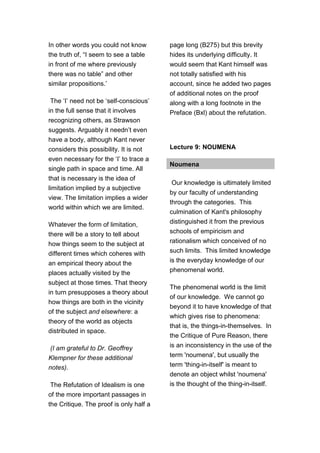
Kant derives three stages to the 
process of understanding. 
1. Synopsis Experiencing a 
manifold of 
intuitions 
together. 
2. Imagination Bringing 
together, 
holding and 
comparing 
impressions 
across the 
range of our 
experience. 
3. Recognition The 
representation 
of objects of 
experience by 
concepts. 
These three stages are ordered so 
imagination is dependent on the 
synopsis, and recognition is 
dependent on the imagination, but 
they are simultaneous in time. The 
stages represent a logical 
dependency, not a temporal one. 
These stages of understanding are 
true of the most complex scientific 
theories, and also of very simple 
statements, such as "This is a tree" 
formed when perceiving a tree. 
The Method For Deducing The 
Categories 
The rationalist philosophers 
thought of categories such as 
substance and causality as innate 
knowledge, the building blocks of 
all knowledge. The empiricists 
thought of them as rules or 
theorems that could be arrived at 
by empirical analysis. So, for 
example, Hume thought that 
causality was an empirical concept 
that we arrive at by habit. Kant 
disagreed with both of these 
views. He says that the categories 
are a means by which we know 
things about the world. He used 
the transcendental deduction to 
establish them. 
Kant was critical of the empiricists 
Locke and Hume. He writes that 
Locke is "extravagant" in his 
attempt to show that pure concepts 
(ie categories) could be derived 
empirically. He writes of Hume that, 
though he realized correctly that 
they could not be derived so, he 
remained "sceptical" since he was 
unable to see that pure concepts 
could be deduced. 
The transcendental deduction of 
categories is a subjective task, yet 
the deduction provides for the 
categories an objective validity. 
Transcendental Synthesis of 
Apperception 
Kant uses the term apperception 
to denote experience coming 
together in the transcendental unity
of self-consciousness. He argues 
that this transcendental unity of 
experience must hold, since 
without it we would not be able to 
have any synthesis of intuitions. 
That is, for a manifold of separate 
intuitions to come together to form 
a single concept, there must be a 
unified cognitive self to perceive 
and bring together the disparate 
intuitions. 
For example, when seeing an 
elephant, one may see four legs, a 
trunk, two ears, a body, a tail, and 
so on; that is, a disparate set of 
components. To see them all as a 
whole elephant requires that there 
be a single unified observer: the 
transcendental self. If the self were 
not unified it would be several 
distinct consciousnesses, each 
perceiving just one part of the 
presented phenomena and the 
concept of the whole elephant 
would never arise. 
Note that this argument for the 
transcendental unity is achieved 
through the transcendental 
deduction. That is: 
(1) Only if there is 
transcendental unity can 
synthesis of concepts be 
achieved, 
(2) I experience the 
synthesis of concepts 
(e.g. the concept of the 
elephant) in the world, 
therefore, 
(3) There is transcendental 
unity. 
Kant's notion of the transcendental 
unity is the same as the 'I' we refer 
to that perceives and understands 
the world around it. Many have 
found this transcendental 'I' difficult 
to comprehend because it does not 
seem to relate to the bodily self that 
we are familiar with. It seems a 
ghostly, disembodied 
representation of the self. Indeed 
Kant considered the transcendental 
'I' to be distinct from the bodily or 
the psychological person. We shall 
look at this more closely in the next 
lecture. 
Substance and causality are two of 
the twelve categories derived by 
Kant. In these lectures we will 
focus on these two in particular, as 
these two concepts were of 
importance to the rationalist 
philosophers. It will be useful to 
compare Kant's approach to theirs. 
Substance and causality are ways 
that we organize the data we 
receive through intuitions. They 
are only necessary for
understanding. We can imagine 
the world of intuitions without 
them. However, Kant says that if 
we did not have and use these 
categories the world would appear 
to us as a rhapsody of experience, 
"something less than a dream". 
Categories are rules which provide 
a relation between predicate and 
subject in a statement. For 
example, in the statement "All 
bodies are divisible" it is difficult to 
determine which is the predicate 
and which is the subject, for the 
statement could equally be written 
as "There exists a divisible thing 
which is a body, for all bodies." 
Which is the subject: "divisible 
thing" or "body"? By merely using 
logic we cannot tell. Only by using 
the categories can we decide, for 
the categories provide the proper 
relations between representations. 
So, with this example, based on the 
category of substance, we 
determine that "body" must be the 
subject, since it is substance, and 
"divisible" is thus the predicate. 
Lecture 5: CONCEPTS AND 
OBJECTS 
The Cognitive and Empirical 'I' 
The transcendental synthesis of 
apperception is the cognitive 'I', 
whereby all our intuitions are 
understood together meaningfully. 
The cognitive 'I' should not be 
confused with the person. A 
person is a psychological, thus 
empirical, self formed of memories, 
body image, personality and so on. 
This may be referred to as the 
empirical 'I'. In Descartes' sceptical 
philosophy, the assumption was 
made that the cognitive 'I' and 
empirical 'I' were one and the same 
thing. From Kant's point of view, 
this was the error which was the 
source of his scepticism. 
A consequence of Kant’s view is 
that the empirical 'I' is phenomenal, 
just like any other empirical object. 
Thus the empirical 'I' is only 
ourselves as we appear to 
ourselves. Ultimately, our real self 
remains an unknown noumenal 
self. For example, if I experience 
anger, it is only the impression of 
anger that I have. This outcome of 
Kant's view seems to be non-intuitive, 
in the sense that we 
believe that we have direct 
awareness of our own 
characteristics. However, it turns 
out that modern psychology, 
following Freud, has revealed that 
much of our self is not directly 
known to us, remaining below the 
directly conscious level. Quite often 
we cannot be sure what motivates 
us. This new insight vindicates
Kant's analysis of the empirical 
self. 
Many philosophers have been 
unhappy with Kant's, almost 
ghostly, concept of the cognitive 'I'. 
They have attempted to embody 
the concept. Marx formulated it in 
materialist terms: man's 
consciousness stands in relation to 
his economic and social 
conditions. Nietzsche stressed the 
animal side of the self and that our 
animal instincts always influence 
the way we think and understand 
the world. But for Kant, the 
cognitive 'I' is a pure notion which 
is independent of psychological 
state. For example, the cognitive 'I' 
does not get headaches or 
experience elation: these are 
properties of the empirical 'I'. The 
cognitive 'I' only stands in relation 
to our understanding. It is a 
necessary pre-supposition of 
knowledge. 
The Limits of The Categories 
The categories are the rules by 
which we understand the world 
given through intuitions. As such, 
they cannot be applied beyond 
experience to formulate 
knowledge. For example, Kant 
said that statements about God, 
not being based on experience, 
could never be derived from the 
categories, and as such were not 
knowledge proper. He suggests 
that such statements are simply 
beliefs. This was in opposition to 
the rationalist philosophers who 
attempted to derive a proof of 
God’s existence using dialectic 
logic. At the time, the Roman 
Church were unhappy with Kant's 
conclusion. However, later, other 
philosophers, like Kierkegaard, saw 
that Kant's conclusion was 
satisfactory since it would not be 
correct for there to be a proof of 
God. God must remain elusive and 
belief should be based on faith. 
The Critique of Pure Reason was 
written by Kant in order to draw the 
boundaries of the range and 
limitations of reason. The second 
half of the Critique is more 
concerned with these limits and 
explores those aspects of reason 
whereby it is drawn into the logic of 
illusion. Kant stresses that there 
are perfectly meaningful 
statements and questions which 
have a nature that is fundamentally 
paradoxical, in that both their 
affirmation and their negation are 
false. He calls such statements 
antinomies. An example is 'Does 
time have a beginning?' which Kant 
shows is false for both the answer 
'yes' and 'no'.
Objects 
Objects are conceived through the 
faculty of understanding using the 
categories. It is by holding our 
experience in terms of objects that 
prevents our knowledge being 
haphazard and arbitrary. We 
receive intuitions and we 
synthesize these intuitions, through 
the categories, into concepts of 
objects. The categories are 
necessary a priori rules that impose 
the way that the intuitions must 
come together as objects in space. 
This act of synthesis is 
spontaneous. 
As intuitions are compelled to be 
viewed in particular relations as 
objects by the categories, it follows 
that the categories are the 
intellectual form of all such 
knowledge about objects. 
Events can be conceived in a 
similar way, except in relation to 
time, rather than space. We are 
compelled to conceptualize events 
in a certain way because of the 
rules of the categories in our faculty 
of understanding. 
Thus objects are just a question of 
experience. Their sensuality is 
presented in the manifold of 
intuitions, yet their relational 
conception is given by the 
understanding. 
Laws of nature about our world of 
objects and events are also 
formulated as the aggregate of 
experience, and this aggregation is 
achieved in the understanding. 
Thus, the laws of nature are not out 
there in the things-in-themselves, 
but only within the context of our 
understanding of the world. The 
categories provide the possibility of 
synthesis of the laws of nature. 
Thus, we derive the laws of nature 
from the manifold of intuitions in 
understanding. Thus, if laws of 
nature have any objectivity then it 
is only by consensus to agree to 
the truth of laws. Again, this is an 
example of objectivity through inter-subjectivity 
(being the interaction 
by communication of disparate 
individuals). 
This analysis of object shows that 
the unity of apperception arising 
from the concept of objects is an 
objective unity. 
Lecture 6: APPLICATION OF THE 
CATEGORIES 
The Limits of the Possibilities of 
Experience 
The categories only have meaning 
and significance in relation to 
intuitions to which they apply. But, 
equally, the categories present
conditions of the possibility of 
experience. This is because they 
are the rules, and the only rules, by 
which we can understand the 
world. Therefore it is only 
according to the categories that we 
can experience the world. 
For example, if I propose the 
concept of intangible spirits that fly 
around in space around me, such a 
concept is unintelligible since it 
does not conform to the rules of 
categories. That is, there is no way 
for us to make sense of such a 
concept in empirical application. 
This limitation is due only to the 
peculiarity of the categories that we 
have as humans. It is possible to 
imagine a race of other intelligent 
beings – somewhere else in the 
Universe – that might have a 
different set of categories. 
Ultimately, then, the categories 
provide laws a priori, under which 
all our natural laws of the physical 
world must sit. Thus the categories 
are limits to our knowledge, and 
therefore also limits of our world. 
The Faculties of Cognition 
There are three faculties of 
cognition: the understanding, 
judgement and reason. 
Understanding gives rise to 
concepts, the faculty of judgement 
gives rise to judgements and 
reason gives rise to conclusions. 
These three faculties are the 
proper area of study of general 
logic. 
Kant terms the application of a 
concept to an object of intuition, the 
subsumption of the object under 
the concept. This subsumption is 
thus a judgement. 
Kant says there is a distinction 
between knowing concepts and 
applying them in judgements. That 
is, the concept, in abstract, is 
distinct from the concept as applied 
in any concrete example. 
Therefore it is possible to be 
learned, i.e. in possession of a 
great number of useful concepts, 
yet be stupid, in the sense that one 
finds it difficult or impossible to 
apply these concepts properly. 
Kant sets the greatest virtue in the 
ability to apply, as he suggests that 
it is always possible to learn more 
concepts, but never possible to 
learn how to apply them 
effectively. This is because the 
faculty of judgement is a purely 
innate quality. 
Although empirical judgements 
require a level of innate ability to be 
constructed, Kant says that this is
not true for transcendental 
judgements, which are judgements 
about the way we understand the 
world. Transcendental judgements 
can specify a priori the situations to 
which their concepts, ie the 
categories, can apply. 
The Schematism of the Pure 
Concepts of Understanding 
This section (A137/B176) of the 
Critique of Pure Reason can be 
considered the inner sanctum of 
the work. It is the heart of the 
enterprise, within which Kant 
presents the necessary conditions 
by which we can transcendentally 
deduce the categories from 
experience. 
There is a general philosophical 
problem about how we can 
represent concepts to ourselves, in 
the abstract, and further how we 
can come to recognise those 
abstract concepts in objects. 
For example, there is no single 
image which will fit the general 
concept of a dog. I may imagine a 
dog, but this will always be a 
particular kind of dog, say an 
Alsatian or a Greyhound, and so 
on. Thus the general concept of a 
dog cannot be imagined. Nor is the 
concept a simple composite of 
these images because each of the 
images is only a particular 
example, and together are not 
sufficient to represent the concept 
of dog, in general, since there is 
bound to be many dogs we will not 
have seen. 
Kant answers this question by 
saying that concepts exist through 
schemas, which are rules of how 
they may be applied. These 
schemas, then, are agents for the 
application of concepts to object. 
The schemas, themselves, must be 
pure; that is, they should not be 
empirical. But they must also 
bridge the gap between the 
intellectual concepts, in abstract, 
and sensuous objects. Thus the 
only candidates for this task are the 
pure forms of intuition, which are at 
once pure and also the structure of 
experience. In particular, Kant 
argues that the pure form of time is 
the schema that mediates the 
subsumption of objects under 
concepts. 
A consequence of this result is that 
it is only through time that we can 
understand and perceive the world, 
and so all our experience must by 
necessity be temporal. 
This then is the first transcendental 
deduction, in two steps:
(1a) Only if we have the 
form of time, can we 
subsume objects under 
concepts; 
(1b) Only if we can 
subsume objects under 
concepts, can we 
experience the world; 
(2) We experience the 
world; 
therefore 
(3) We must have the 
form of time. 
Kant goes on to define the 
categories of substance and 
causality as further schemas in 
relation to time as follows. 
· Substance is the 
permanence of objects 
within time. 
· Causality is the following, or 
succession, of changing 
events in time. 
It is only with respect to 
permanence that change can 
occur, for we know that changes 
must always occur in relation to a 
something which remains 
permanent. For example, if 
someone, say Fred, has a haircut, 
it is usual to say that Fred is 
something that is permanent, and 
the haircut is a change that has 
occurred to him. It makes no 
sense to say that since the haircut 
he is a different something from the 
Fred before the haircut. Nor does it 
make sense to refer to the haircut 
in the abstract without relation to 
Fred. That is, the haircut is 
essentially a process happening to 
Fred. Consequently substance, as 
defined as permanence of object, is 
a necessary condition of the 
experience of change. 
Causality is this succession of 
changes in time. Without 
succession, it would be impossible 
to perceive time, for time is simply 
the form by which successive 
events are presented. This gives us 
the second transcendental 
deduction: 
(1) Only if we have the 
categories of substance (as 
permanence) and 
causality (as succession of events), 
can we experience time; 
(2) We have the form of 
time (from the first deduction); 
therefore 
(3) We have the 
categories of substance and 
causality. 
The schemata of the pure concepts 
(i.e. categories) are the only
grounds for understanding. They 
are the necessary organising 
principles and it is only through 
schemata that we represent 
experience with concepts, in 
general, and not just as a collection 
of impressions. 
Lectures 7 & 8: THE 
ANALOGIES 
The Analogies 
The three Analogies of the Critique 
of Pure Reason are proofs of the 
necessary conditions of the 
categories of substance, causality 
and community. Substance and 
causality formed the battlefield 
between rationalism and 
empiricism. The former taking 
them for granted as innate 
properties, and the latter denying 
their innate nature beyond 
experience. Kant shows that they 
are necessary conditions of the 
understanding, and so are a priori, 
but only meaningful in relation to 
experience, and so are synthetic. 
The arguments used in the 
Analogies follow from an 
application of the pure forms of 
intuition. That is, the categories are 
derived as conditions of our 
experiencing space and time. 
The first analogy is the Principle of 
the Permanence of Substance and 
explores the problem of envisaging 
time. How are we to present the 
notion of time in general? Kant 
shows that experience is always 
apprehended in succession. It 
follows from the act of knowing this 
succession follows from the rules 
provided by the categories of 
substance and causality. We just 
could not understand temporal 
events without these categories. 
Kant points out that sometimes 
these sequences are not simply 
temporal, but are logical. For 
example, consider a heavy metal 
ball indenting a cushion. It is 
obvious that the causality is 
directed from the heavy ball to the 
cushion, and that this causality is 
immediate. According to Kant, the 
reason that we see the necessity of 
the heavy ball causing the 
indentation in the cushion, and not 
vice versa, is because of the 
categories we use. 
The categories are only 
meaningful in relation to temporal 
experience. Thus, as the 
categories are our only forms of 
thought, it follows that we can only 
have experiences in time. Of the 
categories, substance is that which 
persists in time, and causality is the 
necessary ordering of changes in 
time.
The Analogies of experience show 
how the categories make 
experience possible. Therefore 
they are a central argument within 
Kant's system. 
The Refutation of Idealism 
Kant considered it important to give 
a refutation of material idealism. 
This is the idealism which follows 
from a materialist or empiricist 
account of the world. He identifies 
idealism in two ways: 
1. the problematic idealism 
of Descartes; 
2. the dogmatic idealism of 
Berkeley. 
The first espouses a philosophy 
that is doubtful of the existence of 
external objects, and that such 
existence is indemonstrable. The 
second makes a stronger claim that 
the notion of external objects is 
wholly false and impossible. 
Kant rejected both these sceptical 
conclusions. 
Firstly, Kant rejected the empiricist 
foundations that lead to them. 
Empiricists claim that space and 
time is a structure external to 
perception. Within such a 
framework, it is easy to argue for 
dogmatic idealism. However, Kant 
shows that space and time are 
forms of sensibility and so the 
usual sceptical arguments do not 
follow. 
Secondly, to counter Descartes’ 
scepticism, Kant argues that 
without an objective world, there is 
no way to determine a subject 
experiencing and living in the 
world. That is, without a means to 
experience distinct objects, I 
cannot find myself in this world. 
Since it is clear that I do exist – and 
Descartes takes this as indubitable 
– it follows that an external 
objective world must exist too. That 
is, Kant shows that there must be 
an external world that brings forth 
the appearances in 
consciousness. Kant insists that 
there must be something that 
appears. We must be modest, 
knowing that we can see it only in a 
certain way, depending on our 
particular perspective, but it must 
be there as an objective reality 
nonetheless. 
Kant’s argument is 
straightforwardly dialectical. His 
reply to the Cartesian who says ‘I 
know I exist but I am not sure about 
the table’, is: ‘If it were not possible 
to have empirical knowledge of the 
table, it would be impossible to 
have empirical knowledge of 
yourself as a subject of experience.
In other words you could not know 
the truth of, “I seem to see a table 
in front of me where previously 
there was no table” and other 
similar propositions.’ 
The ‘I’ need not be ‘self-conscious’ 
in the full sense that it involves 
recognizing others, as Strawson 
suggests. Arguably it needn’t even 
have a body, although Kant never 
considers this possibility. It is not 
even necessary for the ‘I’ to trace a 
single path in space and time. All 
that is necessary is the idea of 
limitation implied by a subjective 
view. The limitation implies a wider 
world within which we are limited. 
Whatever the form of limitation, 
there will be a story to tell about 
how things seem to the subject at 
different times which coheres with 
an empirical theory about the 
places actually visited by the 
subject at those times. That theory 
in turn presupposes a theory about 
how things are both in the vicinity 
of the subject and elsewhere: a 
theory of the world as objects 
distributed in space. 
(I am grateful to Dr. Geoffrey 
Klempner for these additional 
notes). 
The Refutation of Idealism is one 
of the more important passages in 
the Critique. The proof is only half a 
page long (B275) but this brevity 
hides its underlying difficulty. It 
would seem that Kant himself was 
not totally satisfied with his 
account, since he added two pages 
of additional notes on the proof 
along with a long footnote in the 
Preface (Bxl) about the refutation. 
Lecture 9: NOUMENA 
Noumena 
Our knowledge is ultimately limited 
by our faculty of understanding 
through the categories. This 
culmination of Kant's philosophy 
distinguished it from the previous 
schools of empiricism and 
rationalism which conceived of no 
such limits. This limited knowledge 
is the everyday knowledge of our 
phenomenal world. 
The phenomenal world is the limit 
of our knowledge. We cannot go 
beyond it to have knowledge of that 
which gives rise to phenomena: 
that is, the things-in-themselves. In 
the Critique of Pure Reason, there 
is an inconsistency in the use of the 
term 'noumena', but usually the 
term 'thing-in-itself' is meant to 
denote an object whilst 'noumena' 
is the thought of the thing-in-itself.
Thus the noumena stands as an 
intellectual marker of that which we 
cannot know, but stands beyond 
phenomena. 
Many thinkers were unhappy with 
Kant's notion of the unknowable 
things-in-themselves. If we do not 
know anything about them, how do 
we know they are there at all? 
And, how do noumena relate to the 
phenomena? Since causality is a 
category applicable only in the 
world of experience, it means that 
causality cannot be proposed as 
the relation between the two. 
Unable to find satisfactory answers 
to these questions, some followers 
of Kant revised his notion of 
noumena. 
The German idealist Hegel 
removed noumena altogether and 
took phenomena as the only reality 
within an Absolute spirit. 
Others have taken noumena to be 
the objects of modern physics. 
However, this is not convincing, as 
ultimately evidence of the objects 
of physics, e.g. atoms, can still be 
given phenomenally, and we 
conceive concepts within the 
atomic realm. These properties 
were necessarily excluded from 
what Kant termed noumena. Kant's 
notion of the noumena was a 
negative one: noumena is the 
thinking about that ultimate reality 
that we can never know. It is the 
thought of the limitation of 
understanding. 
Our phenomenal knowledge is 
transcendentally valid, but also 
objectively real. Yet, beyond the 
phenomena there must be a 
noumenal world of unknowable 
things-in-themselves.
Bibliography 
This is a brief list of books I have 
found useful in understanding the 
Critique of Pure Reason. 
· Immanuel Kant, Critique 
of Pure Reason, 
translated by Norman 
Kemp Smith (1929) 
The recommended English 
translation of both editions. 
· Roger Scruton, Kant 
(OUP 1982) 
This very short book clearly 
introduces the main points of 
Kant’s philosophy. 
· P.F. Strawson, The 
Bounds of Sense (1966) 
A thorough commentary on 
the Critique of Pure Reason, 
providing insight into many 
areas of Kant’s thought. 
However, Strawson’s 
commentary is skewed by 
his unsympathetic analysis 
of the doctrine of 
transcendental idealism. 
Therefore, Strawson is at 
pains to understand Kant 
without reliance on that 
framework. However, 
arguably, without the context 
of transcendental idealism, 
the impact of Kant’s work 
diminishes considerably. 
· Henry E. Allison, Kant’s 
Transcendental Idealism 
(1983) 
A thorough and highly 
technical account of Kant’s 
transcendental idealism, 
providing both an 
interpretation and a defence. 
· Matthew C. Altman, A 
Companion to Kants 
Critique of Pure Reason 
(2008)

Lecture notes-on-immanuel-kant

  • 1.
    Lecture notes onImmanuel Kant's Critique of Pure Reason Delivered by Peter Rickman during Autumn 1995 Preface Immanuel Kant’s Critique of Pure Reason introduces his critical philosophy. His philosophical approach is ‘critical’ in the sense that he is making a critical analysis of the power and limits of our mind and our ability to understand the world we find ourselves in. As such, Kant is the founder of a philosophical tradition of critical analysis that has included many other important philosophers since, such as Schopenhauer and Wittgenstein. I found Peter Rickman’s lecture series, delivered in 1995 at the City University in London UK, on the Critique of Pure Reason of immense value in trying to understand Kant’s work. It is my view that Kant’s work is so subtle and revolutionary that one needs the guidance of a good teacher to properly appreciate it and to avoid the common misunderstandings. Since I had these notes in electronic form, I thought they may be of benefit to others so I have published them here. I thank Peter Rickman for his permission to make the notes available and for his helpful comments and suggestions. I hope they may help others who are trying to understand Kant’s great work and answer some of the riddles of philosophy. These are my notes of the lectures, so I should make it clear that any flaws and errors in them are mine. If you spot any, I can be contacted at the email address below. Tony Bellotti, January 2006 ag_bellotti@yahoo.co.uk
  • 2.
    Contents Preface Lecture1: INTRODUCTION · The Text · Historical Background · Key Concepts (1) The Aesthetics and Intuition (2) Kant’s Copernican Revolution (3) The Nature of Knowledge (4) Synthetic A priori Statements (5) Phenomena and Noumena Lecture 2: TRANSCENDENTAL KNOWLEDGE · The Transcendental Deduction · Pure and Empirical Knowledge · The Forms of Space and Time Lecture 3: LOGIC · Logical methods · The Synthesis of Concepts · The Categories Lecture 4: DEDUCTION OF THE CATEGORIES · Stages of Understanding · Method for Deducing the Categories · Transcendental Synthesis of Apperception Lecture 5: CONCEPTS AND OBJECTS · The Cognitive and Empirical ‘I’ · The Limits of the Categories · Objects Lecture 6: APPLICATION OF THE CATEGORIES · The Limits of the Possibilities of Experience · Faculties of Cognition · The Schematism of the Pure Concepts of Understanding Lectures 7 & 8: THE ANALOGIES · Introduction · The Refutation of Idealism Lecture 9: NOUMENA Bibliography
  • 3.
    Lecture 1: INTRODUCTION The Text In these lecture notes, we shall examine the ideas in Immanuel Kant’s groundbreaking philosophical work, the Critique of Pure Reason. Kant published this work as a first edition in 1781, but followed it up in 1787 with a substantially revised second edition. Norman Kemp Smith's translation (1929) is the recommended text for English readers. It contains the full text from both editions and includes a standard indexing of the works using A and B page numbers for the first and second edition respectively. This course will deal mostly with that part of the work called the Transcendental Analytic. This section is considered to be the most important part of the book. However, it should be noted that it is far from the only important part. There is some difficulty in translating from the original old eighteenth century German that Kant used. Additionally, Kant's particular writing style can be awkward and difficult to understand. He tends to be very exact and to carefully qualify his statements. This can lead to problems when reading the Critique. Kant uses some words in a very specialized and technical sense. For example, the words ‘form’, ‘intuition’ and ‘synthesis’ all have a special meaning. The reader should bear this in mind when reading the Critique. Kant worked on the contents of the Critique of Pure Reason over a period of ten years, gathering dispersed notes and papers across that time. After these ten years Kant seemed to be concerned that he was getting old and that he may not complete his philosophical work before he died. Thus he spent just a single year putting all his notes and thoughts together in the Critique of Pure Reason. Some have considered the overall work to be a little divergent. Also, the quality of Kant's writing seems to have suffered because he felt rushed. Even though Kant's writing style may be difficult, it is generally accepted that the concepts and ideas behind his words are full of clarity. Goethe is quoted as having said of Kant's work that reading it was like "walking into a lighted room". Many critics have found flaws with the Critique of Pure
  • 4.
    Reason, yet itremains a watershed in the history of philosophy. Historical Background It should be remembered that the work of a philosopher is both personal and a product of and response to the age within which he or she lives. Kant was born in 1724 in East Prussia during a time of war, the son of a poor saddler. His family were of protestant Scottish descent. Because of his low background, Kant struggled his way into his position at the University of Königsberg. He first joined the university in 1740 as a student, from 1746 he was a private tutor, became an assistant lecturer in 1755 and in 1770 a professor. He died in 1804. He spent his whole life in Königsberg. He lived most of his life whilst Frederick the Great reigned as King of Prussia. Frederick the Great was considered an enlightened autocrat, encouraging free-thought and philosophical speculation. Kant was described by others as a happy and witty man throughout his life. His lectures were entertaining and very popular. On the other hand, Kant was a bachelor who lived a mechanical life and required punctuality in all his engagements. He was also very health-conscious. Kant wrote many essays on natural philosophy prior to the Critique, but it was the Critique that made his reputation as a great philosopher. The first edition of the Critique of Pure Reason was published in 1781. After this date, Kant wrote several other important books including the Critique of Practical Reason. When Kant was writing the Critique of Pure Reason he was very much aware of the works of philosophers before him. Much of the book is addressed to the works of Hume, Berkeley and Locke, delivering a refutation of their empirical philosophies. In particular, the second edition offers a refutation of idealism. Kant's main goal in this work was to demonstrate that empiricism and rationalism - i.e. the sense and the reason - both necessarily complement each other.
  • 5.
    Key Concepts 1.The Aesthetics and Intuition The first part of the Critique contains an analysis of the Aesthetics. This word, as commonly used, has only an approximate meaning to that intended by Kant. Although we usually use it to mean an appreciation of beauty and love of the arts, Kant never intended this particular meaning. In the Critique of Pure Reason, aesthetics simply refers to the study of the senses as directly given through perception. Kant divides the aesthetic into two parts: an intuitive aspect and a conceptual aspect. That is, any sense perception is given as raw sense data, but organised and understood through conceptualization. The word ‘intuition’ does not have the meaning we usually attach to it as instinctive knowledge. In Kant’s technical sense, ‘intuition’ means the reception of raw sense data of an experience, prior to the application of any concept. ‘Intuition’ is the accepted English translation of the German ‘Anschauung’ which gives a much better sense of Kant’s usage as a ‘view’ or a ‘looking at’. Intuition is intended to refer to that which is just given: the state of just observing something, without any conceptualization of the data. There is no other intended meaning behind the use of this word. 2. Kant's Copernican Revolution One of the key consequences of Kant's philosophy is his Copernican Revolution. This is mentioned in the preface to the second edition (although nowhere else). Copernicus was a sixteenth century astronomer who suggested replacing the old Ptolemaic astronomic model, where the Sun and all the heavenly bodies are viewed as orbiting about the Earth, with the new model where the planets, including Earth, are viewed as orbiting the Sun. This new model turns out to be the far simpler and more accurate model and eventually overturned the Ptolemaic model in science. Although, in its day, it was a revolutionary theory and Copernicus was much condemned by the Church in Rome. Kant's parallel theory was to view the human mind not as a passive vessel that experiences events, but rather as active in cognition. So, instead of viewing the mind as the passive centre of observation, Kant
  • 6.
    viewed the mindas an active participator in observation. More radically, the consequence of this theory was that the mind creates and shapes its experiences. The world that we know is very much a product of the organizing effort of the mind. How Kant arrived at these conclusions will be explored in this series of lectures. 3. The Nature of Knowledge Another word which is given only an approximate English translation is Understanding from the German ‘Verstand’. Kant intended this word to refer simply to the use of reason and concepts in knowledge. Kant's approach to the analysis of knowledge is based very much on common sense. He did not believe there was any value in doubting our observations. If we see a tree, then we see a tree. There is no doubting it. Thus Kant believed that to postulate sceptical theories, such as there is really no external world, was a bottomless pit that discredits philosophy. Kant argued that we cannot seriously doubt our knowledge. The real task is to explore what is involved in having knowledge. Kant looked to discover the conditions that must be fulfilled for us to have knowledge. He saw this as an analytic problem that could be solved by reason. Kant asks if any of our knowledge has a privileged position. For example, our notion of causality between events in the universe seems to be presupposed. That is, it is a notion about the universe, yet it does not need to be shown to be true by empirical evidence. According to Kant, it seems to be necessarily true that every event must have a cause. Kant categorized our knowledge as follows: · A statement is analytic if the predicate of the subject is contained in the subject. For example, tautologies are analytic statements. For example, ‘every bachelor is unmarried’ is true since the predicate ‘unmarried’ is contained in the subject ‘bachelor’. · If a statement is not analytic, then the predicate of the statement says something new about the subject, thus we call such statements synthetic. · A statement is true a priori if its truth is determined before
  • 7.
    experience, or without reference to experience. · A statement is true a posteriori if its truth follows after experience. That is, its truth can only be determined with reference to empirical evidence. All analytic statements are a priori on the grounds that they are logical truths that are true regardless of our experience. They do not require empirical evidence to be proved. All a posteriori statements are synthetic, as they provide added information from experience, which was not there prior to the experience. So, for example, if I observe a particular chair is red then this is synthetic as the predicate 'is red' is not in the notion of the subject 'chair'. The question remains, however, whether there are any synthetic statements that are a priori. Kant argued that there are and gives the idea of causality as an example of this. 4. Synthetic A Priori Statements Kant argued that philosophy was at its most interesting when dealing with synthetic a priori statements. In fact, philosophy must be synthetic a priori. This was counter to the views of many empiricists of the time. Hume denied that synthetic a priori statements were possible. However, Kant challenged this by arguing that ironically Hume's denial is itself synthetic a priori (this argument anticipated the similar argument used against the logical positivist Verification Principle later this century: how do you verify the Verification Principle?). Kant argued that the synthetic a priori was essential because it was a part of our cognitive equipment. Synthetic a priori truths are those essential truths that are necessary conditions for knowledge to be possible at all. This is where Kant's Copernican Revolution comes in. The mind is active in knowledge, and the synthetic a priori is how we have that active role. 5. Phenomena and Noumena The phenomenal world refers to the world as it appears to each of us from our own personal perspective. For Kant, the real world is just this phenomenal world that we perceive and conceptualize.
  • 8.
    We can broadenour perspective to the general human point of view, and it is from this position that we have an appreciation for the notion of objectivity. The objective world is constructed from our human and cultural consensus and shared knowledge. Yet ultimately, we cannot break out of our own individual perspective. We always perceive our world from our own individual point of view. The phenomenal world is in contrast to what Kant calls the noumenal world consisting of things-in-themselves that exist for themselves independently of our perceiving them. The thing-in-itself is the thing beyond our experience, yet it is what our phenomenal knowledge is about. Kant argues that we can never know this noumenal world. It is forever out of our reach because we cannot step out of our perspective on the world. A consequence of Kant's theory of phenomena and noumena is that the world we know and live in is the phenomenal world that our own minds organize and synthesize from the multiplicity of data. If I see a tree, then that tree exists because it can be seen (and touched, etc.). It is essentially phenomenal, not noumenal. Kant supposes a thing-in-itself, beyond our experience, which gives rise to the phenomenon of the tree, but we cannot call this a tree-in-itself since the application of concepts such as ‘tree’ is limited to phenomena. Beyond our own experience, their application makes no sense. There can be no tree-in-itself. Thus the limits of the world are only as limited as my ability to actively conceptualize and understand the world. This is reminiscent of the line "I never had the blues until I knew the words". We have only touched the surface of this topic. More will be said about the noumenal world in later lectures. Lecture 2: TRANSCENDENTAL KNOWLEDGE The Transcendental Deduction The transcendental deduction is a method which is characteristic of Kant's arguments in the Critique of Pure Reason. By the word transcendent, Kant means that which is beyond experience. By transcendental he intends knowledge about our having knowledge, or "our mode of
  • 9.
    cognition". Thus thetwo words have slightly different meanings for Kant. The transcendental deduction is a logical deduction from the two premises (1) Only if A then B, (2) B from which we can infer (3) A. Kant uses this syllogism to deduce the necessary conditions of experience. Thus premise (2) denotes our having an experience and premise (1) is the necessary condition for having that experience. Since both are true, the transcendental element A in step (3) must follow. Kant uses this method to discover the nature of knowledge or that which is pre-supposed in our having knowledge. It is important to understand that Kant’s method is deductive. It does not involve psychological analysis, which is empirical, at least in the modern sense. Since part of Kant’s task is to discover the faculties of human understanding, it is tempting to refer to Kant’s philosophy as a ‘transcendental psychology’, but this would be misleading. Philosophy cannot make use of empirical methods as this would lead to a vicious circle. That is, since we are trying to discover and justify how we come to have empirical knowledge, it is no use trying to use empirical knowledge to do this. An example of transcendental deduction, given by Kant, is the necessity of the unity of the self across experience. That is, only if there is a single unified observer across the whole of an experience, can it be experienced. So, take the example of the temporal experience of a piece of music. The syllogism would be: (1) Only if there is a unity of the self across time, can I experience music, (2) I can experience a piece of music therefore (3) There is a unity of the self across time. Pure and Empirical Knowledge Concepts are referred to as “pure” if they are abstracted from experience and are not directly empirical in nature. This is the case for transcendental knowledge.
  • 10.
    Kant states that"though all our knowledge begins in experience, it by no means follows that all arises out of experience". In this Kant is alluding to transcendental knowledge. Transcendental knowledge is not of experience itself, but it cannot be true without experience. So in the transcendental deduction, described in the previous section, unless premise (2), experience, is true, we cannot conclude the transcendental premise (3). But Kant also argues that without the mind’s ability to organize and conceptualize experience, we cannot have any experience. Thus on the one hand Kant is conceding to the arguments of empiricist thinkers, such as Hume, who claim that all knowledge begins in experience, but on the other hand he also concedes to rationalists, such as Leibniz, that ideas and thought are essential to knowledge. Kant's theory is a synthesis of these two philosophical camps. Kant provides some terms to encompass this theory. · Sensibility is the means by which we have intuitions. Sensibility is receptive, in that intuitions are immediately given to mind. · Understanding is our mental faculty to conceptualize the manifold of intuitions given by sensibility. Understanding is an active and imaginative process of mind. Both sensibility and understanding are needed to make sense of and experience the world. · All phenomena of experience are given in terms of matter and form. The matter is the raw sensation and form is the way we grasp that matter. For example, space is the form of a visual experience and colour and brightness are the matter. Kant distinguishes form from concept. Form is the structure by which we perceive phenomena, whilst concepts are the means by which we understand and categorize phenomena to gain knowledge. Form is part of the intuition, whilst concepts may be learnt and are applied to intuition to make sense of them.
  • 11.
    The Forms ofSpace and Time Space and time are the forms by which we perceive the world. Space and time are neither empirical data, nor concepts. They are the way we experience the world. We can imagine space and time independently of experience thus they stand beyond experience. Kant argues that they are not learnt, therefore they are not concepts. That is, the way we use concepts is driven by experience, so one culture may conceptualize the world differently to another. Yet space and time are necessary forms in any culture. Furthermore, spaces and moments of time are part of the notion of space and time. This is not the case for concepts (e.g. the concept of horses does not contain particular examples of horses themselves). Space and time are necessary conditions for our having experience. As such they do not need to be proved, beyond the simple fact that we have experiences. Kant argues that space and time are empirically real, but by using our method of transcendental examination - characterized by Kant's Copernican Revolution - we also understand that space and time do not represent properties of things-in-themselves. Rather, they are part of the way that we perceive the world. This is an example of the distinction that Kant draws between empirical objectivity and transcendental subjectivity. It also demonstrates the unity of these two notions. · Space and time have empirical objectivity since they are a necessary precondition for experiencing (empirically) the world objectively. · Space and time have transcendental subjectivity since they are forms through which the mind understands the world. Time is the continuity and ordering of experience. Space is the form of appearance. Space is not discursive: there is only one space. It is an infinitely given magnitude. Geometry is the science for studying space and relations in space. As such geometry is synthetic a priori. This view is in contrast to the analytic school of
  • 12.
    mathematics that attemptsto found all mathematics in logic. It may be argued, against Kant, that space is not a necessarily given form. It may be argued that the development of non-Euclidean geometries shows how we can learn to conceptualize space in a different way and how Kant's own Euclidean view of space was itself limited. However, in Kant's defence, this claim can be countered by arguing that, nevertheless, there is a fundamental way we, as humans, perceive the world in space, and that this is not affected by modern developments. Thus, non- Euclidean geometries are cultural devices that we use to refine our understanding of the world at an objective level, not at the experiential level. The form of experience is still the basic spatial form that Kant was familiar with and we are all familiar with. This does not make non-Euclidean geometries less real, as such concepts are part of the way the world is, in the context of Kant's philosophy. Lecture 3: LOGIC Logical Methods The understanding is our faculty to think about intuitions and so to form concepts. Kant states that understanding is essential since knowledge must always involve the two components: intuition and concept. "Thoughts without content are empty, intuitions without concepts are blind" (A51/B75). Kant presents Logic as the science of the laws of understanding. He divides it into three categories: General Logic, Particular Logic, and Transcendental Logic. · General Logic is the study of the understanding in general. That is, understanding of empirical intuitions in forming concepts. (1) Particular Logic is the logic that pertains to a particular area of knowledge. For example, there would be a logic of scientific discovery. Such logics are organons for these fields of knowledge; that is, they are the rules and methods used in these fields. Kant says that Particular Logic is
  • 13.
    descriptive and analytic.It does not precede its subject; it is a reflection of the methodology of a mature subject area. · Transcendental Logic is the study of pure understanding, without reference to experience. Thus Transcendental Logic is the science of the pure concepts of understanding. A consequence of this is that Transcendental Logic is the study of the origin, the extent, and the objective validity of pure understanding. The philosopher is mainly interested in the Transcendental Logic. Kant makes reference to the Dialectic method of logic. He describes it as an attempt to infer empirical truth using pure logic. He dismisses the Dialectic as a logic of illusion and sophistry. Thus, in the Critique of Pure Reason, Kant makes reference to the Dialectic only as a critique of the method. Instead, Kant proposes the Analytic as the proper method of logic. The Analytic is the method of dissecting our faculty of understanding and reason into their elements. Kant is not interested in the analysis of concepts in general. This is not the proper study of philosophy. Kant means to analyse only those concepts that are necessarily in the nature of reason and knowledge. Thus philosophical analysis should only be about the pure concepts of the understanding, free from the empirical conditions attached to them. In answer to the question "What is truth?", Kant asserts that some questions are just absurd since any answer to them would be nonsensical. This is one of them. It is part of the art of philosophy to distinguish the proper questions from the meaningless questions. Kant gives a simple definition of truth as the "accordance of the cognition with its object", and suggests that the question "What is truth?" is absurd (if it is not simply that definition) because its answer would require a universal criterion of truth that would contradict this definition which tells us that the truth of a cognition can only be ascertained with respect to its particular object, not by universal criteria. Note however that Kant does state that such a universal criterion is possible for the case of pure cognitions.
  • 14.
    The Synthesis ofConcepts As intuitions rest on the function of affection upon the mind by sensibility, so concepts rest on the function of unifying and generalizing upon the manifold representations that are given to the mind. This act of conceptualizing (i.e. the act of unification of disparate representations) is performed through the understanding mind, and is referred to as the synthesis of representations. Imagination is the faculty of mind which is able to generate syntheses and is essential for us to have knowledge at all. The imagination is able to hold concepts, compare representations, and perform such functions necessary for synthesis. Kant introduces the notion of judgement. He does not intend the word to have any moral connotations. It is simply meant to refer to that knowledge about objects which is derived from concepts. For example, the statement "this is a table" is a judgement based on the concept "table" and the series of sensory intuition of which the "this" refers to. Because the learning and application of concepts rest on a function of the mind, it follows that judgements are mediated knowledge. That is, they do not have a direct connection to their subject. The function of understanding mediates between subject and judgement. Notice that the range of concepts that are entertained in our minds is only limited by the power of imagination. However, the application of a concept is restricted by the representations given in the manifold intuitions. So, for example, it may be easy to imagine a unicorn, but this does not mean they can be found in the real world. However, it is because of this restriction, that it is wrong to characterize Kant as claiming that the world is in some way constructed by mind. It is more correct to say the world is interpreted by mind. Hence, Kant’s philosophy is only a form of idealism in this weak sense. The Categories Kant presents the categories as the pure concepts of the understanding. He derives twelve such categories. They are “pure” in the sense that they do not refer directly to experience, but are
  • 15.
    concepts superimposed on empirical content. The categories form the rules by which synthesis of concepts can be achieved. They are necessary conditions of acts of synthesis. Kant derives the categories by using transcendental deduction. Thus the categories are necessary conditions for us to have knowledge. It should be noted that the categories are not about the world of things-in-themselves (i.e. the noumenal world), but are only true of our understanding of the world. Thus the category of causality only holds true of the world as it is represented and within our understanding. An apt metaphor is as follows. When fishing, the size of fish one catches is dependent on the size of hole in the net used to catch them. Thus big holes will mean only big fish are caught. However, just because we only catch big fish, it does not mean that there are no little fish in the ocean. Thus, Kant is saying that the categories are necessary conditions which are also restrictions on our knowledge of the world. We are necessarily bound, or trapped, within the categorical framework with which we come to know the world. Yet, there may be more to the world than what we are capable of perceiving. Lecture 4: DEDUCTION OF THE CATEGORIES Stages of Understanding Kant describes the understanding as an intellectual faculty that is spontaneous, active and creative in forming concepts. Understanding is always mediate. Understanding can be contrasted with sensibility which is sensuous, passive and receptive. Yet the intuitions given by sensibility provide us with our immediate impressions of the external world. The understanding is two-fold: a) it is the faculty of conceptualization, b) it is the faculty of judgement, being the application of concepts to objects.
  • 16.
    Kant derives threestages to the process of understanding. 1. Synopsis Experiencing a manifold of intuitions together. 2. Imagination Bringing together, holding and comparing impressions across the range of our experience. 3. Recognition The representation of objects of experience by concepts. These three stages are ordered so imagination is dependent on the synopsis, and recognition is dependent on the imagination, but they are simultaneous in time. The stages represent a logical dependency, not a temporal one. These stages of understanding are true of the most complex scientific theories, and also of very simple statements, such as "This is a tree" formed when perceiving a tree. The Method For Deducing The Categories The rationalist philosophers thought of categories such as substance and causality as innate knowledge, the building blocks of all knowledge. The empiricists thought of them as rules or theorems that could be arrived at by empirical analysis. So, for example, Hume thought that causality was an empirical concept that we arrive at by habit. Kant disagreed with both of these views. He says that the categories are a means by which we know things about the world. He used the transcendental deduction to establish them. Kant was critical of the empiricists Locke and Hume. He writes that Locke is "extravagant" in his attempt to show that pure concepts (ie categories) could be derived empirically. He writes of Hume that, though he realized correctly that they could not be derived so, he remained "sceptical" since he was unable to see that pure concepts could be deduced. The transcendental deduction of categories is a subjective task, yet the deduction provides for the categories an objective validity. Transcendental Synthesis of Apperception Kant uses the term apperception to denote experience coming together in the transcendental unity
  • 17.
    of self-consciousness. Heargues that this transcendental unity of experience must hold, since without it we would not be able to have any synthesis of intuitions. That is, for a manifold of separate intuitions to come together to form a single concept, there must be a unified cognitive self to perceive and bring together the disparate intuitions. For example, when seeing an elephant, one may see four legs, a trunk, two ears, a body, a tail, and so on; that is, a disparate set of components. To see them all as a whole elephant requires that there be a single unified observer: the transcendental self. If the self were not unified it would be several distinct consciousnesses, each perceiving just one part of the presented phenomena and the concept of the whole elephant would never arise. Note that this argument for the transcendental unity is achieved through the transcendental deduction. That is: (1) Only if there is transcendental unity can synthesis of concepts be achieved, (2) I experience the synthesis of concepts (e.g. the concept of the elephant) in the world, therefore, (3) There is transcendental unity. Kant's notion of the transcendental unity is the same as the 'I' we refer to that perceives and understands the world around it. Many have found this transcendental 'I' difficult to comprehend because it does not seem to relate to the bodily self that we are familiar with. It seems a ghostly, disembodied representation of the self. Indeed Kant considered the transcendental 'I' to be distinct from the bodily or the psychological person. We shall look at this more closely in the next lecture. Substance and causality are two of the twelve categories derived by Kant. In these lectures we will focus on these two in particular, as these two concepts were of importance to the rationalist philosophers. It will be useful to compare Kant's approach to theirs. Substance and causality are ways that we organize the data we receive through intuitions. They are only necessary for
  • 18.
    understanding. We canimagine the world of intuitions without them. However, Kant says that if we did not have and use these categories the world would appear to us as a rhapsody of experience, "something less than a dream". Categories are rules which provide a relation between predicate and subject in a statement. For example, in the statement "All bodies are divisible" it is difficult to determine which is the predicate and which is the subject, for the statement could equally be written as "There exists a divisible thing which is a body, for all bodies." Which is the subject: "divisible thing" or "body"? By merely using logic we cannot tell. Only by using the categories can we decide, for the categories provide the proper relations between representations. So, with this example, based on the category of substance, we determine that "body" must be the subject, since it is substance, and "divisible" is thus the predicate. Lecture 5: CONCEPTS AND OBJECTS The Cognitive and Empirical 'I' The transcendental synthesis of apperception is the cognitive 'I', whereby all our intuitions are understood together meaningfully. The cognitive 'I' should not be confused with the person. A person is a psychological, thus empirical, self formed of memories, body image, personality and so on. This may be referred to as the empirical 'I'. In Descartes' sceptical philosophy, the assumption was made that the cognitive 'I' and empirical 'I' were one and the same thing. From Kant's point of view, this was the error which was the source of his scepticism. A consequence of Kant’s view is that the empirical 'I' is phenomenal, just like any other empirical object. Thus the empirical 'I' is only ourselves as we appear to ourselves. Ultimately, our real self remains an unknown noumenal self. For example, if I experience anger, it is only the impression of anger that I have. This outcome of Kant's view seems to be non-intuitive, in the sense that we believe that we have direct awareness of our own characteristics. However, it turns out that modern psychology, following Freud, has revealed that much of our self is not directly known to us, remaining below the directly conscious level. Quite often we cannot be sure what motivates us. This new insight vindicates
  • 19.
    Kant's analysis ofthe empirical self. Many philosophers have been unhappy with Kant's, almost ghostly, concept of the cognitive 'I'. They have attempted to embody the concept. Marx formulated it in materialist terms: man's consciousness stands in relation to his economic and social conditions. Nietzsche stressed the animal side of the self and that our animal instincts always influence the way we think and understand the world. But for Kant, the cognitive 'I' is a pure notion which is independent of psychological state. For example, the cognitive 'I' does not get headaches or experience elation: these are properties of the empirical 'I'. The cognitive 'I' only stands in relation to our understanding. It is a necessary pre-supposition of knowledge. The Limits of The Categories The categories are the rules by which we understand the world given through intuitions. As such, they cannot be applied beyond experience to formulate knowledge. For example, Kant said that statements about God, not being based on experience, could never be derived from the categories, and as such were not knowledge proper. He suggests that such statements are simply beliefs. This was in opposition to the rationalist philosophers who attempted to derive a proof of God’s existence using dialectic logic. At the time, the Roman Church were unhappy with Kant's conclusion. However, later, other philosophers, like Kierkegaard, saw that Kant's conclusion was satisfactory since it would not be correct for there to be a proof of God. God must remain elusive and belief should be based on faith. The Critique of Pure Reason was written by Kant in order to draw the boundaries of the range and limitations of reason. The second half of the Critique is more concerned with these limits and explores those aspects of reason whereby it is drawn into the logic of illusion. Kant stresses that there are perfectly meaningful statements and questions which have a nature that is fundamentally paradoxical, in that both their affirmation and their negation are false. He calls such statements antinomies. An example is 'Does time have a beginning?' which Kant shows is false for both the answer 'yes' and 'no'.
  • 20.
    Objects Objects areconceived through the faculty of understanding using the categories. It is by holding our experience in terms of objects that prevents our knowledge being haphazard and arbitrary. We receive intuitions and we synthesize these intuitions, through the categories, into concepts of objects. The categories are necessary a priori rules that impose the way that the intuitions must come together as objects in space. This act of synthesis is spontaneous. As intuitions are compelled to be viewed in particular relations as objects by the categories, it follows that the categories are the intellectual form of all such knowledge about objects. Events can be conceived in a similar way, except in relation to time, rather than space. We are compelled to conceptualize events in a certain way because of the rules of the categories in our faculty of understanding. Thus objects are just a question of experience. Their sensuality is presented in the manifold of intuitions, yet their relational conception is given by the understanding. Laws of nature about our world of objects and events are also formulated as the aggregate of experience, and this aggregation is achieved in the understanding. Thus, the laws of nature are not out there in the things-in-themselves, but only within the context of our understanding of the world. The categories provide the possibility of synthesis of the laws of nature. Thus, we derive the laws of nature from the manifold of intuitions in understanding. Thus, if laws of nature have any objectivity then it is only by consensus to agree to the truth of laws. Again, this is an example of objectivity through inter-subjectivity (being the interaction by communication of disparate individuals). This analysis of object shows that the unity of apperception arising from the concept of objects is an objective unity. Lecture 6: APPLICATION OF THE CATEGORIES The Limits of the Possibilities of Experience The categories only have meaning and significance in relation to intuitions to which they apply. But, equally, the categories present
  • 21.
    conditions of thepossibility of experience. This is because they are the rules, and the only rules, by which we can understand the world. Therefore it is only according to the categories that we can experience the world. For example, if I propose the concept of intangible spirits that fly around in space around me, such a concept is unintelligible since it does not conform to the rules of categories. That is, there is no way for us to make sense of such a concept in empirical application. This limitation is due only to the peculiarity of the categories that we have as humans. It is possible to imagine a race of other intelligent beings – somewhere else in the Universe – that might have a different set of categories. Ultimately, then, the categories provide laws a priori, under which all our natural laws of the physical world must sit. Thus the categories are limits to our knowledge, and therefore also limits of our world. The Faculties of Cognition There are three faculties of cognition: the understanding, judgement and reason. Understanding gives rise to concepts, the faculty of judgement gives rise to judgements and reason gives rise to conclusions. These three faculties are the proper area of study of general logic. Kant terms the application of a concept to an object of intuition, the subsumption of the object under the concept. This subsumption is thus a judgement. Kant says there is a distinction between knowing concepts and applying them in judgements. That is, the concept, in abstract, is distinct from the concept as applied in any concrete example. Therefore it is possible to be learned, i.e. in possession of a great number of useful concepts, yet be stupid, in the sense that one finds it difficult or impossible to apply these concepts properly. Kant sets the greatest virtue in the ability to apply, as he suggests that it is always possible to learn more concepts, but never possible to learn how to apply them effectively. This is because the faculty of judgement is a purely innate quality. Although empirical judgements require a level of innate ability to be constructed, Kant says that this is
  • 22.
    not true fortranscendental judgements, which are judgements about the way we understand the world. Transcendental judgements can specify a priori the situations to which their concepts, ie the categories, can apply. The Schematism of the Pure Concepts of Understanding This section (A137/B176) of the Critique of Pure Reason can be considered the inner sanctum of the work. It is the heart of the enterprise, within which Kant presents the necessary conditions by which we can transcendentally deduce the categories from experience. There is a general philosophical problem about how we can represent concepts to ourselves, in the abstract, and further how we can come to recognise those abstract concepts in objects. For example, there is no single image which will fit the general concept of a dog. I may imagine a dog, but this will always be a particular kind of dog, say an Alsatian or a Greyhound, and so on. Thus the general concept of a dog cannot be imagined. Nor is the concept a simple composite of these images because each of the images is only a particular example, and together are not sufficient to represent the concept of dog, in general, since there is bound to be many dogs we will not have seen. Kant answers this question by saying that concepts exist through schemas, which are rules of how they may be applied. These schemas, then, are agents for the application of concepts to object. The schemas, themselves, must be pure; that is, they should not be empirical. But they must also bridge the gap between the intellectual concepts, in abstract, and sensuous objects. Thus the only candidates for this task are the pure forms of intuition, which are at once pure and also the structure of experience. In particular, Kant argues that the pure form of time is the schema that mediates the subsumption of objects under concepts. A consequence of this result is that it is only through time that we can understand and perceive the world, and so all our experience must by necessity be temporal. This then is the first transcendental deduction, in two steps:
  • 23.
    (1a) Only ifwe have the form of time, can we subsume objects under concepts; (1b) Only if we can subsume objects under concepts, can we experience the world; (2) We experience the world; therefore (3) We must have the form of time. Kant goes on to define the categories of substance and causality as further schemas in relation to time as follows. · Substance is the permanence of objects within time. · Causality is the following, or succession, of changing events in time. It is only with respect to permanence that change can occur, for we know that changes must always occur in relation to a something which remains permanent. For example, if someone, say Fred, has a haircut, it is usual to say that Fred is something that is permanent, and the haircut is a change that has occurred to him. It makes no sense to say that since the haircut he is a different something from the Fred before the haircut. Nor does it make sense to refer to the haircut in the abstract without relation to Fred. That is, the haircut is essentially a process happening to Fred. Consequently substance, as defined as permanence of object, is a necessary condition of the experience of change. Causality is this succession of changes in time. Without succession, it would be impossible to perceive time, for time is simply the form by which successive events are presented. This gives us the second transcendental deduction: (1) Only if we have the categories of substance (as permanence) and causality (as succession of events), can we experience time; (2) We have the form of time (from the first deduction); therefore (3) We have the categories of substance and causality. The schemata of the pure concepts (i.e. categories) are the only
  • 24.
    grounds for understanding.They are the necessary organising principles and it is only through schemata that we represent experience with concepts, in general, and not just as a collection of impressions. Lectures 7 & 8: THE ANALOGIES The Analogies The three Analogies of the Critique of Pure Reason are proofs of the necessary conditions of the categories of substance, causality and community. Substance and causality formed the battlefield between rationalism and empiricism. The former taking them for granted as innate properties, and the latter denying their innate nature beyond experience. Kant shows that they are necessary conditions of the understanding, and so are a priori, but only meaningful in relation to experience, and so are synthetic. The arguments used in the Analogies follow from an application of the pure forms of intuition. That is, the categories are derived as conditions of our experiencing space and time. The first analogy is the Principle of the Permanence of Substance and explores the problem of envisaging time. How are we to present the notion of time in general? Kant shows that experience is always apprehended in succession. It follows from the act of knowing this succession follows from the rules provided by the categories of substance and causality. We just could not understand temporal events without these categories. Kant points out that sometimes these sequences are not simply temporal, but are logical. For example, consider a heavy metal ball indenting a cushion. It is obvious that the causality is directed from the heavy ball to the cushion, and that this causality is immediate. According to Kant, the reason that we see the necessity of the heavy ball causing the indentation in the cushion, and not vice versa, is because of the categories we use. The categories are only meaningful in relation to temporal experience. Thus, as the categories are our only forms of thought, it follows that we can only have experiences in time. Of the categories, substance is that which persists in time, and causality is the necessary ordering of changes in time.
  • 25.
    The Analogies ofexperience show how the categories make experience possible. Therefore they are a central argument within Kant's system. The Refutation of Idealism Kant considered it important to give a refutation of material idealism. This is the idealism which follows from a materialist or empiricist account of the world. He identifies idealism in two ways: 1. the problematic idealism of Descartes; 2. the dogmatic idealism of Berkeley. The first espouses a philosophy that is doubtful of the existence of external objects, and that such existence is indemonstrable. The second makes a stronger claim that the notion of external objects is wholly false and impossible. Kant rejected both these sceptical conclusions. Firstly, Kant rejected the empiricist foundations that lead to them. Empiricists claim that space and time is a structure external to perception. Within such a framework, it is easy to argue for dogmatic idealism. However, Kant shows that space and time are forms of sensibility and so the usual sceptical arguments do not follow. Secondly, to counter Descartes’ scepticism, Kant argues that without an objective world, there is no way to determine a subject experiencing and living in the world. That is, without a means to experience distinct objects, I cannot find myself in this world. Since it is clear that I do exist – and Descartes takes this as indubitable – it follows that an external objective world must exist too. That is, Kant shows that there must be an external world that brings forth the appearances in consciousness. Kant insists that there must be something that appears. We must be modest, knowing that we can see it only in a certain way, depending on our particular perspective, but it must be there as an objective reality nonetheless. Kant’s argument is straightforwardly dialectical. His reply to the Cartesian who says ‘I know I exist but I am not sure about the table’, is: ‘If it were not possible to have empirical knowledge of the table, it would be impossible to have empirical knowledge of yourself as a subject of experience.
  • 26.
    In other wordsyou could not know the truth of, “I seem to see a table in front of me where previously there was no table” and other similar propositions.’ The ‘I’ need not be ‘self-conscious’ in the full sense that it involves recognizing others, as Strawson suggests. Arguably it needn’t even have a body, although Kant never considers this possibility. It is not even necessary for the ‘I’ to trace a single path in space and time. All that is necessary is the idea of limitation implied by a subjective view. The limitation implies a wider world within which we are limited. Whatever the form of limitation, there will be a story to tell about how things seem to the subject at different times which coheres with an empirical theory about the places actually visited by the subject at those times. That theory in turn presupposes a theory about how things are both in the vicinity of the subject and elsewhere: a theory of the world as objects distributed in space. (I am grateful to Dr. Geoffrey Klempner for these additional notes). The Refutation of Idealism is one of the more important passages in the Critique. The proof is only half a page long (B275) but this brevity hides its underlying difficulty. It would seem that Kant himself was not totally satisfied with his account, since he added two pages of additional notes on the proof along with a long footnote in the Preface (Bxl) about the refutation. Lecture 9: NOUMENA Noumena Our knowledge is ultimately limited by our faculty of understanding through the categories. This culmination of Kant's philosophy distinguished it from the previous schools of empiricism and rationalism which conceived of no such limits. This limited knowledge is the everyday knowledge of our phenomenal world. The phenomenal world is the limit of our knowledge. We cannot go beyond it to have knowledge of that which gives rise to phenomena: that is, the things-in-themselves. In the Critique of Pure Reason, there is an inconsistency in the use of the term 'noumena', but usually the term 'thing-in-itself' is meant to denote an object whilst 'noumena' is the thought of the thing-in-itself.
  • 27.
    Thus the noumenastands as an intellectual marker of that which we cannot know, but stands beyond phenomena. Many thinkers were unhappy with Kant's notion of the unknowable things-in-themselves. If we do not know anything about them, how do we know they are there at all? And, how do noumena relate to the phenomena? Since causality is a category applicable only in the world of experience, it means that causality cannot be proposed as the relation between the two. Unable to find satisfactory answers to these questions, some followers of Kant revised his notion of noumena. The German idealist Hegel removed noumena altogether and took phenomena as the only reality within an Absolute spirit. Others have taken noumena to be the objects of modern physics. However, this is not convincing, as ultimately evidence of the objects of physics, e.g. atoms, can still be given phenomenally, and we conceive concepts within the atomic realm. These properties were necessarily excluded from what Kant termed noumena. Kant's notion of the noumena was a negative one: noumena is the thinking about that ultimate reality that we can never know. It is the thought of the limitation of understanding. Our phenomenal knowledge is transcendentally valid, but also objectively real. Yet, beyond the phenomena there must be a noumenal world of unknowable things-in-themselves.
  • 28.
    Bibliography This isa brief list of books I have found useful in understanding the Critique of Pure Reason. · Immanuel Kant, Critique of Pure Reason, translated by Norman Kemp Smith (1929) The recommended English translation of both editions. · Roger Scruton, Kant (OUP 1982) This very short book clearly introduces the main points of Kant’s philosophy. · P.F. Strawson, The Bounds of Sense (1966) A thorough commentary on the Critique of Pure Reason, providing insight into many areas of Kant’s thought. However, Strawson’s commentary is skewed by his unsympathetic analysis of the doctrine of transcendental idealism. Therefore, Strawson is at pains to understand Kant without reliance on that framework. However, arguably, without the context of transcendental idealism, the impact of Kant’s work diminishes considerably. · Henry E. Allison, Kant’s Transcendental Idealism (1983) A thorough and highly technical account of Kant’s transcendental idealism, providing both an interpretation and a defence. · Matthew C. Altman, A Companion to Kants Critique of Pure Reason (2008)